


1 Kings 6:5
- וַיִּבֶןvai·yi·Venand he builtH1129Conj-w ¦ V-Qal-ConsecImperf-3msVerb Qal Consecutive Imperfect 3rd Singular Masculineוַandיִּבֶןhe built
- עַל'alonH5921PrepPreposition
- קִירkir[the] wall ofH7023N-mscNoun Singular Masculine Construct
- הַבַּיִתha·Ba·yitthe houseH1004Art ¦ N-msNoun Singular Masculine Absoluteהַtheבַּיִתhouse
- יָצִיעַya·tzo·a'an extensionH3326N-msNoun Singular Masculine Absolute
- סָבִיבsa·Vivall aroundH5439N-csNoun Singular common gender Absolute
- אֶת'et<obj.>H853DirObjMParticle Object Indicator
- קִירוֹתki·Rot[the] walls ofH7023N-fpcNoun Plural Feminine Construct
- הַבַּיִתha·Ba·yitthe houseH1004Art ¦ N-msNoun Singular Masculine Absoluteהַtheבַּיִתhouse
- סָבִיבsa·VivaroundH5439N-csNoun Singular common gender Absolute
- לַהֵיכָלla·hei·Khal<to> the templeH1964Prep-l ¦ N-msNoun Singular Masculine Absoluteלַ<to> theהֵיכָלtemple
- וְלַדְּבִירve·la·de·Virand <to> the innermost roomH1687Conj-w ¦ Prep-l ¦ N-msNoun Singular Masculine Absoluteוְandלַ<to> theדְּבִירinnermost room
- וַיַּעַשׂvai·Ya·'asand he madeH6213Conj-w ¦ V-Qal-ConsecImperf-3msVerb Qal Consecutive Imperfect 3rd Singular Masculineוַandיַּעַשׂhe made
- צְלָעוֹתtze·la·'otside-chambersH6763N-fpNoun Plural Feminine Absolute
- סָבִיבsa·Vivall aroundH5439N-csNoun Singular common gender Absolute
English is a literal word-by-word gloss of the Hebrew, not the KJV's wording. Why?
This is the original text the KJV's translators worked from — each Hebrew word with its own literal English meaning in this verse, prepared by scholars at Tyndale House, Cambridge. The KJV translates whole sentences, not word by word, so its wording differs: one Hebrew word can become several English words, and the KJV may choose “the LORD” where the gloss reads “Yahweh”. Both are faithful — they answer different questions. For the KJV's own rendering, switch to the KJV text.
Details
See on the biblical-era map
Study this verse
Public-domain commentary
Matthew Henry
From his Commentary on the Whole Bible. Henry comments on passages, not single verses — this entry covers 1 Kings 6:1–10. His two-level outline is real structure in the source text, so it is rendered as structure.
Here, I. The temple is called the house of the Lord (Kg1 6:1), because it was, 1. Directed and modelled by him. Infinite Wisdom was the architect, and gave David the plan or pattern by the Spirit, not by word of mouth only, but, for the greater certainty and exactness, in writing (Ch1 28:11, Ch1 28:12), as he had given to Moses in the mouth a draught of the tabernacle. 2. Dedicated and devoted to him and to his honour, to be employed in his service, so his as never any other house was, for he manifested his glory in it (so as never in any other) in a way agreeable to that dispensation; for, when there were carnal ordinances, there was a worldly sanctuary, Heb 9:1, Heb 9:10. This gave it its beauty of holiness, that it was the house of the Lord, which far transcended all its other beauties.
II.The time when it began to be built is exactly set down.
1.It was just 480 years after the bringing of the children of Israel out of Egypt. Allowing forty years to Moses, seventeen to Joshua, 299 to the Judges, forty to Eli, forty to Samuel and Saul, forty to David, and four to Solomon before he began the work, we have just the sum of 480. So long it was after that holy state was founded before that holy house was built, which, in less than 430 years, was burnt by Nebuchadnezzar. It was thus deferred because Israel had, by their sins, rendered themselves unworthy of this honour, and because God would show how little he values external pomp and splendour in his service: he was in no haste for a temple. David's tent, which was clean and convenient, though it was neither stately nor rich, nor, for aught that appears, ever consecrated, is called the house of the Lord (Sa2 12:20), and served as well as Solomon's temple; yet, when God gave Solomon great wealth, he put it into his heart thus to employ it, and graciously accepted him, chiefly because it was to be a shadow of good things to come, Heb 9:9.
2.It was in the fourth year of Solomon's reign, the first three years being taken up in settling the affairs of his kingdom, that he might not find any embarrassment from them in this work. It is not time lost which is spent in composing ourselves for the work of God, and disentangling ourselves from every thing which might distract or divert us. During this time he was adding to the preparations which his father had made (Ch1 22:14), hewing the stone, squaring the timber, and getting every thing ready, so that he is not to be blamed for slackness in deferring it so long. We are truly serving God when we are preparing for his service and furnishing ourselves for it.
III.The materials are brought in, ready for their place (Kg1 6:7), so ready that there was neither hammer nor ax heard in the house while it was in building. In all building Solomon prescribes it as a rule of prudence to prepare the work in the field, and afterwards build, Pro 24:27. But here, it seems, the preparation was more than ordinarily full and exact, to such a degree that, when the several parts came to be put together, there was nothing defective to be added, nothing amiss to be amended. It was to be the temple of God of peace, and therefore no iron tool must be heard in it. Quietness and silence both become and befriend religious exercises: God's work should be done with as much care and as little noise as may be. The temple was thrown down with axes and hammers, and those that threw it down roared in the midst of the congregation (Psa 74:4, Psa 74:6); but it was built up in silence. Clamour and violence often hinder the work of God, but never further it.
IV.The dimensions are laid down (Kg1 6:2, Kg1 6:3) according to the rules of proportion.
Some observe that the length and breadth were just double to that of the tabernacle. Now that Israel had grown more numerous the place of their meeting needed to be enlarged (Isa 54:1, Isa 54:2), and now that they had grown richer they were the better able to enlarge it. Where God sows plentifully he expects to reap so.
V.An account of the windows (Kg1 6:4):
They were broad within, and narrow without, Marg. Such should the eyes of our mind be, reflecting nearer on ourselves than on other people, looking much within, to judge ourselves, but little without, to censure our brethren. The narrowness of the lights intimated the darkness of that dispensation, in comparison with the gospel day.
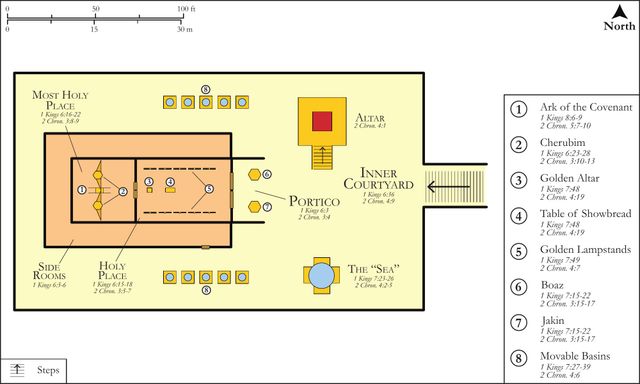
VI.The chambers are described (Kg1 6:5, Kg1 6:6), which served as vestries, in which the utensils of the tabernacle were carefully laid up, and where the priests dressed and undressed themselves and left the clothes in which they ministered: probably in some of these chambers they feasted upon the holy things. Solomon was not so intent upon the magnificence of the house as to neglect the conveniences that were requisite for the offices thereof, that every thing might be done decently and in order. Care was taken that the beams should not be fastened in the walls to weaken them, Kg1 6:6. Let not the church's strength be impaired under pretence of adding to its beauty or convenience.
Historical interpretation
Nine Centuries of Reception
4 surviving comments on this verse. Each one is dated, so this reads as a timeline rather than a list.
Select a marker to jump to its quote. Markers stagger vertically where authors wrote within a few decades of each other.
Against the sides of the house he made side chambers, that is, some porticos like those built around a basilica, one on the other, in three levels. He did this, in the first place, because the portico was narrow and could not been divided into separate parts; secondly, in order that they might work as a support to the house so that it did not collapse.
He built floors round about: Chambers or cells adjoining to the temple, for the use of the temple and of the priests, so contrived as to be between the inward and outward wall of the temple, in three stories, one above another.-- Ibid.
The oracle: The inner temple or holy of holies, where God gave his oracles.
Upon the wall: i. e. joining to the wall.-- Ibid.
Continue studying 1 Kings 6:5 across the web’s major study libraries — every link below opens this exact verse, chapter, or book on the destination site.
Read & Compare
 BibleGatewayThis verse in more than 200 translations and 70 languages.
 Bible.comThe YouVersion reader — hundreds of translations, reading plans, and highlights.
 ESV.orgCrossway's official English Standard Version reader.
 NET BibleThe NET translation with 60,000+ translators' notes on every rendering decision.
 STEP BibleTyndale House's free study tool — original text, vocabulary, and scholarly resources.
 BibliaLogos Bible Software's free web reader.
 USCCBThe New American Bible (Revised Edition) with the U.S. bishops' study notes.
Commentaries
 BibleHub CommentariesDozens of classic commentaries on this verse, gathered on one page.
 StudyLightMore than 100 commentary sets — the largest collection on the web.
 BibleRefPlain-English commentary on what this verse means, verse by verse.
 Enduring WordDavid Guzik's free commentary on this chapter, widely used by Bible teachers.
 Bible Study ToolsVerse commentary alongside Greek and Hebrew study aids.
Original Language & Research
- BibleHub InterlinearThe verse word by word — original language, transliteration, and English.
- BibleHub LexiconEvery word's original-language definition and Strong's entry.
 Blue Letter BibleDeep-study tools — Strong's numbers, concordance, and word studies.
 SefariaThe Hebrew text with Rashi and centuries of Jewish commentary.
Sermons, Hymns & Audio


TrulyRandomVerse is not affiliated with these sites and doesn’t control their content. They’re linked because they’re genuinely useful.
Summary
First Kings 6:5 provides a meticulous architectural detail of Solomon's Temple, describing the construction of ancillary chambers that were built around the exterior walls of the main sanctuary. These side rooms encircled both the Holy Place (referred to as the "temple") and the Most Holy Place (the "oracle"), underscoring the comprehensive planning and functional design integral to God's dwelling place. This verse highlights the extensive nature of the Temple complex, which incorporated practical spaces crucial for the daily operations, maintenance, and support of the sacred structure, reflecting a divine blueprint for order and provision in worship.
Context
ShowHideLiterary Context
This verse is situated within the highly detailed account of Solomon's construction of the Temple, which commences in 1 Kings 6:1. The preceding verses establish the overall dimensions, foundational elements, and primary materials, setting the stage for the specific architectural components described here. Following 1 Kings 6:5, the narrative continues to elaborate on the structure of these chambers, detailing their support systems and the exquisite materials used for the interior, such as cedar and gold, as seen in 1 Kings 6:9-10. The meticulous and repetitive detail throughout 1 Kings 6 emphasizes the divine mandate behind the Temple's design and the unparalleled craftsmanship dedicated to building God's sacred house.
Historical & Cultural Context
Solomon's Temple, erected in Jerusalem, served as the singular, central place of worship for the Israelite nation, marking a profound transition from the portable Tabernacle. Its construction symbolized God's stable and permanent presence among His people, solidifying Jerusalem's role as the spiritual capital. In the broader ancient Near East, temples were rarely simple structures; they were often elaborate complexes that included administrative offices, storage facilities for offerings, treasuries, and quarters for priests. The description of these chambers in 1 Kings 6:5 aligns with common ancient architectural practices for major religious edifices, adapted to meet the unique theological and ritual requirements of Israelite worship. The involvement of skilled craftsmen, including Phoenicians, as detailed in 1 Kings 5, highlights the international collaboration and advanced building techniques employed in this monumental undertaking.
Key Themes
ShowHideThe construction of the Temple, as meticulously described in 1 Kings 6, is a pivotal theme that underscores God's profound desire to dwell intimately among His people, echoing the instructions for the Tabernacle in Exodus 25:8. The precise architectural specifications, including the functional chambers mentioned in 1 Kings 6:5, highlight the themes of divine order and meticulous design. Every element of the Temple, from its grand dimensions to its practical side rooms, was purposed for sacred service and the maintenance of holiness. This points to the theme of provision for ministry, as these chambers were likely essential for storing priestly garments, sacred vessels, tithes, and offerings, thereby ensuring the seamless operation of the elaborate Temple rituals. Furthermore, the explicit distinction between the "temple" (Holy Place) and the "oracle" (Most Holy Place) reinforces the overarching theme of holiness and separation, with the most sacred space being the very core of the entire complex.
Exposition and Analysis
ShowHideKey Word Analysis
ShowHideDerived from a passive participle meaning "spread," this term, in an architectural context, refers to an extension, wing, or lean-to, often a single story or a collective of such rooms. In the Temple's design, these were not merely decorative but highly functional side rooms. They likely served practical purposes such as storage for sacred items, priestly vestments, tithes, and offerings, or even as lodging for priests on duty. Their construction "round about" signifies their comprehensive integration into the Temple's overall structure, maximizing functional space within the sacred precinct.
This word designates the main sanctuary or nave of the Temple, commonly translated as the Holy Place. It was the larger, outer room where priests performed daily rituals, including burning incense on the altar of incense and tending the golden lampstand. The fact that the chambers surrounded this area indicates that even the public-facing aspects of the Temple's sacred service required extensive support infrastructure and practical spaces for its operation.
This term refers to the innermost sanctuary, known as the Most Holy Place or Holy of Holies. It was the most sacred and exclusive part of the Temple, where the Ark of the Covenant was housed, as detailed in 1 Kings 6:19. Only the High Priest was permitted to enter this space, and only once a year on the Day of Atonement. The chambers encompassing the dᵉbîyr further emphasize the profound sanctity and protective nature of the entire complex, ensuring that even the most hallowed ground was supported by necessary, albeit less sacred, functional spaces.
Verse Breakdown
ShowHide"And against the wall of the house he built chambers round about,"
This initial clause introduces the primary architectural feature: the construction of ancillary rooms directly against the exterior walls of the main Temple structure. The phrase "round about" (Hebrew: סָבִיב, saviv) immediately conveys the encircling nature of these chambers, indicating they were not isolated additions but integral parts of the building's perimeter, designed for comprehensive support.
"[against] the walls of the house round about,"
This repetition serves as an emphatic restatement, reinforcing the concept of the chambers completely surrounding the main edifice. It underscores the thoroughness of the construction and the comprehensive nature of the design, ensuring no part of the primary structure was left without these supportive annexes. This highlights the meticulous attention to detail in the Temple's construction.
"[both] of the temple and of the oracle:"
This crucial specification clarifies precisely which parts of the "house" (the Temple) were encircled by these chambers. It explicitly names the hêykâl (the Holy Place) and the dᵉbîyr (the Most Holy Place), signifying that the entire sacred core of the Temple, from its outer priestly service areas to its innermost divine presence, was encompassed by these functional rooms. This highlights the unified and holistic design of the sacred complex, where every part served the overall purpose.
"and he made chambers round about:"
This concluding phrase acts as a final summary and reiteration of the main action. It emphasizes the completion and pervasive nature of the chamber construction, leaving no doubt about their extensive presence around the entire Temple structure. The repetition of "chambers round about" creates a powerful sense of completeness, meticulous execution, and the all-encompassing nature of the Temple's design.
Literary Devices
ShowHideThe primary literary device prominently employed in 1 Kings 6:5 is Repetition, specifically of the phrase "round about" (סָבִיב, saviv). This repetition is not redundant but serves a crucial rhetorical and descriptive purpose: it emphatically underscores the comprehensive and encircling nature of the chambers built against the Temple walls. It visually and textually reinforces the idea that these functional rooms completely enveloped the sacred core, from the Holy Place to the Most Holy Place, conveying a sense of thoroughness and protective enclosure. This meticulous detail is also a form of Architectural Description, characteristic of the entire chapter, which provides precise measurements and structural elements. This device highlights the divine blueprint and the profound human effort invested in constructing God's dwelling place. Furthermore, the mention of "the temple and of the oracle" can be interpreted as a form of Merism, where two distinct or contrasting parts are named to represent the whole. By naming both the outer sanctuary and the innermost shrine, the text effectively signifies the entirety of the sacred interior, emphasizing that the entire holy structure was supported by these surrounding chambers.
Theological and Thematic Connections
ShowHideThe detailed description of the Temple's ancillary chambers in 1 Kings 6:5 offers profound insights into God's character and His relationship with His people. It reveals a God who values order, functionality, and meticulous preparation in worship and service. The existence of these chambers, designed for storage, administration, and support, underscores the principle that sacred spaces and divine service are not haphazard but require thoughtful provision and organization. This divine attention to detail in the physical structure of the Temple reflects the spiritual truth that God desires a well-ordered and well-resourced ministry, where every component, from the most sacred rites to the most practical logistical support, contributes to the overall purpose of glorifying Him and facilitating communion with His people. It teaches us that even the seemingly mundane or "behind-the-scenes" aspects of spiritual life and community are vital for the flourishing of God's work and the manifestation of His presence.
Reflection and Application
ShowHideThe intricate details of the Temple's construction, including its functional chambers, invite us to reflect deeply on the intentionality with which God designs and sustains His presence among His people. While we no longer worship in a physical Temple, the enduring principles of order, provision, and purpose remain profoundly relevant for our personal spiritual lives and corporate worship. Just as the chambers supported the sacred work of the priests and the maintenance of the holy space, our personal disciplines, practical preparations, and supportive ministries within the church are vital for facilitating genuine worship and effective outreach. This verse challenges us to consider how we, as individuals and as a community, can contribute to creating environments—both physical and spiritual—that are conducive to encountering God. It encourages us to ensure that our "chambers" (our resources, time, talents, practical efforts, and even our unseen acts of service) are intentionally built "round about" the core mission of glorifying God and serving others. We are called to be diligent in the unseen, supportive roles that enable the visible work of God to thrive, recognizing that every detail, no matter how small, matters in His divine economy.
Questions for Reflection
ShowHideFAQ
ShowHideWhat were the primary uses of these "chambers round about" the Temple?
ShowHideThe "chambers round about" the Temple, as described in 1 Kings 6:5, served various practical and administrative purposes essential for the daily operation and maintenance of the sacred complex. While the biblical text does not provide an exhaustive list specifically for Solomon's Temple, based on parallels with the Tabernacle, later Temple descriptions (e.g., Ezekiel's vision), and historical accounts, these rooms were likely used for:
These chambers ensured that the Temple functioned as a well-ordered, self-sufficient, and highly organized institution, supporting the central acts of worship, sacrifice, and the ongoing spiritual life of the nation.
Christ-Centered Fulfillment
ShowHideWhile 1 Kings 6:5 meticulously describes the physical structure of Solomon's Temple, its ultimate theological fulfillment is found in the person and work of Jesus Christ. The earthly Temple, with its Holy Place and Most Holy Place, served as a profound shadow and type of God's true dwelling among humanity. Jesus Himself declared that something "greater than the temple" was present in Him (Matthew 12:6), and He famously spoke of His own body as the temple that would be destroyed and raised in three days (John 2:19-21). In Christ, God's presence is no longer confined to a building with surrounding chambers, but dwells fully and bodily in a person (Colossians 2:9). Through His perfect sacrifice, Jesus, our great High Priest, opened the way into the true Most Holy Place—the very presence of God in heaven—making access available to all believers (Hebrews 10:19-20). Moreover, the New Testament reveals that believers, united with Christ, become living stones built into a spiritual house, a "holy temple in the Lord" (Ephesians 2:19-22; 1 Peter 2:5). Just as the physical chambers supported the ancient Temple's operations, the diverse gifts, ministries, and supportive roles within the body of Christ (the spiritual temple) serve to build up and equip the whole, ensuring that the dwelling place of God continues to function dynamically in the world, making His presence, glory, and redemptive purpose known to all.