


Ezekiel 40:16
Bible text: King James Version (1769 Blayney text) · Public domain
Bible text: King James Version with Strong's numbers · Public domain
Bible text: Berean Standard Bible · Public domain
Bible text: American Standard Version (1901) · Public domain
Bible text: World English Bible, Messianic edition · Public domain
Bible text: Geneva Bible (1599) · Public domain
Bible text: Young's Literal Translation · Public domain
- וְחַלֹּנוֹתve·cha·lo·Notand windowsH2474Conj-w ¦ N-fpNoun Plural Feminine Absoluteוְandחַלֹּנוֹתwindows
- אֲטֻמוֹת'a·tu·MotclosedH331V-Qal-PassPrtcpl-fpVerb Qal Participle Passive Plural Feminine Absolute
- אֶל'el[were] toH413PrepPreposition
- הַתָּאִיםha·ta·'Imthe chambersH8372Art ¦ N-mpNoun Plural Masculine Absoluteהַtheתָּאִיםchambers
- וְאֶלve·'Eland toH413Conj-w ¦ PrepPrepositionוְandאֶלto
- אֵלֵיהֵמָה'e·lei·He·mahtheir pillarsH352N-mpc ¦ 3mpNoun Plural Masculine Constructאֵלֵיpillarsהֵמָהtheir
- לִפְנִימָהlif·Ni·mahto withinH6441Prep-l ¦ AdvAdverbלִtoפְנִימָהwithin
- לַשַּׁעַרla·Sha·'arto the gateH8179Prep-l ¦ N-msNoun Singular Masculine Absoluteלַto theשַּׁעַרgate
- סָבִיבsa·Vivall aroundH5439N-csNoun Singular common gender Absolute
- סָבִיבsa·Vivall aroundH5439N-csNoun Singular common gender Absolute
- וְכֵןve·Khenand thusH3651Conj-w ¦ AdvAdverbוְandכֵןthus
- לָאֵלַמּוֹתla·'e·la·Motto the porchesH361Prep-l ¦ N-fpNoun Plural Feminine Absoluteלָto theאֵלַמּוֹתporches
- וְחַלּוֹנוֹתve·cha·lo·Notand windowsH2474Conj-w ¦ N-fpNoun Plural Feminine Absoluteוְandחַלּוֹנוֹתwindows
- סָבִיבsa·Viv[were] all aroundH5439N-csNoun Singular common gender Absolute
- סָבִיבsa·Vivall aroundH5439N-csNoun Singular common gender Absolute
- לִפְנִימָהlif·Ni·mahto withinH6441Prep-l ¦ AdvAdverbלִtoפְנִימָהwithin
- וְאֶלve·'eland [were] toH413Conj-w ¦ PrepPrepositionוְandאֶל[were] to
- אַיִל'A·yila pillarH352N-msNoun Singular Masculine Absolute
- תִּמֹרִיםti·mo·Rimpalm treesH8561N-mpNoun Plural Masculine Absolute
English is a literal word-by-word gloss of the Hebrew, not the KJV's wording. Why?
This is the original text the KJV's translators worked from — each Hebrew word with its own literal English meaning in this verse, prepared by scholars at Tyndale House, Cambridge. The KJV translates whole sentences, not word by word, so its wording differs: one Hebrew word can become several English words, and the KJV may choose “the LORD” where the gloss reads “Yahweh”. Both are faithful — they answer different questions. For the KJV's own rendering, switch to the KJV text.
Details
See on the biblical-era map
Study this verse
Public-domain commentary
Matthew Henry
From his Commentary on the Whole Bible. Henry comments on passages, not single verses — this entry covers Ezekiel 40:5–26. His three-level outline is real structure in the source text, so it is rendered as structure.
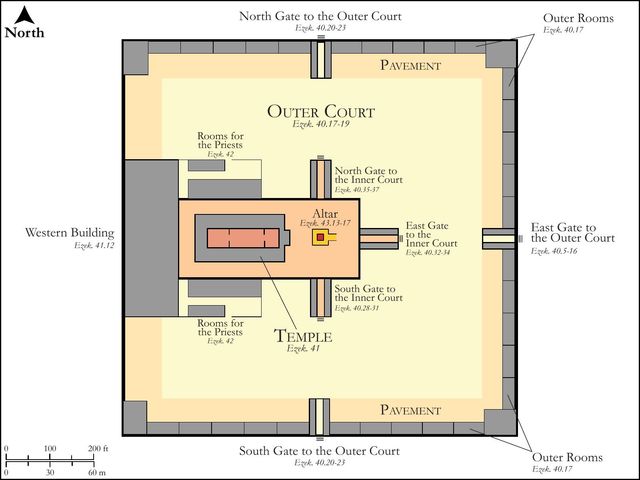
The measuring-reed which was in the hand of the surveyor-general was mentioned before, Eze 40:3. Here we are told (Eze 40:5) what was the exact length of it, which must be observed, because the house was measured by it. It was six cubits long, reckoning, not by the common cubit, but the cubit of the sanctuary, the sacred cubit, by which it was fit that this holy house should be measured, and that was a hand-breadth (that it, four inches) longer than the common cubit: the common cubit was eighteen inches, this twenty-two, see Eze 43:13. Yet some of the critics contend that this measuring-reed was but six common cubits in length, and one handbreadth added to the whole. The former seems more probable. Here is an account,
I.Of the outer wall of the house, which encompassed it round, which was three yards thick and three yards high, which denotes the separation between the church and the world on every side and the divine protection which the church is under. If a wall of this vast thickness will not secure it, God himself will be a wall of fire round about it; whoever attack it will do so at their peril.
II.Of the several gates with the chambers adjoining to them.
Here is no mention of the outer court of all, which was called the court of the Gentiles, some think because in gospel-times there should be such a vast confluence of Gentiles to the church that their court should be left unmeasured, to signify that the worshippers in that court should be unnumbered, Rev 7:9, Rev 7:11, Rev 7:12.
1.He begins with the east gate, because that was the usual way of entering into the lower end of the temple, the holy of holies being at the west end, in opposition to the idolatrous heathen that worshipped towards the east. Now, in the account of this gate, observe,
(1.)That he went up to it by stairs (Eze 40:6), for the gospel-church was exalted above that of the Old Testament, and when we go to worship God we must ascend; so is the call, Rev 4:1. Come up hither. Sursum corda - Up with your hearts.
(2.)That the chambers adjoining to the gates were but little chambers, about ten feet square, Eze 40:7. These were for those to lodge in who attended the service of the house. And it becomes such as are made spiritual priests to God to content themselves with little chambers and not to seek great things to themselves; so that we may but have a place within the verge of God's court we have reason to be thankful though it be in a little chamber, a mean apartment, though we be but door-keepers there.
(3.)The chambers, as they were each of them four-square, denoting their stability and due proportion and their exact agreement with the rule (for they were each of them one reed long and one reed broad), so they were all of one measure, that there might be an equality among the attendants on the service of the house.
(4.)The chambers were very many; for in our Father's house there are many mansions (Joh 14:2), in his house above, and in that here on earth. In the secret of his tabernacle shall those be hid, and in a safe pavilion, whose desire is to dwell in the house of the Lord all the days of their life, Psa 27:4, Psa 27:5. Some make these chambers to represent the particular congregations of believers, which are parts of the great temple, the universal church, which are, and must be, framed by the scripture-line and rule, and which Jesus Christ takes the measure of, that is, takes cognizance of, for he walks in the midst of the seven golden candle-sticks.
(5.)It is said (Eze 40:14), He made also the posts. He that now measured them was the same that made them; for Christ is the builder of his church and therefore is best able to give us the knowledge of it. And his reducing them to the rule and standard is called his making them, for no account is made of them further than they agree with that. To the law and to the testimony.
(6.)Here are posts of sixty cubits, which, some think, was literally fulfilled when Cyrus, in his edict for rebuilding the temple at Jerusalem, ordered that the height thereof should be sixty cubits, that is, thirty yards and more, Ezr 6:3.
(7.)Here were windows to the little chambers, and windows to the posts and arches (that is, to the cloisters below), and windows round about (Eze 40:16), to signify the light from heaven with which the church is illuminated; divine revelation is let into it for instruction, direction, and comfort, to those that dwell in God's house, light to work by, light to walk by, light to see themselves and one another by. There were lights to the little chambers; even the least, and least considerable, parts and members of the church, shall have light afforded them. All thy children shall be taught of the Lord. But they are narrow windows, as those in the temple, Kg1 6:4. The discoveries made to the church on earth are but narrow and scanty compared with what shall be in the future state, when we shall no longer see through a glass darkly.
(8.)Divers courts are here spoken of, an outermost of all, then an outer court, then an inner, and then the innermost of all, into which the priests only entered, which (some think) may put us in mind "of the diversities of gifts, and graces, and offices, in the several members of Christ's mystical body here, as also of the several degrees of glory in the courts and mansions of heaven, as there are stars in several spheres and stars of several magnitudes in the fixed firmament." English Annotations. Some draw nearer to God than others and have a more intimate acquaintance with divine things; but to a child of God a day in any of his courts is better than a thousand elsewhere. These courts had porches, or piazzas, round them, for the shelter of those that attended in them from wind and weather; for when we are in the way of our duty to God we may believe ourselves to be under his special protection, that he will graciously provide for us, nay, that he will himself be to us a covert from the storm and tempest, Isa 4:5, Isa 4:6.
(9.)On the posts were palm-trees engraven (Eze 40:16), to signify that the righteous shall flourish like the palm-tree in the courts of God's house, Psa 92:12. The more they are depressed with the burden of affliction the more strongly do they grow, as they say of the palm-trees. It likewise intimates the saints' victory and triumph over their spiritual enemies; they have palms in their hands (Rev 7:9); but lest they should drop these, or have them snatched out of their hands, they are here engraven upon the posts of the temple as perpetual monuments of their honour. Thanks be to God, who always causes us to triumph. Nay, believers shall themselves be made pillars in the temple of our God, and shall go no more out, and shall have his name engraven on them, which will be their brightest ornament and honour, Rev 3:12.
(10.)Notice is here taken of the pavement of the court, Eze 40:17, Eze 40:18. The word intimates that the pavement was made of porphyry-stone, which was of the colour of burning coals; for the brightest and most sparkling glories of this world should be put and kept under our feet when we draw near to God and are attending upon him. The stars are, as it were, the burning coals, or stones of a fiery colour, with which the pavement of God's celestial temple is laid; and, if the pavement of the court be so bright and glittering, how glorious must we conclude the mansions of that house to be!
2.The gates that looked towards the north (Eze 40:20) and towards the south (Eze 40:24), with their appurtenances, are much the same with that towards the east, after the measure of the first gate, Eze 40:21. But the description is repeated very particularly. And thus largely was the structure of the tabernacle related in Exodus, and of the temple in the books of Kings and Chronicles, to signify the special notice God does take, and his ministers should take, of all that belong to his church. His delight is in them; his eye is upon them. He knows all that are his, all his living temples and all that belongs to them. Observe,
(1.)This temple had not only a gate towards the east, to let into it the children of the east, that were famous for their wealth and wisdom, but it had a gate to the north, and another to the south, for the admission of the poorer and less civilized nations. The new Jerusalem has twelve gates, three towards each quarter of the world (Rev 21:13); for many shall come from all parts to sit down there, Mat 8:11.
(2.)To those gates they went up by steps, seven steps (Eze 40:22-26), which, as some observe, may remind us of the necessity of advancing in grace and holiness, adding one grace to another, going from step to step, from strength to strength, still pressing forward towards perfection - upward, upward, towards heaven, the temple above.
Historical interpretation
Two Centuries of Reception
5 surviving comments on this verse. Each one is dated, so this reads as a timeline rather than a list.
Select a marker to jump to its quote. Markers stagger vertically where authors wrote within a few decades of each other.
(Verse 14 and following) He made fronts for sixty cubits, and the courtyard of the gate had a surrounding circuit. And before the face of the gate, which reached up to the face of the interior vestibule gate, there were fifty cubits, and oblique windows in the chambers, and in their fronts which were inside the gate all around. Similarly, there were windows in the vestibules all around inside: and before the fronts, there was a depiction of palms. LXX: And under the sky was the court of the gate sixty cubits, and the threshold of the court of the gate all round. And under the sky of the court outside was the gate of the inner court fifty cubits, and windows screened with palm trees, and also the threshold of the gate within the court round about. And similarly the gate chambers, and windows all around inside, and the thresholds of the gates were palm trees on both sides." Symmachus interpreted this passage as follows: And he made circuits, which we can call surroundings: for which in Hebrew he has Elim (), which Aquila interpreted as κρίωμα, and we translate as frontiers. Again, where the Seventy placed the entrance of the atrium, in Hebrew it has El () in the singular number, which Symmachus translated as near the entrance, Aquila as κρίωμα, that is, the front of the atrium. Also, under the open sky, Aquila, before the face of the gate's posts; Symmachus, opposite the face of the gate's vestibule, translated. The hidden windows called Atemoth in Hebrew, Symmachus translated as τοξικὰς. And where the Seventy said above the entrance and above the gate's post, Symmachus placed the posts and the surroundings; Aquila, the chambers, and their fronts: for which it is written in Hebrew Theim and Ele. Moreover, Elamoth, which Septuagint and Theodotion also translated similarly; Symmachus translated circumstantias [circumstances], Aquila translated frontes [fronts]. But Aelam, for which it is written El in Hebrew ((Mss. Ul)), is called ostium [door] or porticus [porch]. Also, for palmis [palms], it is written in Hebrew as Thamarim [plural number]: because in the singular number, it calls palmam [palm], Thamar. I know that these things will be annoying to a fastidious reader: but I wanted to show briefly how much the ancient translation differs from the Hebrew truth due to the length of time, or rather the fault of the scribes, and, to speak more openly, our lack of knowledge of Hebrew: especially in Hebrew names, which we have translated from other editions into the Latin language, indicating not so much an explanation of the words as our simple suspicion. However, I think that around the wall of the temple on the outside, and the temple itself in the courtyard, that is, in the middle, there were certain things placed for decoration, which Symmachus interprets as surroundings, that is, certain standing structures, raised high from the ground, and these occupied a space of sixty cubits. And again, as one went out from the inner gate to the front of the vestibule, which faced the outer gate, there were fifty cubits of space, in which there were oblique windows, which Seventy called 'toxicas'. And in these windows were in the chambers, that is, in each room, and in the porticoes that extended before the rooms, measuring fifty cubits. These windows were slanted or arched, therefore they were called 'sagittae', which means 'arrows', because they allow a narrow light to enter the house, like arrows, and expand inward: and all around they were full of such windows. And in front of the facades of the porticoes, he says, there were paintings or carvings of palm trees, through which it is shown at the entrance of the gate, and immediately upon entering, a wall measuring sixty cubits with various ornaments meets, which refer to the condition of the world, so that the Creator may be understood through His creations: and everything in order and with reason, show the variety of the world, which among the Greeks is called 'kosmos', derived from adornment: and it was made in six days, so that each day, ten decades are reckoned, which we have mentioned above as the perfect number. After this, as we enter the inner atrium, we come across before us the vestibule of the inner gate of the bedroom, with oblique windows, occupying a space of fifty cubits, which itself is a sacred number. And after seven full weeks of festivity and joy, the first day of the Octave begins, which is the Day of Resurrection, and it brings us close to the temple. For when we have done all things, repenting for our previous errors, then we become neighbors and close to God, so that in the outer atrium, the order of creatures teaches us knowledge of the Creator with constancy, and in the inner [atrium] true jubilation, in which all our debts are forgiven, instructs us in the theology, and introduces us to the Holy of Holies. It is also worth noting that the inner courtyard has several windows, which are not direct and equal, but rather oblique and narrow on the outside, and widening inward, so that we can penetrate the interior through small openings and reach the fullness of the brightest light, which is present in the temple. Finally, after sixty and fifty cubits, and chambers, and porticoes, and the facades of the porticoes, and numerous windows all around, the carving or painting of palm trees is shown to us, so that as victors of the world, we may become worthy to see the palm trees of virtues.
And oblique windows in the chambers.
In slanted windows, the part through which light enters is narrow, but the interior part which receives the light is wide, because the minds of those who contemplate, although they may see something slight of the true light, are nevertheless expanded within themselves with great amplitude. And indeed these minds can scarcely grasp even a few of the things they behold. For truly what those contemplating see of eternity is exceedingly small, yet from this small amount the bosom of their minds is enlarged into an increase of fervor and love; and hence they become spacious within themselves, from whence they admit the light of truth to themselves as if through narrow openings. Because this greatness of contemplation can be granted only to those who love, slanted windows are said to be in the chambers, or in those things which are said to be near the chambers, no longer on the outside but on the inside.
And in their fronts which were within the gate on every side round about.
For there were windows in the chambers, and there were also windows in their fronts, which had been constructed within the gate on every side all around, because he who has a heart within also receives the light of contemplation. For those who still think immoderately about external things do not know what the openings of contemplation concerning eternal light may be. For that infusion of incorporeal light is not grasped together with images of corporeal things, because while only visible things are thought about, invisible light is not admitted to the mind. But whoever now attends to the light of contemplation must take great care to always guard the mind in humility, never to exalt himself because of the grace with which he is filled, and to consider what the oblique windows that mark the minds of contemplatives are like. For through oblique windows light enters, and a thief does not enter, because those who are true watchmen always keep their understanding pressed down in humility, and the understanding of contemplation enters their minds, but the boasting of pride does not enter. And so the windows are both open and fortified, because the grace with which they are filled is open in their minds, and yet they do not permit the adversary to enter through pride.
It should be noted that within the gate, windows slanting inward are mentioned on every side throughout the circuit. For the grace of contemplation is not given only to the highest and denied to the lowly, but often the highest receive it, often the lowly, more frequently those who have withdrawn from the world, and sometimes even the married. If therefore there is no office among the faithful from which the grace of contemplation can be excluded, whoever has a heart within can also be illuminated by the light of contemplation, because within the gate windows slanting inward are constructed on every side throughout the circuit, so that no one may boast of this grace as though it were something singular to himself. Let no one think he possesses the gift of true light as his own private possession, because in that which he thinks he has as something special, often another is richer—one whom he did not think possessed any good within himself.
And before the fronts was a picture of palm trees.
What is designated by palms, if not the rewards of victory? For these are customarily given to victors. Hence also concerning those who in the contest of martyrdom had conquered the ancient enemy, and were now rejoicing as victors in their homeland, it is written: "And palms in their hands, and they cried out with a loud voice, saying: Salvation to our God, who sits upon the throne, and to the Lamb." For to have palms in their hands is to have held fast to victories in their deeds. The palm of this deed is repaid there, where one now rejoices without struggle. Hence also here it does not say: "Palms before the fronts," but "a picture of palms before the fronts." For there the palm of victory will be seen, where one will now rejoice without end. For here we often observe holy men doing wondrous things, performing many miracles, cleansing lepers, casting out demons, driving away bodily illnesses by touch, predicting future things by the spirit of prophecy. All these things are not yet palms, but still a picture of palms, for these are sometimes given even to the reprobate. Hence also through the Gospel, Truth says: "Many will say to me on that day: Lord, Lord, did we not prophesy in your name, and cast out demons in your name, and perform many miracles in your name? And then I will confess to them: I never knew you; depart from me, you who work iniquity." But the one true sign of election is the steadfastness of charity, as it is written: "By this it shall be known that you are my disciples, if you have love for one another." Moreover, when the elect perform these miracles, they do so in a manner far different from the reprobate, because what the elect do from charity, the reprobate strive to do through pride. But even for those same elect, the very wonders they perform through charity are not yet palms, but still a picture of palms, because through these things it is shown outwardly what sort of people they are held to be inwardly before the almighty Lord. But there the palm will be theirs, where there will no longer be any struggle with death. For the outstanding preacher then beheld the true palm being given to victors, when he foresaw the resurrection of the dead taking place, as he says: "For this corruptible must put on incorruption, and this mortal must put on immortality. But when this mortal has put on immortality, then shall come to pass the saying that is written: Death is swallowed up in victory. Where, O death, is your victory? Where, O death, is your sting?" Then therefore there will be perfect victory, when death shall have been fully swallowed up. But in everything that we now observe being done wondrously through signs, we see not yet victory itself, but still images of victory. Therefore, because virtues and signs are often given even to saints placed in more exalted positions, so that others may be stirred to good works, a picture of palms is shown before the fronts of the inner building. Let what has been treated today suffice, so that we may come, with the help of our Lord Jesus Christ, more vigorous to those things that follow—he who lives and reigns with God the Father in the unity of the Holy Spirit, God, through all ages of ages. Amen.
And likewise there were windows round about within in the vestibules.
After he said there were windows in the fronts, he adds windows in the vestibules round about on the inside, because not only do the lofty members of holy Church who stand out have the grace of contemplation, but often even those members receive this gift who, although they already spring up toward the highest things through desire, nevertheless still lie low through their office. For unless almighty God poured the light of contemplation even into those who seem despised, there would not have been windows in the vestibules. And so we see some who are placed in the highest positions of holy Church speaking lofty things about heavenly matters, searching out with wondrous zeal, insofar as the illuminated mind suffices, the secrets of the heavenly fatherland: these are windows in the fronts. But others are contained within the bosom of holy Church and seem despised in human eyes, yet within themselves they are occupied with the pursuits of wisdom, they yearn for heavenly things, and insofar as they are able, they consider what the eternal joys may be: these therefore are oblique windows, but in the vestibules.
It is well said "round about," because all inquiry into hidden things involves a circuit, since in its cogitation the mind says: "Do you suppose it is this? Do you suppose it is that?" It goes around, as it were, in order to find what it seeks. When the uncircumscribed light begins to break forth into knowledge, it is as though a ray of truth comes through an oblique window. For thus in our contemplation we make progress by circling around many things in our thoughts, just as we often seek examples of good people in order to make progress in our conduct. For when the mind is already thinking of passing on to better things, it seeks out whatever better thing it can hear about from others; it examines now the life of this holy person, now of another. Hence a certain chosen one, who had cast the eyes of his mind throughout the whole world in the broad embrace of Holy Church, seeking the life of good people for imitation, said: "I will go about and sacrifice in the tabernacle of God a sacrifice of jubilation." Behold, in order to sacrifice a sacrifice of jubilation, he was going about, because unless he sent his mind here and there to seek out the life of good people, he himself would not arrive at the sacrifice of jubilation. But when holy men are brought to the highest places within Holy Church, their life is set as if in a mirror, so that all may see the good things they ought to imitate.
Continue studying Ezekiel 40:16 across the web’s major study libraries — every link below opens this exact verse, chapter, or book on the destination site.
Read & Compare
 BibleGatewayThis verse in more than 200 translations and 70 languages.
 Bible.comThe YouVersion reader — hundreds of translations, reading plans, and highlights.
 ESV.orgCrossway's official English Standard Version reader.
 NET BibleThe NET translation with 60,000+ translators' notes on every rendering decision.
 STEP BibleTyndale House's free study tool — original text, vocabulary, and scholarly resources.
 BibliaLogos Bible Software's free web reader.
 USCCBThe New American Bible (Revised Edition) with the U.S. bishops' study notes.
Commentaries
 BibleHub CommentariesDozens of classic commentaries on this verse, gathered on one page.
 StudyLightMore than 100 commentary sets — the largest collection on the web.
 BibleRefPlain-English commentary on what this verse means, verse by verse.
 Enduring WordDavid Guzik's free commentary on this chapter, widely used by Bible teachers.
 Bible Study ToolsVerse commentary alongside Greek and Hebrew study aids.
Original Language & Research
- BibleHub InterlinearThe verse word by word — original language, transliteration, and English.
- BibleHub LexiconEvery word's original-language definition and Strong's entry.
 Blue Letter BibleDeep-study tools — Strong's numbers, concordance, and word studies.
 SefariaThe Hebrew text with Rashi and centuries of Jewish commentary.
Sermons, Hymns & Audio


TrulyRandomVerse is not affiliated with these sites and doesn’t control their content. They’re linked because they’re genuinely useful.
Summary
Ezekiel 40:16 offers a meticulous architectural description within the prophet's expansive vision of a new temple, detailing specific features of the gate complex. It highlights the "narrow windows" of the guard chambers, designed to face inward, and the decorative "palm trees" adorning the posts. This precise rendering contributes to the overall impression of divine precision, sacred order, and symbolic beauty inherent in this future sanctuary, emphasizing God's detailed blueprint for a holy dwelling place and His enduring presence among His people.
Context
ShowHideLiterary Context
Ezekiel 40:16 is deeply embedded within the initial and highly detailed segment of Ezekiel's profound temple vision, which spans from Ezekiel 40 through Ezekiel 48. The entire vision, commencing in Ezekiel 40:1 and concluding with the naming of the city in Ezekiel 48:35, presents an elaborate blueprint for a future temple, its surrounding courts, and the re-allotment of the land. Specifically, Ezekiel 40 focuses on the outer court and its impressive gates. Verses Ezekiel 40:5-16 meticulously describe the eastern gate, detailing its precise dimensions, the guard chambers within it, and various other architectural elements. Verse 16, in particular, elaborates on the design of the windows and the symbolic palm tree decorations within these gate chambers, adding to the pervasive sense of divine precision and aesthetic design that characterizes the entirety of this visionary structure.
Historical & Cultural Context
The vision of the new temple was granted to Ezekiel during the profound trauma of the Babylonian exile, around 573 BC. This was years after the devastating destruction of Solomon's magnificent Temple by the Babylonians in 586 BC, an event vividly recounted in 2 Kings 25:8-10. For the exiled Israelites, who had suffered the loss of their land, their cherished temple, and their monarchy, this vision served as an unparalleled source of hope and reassurance. It was a tangible promise of God's enduring covenant faithfulness and a future restoration. The intricate architectural plans provided a concrete assurance of a renewed divine presence among His people, signaling the dawn of a new era of worship and the re-establishment of sacred order. The meticulousness of the description, extending even to the design of windows and decorative motifs, powerfully underscored the divine origin and paramount importance of this future sanctuary, offering a stark and hopeful contrast to the desolation they currently endured in exile.
Key Themes
ShowHideThis verse, as an integral part of the broader temple vision, contributes significantly to several overarching theological themes. Firstly, it profoundly emphasizes Divine Precision and Order. Every measurement and architectural feature, including the "narrow windows" and the "palm trees," is described with exacting detail, underscoring God's absolute control, intentionality, and perfect design in all His plans, as echoed in Ezekiel 43:10-12. Secondly, the design elements, particularly the "narrow windows" facing inward, strongly suggest Sanctity and Separation. This highlights the temple's inherent sacredness and its distinctiveness from the profane world, directing all focus toward the divine presence within, a principle reinforced in passages like Ezekiel 44:7-9. Lastly, the inclusion of "palm trees" points to Beauty, Flourishing, and Righteousness. Palm trees are ancient and enduring symbols of life, victory, prosperity, and spiritual vitality. Their presence suggests that God's dwelling place would be a source of abundant spiritual life and blessedness for His people, a theme beautifully articulated in Psalm 92:12-14.
Exposition and Analysis
ShowHideKey Word Analysis
ShowHideThis word (H331) derives from a primitive root meaning "to close" or "to contract." In the context of windows, it signifies a restricted opening, not wide or expansive. This design likely served practical purposes such as security or privacy, but also symbolically controlled the view and light, directing attention inward towards the sanctity of the temple rather than outward to the secular world, emphasizing the sacred and protected nature of the sanctuary.
This term (H352) refers to a strong support or pilaster, often used as a structural element in architecture. Its root conveys the idea of strength, indicating the foundational and load-bearing components of the gate structure. These posts were not merely functional but also served as canvases for significant decorative elements, as evidenced by the presence of the palm tree motifs, adding both strength and beauty to the design.
This word (H8561) denotes an architectural motif resembling a palm tree, often used as a decorative pilaster or carving. The palm tree (Hebrew: tamar) in Scripture is a rich and multifaceted symbol of victory, righteousness, beauty, flourishing, and vitality. Its inclusion here signifies the sacredness, abundance, and blessedness associated with God's dwelling place, echoing similar decorative elements found in Solomon's Temple.
Verse Breakdown
ShowHide"And there were narrow windows to the little chambers"
This initial clause introduces a specific and significant architectural detail: windows characterized by their restricted width. These windows are explicitly located within the "little chambers," which were likely guardrooms or ancillary spaces integrated into the gate complex. The "narrow" design suggests a deliberate choice, possibly for security, privacy, or to control the ingress of light and external views, thereby emphasizing the sacred and protected nature of the temple entrance.
"and to their posts within the gate round about, and likewise to the arches"
This segment further specifies the pervasive placement of these architectural features. The narrow windows were not confined solely to the chambers but were also associated with the "posts" (the strong, supportive pilasters) and the "arches" (the pillar-spaces or porticos) that comprised the larger gate structure. The phrase "round about" indicates a consistent and comprehensive application of these features throughout the gate's interior, underscoring the uniformity and holistic nature of the divine design.
"and windows were round about inward"
This clause reiterates the presence of windows and, crucially, defines their orientation. The emphatic phrase "round about inward" strongly suggests that these windows were designed to face the interior of the gate complex or the temple courts, rather than providing views of the profane world outside. This directional emphasis powerfully reinforces the overarching theme of separation, sanctity, and the singular focus on the sacred space within the temple.
"and upon each post were palm trees"
This final clause describes the decorative elements that adorned the structural posts. These posts, which provided essential support, were embellished with carvings or reliefs of palm trees. This detail adds a profound layer of symbolic beauty and theological significance, linking the temple's architecture to timeless themes of life, flourishing, divine blessing, and the righteous character of those who dwell in God's presence.
Literary Devices
ShowHideThe primary literary device employed in Ezekiel 40:16, and indeed throughout the entire temple vision, is Detailed Description. The prophet meticulously records the precise dimensions, materials, and architectural features of the visionary temple, creating an extraordinarily vivid and almost tangible mental image for the audience. This serves to emphasize the divine origin, exactitude, and comprehensive nature of God's blueprint for His dwelling place. Furthermore, Symbolism is profoundly evident, particularly with the inclusion of the "palm trees." These are not merely ornamental but carry rich theological meaning, representing life, victory, righteousness, and flourishing. Their presence transforms a purely architectural detail into a powerful spiritual statement about the nature of God's sanctuary and the life found within it. The "narrow windows" can also be interpreted symbolically, perhaps indicating Exclusivity or Sanctity, suggesting a controlled and consecrated environment that filters out the external world and directs attention solely toward the sacred interior. The repetitive nature of the details ("round about," "upon each post") also employs a form of Emphasis, reinforcing the comprehensive and uniform application of the divine design throughout the gate structure.
Theological and Thematic Connections
ShowHideEzekiel 40:16, with its precise details of narrow windows and palm trees, offers profound insights into God's character and the nature of His dwelling place. The meticulousness of the architectural specifications reflects God's divine order, intentionality, and perfection in all His plans, from the grand scope of creation to the intimate details of redemption. The narrow windows, deliberately facing inward, powerfully symbolize the sanctity and separation required for God's holy presence, underscoring that His dwelling is distinct from the common world and demands reverence, purity, and an inward focus. The palm trees, a recurring motif in sacred spaces, point to the flourishing, beauty, and righteousness that characterize life lived in God's presence. This vision, therefore, transcends mere architectural blueprints; it is a deeply theological revelation, conveying eternal truths about God's holiness, His desire for a consecrated people, and the abundant, vital life found exclusively within His sanctuary.
Reflection and Application
ShowHideThe intricate details of Ezekiel's temple vision, including the narrow windows and the symbolic palm trees, serve as a profound invitation to reflect on the nature of God's presence and our appropriate response to it. The divine precision evident in every measurement and feature reminds us that God is a God of perfect order, and His plans are purposeful, intentional, and ultimately flawless. This truth encourages us to cultivate unwavering trust in His sovereignty, even when we cannot fully comprehend every detail of His unfolding will in our lives. The inward-facing, narrow windows offer a powerful metaphor for our spiritual lives, urging us to cultivate an inner focus, diligently guarding our hearts and minds from the pervasive distractions and defilements of the world. They call us to direct our gaze and affections primarily toward God's holiness and His indwelling Spirit. The palm trees, as enduring symbols of flourishing and righteousness, inspire us to seek deep spiritual roots in God's presence, trusting that a life lived in devoted communion with Him will inevitably bear beautiful fruit and demonstrate spiritual vitality, even amidst challenging seasons. We are called to be living temples, consecrated and set apart, reflecting God's divine order, profound holiness, and abundant fruitfulness in every aspect of our daily walk.
Questions for Reflection
ShowHideFAQ
ShowHideWhat is the overall purpose of Ezekiel's temple vision, and is it meant to be built literally?
ShowHideThe overall purpose of Ezekiel's temple vision, encompassing Ezekiel 40-48, was multifaceted: to provide immense hope and a detailed blueprint for restoration to the exiled Israelites. It assured them that God's glorious presence would ultimately return to a purified sanctuary and a renewed, re-ordered land. Whether this temple is meant to be built literally in the future is a subject of significant and ongoing theological debate among scholars. Some interpret it as a literal temple to be constructed in the millennial kingdom, emphasizing the detailed architectural plans as a divine mandate. Others view it primarily as a symbolic vision, representing God's ideal dwelling, the Church as the spiritual temple, or the heavenly city, emphasizing profound themes of divine order, holiness, and the ultimate restoration of God's intimate presence among His people. The extreme precision of the details certainly suggests a divine reality, whether physical or spiritual in its ultimate fulfillment.
What is the significance of the "narrow windows" in the gate chambers?
ShowHideThe "narrow windows" mentioned in Ezekiel 40:16 likely served both practical and profound symbolic purposes within the temple's gate complex. Practically, their narrow design would have provided enhanced security for the guards stationed in the chambers, limiting external access or visibility while still allowing some light and a controlled view. Symbolically, their "narrow" and "inward" orientation is highly significant. They emphasize the sanctity and separation of the temple, suggesting a controlled and consecrated environment. This design directs attention and focus away from the profane, chaotic world outside and firmly towards the sacred space within. This reinforces the theological principle that God's dwelling place is set apart, demanding a reverent and purified approach, filtering out external distractions and focusing the worshiper's gaze on the divine presence.
Why are "palm trees" used as a decorative motif in the temple vision?
ShowHidePalm trees, as described in Ezekiel 40:16 and other biblical texts, hold rich and multifaceted symbolic meaning in Scripture. They are consistently associated with life, victory, righteousness, prosperity, beauty, and spiritual vitality. Their inclusion as decorative elements in the visionary temple, much like their presence in Solomon's Temple, signifies the blessed, flourishing, and abundant nature of God's presence. They suggest that the temple is a place of profound spiritual vitality, where righteousness thrives, and where God's people experience His favor, growth, and divine abundance. The palm tree motif powerfully points to the flourishing and fruitful life that emanates from being in right relationship with God within His holy dwelling.
Christ-Centered Fulfillment
ShowHideEzekiel 40:16, with its meticulous description of the temple's gate features—including narrow windows and decorative palm trees—finds its ultimate Christ-centered fulfillment not in a reconstructed physical edifice, but in the person and redemptive work of Jesus Christ and the spiritual temple He inaugurates. Jesus Himself, the ultimate embodiment of God's dwelling among humanity, declared, "Destroy this temple, and in three days I will raise it up," speaking profoundly of the temple of His own body (John 2:19-21). He is the ultimate gate, the exclusive and "narrow" way through whom all must enter to gain access to God's presence and salvation (John 10:9; Matthew 7:13-14). The "narrow windows" facing inward foreshadow the consecrated, set-apart life of the believer in Christ, who is called to be distinct from the world and to live with an inward gaze towards the indwelling Holy Spirit of God, recognizing their own body as a temple (1 Corinthians 6:19-20). Furthermore, the "palm trees" symbolizing flourishing, righteousness, and victory are beautifully fulfilled in Christ, who is the inexhaustible source of all spiritual life and fruitfulness. Through Him, believers are deeply rooted and continually built up, flourishing in righteousness and bearing abundant fruit for God's glory (Colossians 2:6-7; John 15:5). The divine precision of Ezekiel's vision ultimately points to the perfect, flawless design of salvation in Christ, where every detail of God's redemptive plan is perfectly executed, culminating in the spiritual temple of the Church, where God truly dwells among His redeemed people, built together into a holy habitation (Ephesians 2:19-22).