


Ezekiel 40:22
Bible text: King James Version (1769 Blayney text) · Public domain
Bible text: King James Version with Strong's numbers · Public domain
Bible text: Berean Standard Bible · Public domain
Bible text: American Standard Version (1901) · Public domain
Bible text: World English Bible, Messianic edition · Public domain
Bible text: Geneva Bible (1599) · Public domain
Bible text: Young's Literal Translation · Public domain
- וְחַלּוֹנָיוve·cha·lo·novand its windowsH2474Conj-w ¦ N-mpc ¦ 3msNoun Plural Masculine Constructוְandחַלּוֹנָיwindowsוits
- וְאֵלַמָּיוve·'e·la·movand its porchesH361Conj-w ¦ N-mpc ¦ 3msNoun Plural Masculine Constructוְandאֵלַמָּיporchesוits
- וְתִמֹרָיוve·ti·mo·rovand its palm treesH8561Conj-w ¦ N-mpc ¦ 3msNoun Plural Masculine Constructוְandתִמֹרָיpalm treesוits
- כְּמִדַּתke·mi·Dat[were] like [the] measurement ofH4060Prep-k ¦ N-fscNoun Singular Feminine Constructכְּ[were] likeמִדַּת[the] measurement of
- הַשַּׁעַרha·Sha·'arthe gateH8179Art ¦ N-msNoun Singular Masculine Absoluteהַtheשַּׁעַרgate
- אֲשֶׁר'a·SherwhichH834RelParticle Relative
- פָּנָיוpa·Navits faceH6440N-mpc ¦ 3msNoun Plural Masculine Constructפָּנָיfaceוits
- דֶּרֶךְDe·rekh[was] [the] direction ofH1870N-cscNoun Singular common gender Construct
- הַקָּדִיםha·ka·Dimthe eastH6921Art ¦ N-msNoun Singular Masculine Absoluteהַtheקָּדִיםeast
- וּבְמַעֲלוֹתu·ve·ma·'a·Lotand by stepsH4609Conj-w ¦ Prep-b ¦ N-fpNoun Plural Feminine Absoluteוּandבְbyמַעֲלוֹתsteps
- שֶׁבַעshe·va'sevenH7651Adj-csAdjective Numerical Singular common gender Absolute
- יַעֲלוּya·'a·lupeople go upH5927V-Qal-Imperf-3mpVerb Qal Imperfect 3rd Plural Masculine
- בוֹvoin itPrep-b ¦ 3msSuffix Personal 3rd Singular Masculineבinוֹit
- וְאֵילַמָּיוve·'ei·la·movand its porchesH361Conj-w ¦ N-mpc ¦ 3msNoun Plural Masculine Constructוְandאֵילַמָּיporchesוits
- לִפְנֵיהֶםlif·nei·Hem[were] <to> before themH6440Prep-l ¦ N-mpc ¦ 3mpNoun Plural Masculine Constructלִ[were] <to>פְנֵיbeforeהֶםthem
English is a literal word-by-word gloss of the Hebrew, not the KJV's wording. Why?
This is the original text the KJV's translators worked from — each Hebrew word with its own literal English meaning in this verse, prepared by scholars at Tyndale House, Cambridge. The KJV translates whole sentences, not word by word, so its wording differs: one Hebrew word can become several English words, and the KJV may choose “the LORD” where the gloss reads “Yahweh”. Both are faithful — they answer different questions. For the KJV's own rendering, switch to the KJV text.
Details
See on the biblical-era map
Study this verse
Public-domain commentary
Matthew Henry
From his Commentary on the Whole Bible. Henry comments on passages, not single verses — this entry covers Ezekiel 40:5–26. His three-level outline is real structure in the source text, so it is rendered as structure.
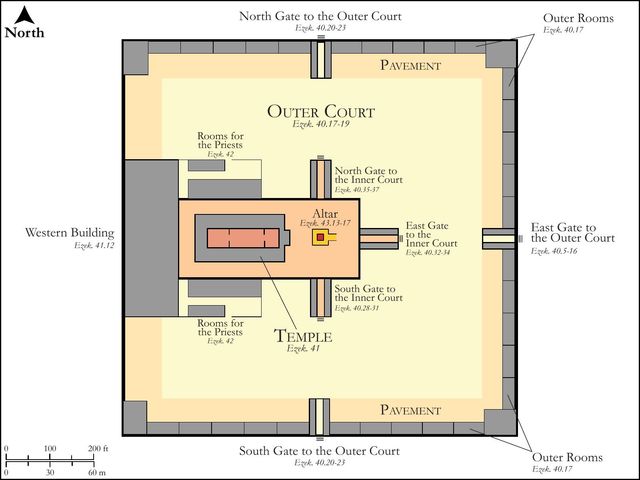
The measuring-reed which was in the hand of the surveyor-general was mentioned before, Eze 40:3. Here we are told (Eze 40:5) what was the exact length of it, which must be observed, because the house was measured by it. It was six cubits long, reckoning, not by the common cubit, but the cubit of the sanctuary, the sacred cubit, by which it was fit that this holy house should be measured, and that was a hand-breadth (that it, four inches) longer than the common cubit: the common cubit was eighteen inches, this twenty-two, see Eze 43:13. Yet some of the critics contend that this measuring-reed was but six common cubits in length, and one handbreadth added to the whole. The former seems more probable. Here is an account,
I.Of the outer wall of the house, which encompassed it round, which was three yards thick and three yards high, which denotes the separation between the church and the world on every side and the divine protection which the church is under. If a wall of this vast thickness will not secure it, God himself will be a wall of fire round about it; whoever attack it will do so at their peril.
II.Of the several gates with the chambers adjoining to them.
Here is no mention of the outer court of all, which was called the court of the Gentiles, some think because in gospel-times there should be such a vast confluence of Gentiles to the church that their court should be left unmeasured, to signify that the worshippers in that court should be unnumbered, Rev 7:9, Rev 7:11, Rev 7:12.
1.He begins with the east gate, because that was the usual way of entering into the lower end of the temple, the holy of holies being at the west end, in opposition to the idolatrous heathen that worshipped towards the east. Now, in the account of this gate, observe,
(1.)That he went up to it by stairs (Eze 40:6), for the gospel-church was exalted above that of the Old Testament, and when we go to worship God we must ascend; so is the call, Rev 4:1. Come up hither. Sursum corda - Up with your hearts.
(2.)That the chambers adjoining to the gates were but little chambers, about ten feet square, Eze 40:7. These were for those to lodge in who attended the service of the house. And it becomes such as are made spiritual priests to God to content themselves with little chambers and not to seek great things to themselves; so that we may but have a place within the verge of God's court we have reason to be thankful though it be in a little chamber, a mean apartment, though we be but door-keepers there.
(3.)The chambers, as they were each of them four-square, denoting their stability and due proportion and their exact agreement with the rule (for they were each of them one reed long and one reed broad), so they were all of one measure, that there might be an equality among the attendants on the service of the house.
(4.)The chambers were very many; for in our Father's house there are many mansions (Joh 14:2), in his house above, and in that here on earth. In the secret of his tabernacle shall those be hid, and in a safe pavilion, whose desire is to dwell in the house of the Lord all the days of their life, Psa 27:4, Psa 27:5. Some make these chambers to represent the particular congregations of believers, which are parts of the great temple, the universal church, which are, and must be, framed by the scripture-line and rule, and which Jesus Christ takes the measure of, that is, takes cognizance of, for he walks in the midst of the seven golden candle-sticks.
(5.)It is said (Eze 40:14), He made also the posts. He that now measured them was the same that made them; for Christ is the builder of his church and therefore is best able to give us the knowledge of it. And his reducing them to the rule and standard is called his making them, for no account is made of them further than they agree with that. To the law and to the testimony.
(6.)Here are posts of sixty cubits, which, some think, was literally fulfilled when Cyrus, in his edict for rebuilding the temple at Jerusalem, ordered that the height thereof should be sixty cubits, that is, thirty yards and more, Ezr 6:3.
(7.)Here were windows to the little chambers, and windows to the posts and arches (that is, to the cloisters below), and windows round about (Eze 40:16), to signify the light from heaven with which the church is illuminated; divine revelation is let into it for instruction, direction, and comfort, to those that dwell in God's house, light to work by, light to walk by, light to see themselves and one another by. There were lights to the little chambers; even the least, and least considerable, parts and members of the church, shall have light afforded them. All thy children shall be taught of the Lord. But they are narrow windows, as those in the temple, Kg1 6:4. The discoveries made to the church on earth are but narrow and scanty compared with what shall be in the future state, when we shall no longer see through a glass darkly.
(8.)Divers courts are here spoken of, an outermost of all, then an outer court, then an inner, and then the innermost of all, into which the priests only entered, which (some think) may put us in mind "of the diversities of gifts, and graces, and offices, in the several members of Christ's mystical body here, as also of the several degrees of glory in the courts and mansions of heaven, as there are stars in several spheres and stars of several magnitudes in the fixed firmament." English Annotations. Some draw nearer to God than others and have a more intimate acquaintance with divine things; but to a child of God a day in any of his courts is better than a thousand elsewhere. These courts had porches, or piazzas, round them, for the shelter of those that attended in them from wind and weather; for when we are in the way of our duty to God we may believe ourselves to be under his special protection, that he will graciously provide for us, nay, that he will himself be to us a covert from the storm and tempest, Isa 4:5, Isa 4:6.
(9.)On the posts were palm-trees engraven (Eze 40:16), to signify that the righteous shall flourish like the palm-tree in the courts of God's house, Psa 92:12. The more they are depressed with the burden of affliction the more strongly do they grow, as they say of the palm-trees. It likewise intimates the saints' victory and triumph over their spiritual enemies; they have palms in their hands (Rev 7:9); but lest they should drop these, or have them snatched out of their hands, they are here engraven upon the posts of the temple as perpetual monuments of their honour. Thanks be to God, who always causes us to triumph. Nay, believers shall themselves be made pillars in the temple of our God, and shall go no more out, and shall have his name engraven on them, which will be their brightest ornament and honour, Rev 3:12.
(10.)Notice is here taken of the pavement of the court, Eze 40:17, Eze 40:18. The word intimates that the pavement was made of porphyry-stone, which was of the colour of burning coals; for the brightest and most sparkling glories of this world should be put and kept under our feet when we draw near to God and are attending upon him. The stars are, as it were, the burning coals, or stones of a fiery colour, with which the pavement of God's celestial temple is laid; and, if the pavement of the court be so bright and glittering, how glorious must we conclude the mansions of that house to be!
2.The gates that looked towards the north (Eze 40:20) and towards the south (Eze 40:24), with their appurtenances, are much the same with that towards the east, after the measure of the first gate, Eze 40:21. But the description is repeated very particularly. And thus largely was the structure of the tabernacle related in Exodus, and of the temple in the books of Kings and Chronicles, to signify the special notice God does take, and his ministers should take, of all that belong to his church. His delight is in them; his eye is upon them. He knows all that are his, all his living temples and all that belongs to them. Observe,
(1.)This temple had not only a gate towards the east, to let into it the children of the east, that were famous for their wealth and wisdom, but it had a gate to the north, and another to the south, for the admission of the poorer and less civilized nations. The new Jerusalem has twelve gates, three towards each quarter of the world (Rev 21:13); for many shall come from all parts to sit down there, Mat 8:11.
(2.)To those gates they went up by steps, seven steps (Eze 40:22-26), which, as some observe, may remind us of the necessity of advancing in grace and holiness, adding one grace to another, going from step to step, from strength to strength, still pressing forward towards perfection - upward, upward, towards heaven, the temple above.
Historical interpretation
Historical reception
1 surviving comment on this verse from the historical church.
"And its windows, and its vestibule, and its carvings were according to the measure of the gate which looked toward the East; and its ascent was of seven steps, and the vestibule before it."
All these things have already been discussed more extensively above, and therefore the discourse should not be delayed with a lengthy exposition. However, this must be especially noted: that the gate toward the North is said to have all the same things that the gate toward the East has, namely the windows of contemplation, the vestibule of humility, and the carving of good works. For all who have persevered in innocence because they were born to God in their conversion have the gate toward the East, because the entrance to the heavenly kingdom lies open to them from the light they received. And all who, having later fallen into sins, were weighed down by the coldness of their torpor, but who, when they return through penance, grow warm again toward love of the heavenly homeland, have the gate toward the North, because for them also, after the coldness of their sin, the entrance to the heavenly kingdom lies open through mercy. Therefore the gate toward the North is said to have the same things that the gate toward the East has, because converted sinners are enriched with virtues just as those are rich who avoided falling into sin. Hence also by the voice of the Psalmist it is said through the Lord: "I ate ashes like bread," because He receives the penitent just as He does the righteous. For it is written concerning sinners: "They would have done penance long ago in sackcloth and ashes." Therefore ashes are eaten like bread when a sinner is recalled through penance to the grace of his Creator just like an innocent person. Therefore the gate toward the North has windows, has a vestibule, has carvings, because when a sinner is led back to life after his faults, he often receives the light of contemplation, and from the very memory of his iniquity he gains the grace of great humility and also the efficacy of good works, so that everything that is commanded to be done appears as if carved in his life. "Its ascent was of seven steps, and a vestibule was before it."
The gate is ascended by seven steps, because through the sevenfold grace of the Holy Spirit the entrance to heavenly life is opened to us. Isaiah, enumerating this sevenfold grace in our very Head, or in His body, which we are, says: "The spirit of wisdom and understanding shall rest upon Him, the spirit of counsel and fortitude, the spirit of knowledge and piety, and the spirit of the fear of the Lord shall fill Him." Speaking of heavenly things, he numbered these steps by descending rather than ascending, namely: wisdom, understanding, counsel, fortitude, knowledge, piety, fear. And since it is written, "The fear of the Lord is the beginning of wisdom," it is without doubt established that one ascends from fear to wisdom, but does not return from wisdom to fear, because indeed wisdom possesses perfect charity. And it is written: "Perfect charity casts out fear." Therefore the prophet, because he was speaking from heavenly things down to the lowest, began rather from wisdom and descended to fear. But we who strive from earthly things toward heavenly things, let us enumerate those same steps by ascending, that we may be able to arrive from fear to wisdom. For in our mind the first step of ascent is the fear of the Lord; the second, piety; the third, knowledge; the fourth, fortitude; the fifth, counsel; the sixth, understanding; the seventh, wisdom. For the fear of the Lord exists in the mind. But what kind of fear is this, if piety is not with it? For he who knows not how to show mercy to his neighbor, who pretends not to share in his tribulations, his fear is nothing before the eyes of almighty God, because it is not raised up to piety. But often piety is accustomed to err through disordered mercy, if perchance it spares what ought not to be spared. For sins that can be struck by the fires of hell must be corrected by the rod of discipline. But disordered piety, when it spares temporally, drags one down to eternal punishment. Therefore, that piety may be true and ordered, it must be raised to another step, that is, to knowledge, so that it may know what to punish by judgment and what to forgive by mercy. But what if someone knows what he ought to do, yet lacks the strength to do it? Therefore let our knowledge grow to fortitude, so that when it sees what must be done, it can do this through strength of mind, lest it tremble with fear and, collapsed by dread, be unable to defend the good things it perceives. But often fortitude, if it is improvident and less circumspect against vices, falls into ruin by its very presumption. Therefore let it ascend to counsel, so that by foreseeing it may fortify everything it can do boldly. But there cannot be counsel if understanding is lacking, because he who does not understand the evil that burdens the doer, how can he strengthen the good that helps? And so let us ascend from counsel to understanding. But what if understanding watches with great sharpness, yet knows not how to moderate itself through maturity? Therefore let one ascend from understanding to wisdom, so that what understanding discovers keenly, wisdom may arrange with maturity. Because therefore through fear we rise to piety, through piety we are led to knowledge, through knowledge we are strengthened to fortitude, through fortitude we strive toward counsel, through counsel we advance into understanding, through understanding we arrive at the maturity of wisdom, we ascend to the gate by seven steps, through which the entrance to spiritual life is opened to us.
But it is well said that the vestibule was before it, because unless one first has humility, he does not ascend to these steps of spiritual gifts, as it is written: "Upon whom shall my spirit rest, if not upon the humble and quiet one, and the one trembling at my words." Concerning which it is said through the Psalmist: "He disposed ascents in his heart in the valley of tears." For a valley is a low place, and every sinner, while he humbly afflicts himself in tears in his heart, advances through the ascent of virtues. Who again says: "He sends forth springs in the valleys," because almighty God bestows the gifts of spiritual grace upon the humble.
The vestibule can also be understood as faith. For faith itself comes before the steps and the gate, because we first come to faith so that afterward we may enter the access to heavenly life through the steps of spiritual gifts. For one does not come to faith through virtues, but through faith one attains to virtues. For Cornelius the centurion, whose alms before baptism were praised by the testimony of an angel, did not come to faith through works, but came to works through faith. For to him also it is said through the angel: "Your prayers and alms have ascended in the sight of God." For if he had not believed in the true God even before baptism, whom was he praying to? Or how had almighty God heard him, if he was not asking to be perfected in good things by Him? Therefore he knew God the Creator of all things, but he did not know that His almighty Son had become incarnate. For he could not have done good things unless he had first believed. For it is written: "Without faith it is impossible to please God." Therefore he had faith, whose prayers and alms were able to please God. But through good action he merited to know God perfectly and to believe the mystery of His incarnation, so that he might arrive at the sacraments of baptism. Therefore through faith he came to works, but through works he was strengthened in faith. And so the vestibule is before the steps, because he who first believed, he himself afterward ascends by the steps of the virtues to the access of the gate.
Continue studying Ezekiel 40:22 across the web’s major study libraries — every link below opens this exact verse, chapter, or book on the destination site.
Read & Compare
 BibleGatewayThis verse in more than 200 translations and 70 languages.
 Bible.comThe YouVersion reader — hundreds of translations, reading plans, and highlights.
 ESV.orgCrossway's official English Standard Version reader.
 NET BibleThe NET translation with 60,000+ translators' notes on every rendering decision.
 STEP BibleTyndale House's free study tool — original text, vocabulary, and scholarly resources.
 BibliaLogos Bible Software's free web reader.
 USCCBThe New American Bible (Revised Edition) with the U.S. bishops' study notes.
Commentaries
 BibleHub CommentariesDozens of classic commentaries on this verse, gathered on one page.
 StudyLightMore than 100 commentary sets — the largest collection on the web.
 BibleRefPlain-English commentary on what this verse means, verse by verse.
 Enduring WordDavid Guzik's free commentary on this chapter, widely used by Bible teachers.
 Bible Study ToolsVerse commentary alongside Greek and Hebrew study aids.
Original Language & Research
- BibleHub InterlinearThe verse word by word — original language, transliteration, and English.
- BibleHub LexiconEvery word's original-language definition and Strong's entry.
 Blue Letter BibleDeep-study tools — Strong's numbers, concordance, and word studies.
 SefariaThe Hebrew text with Rashi and centuries of Jewish commentary.
Sermons, Hymns & Audio


TrulyRandomVerse is not affiliated with these sites and doesn’t control their content. They’re linked because they’re genuinely useful.
Summary
Ezekiel 40:22 offers a meticulous description of the gates within Ezekiel's visionary temple, detailing their architectural features, including windows, arches, and decorative palm trees, all precisely conformed to the established measure of the east gate. This verse further specifies the ascent to these gates by seven steps, underscoring the structured, orderly, and sacred nature of the approach to this divinely revealed sanctuary. The precise and repetitive detailing across the gates emphasizes the divine blueprint for a future dwelling place for God's presence among His people, serving as a profound message of hope, restoration, and the re-establishment of holy worship for the exiled Israelites.
Context
ShowHideLiterary Context
Ezekiel 40:22 is situated within the expansive and highly detailed vision of the new temple, which commences in Ezekiel 40 and extends through Ezekiel 48. This particular verse is part of the initial architectural survey, where the prophet Ezekiel is led by a divine guide to measure and record the various components of the temple complex. Specifically, it follows the comprehensive description of the outer court and the east gate in Ezekiel 40:6-16. The verse then serves as a general statement applicable to the subsequent descriptions of the north and south gates, which are noted to have identical dimensions and features. The repetitive nature of these architectural descriptions throughout the chapter emphasizes the uniformity, divine precision, and immutable nature of the entire structure, establishing a consistent pattern for the subsequent detailed measurements of the inner court, the temple building itself, and the surrounding chambers.
Historical & Cultural Context
The vision recorded in Ezekiel 40 was given to the prophet Ezekiel in the 25th year of the Babylonian exile, approximately 573 BC, as explicitly stated in Ezekiel 40:1. At this dire time, Jerusalem and its first temple had been utterly destroyed by the Babylonians, and the people of Judah were in deep despair, feeling abandoned by God and hopeless about their future. The meticulous blueprint of a new, glorious temple served as an extraordinarily profound message of hope, assurance, and divine faithfulness for the exiles. It promised a future restoration of God's tangible presence among His people, a re-establishment of proper, holy worship, and the eventual return to their ancestral land. The architectural elements described, such as windows, arches, and palm trees, were indeed common decorative and structural motifs in Solomon's temple and the palaces of Israel's kings. However, their precise measurements and divine origin in Ezekiel's vision elevate them to a unique status, signifying God's meticulous planning, His unwavering commitment to His covenant, and His desire for a perfectly ordered and holy dwelling place.
Key Themes
ShowHideThis verse, like much of Ezekiel 40, contributes significantly to several overarching theological themes. Firstly, it highlights Divine Precision and Order, emphasizing God's meticulous attention to detail in His plans for restoration. The repeated use of the concept of "measure" throughout the chapter underscores that every aspect of this future temple is divinely ordained and perfectly ordered, reflecting God's character as a God of ultimate design and holiness in His dwelling place. Secondly, the presence of Symbolism is profoundly evident; the "seven steps" leading to the gate carry strong biblical connotations of completeness, perfection, and divine fullness, suggesting a sacred and deliberate approach to God's presence, reminiscent of the seven days of creation in Genesis 1. The palm trees, a motif of Solomon's temple, often symbolize beauty, victory, and righteousness, suggesting a flourishing spiritual environment within the temple, as seen in Psalm 92:12. Finally, the entire vision, including these architectural specifics, serves as a powerful message of Hope and Restoration for the exiled Israelites, assuring them of God's faithfulness and His unwavering plan to dwell among His people once more, signifying a future of renewed fellowship, holiness, and divine blessing.
Exposition and Analysis
ShowHideKey Word Analysis
ShowHideThis term refers to an opening or perforation, specifically a window. In the context of a temple, windows would provide light and ventilation, but their inclusion in a divinely measured blueprint suggests more than mere functionality. Their precise dimensions imply that even seemingly practical elements are integral to the divine design, contributing to the overall aesthetic and sacred atmosphere. Symbolically, windows can represent divine illumination or the transparency of God's presence, allowing light to enter and reveal the interior.
This word denotes a pillar-space or colonnade, often translated as "arch" or "portico." These are robust architectural features that define entrances and provide structural support, creating a sense of grandeur and permanence. Their presence in the temple gates emphasizes the stability, imposing nature, and sacred boundary of the sanctuary's entry points, indicating a well-defined and reverent threshold. They frame the passage into the holy space, underscoring the transition from the mundane to the sacred.
Meaning "elevation," "ascent," or "stair," this term refers to the act or concrete condition of going up. The "seven steps" are not merely functional but carry profound symbolic weight. While physically facilitating elevation to a higher platform, the number seven frequently signifies completeness, perfection, or divine fullness in biblical numerology. This suggests a sacred and deliberate ascent, implying a journey of purification, dedication, or a climactic progression required to draw near to God's holy presence.
Verse Breakdown
ShowHide"And their windows, and their arches, and their palm trees, [were] after the measure of the gate that looketh toward the east;"
This clause establishes the foundational principle of uniformity and precision in the temple's design. It explicitly states that the architectural elements—windows, arches, and decorative palm trees—of all the other gates within the complex were identical in their dimensions, style, and decorative motifs to those of the east gate, which was described earlier in Ezekiel 40:6-16. This repetition reinforces the idea of a single, divinely ordained blueprint, where every detail is consistent and perfectly calibrated, reflecting God's meticulous planning. The palm trees, a common motif in Israel's sacred architecture, symbolize beauty, life, and flourishing, adding to the aesthetic and symbolic richness of the gates, suggesting a vibrant and blessed environment.
"and they went up unto it by seven steps;"
This phrase describes the specific approach to these gates. The ascent by "seven steps" is highly significant, moving beyond mere functionality. While steps physically facilitate elevation to a higher platform, the number seven, representing completeness or perfection in biblical numerology, suggests a sacred and deliberate process of drawing near to God's holy presence. It implies a journey of purification, intentionality, or dedication required to enter the sacred precincts, underscoring the reverence due to the divine dwelling.
"and the arches thereof [were] before them."
This final clause reiterates the prominent and defining placement of the arches. The phrase "before them" (Hebrew: pânîym, meaning "face" or "front") emphasizes that these structural elements were immediately visible and central to the entrance, framing the approach and underscoring their importance as defining features of the gate. It reinforces the sense of a grand, imposing, and meticulously designed entrance, carefully measured and positioned to signify the sacred threshold.
Literary Devices
ShowHideEzekiel 40:22 employs several literary devices to convey its profound message of divine order and sacred space. Detailed Description is paramount, as the verse meticulously lists specific architectural elements such as windows, arches, palm trees, and steps, reflecting the overall precision and thoroughness of the temple vision. This serves to impress upon the reader the divine origin and perfect order of the blueprint, leaving no room for human improvisation. Repetition is also evident, particularly in the implied uniformity across the gates, as the features are "after the measure of the gate that looketh toward the east." This linking reinforces the consistency and absolute adherence to the divine design throughout the entire temple complex. Furthermore, Symbolism is deeply embedded, most notably with the "seven steps." The number seven, frequently associated with completeness, perfection, and divine covenant in biblical numerology, transforms a simple architectural feature into a profound spiritual metaphor for the sacred and deliberate approach required to enter God's holy presence. The Architectural Imagery itself functions as an extended metaphor for divine order, holiness, and the structured pathway to God, reflecting God's desire for a perfectly ordered dwelling place among His people and the reverence required to approach Him.
Theological and Thematic Connections
ShowHideEzekiel 40:22, with its meticulous architectural details, serves as a powerful testament to God's character as a God of order, precision, and holiness. The divine blueprint for the temple, down to the exact number of steps and the specific decorative motifs, underscores that God's plans are not haphazard but perfectly conceived and executed, reflecting His inherent perfection and sovereignty. For the exiled Israelites, this vision was a profound assurance of God's faithfulness, promising a future where His presence would once again dwell among them in a perfectly ordered and holy sanctuary. It speaks to the importance of intentionality and reverence in approaching God, foreshadowing the ultimate, perfect access provided through Christ. The physical details of the temple, while concrete, also point to spiritual realities about God's dwelling and the pathway to Him, emphasizing that true worship requires intentionality and adherence to divine standards.
Reflection and Application
ShowHideEzekiel 40:22 invites us to consider the profound intentionality behind God's designs, whether for a physical temple or for our spiritual lives. The meticulous measurements and symbolic details remind us that God is a God of order, beauty, and purposeful design. Just as every window, arch, and step in the visionary temple served a specific function and held symbolic meaning, so too does every aspect of our lives, when surrendered to God, have purpose within His grand design. The seven steps suggest that approaching God is a deliberate, sacred journey, requiring reverence, humility, and a conscious progression towards holiness. This verse challenges us to consider the "measure" of our own spiritual lives: are we living in alignment with God's perfect blueprint for holiness and worship? It encourages us to cultivate an environment of order, intentionality, and reverence in our personal walk with God and in our corporate worship, recognizing that God desires a dwelling place—whether a physical structure or the hearts of His people—that reflects His own perfection and glory.
Questions for Reflection
ShowHideFAQ
ShowHideWhat is the significance of the "seven steps" mentioned in Ezekiel 40:22?
ShowHideThe "seven steps" are highly symbolic and carry profound meaning in biblical numerology. The number seven often signifies completeness, perfection, divine fullness, or covenant (e.g., the seven days of creation in Genesis 1, the seven-branched menorah in the Tabernacle, or the seven seals in Revelation 5). In Ezekiel's vision, these steps suggest a sacred and deliberate ascent, emphasizing the holiness of the temple and the reverent, intentional approach required to enter God's presence. They imply a journey of purification, dedication, or a climactic progression towards deeper divine fellowship and communion.
Was Ezekiel's temple vision, including these architectural details, meant to be built literally?
ShowHideThe interpretation of Ezekiel's temple vision, including the architectural details in Ezekiel 40:22, varies significantly among scholars. Some believe it describes a literal temple to be built in the future, often associated with the millennial reign of Christ. Others view it as a symbolic blueprint for the post-exilic temple that was never fully realized in its grand scale, or as an idealized spiritual reality representing God's perfect dwelling among His people. Still others interpret it as a prophetic picture of the New Testament church, the spiritual body of Christ, or even the New Jerusalem described in Revelation 21. Regardless of the literal interpretation, the meticulous details underscore God's desire for order, holiness, and His abiding presence among His people, whether manifested physically or spiritually.
Christ-Centered Fulfillment
ShowHideEzekiel 40:22, with its intricate details of the visionary temple, finds its ultimate and glorious fulfillment in Jesus Christ. While the physical temple in Ezekiel's vision represented God's desire to dwell among His people, offering a glimpse of future restoration and perfect order, it was ultimately a shadow pointing to a greater reality. Christ Himself is the true and ultimate temple, the perfect dwelling place of God among humanity (John 1:14). He declared, "Destroy this temple, and in three days I will raise it up," speaking of the temple of His body (John 2:19-21). The "seven steps" leading to the temple gates in Ezekiel's vision, symbolizing a sacred and complete approach to God, are perfectly fulfilled in Christ, who is the only way to the Father, the truth, and the life (John 14:6). Through His perfect life, atoning death, and glorious resurrection, Jesus has opened a new and living way into the very presence of God (Hebrews 10:19-20). Moreover, believers in Christ are now living stones, being built into a spiritual house, a holy priesthood, with Christ as the chief cornerstone (1 Peter 2:5, Ephesians 2:19-22). The precision and beauty of Ezekiel's temple point to the flawless perfection of Christ's redemptive work and the divine order established in the New Covenant, where God's Spirit indwells believers, making them temples of the Holy Spirit (1 Corinthians 6:19). Thus, the vision's meticulous details ultimately highlight the perfect access and intimate dwelling God now provides through His Son.