


Ezekiel 40:34
Bible text: King James Version (1769 Blayney text) · Public domain
Bible text: King James Version with Strong's numbers · Public domain
Bible text: Berean Standard Bible · Public domain
Bible text: American Standard Version (1901) · Public domain
Bible text: World English Bible, Messianic edition · Public domain
Bible text: Geneva Bible (1599) · Public domain
Bible text: Young's Literal Translation · Public domain
- וְאֵלַמָּיוve·'e·la·movand its porchesH361Conj-w ¦ N-mpc ¦ 3msNoun Plural Masculine Constructוְandאֵלַמָּיporchesוits
- לֶחָצֵרle·cha·Tzer[were] to the courtyardH2691Prep-l ¦ N-csNoun Singular common gender Absoluteלֶ[were] to theחָצֵרcourtyard
- הַחִיצוֹנָהha·Chi·tzo·Nah<the> outerH2435Art ¦ Adj-fsAdjective Singular Feminine Absoluteהַ<the>חִיצוֹנָהouter
- וְתִמֹרִיםve·ti·mo·Rimand palm treesH8561Conj-w ¦ N-mpNoun Plural Masculine Absoluteוְandתִמֹרִיםpalm trees
- אֶל'el[were] toH413PrepPreposition
- אֵלָיו'e·lovits pillarsH352N-mpc ¦ 3msNoun Plural Masculine Constructאֵלָיpillarsוits
- מִפּוֹmi·Pofrom hereH6311Prep-m ¦ AdvAdverbמִfromפּוֹhere
- וּמִפּוֹu·mi·Poand from hereH6311Conj-w ¦ Prep-m ¦ AdvAdverbוּandמִfromפּוֹhere
- וּשְׁמֹנֶהu·she·mo·Nehand [was] eightH8083Conj-w ¦ Adj-csAdjective Numerical Singular common gender Absoluteוּandשְׁמֹנֶה[was] eight
- מַעֲלוֹתma·'a·LotstepsH4609N-fpNoun Plural Feminine Absolute
- מַעֲלָיוma·'a·lovits ascentsH4608N-mpc ¦ 3msNoun Plural Masculine Constructמַעֲלָיascentsוits
English is a literal word-by-word gloss of the Hebrew, not the KJV's wording. Why?
This is the original text the KJV's translators worked from — each Hebrew word with its own literal English meaning in this verse, prepared by scholars at Tyndale House, Cambridge. The KJV translates whole sentences, not word by word, so its wording differs: one Hebrew word can become several English words, and the KJV may choose “the LORD” where the gloss reads “Yahweh”. Both are faithful — they answer different questions. For the KJV's own rendering, switch to the KJV text.
Details
See on the biblical-era map
Study this verse
Public-domain commentary
Matthew Henry
From his Commentary on the Whole Bible. Henry comments on passages, not single verses — this entry covers Ezekiel 40:27–38.
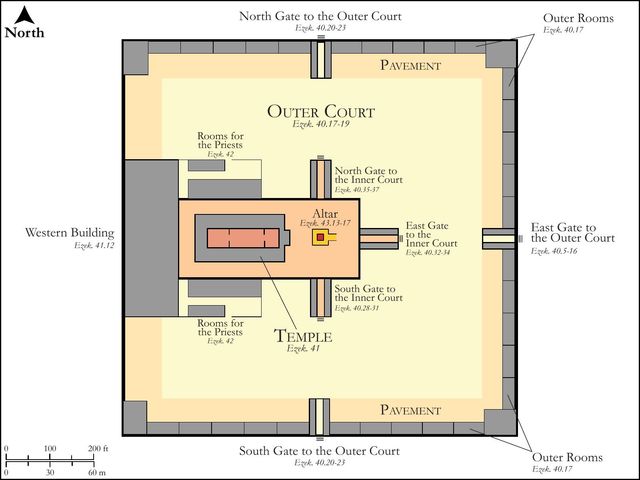
In these verses we have a delineation of the inner court. The survey of the outer court ended with the south side of it. This of the inner court begins with the south side (Eze 40:27), proceeds to the east (Eze 40:32), and so to the north (Eze 40:35); for here is no gate either of the outer or inner court towards the west. It should seem that in Solomon's temple there were gates westward, for we find porters towards the west, Ch1 9:24; Ch1 26:8. But Josephus says that in the second temple there was no gate on the west side. Observe, 1. These gates into the inner court were exactly uniform with those into the outer court, the dimensions the same, the chambers adjoining the same, the galleries or rows round the court the same, and the very engravings on the posts the same. The work of grace, and its workings, are the same, for substance, in grown Christians that they are in young beginners, only that the former have got so much nearer their perfection. The faith of all the saints is alike precious, though it be not alike strong. There is a great resemblance between one child of God and another; for all they are brethren and bear the same image. 2. The ascent into the outer court at each gate was by seven steps, but the ascent into the inner court at each gate was by eight steps. This is expressly taken notice of (Eze 40:31, Eze 40:34, Eze 40:37), to signify that the nearer we approach to God the more we should rise above this world and the things of it. The people, who worshipped in the outer court, must rise seven steps above other people, but the priests, who attended in the inner court, must rise eight steps above them, must exceed them at least one step more than they exceed other people.
Historical interpretation
Two Centuries of Reception
2 surviving comments on this verse. Each one is dated, so this reads as a timeline rather than a list.
Select a marker to jump to its quote. Markers stagger vertically where authors wrote within a few decades of each other.
(Versed. 28 seqq.) And he led me into the inner courtyard by the eastern way: and he measured the gate according to the upper measurements; its chamber and its front and its vestibule as before, and its windows and its vestibules all around, with a length of fifty cubits and a width of twenty-five cubits. And its vestibule, that is, the outer courtyard (which the Septuagint and Symmachus have placed as the inner courtyard); and carved palm trees on its front, both here and there, and with eight steps leading up to it. » From the Northern region, into whose courtyard only seven steps were ascended, one passes to the Southern gate and courtyard of the same region, to which not only seven, as mentioned above, but eight steps are ascended: namely, so that we may pass from the Old to the New; and to speak more clearly, through the patriarchs and prophets, we come to the apostles: so that in one week there is an octet in the other. But now it comes to the last, or rather to the highest, and introduces the prophet through the way of the inner gate, or through the courtyard, to which one goes through the Eastern gate. In this place, according to the Septuagint, the way is only mentioned; in the Northern and Southern regions, it is completely silent, so that we can understand that in the Eastern region only is that way to be understood, which says: I am the way, the truth and the life (John 14:6). For through Him we come to the Father, and it is written about Him: Blessed are the undefiled in the way (Psalm 119:1), who think nothing left of Christ, but their faith is pure and not in any way polluted by the stain of heretics. Likewise, the number of rooms, facades, entrances, windows, and the amount of light in them, as well as the same measurement of length and width: fifty by twenty-five cubits, preserving the sacredness, and the vestibule of its gate or inner courtyard, which is placed outside according to the Hebrew, so that everything is enclosed by the Eastern light, according to what is written: 'There is no one who can hide from its heat' (Psalm 19:7). But if we understand the atrium both externally and internally: thus it must be understood that God is both encompassing and indwelling, saying through the prophet: He who holds the heavens in the palm of his hand, and the earth in his fist (Isaiah XL, 12): so that everything may be seen as included in him. And again: Heaven is my throne, and the earth is the footstool of my feet (Isaiah LXVI, 1), so that he is believed to exist within all things: according to that verse from Virgil's Aeneid (Book VI).
In the beginning, the sky and the earth, and the liquid fields, And the shining globe of the moon, and the Astra of Titania, A Spirit nourishes them within: and infused throughout their limbs, The Mind moves the whole mass, and mingles itself with the great body.
And when, through the weapons of justice, on the right and left, through glory and disgrace, through good and bad reputation, through praise and blame, we have obtained victory over this world (2 Cor. 6): then palms are given to us on both sides, which neither joys have changed, nor sorrow, nor prosperity, nor adversity have overcome: and not by seven (or eight) degrees, as in the region of the North, nor by seven and eight, as in the South, are we contained, but by only eight (or seven) degrees do we ascend to the highest: because the number eight is sufficient for us, that is, the sacrament of the Gospel; so that we may say with the Apostle: And though we have known Christ according to the flesh, yet now we know him no more (2 Cor. 5:16), it is understood, according to the flesh.
"And its vestibule, that is, of the inner court, and palm trees carved on its front on this side and on that, and its ascent was by eight steps." In the first description, therefore, let the Eastern gate be before the gate of the North and of the South; but in the second, let the gate of the East be named between the gate of the South and of the North, because both from His divinity He preceded all things, and from His humanity He came among all things, He who became both the end of the departing Judea and the beginning of the succeeding Gentile world.
Continue studying Ezekiel 40:34 across the web’s major study libraries — every link below opens this exact verse, chapter, or book on the destination site.
Read & Compare
 BibleGatewayThis verse in more than 200 translations and 70 languages.
 Bible.comThe YouVersion reader — hundreds of translations, reading plans, and highlights.
 ESV.orgCrossway's official English Standard Version reader.
 NET BibleThe NET translation with 60,000+ translators' notes on every rendering decision.
 STEP BibleTyndale House's free study tool — original text, vocabulary, and scholarly resources.
 BibliaLogos Bible Software's free web reader.
 USCCBThe New American Bible (Revised Edition) with the U.S. bishops' study notes.
Commentaries
 BibleHub CommentariesDozens of classic commentaries on this verse, gathered on one page.
 StudyLightMore than 100 commentary sets — the largest collection on the web.
 BibleRefPlain-English commentary on what this verse means, verse by verse.
 Enduring WordDavid Guzik's free commentary on this chapter, widely used by Bible teachers.
 Bible Study ToolsVerse commentary alongside Greek and Hebrew study aids.
Original Language & Research
- BibleHub InterlinearThe verse word by word — original language, transliteration, and English.
- BibleHub LexiconEvery word's original-language definition and Strong's entry.
 Blue Letter BibleDeep-study tools — Strong's numbers, concordance, and word studies.
 SefariaThe Hebrew text with Rashi and centuries of Jewish commentary.
Sermons, Hymns & Audio


TrulyRandomVerse is not affiliated with these sites and doesn’t control their content. They’re linked because they’re genuinely useful.
Summary
Ezekiel 40:34 offers a meticulous architectural description of one of the gates within the visionary temple complex revealed to the prophet Ezekiel during the Babylonian exile. This verse precisely details the orientation of the gate's arches toward the outer court, the decorative palm trees adorning its posts, and the exact count of eight steps leading up to its entrance. These seemingly minor architectural specifications collectively contribute to the overarching themes of divine precision, sacred order, and the glorious, divinely ordained nature of God's future dwelling place among His people, offering a powerful message of hope and restoration in a time of despair.
Context
ShowHideLiterary Context
Ezekiel 40:34 is embedded within the extensive temple vision that forms the latter portion of the book of Ezekiel, specifically encompassing chapters 40-48. This visionary sequence commences in Ezekiel 40:1 with Ezekiel's divine transport to the land of Israel, where he encounters a celestial guide who meticulously measures and describes a new, glorious temple. Chapters Ezekiel 40-42 are dedicated to the architectural blueprint of the temple, its various courts, and gates, detailing dimensions, materials, and specific features with extraordinary precision. Verse 34, along with the surrounding verses in Ezekiel 40, contributes to the comprehensive description of the outer gates, focusing on their structural elements, ornamentation, and access points. This meticulousness underscores the divine origin and profound significance of the entire vision, preparing the reader for the awe-inspiring return of God's glory described in Ezekiel 43.
Historical & Cultural Context
The temple vision was granted to Ezekiel during the Babylonian exile, a period of profound national despair and spiritual desolation for the Israelites. Jerusalem and its revered temple had been utterly destroyed by Nebuchadnezzar in 586 BC, leaving the people far from their homeland, questioning God's faithfulness and their very future. In this context of profound loss, a detailed vision of a restored, perfect temple served as an immense source of hope, assuring the exiles that God had not abandoned them and that His covenant promises would ultimately be fulfilled. In Israel, the temple was the dwelling place of the LORD, and its design reflected divine order, divine presence, and His character. The meticulous details, including specific measurements and decorative elements like palm trees, would have deeply resonated with the cultural understanding of sacred architecture, signaling divine presence, prosperity, and order. The vision provided a tangible, albeit prophetic, assurance of a future where God's presence would once again dwell among His people in holiness and glory, a stark contrast to the desolation described in Lamentations 2:7.
Key Themes
ShowHideEzekiel 40:34, as an integral part of the larger temple vision, contributes to several pivotal theological themes. Foremost is the theme of Divine Precision and Order, where God's meticulous planning is evident in every architectural detail, emphasizing His absolute sovereignty and the perfect design of His future kingdom. This stands in stark contrast to the chaos and destruction experienced by the exiles. Another significant theme is Hope and Restoration, as the vision offered a powerful antidote to despair, promising a future where God's presence would return to a purified Israel, rebuilding what was lost. The temple, with its specific features like the "eight steps," subtly introduces the theme of New Beginnings and a New Dispensation, hinting at a perfect, divinely ordained era distinct from previous covenants and failures. The decorative "palm trees" further introduce the theme of Righteousness and Flourishing, symbolizing the spiritual vitality, blessing, and prosperity that would characterize this restored community, echoing sentiments found in Psalm 92:12. Ultimately, the entire vision points to the ultimate Presence of God among His people, a central longing throughout Israel's history, from the tabernacle in Exodus 25:8 to the first temple, culminating in this glorious future.
Exposition and Analysis
ShowHideKey Word Analysis
ShowHideProbably from אַיִל, meaning a pillar-space or colonnade, i.e., a pale or portico. In the context of Ezekiel's temple, this refers to a prominent architectural feature of a porch or vestibule, likely supported by pillars, forming the grand entranceway to the gate. Its mention highlights the structural grandeur and intricate design of the temple complex, indicating a carefully constructed and aesthetically pleasing entrance that signifies the importance of the space it introduces.
(architectural) a palm-like pilaster (i.e., umbellate). These are not natural trees but rather architectural decorations carved or fashioned to resemble palm trees, adorning the gate posts. In biblical symbolism, palm trees frequently represent righteousness, prosperity, beauty, victory, and flourishing life. Their inclusion on the temple gates signifies the spiritual vitality, divine blessing, and enduring life associated with this future sanctuary, suggesting a place of God's enduring presence and the flourishing of His people.
Elevation, i.e., the act (literally, a journey to a higher place, figuratively, a thought arising), or (concretely) the condition (literally, a step or grademark, figuratively, a superiority of station). This refers to the physical ascent required to enter the gate. The specific number "eight steps" is numerically significant in biblical thought, often symbolizing new beginnings, a new era, or resurrection. This detail subtly points to the unique and perfect nature of this future temple, distinct from previous ones, hinting at a new dispensation or a fresh start in God's perfect plan for His people.
Verse Breakdown
ShowHide"And the arches thereof [were] toward the outward court;"
This clause precisely describes the orientation of the gate's portico or vestibule. The "arches" (or more broadly, the architectural entrance structure) faced the "outward court," indicating that this particular gate served as a primary entrance or exit point, facilitating controlled movement between the outer perimeter and the main, public outer court of the temple complex. This detail emphasizes the structured and orderly flow of movement within the sacred precinct, guiding visitors through designated pathways and subtly reinforcing the distinction between the more public outer court and the inner, more sacred areas of the temple.
"and palm trees [were] upon the posts thereof, on this side, and on that side:"
This part details the decorative elements adorning the gate's posts or pilasters. The presence of "palm trees" as architectural ornamentation, symmetrically placed on both sides, signifies beauty, prosperity, and divine blessing. In Scripture, the palm tree was a widely recognized symbol of flourishing, victory, and righteousness. Their inclusion on the temple gates suggests that this future sanctuary would be a place characterized by spiritual vitality, God's enduring presence, and the flourishing of His people, reflecting the inherent beauty and glory of God's dwelling place.
"and the going up to it [had] eight steps."
This final clause specifies the means of access to the gate. The phrase "the going up" implies a necessary elevation, and the "eight steps" denote a deliberate and precise ascent. The number eight in biblical numerology often symbolizes new beginnings, resurrection, or a new covenant. This specific detail suggests that entering this temple signifies not merely a physical transition but also a spiritual one, marking a new era or a fresh start in God's perfect plan. It underscores the unique and perfect nature of this temple, distinct from previous structures, and hints at the divine order and sacredness of the space.
Literary Devices
ShowHideEzekiel 40:34, like much of the expansive temple vision, primarily employs Architectural Detail as a foundational literary device. The meticulous enumeration of measurements, materials, and structural features serves to convey the divine origin and perfect design of the temple, underscoring God's absolute sovereignty and His meticulous care in establishing His future kingdom. Beyond mere description, the verse also utilizes rich Symbolism, most notably with the "palm trees" and "eight steps." The palm trees are a well-established biblical symbol of righteousness, flourishing, and victory, imbuing the architectural decoration with deeper spiritual meaning about the character and vitality of the restored community. The "eight steps" carry potent Numerological Symbolism, suggesting a new beginning or a new era, a subtle yet powerful message of hope and transformation for the exiled Israelites. The entire vision, including this specific verse, functions as profound Visionary Literature, transporting the reader into a divinely revealed future reality that transcends the immediate historical circumstances, offering a glimpse into God's ultimate eschatological plan and His unwavering commitment to His people.
Theological and Thematic Connections
ShowHideEzekiel 40:34, though describing seemingly mundane architectural features, contributes significantly to the broader theological narrative of God's unwavering faithfulness, His commitment to restoration, and His ultimate desire to dwell among His people. The divine precision evident in every detail of the temple's design reflects God's perfect order, His absolute sovereignty, and His unwavering commitment to establishing a holy and beautiful space for His presence. The rich symbolism embedded in the "palm trees" and the "eight steps" points to a future characterized by spiritual flourishing, profound righteousness, and the inauguration of a new era of divine blessing and intimate communion. This vision provided profound and tangible hope to the exiles, assuring them that God's promises of restoration were not forgotten, and that a time would indeed come when His glory would once again fill a purified sanctuary, ushering in a period of unparalleled communion between God and humanity. It speaks to the enduring truth that God is a God of order, beauty, and new beginnings, always working towards the ultimate reconciliation and dwelling with His creation, fulfilling His redemptive purposes.
Reflection and Application
ShowHideEzekiel 40:34, with its intricate details of the visionary temple, invites us to contemplate the meticulousness of God's plans and the profound hope embedded in His divine promises. For the exiled Israelites, this vision was a lifeline, assuring them that despite their present desolation and the destruction of their earthly temple, God's ultimate design for their restoration was perfect, unwavering, and glorious. Today, this verse serves as a powerful reminder that God is a God of order, purpose, and beauty, evident even in the smallest details of His creation and His grand redemptive work. It encourages us to trust implicitly in His sovereign plan, knowing that His timing and methods are always precise and ultimately for our good. The symbolism of the palm trees speaks to the flourishing life found in righteousness and divine blessing, while the eight steps hint at the new beginnings God continually offers in our spiritual journeys. We are called to live lives that reflect the order and beauty of God's design, seeking spiritual flourishing and embracing the new mercies and fresh starts He provides each day. The vision of a perfectly ordered temple should inspire us to pursue holiness, intentionality, and order in our own lives, recognizing that our bodies are temples of the Holy Spirit and that God desires to dwell within us in a profound and transformative way.
Questions for Reflection
ShowHideFAQ
ShowHideWhat is the significance of the "eight steps" mentioned in Ezekiel 40:34?
ShowHideThe "eight steps" are numerically significant in biblical symbolism. While the number seven often represents completion, perfection, or divine rest, the number eight frequently symbolizes new beginnings, a new era, or resurrection. For example, circumcision, a sign of the covenant, was commanded to be performed on the eighth day (Genesis 17:12), marking a new life in covenant with God. The eighth day of the week marks a new cycle, and significantly, Jesus rose from the dead on the first day of the week (which is the eighth day after the previous Sabbath), inaugurating a new creation. In the context of Ezekiel's temple, the eight steps suggest that this new temple and the era it represents are distinct, perfect, and usher in a fresh, divinely ordained beginning for God's people, moving beyond past failures and into a new dispensation of God's presence and blessing.
Why are "palm trees" included as decoration on the temple posts?
ShowHidePalm trees (Hebrew: timmôr) were common decorative motifs in Solomon's temple, often symbolizing beauty, prosperity, and fertility. In biblical symbolism, the palm tree is frequently associated with righteousness, flourishing, victory, and enduring life. For instance, Psalm 92:12 beautifully states, "The righteous shall flourish like the palm tree." Their presence on the temple posts in Ezekiel's vision signifies the spiritual vitality, divine blessing, and moral uprightness that would characterize the restored community and the sacred space itself. It suggests that this future temple would be a place where God's people would thrive in His presence, living lives of righteousness and experiencing His enduring favor, reflecting the beauty and fruitfulness of God's kingdom.
Christ-Centered Fulfillment
ShowHideWhile Ezekiel's temple vision provides a literal blueprint for a future physical temple, its intricate details and profound symbolism ultimately find their fullest and most glorious fulfillment in the person and redemptive work of Jesus Christ. The temple, with its precise measurements and holy spaces, foreshadowed the ultimate dwelling of God among humanity, which is perfectly realized in Christ. Jesus Himself declared that He was the true temple, stating, "Destroy this temple, and in three days I will raise it up" (John 2:19), referring prophetically to His own body. The "eight steps" symbolizing a new beginning are profoundly fulfilled in Christ's resurrection on the "eighth day" (the first day of a new week), inaugurating the new covenant and a new creation where "if anyone is in Christ, he is a new creation" (2 Corinthians 5:17). The "palm trees" representing flourishing, righteousness, and victory are realized in Christ, who is the source of all true righteousness and spiritual vitality for believers (Philippians 3:9). Through His perfect sacrifice on the cross, Christ has opened a new and living way into God's presence (Hebrews 10:19-20), making every believer a part of a spiritual temple where God dwells by His Holy Spirit (1 Corinthians 3:16). Ultimately, the vision of the temple, with its glory and divine order, points to the New Jerusalem, the eternal city where God's presence is direct and complete, and there is no longer a need for a physical temple, "for the Lord God Almighty and the Lamb are its temple" (Revelation 21:22).