


Ezekiel 40:26
Bible text: King James Version (1769 Blayney text) · Public domain
Bible text: King James Version with Strong's numbers · Public domain
Bible text: Berean Standard Bible · Public domain
Bible text: American Standard Version (1901) · Public domain
Bible text: World English Bible, Messianic edition · Public domain
Bible text: Geneva Bible (1599) · Public domain
Bible text: Young's Literal Translation · Public domain
- וּמַעֲלוֹתu·ma·'a·Lotand [was] stepsH4609Conj-w ¦ N-fpNoun Plural Feminine Absoluteוּandמַעֲלוֹת[was] steps
- שִׁבְעָהshiv·'AhsevenH7651Adj-csAdjective Numerical Singular common gender Absolute
- עֹלוֹתָיוo·lo·tovits stairwaysH5930V-Qal-Prtcpl-fp ¦ 3msVerb Qal Participle Plural Feminine Constructעֹלוֹתָיstairwaysוits
- וְאֵלַמָּיוve·'e·la·movand its porchesH361Conj-w ¦ N-mpc ¦ 3msNoun Plural Masculine Constructוְandאֵלַמָּיporchesוits
- לִפְנֵיהֶםlif·nei·Hem[were] <to> before themH6440Prep-l ¦ N-mpc ¦ 3mpNoun Plural Masculine Constructלִ[were] <to>פְנֵיbeforeהֶםthem
- וְתִמֹרִיםve·ti·mo·Rimand palm treesH8561Conj-w ¦ N-mpNoun Plural Masculine Absoluteוְandתִמֹרִיםpalm trees
- לוֹlo[belonged] to itPrep-l ¦ 3msSuffix Personal 3rd Singular Masculineל[belonged] toוֹit
- אֶחָד'e·ChadoneH259Adj-fsAdjective Numerical Singular Feminine Absolute
- מִפּוֹmi·Pofrom hereH6311Prep-m ¦ AdvAdverbמִfromפּוֹhere
- וְאֶחָדve·'e·Chadand oneH259Conj-w ¦ Adj-fsAdjective Numerical Singular Feminine Absoluteוְandאֶחָדone
- מִפּוֹmi·Pofrom hereH6311Prep-m ¦ AdvAdverbמִfromפּוֹhere
- אֶל'eltoH413PrepPreposition
- אֵילָיו'ei·lovits pillarsH352N-mpc ¦ 3msNoun Plural Masculine Constructאֵילָיpillarsוits
English is a literal word-by-word gloss of the Hebrew, not the KJV's wording. Why?
This is the original text the KJV's translators worked from — each Hebrew word with its own literal English meaning in this verse, prepared by scholars at Tyndale House, Cambridge. The KJV translates whole sentences, not word by word, so its wording differs: one Hebrew word can become several English words, and the KJV may choose “the LORD” where the gloss reads “Yahweh”. Both are faithful — they answer different questions. For the KJV's own rendering, switch to the KJV text.
Details
See on the biblical-era map
Study this verse
Public-domain commentary
Matthew Henry
From his Commentary on the Whole Bible. Henry comments on passages, not single verses — this entry covers Ezekiel 40:5–26. His three-level outline is real structure in the source text, so it is rendered as structure.
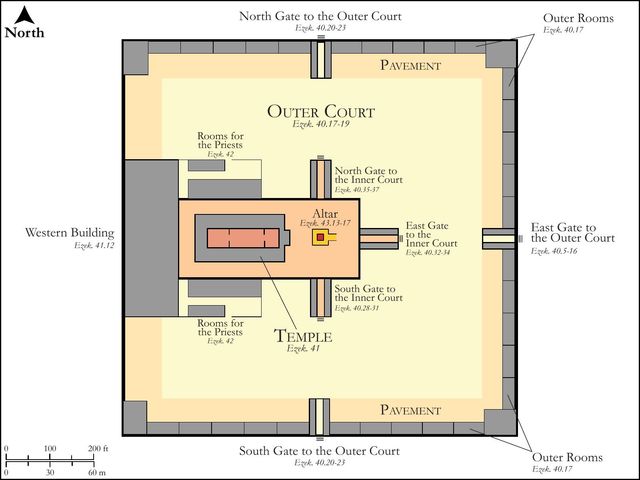
The measuring-reed which was in the hand of the surveyor-general was mentioned before, Eze 40:3. Here we are told (Eze 40:5) what was the exact length of it, which must be observed, because the house was measured by it. It was six cubits long, reckoning, not by the common cubit, but the cubit of the sanctuary, the sacred cubit, by which it was fit that this holy house should be measured, and that was a hand-breadth (that it, four inches) longer than the common cubit: the common cubit was eighteen inches, this twenty-two, see Eze 43:13. Yet some of the critics contend that this measuring-reed was but six common cubits in length, and one handbreadth added to the whole. The former seems more probable. Here is an account,
I.Of the outer wall of the house, which encompassed it round, which was three yards thick and three yards high, which denotes the separation between the church and the world on every side and the divine protection which the church is under. If a wall of this vast thickness will not secure it, God himself will be a wall of fire round about it; whoever attack it will do so at their peril.
II.Of the several gates with the chambers adjoining to them.
Here is no mention of the outer court of all, which was called the court of the Gentiles, some think because in gospel-times there should be such a vast confluence of Gentiles to the church that their court should be left unmeasured, to signify that the worshippers in that court should be unnumbered, Rev 7:9, Rev 7:11, Rev 7:12.
1.He begins with the east gate, because that was the usual way of entering into the lower end of the temple, the holy of holies being at the west end, in opposition to the idolatrous heathen that worshipped towards the east. Now, in the account of this gate, observe,
(1.)That he went up to it by stairs (Eze 40:6), for the gospel-church was exalted above that of the Old Testament, and when we go to worship God we must ascend; so is the call, Rev 4:1. Come up hither. Sursum corda - Up with your hearts.
(2.)That the chambers adjoining to the gates were but little chambers, about ten feet square, Eze 40:7. These were for those to lodge in who attended the service of the house. And it becomes such as are made spiritual priests to God to content themselves with little chambers and not to seek great things to themselves; so that we may but have a place within the verge of God's court we have reason to be thankful though it be in a little chamber, a mean apartment, though we be but door-keepers there.
(3.)The chambers, as they were each of them four-square, denoting their stability and due proportion and their exact agreement with the rule (for they were each of them one reed long and one reed broad), so they were all of one measure, that there might be an equality among the attendants on the service of the house.
(4.)The chambers were very many; for in our Father's house there are many mansions (Joh 14:2), in his house above, and in that here on earth. In the secret of his tabernacle shall those be hid, and in a safe pavilion, whose desire is to dwell in the house of the Lord all the days of their life, Psa 27:4, Psa 27:5. Some make these chambers to represent the particular congregations of believers, which are parts of the great temple, the universal church, which are, and must be, framed by the scripture-line and rule, and which Jesus Christ takes the measure of, that is, takes cognizance of, for he walks in the midst of the seven golden candle-sticks.
(5.)It is said (Eze 40:14), He made also the posts. He that now measured them was the same that made them; for Christ is the builder of his church and therefore is best able to give us the knowledge of it. And his reducing them to the rule and standard is called his making them, for no account is made of them further than they agree with that. To the law and to the testimony.
(6.)Here are posts of sixty cubits, which, some think, was literally fulfilled when Cyrus, in his edict for rebuilding the temple at Jerusalem, ordered that the height thereof should be sixty cubits, that is, thirty yards and more, Ezr 6:3.
(7.)Here were windows to the little chambers, and windows to the posts and arches (that is, to the cloisters below), and windows round about (Eze 40:16), to signify the light from heaven with which the church is illuminated; divine revelation is let into it for instruction, direction, and comfort, to those that dwell in God's house, light to work by, light to walk by, light to see themselves and one another by. There were lights to the little chambers; even the least, and least considerable, parts and members of the church, shall have light afforded them. All thy children shall be taught of the Lord. But they are narrow windows, as those in the temple, Kg1 6:4. The discoveries made to the church on earth are but narrow and scanty compared with what shall be in the future state, when we shall no longer see through a glass darkly.
(8.)Divers courts are here spoken of, an outermost of all, then an outer court, then an inner, and then the innermost of all, into which the priests only entered, which (some think) may put us in mind "of the diversities of gifts, and graces, and offices, in the several members of Christ's mystical body here, as also of the several degrees of glory in the courts and mansions of heaven, as there are stars in several spheres and stars of several magnitudes in the fixed firmament." English Annotations. Some draw nearer to God than others and have a more intimate acquaintance with divine things; but to a child of God a day in any of his courts is better than a thousand elsewhere. These courts had porches, or piazzas, round them, for the shelter of those that attended in them from wind and weather; for when we are in the way of our duty to God we may believe ourselves to be under his special protection, that he will graciously provide for us, nay, that he will himself be to us a covert from the storm and tempest, Isa 4:5, Isa 4:6.
(9.)On the posts were palm-trees engraven (Eze 40:16), to signify that the righteous shall flourish like the palm-tree in the courts of God's house, Psa 92:12. The more they are depressed with the burden of affliction the more strongly do they grow, as they say of the palm-trees. It likewise intimates the saints' victory and triumph over their spiritual enemies; they have palms in their hands (Rev 7:9); but lest they should drop these, or have them snatched out of their hands, they are here engraven upon the posts of the temple as perpetual monuments of their honour. Thanks be to God, who always causes us to triumph. Nay, believers shall themselves be made pillars in the temple of our God, and shall go no more out, and shall have his name engraven on them, which will be their brightest ornament and honour, Rev 3:12.
(10.)Notice is here taken of the pavement of the court, Eze 40:17, Eze 40:18. The word intimates that the pavement was made of porphyry-stone, which was of the colour of burning coals; for the brightest and most sparkling glories of this world should be put and kept under our feet when we draw near to God and are attending upon him. The stars are, as it were, the burning coals, or stones of a fiery colour, with which the pavement of God's celestial temple is laid; and, if the pavement of the court be so bright and glittering, how glorious must we conclude the mansions of that house to be!
2.The gates that looked towards the north (Eze 40:20) and towards the south (Eze 40:24), with their appurtenances, are much the same with that towards the east, after the measure of the first gate, Eze 40:21. But the description is repeated very particularly. And thus largely was the structure of the tabernacle related in Exodus, and of the temple in the books of Kings and Chronicles, to signify the special notice God does take, and his ministers should take, of all that belong to his church. His delight is in them; his eye is upon them. He knows all that are his, all his living temples and all that belongs to them. Observe,
(1.)This temple had not only a gate towards the east, to let into it the children of the east, that were famous for their wealth and wisdom, but it had a gate to the north, and another to the south, for the admission of the poorer and less civilized nations. The new Jerusalem has twelve gates, three towards each quarter of the world (Rev 21:13); for many shall come from all parts to sit down there, Mat 8:11.
(2.)To those gates they went up by steps, seven steps (Eze 40:22-26), which, as some observe, may remind us of the necessity of advancing in grace and holiness, adding one grace to another, going from step to step, from strength to strength, still pressing forward towards perfection - upward, upward, towards heaven, the temple above.
Historical interpretation
Two Centuries of Reception
2 surviving comments on this verse. Each one is dated, so this reads as a timeline rather than a list.
Select a marker to jump to its quote. Markers stagger vertically where authors wrote within a few decades of each other.
(Verse 24 and following) 'And he led me to the south gate, and behold, there was a gate that faced south. And its frontispiece and vestibule were measured according to the upper measurements, and its windows and vestibules all around were like the other windows. It had a length of fifty cubits, and a width of twenty-five cubits, and it was ascended by seven steps, and there was a vestibule in front of its doors, and palm trees were carved on it, one on one side, and the other on the other side in front of it.' And the entrance of the inner court was on the south side, and it measured from entrance to entrance on the south side, one hundred cubits. And he brought me to the inner court by the south gate, and he measured the south gate according to the same measurements, its rooms, its doorway, and its vestibule, with the same measurements. And the vestibules all around the court were fifty cubits in length and twenty-five cubits in width. And a vestibule in a circular shape, with a length of twenty-five cubits and a width of five cubits. And its vestibule was towards the outer court, and its palm trees were on its front, and it had eight steps by which it was ascended. Seventy agree in the same words, except for thee, elau, elamoth, and elam, which in Hebrew is ulam. But thee is interpreted as threshold or front; elau, around it or supports; elamoth, entrance or vestibule; ulam is πρόπυλον, that is, before the doors. But what we have placed next to the Hebrew, that is, the vestibule or πρόπυλον, is not found in the Septuagint. But it should also be noted that in the southern gate it is not called a road according to the Septuagint, but simply 'and he led me to the south,' and behold, a gate that faced south. Therefore, through each entrance, Ezekiel, whose name means 'God strengthens,' is led. And from the northern gate, he goes to the southern gate, whose fronts, thresholds, τροπύλαια, or vestibules, and windows had similar measurements around, twenty-five cubits in length and five cubits in width. And it was ascended by seven steps, that is, to the southern gate and its vestibule, which is called elamoth, in front of its doors. Also, two carved palm trees, which we mentioned in the gate of the northern region. And let this be enough to remind you, that whatever is presented there, according to the more common understanding, that is, according to the literal sense, we understand at the south gate according to the spiritual sense. For in the same lines, both history and tropology run: but the former is lowly, the latter is sublime: the former clings to the earth, the latter soars to the heavens. And all things were filled with light around through the windows. For each problem has its own limits, and through them the light of faith enters the soul of the believer, especially if the length of his life has been extended to fifty years, that is, to the mystery of jubilee, and he is able to reach the breadth of a more divine understanding. In this latitude and on these streets, wisdom moves confidently, and with a lofty voice she exclaims: she climbs seven steps in order to reach the vestibule, and through the palms of her purpose and efforts, she holds eternal victory. And lest we think there is only one atrium to the south, it is said about the second atrium: And the entrance of the inner atrium is on the southern road: and it is measured from the entrance to the entrance on the southern road one hundred cubits; so that after a week and the sacraments of the old covenant, she may reach the good land and the grace of the Gospel. Not only is there a second atrium in the southern gate, but also a third, which is now called: 'And he brought me to the inner atrium at the southern gate, and he measured the gate according to the upper measurements, etc. For each atrium has its own measurements and arrangement, and in these measurements there is a different grace, as we know the same things differently at the beginning, in progress, and at the end. However, what is not found in the Septuagint, and the vestibule, or πρόπυλον, around twenty-five cubits long and five cubits wide, seems to raise a question, because it was not placed in the ancient interpretation, how twenty-five cubits and five are placed after the progress of the third step.' But it removes the ambiguity that follows: And its vestibule is towards the outer courtyard, and its palms are at the front; so that this courtyard, which had a length of twenty-five cubits and a width of five, belongs not to the inner courtyard but to the outer courtyard, so that the width of the former courtyard, that is, twenty-five cubits, is possessed by the length of the outer courtyard, and it holds a width of five cubits. These measurements, that is, twenty-five and five, we refer to the same senses, namely sight, hearing, taste, smell, and touch, which if we ascend to higher things, we double by fivefold and make them spiritual from carnal senses, as it is written: Lift up your eyes and see that the fields are already white for harvest (John 4:35), and: He who has ears to hear, let him hear (Luke 8:8). And: Taste and see, for the Lord is sweet (Psalm 33:8). And: We are the good fragrance of Christ to God among those who believe (2 Corinthians 2:15). And in the Epistle of John it is said: That which we have heard and seen, and our hands have touched, concerning the Word of life (1 John 1:1). And finally, in no way are only seven degrees sufficient in the northern region: but after seven, the number eight is added, as we move from the Synagogue to the Church, from the old covenant to the new, from earthly things to heavenly things.
"And there were seven steps to go up to it, and the arches thereof were before them: and it had palm trees, one on this side, and another on that side, upon the posts thereof."
What is the meaning of this, that earlier a painting of palms was on the fronts, but now carved palms are mentioned as being on the front? In the carving of stones, indeed, the works appear to be external. But, as we have already said above, the painting of palms is a display of signs. Now, however, carving of palms is spoken of, so that a demonstration of good works may be designated. For to those highest preachers themselves it is said: "Let them see your good works, and glorify your Father who is in heaven." Therefore those who demonstrate that holy works have been impressed upon their life have carved palms on the front, because they already now show in their holy works how great a victory follows them in the future. Or certainly because we have said that faith is designated through the Eastern gate, hope through the Northern gate, but charity through the Southern gate, we must note that in the Eastern gate a painting of palms is reported, but in the Northern and Southern gates, carving is said to be, because it often happens that those who are still beginners do not yet exercise themselves in solid and great works; but those who return from iniquities to virtues are frequently exercised in great works, so that they may be able to cover their faults before the eyes of almighty God. And those who have already grown in virtues by the fervor of the spirit burn as it were like the South in holy actions. In the Eastern gate, therefore, there is painting, but in the Northern and Southern gates there is carving, because the sign of victory which is shown in beginners is already held more solidly and more firmly in those who are returning and in those who are fervent.
It must also be noted with great importance what is said: "on this side and that." For all of us who strive toward the entrance of life must have the palm both on the right and on the left side. For what is said "on this side and that" signifies each side. Therefore, he has the palm on the right whom prosperity does not exalt; he has the palm on the left whom adversity does not cast down. Paul carried the palm as if from each side when he said: "Through the weapons of righteousness on the right and on the left, through glory and dishonor, through ill repute and good repute, as deceivers yet true." Adversity did not break him, prosperity did not lift him up into swelling of mind. Therefore he bore the palm on this side and that, because he remained both strong in adversity and humble in prosperity. For whoever is exalted by prosperity does not know how to have the palm on the right side. Whoever is broken in adversities does not know how to carry the palm on the left side. Therefore, in order that the palm may be borne on the forehead on this side and that, there must always be present in our minds both confidence in adversity and fear in prosperity, lest either adversity drag us into despair or prosperity lift up the soul into self-confidence. Hence it is that the same outstanding preacher said: "I know both how to be humbled, and I know how to abound; everywhere and in all things I have been instructed. Both to be satisfied and to hunger, and to abound and to suffer want—I can do all things in Him who strengthens me."
Is it then, brethren, some skill to be humbled and to abound, to be filled and to hunger, to abound and to suffer want, that so great a preacher would suggest he knows these things as something great? It is entirely a skill, and a wonderful knowledge of discipline, which must be learned by us with the whole effort of our heart. For he who is not broken by his want, who is not drawn back from the giving of thanks, who is not kindled into desire for temporal things, knows how to be humbled. For in this place the Apostle calls being humbled suffering want. For immediately he adds the contrary: "I know also how to abound." For he who is not puffed up by things received, who does not twist them to the use of vain glory, who does not possess alone what he has received, but mercifully divides it with the needy, knows how to abound. He who does not use food received for the gorging of the belly, but for the restoration of strength, nor gives more to the flesh than necessity demands, knows how to be filled. He who tolerates lack of food without murmuring, nor for the necessity of sustenance does anything by which the soul might incur the snare of sin, knows how to hunger. He therefore whom neither pride lifts up in abundance, nor desire provokes in necessity, knows how to abound, knows how to suffer want. When he immediately added, "I can do all things," lest we should believe these to be words of boasting, he added in what, "In him who strengthens me." Behold, a branch has gone forth on high, but because it held itself in the root, it remained in greenness. For rising on high it would have withered, if it had separated itself from the root. For he attributes nothing to himself, because he confesses that he can do all things not in himself, but in him who strengthens him. Therefore on this side and on that the outstanding preacher has the palm, whom neither abundance draws to pride, nor want drags to avarice.
Let us learn, therefore, brothers, to give thanks not only in prosperity but also in adversity. For out of his loving-kindness our Father has become our creator, and he nourishes us as adopted sons for the inheritance of the heavenly kingdom. And he not only refreshes us with gifts but also instructs us with chastisements. Let us learn, therefore, to abound, so that we may share with the needy all that we have received from him. And let not abundance lift up the mind, lest perhaps one rejoice because what is lacking to another is present to oneself, and no longer rejoice in the common good but in one's own private good. Truth calls the disciples back from private joy to common joy, when he admonishes those returning from preaching and rejoicing over the subjection of demons, saying: "Do not rejoice over this, but rather rejoice and exult because your names are written in heaven." For not all the elect cast out demons, yet nevertheless the names of all the elect are held inscribed in heaven. The disciples are therefore admonished to lay aside private joy and to rejoice in common and perpetual happiness. Whoever, therefore, rejoices in what another does not have, made worse by his very abundance, has private joy. Against this craving for abundance John admonishes us, saying: "Do not love the world, nor the things that are in the world." He immediately added the reason why: "If anyone loves the world, the love of the Father is not in him." For no one can serve two masters, because one cannot love both transitory and eternal things at the same time. For if we love eternity, we possess all temporal things in use, not in affection. He immediately added this same reason, saying: "Because all that is in the world is the lust of the flesh, and the lust of the eyes, and the pride of life."
For this reason people desire to have something even beyond what is necessary, so that they may be proud in having it, and because another does not have this, they exalt themselves in their thoughts. Whoever therefore is of this sort has not yet learned to bear abundance. Often, however, what avarice suggests from desire, one thinks to be necessity, and when lesser things would suffice, one grieves that greater things are lacking, and the incautious mind suffers a kind of quasi-necessity which it begets. And when the things it desires are excessive, it somehow excuses its own avarice to itself. Abundance therefore is close to pride. And if at some point desire has also seized it, this has invaded it, so to speak, like a foreign captivity. If therefore we wish to know the art of abounding, it is necessary that we flee not only those vices which are near, but also those which come from afar. Let us learn to suffer want, lest we seek even with fault to have those things which we do not have, nor let us think happy those whom we see burdened with possessions. The things which they prepare for themselves as if for the expenses of the present life are exceedingly excessive. They carry much, but on a short road; poverty is a great companion to us on this journey, which does not constrict the soul when earthly substance is lacking, for which we must render accounts to the eternal Judge. We proceed more freely toward our homeland, because we are, as it were, without burden on the way.
Let us learn to be satisfied, lest in taking nourishment for the body we serve gluttony rather than necessity. For desire seeks more than necessity requires. And often while we take care to satisfy the want of the flesh, pleasure creeps in and exceeds the measure of refreshment. Hence it happens that fault passes into fault, because frequently another temptation of the flesh arises from the very fact that the flesh is served immoderately in refreshment. For from the sin of the first man, with nature weakened, we are born into this world with our temptations. And the flesh is sometimes our helper in good work, but sometimes a seductress in evil. If therefore we give it more than we ought, we nourish an enemy. And if we do not render to its necessity what we owe, we kill a citizen. The flesh therefore must be satisfied, but only to the point that it may suffice to serve us in good work. For whoever gives it so much that it grows proud utterly knows not how to be satisfied. It is therefore a great art to be satisfied, lest anyone through the satiety of the flesh burst forth into the wickedness of shameful conduct. Let us learn to hunger, so that our want here may please us on account of the abundance to follow, lest the necessity of the belly drag us into fault, lest need suggest sin to the mind itself; and while the flesh is afflicted with hunger, the spirit be provoked to covetousness, and seek with fault to provide whence it might satisfy the flesh in necessity, lest the heart leap forth into indignation and kindle the tongue into the bitterness of murmuring. He therefore who in the want of his flesh looks around himself on every side and guards himself from the snare of sin, knows how to hunger.
Therefore, brothers most dear, fleeing wrath and avarice in adversity, and avoiding elation and immoderate joys in prosperity, because through faith, hope, and charity we desire to enter the court of the interior life by three gates, let us hold palms on this side and on that. It is fitting still to bring to mind another citizen of the heavenly fatherland, and to demonstrate how he holds a palm on this side and on that. For blessed Job, when he was richer than all the men of the East, and all prosperous things abounded for him, his sons flourished, his household grew, his flocks overflowed, he persisted in such great fear of almighty God that amid the keeping of discipline, amid acts of justice, amid many services of humility, intent upon works of mercy, devoted to offering sacrifices, he immolated burnt offerings to the Lord for each of his sons, lest any of them had sinned even in his heart. Let us consider therefore how great was the keeping of good work in him who expiated in his sons the sins of the heart through sacrifices. But how just he was had become known in prosperity; yet it was very much unknown whether he could persevere as just also amid afflictions. Therefore he had to be touched by the rod, so that holy man might be tested in prosperity through adversity, so that he who was known to the almighty Lord might become known through afflictions to us and to himself. Thus with the Lord disposing, the flocks were consumed, the keepers slain, the house overthrown, the sons destroyed, his flesh struck from the sole of his foot to the crown of his head. His wife remained unharmed, who might increase his wounds with the javelins of words. But the holy man wisely teaches her in temptation, sound amid his wounds, and responds to her, saying: "If we have received good things from the hand of the Lord, why should we not accept evil things?" Friends also come to console him, but break forth into insults, and to the pain of his wounds they add still more wounds of words. They call him merciless, they name him a plunderer, they denounce him as violent, they declare him an oppressor of the poor. What therefore would the soldier of God do, caught between painful wounds and bitter words? Behold, the scourges of God and the words of men together press his afflicted soul toward despair; but, filled with the power of the spirit, lying down with wounds of the flesh, standing with strength of mind, against the impulse of despair he brought back to memory the good things he had done. Because he had been merciful, he says: "I was an eye to the blind, and a foot to the lame." And again: "I was a father to the poor." Because he was both a guardian of discipline and kind, he says: "And when I sat as a king, with the army standing around me, I was nevertheless a consoler of those who mourned." Because he had been humble, he says: "If I refused to undergo judgment with my servant and my maidservant, when they disputed against me." Because he had been hospitable, he confesses: "If I despised one passing by, because he had no garment." Because he was generous in gifts, he says: "If his sides have not blessed me, and he was warmed from the fleeces of my sheep." Because he was not violent, he testifies, saying: "If I raised my hand against the orphan, when I saw myself superior at the gate." Because he never exulted at the peril of an enemy, he says: "If I rejoiced at the ruin of him who hated me." Because he was patient, and also bore the malice of his own people with equanimity, he says: "If the men of my tent have not said, Who will give us of his flesh that we may be satisfied?" What is it therefore that the holy man enumerates so many of his virtues amid afflictions? What is it that he praises with his own mouth the works he had done, except that amid wounds and words which could drag him to despair, they reform his soul to hope? And he who was humble in prosperity, having recalled his good deeds to memory, remained unbroken in adversity. For whose soul would those words not drive to despair amid so many afflictions, unless he had recalled to memory the good things he had done? The holy man therefore saw his mind being shaken toward despair upon hearing so many evils, and he wonderfully strove to be strengthened in certain hope from his good actions. Thus is fulfilled what is written: "In the day of good things be not unmindful of evil things, and in the day of evil things be not unmindful of good things." For if when we have good things we remember the evil things which we have either already suffered or can still suffer, the good things received do not elevate the mind, because the fear from the memory of evil things suppresses their joy. And if when we have evil things we remember the good things which we have either already received or hope we can still receive, the weight of evil things does not press the soul down into despair, because the memory of good things lifts it to hope. If therefore, brothers most dear, we so walk through the Lord's precepts and through the examples of the saints, that neither prosperity elevates us nor adversity breaks us, we show that we hold palms on this side and on that before the eyes of almighty God. To whom is honor and glory forever and ever. Amen.
Continue studying Ezekiel 40:26 across the web’s major study libraries — every link below opens this exact verse, chapter, or book on the destination site.
Read & Compare
 BibleGatewayThis verse in more than 200 translations and 70 languages.
 Bible.comThe YouVersion reader — hundreds of translations, reading plans, and highlights.
 ESV.orgCrossway's official English Standard Version reader.
 NET BibleThe NET translation with 60,000+ translators' notes on every rendering decision.
 STEP BibleTyndale House's free study tool — original text, vocabulary, and scholarly resources.
 BibliaLogos Bible Software's free web reader.
 USCCBThe New American Bible (Revised Edition) with the U.S. bishops' study notes.
Commentaries
 BibleHub CommentariesDozens of classic commentaries on this verse, gathered on one page.
 StudyLightMore than 100 commentary sets — the largest collection on the web.
 BibleRefPlain-English commentary on what this verse means, verse by verse.
 Enduring WordDavid Guzik's free commentary on this chapter, widely used by Bible teachers.
 Bible Study ToolsVerse commentary alongside Greek and Hebrew study aids.
Original Language & Research
- BibleHub InterlinearThe verse word by word — original language, transliteration, and English.
- BibleHub LexiconEvery word's original-language definition and Strong's entry.
 Blue Letter BibleDeep-study tools — Strong's numbers, concordance, and word studies.
 SefariaThe Hebrew text with Rashi and centuries of Jewish commentary.
Sermons, Hymns & Audio


TrulyRandomVerse is not affiliated with these sites and doesn’t control their content. They’re linked because they’re genuinely useful.
Summary
Ezekiel 40:26 offers a precise architectural description within the prophet's expansive vision of a new temple, detailing the entrance to one of its inner gates. This verse meticulously outlines the construction, noting the seven steps leading up to the gate, the placement of its arches, and the decorative palm trees adorning its supporting posts. These specific elements are integral to a larger divine blueprint, underscoring themes of sacred order, profound holiness, and the intentional design of God's future dwelling place among His restored people.
Context
ShowHideLiterary Context
Ezekiel 40:26 is situated within the monumental temple vision spanning Ezekiel 40-48, which forms the climactic section of the book. This vision follows Ezekiel's earlier prophecies of judgment against Judah and the nations, and crucially, promises of Israel's restoration. The prophet, transported by a divine hand to a high mountain, encounters a celestial guide who meticulously measures every dimension of a new, glorious temple complex. Beginning in Ezekiel 40:1, the narrative systematically describes the outer court, its gates, the inner court, and the temple proper. Verse 26 specifically details the features of the inner gate on the south side, building upon the descriptions of the outer gates and preceding further measurements of the inner sanctuary. The extraordinary precision and repetition of these architectural details throughout the chapters emphasize the divine origin, meticulous planning, and profound significance of this eschatological structure.
Historical & Cultural Context
The vision of the new temple was granted to Ezekiel during the Babylonian exile (circa 593-571 BC), a period of profound national trauma for the Israelites. Solomon's Temple, the heart of their religious and national identity, had been utterly destroyed by Nebuchadnezzar's forces in 586 BC, and the people were forcibly removed from their homeland. In this context of despair and displacement, Ezekiel's vision served as a powerful message of hope, divine faithfulness, and future restoration. Israel's temple was not merely a building but the house of the LORD, His dwelling place. Architectural elements like specific numbers of steps, symmetrical designs, and decorative motifs (such as palm trees) carried deep symbolic meanings related to divine presence, divine order, and prosperity. This vision, therefore, provided a crucial theological anchor for a dispossessed people, assuring them that God's covenant promises remained steadfast and that He would indeed dwell among them once more in a renewed and perfect sanctuary.
Key Themes
ShowHideThis verse, as part of the broader temple vision, contributes significantly to several overarching themes in Ezekiel. The theme of Divine Precision and Order is paramount; the exact measurements, the specific number of steps (seven), and the symmetrical placement of decorative elements highlight God's meticulous nature and the perfect order of His redemptive plans. This stands in stark contrast to the destruction of the first temple and the spiritual disarray of exiled Israel, pointing toward a future of divine restoration and perfect governance. The Holiness and Sacredness of God's Presence are central, as the detailed design creates a distinct, separated space for God's dwelling, emphasizing the reverence and purity required to approach Him. The "seven steps" and the ornate gates signify a deliberate, structured ascent into a holy area, reinforcing the idea of Ordered Access to Sacred Space that is divinely ordained. Furthermore, the Symbolism of Palm Trees (as further explored in the exposition) points to themes of righteousness, flourishing, vitality, and victory associated with God's renewed dwelling, echoing imagery found in other biblical texts like Psalm 92:12. The entire vision speaks to God's ultimate plan for Restoration and Renewal for His people.
Exposition and Analysis
ShowHideKey Word Analysis
ShowHideA primitive cardinal number, meaning "seven (as the sacred full one); also (adverbially) seven times; by implication, a week; by extension, an indefinite number." In this specific context, "seven" signifies completeness, perfection, and divine order. Its application to the steps emphasizes the sacredness and intentionality of the ascent into the holy temple area, reinforcing that access is divinely structured and not arbitrary.
Meaning "elevation, i.e. the act (literally, a journey to a higher place, figuratively, a thought arising), or (concretely) the condition (literally, a step or grademark, figuratively, a superiority of station)." Here, it refers to physical steps, indicating a deliberate and structured upward movement. These steps are a common feature in ancient temple architecture, signifying a gradual, reverent approach to a sacred, elevated space.
Meaning "(architectural) a palm-like pilaster (i.e. umbellate); palm tree." These are not living trees but architectural carvings or decorative pilasters shaped like palm trees. In Scripture, palm trees frequently symbolized righteousness, flourishing, victory, prosperity, and life. Their inclusion on the temple posts speaks to the beauty, vitality, and spiritual fruitfulness associated with God's dwelling and the life found in His presence.
Verse Breakdown
ShowHide"And there were seven steps to go up to it,"
This initial clause specifies a crucial architectural detail: the gate of the inner court was accessed by seven steps. The number "seven" is profoundly significant in biblical numerology, often symbolizing completeness, perfection, and divine order. This detail underscores the sacredness and divine design of the temple complex, indicating that access to this holy space is not casual but requires a deliberate, structured, and reverent ascent, setting it apart from common ground.
"and the arches thereof were before them:"
This part describes the presence of "arches" (or more broadly, porticos or colonnades, as suggested by the Strong's definition of H361, ʼêylâm) that formed part of the gate's structure. Their placement "before them" (likely referring to the entrance or the perspective of one ascending the steps) suggests a grand, imposing, and perhaps welcoming entryway. This architectural feature would have contributed to the majestic and sacred ambiance of the gate, serving as a significant threshold to the inner court.
"and it had palm trees, one on this side, and another on that side, upon the posts thereof."
The final clause details the decorative elements of the gate. Carved palm trees adorned the strong supporting "posts" (H352, ʼayil) of the gate, symmetrically placed on either side. The presence of palm trees, rich in symbolism, signifies beauty, vitality, righteousness, and flourishing. Their precise, symmetrical arrangement further highlights the divine order, aesthetic perfection, and spiritual fruitfulness intended for God's restored dwelling, suggesting a place of life and blessing.
Literary Devices
ShowHideEzekiel 40:26, like the broader temple vision, is rich in literary devices that enhance its theological message. The most prominent is Architectural Detail, which serves as the primary mode of communication. The meticulous enumeration of specific features like "seven steps," "arches," and "palm trees" is not merely descriptive; it creates a vivid, almost blueprint-like image, emphasizing divine precision and the tangible reality of God's future plans. This detail inherently functions as Symbolism, where each element carries deeper theological meaning. The "seven steps" symbolize completeness, perfection, and the sacredness of approaching God, while the "palm trees" are potent symbols of righteousness, flourishing, vitality, and victory, often linked to God's people and His presence. The overall Imagery evoked is one of divine order, beauty, and profound holiness, designed to inspire awe and reverence. The consistent and precise descriptions throughout Ezekiel 40-48 also create a sense of Ritualistic Precision, suggesting that every aspect of God's dwelling and the approach to it is purposeful, divinely ordained, and demands a specific, reverent response.
Theological and Thematic Connections
ShowHideEzekiel 40:26, with its detailed description of the temple gate, profoundly connects to broader biblical themes of divine order, the sanctity of God's presence, and the reverent approach required of humanity. The meticulous measurements and specific architectural features underscore that God is a God of precision and intentionality, where every detail matters in His divine economy and redemptive purposes. The seven steps symbolize the completeness and perfection inherent in God's design and the reverence necessary for access to His holy dwelling. The palm trees, a recurring motif in biblical art and literature, speak to the flourishing and righteousness that characterize life in God's presence, reflecting His desire for His people to thrive spiritually. This vision serves as a powerful reminder of God's unwavering commitment to dwelling among His people in holiness and beauty, a promise that resonates throughout salvation history and finds its ultimate fulfillment in the New Covenant.
Reflection and Application
ShowHideEzekiel 40:26, though describing an ancient architectural vision, offers profound principles for contemporary believers. The meticulous detail and divine precision in God's blueprint for the temple remind us that God is a God of order, beauty, and intentionality. Every aspect of His creation and His redemptive plan is purposeful, inviting us to live lives that reflect His divine order rather than chaos. The "seven steps" and the sacred imagery emphasize the reverence and intentionality required in our approach to God. We are called to draw near to Him not casually, but with a conscious recognition of His holiness and majesty, preparing our hearts and minds for His presence. The palm trees, symbolizing righteousness and flourishing, serve as an encouragement for us to cultivate spiritual fruitfulness in our own lives, growing in grace and bearing witness to God's glory. This verse ultimately points us to the importance of living a life that honors God in every detail, embracing His design for holiness and spiritual vitality, and recognizing that His desire is to dwell among a people who reflect His character and bear fruit for His kingdom.
Questions for Reflection
ShowHideFAQ
ShowHideWhat is the significance of the "seven steps" mentioned in Ezekiel 40:26?
ShowHideThe "seven steps" are highly significant in biblical numerology, where the number seven frequently symbolizes completeness, perfection, and divine order. Its inclusion here underscores the sacredness and divine design of the temple complex. It suggests that approaching God's presence is not a casual act but a deliberate, structured, and holy ascent, emphasizing the reverence and intentionality required to enter His dwelling place. This specific number reinforces the idea that the entire temple vision is perfectly conceived and ordained by God, reflecting His flawless plan for His future dwelling among His people.
What do the "palm trees" on the posts symbolize in this vision?
ShowHideThe "palm trees" (Hebrew: timmôr) mentioned in Ezekiel 40:26 are architectural carvings or pilasters resembling palm trees, not living flora. In Scripture, palm trees were rich in symbolism. They often represented righteousness, flourishing, vitality, victory, and prosperity due to their upright stature, fruitfulness, and resilience. Their presence on the temple posts suggests beauty, spiritual fruitfulness, and the vibrant life associated with God's renewed dwelling among His people. This imagery connects with other biblical passages, such as Psalm 92:12, which describes the righteous flourishing like a palm tree, indicating a state of spiritual health and blessing in God's presence.
Christ-Centered Fulfillment
ShowHideEzekiel's vision of a meticulously designed temple, with its seven steps and symbolic palm trees, finds its ultimate and profound fulfillment in the person and work of Jesus Christ. While the vision describes a physical structure, its deeper theological truths—divine presence, holy access, and spiritual flourishing—are fully realized in the New Covenant through Christ. Jesus Himself declared, "Destroy this temple, and in three days I will raise it up," referring to "the temple of his body" (John 2:19-21). He is the ultimate dwelling place of God among humanity, the true and perfect sanctuary, embodying God's presence in a way no physical building ever could. The "seven steps" to access the temple foreshadow the perfect and complete access to God that we now have through Christ's atoning sacrifice, which provides the only way to draw near to the Holy One. The writer of Hebrews proclaims, "Therefore, brothers and sisters, since we have confidence to enter the Most Holy Place by the blood of Jesus, by a new and living way opened for us through the curtain, that is, his body... let us draw near to God with a sincere heart in full assurance of faith" (Hebrews 10:19-22). The symbolic palm trees, representing righteousness and flourishing, are fulfilled in the spiritual vitality and fruitfulness that believers experience by being "in Christ." As members of His body, the Church becomes "a holy temple in the Lord," in whom God "is building together to become a dwelling in which God lives by his Spirit" (Ephesians 2:21-22). Ultimately, the New Jerusalem, the eternal city, will have no temple within it, "because the Lord God Almighty and the Lamb are its temple" (Revelation 21:22), signifying that God's direct, unmediated, and perfect presence in Christ is the ultimate fulfillment of all temple imagery and the eternal reality for His redeemed people.