


John 2:21
Bible text: King James Version (1769 Blayney text) · Public domain
Bible text: Berean Standard Bible · Public domain
Bible text: American Standard Version (1901) · Public domain
Bible text: World English Bible, Messianic edition · Public domain
Bible text: Geneva Bible (1599) · Public domain
Bible text: Young's Literal Translation · Public domain
- ἐκεῖνοςekeinosHeG1565D-NSMDemonstrative pronoun Nominative Singular Masculine
- δὲdehoweverG1161CONJConjunction
- ἔλεγενelegenwas speakingG3004V-IAI-3SVerb Imperfect Active Indicative 3rd Singular
- περὶpericoncerningG4012PREPPreposition
- τοῦtoutheG3588T-GSMDefinite article Genitive Singular Masculine
- ναοῦnaoutempleG3485N-GSMNoun Genitive Singular Masculine
- τοῦtouof theG3588T-GSNDefinite article Genitive Singular Neuter
- σώματοςsōmatosbodyG4983N-GSNNoun Genitive Singular Neuter
- αὐτοῦautouof HimG846P-GSMPersonal pronoun Genitive Singular Masculine
English is a literal word-by-word gloss of the Greek, not the KJV's wording. Why?
This is the original text the KJV's translators worked from — each Greek word with its own literal English meaning in this verse, prepared by scholars at Tyndale House, Cambridge. The KJV translates whole sentences, not word by word, so its wording differs: one Greek word can become several English words, and the KJV may choose “charity” where the gloss reads “love”. Both are faithful — they answer different questions. For the KJV's own rendering, switch to the KJV text.
Details
See on the biblical-era maps
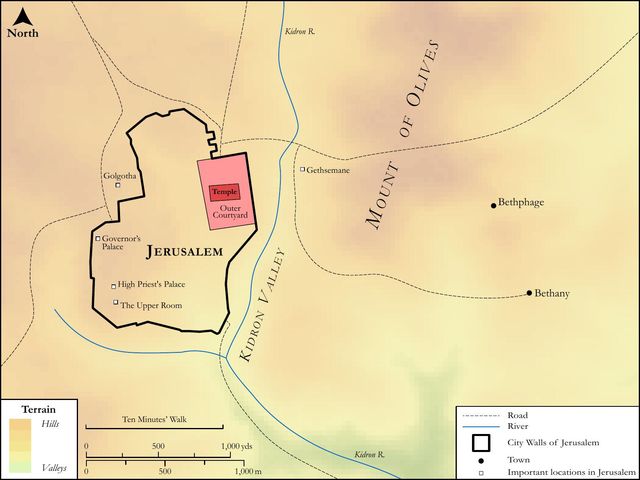
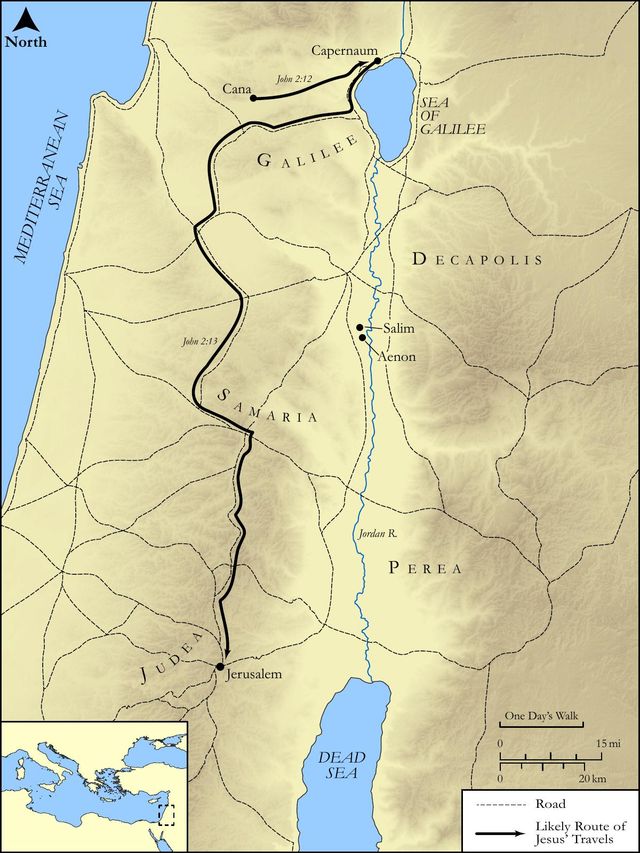
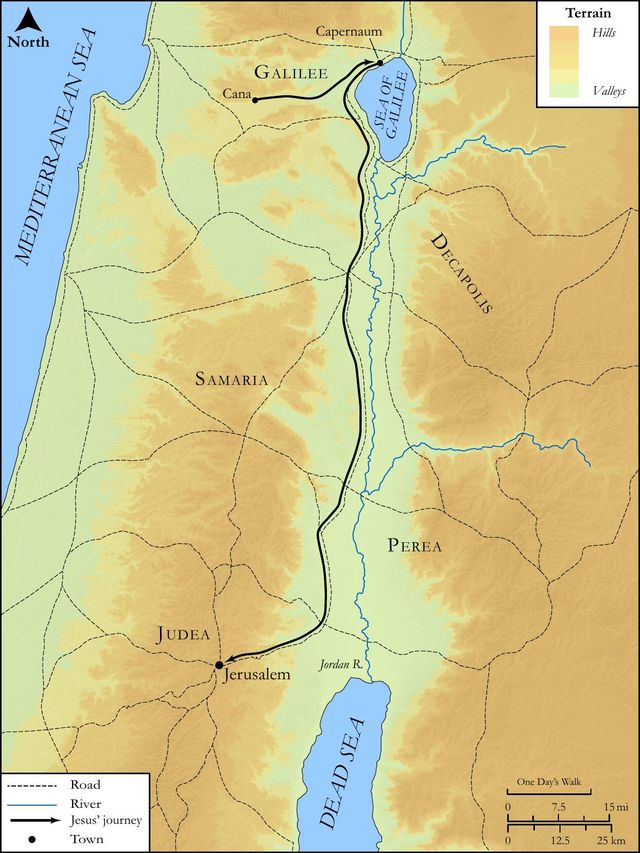
Study this verse
Public-domain commentary
Matthew Henry
From his Commentary on the Whole Bible. Henry comments on passages, not single verses — this entry covers John 2:12–22. His four-level outline is real structure in the source text, so it is rendered as structure.
Here we have,
I.The short visit Christ made to Capernaum, Joh 2:12.
It was a large and populous city, about a day's journey from Cana; it is called his own city (Mat 9:1), because he made it his head-quarters in Galilee, and what little rest he had was there. It was a place of concourse, and therefore Christ chose it, that the fame of his doctrine and miracles might thence spread the further. Observe,
1.The company that attended him thither: his mother, his brethren, and his disciples. Wherever Christ went,
(1.)He would not go alone, but would take those with him who had put themselves under his guidance, that he might instruct them, and that they might attest his miracles.
(2.)He could not go alone, but they would follow him, because they liked the sweetness either of his doctrine or of his wine, Joh 6:26. His mother, though he had lately given her to understand that in the works of his ministry he should pay no more respect to her than to any other person, yet followed him; not to intercede with him, but to learn of him. His brethren also and relations, who were at the marriage and were wrought upon by the miracle there, and his disciples, who attended him wherever he went. It should seem, people were more affected with Christ's miracles at first than they were afterwards, when custom made them seem less strange.
2.His continuance there, which was at this time not many days, designing now only to begin the acquaintance he would afterwards improve there. Christ was still upon the remove, would not confine his usefulness to one place, because many needed him. And he would teach his followers to look upon themselves but as sojourners in this world, and his ministers to follow their opportunities, and go where their work led them. We do not now find Christ in the synagogues, but he privately instructed his friends, and thus entered upon his work by degrees. It is good for young ministers to accustom themselves to pious and edifying discourse in private, that they may with the better preparation, and greater awe, approach their public work. He did not stay long at Capernaum, because the passover was at hand, and he must attend it at Jerusalem; for every thing is beautiful in its season. The less good must give way to the greater, and all the dwellings of Jacob must give place to the gates of Zion.
II.The passover he kept at Jerusalem; it is the first after his baptism, and the evangelist takes notice of all the passovers he kept henceforward, which were four in all, the fourth that at which he suffered (three years after this), and half a year was now past since his baptism. Christ, being made under the law, observed the passover at Jerusalem; see Exo 23:17. Thus he taught us by his example a strict observance of divine institutions, and a diligent attendance on religious assemblies. He went up to Jerusalem when the passover was at hand, that he might be there with the first. It is called the Jews' passover, because it was peculiar to them (Christ is our Passover); now shortly God will no longer own it for his. Christ kept the passover at Jerusalem yearly, ever since he was twelve years old, in obedience to the law; but now that he has entered upon his public ministry we may expect something more from him than before; and two things we are here told he did there: -
1.He purged the temple, Joh 2:14-17. Observe here,
(1.)The first place we find him in at Jerusalem was the temple, and, it should seem, he did not make any public appearance till he came thither; for his presence and preaching there were that glory of the latter house which was to exceed the glory of the former, Hag 2:9. It was foretold (Mal 3:1): I will send my messenger, John Baptist; he never preached in the temple, but the Lord, whom ye seek, he shall suddenly come to his temple, suddenly after the appearing of John Baptist; so that this was the time, and the temple the place, when, and where, the Messiah was to be expected.
(2.)The first work we find him at in the temple was the purging of it; for so it was foretold there (Mal 3:2, Mal 3:3): He shall sit as a refiner and purify the sons of Levi. Now was come the time of reformation. Christ came to be the great reformer; and, according to the method of the reforming kings of Judah, he first purged out what was amiss (and that used to be passover-work too, as in Hezekiah's time, Ch2 30:14, Ch2 30:15, and Josiah's, Kg2 23:4, etc.), and then taught them to do well. First purge out the old leaven, and then keep the feast. Christ's design in coming into the world was to reform the world; and he expects that all who come to him should reform their hearts and lives, Gen 35:2. And this he has taught us by purging the temple. See here,
[1.]What were the corruptions that were to be purged out. He found a market in one of the courts of the temple, that which was called the court of the Gentiles, within the mountain of that house. There, First, They sold oxen, and sheep, and doves, for sacrifice; we will suppose, not for common use, but for the convenience of those who came out of the country, and could not bring their sacrifices in kind along with them; see Deu 14:24-26. This market perhaps had been kept by the pool of Bethesda (Joh 5:2), but was admitted into the temple by the chief priests, for filthy lucre; for, no doubt, the rents for standing there, and fees for searching the beasts sold there, and certifying that they were without blemish, would be a considerable revenue to them. Great corruptions in the church owe their rise to the love of money, Ti1 6:5, Ti1 6:10. Secondly, They changed money, for the convenience of those that were to pay a half-shekel in specie every year, by way of poll, for the service of the tabernacle (Exo 30:12), and no doubt they got by it.
[2.]What course our Lord took to purge out those corruptions. He had seen these in the temple formerly, when he was in a private station; but never went about to drive them out till now, when he had taken upon him the public character of a prophet. He did not complain to the chief priests, for he knew they countenanced those corruptions. But he himself,
First, Drove out the sheep and oxen, and those that sold them, out of the temple. He never used force to drive any into the temple, but only to drive those out that profaned it. He did not seize the sheep and oxen for himself, did not distrain and impound them, though he found them damage faissant - actual trespassers upon his Father's ground; he only drove them out, and their owners with them. He made a scourge of small cords, which probably they had led their sheep and oxen with, and thrown them away upon the ground, whence Christ gathered them. Sinners prepare the scourges with which they themselves will be driven out from the temple of the Lord. He did not make a scourge to chastise the offenders (his punishments are of another nature), but only to drive out the cattle; he aimed no further than at reformation. See Rom 13:3, Rom 13:4; Co2 10:8.
Secondly, He poured out the changers' money, to kerma - the small money - the Nummorum Famulus. In pouring out the money, he showed his contempt of it; he threw it to the ground, to the earth as it was. In overthrowing the tables, he showed his displeasure against those that make religion a matter of worldly gain. Money-changers in the temple are the scandal of it. Note, In reformation, it is good to make thorough work; he drove them all out; and not only threw out the money, but, in overturning the tables, threw out the trade too.
Thirdly, He said to them that sold doves (sacrifices for the poor), Take these things hence. The doves, though they took up less room, and were a less nuisance than the oxen and sheep, yet must not be allowed there. The sparrows and swallows were welcome, that were left to God's providence (Psa 84:3), but not the doves, that were appropriated to man's profit. God's temple must not be made a pigeon-house. But see Christ's prudence in his zeal. When he drove out the sheep and oxen, the owners might follow them; when he poured out the money, they might gather it up again; but, if he had turned the doves flying, perhaps they could not have been retrieved; therefore to them that sold doves he said, Take these things hence. Note, Discretion must always guide and govern our zeal, that we do nothing unbecoming ourselves, or mischievous to others.
Fourthly, He gave them a good reason for what he did: Make not my Father's house a house of merchandise. Reason for conviction should accompany force for correction.
a.Here is a reason why they should not profane the temple, because it was the house of God, and not to be made a house of merchandise. Merchandise is a good thing in the exchange, but not in the temple. This was, (a.) to alienate that which was dedicated to the honour of God; it was sacrilege; it was robbing God. (b.) It was to debase that which was solemn and awful, and to make it mean. (c.) It was to disturb and distract those services in which men ought to be most solemn, serious, and intent. It was particularly an affront to the sons of the stranger in their worship to be forced to herd themselves with the sheep and oxen, and to be distracted in their worship by the noise of a market, for this market was kept in the court of the Gentiles. (d.) It was to make the business of religion subservient to a secular interest; for the holiness of the place must advance the market, and promote the sale of their commodities. Those make God's house a house of merchandise, [a.] Whose minds are filled with cares about worldly business when they are attending on religious exercises, as those, Amo 8:5; Eze 33:31. [b.] Who perform divine offices for filthy lucre, and sell the gifts of the Holy Ghost, Act 8:18.
b.Here is a reason why he was concerned to purge it, because it was his Father's house. And, (a.) Therefore he had authority to purge it, for he was faithful, as a Son over his own house. Heb 3:5, Heb 3:6. In calling God his Father, he intimates that he was the Messiah, of whom it was said, He shall build a house for my name, and I will be his Father, Sa2 7:13, Sa2 7:14. (b.) Therefore he had a zeal for the purging of it: "It is my Father's house, and therefore I cannot bear to see it profaned, and him dishonoured." Note, If God be our Father in heaven, and it be therefore our desire that his name may be sanctified, it cannot but be our grief to see it polluted. Christ's purging the temple thus may justly be reckoned among his wonderful works. Inter omnia signa quae fecit Dominus, hoc mihi videtur esse mirabilius - Of all Christ's wonderful works this appears to me the most wonderful. - Hieron. Considering, [a.] That he did it without the assistance of any of his friends; probably it had been no hard matter to have raised the mob, who had a great veneration for the temple, against these profaners of it; but Christ never countenanced any thing that was tumultuous or disorderly. There was one to uphold, but his own arm did it. [b.] That he did it without the resistance of any of his enemies, either the market-people themselves, or the chief priests that gave them their licences, and had the posse templi - temple force, at their command. But the corruption was too plain to be justified; sinners' own consciences are reformers' best friends; yet that was not all, there was a divine power put forth herein, a power over the spirits of men; and in this non-resistance of theirs that scripture was fulfilled (Mal 3:2, Mal 3:3), Who shall stand when he appeareth?
Fifthly, Here is the remark which his disciples made upon it (Joh 2:17): They remembered that it was written, The Zeal of thine house hath eaten me up. They were somewhat surprised at first to see him to whom they were directed as the Lamb of God in such a heat, and him whom they believed to be the King of Israel take so little state upon him as to do this himself; but one scripture came to their thoughts, which taught them to reconcile this action both with the meekness of the Lamb of God and with the majesty of the King of Israel; for David, speaking of the Messiah, takes notice of his zeal for God's house, as so great that it even ate him up, it made him forget himself, Psa 69:9. Observe, 1. The disciples came to understand the meaning of what Christ did, by remembering the scriptures: They remembered now that it was written. Note, The word of God and the works of God do mutually explain and illustrate each other. Dark scriptures are expounded by their accomplishment in providence, and difficult providences are made easy by comparing them with the scriptures. See of what great use it is to the disciples of Christ to be ready and mighty in the scriptures, and to have their memories well stored with scripture truths, by which they will be furnished for every good work, 2. The scripture they remembered was very apposite: The zeal of thine house hath eaten me up. David was in this a type of Christ that he was zealous for God's house, Psa 132:2, Psa 132:3. What he did for it was with all his might; see Ch1 29:2. The latter part of that verse (Psa 69:9) is applied to Christ (Rom 15:3), as the former part of it here. All the graces that were to be found among the Old Testament saints were eminently in Christ, and particularly this of zeal for the house of God, and in them, as they were patterns to us, so they were types of him. Observe, (1.) Jesus Christ was zealously affected to the house of God, his church: he loved it, and was always jealous for its honour and welfare. (2.) This zeal did even eat him up; it made him humble himself, and spend himself, and expose himself. My zeal has consumed me, Psa 119:139. Zeal for the house of God forbids us to consult our own credit, ease, and safety, when they come in competition with our duty and Christ's service, and sometimes carries on our souls in our duty so far and so fast that our bodies cannot keep pace with them, and makes us as deaf as our Master was to those who suggested, Spare thyself. The grievances here redressed might seem but small, and such as should have been connived at; but such was Christ's zeal that he could not bear even those that sold and bought in the temple. Si ibi ebrios inveniret quid faceret Dominus! (saith St. Austin.) If he had found drunkards in the temple, how much more would he have been displeased!
2.Christ, having thus purged the temple, gave a sign to those who demanded it to prove his authority for so doing. Observe here,
(1.)Their demand of a sign: Then answered the Jews, that is the multitude of the people, with their leaders. Being Jews, they should rather have stood by him, and assisted him to vindicate the honour of their temple; but, instead of this, they objected against it. note, Those who apply themselves in good earnest to the work of reformation must expect to meet with opposition. When they could object nothing against the thing itself, they questioned his authority to do it: "What sign showest thou unto us, to prove thyself authorized and commissioned to do these things?" It was indeed a good work to purge the temple; but what had he to do to undertake it, who was in no office there? They looked upon it as an act of jurisdiction, and that he must prove himself a prophet, yea, more than a prophet. But was not the thing itself sign enough? His ability to drive so many from their posts, without opposition, was a proof of his authority; he that was armed with such a divine power was surely armed with a divine commission. What ailed these buyers and sellers, that they fled, that they were driven back? Surely it was at the presence of the Lord (Psa 114:5, Psa 114:7), no less a presence.
(2.)Christ's answer to this demand, Joh 2:19. He did not immediately work a miracle to convince them, but gave them a sign in something to come, the truth of which must appear by the event, according to Deu 18:21, Deu 18:22.
Now, [1.] The sign that he gives them is his own death and resurrection. He refers them to that which would be, First, His last sign. If they would not be convinced by what they saw and heard, let them wait. Secondly, The great sign to prove him to be the Messiah; for concerning him it was foretold that he should be bruised (Isa 53:5), cut off (Dan 9:26), and yet that he should not see corruption, Psa 16:10. These things were fulfilled in the blessed Jesus, and therefore truly he was the Son of God, and had authority in the temple, his Father's house.
[2.]He foretels his death and resurrection, not in plain terms, as he often did to his disciples, but in figurative expressions; as afterwards, when he gave this for a sign, he called it the sign of the prophet Jonas, so here, Destroy this temple, and in three days I will raise it up. Thus he spoke in parables to those who were willingly ignorant, that they might not perceive, Mat 13:13, Mat 13:14. Those that will not see shall not see. Nay, this figurative speech used here proved such a stumbling-block to them that it was produced in evidence against him at his trial to prove him a blasphemer. Mat 26:60, Mat 26:61. Had they humbly asked him the meaning of what he said, he would have told them, and it had been a savour of life unto life to them, but they were resolved to cavil, and it proved a savour of death unto death. They that would not be convinced were hardened, and the manner of expressing this prediction occasioned the accomplishment of the prediction itself. First, He foretels his death by the Jews' malice, in these words, Destroy you this temple; that is, "You will destroy it, I know you will. I will permit you to destroy it." Note, Christ, even at the beginning of his ministry, had a clear foresight of all his sufferings at the end of it, and yet went on cheerfully in it. It is good, at setting out, to expect the worst. Secondly, He foretels his resurrection by his own power: In three days I will raise it up. There were others that were raised, but Christ raised himself, resumed his own life.
[3.]He chose to express this by destroying and re-edifying the temple, First, Because he was now to justify himself in purging the temple, which they had profaned; as if he had said, "You that defile one temple will destroy another; and I will prove my authority to purge what you have defiled by raising what you will destroy." The profaning of the temple is the destroying of it, and its reformation its resurrection. Secondly, Because the death of Christ was indeed the destruction of the Jewish temple, the procuring cause of it; and his resurrection was the raising up of another temple, the gospel church, Zac 6:12. The ruins of their place and nation (Joh 11:48) were the riches of the world. See Amo 9:11; Act 15:16.
(3.)Their cavil at this answer: "Forty and six years was this temple in building, Joh 2:20. Temple work was always slow work, and canst thou make such quick work of it?" Now here,
[1.]They show some knowledge; they could tell how long the temple was in building. Dr. Lightfoot computes that it was just forty-six years from the founding of Zerubbabel's temple, in the second year of Cyrus, to the complete settlement of the temple service, in the 32nd year of Artaxerxes; and the same from Herod's beginning to build this temple, in the 18th year of his reign, to this very time, when the Jews said that this as just forty-six years: ōkodomēthē - hath this temple been built.
[2.]They show more ignorance, First, Of the meaning of Christ's words. Note, Men often run into gross mistakes by understanding that literally which the scripture speaks figuratively. What abundance of mischief has been done by interpreting, This is my body, after a corporal and carnal manner! Secondly, Of the almighty power of Christ, as if he could do no more than another man. Had they known that this was he who built all things in six days they would not have made it such an absurdity that he should build a temple in three days.
(4.)A vindication of Christ's answer from their cavil. The difficulty is soon solved by explaining the terms: He spoke of the temple of his body, Joh 2:21. Though Christ had discovered a great respect for the temple, in purging it, yet he will have us know that the holiness of it, which he was so jealous for, was but typical, and leads us to the consideration of another temple of which that was but a shadow, the substance being Christ, Heb 9:9; Col 2:17. Some think that when he said, Destroy this temple, he pointed to his own body, or laid his hand upon it; however, it is certain that he spoke of the temple of his body. Note, The body of Christ is the true temple, of which that at Jerusalem was a type.
[1.]Like the temple, it was built by immediate divine direction: "A body hast thou prepared me," Ch1 28:19.
[2.]Like the temple, it was a holy house; it is called that holy thing.
[3.]It was, like the temple, the habitation of God's glory; there the eternal Word dwelt, the true shechinah. He is Emmanuel - God with us.
[4.]The temple was the place and medium of intercourse between God and Israel: there God revealed himself to them; there they presented themselves and their services to him. Thus by Christ God speaks to us, and we speak to him. Worshippers looked towards that house, Kg1 8:30, Kg1 8:35. So we must worship God with an eye to Christ.
(5.)A reflection which the disciples made upon this, long after, inserted here, to illustrate the story (Joh 2:22): When he was risen from the dead, some years after, his disciples remembered that he had said this. We found them, Joh 2:17, remembering what had been written before of him, and here we find them remembering what they had heard from him. Note, The memories of Christ's disciples should be like the treasure of the good house-holder, furnished with things both new and old, Mat 13:52. Now observe,
[1.]When they remembered that saying: When he was risen from the dead. It seems, they did not at this time fully understand Christ's meaning, for they were as yet but babes in knowledge; but they laid up the saying in their hearts, and afterwards it became both intelligible and useful. Note, It is good to hear for the time to come, Isa 42:23. The juniors in years and profession should treasure up those truths of which at present they do not well understand either the meaning or the use, for they will be serviceable to them hereafter, when they come to greater proficiency. It was said of the scholars of Pythagoras that his precepts seemed to freeze in them till they were forty years old, and then they began to thaw; so this saying of Christ revived in the memories of his disciples when he was risen from the dead; and why the? First, Because then the Spirit was poured out to bring things to their remembrance which Christ had said to them, and to make them both easy and ready to them, Joh 14:26. That very day that Christ rose form the dead he opened their understandings, Luk 24:45. Secondly, Because then this saying of Christ was fulfilled. When the temple of his body had been destroyed and was raised again, and that upon the third day, then they remembered this among other words which Christ had said to this purport. Note, It contributes much to the understanding of the scripture to observe the fulfilling of the scripture. The event will expound the prophecy.
[2.]What use they made of it: They believed the scripture, and the word that Jesus had said; their belief of these was confirmed and received fresh support and vigour. They were slow of heart to believe (Luk 24:25), but they were sure. The scripture and the word of Christ are here put together. not because they concur and exactly agree together, but because they mutually illustrate and strengthen each other. When the disciples saw both what they had read in the Old Testament, and what they had heard from Christ's own mouth, fulfilled in his death and resurrection, they were the more confirmed in their belief of both.
Historical interpretation
Nine Centuries of Reception
14 surviving comments on this verse. Each one is dated, so this reads as a timeline rather than a list.
Select a marker to jump to its quote. Markers stagger vertically where authors wrote within a few decades of each other.
For He showed to what belongs (the incidents of) being destroyed, thrown down, and kept down-even to that to which it also appertains to be lifted and raised up again; although He was at the same time bearing about with Him "a soul that was trembling even unto death," but which did not fall through death, because even the Scripture informs us that "He spoke of His body." So that it is the flesh which falls by death; and accordingly it derives its name, cadaver, from cadendo.
[Christ] meant that his passion would be brief and that when he was put to death … he would raise himself up on the third day. For he himself was the true temple of God.… For when there was no justice on the earth, [God] sent a teacher, a living law, as it were, to establish his name and a new temple, to sow the seeds of true and loving worship throughout the whole earth by his words and example.
By the power to take his soul again and to raise the temple up, he declares himself God and the resurrection his own work: yet he refers all to the authority of his Father’s command. This is not contrary to the meaning of the apostle, when he proclaims Christ, the “power of God and the wisdom of God,” thus referring all the magnificence of his work to the glory of the Father. For whatever Christ does, the power and the wisdom of God does.… Christ was raised from the dead by the working of God, for he himself worked the works of God the Father with a nature indistinguishable from God’s. And our faith in the resurrection rests on the God who raised Christ from the dead.
"When He was risen from the dead, His disciples remembered that He had said this; and they believed the Scripture, and the word which Jesus had said."
But at the time when this was spoken, the Jews were perplexed as to what it might mean, and cast about to discover, saying,
"Forty and six years was this Temple in building, and wilt thou rear it up in three days?"
"Forty and six years," they said, referring to the latter building, for the former was finished in twenty years' time.
The question still remains, "How was it that the disciples did not know that He must rise from the dead?" It was, because they had not been vouchsafed the gift of the Spirit; and therefore, though they constantly heard His discourses concerning the Resurrection, they understood them not, but reasoned with themselves what this might be. For very strange and paradoxical was the assertion that one could raise himself, and would raise himself in such wise. And so Peter was rebuked, when, knowing nothing about the Resurrection, he said, "Be it far from Thee." And Christ did not reveal it clearly to them before the event, that they might not be offended at the very outset, being led to distrust His words on account of the great improbability of the thing, and because they did not yet clearly know Him, who He was. For no one could help believing what was proclaimed aloud by facts, while some would probably disbelieve what was told to them in words. Therefore He at first allowed the meaning of His words to be concealed; but when by their experience He had verified His sayings, He after that gave them understanding of His words, and such gifts of the Spirit that they received them all at once. "He," saith Jesus, "shall bring all things to your remembrance." For they who in a single night cast off all respect for Him, and fled from and denied that they even knew Him, would scarcely have remembered what He had done and said during the whole time, unless they had enjoyed much grace of the Spirit.
(Hom. xxiii. 3) But why does He give them the sign of His resurrection? Because this was the greatest proof that He was not a mere man; showing, as it did, that He could triumph over death, and in a moment overthrow its long tyranny.
(Hom. xxiii. in Joan. 3) TWO. things there were in the mean time very far removed from the comprehension of the disciples: one, the resurrection of our Lord's Body: the other, and the greater mystery, that it was God who dwelt in that Body: as our Lord declares by saying, Destroy this temple, and in three days I will raise it up. And thus it follows, When therefore He had risen from the dead, His disciples remembered that He had said this unto them: and they believed the Scripture, and the word which Jesus had said.
"But," says one, "if they were to hear from the Spirit, why needed they to accompany Christ when they would not retain His words?" Because the Spirit taught them not, but called to their mind what Christ had said before; and it contributes not a little to the glory of Christ, that they were referred to the remembrance of the words He had spoken to them. At the first then it was of the gift of God that the grace of the Spirit lighted upon them so largely and abundantly; but after that, it was of their own virtue that they retained the Gift. For they displayed a shining life, and much wisdom, and great labors, and despised this present life, and thought nothing of earthly things, but were above them all; and like a sort of light-winged eagle, soaring high by their works, reached to heaven itself, and by these possessed the unspeakable grace of the Spirit.
Wherefore then did He not resolve the difficulty and say, "I speak not of that Temple, but of My flesh"? Why does the Evangelist, writing the Gospel at a later period, interpret the saying, and Jesus keep silence at the time? Why did He so keep silence? Because they would not have received His word; for if not even the disciples were able to understand the saying, much less were the multitudes. "When," saith the Evangelist, "He was risen from the dead, then they remembered, and believed the Scripture and His word." There were two things that hindered them for the time, one the fact of the Resurrection, the other, the greater question whether He was God that dwelt within; of both which things He spake darkly when He said, "Destroy this Temple, and I will rear it up in three days." And this St. Paul declares to be no small proof of His Godhead, when he writes, "Declared to be the Son of God with power, according to the Spirit of holiness, by the Resurrection from the dead."
But why doth He both there, and here, and everywhere, give this for a sign, at one time saying, "When ye have lifted up the Son of Man, then ye shall know that I Am"; at another, "There shall no sign be given you but the sign of the prophet Jonas"; and again in this place, "In three days I will raise it up"? Because what especially showed that He was not a mere man, was His being able to set up a trophy of victory over death, and so quickly to abolish His long enduring tyranny, and conclude that difficult war. Wherefore He saith, "Then ye shall know." "Then." When? When after My Resurrection I shall draw (all) the world to Me, then ye shall know that I did these things as God, and Very Son of God, avenging the insult offered to My Father.
"The Jews said unto Him, What sign showest thou unto us, seeing that thou doest these things?" And the Lord answered, "Destroy this temple, and in three days I will raise it up. Then said the Jews, Forty and six years was this temple in building, and dost thou say, In three days I will rear it up?" Flesh they were, fleshly things they minded; but He was speaking spiritually. But who could understand of what temple He spoke? But yet we have not far to seek; He has discovered it to us through the evangelist, he has told us of what temple He said it. "But He spake," saith the evangelist, "of the temple of His body." And it is manifest that, being slain, the Lord did rise again after three days. This is known to us all now: and if from the Jews it is concealed, it is because they stand without; yet to us it is open, because we know in whom we believe.
Acceptable to the wise man is the word of wisdom, and the knowledge of discipline abideth more easily with men of understanding, and as in wax not too hard, the impression of seals is well made, so in the more tender hearts of men the Divine Word is readily infixed: wherefore the hard of heart is also called wicked. The disciples then, being of a good disposition, become wise, and ruminate the words of divine Scripture, nourishing themselves to more accurate knowledge, and thence coming firmly to belief. Since the Body of Christ is called a temple also, how is not the Only-Begotten Word Which indwelleth therein, God by Nature, since he that is not God cannot be said to dwell in aTemple? Or let one come forward and say, what saint's body was ever called a temple; but I do not suppose any one can show this. I say then, what we shall find to be true, if we accurately search the Divine Scripture, that to none of the Saints was such honour attached. And indeed the blessed Baptist, albeit he attained unto the height of all virtue, and suffered none to exceed him in piety, was through the madness of Herod beheaded, and yet is no such thing attributed to him. On the contrary, the Evangelist devised a grosser word for his remains, saying this too, as appears to me by an oeconomy, in order that the dignity may be reserved to Christ Alone. For he writes thus; And the blood-shedder to wit, Herod, sent and beheaded John in the prison, and his disciples came and took up his carcase. If the body of John be called a carcase, whose temple will it be? In another sense indeed, we are called temples of God, by reason of the Holy Ghost indwelling in us. For we are called the temples of God, and not of ourselves.
But haply some one will say: How then, tell me, doth the Saviour Himself call His own Body a carcase, For wheresoever He saith the carcase is, there will the eagles be gathered together. To this we say, that Christ saith this not of His Own Body, but in manner and guise of a parable He signifieth that concourse of the Saints to Him, that shall be at that time when He appeareth again to us, with the holy angels, in the glory of His Father. For like as, saith He, flocks of carnivorous birds rush down with a sharp whizzing to fallen carcases, so shall ye too be gathered together to Me. Which indeed Paul too doth make known to us, saying, For the trumpet shall sound, and the dead shall be raised incorruptible; And again in another place, and we shall be caught up in the clouds to meet the Lord in the air, and so shall we ever be with the Lord. That therefore which is taken by way of similitude for an image will no wise damage the force of the truth.
With perfect justice he banished the wicked from the temple, since the temple represented the temple of his body, in which there was no stain of any kind of sin.
For inasmuch as they sought a sign from our Lord of His right to eject the customary merchandize from the temple, He replied, that that temple signified the temple of His Body, in which was no spot of sin; as if He said, As by My power I purify your inanimate temple from your merchandize and wickedness; so the temple of My Body, of which that is the figure, destroyed by your hands, on the third day I will raise again.
(hoc loco.) The Jews seeing Jesus thus acting with power, and having heard Him say, Make not My Father's house an house of merchandize, ask of Him a sign; Then answered the Jews and said unto Him, What sign shewest Thou unto us, seeing that Thou doest these things?
He does not however provoke them to commit murder, by saying, Destroy; but only shows that their intentions were not hidden from Him. Let the Arians observe how our Lord, as the destroyer of death, says, I will raise it up; that is to say, by My own power.
The Jews, supposing that He spoke of the material temple, scoffed: Then said the Jews, Forty and six years was this temple in building, and will Thou rear it up in three days?
(ad loc. fin.) From this Apollinarius draws an heretical inference: and attempts to show that Christ's flesh was inanimate, because the temple was inanimate. In this way you will prove the flesh of Christ to be wood and stone, because the temple is composed of these materials. Now if you refuse to allow what is said, Now is My soul troubled; (John 12:27) and, I have power to lay it (My life) down, (ib. 10:18) to be said of the rational soul, still how will you interpret, Into Thy hands, O Lord, I commend My spirit? (Luke 23:46) you cannot understand this of an irrational soul: or again, the passage, Thou shall not leave My soul in hell. (Ps. 16:11)
Continue studying John 2:21 across the web’s major study libraries — every link below opens this exact verse, chapter, or book on the destination site.
Read & Compare
 BibleGatewayThis verse in more than 200 translations and 70 languages.
 Bible.comThe YouVersion reader — hundreds of translations, reading plans, and highlights.
 ESV.orgCrossway's official English Standard Version reader.
 NET BibleThe NET translation with 60,000+ translators' notes on every rendering decision.
 STEP BibleTyndale House's free study tool — original text, vocabulary, and scholarly resources.
 BibliaLogos Bible Software's free web reader.
 USCCBThe New American Bible (Revised Edition) with the U.S. bishops' study notes.
Commentaries
 BibleHub CommentariesDozens of classic commentaries on this verse, gathered on one page.
 StudyLightMore than 100 commentary sets — the largest collection on the web.
 BibleRefPlain-English commentary on what this verse means, verse by verse.
 Enduring WordDavid Guzik's free commentary on this chapter, widely used by Bible teachers.
 Bible Study ToolsVerse commentary alongside Greek and Hebrew study aids.
Original Language & Research
- BibleHub InterlinearThe verse word by word — original language, transliteration, and English.
- BibleHub LexiconEvery word's original-language definition and Strong's entry.
 Blue Letter BibleDeep-study tools — Strong's numbers, concordance, and word studies.
 CNTR CollationThe earliest Greek manuscripts of this verse, collated letter by letter.
Sermons, Hymns & Audio


TrulyRandomVerse is not affiliated with these sites and doesn’t control their content. They’re linked because they’re genuinely useful.
Summary
John 2:21 serves as a pivotal interpretive clarification in John's Gospel, revealing the profound spiritual meaning behind Jesus' enigmatic prophecy concerning the destruction and raising of the temple. Following His initial cleansing of the Jerusalem Temple, Jesus declared, "Destroy this temple, and in three days I will raise it up" (John 2:19). While His Jewish interlocutors understood this literally, referring to the physical edifice, the Apostle John interjects this verse to illuminate that Jesus was speaking not of a stone structure, but of the temple of His own body, thereby foreshadowing His death and glorious resurrection.
Context
ShowHideLiterary Context
This verse is strategically placed immediately after Jesus' first public act in Jerusalem, the dramatic cleansing of the Temple courts (John 2:13-17). This forceful display of authority prompts the Jewish leaders to demand a sign, to which Jesus responds with the cryptic statement about destroying and raising the temple (John 2:19). The Jews, fixed on the physical structure, scoff at His words, noting the decades it took to build Herod's Temple (John 2:20). John 2:21 then functions as the inspired commentary, providing the divine interpretation that unlocks the true meaning of Jesus' prophecy. This deliberate clarification by the narrator highlights a recurring theme in John's Gospel: the contrast between human misunderstanding of Jesus' words and actions, and the divine revelation of their deeper, spiritual significance, often fully grasped only after Jesus' resurrection (John 2:22).
Historical & Cultural Context
The Second Temple, often referred to as Herod's Temple due to the extensive renovations begun by Herod the Great, was the epicenter of Jewish religious, cultural, and national life in the first century. It was a magnificent structure, a symbol of God's presence among His people, and the place where sacrifices were offered according to Mosaic Law. The Passover festival, during which Jesus performed the Temple cleansing, was one of the three annual pilgrimage festivals, drawing vast numbers of Jews to Jerusalem. The Temple's immense size, the forty-six years of construction mentioned by the Jews (John 2:20), and its central role made any talk of its destruction deeply provocative and blasphemous in their eyes. Their literal interpretation of Jesus' words was entirely natural given their cultural and religious framework, making John's spiritual clarification all the more crucial.
Key Themes
ShowHideJohn 2:21 contributes significantly to several major themes within John's Gospel and broader biblical theology. Firstly, it underscores Jesus' Identity and Divinity, presenting Him as the ultimate dwelling place of God, a concept that transcends and ultimately supersedes the physical Temple. He is the true sanctuary, the locus of God's presence among humanity, fulfilling the Old Testament types. Secondly, it serves as a direct Prophecy of His Resurrection, foretelling His death and miraculous rising on the third day, which is the foundational event of Christian faith (as articulated in 1 Corinthians 15:4). Thirdly, the verse signifies a radical shift from the Old Covenant to the New Covenant, where God's presence is no longer confined to a physical building but is found in Christ and, subsequently, in believers who become the spiritual temple of the Holy Spirit (see 1 Corinthians 6:19 and 2 Corinthians 6:16). Finally, it exemplifies the recurring Johannine theme of Misunderstanding vs. Divine Revelation, where Jesus' words are initially misinterpreted by His audience, but their deeper, spiritual truth is revealed by the narrator or through subsequent events, particularly the resurrection (as seen in John 2:22).
Exposition and Analysis
ShowHideKey Word Analysis
ShowHideThis verb signifies a systematic or set discourse, implying a deliberate and meaningful utterance, rather than a casual remark. Here, it emphasizes that Jesus' statement, though cryptic to His listeners, was a profound and intentional prophecy with deep theological significance, not merely a spontaneous outburst. It points to the authoritative nature of His words.
The Greek word naós specifically refers to the inner sanctuary of the Temple, the Holy of Holies, where God's presence was believed to reside. This is distinct from hieron (ἱερόν), which denotes the entire temple complex, including its outer courts. By using naós, John emphasizes that Jesus' body is not just a part of a religious system, but the very dwelling place of God's most intimate and sacred presence, the ultimate point of connection between God and humanity.
This term, while literally referring to a physical body, is used here in a profound theological sense. It points to Jesus' incarnate humanity, through which God's divine presence is fully manifested. In this context, "His body" becomes the new locus of worship and divine encounter, replacing the physical Temple as the place where God truly dwells and where atonement is made.
Verse Breakdown
ShowHide"But he spake"
This opening phrase, introduced by the adversative particle "But" (G1161, dé), signals a crucial contrast and clarification. It immediately shifts the reader's understanding from the literal interpretation of the Jewish leaders to the true, spiritual intent of Jesus' words. John, as the inspired narrator, intervenes to provide the authoritative divine perspective.
"of the temple"
This refers back to Jesus' earlier statement in John 2:19, where He commanded, "Destroy this temple." The Jewish leaders had understood "this temple" to mean the magnificent physical structure in Jerusalem. John's clarification in verse 21 directly addresses this misunderstanding, affirming that while Jesus used the term "temple," His referent was entirely different from what His audience perceived.
"of his body"
This is the interpretive key, the profound revelation that redefines Jesus' entire statement. John clarifies that Jesus was not speaking of the stone edifice, but of His own physical body. This immediately transforms the prophecy from a literal architectural prediction into a profound theological statement about Jesus' death and resurrection. His body, soon to be "destroyed" through crucifixion, would be "raised" in three days, becoming the new and ultimate dwelling place of God's presence, superseding the Old Covenant temple.
Literary Devices
ShowHideJohn 2:21 masterfully employs several literary devices to convey its profound theological truth. The most prominent is Symbolism, where Jesus' physical "body" is presented as the new "temple." This is not a mere metaphor but a profound theological reality, indicating that the true presence of God is now embodied in Christ Himself, replacing the Old Covenant structure. This symbolic connection is further enriched by Prophecy, as Jesus' statement (and John's clarification) directly foretells His death and resurrection, central events in the gospel narrative. There is also a strong element of Irony present in the broader passage, as the Jewish leaders, who are custodians of the physical temple, completely miss the spiritual meaning of Jesus' words, highlighting their spiritual blindness. Finally, John 2:21 itself functions as Narrative Clarification or Interpretation, where the author steps in to explain a previously ambiguous or misunderstood statement, ensuring the reader grasps the deeper, divine truth.
Theological and Thematic Connections
ShowHideJohn 2:21 is a cornerstone verse that profoundly redefines the concept of God's dwelling among humanity, shifting it from a physical edifice to the person of Jesus Christ. It asserts that Jesus Himself is the ultimate locus of God's presence, the true sanctuary where humanity can encounter the divine. This reorientation signifies the inauguration of the New Covenant, where access to God is no longer mediated through rituals and sacrifices performed in a building, but through the person and finished work of Christ. His body, broken on the cross and raised in triumph, becomes the new and living way to the Father, fulfilling all the types and shadows of the Old Testament temple system. This truth underscores the absolute centrality of Christ in salvation and worship.
Reflection and Application
ShowHideUnderstanding John 2:21 profoundly impacts our perception of God's presence and our relationship with Him. It calls us to recognize that true worship is not confined to sacred spaces or rituals, but is found in Christ alone. Jesus is the ultimate revelation of God, the center of our faith, and the sole mediator of salvation. The reality that Jesus' body was "destroyed" and "raised" for our sake underscores the power of His resurrection, which validates His claims, conquers sin and death, and offers us the hope of eternal life and newness of life in Him. Furthermore, as believers, we are now incorporated into this new spiritual temple, with the Holy Spirit dwelling within us. This truth elevates the sanctity of our own bodies and calls us to live lives that honor God, recognizing ourselves as sacred vessels for His presence and instruments for His purposes in the world. Just as the disciples only fully grasped Jesus' words after His resurrection, we are reminded to trust God's timing and His ultimate revelation of His plans, even when they seem unclear or paradoxical in the moment.
Questions for Reflection
ShowHideFAQ
ShowHideWhy did the Jewish leaders misunderstand Jesus' statement about the temple?
ShowHideThe Jewish leaders misunderstood Jesus' statement primarily because they interpreted His words literally, focusing on the physical structure of Herod's Temple, which was a massive construction project that had been underway for decades (John 2:20). Their worldview was heavily centered on the physical Temple as the exclusive dwelling place of God and the hub of their religious and national identity. They lacked the spiritual discernment to grasp the deeper, symbolic meaning Jesus intended, which pointed to His own body as the ultimate sanctuary and the fulfillment of all that the Temple represented. This misunderstanding highlights a recurring theme in John's Gospel, where human, earthly perspectives often clash with divine, spiritual truths.
What is the significance of John, the author, clarifying Jesus' words in this verse?
ShowHideJohn's clarification in John 2:21 is immensely significant for several reasons. Firstly, it serves as an inspired theological commentary, guiding the reader to the true meaning of Jesus' cryptic prophecy. Without this clarification, readers might, like the Jewish leaders, remain confused or misinterpret Jesus' words. Secondly, it highlights John's theological purpose throughout his Gospel: to reveal Jesus' true identity as the Son of God and the Christ. By explaining that Jesus spoke of "the temple of his body," John immediately elevates Jesus' status, showing Him to be greater than the Temple itself. Thirdly, it underscores the theme of divine revelation, where truths about Jesus are often veiled at first but later made clear, especially after the resurrection (John 2:22). This clarification ensures that the reader grasps the profound Christological implications of Jesus' statement, linking it directly to His death and resurrection, which are central to the Christian faith.
Christ-Centered Fulfillment
ShowHideJohn 2:21 stands as a profound declaration of Christ's ultimate fulfillment of all that the Old Testament Temple represented. The physical Temple in Jerusalem, with its Holy of Holies, altars, and sacrificial system, was a shadow and a type, pointing forward to the coming reality of God's perfect dwelling among humanity. In Jesus, this reality is fully realized. His incarnate body becomes the true and ultimate meeting place between God and humanity, the place where God's glory truly resides (as hinted in John 1:14). The "destruction" of this temple—His crucifixion—was not a defeat but the necessary act through which He offered the perfect, once-for-all sacrifice for sin (as explained in Hebrews 9:11-12). His "raising" in three days—His resurrection—validated His divine claims and established the New Covenant, opening a new and living way for all believers to access God directly through His torn flesh (Hebrews 10:19-20). Thus, Jesus is not merely a prophet or a reformer; He is the living Temple, the very presence of God, through whom all worship is directed and all reconciliation is achieved, ultimately building up His church as a spiritual house where God dwells by His Spirit (Ephesians 2:19-22).