


Romans 13:3
Bible text: King James Version (1769 Blayney text) · Public domain
Bible text: King James Version with Strong's numbers · Public domain
Bible text: Berean Standard Bible · Public domain
Bible text: American Standard Version (1901) · Public domain
Bible text: World English Bible, Messianic edition · Public domain
Bible text: Geneva Bible (1599) · Public domain
Bible text: Young's Literal Translation · Public domain
- οἱhoiTheG3588T-NPMDefinite article Nominative Plural Masculine
- γὰρgarforG1063CONJConjunction
- ἄρχοντεςarchontesrulersG758N-NPMNoun Nominative Plural Masculine
- οὐκouknotG3756PRT-NNegative Particle Negative
- εἰσὶνeisinareG1510V-PAI-3PVerb Present Active Indicative 3rd Plural
- φόβοςphobosa terrorG5401N-NSMNoun Nominative Singular Masculine
- τῷtōto theG3588T-DSNDefinite article Dative Singular Neuter
- ἀγαθῷagathōgoodG18A-DSNAdjective Dative Singular Neuter
- ἔργῳergōworkG2041N-DSNNoun Dative Singular Neuter
- ἀλλὰallabutG235CONJConjunction
- τῷtōto theG3588T-DSNDefinite article Dative Singular Neuter
- κακῷkakōevilG2556A-DSNAdjective Dative Singular Neuter
- θέλειςtheleisDo you desireG2309V-PAI-2SVerb Present Active Indicative 2nd Singular
- δὲdenowG1161CONJConjunction
- μὴmēnotG3361PRT-NNegative Particle Negative
- φοβεῖσθαιphobeisthaito fearG5399V-PNNVerb Present Middle Or Passive Deponent Infinitive
- τὴνtēntheG3588T-ASFDefinite article Accusative Singular Feminine
- ἐξουσίαν;exousianauthority?G1849N-ASFNoun Accusative Singular Feminine
- τὸtoTheG3588T-ASNDefinite article Accusative Singular Neuter
- ἀγαθὸνagathongoodG18A-ASNAdjective Accusative Singular Neuter
- ποίειpoieido performG4160V-PAM-2SVerb Present Active Imperative 2nd Singular
- καὶkaiandG2532CONJConjunction
- ἕξειςhexeisyou will haveG2192V-FAI-2SVerb Future Active Indicative 2nd Singular
- ἔπαινονepainonpraiseG1868N-ASMNoun Accusative Singular Masculine
- ἐξexfromG1537PREPPreposition
- αὐτῆς·autēshimG846P-GSFPersonal pronoun Genitive Singular Feminine
English is a literal word-by-word gloss of the Greek, not the KJV's wording. Why?
This is the original text the KJV's translators worked from — each Greek word with its own literal English meaning in this verse, prepared by scholars at Tyndale House, Cambridge. The KJV translates whole sentences, not word by word, so its wording differs: one Greek word can become several English words, and the KJV may choose “charity” where the gloss reads “love”. Both are faithful — they answer different questions. For the KJV's own rendering, switch to the KJV text.
Details
See on the biblical-era maps
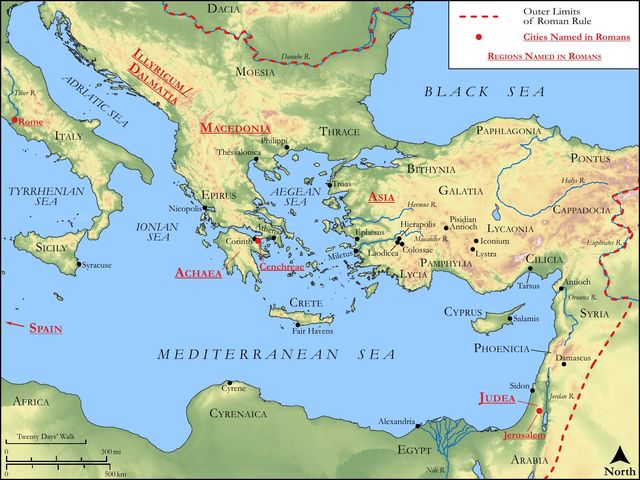

Study this verse
Public-domain commentary
Matthew Henry
From his Commentary on the Whole Bible. Henry comments on passages, not single verses — this entry covers Romans 13:1–6. His four-level outline is real structure in the source text, so it is rendered as structure.
We are here taught how to conduct ourselves towards magistrates, and those that are in authority over us, called here the higher powers, intimating their authority (they are powers), and their dignity (they are higher powers), including not only the king as supreme, but all inferior magistrates under him: and yet it is expressed, not by the persons that are in that power, but the place of power itself, in which they are. However the persons themselves may be wicked, and of those vile persons whom the citizen of Zion contemneth (Psa 15:4), yet the just power which they have must be submitted to and obeyed. The apostle had taught us, in the foregoing chapter, not to avenge ourselves, nor to recompense evil for evil; but, lest it should seem as if this did cancel the ordinance of a civil magistracy among Christians, he takes occasion to assert the necessity of it, and of the due infliction of punishment upon evil doers, however it may look like recompensing evil for evil. Observe,
I.The duty enjoined:
Let every soul be subject. Every soul - every person, one as well as another, not excluding the clergy, who call themselves spiritual persons, however the church of Rome may not only exempt such from subjection to the civil powers, but place them in authority above them, making the greatest princes subject to the pope, who thus exalteth himself above all that is called God. - Every soul. Not that our consciences are to be subjected to the will of any man. It is God's prerogative to make laws immediately to bind conscience, and we must render to God the things that are God's. But it intimates that our subjection must be free and voluntary, sincere and hearty. Curse not the king, no, not in thy thought, Ecc 10:20. To compass and imagine are treason begun. The subjection of soul here required includes inward honour (Pe1 2:17) and outward reverence and respect, both in speaking to them and in speaking of them - obedience to their commands in things lawful and honest, and in other things a patient subjection to the penalty without resistance - a conformity in every thing to the place and duty of subjects, bringing our minds to the relation and condition, and the inferiority and subordination of it. "They are higher powers; be content they should be so, and submit to them accordingly." Now there was good reason for the pressing of this duty of subjection to civil magistrates,
1.Because of the reproach which the Christian religion lay under in the world, as an enemy to public peace, order, and government, as a sect that turned the world upside down, and the embracers of it as enemies to Caesar, and the more because the leaders were Galileans - an old slander. Jerusalem was represented as a rebellious city, hurtful to kings and provinces, Ezr 4:15, Ezr 4:16. Our Lord Jesus was so reproached, though he told them his kingdom was not of this world: no marvel, then, if his followers have been loaded in all ages with the like calumnies, called factious, seditious, and turbulent, and looked upon as the troublers of the land, their enemies having found such representations needful for the justifying of their barbarous rage against them. The apostle therefore, for the obviating of this reproach and the clearing of Christianity from it, shows that obedience to civil magistrates is one of the laws of Christ, whose religion helps to make people good subjects; and it was very unjust to charge upon Christianity that faction and rebellion to which its principles and rules are so directly contrary.
2.Because of the temptation which the Christians lay under to be otherwise affected to civil magistrates, some of them being originally Jews, and so leavened with a principle that it was unmeet for any of the seed of Abraham to be subject to one of another nation - their king must be of their brethren, Deu 17:15. Besides, Paul had taught them that they were not under the law, they were made free by Christ. Lest this liberty should be turned into licentiousness, and misconstrued to countenance faction and rebellion, the apostle enjoins obedience to civil government, which was the more necessary to be pressed now because the magistrates were heathens and unbelievers, which yet did not destroy their civil power and authority. Besides, the civil powers were persecuting powers; the body of the law was against them.
II.The reasons to enforce this duty. Why must we be subject?
1.For wrath's sake. Because of the danger we run ourselves into by resistance. Magistrates bear the sword, and to oppose them is to hazard all that is dear to us in this world; for it is to no purpose to contend with him that bears the sword. The Christians were then in those persecuting times obnoxious to the sword of the magistrate for their religion, and they needed not make themselves more obnoxious by their rebellion. The least show of resistance or sedition in a Christian would soon be aggravated and improved, and would be very prejudicial to the whole society; and therefore they had more need than others to be exact in their subjection, that those who had so much occasion against them in the matter of their God might have no other occasion. To this head must that argument be referred (Rom 13:2), Those that resist shall receive to themselves damnation: krima lēpsontai, they shall be called to an account for it. God will reckon with them for it, because the resistance reflects upon him. The magistrates will reckon with them for it. They will come under the lash of the law, and will find the higher powers too high to be trampled upon, all civil governments being justly strict and severe against treason and rebellion; so it follows (Rom 13:3), Rulers are a terror. This is a good argument, but it is low for a Christian.
2.We must be subject, not only for wrath, but for conscience' sake; not so much formidine poenae - from the fear of punishment, as virtutis amore - from the love of virtue. This makes common civil offices acceptable to God, when they are done for conscience' sake, with an eye to God, to his providence putting us into such relations, and to his precept making subjection the duty of those relations. Thus the same thing may be done from a very different principle. Now to oblige conscience to this subjection he argues, Rom 13:1-4, Rom 13:6,
(1.)From the institution of magistracy: There is no power but of God. God as the ruler and governor of the world hath appointed the ordinance of magistracy, so that all civil power is derived from him as from its original, and he hath by his providence put the administration into those hands, whatever they are that have it. By him kings reign, Pro 8:15. The usurpation of power and the abuse of power are not of God, for he is not the author of sin; but the power itself is. As our natural powers, though often abused and made instruments of sin, are from God's creating power, so civil powers are from God's governing power. The most unjust and oppressive princes in the world have no power but what is given them from above (Joh 19:11), the divine providence being in a special manner conversant about those changes and revolutions of governments which have such an influence upon states and kingdoms, and such a multitude of particular persons and smaller communities. Or, it may be meant of government in general: it is an instance of God's wisdom, power, and goodness, in the management of mankind, that he has disposed them into such a state as distinguishes between governors and governed, and has not left them like the fishes of the sea, where the greater devour the less. He did herein consult the benefit of his creatures. - The powers that be: whatever the particular form and method of government are - whether by monarchy, aristocracy, or democracy - wherever the governing power is lodged, it is an ordinance of God, and it is to be received and submitted to accordingly; though immediately an ordinance of man (Pe1 2:13), yet originally an ordinance of God. - Ordained of God - tetagmenai, a military word, signifying not only the ordination of magistrates, but the subordination of inferior magistrates to the supreme, as in an army; for among magistrates there is a diversity of gifts, and trusts, and services. Hence it follows (Rom 13:2) that whosoever resisteth the power resisteth the ordinance of God. There are other things from God that are the greatest calamities; but magistracy is from God as an ordinance, that is, it is a great law, and it is a great blessing: so that the children of Belial, that will not endure the yoke of government, will be found breaking a law and despising a blessing. Magistrates are therefore called gods (Psa 82:6), because they bear the image of God's authority. And those who spurn at their power reflect upon God himself. This is not at all applicable to the particular rights of kings and kingdoms, and the branches of their constitution; nor can any certain rule be fetched from this for the modelling of the original contracts between the governors and governed; but it is intended for direction to private persons in their private capacity, to behave themselves quietly and peaceably in the sphere in which God has set them, with a due regard to the civil powers which God in his providence has set over them, Ti1 2:1, Ti1 2:2. Magistrates are here again and again called God's ministers. he is the minister of God, Rom 13:4, Rom 13:6. Magistrates are in a more peculiar manner God's servants; the dignity they have calls for duty. Though they are lords to us, they are servants to God, have work to do for him, and an account to render to him. In the administration of public justice, the determining of quarrels, the protecting of the innocent, the righting of the wronged, the punishing of offenders, and the preserving of national peace and order, that every man may not do what is right in his own eyes - in these things it is that magistrates act as God's ministers. As the killing of an inferior magistrate, while he is actually doing his duty, is accounted treason against the prince, so the resisting of any magistrates in the discharge of these duties of their place is the resisting of an ordinance of God.
(2.)From the intention of magistracy: Rulers are not a terror to good works, but to the evil, etc. Magistracy was designed to be,
[1.]A terror to evil works and evil workers. They bear the sword; not only the sword of war, but the sword of justice. They are heirs of restraint, to put offenders to shame; Laish wanted such, Jdg 18:7. Such is the power of sin and corruption that many will not be restrained from the greatest enormities, and such as are most pernicious to human society, by any regard to the law of God and nature or the wrath to come; but only by the fear of temporal punishments, which the wilfulness and perverseness of degenerate mankind have made necessary. Hence it appears that laws with penalties for the lawless and disobedient (Ti1 1:9) must be constituted in Christian nations, and are agreeable with, and not contradictory to, the gospel. When men are become such beasts, such ravenous beasts, one to another, they must be dealt with accordingly, taken and destroyed in terrorem - to deter others. The horse and the mule must thus be held in with bit and bridle. In this work the magistrate is the minister of God, Rom 13:4. He acts as God's agent, to whom vengeance belongs; and therefore must take heed of infusing into his judgments any private personal resentments of his own. - To execute wrath upon him that doeth evil. In this the judicial processes of the most vigilant faithful magistrates, though some faint resemblance and prelude of the judgments of the great day, yet come far short of the judgment of God: they reach only to the evil act, can execute wrath only on him that doeth evil: but God's judgment extends to the evil thought, and is a discerner of the intents of the heart. - He beareth not the sword in vain. It is not for nothing that God hath put such a power into the magistrate's hand; but it is intended for the restraining and suppressing of disorders. And therefore, "If thou do that which is evil, which falls under the cognizance and censure of the civil magistrate, be afraid; for civil powers have quick eyes and long arms." It is a good thing when the punishment of malefactors is managed as an ordinance of God, instituted and appointed by him. First, As a holy God, that hates sin, against which, as it appears and puts up its head, a public testimony is thus borne. Secondly, As King of nations, and the God of peace and order, which are hereby preserved. Thirdly, As the protector of the good, whose persons, families, estates, and names, are by this means hedged about. Fourthly, As one that desires not the eternal ruin of sinners, but by the punishment of some would terrify others, and so prevent the like wickedness, that others may hear and fear, and do no more presumptuously. Nay, it is intended for a kindness to those that are punished, that by the destruction of the flesh the spirit may be saved in the day of the Lord Jesus.
[2.]A praise to those that do well. Those that keep in the way of their duty shall have the commendation and protection of the civil powers, to their credit and comfort. "Do that which is good (Rom 13:3), and thou needest not be afraid of the power, which, though terrible, reaches none but those that by their own sin make themselves obnoxious to it; the fire burns only that which is combustible: nay, thou shalt have praise of it." This is the intention of magistracy, and therefore we must, for conscience' sake, be subject to it, as a constitution designed for the public good, to which all private interests must give way. But pity it is that ever this gracious intention should be perverted, and that those who bear the sword, while they countenance and connive at sin, should be a terror to those who do well. But so it is, when the vilest men are exalted (Psa 12:1, Psa 12:8); and yet even then the blessing and benefit of a common protection, and a face of government and order, are such that it is our duty in that case rather to submit to persecution for well-doing, and to take it patiently, than by any irregular and disorderly practices to attempt a redress. Never did sovereign prince pervert the ends of government as Nero did, and yet to him Paul appealed, and under him had the protection of the law and the inferior magistrates more than once. Better a bad government than none at all.
(3.)From our interest in it: "He is the minister of God to thee for good. Thou hast the benefit and advantage of the government, and therefore must do what thou canst to preserve it, and nothing to disturb it." Protection draws allegiance. If we have protection from the government, we owe subjection to it; by upholding the government, we keep up our own hedge. This subjection is likewise consented to by the tribute we pay (Rom 13:6): "For this cause pay you tribute, as a testimony of your submission, and an acknowledgment that in conscience you think it to be due. You do by paying taxes contribute your share to the support of the power; if therefore you be not subject, you do but pull down with one hand what you support with the other; and is that conscience?" "By your paying tribute you not only own the magistrate's authority, but the blessing of that authority to yourselves, a sense of which you thereby testify, giving him that as a recompence for the great pains he takes in the government; for honour is a burden: and, if he do as he ought, he is attending continually upon this very thing, for it is enough to take up all a man's thoughts and time, in consideration of which fatigue, we pay tribute, and must be subject." - Pay you tribute, phorous teleite. He does not say, "You give it as an alms," but, "You pay it as a just debt, or lend it to be repaid in all the blessings and advantages of public government, of which you reap the benefit." This is the lesson the apostle teaches, and it becomes all Christians to learn and practise it, that the godly in the land may be found (whatever others are) the quiet and the peaceable in the land.
Historical interpretation
Two Centuries of Reception
8 surviving comments on this verse. Each one is dated, so this reads as a timeline rather than a list.
Select a marker to jump to its quote. Markers stagger vertically where authors wrote within a few decades of each other.
For if rulers are not a terror to a good work, how shall God, who is by nature good, be a terror to him who sins not? "If thou doest evil, be afraid"
That the servant of God ought to be innocent, lest he fall into secular punishment. In the Epistle of Paul to the Romans: "Wilt thou not be afraid of the power? Do that which is good, and thou shall have praise of it."
It is right to submit to higher authority whenever a command of God is not violated thereby.
Be subject to all royal power and dominion in things which are pleasing to God, as to the ministers of God, and the punishers of the ungodly. Render all the fear that is due to them, all offerings, all customs, all honour, gifts, and taxes. For this is God's command, that you owe nothing to any one but the pledge of love, which God has commanded by Christ.
Rulers here are kings who are created in order to correct behavior and prevent bad things from happening. They have the image of God, because everyone else is under one head.
"For rulers are not a terror to good works, but to the evil."
For when he has given a deep wound, and stricken them down, he again uses gentler treatment, like a wise physician, who applies soothing medicines, and he comforts them, and says, why be afraid? why shudder? For does he punish a person that is doing well? Or is he terrible to a person who lives in the practice of virtue? Wherefore also he proceeds, "Wilt thou then not be afraid of the power? Do that which is good, and thou shall have praise of the same." You see how he has made him friends with the ruler, by showing that he even praises him from his throne. You see how he has made wrath unmeaning.
The wicked should be afraid of the authorities, but the good have no reason to fear, for they come into glory if they are killed unjustly. Paul says: “Take my advice and you will never be afraid.” Condemnation of the wicked is in itself commendation of the good.
This can upset some people, when they think that Christians have often suffered persecution by these authorities. They say: “Were these Christians not doing good, since not only did the authorities not praise them, they punished and killed them!” The apostle’s words must be carefully considered. He does not say: “Do what is good and the authorities will praise you,” but: “Do what is good and you will have praise from him.” Whether someone in authority approves what you do or persecutes you, “you will have praise from him,” either when you win it by your obedience to God or when you earn your crown by persecution.
Continue studying Romans 13:3 across the web’s major study libraries — every link below opens this exact verse, chapter, or book on the destination site.
Read & Compare
 BibleGatewayThis verse in more than 200 translations and 70 languages.
 Bible.comThe YouVersion reader — hundreds of translations, reading plans, and highlights.
 ESV.orgCrossway's official English Standard Version reader.
 NET BibleThe NET translation with 60,000+ translators' notes on every rendering decision.
 STEP BibleTyndale House's free study tool — original text, vocabulary, and scholarly resources.
 BibliaLogos Bible Software's free web reader.
 USCCBThe New American Bible (Revised Edition) with the U.S. bishops' study notes.
Commentaries
 BibleHub CommentariesDozens of classic commentaries on this verse, gathered on one page.
 StudyLightMore than 100 commentary sets — the largest collection on the web.
 BibleRefPlain-English commentary on what this verse means, verse by verse.
 Enduring WordDavid Guzik's free commentary on this chapter, widely used by Bible teachers.
 Bible Study ToolsVerse commentary alongside Greek and Hebrew study aids.
Original Language & Research
- BibleHub InterlinearThe verse word by word — original language, transliteration, and English.
- BibleHub LexiconEvery word's original-language definition and Strong's entry.
 Blue Letter BibleDeep-study tools — Strong's numbers, concordance, and word studies.
 CNTR CollationThe earliest Greek manuscripts of this verse, collated letter by letter.
Sermons, Hymns & Audio


TrulyRandomVerse is not affiliated with these sites and doesn’t control their content. They’re linked because they’re genuinely useful.
Summary
Romans 13:3 elaborates on the divine purpose of governing authorities, asserting that their function is not to instill fear in those who practice good deeds but rather to be a source of dread for those who engage in evil. The apostle Paul then poses a rhetorical question, challenging believers to consider whether they truly wish to avoid the fear associated with governmental power, before concluding with the assurance that by living righteously, they will receive commendation from these same authorities. This verse serves as a foundational principle for Christian engagement with civil government, emphasizing order, justice, and the positive outcomes of virtuous living.
Context
ShowHideLiterary Context
This verse is an integral part of Paul's extended discourse in Romans 13:1-7, which immediately follows his exhortations for transformed living and love within the Christian community in Romans 12. Having established the principle of submission to governing authorities as divinely instituted in Romans 13:1-2, Paul now clarifies why such submission is beneficial and logical for those who live righteously. He shifts from the general command to submit to an explanation of the practical function of rulers, framing their role in terms of justice and order, thereby providing a theological rationale for the Christian's civic duty.
Historical & Cultural Context
The early Christian community in Rome lived under the powerful, often oppressive, Roman Empire. While the empire provided a measure of peace and order (the Pax Romana), it was also pagan, demanding emperor worship and occasionally persecuting Christians. Many Jewish and Christian groups harbored anti-Roman sentiments, some even advocating for rebellion. Paul's teaching here directly counters such inclinations, urging a posture of submission and cooperation rather than resistance, unless it directly conflicted with God's commands. This was a pragmatic and theological stance, recognizing that even pagan rulers served a divine purpose in maintaining societal order, which was crucial for the spread of the gospel.
Key Themes
ShowHideRomans 13:3 contributes significantly to several key themes within Romans and Paul's broader theology. It underscores the Divine Ordination of Authority, emphasizing that even secular governments are established by God to serve His purposes of order and justice. It highlights the Purpose of Government as an instrument for punishing evil and commending good, acting as "God's servant" (Romans 13:4). Furthermore, it reinforces the theme of Christian Conduct and Witness, suggesting that righteous living not only aligns with God's will but also garners positive recognition from worldly powers, thus serving as a powerful testimony to the transforming power of the gospel, as also seen in 1 Peter 2:12.
Exposition and Analysis
ShowHideKey Word Analysis
ShowHideMeaning "alarm or fright." In this context, it refers to the dread or fear of punishment that rulers are meant to inspire in those who do evil. It signifies the punitive aspect of governmental authority, designed to deter wrongdoing.
Meaning "privilege, i.e. (subjectively) force, capacity, competency, freedom, or (objectively) mastery (concretely, magistrate, superhuman, potentate, token of control), delegated influence." Here, it refers to the legitimate authority, jurisdiction, and right to act that is vested in governing officials, underscoring their rightful dominion.
Meaning "laudation; concretely, a commendable thing." This word signifies commendation, approval, or positive recognition. It highlights the favorable outcome and affirmation that righteous conduct can receive from governing authorities, contrasting sharply with the "terror" experienced by evildoers.
Verse Breakdown
ShowHide"For rulers are not a terror to good works, but to the evil."
This opening clause establishes the fundamental principle of governmental function. Paul asserts that the inherent nature and purpose of rulers, as divinely ordained, is not to oppress or frighten those who act righteously ("good works") but specifically to be a source of fear and punishment for those who commit wrong ("the evil"). This defines the moral compass of legitimate authority.
"Wilt thou then not be afraid of the power?"
This is a rhetorical question that challenges the reader. If rulers are a terror only to evildoers, then why would someone who desires to avoid fear refuse to do good? It implicitly encourages the listener to align their actions with "good works" to avoid the negative consequences of governmental "power" (authority).
"do that which is good, and thou shalt have praise of the same:"
This concluding imperative provides the practical solution and positive outcome. The command "do that which is good" is a direct call to righteous living. The promised result is "praise of the same," meaning commendation or approval from the very authorities who are a terror to evil. This highlights the reciprocal relationship between righteous conduct and positive governmental recognition.
Literary Devices
ShowHidePaul employs several literary devices in Romans 13:3 to convey his message effectively. The most prominent is Contrast, setting "good works" against "the evil," and the resulting "terror" against "praise." This stark juxtaposition clarifies the dual function of government and the divergent outcomes of different behaviors. A Rhetorical Question ("Wilt thou then not be afraid of the power?") is used not to elicit an answer, but to prompt self-reflection and reinforce the logical conclusion that avoiding evil actions is the path to avoiding fear of authority. The verse also exhibits a Didactic Tone, characteristic of Paul's teaching, as he instructs believers on proper conduct and understanding of civil structures.
Theological and Thematic Connections
ShowHideThis verse profoundly shapes our understanding of the Christian's relationship with the state, asserting that governmental authority is not inherently evil but divinely instituted for the preservation of order and the administration of justice. It challenges the notion that all secular power is antithetical to God's will, instead portraying rulers as "ministers of God" (Romans 13:4) who, even unwittingly, serve divine purposes. For believers, this means that living righteously is not merely a personal spiritual discipline but also a civic responsibility that aligns with God's design for a well-ordered society. When Christians engage in good works, they not only honor God but also contribute to public good and, as Paul suggests, can expect positive recognition from the authorities. This perspective encourages active, responsible citizenship rather than withdrawal or rebellion, fostering a society where justice prevails and virtue is affirmed.
Reflection and Application
ShowHideRomans 13:3 offers a timeless framework for how believers should view and interact with governing authorities. It calls us to a posture of responsible citizenship, understanding that our actions have civic consequences. Rather than viewing government solely as a potential threat, we are reminded that its fundamental purpose, as ordained by God, is to uphold justice and commend good. This perspective encourages us to live lives of integrity, marked by "good works," not out of fear of punishment, but out of a desire to honor God and contribute positively to society. When we consistently choose to do what is right, we not only avoid conflict with the law but also become a positive influence, demonstrating the transformative power of the gospel through our conduct. This verse challenges us to be exemplary citizens, reflecting God's order and righteousness in every sphere of life, thereby disarming criticism and earning respect.
Questions for Reflection
ShowHideFAQ
ShowHideDoes this verse mean Christians should never resist government, even if it's corrupt or unjust?
ShowHideRomans 13:3, along with the broader passage of Romans 13:1-7, primarily addresses the general principle of submission to governing authorities as divinely instituted for the purpose of maintaining order and punishing evil. It emphasizes that rulers are not a terror to those who do good. However, this passage does not explicitly address situations where governmental authority demands actions contrary to God's law. Biblical examples like Acts 5:29, where Peter declares, "We must obey God rather than men," indicate that there are limits to submission when earthly laws conflict with divine commands. Therefore, while Christians are generally called to be exemplary citizens and submit to authority, this submission is ultimately subordinate to their ultimate allegiance to God. The verse encourages good conduct to avoid legitimate governmental intervention, but it does not preclude righteous civil disobedience when God's commands are directly violated.
Christ-Centered Fulfillment
ShowHideRomans 13:3, by articulating the principle that rulers are a terror to evil but a source of praise for good, points us to the ultimate example of one who perfectly embodied "good works" and yet faced the ultimate "terror" of unjust authority: Jesus Christ. Though He "committed no sin, nor was any deceit found in his mouth" (1 Peter 2:22), Jesus was unjustly condemned and executed by the very powers meant to commend good. His life was a perfect demonstration of doing "that which is good," yet His "praise" came not from earthly authorities but from His heavenly Father, who exalted Him above all rule and authority (Philippians 2:9-11). For believers, our call to "do that which is good" is a reflection of Christ's own righteous life and His command to be salt and light in the world (Matthew 5:13-16). While we may receive earthly "praise" for our good works, our ultimate reward and commendation come from Christ, who will judge all according to their deeds (2 Corinthians 5:10). Thus, our submission to earthly powers and our commitment to good works are not merely civic duties but acts of worship, mirroring the perfect obedience of our Savior and anticipating His final, glorious reign.