


1 Timothy 2:1
Bible text: King James Version (1769 Blayney text) · Public domain
Bible text: Berean Standard Bible · Public domain
Bible text: American Standard Version (1901) · Public domain
Bible text: World English Bible, Messianic edition · Public domain
Bible text: Geneva Bible (1599) · Public domain
Bible text: Young's Literal Translation · Public domain
- ΠαρακαλῶParakalōI exhortG3870V-PAI-1SVerb Present Active Indicative 1st Singular
- οὖνounthereforeG3767CONJConjunction
- πρῶτονprōtonfirstG4413A-ASNAdjective Accusative Singular Neuter
- πάντωνpantōnof allG3956A-GPNAdjective Genitive Plural Neuter
- ποιεῖσθαιpoieisthaito be madeG4160V-PENVerb Present Middle Or Passive Infinitive
- δεήσειςdeēseisentreatiesG1162N-APFNoun Accusative Plural Feminine
- προσευχάςproseuchasprayersG4335N-APFNoun Accusative Plural Feminine
- ἐντεύξειςenteuxeisintercessionsG1783N-APFNoun Accusative Plural Feminine
- εὐχαριστίαςeucharistias[and] thanksgivingsG2169N-APFNoun Accusative Plural Feminine
- ὑπὲρhuperon behalf ofG5228PREPPreposition
- πάντωνpantōnallG3956A-GPMAdjective Genitive Plural Masculine
- ἀνθρώπωνanthrōpōnmenG444N-GPMNoun Genitive Plural Masculine
English is a literal word-by-word gloss of the Greek, not the KJV's wording. Why?
This is the original text the KJV's translators worked from — each Greek word with its own literal English meaning in this verse, prepared by scholars at Tyndale House, Cambridge. The KJV translates whole sentences, not word by word, so its wording differs: one Greek word can become several English words, and the KJV may choose “charity” where the gloss reads “love”. Both are faithful — they answer different questions. For the KJV's own rendering, switch to the KJV text.
Details
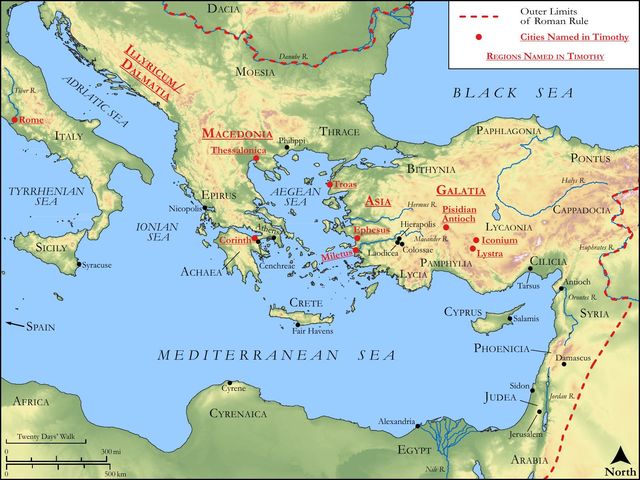
See on the biblical-era maps

Study this verse
Public-domain commentary
Matthew Henry
From his Commentary on the Whole Bible. Henry comments on passages, not single verses — this entry covers 1 Timothy 2:1–8. His three-level outline is real structure in the source text, so it is rendered as structure.
Here is, I. A charge given to Christians to pray for all men in general, and particularly for all in authority. Timothy must take care that this be done. Paul does not send him any prescribed form of prayer, as we have reason to think he would if he had intended that ministers should be tied to that way of praying; but, in general, that they should make supplications, prayers, intercessions, and giving of thanks: supplications for the averting of evil, prayers for the obtaining of good, intercessions for others, and thanksgivings for mercies already received. Paul thought it enough to give them general heads; they, having the scripture to direct them in prayer and the Spirit of prayer poured out upon them, needed not any further directions. Observe, The design of the Christian religion is to promote prayer; and the disciples of Christ must be praying people. Pray always with all prayer, Eph 6:18. There must be prayers for ourselves in the first place; this is implied here. We must also pray for all men, for the world of mankind in general, for particular persons who need or desire our prayers. See how far the Christian religion was from being a sect, when it taught men this diffusive charity, to pray, not only for those of their own way, but for all men. Pray for kings (Ti1 2:2); though the kings at this time were heathens, enemies to Christianity, and persecutors of Christians, yet they must pray for them, because it is for the public good that there should be civil government, and proper persons entrusted with the administration of it, for whom therefore we ought to pray, yea, though we ourselves suffer under them. For kings, and all that are in authority, that is, inferior magistrates: we must pray for them, and we must give thanks for them, pray for their welfare and for the welfare of their kingdoms, and therefore must not plot against them, that in the peace thereof we may have peace, and give thanks for them and for the benefit we have under their government, that we may lead a quiet and peaceable life in all godliness and honesty. Here see what we must desire for kings, that God will so turn their hearts, and direct them and make use of them, that we under them may lead a quiet and peaceable life. He does not say, "that we may get preferments under them, grow rich, and be in honour and power under them;" no, the summit of the ambition of a good Christian is to lead a quiet and peaceable life, to get through the world unmolested in a low private station. We should desire that we and others may lead a peaceable life in all godliness and honesty, implying that we cannot expect to be kept quiet and peaceable unless we keep in all godliness and honesty. Let us mind our duty, and then we may expect to be taken under the protection both of God and the government. In all godliness and honesty. Here we have our duty as Christians summed up in two words: godliness, that is, the right worshipping of God; and honesty, that is, a good conduct towards all men. These two must go together; we are not truly honest if we are not godly, and do not render to God his due; and we are not truly godly if we are not honest, for God hates robbery for burnt-offering. Here we may observe, 1. Christians are to be men much given to prayer: they ought to abound herein, and should use themselves to prayers, supplications, etc. 2. In our prayers we are to have a generous concern for others as well as for ourselves; we are to pray for all men, and to give thanks for all men; and must not confine our prayers nor thanksgiving to our own persons or families. 3. Prayer consists of various parts, of supplications, intercessions, and thanksgivings; for we must pray for the mercies we want, as well as be thankful for mercies already received; and we are to deprecate the judgments which our own sins or the sins of others have deserved. 4. All men, yea, kings themselves, and those who are in authority, are to be prayed for. They want our prayers, for they have many difficulties to encounter, many snares to which their exalted stations expose them. 5. In praying for our governors, we take the most likely course to lead a peaceable and quiet life. The Jews at Babylon were commanded to seek the peace of the city whither the Lord had caused them to be carried captives, and to pray to the Lord for it; for in the peace thereof they should have peace, Jer 29:7. 6. If we would lead a peaceable and quiet life, we must live in all godliness and honesty; we must do our duty to God and man. He that will love life, and see good days, let him refrain his tongue from evil, and his lips that they speak no guile; let him eschew evil, and do good; let him seek peace, and pursue it, Pe1 3:10, Pe1 3:11. Now the reason he gives for this is because this is good in the sight of God our Saviour; that is, the gospel of Christ requires this. That which is acceptable in the sight of God our Saviour we should do, and should abound in.
II.As a reason why we should in our prayers concern ourselves for all men, he shows God's love to mankind in general, Ti1 2:4.
1.One reason why all men are to be prayed for is because there is one God, and that God bears a good will to all mankind. There is one God (Ti1 2:5), and one only, there is no other, there can be no other, for there can be but one infinite. This one God will have all men to be saved; he desires not the death and destruction of any (Eze 33:11), but the welfare and salvation of all. Not that he has decreed the salvation of all, for then all men would be saved; but he has a good will to the salvation of all, and none perish but by their own fault, Mat 23:37. He will have all to be saved, and to come to the knowledge of the truth, to be saved in the way that he has appointed and not otherwise. It concerns us to get the knowledge of the truth, because that is the way to be saved; Christ is the way and the truth, and so he is the life.
2.There is one Mediator, and that mediator gave himself a ransom for all. As the mercy of God extends itself to all his works, so the mediation of Christ extends itself thus far to all the children of men that he paid a price sufficient for the salvation of all mankind; he brought mankind to stand upon new terms with God, so that they are not now under the law as a covenant of works, but as a rule of life. They are under grace; not under the covenant of innocence, but under a new covenant: He gave himself a ransom. Observe, The death of Christ was a ransom, a counter-price. We deserved to have died. Christ died for us, to save us from death and hell; he gave himself a ransom voluntarily, a ransom for all; so that all mankind are put in a better condition than that of devils. He died to work out a common salvation: in order hereunto, he put himself into the office of Mediator between God and man. A mediator supposes a controversy. Sin had made a quarrel between us and God; Jesus Christ is a Mediator who undertakes to make peace, to bring God and man together, in the nature of an umpire or arbitrator, a days - man who lays his hand upon u both, Job 9:33. He is a ransom that was to be testified in due time; that is, in the Old Testament times, his sufferings and the glory that should follow were spoken of as things to be revealed in the last times, Pe1 1:10, Pe1 1:11. And they are accordingly revealed, Paul himself having been ordained a preacher and an apostle, to publish to the Gentiles the glad tidings of redemption and salvation by Jesus Christ. This doctrine of Christ's mediation Paul was entrusted to preach to every creature, Mar 16:15. He was appointed to be a teacher of the Gentiles; besides his general call to the apostleship, he was commissioned particularly to preach to the Gentiles, in faith and truth, or faithfully and truly. Note,
(1.)It is good and acceptable in the sight of God and our Saviour that we pray for kings and for all men, and also that we lead a peaceable and quiet life; and this is a very good reason why we should do the one as well as the other.
(2.)God has a good will to the salvation of all; so that it is not so much the want of a will in God to save them as it is a want of will in themselves to be saved in God's way. Here our blessed Lord charges the fault: You will not come unto me that you may have life, Joh 5:40. I would have gathered you, and you would not.
(3.)Those who are saved must come to the knowledge of the truth, for this is God's appointed way to save sinners. Without knowledge the heart cannot be good; if we do not know the truth, we cannot be ruled by it.
(4.)It is observable that the unity of God is asserted, and joined with the unity of the Mediator; and the church of Rome might as well maintain a plurality of gods as a plurality of mediators.
(5.)He that is a Mediator in the New Testament sense, gave himself a ransom. Vain then is the pretence of the Romanists that there is but one Mediator of satisfaction, but many of intercession; for, according to Paul, Christ's giving himself a ransom was a necessary part of the Mediator's office; and indeed this lays the foundation for his intercession.
(6.)Paul was ordained a minister, to declare this to the Gentiles, that Christ is the one Mediator between God and men, who gave himself a ransom for all. This is the substance of which all ministers are to preach, to the end of the world; and Paul magnified his office, as he was the apostle of the Gentiles, Rom 11:13.
(7.)Ministers must preach the truth, what they apprehend to be so, and they must believe it themselves; they are, like our apostle, to preach in faith and verity, and they must also be faithful and trusty.
III.A direction how to pray, Ti1 2:8.
1.Now, under the gospel, prayer is not to be confined to any one particular house of prayer, but men must pray every where: no place is amiss for prayer, no place more acceptable to God than another, Joh 4:21. Pray every where. We must pray in our closets, pray in our families, pray at our meals, pray when we are on journeys, and pray in the solemn assemblies, whether more public or private.
2.It is the will of God that in prayer we should lift up holy hands: Lifting up holy hands, or pure hands, pure from the pollution of sin, washed in the fountain opened for sin and uncleanness. I will wash my hands, etc., Psa 26:6.
3.We must pray in charity: Without wrath, or malice, or anger at any person.
4.We must pray in faith without doubting (Jam 1:6), or, as some read it, without disputing, and then it falls under the head of charity.
Historical interpretation
Eight Centuries of Reception
8 surviving comments on this verse. Each one is dated, so this reads as a timeline rather than a list.
Select a marker to jump to its quote. Markers stagger vertically where authors wrote within a few decades of each other.
On the other hand, for our own petition, when we say, "Hallowed be Thy name," we pray this; that it may be hallowed in us who are in Him, as well in all others for whom the grace of God is still waiting; that we may obey this precept, too, in "praying for all," even for our personal enemies.
I think that supplication is a prayer offered with a special request for something a person lacks. From this is distinguished prayer which is more plainly offered with simple praise, not to obtain a request but simply to praise the nobility of great things. And I think that intercession is a petition for certain things addressed to God by someone who has some greater boldness, while thanksgiving is a statement of gratitude made with prayers for receiving good things from God, either when it is a great thing that is received and acknowledged with gratitude or when the greatness of the benefit is apparent only to the one who has benefited. ON PRAYER 14.2.Ambrosiaster: “Supplications” are on behalf of secular rulers, that they may have obedient subjects, and thus peace and tranquillity. “Prayers” are for those to whom power has been entrusted, that they may govern with justice and truth, so that all may prosper. “Intercessions” are for those in dire necessity, that they may find help. And “thanksgivings” refer to gratitude for God’s daily providences. Commentary on the First Letter to Timothy.
Theodore of Mopsuestia: Here supplications express the desire for good things from God. Prayers express the desire to be released from various evils. Intercessions ask for freedom from undeserved consequences. And thanksgivings express gratitude for blessings. Commentary on 1 Timothy.
Augustine: I prefer to understand by these words what the entire, or almost the entire, church observes: that we take as supplications those prayers which are said in celebrating the mysteries, before we begin to consecrate what lies on the table of the Lord. Prayers are said when it is blessed and sanctified and broken for distribution; and the whole church, for the most part, closes this complete petition with the Lord’s Prayer. The original Greek word helps us to understand this distinction: the Scripture seldom uses the word euche in the sense of oratio, but generally and much more frequently euchē means votum; whereas proseuchē,the word used in the passage we are treating, is always rendered by oratio.… Now, all the things which are offered to God are vowed, especially the oblation at the holy altar, for in this sacrament we show forth that supreme offering, by which we vow to abide in Christ, even to the union of the body of Christ. The outward sign of this is that “we, being many, are one bread, one body.” Consequently, I think that at this consecration and this preparation for Communion the apostle fittingly wishes that proseuchas, that is, prayers, should be made, or, as some have unskillfully rendered it, adoration, that is, what takes place at the offering, although this is more commonly expressed in Scripture by euchē. Intercessions, however, or, as your texts have it, requests, are offered while the blessing is being given to the people, for at that time, by the laying on of hands, the bishops, as intercessors, offer the members of their flock to the most merciful Power. When this is completed and all have received the holy sacrament, the whole is ended by thanksgiving, and this last is the very term called to our notice by the apostle. LETTERS 149.2.16.
John Cassian: “Supplication’ is a beseeching or petition for sins.… “Prayers” are those by which we offer a vow to God.… “Intercession” is customarily offered, in moments of fervor, for other men and women—our family, the peace of the world. To use St. Paul’s words, we pray “for all men, for kings and all in authority.” … “Thanksgiving” is when the mind recollects what God has done or is doing or looks forward to the good which he has prepared for those who love him, and so offers its gratitude in an indescribable transport of spirit. Sometimes it offers still deeper prayers of this sort; when the soul contemplates in singleness of heart the reward of the saints and so is moved in its happiness to pour forth a wordless thanksgiving.
“Supplications” are on behalf of secular rulers, that they may have obedient subjects, and thus peace and tranquillity. “Prayers” are for those to whom power has been entrusted, that they may govern with justice and truth, so that all may prosper. “Intercessions” are for those in dire necessity, that they may find help. And “thanksgivings” refer to gratitude for God’s daily providences. .
Let us then exhort the saints to give thanks for us. And let us exhort one another toward gratitude. To ministers especially this good work belongs, since it is an exceeding privilege. Drawing near to God, we give thanks for the whole world and the good things we commonly share. The blessings of God are shared in common, and in this common preservation you yourselves are included. Consequently, you both owe common thanksgivings for your own peculiar blessings and for those shared in common with others, for which you rightly should offer your own special form of praise.… So then let us give thanks also for the faith that others have toward God. This custom is an ancient one, planted in the church from the beginning. Thus Paul also gives thanks for the Romans, for the Corinthians and for the whole world.
The Priest is the common father, as it were, of all the world; it is proper therefore that he should care for all, even as God, Whom he serves. For this reason he says, "I exhort therefore that, first of all, supplications, prayers, intercessions, and giving of thanks be made for all men." From this, two advantages result. First, hatred towards those who are without is done away; for no one can feel hatred towards those for whom he prays: and they again are made better by the prayers that are offered for them, and by losing their ferocious disposition towards us. For nothing is so apt to draw men under teaching, as to love, and be loved. Think what it was for those who persecuted, scourged, banished, and slaughtered the Christians, to hear that those whom they treated so barbarously offered fervent prayers to God for them. Observe how he wishes a Christian to be superior to all ill-treatment. As a father who was struck on the face by a little child which he was carrying, would not lose anything of his affection for it; so we ought not to abate in our good will towards those who are without, even when we are stricken by them. What is "first of all"? It means in the daily Service; and the initiated know how this is done every day both in the evening and the morning, how we offer prayers for the whole world, for kings and all that are in authority.
I prefer to understand by these words what the entire, or almost the entire, church observes: that we take as supplications those prayers which are said in celebrating the mysteries, before we begin to consecrate what lies on the table of the Lord. Prayers are said when it is blessed and sanctified and broken for distribution; and the whole church, for the most part, closes this complete petition with the Lord’s Prayer. The original Greek word helps us to understand this distinction: the Scripture seldom uses the word euche in the sense of oratio, but generally and much more frequently euch&#; means votum; whereas proseuch&#;,the word used in the passage we are treating, is always rendered by oratio. … Now, all the things which are offered to God are vowed, especially the oblation at the holy altar, for in this sacrament we show forth that supreme offering, by which we vow to abide in Christ, even to the union of the body of Christ. The outward sign of this is that “we, being many, are one bread, one body.” Consequently, I think that at this consecration and this preparation for Communion the apostle fittingly wishes that proseuchas, that is, prayers, should be made, or, as some have unskillfully rendered it, adoration, that is, what takes place at the offering, although this is more commonly expressed in Scripture by euch&#;.Intercessions, however, or, as your texts have it, requests, are offered while the blessing is being given to the people, for at that time, by the laying on of hands, the bishops, as intercessors, offer the members of their flock to the most merciful Power. When this is completed and all have received the holy sacrament, the whole is ended by thanksgiving, and this last is the very term called to our notice by the apostle. .
“Supplication’ is a beseeching or petition for sins…. “Prayers” are those by which we offer a vow to God…. “Intercession” is customarily offered, in moments of fervor, for other men and women—our family, the peace of the world. To use St. Paul’s words, we pray “for all men, for kings and all in authority.” … “Thanksgiving” is when the mind recollects what God has done or is doing or looks forward to the good which he has prepared for those who love him, and so offers its gratitude in an indescribable transport of spirit. Sometimes it offers still deeper prayers of this sort; when the soul contemplates in singleness of heart the reward of the saints and so is moved in its happiness to pour forth a wordless thanksgiving.
First of all, then, I urge that petitions, prayers, intercessions, and thanksgivings be made for all people; for kings and all who are in high positions, that we may lead a peaceful and quiet life in all godliness and dignity.
In daily worship, this would be before the remembrance of others, he says. To make petitions. A petition is a plea offered for deliverance from troubles. Prayer is a request for good things. Intercession is an accusation against wrongdoers.
thanksgivings, for it is necessary to give thanks for the good things that happen to one another.
be made for all people. Since the bishop is a common father, he ought to pray for all people, both the faithful and the unbelievers, friends and enemies, those who slander and those who afflict.
for kings. Then, so that the matter might not appear to be flattery, first saying, be made for all people; thus he declared, "for kings and all who are in high positions."
that we may lead a peaceful and quiet life. Let no Christian be disturbed in any way; therefore, during the time of the mysteries, let him remember that the king, since he is often unfaithful, shows that our profit is their salvation. But how is their salvation our profit? How? For if they are preserved and conduct themselves excellently in wars against enemies, we live quietly and peacefully with no one disturbing us. It would indeed be absurd if they were to be exhausted for the common safety, but we do not even bring together that which is in us as help (I mean prayer) for them.
in all godliness. There are three kinds of wars: one is against the Barbarians; one is against those of the same race; the third, which the soul wages against the body, which is the hardest of all. For the war against the Barbarians brings only death or slavery. The war against those of the same race, I have learned to avoid through gentleness. "Instead of loving me," he says, "they attacked me, but I prayed." (Ps. 109:4) And, "I was peaceful among those who hate peace". (Ps. 120:6) But the one within ourselves is difficult to accomplish, and it brings harm to the soul. Therefore, he wishes to pray for the kings, so that they may both conquer and endure, knowing that the peace from the Barbarians greatly contributes to the peace within ourselves. For if one must be at leisure and know God, then freedom and harmony are necessary for the knowledge of God and kindness. How then could those engaged in wars with the Barbarians be at rest? For it is noble and undeniable to pray for all people, both Greeks and others, so that they may turn back.
Continue studying 1 Timothy 2:1 across the web’s major study libraries — every link below opens this exact verse, chapter, or book on the destination site.
Read & Compare
 BibleGatewayThis verse in more than 200 translations and 70 languages.
 Bible.comThe YouVersion reader — hundreds of translations, reading plans, and highlights.
 ESV.orgCrossway's official English Standard Version reader.
 NET BibleThe NET translation with 60,000+ translators' notes on every rendering decision.
 STEP BibleTyndale House's free study tool — original text, vocabulary, and scholarly resources.
 BibliaLogos Bible Software's free web reader.
 USCCBThe New American Bible (Revised Edition) with the U.S. bishops' study notes.
Commentaries
 BibleHub CommentariesDozens of classic commentaries on this verse, gathered on one page.
 StudyLightMore than 100 commentary sets — the largest collection on the web.
 BibleRefPlain-English commentary on what this verse means, verse by verse.
 Enduring WordDavid Guzik's free commentary on this chapter, widely used by Bible teachers.
 Bible Study ToolsVerse commentary alongside Greek and Hebrew study aids.
Original Language & Research
- BibleHub InterlinearThe verse word by word — original language, transliteration, and English.
- BibleHub LexiconEvery word's original-language definition and Strong's entry.
 Blue Letter BibleDeep-study tools — Strong's numbers, concordance, and word studies.
 CNTR CollationThe earliest Greek manuscripts of this verse, collated letter by letter.
Sermons, Hymns & Audio


TrulyRandomVerse is not affiliated with these sites and doesn’t control their content. They’re linked because they’re genuinely useful.
Summary
1 Timothy 2:1 serves as a foundational exhortation from the Apostle Paul to Timothy, emphasizing the paramount importance and comprehensive nature of prayer within the Christian community. It calls believers to engage in a wide spectrum of prayer—supplications, prayers, intercessions, and thanksgivings—not merely for themselves or fellow believers, but universally "for all men," setting the stage for a holistic and outward-focused approach to corporate and individual devotion that reflects God's redemptive heart for humanity.
Context
ShowHideLiterary Context
This verse initiates a critical section within Paul's first letter to Timothy, transitioning from instructions regarding false teaching and sound doctrine in chapter 1 to practical guidelines for public worship and church order. The "therefore" (οὖν, G3767) links this exhortation directly to the preceding discussion, implying that proper prayer is a necessary response to the challenges of false teaching and a key component of a healthy church. Verses 2-7 elaborate on the reasons for praying for "all men," specifically mentioning kings and those in authority, and connecting this practice to God's universal desire for salvation. This passage thus forms the theological and practical bedrock for the subsequent instructions on gender roles in worship and qualifications for church leadership, as seen in 1 Timothy 3.
Historical & Cultural Context
Written likely between A.D. 62-64, during Paul's release from his first Roman imprisonment, 1 Timothy addresses Timothy, who was leading the church in Ephesus, a prominent city in Asia Minor known for its diverse religious practices and the pervasive cult of Artemis. The Ephesian church faced internal challenges, including false teachers promoting asceticism and myths (1 Timothy 1:3-7), as well as external pressures from a pagan society. In this environment, Paul's instructions on orderly worship and prayer, especially for "all men" and those in authority, were crucial. Such prayers would have been counter-cultural, as Christians were often viewed with suspicion or hostility by Roman authorities, yet Paul insists on a posture of respectful and beneficial intercession, aiming for a peaceful environment conducive to gospel proclamation (1 Timothy 2:2-4).
Key Themes
ShowHideThe overarching theme of 1 Timothy is the proper conduct in God's household, which is "the church of the living God, the pillar and ground of the truth" (1 Timothy 3:15). Within this broader context, 1 Timothy 2 specifically emphasizes the priority of prayer as foundational to church life, underscored by the phrase "first of all." It also highlights the comprehensiveness of prayer, detailing various forms (supplications, prayers, intercessions, thanksgivings) to ensure a rich and balanced communion with God. Most significantly, the passage champions the universal scope of prayer, commanding intercession "for all men," which directly reflects God's redemptive will for humanity, as further articulated in 1 Timothy 2:4.
Exposition and Analysis
ShowHideKey Word Analysis
ShowHideMeaning "to call near, i.e. invite, invoke (by imploration, hortation or consolation)." Paul's use of this word indicates a strong, earnest appeal or urging, more than just a suggestion. It carries the weight of pastoral authority combined with a deep concern for the spiritual well-being and proper conduct of the church.
Meaning "firstly (in time, place, order, or importance)." This adverbial phrase emphatically prioritizes prayer. It signifies that prayer is not merely one item on a list of church activities but holds a preeminent position in terms of importance, foundational necessity, and possibly even chronological order in public worship.
Meaning "all, any, every, the whole." This word is used twice in the verse ("first of all," "for all men") and is crucial for understanding the expansive scope of Paul's instruction. It leaves no room for exclusion, emphasizing the universal reach of Christian prayer, extending beyond the community of believers to encompass all humanity without exception.
Verse Breakdown
ShowHide"I exhort therefore"
Paul begins with a strong pastoral directive, linking this instruction to previous discussions (likely concerning the challenges faced by the Ephesian church). The term "exhort" (G3870, parakaléō) conveys a deep urgency and authoritative plea, not merely a suggestion, indicating the vital importance of what follows.
"that, first of all"
This phrase (G4412, prōton) establishes the absolute priority of prayer. It is not just one spiritual discipline among many, but the foundational and preeminent activity for the church and individual believers. Its placement at the beginning of the list of instructions for public worship underscores its supreme importance.
"supplications, prayers, intercessions, [and] giving of thanks"
Paul provides a comprehensive taxonomy of prayer. "Supplications" (G1162, déēsis) refer to specific requests born out of a sense of need. "Prayers" (G4335, proseuchḗ) is the most general term for worshipful address to God. "Intercessions" (G1783, énteuxis) denote bold approaches to God on behalf of others. "Giving of thanks" (G2169, eucharistía) highlights the essential element of gratitude and praise, ensuring prayer is not solely petitionary but also worshipful acknowledgment of God's goodness.
"be made"
This phrase (G4160, poiéō) indicates that these various forms of prayer are to be actively and intentionally performed or offered. It implies a deliberate and consistent practice, both individually and corporately, within the life of the church.
"for all men"
This crucial phrase (G3956, pâs and G444, ánthrōpos) defines the universal scope of Christian prayer. It commands believers to pray for all humanity, regardless of their faith, status, or relationship to the church. This expansive mandate reflects God's own benevolent character and His desire for the salvation of all people, as further explained in the subsequent verses.
Literary Devices
ShowHidePaul employs several literary devices to convey his urgent and comprehensive message. The use of a List of four distinct but complementary terms for prayer—supplications, prayers, intercessions, and thanksgivings—creates a sense of completeness and ensures that no aspect of communication with God is neglected. This Enumeration emphasizes the richness and breadth of the prayer life Paul envisions for the church. The emphatic phrase "first of all" functions as a form of Emphasis, underscoring the supreme priority of prayer, making it clear that this is not merely a suggestion but a foundational command. Furthermore, the repeated use of the word "all" (G3956, pâs) in "first of all" and "for all men" serves as a powerful Repetition that reinforces the universal scope of the exhortation, highlighting both the preeminence of prayer and its boundless reach to all humanity.
Theological and Thematic Connections
ShowHide1 Timothy 2:1 lays a theological cornerstone for understanding the church's mission and posture in the world. By commanding prayer "first of all" and "for all men," Paul underscores the profound truth that prayer is not merely a spiritual discipline but a primary means through which God's will is advanced on earth. This universal scope of prayer reflects God's own character as a loving Creator who desires the salvation of all humanity, transcending social, ethnic, or political divides. It challenges believers to move beyond self-centered or insular prayers, embracing a missional perspective that intercedes for the lost, the powerful, and the vulnerable, thereby participating in God's redemptive plan for the entire world. This comprehensive approach to prayer, encompassing petition, worship, intercession, and gratitude, ensures a holistic and mature relationship with God.
Reflection and Application
ShowHide1 Timothy 2:1 calls us to a profound re-evaluation of our prayer lives, both individually and corporately. The emphatic "first of all" challenges us to consider if prayer truly holds the preeminent place in our daily routines and church gatherings that Paul insists upon. Are our spiritual lives characterized by a deep dependence on God expressed through consistent, fervent prayer? Furthermore, the comprehensive nature of the four types of prayer encourages us to diversify our communion with God, moving beyond mere requests to include worship, specific intercession for others, and heartfelt thanksgiving, cultivating a rich and balanced dialogue. Most significantly, the command to pray "for all men" compels us to expand the boundaries of our concern, extending our intercessions to those outside our immediate circles—our communities, our nations, our leaders, and indeed, all humanity. This universal scope of prayer is a powerful act of love and obedience, aligning our hearts with God's desire for the salvation of all people and actively participating in His redemptive work in the world.
Questions for Reflection
ShowHideFAQ
ShowHideWhy does Paul list four different types of prayer? Are they distinct or overlapping?
ShowHidePaul's listing of "supplications, prayers, intercessions, and giving of thanks" is not merely redundant but serves to emphasize the richness and comprehensive nature of our communication with God. While there is certainly overlap, each term highlights a distinct nuance:
Together, these terms encourage believers to cultivate a well-rounded and holistic prayer life that encompasses personal needs, general worship, advocacy for others, and heartfelt gratitude.
Christ-Centered Fulfillment
ShowHide1 Timothy 2:1, with its universal call to prayer "for all men," finds its ultimate fulfillment and theological grounding in the person and work of Jesus Christ. The very reason we are to pray for all people is rooted in God's universal redemptive purpose, which is fully embodied in Christ. As 1 Timothy 2:5-6 immediately clarifies, "For there is one God, and one mediator between God and men, the man Christ Jesus; who gave himself a ransom for all, to be testified in due time." Jesus is the singular bridge between a holy God and sinful humanity, having offered Himself as the perfect, all-sufficient sacrifice for the sins of the entire world (John 1:29; 1 John 2:2). Our prayers for "all men" are therefore an active participation in the Father's desire for all to be saved (1 Timothy 2:4) and a reflection of Christ's boundless love and atoning work, which extends to every tribe, tongue, people, and nation (Revelation 5:9). In praying universally, we align ourselves with the cosmic scope of Christ's mission and the ultimate triumph of His kingdom, which will gather believers from every corner of the earth.