


Philippians 4:6
- μηδὲνmēdenNothingG3367A-ASN-NAdjective Accusative Singular Neuter Negative
- μεριμνᾶτεmerimnatedo worry aboutG3309V-PAM-2PVerb Present Active Imperative 2nd Plural
- ἀλλ᾽all᾽butG235CONJConjunction
- ἐνeninG1722PREPPreposition
- παντὶpantieverythingG3956A-DSNAdjective Dative Singular Neuter
- τῇtēa<the>G3588T-DSFDefinite article Dative Singular Feminine
- προσευχῇproseuchēaby prayerG4335N-DSFNoun Dative Singular Feminine
- καὶkaiandG2532CONJConjunction
- τῇtēa<the>G3588T-DSFDefinite article Dative Singular Feminine
- δεήσειdeēseiby supplicationG1162N-DSFNoun Dative Singular Feminine
- μετὰmetawithG3326PREPPreposition
- εὐχαριστίαςeucharistiasthanksgivingG2169N-GSFNoun Genitive Singular Feminine
- τὰtatheG3588T-NPNDefinite article Nominative Plural Neuter
- αἰτήματαaitēmatarequestsG155N-NPNNoun Nominative Plural Neuter
- ὑμῶνhumōnof youG4771P-2GPPersonal pronoun Genitive 2nd Plural
- γνωριζέσθωgnōrizesthōshould be made knownG1107V-PPM-3SVerb Present Passive Imperative 3rd Singular
- πρὸςprostoG4314PREPPreposition
- τὸνton<the>G3588T-ASMDefinite article Accusative Singular Masculine
- θεόν·theonGodG2316N-ASM-TNoun Accusative Singular Masculine Title
English is a literal word-by-word gloss of the Greek, not the KJV's wording. Why?
This is the original text the KJV's translators worked from — each Greek word with its own literal English meaning in this verse, prepared by scholars at Tyndale House, Cambridge. The KJV translates whole sentences, not word by word, so its wording differs: one Greek word can become several English words, and the KJV may choose “charity” where the gloss reads “love”. Both are faithful — they answer different questions. For the KJV's own rendering, switch to the KJV text.
Details
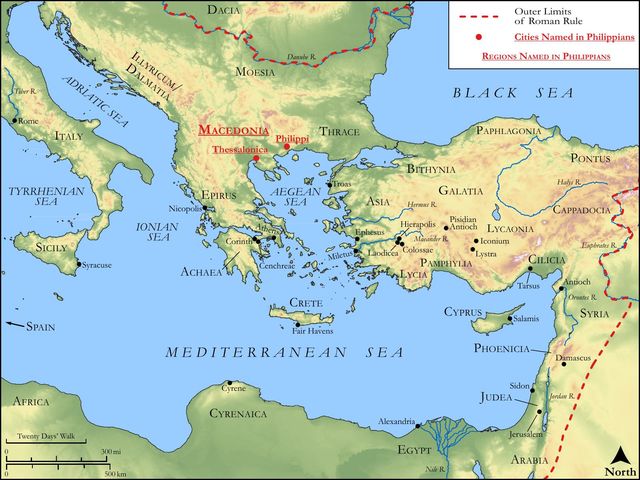
See on the biblical-era map

Study this verse
Public-domain commentary
Matthew Henry
From his Commentary on the Whole Bible. Henry comments on passages, not single verses — this entry covers Philippians 4:1–9. His three-level outline is real structure in the source text, so it is rendered as structure.
The apostle begins the chapter with exhortations to divers Christian duties.
I.To stedfastness in our Christian profession, Phi 4:1.
It is inferred from the close of the foregoing chapter: Therefore stand fast, etc. Seeing our conversation is in heaven, and we look for the Saviour to come thence and fetch us thither, therefore let us stand fast. Note, The believing hope and prospect of eternal life should engage us to be steady, even, and constant, in our Christian course. Observe here,
1.The compellations are very endearing: My brethren, dearly beloved and longed for, my joy and crown; and again, My dearly beloved. Thus he expresses the pleasure he took in them, the kindness he had for them, to convey his exhortations to them with so much the greater advantage. He looked upon them as his brethren, though he was a great apostle. All we are brethren. There is difference of gifts, graces, and attainments, yet, being renewed by the same Spirit, after the same image, we are brethren; as the children of the same parents, though of different ages, statures, and complexions. Being brethren,
(1.)He loved them, and loved them dearly: Dearly beloved; and again, My dearly beloved. Warm affections become ministers and Christians towards one another. Brotherly love must always go along with brotherly relation.
(2.)He loved them and longed for them, longed to see them and hear from them, longed for their welfare and was earnestly desirous of it. I long after you all in the bowels of Jesus Christ, Phi 1:8.
(3.)He loved them and rejoiced in them. They were his joy; he had no greater joy than to hear of their spiritual health and prosperity. I rejoiced greatly that I found of thy children walking in the truth, Jo2 1:4; Jo3 1:4. (4.) he loved them and gloried in them. They were his crown as well as his joy. Never was proud ambitious man more pleased with the ensigns of honour than Paul was with the evidences of the sincerity of their faith and obedience. All this is to prepare his way to greater regard.
2.The exhortation itself: So stand fast in the Lord. Being in Christ, they must stand fast in him, be even and steady in their walk with him, and close and constant unto the end. Or, To stand fast in the Lord is to stand fast in his strength and by his grace; not trusting in ourselves, and disclaiming any sufficiency of our own. We must be strong in the Lord, and in the power of his might, Eph 6:10. "So stand fast, so as you have done hitherto, stand fast unto the end, so as you are by beloved, and my joy and crown; so stand fast as those in whose welfare and perseverance I am so nearly interested and concerned."
II.He exhorts them to unanimity and mutual assistance (Phi 4:2, Phi 4:3):
I beseech Euodias and Syntyche that they be of the same mind in the Lord. This is directed to some particular persons. Sometimes there is need of applying the general precepts of the gospel to particular persons and cases. Euodias and Syntyche, it seems, were at variance, either one with the other or with the church; either upon a civil account (it may be they were engaged in a law-suit) or upon a religious account - it may be they were of different opinions and sentiments. "Pray," says he, "desire them from me to be of the same mind in the Lord, to keep the peace and live in love, to be of the same mind one with another, not thwarting and contradicting, and to be of the same mind with the rest of the church, not acting in opposition to them." Then he exhorts to mutual assistance (Phi 4:3), and this exhortation he directs to particular persons: I entreat thee also, true yoke-fellow. Who this person was whom he calls true yoke-fellow is uncertain. Some think Epaphroditus, who is supposed to have been one of the pastors of the church of the Philippians. Others think it was some eminently good woman, perhaps Paul's wife, because he exhorts his yoke-fellow to help the women who laboured with him. Whoever was the yoke-fellow with the apostle must be a yoke-fellow too with his friends. It seems, there were women who laboured with Paul in the gospel; not in the public ministry (for the apostle expressly forbids that, Ti1 2:12, I suffer not a woman to teach), but by entertaining the ministers, visiting the sick, instructing the ignorant, convincing the erroneous. Thus women may be helpful to ministers in the work of the gospel. Now, says the apostle, do thou help them. Those who help others should be helped themselves when there is occasion. "Help them, that is, join with them, strengthen their hands, encourage them in their difficulties." - With Clement also, and other my fellow-labourers. Paul had a kindness for all his fellow-labourers; and, as he had found the benefit of their assistance, he concluded how comfortable it would be to them to have the assistance of others. Of his fellow-labourers he says, Whose names are in the book of life; either they were chosen of God from all eternity, or registered and enrolled in the corporation and society to which the privilege of eternal life belongs, alluding to the custom among the Jews and Gentiles of registering the inhabitants or the freemen of the city. So we read of their names being written in heaven (Luk 10:20), not blotting his name out of the book of life (Rev 3:5), and of those who are written in the Lamb's book of life, Rev 21:27. Observe, There is a book of life; there are names in that book and not characters and conditions only. We cannot search into that book, or know whose names are written there; but we may, in a judgment of charity, conclude that those who labour in the gospel, and are faithful to the interest of Christ and souls, have their names in the book of life.
III.He exhorts to holy joy and delight in God:
Rejoice in the Lord always, and again I say, Rejoice, Phi 4:4. All our joy must terminate in God; and our thoughts of God must be delightful thoughts. Delight thyself in the Lord (Psa 37:4), in the multitude of our thoughts within us (grievous and afflicting thoughts) his comforts delight our souls (Psa 94:19), and our meditation of him is sweet, Psa 104:34. Observe, It is our duty and privilege to rejoice in God, and to rejoice in him always; at all times, in all conditions; even when we suffer for him, or are afflicted by him. We must not think the worse of him or of his ways for the hardships we meet with in his service. There is enough in God to furnish us with matter of joy in the worst circumstance on earth. He had said it before (Phi 3:1): Finally, my brethren, rejoice in the Lord. Here he says it again, Rejoice in the Lord always; and again I say Rejoice. Joy in God is a duty of great consequence in the Christian life; and Christians need to be again and again called to it. If good men have not a continual feast, it is their own fault.
IV.We are here exhorted to candour and gentleness, and good temper towards our brethren:
"Let your moderation be known to all men, Phi 4:5. In things indifferent do not run into extremes; avoid bigotry and animosity; judge charitably concerning one another." The word to epieikes signifies a good disposition towards other men; and this moderation is explained, Rom. 14. Some understand it of the patient bearing of afflictions, or the sober enjoyment of worldly good; and so it well agrees with the following verse. The reason is, the Lord is at hand. The consideration of our Master's approach, and our final account, should keep us from smiting our fellow-servants, support us under present sufferings, and moderate our affections to outward good. "He will take vengeance on your enemies, and reward your patience."
V.Here is a caution against disquieting perplexing care (Phi 4:6):
Be careful for nothing - mēden merimnate: the same expression with that Mat 6:25, Take no thought for your life; that is, avoid anxious care and distracting thought in the wants and difficulties of life. Observe, It is the duty and interest of Christians to live without care. There is a care of diligence which is our duty, and consists in a wise forecast and due concern; but there is a care of diffidence and distrust which is our sin and folly, and which only perplexes and distracts the mind. "Be careful for nothing, so as by your care to distrust God, and unfit yourselves for his service."
VI.As a sovereign antidote against perplexing care he recommends to us constant prayer:
In every thing by prayer and supplication, with thanksgiving, let your requests be made known to God. Observe,
1.We must not only keep up stated times for prayer, but we must pray upon every particular emergency: In every thing by prayer. When any thing burdens our spirits, we must ease our minds by prayer; when our affairs are perplexed or distressed, we must seek direction and support.
2.We must join thanksgiving with our prayers and supplications. We must not only seek supplies of good, but own receipts of mercy. Grateful acknowledgments of what we have argue a right disposition of mind, and are prevailing motives for further blessings.
3.Prayer is the offering up of our desires to God, or making them known to him: Let your requests be made known to God. Not that God needs to be told either our wants or desires; for he knows them better than we can tell him: but he will know them from us, and have us show our regards and concern, express our value of the mercy and sense of our dependence on him.
4.The effect of this will be the peace of God keeping our hearts, Phi 4:7. The peace of God, that is, the comfortable sense of our reconciliation to God and interest in his favour, and the hope of the heavenly blessedness, and enjoyment of God hereafter, which passeth all understanding, is a great good than can be sufficiently valued or duly expressed. It has not entered into the heart of ham, Co1 2:9. This peace will keep our hearts and minds through Christ Jesus; it will keep us from sinning under our troubles, and from sinking under them; keep us calm and sedate, without discomposure of passion, and with inward satisfaction. Thou wilt keep him in perfect peace whose mind is stayed on thee, Isa 26:3.
VII.We are exhorted to get and keep a good name, a name for good things with God and good men:
Whatsoever things are true and honest (Phi 4:8), a regard to truth in our words and engagements, and to decency and becomingness in our behaviour, suitable to our circumstances and condition of life. Whatsoever things are just and pure, - agreeable to the rules of justice and righteousness in all our dealings with men, and without the impurity or mixture of sin. Whatsoever things are lovely and of good report, that is, amiable; that will render us beloved, and make us well spoken of, as well as well thought of, by others. If there is any virtue, if there is any praise - any thing really virtuous of any kind and worthy of commendation. Observe,
1.The apostle would have the Christians learn any thing which was good of their heathen neighbours: "If there be any virtue, think of these things - imitate them in what is truly excellent among them, and let not them outdo you in any instance of goodness." We should not be ashamed to learn any good thing of bad men, or those who have not our advantages.
2.Virtue has its praise, and will have. We should walk in all the ways of virtue, and abide therein; and then, whether our praise be of men or no, it will be of God, Rom 2:29.
In these things he proposes himself to them for an example (Phi 4:9): Those things which you have learned, and received, and heard and seen in me, do. Observe, Paul's doctrine and life were of a piece. What they saw in him was the same thing with what they heard from him. He could propose himself as well as his doctrine to their imitation. It gives a great force to what we say to others when we can appeal to what they have seen in us. And this is the way to have the God of peace with us - to keep close to our duty to him. The Lord is with us while we are with him.
Historical interpretation
Sixteen Centuries of Reception
3 surviving comments on this verse. Each one is dated, so this reads as a timeline rather than a list.
Select a marker to jump to its quote. Markers stagger vertically where authors wrote within a few decades of each other.
“Do not be anxious about anything.” This means: Do not be concerned for yourselves. Do not give unnecessary thought to or be anxious about the world or worldly things. For all that is needful for you in this life God provides. And it will be even better in that life which is eternal.
"In nothing be anxious." If ye are kindly affected toward those who prepare evil against you, yet it shall not at last turn out to their profit. Already the recompense is at hand, if poverty, if death, if aught else that is terrible be upon you. "But in everything, by prayer and supplication, with thanksgiving, let your requests be made known unto God." There is this for one consolation, "the Lord is at hand." And again, "I will be with you alway, even unto the end of the world." (Matt. xxviii. 20.) Behold another consolation, a medicine which healeth grief, and distress, and all that is painful. And what is this? Prayer, thanksgiving in all things. And so He wills that our prayers should not simply be requests, but thanksgivings too for what we have. For how should he ask for future things, who is not thankful for the past? "But in everything by prayer and supplication." Wherefore we ought to give thanks for all things, even for those which seem to be grievous, for this is the part of the truly thankful man. In the other case the nature of the things demands it; but this springs from a grateful soul, and one earnestly affected toward God. God acknowledgeth these prayers, but others He knoweth not. Offer up such prayers as may be acknowledged; for He disposeth all things for our profit, though we know it not. And this is a proof that it greatly profiteth, namely, that we know it not.
Of the two difficulties you mention I think that only one is often a practical problem for believers. The other is in my experience usually raised by people who are attacking Christianity.
The ideal opening for their attacks - if they know the Bible - is the phrase in Philippians about "making your requests known to God". I mean, the words making known bring out most clearly the apparent absurdity with which they charge us. We say that we believe God to be omniscient; yet a great deal of prayer seems to consist of giving Him information. And indeed we have been reminded by Our Lord too not to pray as if we forgot the omniscience - "for your heavenly Father knows you need all these things".
This is final against one very silly sort of prayer. I have heard a man offer a prayer for a sick person which really amounted to a diagnosis followed by advice as to how God should treat the patient. And I have heard prayers nominally for peace, but really so concerned for various devices which the petitioner believed to be means to peace, that they were open to the same criticism.
But even when that kind of thing is ruled out, the unbeliever's objection remains. To confess our sins before God is certainly to tell Him what He knows much better than we. And also, any petition is a kind of telling. If it does not strictly exclude the belief that God knows our need, it at least seems to solicit His attention. Some traditional formulae make that implication very clear: "Hear us, good Lord" - "O let thine ears consider well the voice of my complaint." As if, though God does not need to be informed, He does need, and even rather frequently, to be reminded. But we cannot really believe that degrees of attention, and therefore of inattention, and therefore of something like forgetfulness, exist in the Absolute Mind. I presume that only God's attention keeps me (or anything else) in existence at all.
What, then, are we really doing? Our whole conception of, so to call it, the prayer-situation depends on the answer.
We are always completely, and therefore equally, known to God. That is our destiny whether we like it or not. But though this knowledge never varies, the quality of our being known can. A school of thought holds that "freedom is willed necessity". Never mind if they are right or not. I want this idea only as an analogy. Ordinarily, to be known by God is to be, for this purpose, in the category of things. We are, like earthworms, cabbages, and nebulae, objects of Divine knowledge. But when we (a) become aware of the fact - the present fact, not the generalisation - and (b) assent with all our will to be so known, then we treat ourselves, in relation to God, not as things but as persons. We have unveiled. Not that any veil could have baffled His sight. The change is in us. The passive changes to the active. Instead of merely being known, we show, we tell, we offer ourselves to view.
Continue studying Philippians 4:6 across the web’s major study libraries — every link below opens this exact verse, chapter, or book on the destination site.
Read & Compare
 BibleGatewayThis verse in more than 200 translations and 70 languages.
 Bible.comThe YouVersion reader — hundreds of translations, reading plans, and highlights.
 ESV.orgCrossway's official English Standard Version reader.
 NET BibleThe NET translation with 60,000+ translators' notes on every rendering decision.
 STEP BibleTyndale House's free study tool — original text, vocabulary, and scholarly resources.
 BibliaLogos Bible Software's free web reader.
 USCCBThe New American Bible (Revised Edition) with the U.S. bishops' study notes.
Commentaries
 BibleHub CommentariesDozens of classic commentaries on this verse, gathered on one page.
 StudyLightMore than 100 commentary sets — the largest collection on the web.
 BibleRefPlain-English commentary on what this verse means, verse by verse.
 Enduring WordDavid Guzik's free commentary on this chapter, widely used by Bible teachers.
 Bible Study ToolsVerse commentary alongside Greek and Hebrew study aids.
Original Language & Research
- BibleHub InterlinearThe verse word by word — original language, transliteration, and English.
- BibleHub LexiconEvery word's original-language definition and Strong's entry.
 Blue Letter BibleDeep-study tools — Strong's numbers, concordance, and word studies.
 CNTR CollationThe earliest Greek manuscripts of this verse, collated letter by letter.
Sermons, Hymns & Audio


TrulyRandomVerse is not affiliated with these sites and doesn’t control their content. They’re linked because they’re genuinely useful.
Summary
Philippians 4:6 serves as a foundational exhortation for believers to combat anxiety not through passive resignation, but through active, faith-filled engagement with God. It directs the Christian to replace worry with a disciplined approach to prayer, supplication, and thanksgiving, ensuring that all needs and desires are transparently communicated to the Heavenly Father, thereby opening the door to divine peace.
Context
ShowHideLiterary Context
This verse is strategically placed within the concluding chapter of Paul's letter to the Philippians, a letter renowned for its themes of joy, unity, and steadfastness in Christ amidst adversity. Following the powerful commands to "rejoice in the Lord always" and to let one's "gentleness be evident to all", Paul transitions from a general disposition to a specific, practical discipline. Philippians 4:6 provides the actionable method for cultivating the joy and peace he advocates, directly preceding the profound promise of "the peace of God, which transcends all understanding" in the subsequent verse. It is the hinge between the call to Christian character and the experience of divine tranquility.
Historical & Cultural Context
Paul wrote this epistle from prison (likely Rome, though Caesarea or Ephesus are also possibilities), enduring confinement for the sake of the Gospel. The Philippian church, his beloved partners in ministry, faced external pressures, possibly persecution, and internal challenges, including disunity (e.g., Philippians 4:2). In the Greco-Roman world, anxiety was a pervasive human experience, often addressed through philosophical stoicism or reliance on fate. Paul's instruction stands in stark contrast to these approaches, offering a radical alternative rooted in a personal, relational God. The cultural context also valued patronage, and Paul's encouragement to "make requests known" aligns with the concept of approaching a benevolent patron (God) with needs, trusting in His ability and willingness to provide.
Key Themes
ShowHidePhilippians 4:6 powerfully contributes to several overarching themes in the letter and broader Pauline theology. It directly addresses the theme of Overcoming Worry, presenting prayer as the divinely appointed antidote to anxious thoughts, which can hinder Christian joy and effectiveness. It underscores the Power of Prayer, portraying it not merely as a religious ritual but as a vital, transformative means of communion and dependence upon God, as seen throughout Paul's writings (e.g., Ephesians 6:18). The inclusion of Thanksgiving highlights the importance of a grateful disposition, even amidst trials, reflecting a deep trust in God's faithfulness and sovereignty, a theme echoed in passages like Colossians 3:17. Finally, the verse reinforces the theme of Divine Provision and Care, inviting believers to cast their burdens upon a God who is both able and willing to hear and respond to their specific needs, thereby fostering a life of confident reliance, as opposed to self-sufficient striving, which is a recurring message in the New Testament, notably in Matthew 6:25-34.
Exposition and Analysis
ShowHideKey Word Analysis
ShowHideFrom μέριμνα, meaning to be anxious about, to be worried, or to have distracting cares. The command "Be careful for nothing" (μηδὲν μεριμνᾶτε) is an imperative, a direct prohibition against a state of anxious worry or being consumed by distracting concerns. It's not a call to indifference, but to freedom from debilitating anxiety that can paralyze faith and action.
From δέομαι, meaning a petition or a specific request. While "prayer" (προσευχή, proseuchḗ) is a general term for addressing God in worship and communion, "supplication" narrows the focus to earnest pleas for particular needs or desires. The pairing emphasizes both the broad scope of our communication with God and the specific nature of our petitions.
From εὐχάριστος, denoting gratitude or grateful language, especially to God as an act of worship. The inclusion of thanksgiving alongside prayer and supplication is crucial. It transforms the act of asking into an expression of faith and trust, acknowledging God's past faithfulness and anticipating His future goodness, even before the requests are answered. It shifts the focus from the problem to the Provider.
Verse Breakdown
ShowHide"Be careful for nothing;"
This is a direct, emphatic command to cease from anxious worry. The Greek construction implies a cessation of an ongoing state, urging believers not to allow any circumstance to induce a state of debilitating anxiety or distracting care. It sets the stage for the positive instruction that follows, highlighting the futility and ungodliness of worry.
"but in every thing"
This phrase establishes the comprehensive scope of the instruction. It means "in all circumstances," "in every situation," or "concerning everything." No area of life, no matter how trivial or overwhelming, is excluded from this divine directive. It contrasts sharply with the "nothing" of the preceding clause, emphasizing that while worry should be absent, God's involvement should be universal.
"by prayer and supplication with thanksgiving"
This tripartite phrase outlines the prescribed method for addressing life's challenges. "Prayer" refers to general communion and worship, while "supplication" denotes specific, earnest requests. The vital addition of "with thanksgiving" elevates the act from mere asking to an expression of faith, trust, and gratitude, acknowledging God's character and past provisions, even as new requests are made. This attitude of gratitude is foundational to a healthy prayer life.
"let your requests be made known unto God."
This is the ultimate action. It's not that God is unaware of our needs, but that the act of articulating our "requests" (αἴτημα, aítēma, a thing asked or a petition) to Him is an act of dependence, humility, and trust. It is a conscious decision to relinquish control and entrust our concerns to the sovereign and loving Father. This transparency fosters intimacy and reinforces our reliance on His divine will and power.
Literary Devices
ShowHidePaul employs several potent literary devices in Philippians 4:6 to convey his message with clarity and force. The most prominent is Antithesis, directly contrasting "nothing" (no anxiety) with "every thing" (all matters brought to God), highlighting the complete shift in mindset and action required. The verse also utilizes a strong Imperative ("Be careful for nothing"), which is a direct command, emphasizing the non-negotiable nature of this instruction. Furthermore, the phrase "prayer and supplication with thanksgiving" forms a powerful Triad or three-part structure, emphasizing the comprehensive and holistic nature of the prescribed spiritual practice. This combination of general prayer, specific petition, and an attitude of gratitude creates a robust framework for engaging with God.
Theological and Thematic Connections
ShowHidePhilippians 4:6 profoundly articulates the Christian's privilege and responsibility in prayer, rooted in the theological understanding of God's sovereignty, benevolence, and intimate knowledge of His children. It underscores that God is not a distant deity but a loving Father who invites His children to bring all their concerns to Him, not out of His ignorance, but out of His desire for relationship and our dependence. The command to pray "with thanksgiving" reflects a deep theological truth: gratitude acknowledges God's past faithfulness and anticipates His future provision, thus fostering a spirit of trust that transcends present anxieties. This passage affirms that true peace is not the absence of trouble, but the presence of God amidst trouble, accessed through surrendered, grateful prayer.
Reflection and Application
ShowHidePhilippians 4:6 offers a profoundly liberating truth for the anxious heart: worry is not an inevitable state but a choice that can be transformed through intentional spiritual discipline. Instead of allowing concerns to fester internally, this verse calls us to an active, faith-filled response. It challenges us to shift our focus from the problem's magnitude to God's immense power and willingness to intervene. The inclusion of "thanksgiving" is a critical component, reminding us that even in our struggles, we can find reasons to be grateful, acknowledging God's past faithfulness and trusting His future grace. This practice is not a magical formula for instant problem-solving, but a profound spiritual discipline that aligns our hearts and minds with God's peace, fostering a deeper intimacy with Him. It encourages a lifestyle of constant, humble reliance on God, knowing that He desires to hear our every request and will respond according to His perfect will and love.
Questions for Reflection
ShowHideFAQ
ShowHideDoes "Be careful for nothing" mean Christians should never plan or be concerned about future events?
ShowHideNo, "Be careful for nothing" (μηδὲν μεριμνᾶτε) does not mean Christians should be irresponsible, indifferent, or fail to plan. The Greek word merimnáō refers specifically to anxious worry, distracting cares, or being consumed by debilitating concern. It's a prohibition against a fretful, agitated state of mind that lacks trust in God's sovereignty and provision. It encourages a confident and peaceful reliance on God, even while we responsibly engage with life's challenges. We are called to be wise stewards and plan for the future (e.g., Proverbs 6:6-8), but without the burden of paralyzing anxiety. The command is to cast our anxieties on God, not to become apathetic.
Why does Paul say "let your requests be made known" if God already knows everything?
ShowHideGod, being omniscient, certainly knows our needs and desires before we even articulate them (as Matthew 6:8 affirms). The purpose of "letting your requests be made known unto God" is not to inform Him, but to transform us. It is an act of humble dependence, acknowledging our limitations and His boundless power. It fosters intimacy in our relationship with Him, as we consciously choose to bring our burdens to Him rather than carrying them ourselves. This act of communication builds faith, deepens trust, and aligns our hearts with His will, preparing us to receive His peace and His answers, whether they are "yes," "no," or "wait." It is an expression of our active faith and reliance.
Christ-Centered Fulfillment
ShowHidePhilippians 4:6 finds its ultimate fulfillment and enablement in Jesus Christ. It is through His finished work that believers gain the confidence and access to approach God with their requests. Christ Himself lived a life of perfect dependence on the Father, modeling prayer as the primary means of communion and trust, even in the face of immense suffering, as seen in His earnest prayers in Gethsemane. He is our great High Priest, who sympathizes with our weaknesses and intercedes for us, allowing us to "approach God's throne of grace with confidence" to receive mercy and find grace in our time of need. The peace that is promised in the subsequent verse (Philippians 4:7) is not merely a human feeling, but the very peace of Christ, which He bequeathed to His disciples (John 14:27). Therefore, when we are commanded to cast our anxieties upon God through prayer and thanksgiving, it is because Christ has already borne our burdens and opened the way for us to live free from the bondage of worry, inviting us to "come to Him, all who are weary and burdened, and He will give us rest". Our ability to obey this command is a direct result of our union with Him.