


Romans 15:33
- ὁho<the>G3588T-NSMDefinite article Nominative Singular Masculine
- δὲdeAndG1161CONJConjunction
- θεὸςtheosthe GodG2316N-NSM-TNoun Nominative Singular Masculine Title
- τῆςtēs<the>G3588T-GSFDefinite article Genitive Singular Feminine
- εἰρήνηςeirēnēsof peaceG1515N-GSFNoun Genitive Singular Feminine
- μετὰmeta[be] withG3326PREPPreposition
- πάντωνpantōnallG3956A-GPMAdjective Genitive Plural Masculine
- ὑμῶνhumōnof youG4771P-2GPPersonal pronoun Genitive 2nd Plural
- ἀμήνamēnAmenG281INJ-HEBInterjection
English is a literal word-by-word gloss of the Greek, not the KJV's wording. Why?
This is the original text the KJV's translators worked from — each Greek word with its own literal English meaning in this verse, prepared by scholars at Tyndale House, Cambridge. The KJV translates whole sentences, not word by word, so its wording differs: one Greek word can become several English words, and the KJV may choose “charity” where the gloss reads “love”. Both are faithful — they answer different questions. For the KJV's own rendering, switch to the KJV text.
Details
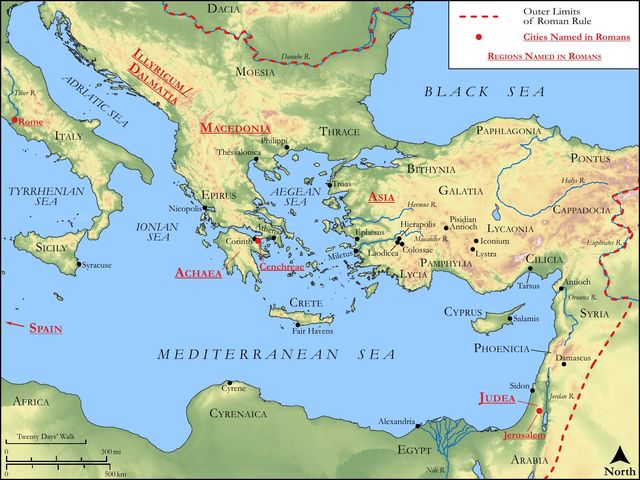
See on the biblical-era map

Study this verse
Public-domain commentary
Matthew Henry
From his Commentary on the Whole Bible. Henry comments on passages, not single verses — this entry covers Romans 15:30–33. His three-level outline is real structure in the source text, so it is rendered as structure.
Here we have, I. St. Paul's desire of a share in the prayers of the Romans for him, expressed very earnestly, Rom 15:30-32. Though Paul was a great apostle, yet he begged the prayers of the meanest Christians, not here only, but in several other of the epistles. He had prayed much for them, and this he desires as the return of his kindness. Interchanging prayers is an excellent token of the interchanging of loves. Paul speaks like one that knew himself, and would hereby teach us how to value the effectual fervent prayer of the righteous. How careful should we be lest we do any thing to forfeit our interest in the love and prayers of god's praying people!
1.Observe why they must pray for him. He begs it with the greatest importunity. He might suspect they would forget him in their prayers, because they had no personal acquaintance with him, and therefore he urges it so closely, and begs it with the most affectionate obtestations, by all that is sacred and valuable: I beseech you, (1.) "For the Lord Jesus Christ's sake. He is my Master, I am going about his work, and his glory is interested in the success of it: if you have any regard to Jesus Christ, and to his cause and kingdom, pray for me. You love Christ, and own Christ; for his sake then do me this kindness." (2.) "For the love of the Spirit. As a proof and instance of that love which the Spirit works in the hearts of believers one to another, pray for me; as a fruit of that communion which we have one with another by the Spirit though we never saw one another. If ever you experienced the Spirit's love to you, and would be found returning your love to the Spirit, be not wanting in this office of kindness."
2.How they must pray for him: That you strive together.
(1.)That you strive in prayer. We must put forth all that is within us in that duty; pray with fixedness, faith, and fervency; wrestle with God, as Jacob did; pray in praying, as Elias did (Jam 5:17), and stir up ourselves to take hold on God (Isa 64:7); and this is not only when we are praying for ourselves, but when we are praying for our friends. True love to our brethren should make us as earnest for them as sense of our own need makes us for ourselves.
(2.)That you strive together with me. When he begged their prayers for him, he did not intend thereby to excuse his praying for himself; no, "Strive together with me, who am wrestling with God daily, upon my own and my friends' account." He would have them to ply the same oar. Paul and these Romans were distant in place, and likely to be so, and yet they might join together in prayer; those who are put far asunder by the disposal of God's providence may yet meet together at the throne of his grace. Those who beg the prayers of others must not neglect to pray for themselves.
3.What they must beg of God for him. He mentions particulars; for, in praying both for ourselves and for our friends, it is good to be particular. What wilt thou that I shall do for thee? So says Christ, when he holds out the golden sceptre. Though he knows our state and wants perfectly, he will know them from us. He recommends himself to their prayers, with reference to three things: - (1.) The dangers which he was exposed to: That I may be delivered from those that do not believe in Judea. The unbelieving Jews were the most violent enemies Paul had and most enraged against him, and some prospect he had of trouble from them in this journey; and therefore they must pray that God would deliver him. We may, and must, pray against persecution. This prayer was answered in several remarkable deliverances of Paul, recorded Acts 21, 22, 23, and 24. (2.) His services: Pray that my service which I have for Jerusalem may be accepted of the saints. Why, was there any danger that it would not be accepted? Can money be otherwise than acceptable to the poor? Yes, there was some ground of suspicion in this case; for Paul was the apostle of the Gentiles, and as the unbelieving Jews looked spitefully at him, which was their wickedness, so those that believed were shy of him upon that account, which was their weakness. He does not say, "Let them choose whether they will accept it or no; if they will not, it shall be better bestowed;" but, "Pray that it may be accepted." As God must be sought unto for the restraining of the ill will of our enemies, so also for the preserving and increasing of the good will of our friends; for God has the hearts both of the one and of the other in his hands. (3.) His journey to them. To engage their prayers for him, he interests them in his concerns (Rom 15:32): That I may come unto you with joy. If his present journey to Jerusalem proved unsuccessful, his intended journey to Rome would be uncomfortable. If he should not do good, and prosper, in one visit, he thought he should have small joy of the next: may come with joy, by the will of God. All our joy depends upon the will of God. The comfort of the creature is in every thing according to the disposal of the Creator.
II.Here is another prayer of the apostle for them (Rom 15:33):
Now the God of peace be with you all, Amen. The Lord of hosts, the God of battle, is the God of peace, the author and lover of peace. He describes God under this title here, because of the divisions among them, to recommend peace to them; if God be the God of peace, let us be men of peace. The Old Testament blessing was, Peace be with you; now, The god of peace be with you. Those who have the fountain cannot want any of the streams. With you all; both weak and strong. To dispose them to a nearer union, he puts them altogether in this prayer. Those who are united in the blessing of God should be united in affection one to another.
Historical interpretation
Historical reception
4 surviving comments on this verse. Each one is dated, so this reads as a timeline rather than a list.
Select a marker to jump to its quote. Markers stagger vertically where authors wrote within a few decades of each other.
The God of peace is Christ, who said: “My peace I give to you, my peace I leave with you.” This is what he prays for them, knowing that the Lord said: “Behold I am with you always, even to the end of the world.” Paul therefore wants them to be the kind of people in whom the Lord Jesus Christ dwells, who has shown them that all the discord caused by human sin has been taken away and who has given them what is true, that they may live peacefully in that truth.
"Now the God of peace be with you all. Amen."
The God of peace dwells only in those who are peaceable. It is good that he has concluded with peace, because the two parties are here called back to peaceful agreement with each other.
Paul called God the “God of peace” here for a reason, because he was concerned about those at Rome who were battling one another or at least who were suspicious of one another. He wanted them to be at peace with each other because of the controversy which they were having over the observance of the law.
Continue studying Romans 15:33 across the web’s major study libraries — every link below opens this exact verse, chapter, or book on the destination site.
Read & Compare
 BibleGatewayThis verse in more than 200 translations and 70 languages.
 Bible.comThe YouVersion reader — hundreds of translations, reading plans, and highlights.
 ESV.orgCrossway's official English Standard Version reader.
 NET BibleThe NET translation with 60,000+ translators' notes on every rendering decision.
 STEP BibleTyndale House's free study tool — original text, vocabulary, and scholarly resources.
 BibliaLogos Bible Software's free web reader.
 USCCBThe New American Bible (Revised Edition) with the U.S. bishops' study notes.
Commentaries
 BibleHub CommentariesDozens of classic commentaries on this verse, gathered on one page.
 StudyLightMore than 100 commentary sets — the largest collection on the web.
 BibleRefPlain-English commentary on what this verse means, verse by verse.
 Enduring WordDavid Guzik's free commentary on this chapter, widely used by Bible teachers.
 Bible Study ToolsVerse commentary alongside Greek and Hebrew study aids.
Original Language & Research
- BibleHub InterlinearThe verse word by word — original language, transliteration, and English.
- BibleHub LexiconEvery word's original-language definition and Strong's entry.
 Blue Letter BibleDeep-study tools — Strong's numbers, concordance, and word studies.
 CNTR CollationThe earliest Greek manuscripts of this verse, collated letter by letter.
Sermons, Hymns & Audio


TrulyRandomVerse is not affiliated with these sites and doesn’t control their content. They’re linked because they’re genuinely useful.
Summary
Romans 15:33 concludes a pivotal section of Paul's letter with a profound benediction, invoking the very presence and character of God as the ultimate source of peace. This concise yet potent prayer serves as a hopeful declaration for the diverse community of believers in Rome, expressing Paul's deep desire for God's wholeness, harmony, and spiritual well-being to permeate their collective and individual lives as they strive for unity and mutual edification.
Context
ShowHideLiterary Context
This verse functions as a concluding benediction to Paul's extensive exhortation on Christian unity and mutual acceptance, which spans from Romans 14 through Romans 15:13. Following this, Paul transitions to discussing his apostolic ministry, his missionary vision to Spain, and his immediate plans to visit Jerusalem with an offering for the saints, requesting the Roman believers' fervent prayers for his safety and successful ministry (Romans 15:14-32). The benediction in Romans 15:33 thus serves as a fitting spiritual capstone, reinforcing his pastoral care and reliance on God to bring about the harmony and divine presence he desires for them amidst their internal differences and external challenges. It echoes earlier prayers and blessings within the letter, such as the one found in Romans 15:5-6.
Historical & Cultural Context
The Roman church was a complex tapestry of Jewish and Gentile believers, often grappling with tensions arising from differing cultural practices, dietary laws, and interpretations of Christian liberty, as highlighted in Romans 14. Paul's emphasis on "peace" (Greek: eirēnē, mirroring the Hebrew shalom) was particularly relevant in this environment. In the Greco-Roman world, eirēnē often signified the absence of war or civil tranquility, but in a biblical context, shalom encompasses a much richer concept of holistic well-being, completeness, harmony, and right relationship with God and others. Paul's invocation of "the God of peace" was a powerful theological statement, asserting that true reconciliation and unity within the diverse Roman church could only come from God Himself, not merely through human effort or compromise. This cultural backdrop underscores the profound spiritual need for divine peace to bridge divides and foster genuine community.
Key Themes
ShowHideRomans 15:33 powerfully encapsulates several major themes woven throughout Romans. Firstly, the Sovereignty and Character of God is paramount; He is not just a source of peace, but "the God of peace," indicating that peace is an intrinsic attribute of His being and His will for His creation. Secondly, the theme of Divine Presence is central, as the prayer "be with you all" emphasizes God's active, sustaining, and comforting presence among His people, which is essential for their flourishing. Thirdly, Christian Unity and Harmony is reinforced, building on Paul's extensive arguments in Romans 14-15, where the presence of the God of peace is presented as the foundational element for fostering and maintaining harmonious relationships within the diverse body of believers. Finally, the verse exemplifies Apostolic Benediction and Pastoral Care, demonstrating Paul's deep affection and spiritual concern for the Roman church, expressed through a prayer that relies entirely on God's power and faithfulness.
Exposition and Analysis
ShowHideKey Word Analysis
ShowHideThis word refers to the supreme Divinity, emphasizing His unique and ultimate authority. In this context, it highlights that the peace Paul invokes is not a human construct or a temporary cessation of conflict, but a divine attribute and gift originating from the one true God, who is the ultimate source of all good, including peace.
Derived from a root meaning "to join," eirḗnē signifies more than just the absence of strife. It denotes a profound state of wholeness, harmony, prosperity, and spiritual well-being. It encapsulates the rich Hebrew concept of shalom, implying a right relationship with God, oneself, and others, leading to a state of comprehensive flourishing.
Of Hebrew origin, amḗn means "firm" or "trustworthy," and functions as an adverb meaning "surely" or "truly." As an interjection, it expresses a strong affirmation, "so be it." Here, it serves as Paul's emphatic confirmation and heartfelt desire for the benediction to be fulfilled, underscoring his conviction in God's ability to grant this peace.
Verse Breakdown
ShowHide"Now the God of peace"
This opening phrase immediately identifies the divine source of the blessing. By calling Him "the God of peace," Paul emphasizes that peace is not merely something God gives, but an inherent characteristic of His very nature. He is the one who establishes, maintains, and embodies peace, making Him the ultimate wellspring of true eirēnē for humanity.
"[be] with you all"
This is the core of the benediction, a prayer for God's active and abiding presence. The implied verb "be" (from the KJV's bracketed addition) highlights the desire for God's personal and intimate fellowship with the Roman believers. The inclusion of "you all" underscores Paul's concern for the entire community, transcending divisions and emphasizing the corporate nature of God's presence and the peace He bestows. It is a prayer for unity in His presence.
"Amen."
This concluding affirmation seals the benediction. It is a solemn and heartfelt "so be it," expressing Paul's earnest desire and conviction that this prayer will indeed be answered. It signifies his faith in God's faithfulness to grant the peace he has invoked for the Roman church.
Literary Devices
ShowHideRomans 15:33 employs several potent literary devices. Primarily, it functions as an Apostolic Benediction, a common feature in Paul's epistles where he pronounces a blessing or prayer over the recipients, conveying his pastoral care and invoking divine favor. The phrase "the God of peace" is a powerful Epithet, a descriptive title that highlights a specific attribute of God, in this case, His inherent nature as the source and embodiment of peace. This epithet not only describes God but also serves as a theological statement about His character and His will for His people. The use of "Amen" at the conclusion is an Affirmation or Exclamation, a strong Hebrew-derived word that seals the prayer with solemnity and conviction, expressing the speaker's earnest desire for the prayer's fulfillment and his belief in its truth.
Theological and Thematic Connections
ShowHideThe declaration of God as "the God of peace" is a profound theological statement, asserting that true and lasting peace, in its fullest biblical sense of shalom—wholeness, harmony, and right relationship—originate solely from Him. This attribute is deeply intertwined with His covenant faithfulness, His redemptive plan, and His desire for humanity's reconciliation, both with Himself and with one another. It points to an eschatological hope where God's peace will ultimately reign supreme, overcoming all conflict and division. Paul's prayer for God to "be with you all" underscores the necessity of divine presence for the realization of this peace within the community, making it a lived reality rather than just an abstract concept.
Reflection and Application
ShowHideRomans 15:33 offers a timeless and deeply comforting truth: our ultimate source of peace is God Himself. In a world perpetually marked by division, anxiety, and unrest, this benediction calls believers to anchor their hope and well-being in the divine presence. It reminds us that true peace is not merely the absence of conflict but a profound, holistic state of spiritual and relational flourishing that flows from a right relationship with God. This compels us to actively cultivate unity within the body of Christ, recognizing that God's peace fosters harmonious relationships among diverse believers. Furthermore, it encourages us to trust in God's sovereignty and abiding presence, finding solace and strength in the assurance that the God who is peace is indeed "with us all," guiding and sustaining us through every challenge and uncertainty.
Questions for Reflection
ShowHideFAQ
ShowHideWhat does it mean for God to be "the God of peace"?
ShowHideWhen Paul refers to God as "the God of peace," he is emphasizing that peace is not just something God grants or creates, but it is an intrinsic aspect of His very nature and character. It signifies that God is the ultimate source, sustainer, and embodiment of true peace. This peace (Greek: eirēnē, akin to Hebrew shalom) is comprehensive, encompassing wholeness, well-being, harmony, and right relationship with God, oneself, and others. It implies that genuine peace, both internal and external, can only be found in and through Him. This title highlights God's desire for reconciliation and His power to bring order out of chaos, as seen throughout biblical history, from creation to redemption.
Why does Paul include "Amen" at the end of this verse?
ShowHideThe word "Amen" is of Hebrew origin and means "so be it," "truly," or "surely." In this context, it serves as Paul's solemn affirmation and heartfelt desire for the benediction to be fulfilled. It's not just a polite closing; it expresses his deep conviction and faith in God's power and faithfulness to grant the peace he has just invoked for the Roman believers. It acts as a sealing of the prayer, indicating that Paul genuinely believes and hopes that God's peace will indeed be with them all. It's a common practice in both Old Testament prayers and New Testament epistles to conclude with such an emphatic confirmation, reinforcing the truth and earnestness of the preceding statement, as also seen in Romans 1:25.
Christ-Centered Fulfillment
ShowHideRomans 15:33, a beautiful benediction invoking "the God of peace," finds its ultimate and most profound fulfillment in Jesus Christ. He is the very embodiment of God's peace, the one through whom this divine attribute is fully revealed and made accessible to humanity. Christ is our peace, who has broken down the dividing wall of hostility between God and humanity, and between Jew and Gentile, through His atoning sacrifice on the cross (Ephesians 2:14-16). His death reconciled us to God, establishing a new covenant of peace (Colossians 1:20). Moreover, Jesus promised His disciples, "Peace I leave with you; my peace I give to you" (John 14:27), a peace that transcends worldly understanding and is sustained by the indwelling Holy Spirit. Thus, the prayer for the "God of peace" to "be with you all" is fundamentally a prayer for the abiding presence of Christ and His Spirit within the community, enabling believers to live out the unity and harmony that are hallmarks of His kingdom (Romans 14:17).