


Romans 15:32
- ἵναinaso thatG2443CONJConjunction
- ἐνeninG1722PREPPreposition
- χαρᾷcharajoyG5479N-DSFNoun Dative Singular Feminine
- ἐλθὼνelthōnhaving comeG2064V-2AAP-NSMVerb 2nd Aorist Active Participle Nominative Singular Masculine
- πρὸςprostoG4314PREPPreposition
- ὑμᾶςhumasyouG4771P-2APPersonal pronoun Accusative 2nd Plural
- διὰdiathroughG1223PREPPreposition
- θελήματοςthelēmatos[the] willG2307N-GSNNoun Genitive Singular Neuter
- θεοῦtheouof GodG2316N-GSM-TNoun Genitive Singular Masculine Title
- καὶkaiandG2532CONJConjunction
- συναναπαύσωμαιsunanapausōmaiI may be refreshed withG4875V-ADS-1SVerb Aorist Middle Deponent Subjunctive 1st Singular
- ὑμῖνhuminyouG4771P-2DPPersonal pronoun Dative 2nd Plural
English is a literal word-by-word gloss of the Greek, not the KJV's wording. Why?
This is the original text the KJV's translators worked from — each Greek word with its own literal English meaning in this verse, prepared by scholars at Tyndale House, Cambridge. The KJV translates whole sentences, not word by word, so its wording differs: one Greek word can become several English words, and the KJV may choose “charity” where the gloss reads “love”. Both are faithful — they answer different questions. For the KJV's own rendering, switch to the KJV text.
Details
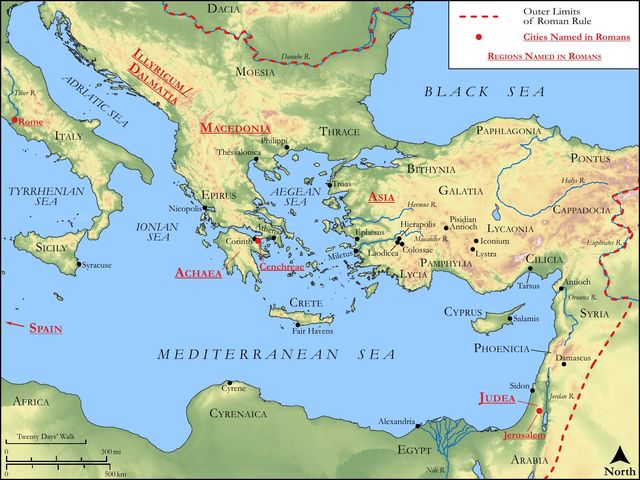
See on the biblical-era map

Study this verse
Public-domain commentary
Matthew Henry
From his Commentary on the Whole Bible. Henry comments on passages, not single verses — this entry covers Romans 15:30–33. His three-level outline is real structure in the source text, so it is rendered as structure.
Here we have, I. St. Paul's desire of a share in the prayers of the Romans for him, expressed very earnestly, Rom 15:30-32. Though Paul was a great apostle, yet he begged the prayers of the meanest Christians, not here only, but in several other of the epistles. He had prayed much for them, and this he desires as the return of his kindness. Interchanging prayers is an excellent token of the interchanging of loves. Paul speaks like one that knew himself, and would hereby teach us how to value the effectual fervent prayer of the righteous. How careful should we be lest we do any thing to forfeit our interest in the love and prayers of god's praying people!
1.Observe why they must pray for him. He begs it with the greatest importunity. He might suspect they would forget him in their prayers, because they had no personal acquaintance with him, and therefore he urges it so closely, and begs it with the most affectionate obtestations, by all that is sacred and valuable: I beseech you, (1.) "For the Lord Jesus Christ's sake. He is my Master, I am going about his work, and his glory is interested in the success of it: if you have any regard to Jesus Christ, and to his cause and kingdom, pray for me. You love Christ, and own Christ; for his sake then do me this kindness." (2.) "For the love of the Spirit. As a proof and instance of that love which the Spirit works in the hearts of believers one to another, pray for me; as a fruit of that communion which we have one with another by the Spirit though we never saw one another. If ever you experienced the Spirit's love to you, and would be found returning your love to the Spirit, be not wanting in this office of kindness."
2.How they must pray for him: That you strive together.
(1.)That you strive in prayer. We must put forth all that is within us in that duty; pray with fixedness, faith, and fervency; wrestle with God, as Jacob did; pray in praying, as Elias did (Jam 5:17), and stir up ourselves to take hold on God (Isa 64:7); and this is not only when we are praying for ourselves, but when we are praying for our friends. True love to our brethren should make us as earnest for them as sense of our own need makes us for ourselves.
(2.)That you strive together with me. When he begged their prayers for him, he did not intend thereby to excuse his praying for himself; no, "Strive together with me, who am wrestling with God daily, upon my own and my friends' account." He would have them to ply the same oar. Paul and these Romans were distant in place, and likely to be so, and yet they might join together in prayer; those who are put far asunder by the disposal of God's providence may yet meet together at the throne of his grace. Those who beg the prayers of others must not neglect to pray for themselves.
3.What they must beg of God for him. He mentions particulars; for, in praying both for ourselves and for our friends, it is good to be particular. What wilt thou that I shall do for thee? So says Christ, when he holds out the golden sceptre. Though he knows our state and wants perfectly, he will know them from us. He recommends himself to their prayers, with reference to three things: - (1.) The dangers which he was exposed to: That I may be delivered from those that do not believe in Judea. The unbelieving Jews were the most violent enemies Paul had and most enraged against him, and some prospect he had of trouble from them in this journey; and therefore they must pray that God would deliver him. We may, and must, pray against persecution. This prayer was answered in several remarkable deliverances of Paul, recorded Acts 21, 22, 23, and 24. (2.) His services: Pray that my service which I have for Jerusalem may be accepted of the saints. Why, was there any danger that it would not be accepted? Can money be otherwise than acceptable to the poor? Yes, there was some ground of suspicion in this case; for Paul was the apostle of the Gentiles, and as the unbelieving Jews looked spitefully at him, which was their wickedness, so those that believed were shy of him upon that account, which was their weakness. He does not say, "Let them choose whether they will accept it or no; if they will not, it shall be better bestowed;" but, "Pray that it may be accepted." As God must be sought unto for the restraining of the ill will of our enemies, so also for the preserving and increasing of the good will of our friends; for God has the hearts both of the one and of the other in his hands. (3.) His journey to them. To engage their prayers for him, he interests them in his concerns (Rom 15:32): That I may come unto you with joy. If his present journey to Jerusalem proved unsuccessful, his intended journey to Rome would be uncomfortable. If he should not do good, and prosper, in one visit, he thought he should have small joy of the next: may come with joy, by the will of God. All our joy depends upon the will of God. The comfort of the creature is in every thing according to the disposal of the Creator.
II.Here is another prayer of the apostle for them (Rom 15:33):
Now the God of peace be with you all, Amen. The Lord of hosts, the God of battle, is the God of peace, the author and lover of peace. He describes God under this title here, because of the divisions among them, to recommend peace to them; if God be the God of peace, let us be men of peace. The Old Testament blessing was, Peace be with you; now, The god of peace be with you. Those who have the fountain cannot want any of the streams. With you all; both weak and strong. To dispose them to a nearer union, he puts them altogether in this prayer. Those who are united in the blessing of God should be united in affection one to another.
Historical interpretation
Historical reception
4 surviving comments on this verse. Each one is dated, so this reads as a timeline rather than a list.
Select a marker to jump to its quote. Markers stagger vertically where authors wrote within a few decades of each other.
Because Paul’s mind is dedicated to delivering the gifts, he wants their mind to respond to him by the judgment of God so that, having understood his love for them, they might with one accord give thanks to God on his behalf. For he was a great blessing to them, in that by his ministry many were made happy and are now praising God.
"That I may come unto you with joy by the will of God."
As he had said at the beginning, "If by any means now at length I might have a prosperous journey, by the will of God, to come unto you" (Rom. i. 10); so here again he takes refuge in the same Will, and says that this is why I press on and wish to be delivered from them, that I may see you shortly, and that with pleasure, without bringing any load of heaviness from thence. "And may with you be refreshed."
See how he again shows unassumingness. For he does not say, I may teach you, and give you a lesson, but that, "I may with you be refreshed." And yet he was the very man engaged in the striving and conflict. In what sense then does he say "that I may be refreshed with you (sunanapauswmai)?" It is to gratify them on this point too, and to make them the more cheerful by making them sharers of his crown, and to show that they too struggle and labor. Then, as was always his custom to do, he adds prayer after the exhortation, and says,
Paul will come to Rome in joy if his offering is accepted at Jerusalem and will then speak the Word of God with peace of mind.… For heaviness of heart is a great hindrance to teaching.
Paul has no desire to do the right thing apart from God’s will.
Continue studying Romans 15:32 across the web’s major study libraries — every link below opens this exact verse, chapter, or book on the destination site.
Read & Compare
 BibleGatewayThis verse in more than 200 translations and 70 languages.
 Bible.comThe YouVersion reader — hundreds of translations, reading plans, and highlights.
 ESV.orgCrossway's official English Standard Version reader.
 NET BibleThe NET translation with 60,000+ translators' notes on every rendering decision.
 STEP BibleTyndale House's free study tool — original text, vocabulary, and scholarly resources.
 BibliaLogos Bible Software's free web reader.
 USCCBThe New American Bible (Revised Edition) with the U.S. bishops' study notes.
Commentaries
 BibleHub CommentariesDozens of classic commentaries on this verse, gathered on one page.
 StudyLightMore than 100 commentary sets — the largest collection on the web.
 BibleRefPlain-English commentary on what this verse means, verse by verse.
 Enduring WordDavid Guzik's free commentary on this chapter, widely used by Bible teachers.
 Bible Study ToolsVerse commentary alongside Greek and Hebrew study aids.
Original Language & Research
- BibleHub InterlinearThe verse word by word — original language, transliteration, and English.
- BibleHub LexiconEvery word's original-language definition and Strong's entry.
 Blue Letter BibleDeep-study tools — Strong's numbers, concordance, and word studies.
 CNTR CollationThe earliest Greek manuscripts of this verse, collated letter by letter.
Sermons, Hymns & Audio


TrulyRandomVerse is not affiliated with these sites and doesn’t control their content. They’re linked because they’re genuinely useful.
Summary
Romans 15:32 encapsulates the Apostle Paul's fervent prayer and profound hope for his upcoming visit to the Roman believers. Following his detailed exposition of missionary strategy and his impending journey to Jerusalem, Paul articulates his desire to arrive in Rome safely, filled with joy, and in accordance with God's sovereign will, anticipating a time of mutual spiritual rejuvenation and encouragement with the church there.
Context
ShowHideLiterary Context
This verse serves as the concluding aspiration to a significant section in Romans 15 where Paul outlines his apostolic mission and future travel plans. Having spent considerable time explaining his ministry to the Gentiles and his desire to preach the Gospel where Christ had not been named (Romans 15:20), Paul reveals his long-standing ambition to visit Rome as a strategic base for further missionary endeavors into Spain (Romans 15:23-24). However, before fulfilling this desire, he is committed to a crucial mission: delivering a financial collection from the Gentile churches in Macedonia and Achaia to the impoverished saints in Jerusalem (Romans 15:25-27). Recognizing the inherent dangers of this journey—both from hostile unbelievers in Judea and potential rejection from some Jewish Christians—Paul earnestly solicits the Roman believers' fervent prayers for his deliverance and for the acceptance of his service (Romans 15:30-31). Romans 15:32 then expresses the positive outcome he devoutly prays for as a result of these intercessions: a successful, joyful, and divinely sanctioned arrival in Rome, leading to shared spiritual refreshment.
Historical & Cultural Context
Paul's journey to Jerusalem was fraught with peril. Judea was a volatile region, and Paul, as the Apostle to the Gentiles, was often viewed with suspicion or outright hostility by some Jewish factions (Acts 21:27-36). The collection itself, while an act of Christian charity, also carried symbolic weight, aiming to foster unity between Jewish and Gentile believers (Galatians 2:10). Travel in the ancient world was arduous and dangerous, involving risks from bandits, shipwrecks, and disease. Paul's emphasis on coming "by the will of God" reflects a common understanding of divine providence in a world where human plans were often subject to unpredictable external forces. Furthermore, the concept of "refreshment" (ἀναπαύω/συναναπαύω) was deeply embedded in the culture of hospitality, where travelers found rest and renewal in the homes and company of others. For early Christians, this hospitality extended to spiritual fellowship, providing a vital source of encouragement and strength in often challenging environments. Rome, as the imperial capital, represented a strategic center for the spread of the Gospel, making Paul's desired visit not just a personal longing but a significant missional objective.
Key Themes
ShowHideRomans 15:32 contributes to several overarching themes in Paul's letter and broader theology. Central is the theme of Divine Sovereignty and Providence, highlighted by the phrase "by the will of God." Paul consistently acknowledges that his plans, however well-intentioned or strategically sound, are ultimately subject to God's overarching purpose and permission (1 Corinthians 4:19, Acts 18:21). This underscores a deep trust in God's control over circumstances and outcomes. Another prominent theme is Mutual Spiritual Refreshment and Fellowship. Paul's desire to be "refreshed" with them emphasizes the reciprocal nature of Christian community. Ministry is not a one-way street; even the Apostle needed the encouragement and spiritual vitality that comes from genuine fellowship with other believers (2 Corinthians 7:5-7). This theme highlights the indispensable role of the Body of Christ in providing support, encouragement, and spiritual renewal. Finally, the verse speaks to Joy in Ministry and Fellowship. Despite the dangers and hardships Paul faced, he anticipated his visit to Rome with "joy." This joy is not merely emotional happiness but a profound spiritual delight rooted in the prospect of shared faith, the advancement of the Gospel, and the fulfillment of God's purposes, a joy that permeates much of Paul's writings even amidst suffering (Philippians 4:4).
Exposition and Analysis
ShowHideKey Word Analysis
ShowHideThis word denotes a determination, purpose, or choice. In the context of "the will of God," it signifies God's active and sovereign intention or decree, not merely passive permission. Paul's plans are not just hoped for, but are submitted to and contingent upon God's specific, active design.
This term refers to cheerfulness or calm delight. It describes a deep-seated spiritual gladness that transcends circumstances, stemming from a right relationship with God and the anticipation of fulfilling His purposes and enjoying fellowship with His people.
This verb, in the middle voice, means to recruit oneself in company with others, to rest together, or to be mutually renewed. It implies a shared experience of repose, spiritual invigoration, and comfort that arises from genuine Christian fellowship and encouragement.
Verse Breakdown
ShowHide"That I may come unto you with joy"
This clause expresses Paul's primary purpose and desired emotional state for his arrival in Rome. The "that" (G2443, hína) indicates a purpose clause, revealing the goal of his preceding prayers and the ultimate aim of his journey. His desire is not merely to arrive, but to arrive with a spirit of deep gladness, anticipating the fellowship and ministry ahead. The preposition "with" (G1722, en) denotes the state or condition accompanying his arrival.
"by the will of God"
This crucial phrase establishes the divine prerequisite for his journey. The preposition "by" (G1223, diá) signifies the channel or means through which his coming will occur, emphasizing that his arrival is entirely dependent on God's sovereign determination and permission (G2307, thélēma). This underscores Paul's submission to divine providence, acknowledging that even his most earnest desires are subject to God's ultimate plan.
"and may with you be refreshed"
This final clause articulates the anticipated outcome of his visit, highlighting the reciprocal nature of Christian fellowship. The conjunction "and" (G2532, kaí) links this outcome to his joyful arrival. The phrase "with you" (G5213, hymîn) emphasizes the shared experience of spiritual renewal. The verb "be refreshed" (G4875, synanapaúomai) implies a mutual rest, comfort, and spiritual invigoration that Paul expects to receive from the Roman believers as much as he hopes to impart to them. It signifies a deep, shared spiritual repose and encouragement.
Literary Devices
ShowHideRomans 15:32 employs several literary devices to convey Paul's earnest hope and theological perspective. The verse functions as a Purpose Clause, introduced by the Greek particle "hina" (that), clearly stating the desired outcome of the prayers mentioned in the preceding verses. This highlights Paul's intentionality and the specific goals he has for his visit. There is a strong sense of Anticipation, as Paul looks forward to a future event with specific, positive expectations: joy and refreshment. This anticipation is not passive but is framed within the context of active prayer and divine will. The concept of "refreshment" is presented with clear Reciprocity through the use of the Greek verb synanapaúomai ("to refresh with" or "to be refreshed together"), indicating that the spiritual benefit will flow both ways between Paul and the Roman believers. This underscores the communal and interdependent nature of the Christian faith. Finally, the phrase "by the will of God" serves as a powerful Theological Framing, placing all human plans and desires within the ultimate context of divine sovereignty and control, a recurring motif in Paul's theology.
Theological and Thematic Connections
ShowHideRomans 15:32 profoundly illustrates the intersection of human desire, fervent prayer, and divine sovereignty in the life of a believer and in the advancement of God's kingdom. Paul's longing to visit Rome was deeply personal and missional, yet he consistently subjected this desire to the ultimate authority of God's will. This demonstrates a mature faith that understands God's providence as the governing principle over all endeavors. The anticipated "refreshment" speaks to the vital, often overlooked, need for mutual encouragement within the Body of Christ, even for seasoned apostles. It underscores that spiritual vitality is not sustained in isolation but thrives in authentic, Spirit-filled fellowship, where believers can find rest, renewal, and joy in one another's faith. This verse, therefore, is a powerful reminder of the importance of prayer, the centrality of God's will, and the indispensable value of Christian community for both personal and corporate spiritual health.
Reflection and Application
ShowHideRomans 15:32 offers timeless principles for contemporary believers. First, it challenges us to cultivate a posture of humble submission to God's will in all our plans and aspirations. While we are called to dream, plan, and work diligently, Paul's example reminds us that true peace and effectiveness come from holding our desires loosely, always acknowledging that our ultimate destination and purpose are "by the will of God." This fosters a spirit of trust and reliance on divine providence, freeing us from anxiety about outcomes. Second, the verse highlights the profound importance of Christian fellowship as a source of mutual refreshment and joy. In a world that often promotes isolation, Paul's longing for shared spiritual renewal underscores the biblical truth that we are designed for community. We are called not only to minister to others but also to be open to receiving spiritual encouragement and strength from our brothers and sisters in Christ. Are we actively seeking out and participating in relationships that genuinely refresh our souls, or are we neglecting the vital spiritual nourishment found in the Body of Christ? Finally, Paul's entire section leading up to this verse emphasizes the power of intercessory prayer. Just as he asked the Romans to pray for his safety and successful ministry, we too should be diligent in praying for our spiritual leaders, missionaries, and fellow believers, recognizing that our prayers can genuinely impact their journeys and the advancement of God's kingdom.
Questions for Reflection
ShowHideFAQ
ShowHideWhat does Paul mean by "refreshed" in this context?
ShowHideWhen Paul expresses his hope to be "refreshed" (Greek: synanapaúomai) with the Roman believers, he is referring to a mutual spiritual and emotional renewal. It's more than just physical rest; it's a deep invigoration of the spirit that comes from genuine Christian fellowship. Paul, despite being an apostle, recognized his own need for encouragement, comfort, and spiritual vitality that could be found in the company of fellow believers. This refreshment would come from sharing faith, praying together, discussing the Gospel, and simply being present with those who shared a common bond in Christ. It implies a reciprocal benefit, where both Paul and the Roman church would draw strength and joy from their time together, much like the comfort Paul received from Titus's arrival in 2 Corinthians 7:5-7.
Why is it important that Paul's visit is "by the will of God"?
ShowHideThe phrase "by the will of God" (Greek: diá thelēmatos theoû) is crucial because it underscores Paul's complete submission to divine sovereignty. It signifies that Paul's plans, however earnest or missional, are not independent but are contingent upon God's active purpose and permission. This reflects a fundamental theological principle: believers should always make their plans with an awareness that God's ultimate will governs all outcomes (James 4:15). For Paul, it was not merely a passive acknowledgement but an active trust that God would direct his steps and open the way if the visit was part of His divine design for the spread of the Gospel. It also serves to humble human ambition and elevate God's supreme authority.
Christ-Centered Fulfillment
ShowHideRomans 15:32, with its emphasis on joyful, God-willed arrival and mutual refreshment, finds its ultimate fulfillment and deepest meaning in Christ. Paul's desire to come with joy by God's will mirrors the very mission of Jesus, who came into the world in perfect obedience to the Father's will (Hebrews 10:7). Christ's life was characterized by a profound joy in fulfilling the Father's purpose, even in the face of suffering (Hebrews 12:2). Moreover, the "refreshment" Paul sought is supremely found in Christ. Jesus Himself invited the weary and burdened to come to Him for "rest for your souls" (Matthew 11:28-29). Through His atoning work, Christ provides the ultimate spiritual refreshment, reconciling us to God and enabling the indwelling of the Holy Spirit, who is our Comforter and source of renewal (Titus 3:5-6). The mutual refreshment Paul anticipated in fellowship with believers is a foretaste of the perfect, unending fellowship we have with Christ and with one another in His presence, empowered by the Spirit He poured out upon His church. Thus, Paul's prayer for a God-willed, joyful, and refreshing reunion points to the greater reality of Christ as the source and sustainer of all true joy, divine purpose, and spiritual renewal within the Body of Christ.