


Philippians 4:10
- ἘχάρηνEcharēnI rejoicedG5463V-2AOI-1SVerb 2nd Aorist Passive Deponent Indicative 1st Singular
- δὲdehoweverG1161CONJConjunction
- ἐνeninG1722PREPPreposition
- κυρίῳkuriō[the] LordG2962N-DSM-TNoun Dative Singular Masculine Title
- μεγάλωςmegalōsgreatlyG3171ADVAdverb
- ὅτιhotithatG3754CONJConjunction
- ἤδηēdēnowG2235ADVAdverb
- ποτὲpoteat lastG4218PRTParticle or Disjunctive
- ἀνεθάλετεanethaleteyou revivedG330V-2AAI-2PVerb 2nd Aorist Active Indicative 2nd Plural
- τὸtotheG3588T-ASNDefinite article Accusative Singular Neuter
- ὑπὲρhuperforG5228PREPPreposition
- ἐμοῦemoumeG1473S-1SGSNPossessive pronoun Genitive 1st Person Singular Neuter
- φρονεῖν·phroneincaringG5426V-PANVerb Present Active Infinitive
- ἐφ᾽eph᾽whereinG1909PREPPreposition
- ᾧhōwhichG3739R-DSNRelative pronoun Dative Singular Neuter
- καὶkaialsoG2532CONJConjunction
- ἐφρονεῖτεephroneiteyou were concernedG5426V-IAI-2PVerb Imperfect Active Indicative 2nd Plural
- ἠκαιρεῖσθεēkaireistheyou were lacking opportunityG170V-INI-2PVerb Imperfect Middle Or Passive Deponent Indicative 2nd Plural
- δέdehoweverG1161CONJConjunction
English is a literal word-by-word gloss of the Greek, not the KJV's wording. Why?
This is the original text the KJV's translators worked from — each Greek word with its own literal English meaning in this verse, prepared by scholars at Tyndale House, Cambridge. The KJV translates whole sentences, not word by word, so its wording differs: one Greek word can become several English words, and the KJV may choose “charity” where the gloss reads “love”. Both are faithful — they answer different questions. For the KJV's own rendering, switch to the KJV text.
Details
See on the biblical-era map
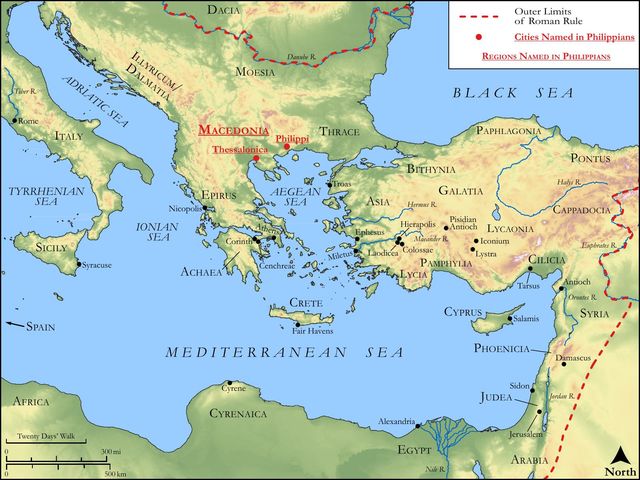

Study this verse
Public-domain commentary
Matthew Henry
From his Commentary on the Whole Bible. Henry comments on passages, not single verses — this entry covers Philippians 4:10–19. His two-level outline is real structure in the source text, so it is rendered as structure.
In these verses we have the thankful grateful acknowledgment which the apostle makes of the kindness of the Philippians in sending him a present for his support, now that he was a prisoner at Rome. And here,
I.He takes occasion to acknowledge their former kindnesses to him, and to make mention of them, Phi 4:15, Phi 4:16.
Paul had a grateful spirit; for, though what his friends did for him was nothing in comparison of what he deserved from them and the obligations he had laid upon them, yet he speaks of their kindness as if it had been a piece of generous charity, when it was really far short of a just debt. If they had each of them contributed half their estates to him, they had not given him too much, since they owed to him even their own souls; and yet, when they send a small present to him, how kindly does he take it, how thankfully does he mention it, even in this epistle which was to be left upon record, and read in the churches, through all ages; so that wherever this epistle shall be read there shall this which they did to Paul be told for a memorial of them. Surely never was present so well repaid. He reminds them that in the beginning of the gospel no church communicated with him as to giving and receiving but they only, Phi 4:15. They not only maintained him comfortably while he was with them, but when he departed from Macedonia they sent tokens of their kindness after him; and this when no other church did so. None besides sent after him of their carnal things, in consideration of what they had reaped of his spiritual things. In works of charity, we are ready to ask what other people do. But the church of the Philippians never considered that. It redounded so much the more to their honour that they were the only church who were thus just and generous. Even in Thessalonica (after he had departed from Macedonia) you sent once and again to my necessity, Phi 4:16. Observe,
1.It was but little which they sent; they sent only to his necessity, just such things as he had need of; perhaps it was according to their ability, and he did not desire superfluities nor dainties.
2.It is an excellent thing to see those to whom God has abounded in the gifts of his grace abounding in grateful returns to his people and ministers, according to their own ability and their necessity: You sent once and again. Many people make it an excuse for their charity that they have given once; why should the charge come upon them again? But the Philippians sent once and again; they often relieved and refreshed him in his necessities. He makes this mention of their former kindness, not only out of gratitude, but for their encouragement.
II.He excuses their neglect of late.
It seems, for some time they had not sent to enquire after him, or sent him any present; but now at the last their care of him flourished again (Phi 4:10), like a tree in the spring, which seemed all the winter to be quite dead. Now, in conformity to the example of his great Master, instead of upbraiding them for their neglect, he makes an excuse for them: Wherein you were also careful, but you lacked opportunity. How could they lack opportunity, if they had been resolved upon it? They might have sent a messenger on purpose. But the apostle is willing to suppose, in favour of them, that they would have done it if a fair opportunity had offered. How contrary is this to the behaviour of many to their friends, by whom neglects which really are excusable are resented very heinously, when Paul excused that which he had reason enough to resent.
III.He commends their present liberality:
Notwithstanding, you have well done that you did communicate with my affliction, Phi 4:14. It is a good work to succour and help a good minister in trouble. Here see what is the nature of true Christian sympathy; not only to be concerned for our friends in their troubles, but to do what we can to help them. They communicated with his affliction, in relieving him under it. He who says, Be you warmed, be you filled, and giveth not those things they have need of, what doth it profit? Jam 2:16. He rejoiced greatly in it (Phi 4:10), because it was an evidence of their affection to him and the success of his ministry among them. When the fruit of their charity abounded towards the apostle, it appeared that the fruit of his ministry abounded among them.
IV.He takes care to obviate the bad use some might make of his taking so much notice of what was sent him.
It did not proceed either from discontent and distrust (Phi 4:11) or from covetousness and love of the world, Phi 4:12. 1. It did not come from discontent, or distrust of Providence: Not that I speak in respect of want (Phi 4:11); not in respect of any want he felt, nor of any want he feared. As to the former, he was content with the little he had, and that satisfied him; as to the latter, he depended upon the providence of God to provide for him from day to day, and that satisfied him: so that he did not speak in respect of want any way. For I have learned, in whatsoever state I am, therewith to be content. We have here an account of Paul's learning, not that which he got at the feet of Gamaliel, but that which he got at the feet of Christ. He had learnt to be content; and that was the lesson he had as much need to learn as most men, considering the hardships and sufferings with which he was exercised. He was in bonds, and imprisonments, and necessities, often; but in all he had learnt to be content, that is, to bring his mind to his condition, and make the best of it. - I know both how to be abased and I know how to abound, Phi 4:12. This is a special act of grace, to accommodate ourselves to every condition of life, and carry an equal temper of mind through all the varieties of our state. (1.) To accommodate ourselves to an afflicted condition - to know how to be abased, how to be hungry, how to suffer want, so as not to be overcome by the temptations of it, either to lose our comfort in God or distrust his providence, or to take any indirect course for our own supply. (2.) To a prosperous condition - to know how to abound, how to be full, so as not to be proud, or secure, or luxurious. And this is as hard a lesson as the other; for the temptations of fulness and prosperity are not less than those of affliction and want. But how must we learn it? I can do all things through Christ who strengthens me, Phi 4:13. We have need of strength from Christ, to enable us to perform not only those duties which are purely Christian, but even those which are the fruit of moral virtue. We need his strength to teach us to be content in every condition. The apostle had seemed to boast of himself, and of his own strength: I know how to be abased (Phi 4:12); but here he transfers all the praise to Christ. "What do I talk of knowing how to be abased, and how to abound? It is only through Christ who strengthens me that I can do it, not in my own strength." So we are required to be strong in the Lord, and in the power of his might (Eph 6:10), and to be strong in the grace which is in Christ Jesus (Ti2 2:1); and we are strengthened with might by his Spirit in the inner man, Eph 3:16. The word in the original is a participle of the present tense, en tō endunamounti me Christō, and denotes a present and continued act; as if he had said, "Through Christ, who is strengthening me, and does continually strengthen me; it is by his constant and renewed strength I am enabled to act in every thing; I wholly depend upon him for all my spiritual power." 2. It did not come from covetousness, or an affection to worldly wealth: "Not because I desired a gift (Phi 4:17): that is, I welcome your kindness, not because it adds to my enjoyments, but because it adds to your account." He desired not so much for his own sake, but theirs: "I desire fruit that may abound to your account, that is, that you may be enabled to make such a good use of your worldly possessions that you may give an account of them with joy." It is not with any design to draw more from you, but to encourage you to such an exercise of beneficence as will meet with a glorious reward hereafter. "For my part," says he, "I have all, and abound, Phi 4:18. What can a man desire more than enough? I do not desire a gift for the gift's sake, for I have all, and abound." They sent him a small token, and he desired no more; he was not solicitous for a present superfluity, or a future supply: I am full, having received from Epaphroditus the things which were sent by you. Note, A good man will soon have enough of this world; not only of living in it, but of receiving from it. A covetous worldling, if he has ever so much, would still have more; but a heavenly Christian, though he has little, has enough.
V.The apostle assures them that God did accept, and would recompense, their kindness to him.
1.He did accept it: It is an odour of a sweet smell, a sacrifice acceptable, well-pleasing to God. Not a sacrifice of atonement, for none makes atonement for sin but Christ; but a sacrifice of acknowledgment, and well-pleasing to God. It was more acceptable to God as it was the fruit of their grace than it was to Paul as it was the supply of his want. With such sacrifices God is well pleased, Heb 13:16.
2.He would recompense it: But my God shall supply all your wants according to his riches in glory by Christ Jesus, Phi 4:19. He does as it were draw a bill upon the exchequer in heaven, and leaves it to God to make them amends for the kindness they had shown him. "He shall do it, not only as your God, but as my God, who takes what is done to me as done to himself. You supplied my needs, according to your poverty; and he shall supply yours, according to his riches." But still it is by Christ Jesus; through him we have grace to do that which is good, and through him we must expect the reward of it. Not of debt, but of grace; for the more we do for God the more we are indebted to him, because we receive the more from him.
Historical interpretation
Historical reception
1 surviving comment on this verse from the historical church.
I Have ofttimes said, that almsgiving hath been introduced not for the sake of the receivers, but of the givers, for the latter are they which make the greatest gain. And this Paul shows here also. In what way? The Philippians had sent him somewhat, after a long time, and had committed the same to Epaphroditus. See then, how when he is about to send Epaphroditus as the bearer of this Epistle, he praises them, and shows that this action was for the need, not of the receiver, but of the givers. This he doth, both that they who benefited him may not be lifted up with arrogance, and that they may become more zealous in well-doing, since they rather benefit themselves; and that they who receive may not fearlessly rush forward to receive, lest they meet with condemnation. For "it is more blessed," He saith, "to give than to receive." Why then does he say, "I rejoice in the Lord greatly"? Not with worldly rejoicing, saith he, nor with the joy of this life, but in the Lord. Not because I had refreshment, but because ye advanced; for this is my refreshment. Wherefore he also saith "greatly"; since this joy was not corporeal, nor on account of his own refreshment, but because of their advancement.
And see how, when he had gently rebuked them on account of the times that were passed, he quickly throweth a shadow over this, and teacheth them constantly and always to remain in well doing. "Because at length," saith he. The words, "at length," show long time to have elapsed. "Ye have revived," as fruits which have shot forth, dried up, and afterwards shot forth. Here he showeth, that being at first blooming, then having faded, they again budded forth. So that the word "flourished again," has both rebuke and praise. For it is no small thing, that he who hath withered should flourish again. He showeth also, that it was from indolence all this had happened to them. But here he signifies, that even in former time they were wont to be zealous in these things. Wherefore he addeth, "your thought for me, wherein ye did indeed take thought." And lest you should think, that in other things too they had been more zealous, and had then withered, but in this thing alone, behold how he has added, "your thought for me." I apply the words, "now at length," only to this; for in other things it is not so.
Here some one may enquire, how when he had said, "It is more blessed to give than to receive"; and, "These hands ministered to my necessities, and to them that were with me"; and again when writing to the Corinthians, "For it were good for me rather to die, than that any man should make my glorying void"; he suffereth his glorying to be made void? And how? By receiving. For if his glorying was, that he received not, how doth he now endure so to do? What is it then? Probably, he then did not receive on account of the false Apostles, "that wherein they glory," saith he, "they may be found even as we." And he said not "are," but "glory"; for they received but secretly. Wherefore he said, "wherein they glory." Wherefore he also said, "No man shall stop me of this glorying." And he said not simply, shall not stop me, but what? "in the regions of Achaia." And again, "I robbed other Churches, taking wages of them that I might minister unto you." Here he showed that he did receive. But Paul indeed received rightly, having so great a work; if in truth he did receive. But they who work not, how can they receive? "Yet I pray," saith one. But there is no work. For this may be done together with work. "But I fast." Neither is this work. For see this blessed one, preaching in many places, and working too. "But ye lacked opportunity." What meaneth lacked opportunity? It came not; saith he, of indolence, but of necessity. Ye had it not in your hands, nor were in abundance. This is the meaning of, "Ye lacked opportunity." Thus most men speak, when the things of this life do not flow in to them abundantly, and are in short supply.
Continue studying Philippians 4:10 across the web’s major study libraries — every link below opens this exact verse, chapter, or book on the destination site.
Read & Compare
 BibleGatewayThis verse in more than 200 translations and 70 languages.
 Bible.comThe YouVersion reader — hundreds of translations, reading plans, and highlights.
 ESV.orgCrossway's official English Standard Version reader.
 NET BibleThe NET translation with 60,000+ translators' notes on every rendering decision.
 STEP BibleTyndale House's free study tool — original text, vocabulary, and scholarly resources.
 BibliaLogos Bible Software's free web reader.
 USCCBThe New American Bible (Revised Edition) with the U.S. bishops' study notes.
Commentaries
 BibleHub CommentariesDozens of classic commentaries on this verse, gathered on one page.
 StudyLightMore than 100 commentary sets — the largest collection on the web.
 BibleRefPlain-English commentary on what this verse means, verse by verse.
 Enduring WordDavid Guzik's free commentary on this chapter, widely used by Bible teachers.
 Bible Study ToolsVerse commentary alongside Greek and Hebrew study aids.
Original Language & Research
- BibleHub InterlinearThe verse word by word — original language, transliteration, and English.
- BibleHub LexiconEvery word's original-language definition and Strong's entry.
 Blue Letter BibleDeep-study tools — Strong's numbers, concordance, and word studies.
 CNTR CollationThe earliest Greek manuscripts of this verse, collated letter by letter.
Sermons, Hymns & Audio


TrulyRandomVerse is not affiliated with these sites and doesn’t control their content. They’re linked because they’re genuinely useful.
Summary
The Apostle Paul expresses profound joy and gratitude to the Philippian believers for their renewed financial support, which he perceives as their long-standing care for him finally finding an opportune moment to manifest. He acknowledges their consistent desire to assist him, even when circumstances had previously prevented them from doing so, highlighting their enduring partnership in the gospel and the spiritual nature of his contentment.
Context
ShowHideLiterary Context
Philippians 4:10 marks a transition in Paul's letter. Having concluded his final exhortations on unity, joy, peace, and right thinking in Philippians 4:1-9, Paul now shifts to a personal expression of thanks for the Philippians' practical support. This verse initiates the closing section of the epistle (often considered Philippians 4:10-20), where he elaborates on their generosity, his contentment in all circumstances, and God's ultimate provision. It serves as a concrete example of the "peace of God" and "God of peace" he just described, demonstrating how divine provision often comes through the tangible acts of fellow believers. The theme of contentment, introduced here by Paul's rejoicing, is further developed in Philippians 4:11-13, where he famously states his ability to be content in every situation through Christ who strengthens him.
Historical & Cultural Context
Paul wrote the letter to the Philippians while imprisoned, likely in Rome (c. A.D. 60-62), though some scholars suggest Ephesus or Caesarea. This imprisonment is referenced in Philippians 1:7 and Philippians 1:13. The Philippian church was unique among Paul's congregations, being the first church he founded in Europe (Acts 16). They had a long history of supporting Paul's missionary endeavors, even from the very beginning of his ministry in Macedonia (Philippians 4:15-16). Their recent gift, delivered by Epaphroditus (Philippians 2:25), was not their first, but a renewed expression of their consistent care. In the ancient world, financial support for itinerant teachers and apostles was a common practice, but Paul often preferred to support himself to avoid accusations of greed (1 Corinthians 9:1-18). However, he gratefully accepted aid from the Philippians due to their genuine partnership and sacrificial giving.
Key Themes
ShowHideThis verse contributes significantly to several key themes in Philippians and Paul's broader theology. Firstly, it underscores the theme of joy in Christ, which permeates the entire epistle, demonstrating that Paul's joy is not circumstantial but rooted in his relationship with the Lord and expressed even in the midst of hardship and imprisonment. Secondly, it highlights the theme of partnership in the gospel, emphasizing the mutual support and shared mission between Paul and the Philippian church. Their financial contribution was not merely charity but an active participation in the spread of the good news (Philippians 1:5). Thirdly, the verse subtly introduces the theme of divine provision and human responsibility, showing how God uses the generosity of His people to meet the needs of His servants. Finally, Paul's gracious acknowledgment of their past "lack of opportunity" showcases his pastoral sensitivity and understanding, a recurring aspect of his ministry where he seeks to build up and encourage, rather than condemn or demand.
Exposition and Analysis
ShowHideKey Word Analysis
ShowHideFrom the root meaning "to be cheerful," this word signifies a deep, abiding joy or gladness. Paul's rejoicing here is not a fleeting emotion but a settled disposition, rooted "in the Lord." It speaks to a profound spiritual delight that transcends his physical circumstances, reflecting the overarching theme of joy in the book of Philippians.
This term denotes supreme authority and control, often used to refer to God or Christ as Master. Paul's joy is "in the Lord," indicating that the ultimate source and object of his gladness is God Himself, not merely the material gift. This anchors his gratitude in a theological reality, elevating the act of receiving a gift into an occasion for spiritual rejoicing and recognizing divine providence.
This word is a compound term meaning "to be inopportune for oneself" or "to fail of a proper occasion." It implies that the Philippians' previous inability to send aid was due to a lack of suitable timing or means, rather than a lack of desire or care. Paul's use of this word graciously exonerates them, affirming their consistent good intentions and demonstrating his understanding of their circumstances.
Verse Breakdown
ShowHide"But I rejoiced in the Lord greatly,"
Paul begins with a strong affirmation of his joy, immediately grounding it "in the Lord." This is not a superficial happiness but a deep, spiritual gladness that transcends his circumstances, echoing the pervasive theme of joy throughout the epistle. The adverb "greatly" (megálōs) intensifies this feeling, underscoring the profound nature of his delight, which is ultimately directed towards God for His faithfulness shown through the Philippians.
"that now at the last your care of me hath flourished again;"
This clause reveals the specific cause of Paul's rejoicing: the renewed expression of the Philippians' care. The phrase "now at the last" (poté) implies a long-awaited moment, suggesting that a period had passed since their last support. The vivid imagery of "flourished again" (anathállō, though the Strong's data for G330 is noted as "not used" in the provided list, the KJV's rendering captures the sense of a dormant plant springing back to life) serves as a beautiful metaphor for the revival of their active concern and generosity, like a plant that had withered but now blossoms anew. This signifies not a new development, but a re-blossoming of their consistent affection and practical support.
"wherein ye were also careful, but ye lacked opportunity."
Paul, with characteristic pastoral sensitivity, clarifies that their previous inability to send aid was not due to a lack of desire or commitment. He affirms that they "were also careful" (phronéō), indicating their continuous mental disposition of concern and thoughtfulness towards him. The crucial qualifier "but ye lacked opportunity" (akairéomai) graciously explains that external circumstances, rather than a deficiency in their love or willingness, were the sole impediments. This demonstrates Paul's deep understanding and appreciation for their enduring intentions, preventing any misunderstanding or guilt on their part.
Literary Devices
ShowHidePaul employs several effective literary devices in Philippians 4:10. The most prominent is Metaphor, specifically in the phrase "your care of me hath flourished again." This agricultural imagery vividly portrays their renewed support as a plant that has revived and blossomed, suggesting growth, vitality, and a natural unfolding of their inherent care. This softens any implication of neglect, framing the delay as a natural cycle rather than a failure. Paul also uses Euphemism and Gracious Affirmation by stating, "ye lacked opportunity," rather than directly saying they couldn't or didn't send aid. This polite and understanding phrasing ensures the Philippians feel affirmed in their consistent intentions, even when practical expression was impossible. The overall tone is one of profound Gratitude and Pastoral Sensitivity, which serves as a rhetorical device to strengthen the bond between Paul and the Philippian church, fostering mutual respect and love.
Theological and Thematic Connections
ShowHidePaul's rejoicing in the Lord for the Philippians' renewed care transcends mere human gratitude; it is deeply rooted in a theological understanding of God's providence and the spiritual nature of Christian giving. His joy is not solely for the material provision but for the spiritual fruit evident in the Philippians' lives—their love, faithfulness, and partnership in the gospel. This act of giving and receiving becomes a tangible expression of the body of Christ functioning as it should, where members care for one another and contribute to the advancement of God's kingdom. It underscores the truth that God often provides for His servants through the generosity of His people, making human acts of kindness instruments of divine faithfulness.
Reflection and Application
ShowHidePhilippians 4:10 offers profound lessons for contemporary believers regarding gratitude, understanding, and the dynamics of Christian community. Paul's example teaches us to cultivate a spirit of genuine, God-centered joy that is not dependent on external circumstances but finds its ultimate source in the Lord. When we receive help or kindness, our gratitude should extend beyond the giver to God Himself, recognizing Him as the ultimate provider working through His people. Furthermore, Paul's gracious acknowledgment of the Philippians' past "lack of opportunity" serves as a powerful model for extending grace and understanding to others. It reminds us to assume the best intentions in people, especially when their actions might seem to fall short due to circumstances beyond their control. This fosters healthier relationships within the body of Christ, built on trust, empathy, and mutual affirmation rather than judgment. Finally, the verse highlights the beautiful reciprocity of Christian partnership, where both giving and receiving are acts of worship and expressions of God's love, strengthening the bonds of fellowship and advancing the gospel.
Questions for Reflection
ShowHideFAQ
ShowHideWhat does Paul mean by "your care of me hath flourished again"?
ShowHideThis phrase uses a beautiful agricultural metaphor. The Greek word for "flourished again" (anathállō) means "to sprout again" or "to grow green again," like a plant that was dormant or withered but has now revived and begun to blossom. Paul is not implying that the Philippians' care for him had died or ceased, but rather that their active expression of that care had been hindered for a time, perhaps by economic hardship, travel restrictions, or other unforeseen circumstances. Now, like a plant springing back to life, their ability to provide practical support has re-emerged and manifested itself. It underscores their consistent desire to help, which has now found a renewed opportunity to bear fruit. This is further clarified by Paul's subsequent statement, "wherein ye were also careful, but ye lacked opportunity," confirming their ongoing intention despite previous limitations.
Why was Paul so grateful for financial support, given his emphasis on contentment?
ShowHidePaul's gratitude for the Philippians' financial support in Philippians 4:10 does not contradict his teaching on contentment, which he elaborates on in Philippians 4:11-12. His contentment is rooted "in the Lord" and is an internal spiritual state independent of external circumstances. He had learned to be content whether abounding or suffering need. However, his gratitude is for the Philippians' love and partnership in the gospel. Their gift was a tangible expression of their fellowship and commitment to his ministry, a "fragrant offering, a sacrifice acceptable, well-pleasing to God" (Philippians 4:18). Paul rejoiced not because his needs were met (though they were), but because their generosity demonstrated their spiritual vitality and their active participation in the spread of the Good News. It was a sign of God's faithfulness working through His people, confirming the spiritual bond between them.
Christ-Centered Fulfillment
ShowHidePhilippians 4:10, while a personal expression of gratitude, finds its ultimate fulfillment and deepest meaning in Christ. Paul's "rejoicing in the Lord" is a direct echo of the joy that is found only in a relationship with Jesus, who is the source of all true contentment and provision. Christ Himself embodied the ultimate act of self-giving, emptying Himself for the sake of humanity (Philippians 2:5-8), setting the pattern for the Philippians' sacrificial generosity. In Him, all needs are ultimately met, not merely through material provision, but through spiritual abundance and the promise of eternal life (John 6:35). The "care" shown by the Philippians reflects the very heart of Christ, who cares for His church and provides for its needs through the Spirit-empowered generosity of His people (Ephesians 4:11-16). Furthermore, the concept of "lacking opportunity" can be seen in light of Christ's patient work in the lives of believers, allowing for growth and maturation until the opportune time for spiritual fruit to "flourish again" (Galatians 6:9). Thus, the Philippians' gift is not just a human transaction, but a manifestation of Christ's ongoing work in His body, demonstrating His faithfulness to His servants and His mission through the love and obedience of His followers.