


1 Timothy 1:17
- ΤῷTō<the>G3588T-DSMDefinite article Dative Singular Masculine
- δὲdenowG1161CONJConjunction
- βασιλεῖbasileito the KingG935N-DSM-TNoun Dative Singular Masculine Title
- τῶνtōnof theG3588T-GPMDefinite article Genitive Plural Masculine
- αἰώνωνaiōnōnagesG165N-GPMNoun Genitive Plural Masculine
- ἀφθάρτῳaphthartō[the] immortalG862A-DSMAdjective Dative Singular Masculine
- ἀοράτῳaoratōinvisibleG517A-DSMAdjective Dative Singular Masculine
- μόνῳmonōonlyG3441A-DSMAdjective Dative Singular Masculine
- σοφῷsophōwiseG4680A-DSMAdjective Dative Singular Masculine
- θεῷtheōGodG2316N-DSM-TNoun Dative Singular Masculine Title
- τιμὴtimē[be] honorG5092N-NSFNoun Nominative Singular Feminine
- καὶkaiandG2532CONJConjunction
- δόξαdoxagloryG1391N-NSFNoun Nominative Singular Feminine
- εἰςeistoG1519PREPPreposition
- τοὺςtoustheG3588T-APMDefinite article Accusative Plural Masculine
- αἰῶναςaiōnasagesG165N-APMNoun Accusative Plural Masculine
- τῶνtōnof theG3588T-GPMDefinite article Genitive Plural Masculine
- αἰώνωνaiōnōnagesG165N-GPMNoun Genitive Plural Masculine
- ἀμήνamēnAmenG281INJ-HEBInterjection
English is a literal word-by-word gloss of the Greek, not the KJV's wording. Why?
This is the original text the KJV's translators worked from — each Greek word with its own literal English meaning in this verse, prepared by scholars at Tyndale House, Cambridge. The KJV translates whole sentences, not word by word, so its wording differs: one Greek word can become several English words, and the KJV may choose “charity” where the gloss reads “love”. Both are faithful — they answer different questions. For the KJV's own rendering, switch to the KJV text.
Details
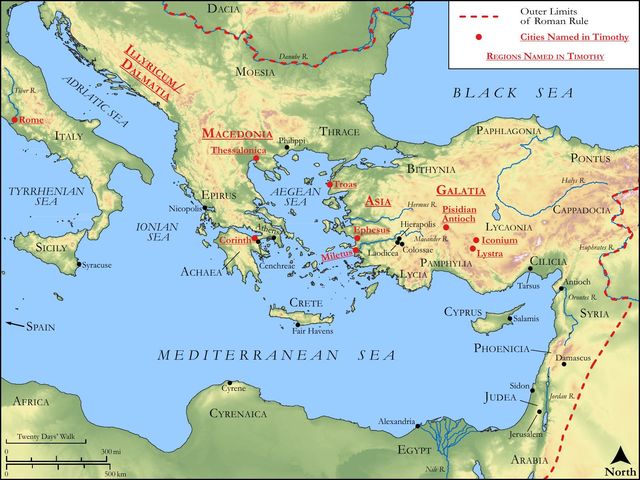
See on the biblical-era map

Study this verse
Public-domain commentary
Matthew Henry
From his Commentary on the Whole Bible. Henry comments on passages, not single verses — this entry covers 1 Timothy 1:12–17. His four-level outline is real structure in the source text, so it is rendered as structure.
Here the apostle, I. Returns thanks to Jesus Christ for putting him into the ministry. Observe, 1. It is Christ's work to put men into the ministry, Act 26:16, Act 26:17. God condemned the false prophets among the Jews in these words, I have not sent these prophets, yet they ran: I have not spoken to them, yet they prophesied, Jer 23:21. Ministers, properly speaking, cannot make themselves ministers; for it is Christ's work, as king and head, prophet and teacher, of his church. 2. Those whom he puts into the ministry he fits for it; whom he calls he qualifies. Those ministers who are no way fit for their work, nor have ability for it, are not of Christ's putting into the ministry, though there are different qualifications as to gifts and graces. 3. Christ gives not only ability, but fidelity, to those whom he puts into the ministry: He counted me faithful; and none are counted faithful but those whom he makes so. Christ's ministers are trusty servants, and they ought to be so, having so great a trust committed to them. 4. A call to the ministry is a great favour, for which those who are so called ought to give thanks to Jesus Christ: I thank Christ Jesus our Lord, who hath put me into the ministry.
II.The more to magnify the grace of Christ in putting him into the ministry, he gives an account of his conversion.
1.What he was before his conversion: A blasphemer, a persecutor, and injurious. Saul breathed out threatenings and slaughter against the disciples of the Lord, Act 9:1. He made havoc of the church, Act 8:3. He was a blasphemer of God, a persecutor of the saints, and injurious to both. Frequently those who are designed for great and eminent services are left to themselves before their conversion, to fall into great wickedness, that the mercy of God may be the more glorified in their remission, and the grace of God in their regeneration. The greatness of sin is no bar to our acceptance with God, no, nor to our being employed for him, if it be truly repented of. Observe here,
(1.)Blasphemy, persecution, and injuriousness, are very great and heinous sins, and those who are guilty of them are sinners before God exceedingly. To blaspheme God is immediately and directly to strike at God; to persecute his people is to endeavour to wound him through their sides; and to be injurious is to be like Ishmael, whose hand was against every one, and every one was against him; for such invade God's prerogative, and encroach upon the liberties of their fellow-creatures.
(2.)True penitents, to serve a good purpose, will not be backward to own their former condition before they were brought home to God: this good apostle often confessed what his former life had been, as Act 22:4; Act 26:10, Act 26:11.
2.The great favour of God to him: But I obtained mercy. This was a blessed but indeed, a great favour, that so notorious a rebel should find mercy with his prince.
(1.)If Paul had persecuted the Christians wilfully, knowing them to be the people of God, for aught I know he had been guilty of the unpardonable sin; but, because he did it ignorantly and in unbelief, he obtained mercy. Note,
[1.]What we do ignorantly is a less crime than what we do knowingly; yet a sin of ignorance is a sin, for he that knew not his Master's will, but did commit things worthy of stripes, shall be beaten with few stripes, Luk 12:48. Ignorance in some cases will extenuate a crime, though it do not take it away.
[2.]Unbelief is at the bottom of what sinners do ignorantly; they do not believe God's threatenings, otherwise they could not do as they do.
[3.]For these reasons Paul obtained mercy: But I obtained mercy, because I did it ignorantly, in unbelief.
[4.]Here was mercy for a blasphemer, a persecutor, and an injurious person: "But I obtained mercy, I a blasphemer," etc.
(2.)Here he takes notice of the abundant grace of Jesus Christ, Ti1 1:14. The conversion and salvation of great sinners are owing to the grace of Christ, his exceedingly abundant grace, even that grace of Christ which appears in his glorious gospel (Ti1 1:15): This is a faithful saying, etc. Here we have the sum of the whole gospel, that Jesus Christ came into the world. The Son of God took upon him our nature, was made flesh, and dwelt among us, Joh 1:14. He came into the world, not to call the righteous but sinners to repentance, Mat 9:13. His errand into the world was to seek and find, and so save, those that were lost, Luk 19:10. The ratification of this is that it is a faithful saying, and worthy of all acceptation. It is good news, worthy of all acceptation; and yet not too good to be true, for it is a faithful saying. It is a faithful saying, and therefore worthy to be embraced in the arms of faith: it is worthy of all acceptation, and therefore to be received with holy love, which refers to the foregoing verse, where the grace of Christ is said to abound in faith and love. In the close of the verse Paul applies it to himself: Of whom I am chief. Paul was a sinner of the first rank; so he acknowledges himself to have been, for he breathed out threatenings and slaughter against the disciples of the Lord, etc., Act 9:1, Act 9:2. Persecutors are some of the worst of sinners: such a one Paul had been. Or, of whom I am chief, that is, of pardoned sinners I am chief. It is an expression of his great humility; he that elsewhere calls himself the least of all saints (Eph 3:8) here calls himself the chief of sinners. Observe,
[1.]Christ Jesus has come into the world; the prophecies concerning his coming are now fulfilled.
[2.]He came to save sinners; he came to save those who could not save and help themselves.
[3.]Blasphemers and persecutors are the chief of sinners, so Paul reckoned them.
[4.]The chief of sinners may become the chief of saints; so this apostle was, for he was not a whit behind the very chief apostles (Co2 11:5), for Christ came to save the chief of sinners.
[5.]This is a very great truth, it is a faithful saying; these are true and faithful words, which may be depended on.
[6.]It deserves to be received, to be believed by us all, for our comfort and encouragement.
(3.)The mercy which Paul found with God, notwithstanding his great wickedness before his conversion, he speaks of,
[1.]For the encouragement of others to repent and believe (Ti1 1:16): For this cause I obtained mercy, that in me first Jesus Christ might show forth all long-suffering, for a pattern to those who should hereafter believe. It was an instance of the long-suffering of Christ that he would bear so much with one who had been so very provoking; and it was designed for a pattern to all others, that the greatest sinners might not despair of mercy with God. Note here, First, Our apostle was one of the first great sinners converted to Christianity. Secondly, He was converted, and obtained mercy, for the sake of others as well as of himself; he was a pattern to others. Thirdly, The Lord Jesus Christ shows great long-suffering in the conversion of great sinners. Fourthly, Those who obtain mercy believe on the Lord Jesus Christ; for without faith it is impossible to please God, Heb 11:6. Fifthly, Those who believe on Christ believe on him to life everlasting; they believe to the saving of the soul, Heb 10:39.
[2.]He mentions it to the glory of God having spoken of the mercy he had found with God, he could not go on with his letter without inserting a thankful acknowledgment of God's goodness to him: Now unto the King eternal, immortal, invisible, the only wise God, be honour and glory for ever and ever. Amen. Observe, First, That grace which we have the comfort of God must have the glory of. Those who are sensible of their obligations to the mercy and grace of God will have their hearts enlarged in his praise. Here is praise ascribed to him, as the King eternal, immortal, invisible. Secondly, When we have found God good we must not forget to pronounce him great; and his kind thoughts of us must not at all abate our high thoughts of him, but rather increase them. God had taken particular cognizance of Paul, and shown him mercy, and taken him into communion with himself, and yet he calls him the King eternal, etc. God's gracious dealings with us should fill us with admiration of his glorious attributes. He is eternal, without beginning of days, or end of life, or change of time. He is the Ancient of days, Dan 7:9. He is immortal, and the original of immortality; he only has immortality (Ti1 6:16), for he cannot die. He is invisible, for he cannot be seen with mortal eyes, dwelling in the light to which no man can approach, whom no man hath seen nor can see, Ti1 6:16. He is the only wise God (Jde 1:25); he only is infinitely wise, and the fountain of all wisdom. "To him be glory for ever and ever," or, "Let me be for ever employed in giving honour and glory to him, as the thousands of thousands do," Rev 5:12, Rev 5:13.
Historical interpretation
Eight Centuries of Reception
14 surviving comments on this verse. Each one is dated, so this reads as a timeline rather than a list.
Select a marker to jump to its quote. Markers stagger vertically where authors wrote within a few decades of each other.
It was of Him, too, that he had said in a previous passage: "Now unto the King eternal, immortal, invisible, to the only God; " so that we might apply even the contrary qualities to the Son Himself-mortality, accessibility-of whom the apostle testifies that "He died according to the Scriptures," and that "He was seen by himself last of all," -by means, of course, of the light which was accessible, although it was not without imperilling his sight that he experienced that light.
Fitly did that temporal king and Thy servant once sing of Thee as the King Eternal, saying, Thou art fairer than the children of men, who amongst men art very God and man.
But the time would fail us, ages and succeeding generations too, to render unto thee thy fitting salutation as the mother of the King Eternal,
We know that of all the names by which Deity is indicated some are expressive of the Divine majesty, employed and understood absolutely, and some are assigned with reference to the operations over us and all creation. When the apostle says, “Now to the immortal, invisible, only wise God,” and the like, by these titles he suggests conceptions which represent to us the transcendent power. In other cases, however, God is spoken of in the Scriptures as gracious, merciful, full of pity, true, good, Lord, Physician, Shepherd, Way, Bread, Fountain, King, Creator, Artificer, Protector, Who is over all and through all, Who is all in all; these and similar titles contain the declaration of the operations of the Divine loving kindness in the creation.
"Now unto the King eternal, immortal, invisible, the only wise God, be honor and glory for ever and ever. Amen."
For these things, then, we glorify not the Son only, but the Father. Here let us argue with the heretics. Speaking of the Father, he says, "To the only God." Is the Son then not God? "The only immortal." Is the Son then not immortal? Or does He not possess that Himself, which hereafter He will give to us? Yes, they say, He is God and immortal, but not such as the Father. What then? is He of inferior essence, and therefore of inferior immortality? What then is a greater and a less immortality? For immortality is nothing else than the not being subject to destruction. For there is a greater and a less glory; but immortality does not admit of being greater or less: as neither is there a greater and a less health. For a thing must either be destructible, or altogether indestructible. Are we men then immortal even as He? God forbid! Surely not! Why? because He has it by nature, but we adventitiously.
It has been said of the Son, "By whom He made the worlds." Now there is a distinction observed among us between creation and workmanship. For one works and toils and executes, another rules; and why? because he that executes is the inferior. But it is not so there; nor is the sovereignty with One, the workmanship with the Other. For when we hear, "By whom He made the worlds," we do not exclude the Father from creation. Nor when we say, "To the King immortal," do we deny dominion to the Son. For these are common to the One and the Other, and each belongs to Both. The Father created, in that He begat the creating Son; the Son rules, as being Lord of all things created. For He does not work for hire, nor in obedience to others, as workmen do among us, but from His own goodness and love for mankind. But has the Son ever been seen? No one can affirm this. What means then, "To the King immortal, invisible, the only wise God"? Or when it is said, "There is no other name whereby we must be saved": and again, "There is salvation in no other"?
We must first turn our words to prayer. I say this because, sometimes, when prayer accompanies a teaching, it will serve to provide us with a demonstration of the things we are seeking to prove.… And Paul often does this at the beginning of his epistles. He first mentions God and then does not go on to his teaching until he pays to God the glory and praise due to him. Listen: "To the King of ages, the immortal, the invisible, the only God of wisdom, be honor and glory for ever and ever! Amen."
"To Him be honor and glory forever. Amen."
Now honor and glory are not mere words; and since He has honored us not by words only, but by what He has done for us, so let us honor Him by works and deeds. Yet this honor touches us, while that reaches not Him, for He needs not the honor that comes from us, we do need that which is from Him.
In honoring Him, therefore, we do honor to ourselves. He who opens his eyes to gaze on the light of the sun, receives delight himself, as he admires the beauty of the star, but does no favor to that luminary, nor increases its splendor, for it continues what it was; much more is this true with respect to God. He who admires and honors God does so to his own salvation, and highest benefit; and how? Because he follows after virtue, and is honored by Him. For "them that honor Me," He says, "I will honor." How then is He honored, if He enjoys no advantage from our honor? Just as He is said to hunger and thirst. For He assumes everything that is ours, that He may in anywise attract us to Him. He is said to receive honors, and even insults, that we may be afraid. But with all this we are not attracted towards Him!
Why then do you make the difference? Because the Father, he says, is made such as He is by no other: but the Son is what He is, from the Father. This we also confess, not denying that the Son is generated from the Father incorruptibly. And we glorify the Father, he means, for having generated the Son, such as He is. Thus you see the Father is most glorified, when the Son hath done great things. For the glory of the Son is referred again to Him. And since He generated Him omnipotent and such as He is in Himself, it is not more the glory of the Son than of the Father, that He is self-sufficient, and self-maintained, and free from infirmity.
He is the only Son of God, our Lord. For he is born One of One, because there is one brightness of light, and there is one word of the understanding. Neither does an incorporeal generation degenerate into the plural number or suffer division. The One who is born is in no way separated from the One who gives life. He is the one and only, the unique. He is as thought is to the mind, as wisdom is to the wise, as a word is to the understanding, as valor is to the brave. As the Father is said by the apostle to be “alone wise,” so likewise the Son alone is called wisdom. He is then the “only Son.” In glory, everlastingness, virtue, dominion, power, he is what the Father is. Yet all these he has not unoriginately as the Father but from the Father, as the Son, without beginning and equal. Although he is the head of all things, yet the Father is the head of him. For so it is written, “The head of Christ is God.”
But if you think that God is seen by those who are pure in heart in this world, why did Moses, who had previously said, “I have seen the Lord face to face, and my life is preserved,” afterwards plead that he might see him distinctly? And because he said that he had seen God, the Lord told him, “You cannot not see my face. For no one shall see my face and live.” For this reason also the apostle calls him the only invisible God, who dwells in light unapproachable, whom no man has seen nor can see.
Let us hold firmly that Father and Son and Holy Spirit in their own proper nature, their proper substance, are together and equally invisible. We believe them to be together and equally immortal, together and equally imperishable. There is one place where the apostle states all these things simultaneously, “Now to the king of ages, immortal, invisible, imperishable, to the only God, be honor and glory for ever and ever. Amen.”
In order to attain that vision by which we see God as he is, he has warned us that our hearts must be cleansed. As objects are called visible in our fashion of speaking, so God is called invisible lest he be thought to be a material body. Yet he will not deprive pure hearts of the contemplation of his essence, since this great and sublime reward is promised, on the Lord’s own word, to those who worship and love God. At the time when he appeared visibly to bodily eyes, he promised that his invisible being also would be seen by the clean of heart, “He that loves me shall be loved of my Father, and I will love him and will manifest myself to him.” It is certain that this nature of his, which he shares with the Father, is equally as invisible as it is equally incorruptible.
So this faith is also a rule for salvation, to “believe in God the Father almighty,” creator of all things, “king of the ages, immortal and invisible.” He is indeed the almighty God who at the origin of the world made all things out of nothing. He is before the ages and made and governs the ages. He doesn’t, after all, grow with time, or stretch out in space, nor is he shut in or bounded by any material. He abides with and in himself as full and perfect eternity, which neither human thought can comprehend nor tongue describe.
To the King of the ages, immortal, invisible, the only wise God, be honor and glory forever and ever. Amen.
To the King of the ages. These things concerning the holy accepted Trinity. For such titles are common to the Father and the Son and the Holy Spirit. For these are found elsewhere concerning the Son, elsewhere concerning the Spirit, but now concerning the Father.
to the only wise God. Having reasoned about Christ's love, Paul also remembers the Father and sends up praise to himself, so that no one might think the Father is a sharer in the love toward us. For on account of the love toward us, the holy Trinity must be glorified, since the love is common.
Instruction concerning faithful and honorable service, which is without risk.
Continue studying 1 Timothy 1:17 across the web’s major study libraries — every link below opens this exact verse, chapter, or book on the destination site.
Read & Compare
 BibleGatewayThis verse in more than 200 translations and 70 languages.
 Bible.comThe YouVersion reader — hundreds of translations, reading plans, and highlights.
 ESV.orgCrossway's official English Standard Version reader.
 NET BibleThe NET translation with 60,000+ translators' notes on every rendering decision.
 STEP BibleTyndale House's free study tool — original text, vocabulary, and scholarly resources.
 BibliaLogos Bible Software's free web reader.
 USCCBThe New American Bible (Revised Edition) with the U.S. bishops' study notes.
Commentaries
 BibleHub CommentariesDozens of classic commentaries on this verse, gathered on one page.
 StudyLightMore than 100 commentary sets — the largest collection on the web.
 BibleRefPlain-English commentary on what this verse means, verse by verse.
 Enduring WordDavid Guzik's free commentary on this chapter, widely used by Bible teachers.
 Bible Study ToolsVerse commentary alongside Greek and Hebrew study aids.
Original Language & Research
- BibleHub InterlinearThe verse word by word — original language, transliteration, and English.
- BibleHub LexiconEvery word's original-language definition and Strong's entry.
 Blue Letter BibleDeep-study tools — Strong's numbers, concordance, and word studies.
 CNTR CollationThe earliest Greek manuscripts of this verse, collated letter by letter.
Sermons, Hymns & Audio


TrulyRandomVerse is not affiliated with these sites and doesn’t control their content. They’re linked because they’re genuinely useful.
Summary
1 Timothy 1:17 is a profound doxology, a spontaneous and fervent outburst of praise from the Apostle Paul, directed toward God. Following a deeply personal reflection on God's abundant grace in saving him from his former life as a persecutor, Paul is moved to ascribe ultimate honor and glory to the divine King, whom he describes with a series of majestic and unique attributes: eternal, immortal, invisible, and the only wise God. This verse serves as a timeless declaration of God's supreme sovereignty, unchangeable nature, incomprehensible essence, and perfect wisdom, affirming His absolute worthiness of everlasting worship.
Context
ShowHideLiterary Context
This glorious doxology concludes a significant section in Paul's letter to Timothy, his spiritual son and trusted associate in ministry. Paul has just recounted his own dramatic conversion and calling to apostleship, emphasizing that he, "formerly a blasphemer, a persecutor, and an insolent opponent," received mercy because he acted in ignorance and unbelief 1 Timothy 1:13. He marvels at the "surpassing grace" of Christ Jesus, who came into the world to save sinners, of whom Paul considers himself the foremost 1 Timothy 1:14-15. This personal testimony of salvation and divine appointment, set against the backdrop of his instructions regarding false teachers and the proper use of the law 1 Timothy 1:3-11, culminates in this spontaneous and heartfelt ascription of praise. The doxology is a natural overflow of a heart overwhelmed by God's transformative power and undeserved favor, shifting from personal testimony to universal adoration.
Historical & Cultural Context
Timothy was serving as Paul's representative in Ephesus, a prominent city known for its diverse religious practices, including the worship of Artemis, and a hub for philosophical and syncretistic ideas. The early church in Ephesus faced challenges from false teachers who promoted "myths and endless genealogies" and distorted the law, leading to "speculation rather than the stewardship from God that is by faith" 1 Timothy 1:4. These teachers often boasted of special knowledge or wisdom, contrasting sharply with the humble confession of faith in Christ. In this environment, Paul's emphatic declaration of God as "the only wise God" directly counters any human claims to ultimate wisdom or spiritual insight apart from Him. The emphasis on God's invisibility and immortality also subtly pushes back against the tangible, often corruptible, idols and deities prevalent in Greco-Roman culture, asserting the unique transcendence of the one true God.
Key Themes
ShowHideThe verse brilliantly encapsulates several core themes prevalent throughout Paul's letters and the broader New Testament. Foremost is the sovereignty and majesty of God, depicted as the "King eternal" whose reign is boundless and everlasting. This reinforces the theme of God's ultimate authority over all creation and time, a concept foundational to Christian theology. Another significant theme is God's unique attributes, particularly His immortality, invisibility, and singular wisdom. These characteristics distinguish the true God from all human conceptions and false deities, emphasizing His transcendence and self-sufficiency. Finally, the verse is a powerful expression of doxology and worship. It demonstrates that the proper response to understanding God's nature and experiencing His grace is profound adoration and the ascription of all "honour and glory" to Him alone. This act of worship is not merely intellectual assent but a heartfelt recognition of God's absolute worthiness, echoing calls to praise found throughout Scripture, such as in Psalm 145 or the heavenly worship described in Revelation 4.
Exposition and Analysis
ShowHideKey Word Analysis
ShowHideProperly, a sovereign; a ruler. In this context, it emphasizes God's supreme authority and dominion over all creation and time. When combined with "eternal," it signifies His unending and universal reign.
Undecaying, incorruptible, imperishable. This attribute highlights God's inherent nature as free from decay, death, or any form of corruption. He is the source of all life and is not subject to the limitations of created beings.
From a root meaning "to seem," "to think," "to have an opinion," evolving to "reputation," "honor," and ultimately "splendor," "majesty." It refers to God's inherent splendor, majesty, and radiant presence, as well as the honor and praise ascribed to Him. It signifies His manifest perfection and worthiness of adoration.
Of Hebrew origin, meaning "firm," "trustworthy," "so be it." It functions as an affirmation of truth, a solemn declaration of agreement, or a concluding seal of certainty. Here, it seals the doxology, expressing profound conviction in the truth of the praise offered.
Verse Breakdown
ShowHide"Now unto the King eternal"
The opening "Now" (G1161, dé) serves as a transition, marking a shift from Paul's personal reflection to an outburst of praise. "The King eternal" (G935, basileús G165, aiṓn) identifies God as the sovereign ruler whose reign transcends all ages and time, without beginning or end. He is the "King of the ages," implying His dominion over all periods of history and eternity.
"immortal, invisible"
These two attributes further define the unique nature of this King. "Immortal" (G862, áphthartos) emphasizes God's inherent imperishability, His freedom from decay, death, or change. He is the only one who possesses true immortality. "Invisible" (G517, aóratos) speaks to God's transcendent essence, which cannot be perceived by human physical senses. He is beyond material form, yet He reveals Himself.
"the only wise God"
This phrase (G3441, mónos G4680, sophós G2316, theós) asserts God's singular and unparalleled wisdom. He alone possesses perfect, unblemished wisdom, in contrast to the limited and often flawed wisdom of humanity. This attribute assures believers that God's plans and purposes are always perfect and beyond human comprehension, worthy of absolute trust.
"be honour and glory"
This is the core of the doxology, an ascription of ultimate worth. "Honour" (G5092, timḗ) refers to the value, esteem, and dignity due to God. "Glory" (G1391, dóxa) signifies His inherent splendor, majesty, and the praise He deserves. The passive voice "be" implies that these are due to Him, not given by human concession, but recognized as His inherent right.
"for ever and ever. Amen."
This concluding phrase (G1519, eis G165, aiṓn G165, aiṓn) emphasizes the eternal duration of this honor and glory. It is not temporary or conditional but perpetual, extending through all ages. The final "Amen" (G281, amḗn) serves as a solemn affirmation, a declaration of "so be it" or "truly," sealing the doxology with conviction and certainty.
Literary Devices
ShowHide1 Timothy 1:17 is a prime example of a Doxology, a liturgical expression of praise to God, often found at the conclusion of a theological section or epistle. Its structure is characterized by an outpouring of adoration, attributing specific, majestic qualities to the divine. The verse employs Accumulation of Attributes (also known as a string of epithets), where Paul lists a series of distinct divine characteristics—"eternal, immortal, invisible, the only wise God"—to build a comprehensive and awe-inspiring portrait of God's transcendent nature. This rhetorical device amplifies the majesty and uniqueness of the God being praised. The phrase "for ever and ever" is an example of Hyperbole used for emphasis, underscoring the infinite and unending nature of the praise due to God. It is a common biblical idiom to express eternity. Furthermore, there is an implied Antithesis between the limited, mortal, and often unwise nature of humanity (as seen in Paul's own prior ignorance) and the boundless, immortal, invisible, and perfectly wise nature of God, which serves to magnify God's greatness by contrast.
Theological and Thematic Connections
ShowHideThis doxology in 1 Timothy 1:17 serves as a theological anchor, grounding Paul's practical instructions in the unchangeable character of God. It asserts God's absolute transcendence and immanence, portraying Him as the sovereign King who governs all time and existence, yet is intimately involved in the salvation of individuals like Paul. The attributes listed—eternal, immortal, invisible, and uniquely wise—are not merely descriptive but foundational to understanding God's nature. They affirm His self-existence, His freedom from the limitations of creation, His incomprehensibility to human senses, and His perfect knowledge. This profound understanding of God's being is the ultimate basis for worship and trust, reminding believers that their faith is placed in a God who is utterly reliable, all-knowing, and eternally glorious.
Reflection and Application
ShowHide1 Timothy 1:17 invites believers into a posture of profound awe and worship. In a world constantly seeking to define wisdom and authority on human terms, this verse redirects our gaze to the one true source of all wisdom and power. Recognizing God as "King eternal, immortal, invisible, the only wise God" should humble us, reminding us of our finite nature and His infinite majesty. It cultivates an unshakeable trust, knowing that the God who orchestrates all of history and holds all knowledge is the same God who extends abundant grace and mercy to sinners. This doxology encourages us to live lives that reflect His honor and glory, not just in moments of formal worship, but in every aspect of our daily existence, acknowledging His supreme dominion over all things. It calls us to surrender our limited understanding and plans to His perfect wisdom, finding peace and security in His eternal reign.
Questions for Reflection
ShowHideFAQ
ShowHideWhy does Paul emphasize God's "invisibility" if God reveals Himself?
ShowHidePaul emphasizes God's "invisible" nature (Greek, aóratos) not to suggest that God is unknowable, but to highlight His transcendent, non-physical essence. Unlike idols or human rulers, God cannot be seen with physical eyes because He is Spirit and exists beyond the material realm. This attribute underscores His uniqueness, purity, and infinite nature, distinguishing Him from anything created. While God's essence remains invisible, He has graciously chosen to reveal Himself through His creation Romans 1:20, His Word Psalm 19:7-11, and supremely through His Son, Jesus Christ, who is the "image of the invisible God" Colossians 1:15. Thus, His invisibility speaks to His divine majesty, while His revelation speaks to His condescending love.
What is the significance of calling God "the only wise God"?
ShowHideCalling God "the only wise God" (Greek, mónos sophós Theós) is a powerful theological statement affirming His unique and unparalleled wisdom. In a world filled with competing philosophies, human ideologies, and false teachers (which Paul addresses throughout 1 Timothy), this phrase declares that true, perfect, and ultimate wisdom resides in God alone. It means His plans are infallible, His judgments are righteous, and His understanding is infinite. This attribute provides immense comfort and assurance, especially when facing life's complexities or the apparent chaos of the world, reminding believers that God is always working according to His perfect, wise purpose. It also serves as a rebuke to any human arrogance that claims to possess ultimate knowledge apart from divine revelation.
Christ-Centered Fulfillment
ShowHide1 Timothy 1:17, though a doxology directly to God, finds its profound Christ-centered fulfillment in the person and work of Jesus Christ. The "King eternal, immortal, invisible, the only wise God" is precisely the God who sent His Son into the world, and in Christ, these very attributes are uniquely revealed and made accessible to humanity. Jesus is the ultimate manifestation of the invisible God, for He is "the image of the invisible God" Colossians 1:15 and the "radiance of the glory of God and the exact imprint of his nature" Hebrews 1:3. Through Christ, the King eternal establishes His eternal kingdom, and His immortality is demonstrated through His resurrection, conquering death and offering eternal life to all who believe John 11:25-26. Moreover, the "only wise God" reveals His perfect wisdom supremely in the cross, which, though foolishness to the world, is "the power of God and the wisdom of God" to those who are being saved 1 Corinthians 1:24. Thus, the honor and glory ascribed to God in this verse are ultimately channeled through and perfectly embodied in Jesus Christ, the Lamb who is worthy to receive "power and wealth and wisdom and might and honor and glory and blessing!" Revelation 5:12.