


1 Timothy 1:18
Bible text: King James Version (1769 Blayney text) · Public domain
Bible text: King James Version with Strong's numbers · Public domain
Bible text: Berean Standard Bible · Public domain
Bible text: American Standard Version (1901) · Public domain
Bible text: World English Bible, Messianic edition · Public domain
Bible text: Geneva Bible (1599) · Public domain
Bible text: Young's Literal Translation · Public domain
- ΤαύτηνTautēnThisG3778D-ASFDemonstrative pronoun Accusative Singular Feminine
- τὴνtēn<the>G3588T-ASFDefinite article Accusative Singular Feminine
- παραγγελίανparangelianchargeG3852N-ASFNoun Accusative Singular Feminine
- παρατίθεμαίparatithemaiI commitG3908V-PMI-1SVerb Present Middle Indicative 1st Singular
- σοιsoito youG4771P-2DSPersonal pronoun Dative 2nd Singular
- τέκνονteknon[my] childG5043N-VSNNoun Vocative Singular Neuter
- ΤιμόθεεTimotheeTimothyG5095N-VSM-PNoun Vocative Singular Masculine Person Gentilic
- κατὰkataaccording toG2596PREPPreposition
- τὰςtastheG3588T-APFDefinite article Accusative Plural Feminine
- προαγούσαςproagousasgoing beforeG4254V-PAP-APFVerb Present Active Participle Accusative Plural Feminine
- ἐπὶepias toG1909PREPPreposition
- σὲseyouG4771P-2ASPersonal pronoun Accusative 2nd Singular
- προφητείαςprophēteiaspropheciesG4394N-APFNoun Accusative Plural Feminine
- ἵναinathatG2443PREPPreposition
- στρατεύῃstrateuēyou may warG4754V-PMS-2SVerb Present Middle Subjunctive 2nd Singular
- ἐνenbyG1722PREPPreposition
- αὐταῖςautaisthemG846P-DPFPersonal pronoun Dative Plural Feminine
- τὴνtēntheG3588T-ASFDefinite article Accusative Singular Feminine
- καλὴνkalēngoodG2570A-ASFAdjective Accusative Singular Feminine
- στρατείανstrateianwarfareG4752N-ASFNoun Accusative Singular Feminine
English is a literal word-by-word gloss of the Greek, not the KJV's wording. Why?
This is the original text the KJV's translators worked from — each Greek word with its own literal English meaning in this verse, prepared by scholars at Tyndale House, Cambridge. The KJV translates whole sentences, not word by word, so its wording differs: one Greek word can become several English words, and the KJV may choose “charity” where the gloss reads “love”. Both are faithful — they answer different questions. For the KJV's own rendering, switch to the KJV text.
Details
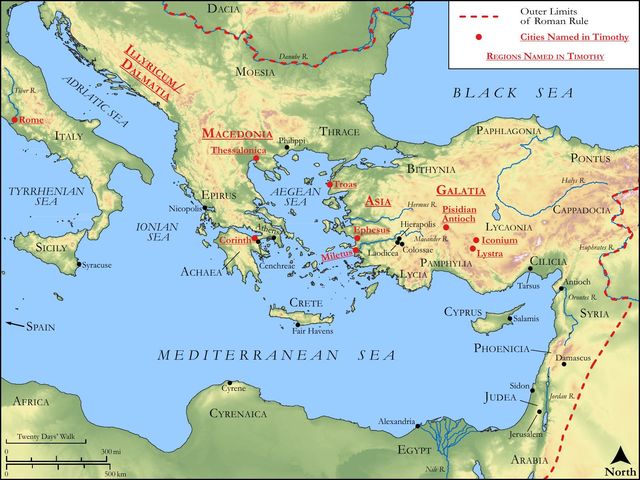
See on the biblical-era maps

Study this verse
Public-domain commentary
Matthew Henry
From his Commentary on the Whole Bible. Henry comments on passages, not single verses — this entry covers 1 Timothy 1:18–20.
Here is the charge he gives to Timothy to proceed in his work with resolution, Ti1 1:18. Observe here, The gospel is a charge committed to the ministers of it; it is committed to their trust, to see that it be duly applied according to the intent and meaning of it, and the design of its great Author. It seems, there had been prophecies before concerning Timothy, that he should be taken into the ministry, and should prove eminent in the work of the ministry; this encouraged Paul to commit this charge to him. Observe, 1. The ministry is a warfare, it is a good warfare against sin and Satan: and under the banner of the Lord Jesus, who is the Captain of our salvation (Heb 2:10), and in his cause, and against his enemies, ministers are in a particular manner engaged. 2. Ministers must war this good warfare, must execute their office diligently and courageously, notwithstanding oppositions and discouragements. 3. The prophecies which went before concerning Timothy are here mentioned as a motive to stir him up to a vigorous and conscientious discharge of his duty; so the good hopes that others have entertained concerning us should excite us to our duty: That thou by them mightest war a good warfare. 4. We must hold both faith and a good conscience: Holding faith and a good conscience, Ti1 1:19. Those that put away a good conscience will soon make shipwreck of faith. Let us live up to the directions of a renewed enlightened conscience, and keep conscience void of offence (Act 24:16), a conscience not debauched by any vice or sin, and this will be a means of preserving us sound in the faith; we must look to the one as well a the other, for the mystery of the faith must be held in a pure conscience, Ti1 3:9. As for those who had made shipwreck of the faith, he specifies two, Hymeneus and Alexander, who had made a profession of the Christian religion, but had quitted that profession; and Paul had delivered them to Satan, had declared them to belong to the kingdom of Satan, and, as some think, had, by an extraordinary power, delivered them to be terrified or tormented by Satan, that they might learn not to blaspheme not to contradict or revile the doctrine of Christ and the good ways of the Lord. Observe, The primary design of the highest censure in the primitive church was to prevent further sin and to reclaim the sinner. In this case it was for the destruction of the flesh, that the spirit might be saved in the day of the Lord Jesus, Co1 5:5. Observe, (1.) Those who love the service and work of Satan are justly delivered over to the power of Satan: Whom I have delivered over to Satan. (2.) God can, if he please, work by contraries: Hymeneus and Alexander are delivered to Satan, that they may learn not to blaspheme, when one would rather think they would learn of Satan to blaspheme the more. (3.) Those who have put away a good conscience, and made shipwreck of faith, will not stick at any thing, blasphemy not excepted. (4.) Therefore let us hold faith and a good conscience, if we would keep clear of blasphemy; for, if we once let go our hold of these, we do not know where we shall stop.
Historical interpretation
Eight Centuries of Reception
7 surviving comments on this verse. Each one is dated, so this reads as a timeline rather than a list.
Select a marker to jump to its quote. Markers stagger vertically where authors wrote within a few decades of each other.
"This charge," he says, "I commit to thee, son Timothy, according to the prophecies which went before on thee, that thou by them mightest war the good warfare; holding faith, and a good conscience; which some having put away concerning faith have made shipwreck."
What is this deposit? Is it so secret as to be supposed to characterize a new doctrine? or is it a part of that charge of which he says, "This charge I commit unto thee, son Timothy? " and also of that precept of which he says, "I charge thee in the sight of God, who quickeneth all things, and before Jesus Christ who witnessed a good confession under Pontius Pilate, that thou keep this commandment? " Now, what is (this) commandment and what is (this) charge? From the preceding and the succeeding contexts, it will be manifest that there is no mysterious hint darkly suggested in this expression about (some) far-fetched doctrine, but that a warning is rather given against receiving any other (doctrine) than that which Timothy had heard from himself, as I take it publicly: "Before many witnesses" is his phrase.
The office of a Teacher and that of a Priest is of great dignity, and to bring forward one that is worthy requires a divine election. So it was of old, and so it is now, when we make a choice without human passion, not looking to any temporal consideration, swayed neither by friendship, nor enmity. For though we be not partakers of so great a measure of the Spirit as they, yet a good purpose is sufficient to draw unto us the election of God. For the Apostles, when they elected Matthias, had not yet received the Holy Spirit, but having committed the matter to prayer, they chose him into the number of the Apostles. For they looked not to human friendships. And so now too it ought to be with us. But we have advanced to the extreme of negligence; and even what is clearly evident, we let pass. Now when we overlook what is manifest, how will God reveal to us what is unseen? as it is said, "If ye have not been faithful in that which is little, who will commit to you that which is great and true?" But then, when nothing human was done, the appointment of Priests too was by prophecy. What is "by prophecy"? By the Holy Spirit. For prophecy is not only the telling of things future, but also of the present. It was by prophecy that Saul was discovered "hidden among the stuff." For God reveals things to the righteous. So it was said by prophecy, "Separate me Barnabas and Saul." In this way Timothy also was chosen, concerning whom he speaks of prophecies in the plural; that, perhaps, upon which he "took and circumcised him," and when he ordained him, as he himself says in his Epistle to him, "Neglect not the gift that is in thee." Therefore to elevate him, and prepare him to be sober and watchful, he reminds him by whom he was chosen and ordained, as if he had said, "God hath chosen thee. He gave thee thy commission, thou wast not made by human vote. Do not therefore abuse or bring into disgrace the appointment of God." When again he speaks of a charge, which implies something burdensome, he adds, "This charge I commit to thee, son Timothy." He charges him as his son, his own son, not so much with arbitrary or despotic authority as like a father, he says, "my son Timothy." The "committing," however, implies that it is to be diligently kept, and that it is not our own. For we did not obtain it for ourselves, but God conferred it upon us; and not it only, but also "faith and a good conscience." What He hath given us then, let us keep. For if He had not come, the faith had not been to be found, nor that pure life which we learn by education. As if he had said, "It is not I that charge thee, but He who chose thee," and this is meant by "the prophecies that went before on thee." Listen to them, obey them.
And say; what chargest thou? "That by them thou shouldest war a good warfare." They chose thee, that then for which they chose thee do thou, "war a good warfare." He named "a good warfare," since there is a bad warfare, of which he says, "As ye have yielded your members instruments to uncleanness and to iniquity." Those men serve under a tyrant, but thou servest under a King. And why calls he it a warfare? To show how mighty a contest is to be maintained by all, but especially by a Teacher; that we require strong arms, and sobriety, and awakenedness, and continual vigilance: that we must prepare ourselves for blood and conflicts, must be in battle array, and have nothing relaxed. "That thou shouldest war in them," he says. For as in an army all do not serve in the same capacity, but in their different stations; so also in the Church one has the office of a Teacher, another that of a disciple, another that of a private man. But thou art in this. And, because this is not sufficient he adds,
It was according to divine revelation that I, Paul, laid hands on you and entrust to you the work of teaching.
By recalling prophecy, Paul makes it clear that Timothy received the laying on of hands in accordance with divine revelation, and after numerous signs that he, Timothy, had been so elected.
With the name of “son,” Paul gives his blessing to Timothy.
I entrust this command to you, Timothy, my child, according to the prophecies previously made about you, so that by them you may wage the good warfare.
this command. It means careful observation.
I entrust. As to a child, Paul says, I command, not according to any authority applying to masters.
according to the prophecies previously. For the sake of emphasis it is placed there. However, the order is this: As soldiers next to those prophecies which have gone before concerning you, that is, as suitable soldiers, responding to the prophecies which were about you. For according to the revelation of the Spirit, Timothy was chosen by Paul as a disciple, and was circumcised, and was ordained a bishop.
them you may wage the good warfare. As a soldier of Christ fighting with spiritual weapons in every way against spiritual enemies.
by them. Namely, by the prophecies: for they have chosen you. Therefore, because of which you were received and by whom you were chosen, serve in them and through them, that is, through the Spirit Himself through whom the prophecies exist.
the good warfare. For there is also a bad warfare, concerning which it is said: "Just as you have presented your members as weapons for sin and impurity." (Rom. 6:13)
Continue studying 1 Timothy 1:18 across the web’s major study libraries — every link below opens this exact verse, chapter, or book on the destination site.
Read & Compare
 BibleGatewayThis verse in more than 200 translations and 70 languages.
 Bible.comThe YouVersion reader — hundreds of translations, reading plans, and highlights.
 ESV.orgCrossway's official English Standard Version reader.
 NET BibleThe NET translation with 60,000+ translators' notes on every rendering decision.
 STEP BibleTyndale House's free study tool — original text, vocabulary, and scholarly resources.
 BibliaLogos Bible Software's free web reader.
 USCCBThe New American Bible (Revised Edition) with the U.S. bishops' study notes.
Commentaries
 BibleHub CommentariesDozens of classic commentaries on this verse, gathered on one page.
 StudyLightMore than 100 commentary sets — the largest collection on the web.
 BibleRefPlain-English commentary on what this verse means, verse by verse.
 Enduring WordDavid Guzik's free commentary on this chapter, widely used by Bible teachers.
 Bible Study ToolsVerse commentary alongside Greek and Hebrew study aids.
Original Language & Research
- BibleHub InterlinearThe verse word by word — original language, transliteration, and English.
- BibleHub LexiconEvery word's original-language definition and Strong's entry.
 Blue Letter BibleDeep-study tools — Strong's numbers, concordance, and word studies.
 CNTR CollationThe earliest Greek manuscripts of this verse, collated letter by letter.
Sermons, Hymns & Audio


TrulyRandomVerse is not affiliated with these sites and doesn’t control their content. They’re linked because they’re genuinely useful.
Summary
First Timothy 1:18 presents a profound and solemn apostolic mandate from Paul to his spiritual son, Timothy, outlining the divine foundation and demanding nature of his ministry in Ephesus. This verse serves as a direct commission, emphasizing that Timothy's calling is rooted in divine prophecies and that his service is to be characterized by a steadfast and honorable engagement in spiritual conflict, likened to a "good warfare." It underscores the weighty responsibility entrusted to Timothy to uphold sound doctrine and godly conduct amidst prevailing false teachings.
Context
ShowHideLiterary Context
This verse is a pivotal statement within the opening chapter of Paul's First Epistle to Timothy, immediately following Paul's initial charge to Timothy regarding the proliferation of false doctrines in Ephesus. Paul has just instructed Timothy to remain in Ephesus specifically to "charge certain persons not to teach any different doctrine" 1 Timothy 1:3. The "charge" (Gk. parangelia) in verse 18 directly refers back to this earlier instruction, reinforcing its gravity and linking Timothy's personal calling to the broader task of preserving the purity of the gospel. The subsequent verses in chapter 1 further elaborate on the nature of the law, the gospel, and Paul's own apostleship, all of which provide the theological framework for Timothy's mission to "war a good warfare."
Historical & Cultural Context
Timothy was a young leader whom Paul had discipled and entrusted with significant responsibilities, particularly in the challenging environment of Ephesus. Ephesus was a prominent Roman city, a center of commerce, culture, and pagan worship, notably the cult of Artemis. This vibrant but spiritually diverse setting meant that the nascent Christian community faced numerous pressures, including internal doctrinal deviations and external pagan influences. Paul's letters to Timothy (and Titus) are often called "Pastoral Epistles" because they provide practical guidance for church leadership and organization in such contexts. The concept of "warfare" would have resonated strongly in a Roman-dominated world, where military service and discipline were highly valued and understood metaphors for commitment and struggle.
Key Themes
ShowHideFirst Timothy 1:18 contributes significantly to several key themes woven throughout the epistle. Foremost is the theme of Apostolic Succession and Mentorship, as Paul formally passes on a vital ministry responsibility to Timothy, his trusted protégé. This highlights the importance of faithful transmission of the gospel and sound doctrine across generations. Another crucial theme is Divine Calling and Affirmation, underscored by the mention of "prophecies which went before on thee," indicating that Timothy's ministry was not merely a human appointment but divinely ordained and publicly confirmed. This divine backing would have been a source of authority and encouragement for Timothy. Finally, the verse introduces the pervasive theme of Spiritual Warfare and the Nature of Christian Ministry, portraying Christian service not as a passive endeavor but as an active, disciplined, and morally upright struggle against spiritual adversaries and false teachings. This resonates with Paul's broader understanding of the Christian life as a battle, as seen in his exhortation to believers to put on the full armor of God in Ephesians 6:10-18, and Timothy's later instruction to "fight the good fight of faith" in 1 Timothy 6:12.
Exposition and Analysis
ShowHideKey Word Analysis
ShowHideThis noun signifies a "mandate" or "command." In this context, it is not merely a suggestion or request but a solemn, authoritative instruction given by Paul as an apostle. It carries the weight of a military order or a legal injunction, emphasizing the seriousness and binding nature of the responsibility entrusted to Timothy.
This verb means "to place alongside," "to present (food, truth)," or, by implication, "to deposit (as a trust or for protection)." Paul is not simply telling Timothy what to do; he is entrusting him with a sacred deposit, a precious charge that must be guarded and faithfully executed. This word highlights the fiduciary nature of Timothy's ministry—he is a steward of God's truth.
This noun refers to "military service," "a campaign," or "a war." Figuratively, it denotes the "apostolic career" as one of hardship and danger. Coupled with the verb "mightest war" (G4754, strateúomai, "to serve in a military campaign; to contend with carnal inclinations"), it paints a vivid picture of Christian ministry as an active, disciplined, and often arduous struggle. The addition of "good" (G2570, kalós, meaning "noble," "honorable," "virtuous") emphasizes that this is not just any battle, but one fought with integrity, according to divine principles, and for a righteous cause.
Verse Breakdown
ShowHide"This charge I commit unto thee, son Timothy,"
Paul directly addresses Timothy, emphasizing the personal and weighty nature of the instruction. The term "son Timothy" highlights their close spiritual relationship, implying both affection and a paternal authority that undergirds the "charge" (mandate) being "committed" (entrusted as a sacred deposit). This sets the tone for the entire letter, which is a pastoral guide for a beloved protégé.
"according to the prophecies which went before on thee,"
This clause reveals the divine authentication of Timothy's ministry. His calling was not arbitrary but had been divinely foretold and affirmed, likely during his ordination or a significant spiritual moment. These prophecies served as public declarations of God's specific plan for Timothy, providing him with a powerful source of assurance, authority, and confidence in the face of challenges.
"that thou by them mightest war a good warfare;"
This final clause states the ultimate purpose of the charge and the prophecies. The prophecies are not just for affirmation but are the means ("by them") through which Timothy is empowered and encouraged to engage in his ministry. The phrase "war a good warfare" is a powerful military metaphor, portraying Christian life and leadership as an active, disciplined, and morally upright struggle against spiritual forces, false teachings, and anything that opposes God's truth. It emphasizes the need for steadfastness, courage, and adherence to divine principles in ministry.
Literary Devices
ShowHideThe most prominent literary device in 1 Timothy 1:18 is the Metaphor of "warfare." Paul employs military imagery to describe the nature of Christian ministry and the Christian life. Timothy is not merely a pastor or teacher; he is a soldier engaged in a "good warfare." This metaphor conveys several layers of meaning: it implies discipline, struggle, opposition, strategy, endurance, and a clear objective. The addition of the adjective "good" (Greek: kalos) elevates this struggle from a mere conflict to a noble, honorable, and virtuous campaign, fought with integrity and for a righteous cause. This Symbolism of the soldier highlights the active, combative nature of contending for the faith against spiritual adversaries and doctrinal error, requiring courage and steadfastness.
Theological and Thematic Connections
ShowHideFirst Timothy 1:18 profoundly connects to the broader biblical themes of divine calling, spiritual conflict, and faithful stewardship. It underscores that Christian ministry is not a self-initiated endeavor but a divinely appointed mission, authenticated by God's own prophetic word. This divine backing empowers believers to engage in the spiritual battle for truth and righteousness, a battle that requires discipline, endurance, and unwavering commitment to the gospel. The "good warfare" is fought not with carnal weapons but with spiritual ones, upholding sound doctrine and living a life of integrity, recognizing that the true enemy is not flesh and blood but spiritual forces of evil. This verse encourages believers to view their service as a sacred trust, to be defended and advanced with valor and integrity, knowing that God himself has equipped and called them for this purpose.
Reflection and Application
ShowHideFirst Timothy 1:18 offers timeless principles for every believer, not just those in vocational ministry. It calls us to recognize that our Christian walk is inherently a "warfare," a spiritual struggle against internal temptations, external cultural pressures, and the deceptive schemes of the enemy. This understanding should not lead to fear, but to a sober recognition of the reality of our faith journey. Just as Timothy was called and equipped, we too are called by God for a specific purpose, and we are empowered by His Spirit and His Word. The challenge is to "war a good warfare," meaning to engage in this struggle with integrity, perseverance, and adherence to biblical truth. This involves actively contending for the faith, living righteously, and resisting compromise, all while relying on God's strength rather than our own. It encourages us to be disciplined in our spiritual lives, to stand firm against error, and to pursue holiness with intentionality, knowing that our efforts are part of a larger, divinely ordained plan.
Questions for Reflection
ShowHideFAQ
ShowHideWhat does Paul mean by "This charge I commit unto thee"?
ShowHidePaul is entrusting Timothy with a solemn and authoritative mandate, not merely a suggestion. The Greek word for "charge" (parangelía) implies a command or injunction, often with legal or military connotations. The word "commit" (paratíthēmi) means to deposit something as a trust or for safekeeping. Therefore, Paul is formally depositing a sacred responsibility with Timothy, specifically referring to the instructions he has just given him regarding confronting false teachers and upholding sound doctrine in Ephesus, as outlined in 1 Timothy 1:3-4. This is a weighty and binding commission for Timothy's ministry.
What are the "prophecies which went before on thee"?
ShowHideThese were likely specific prophetic utterances or public affirmations given by others (perhaps during Timothy's ordination or a significant spiritual gathering) that confirmed God's calling and plan for Timothy's life and ministry. While the Bible doesn't record the exact prophecies, they served as divine authentication of Timothy's gifting and appointment. Paul mentions something similar in 1 Timothy 4:14, where he reminds Timothy not to neglect the gift given to him "through prophecy when the council of elders laid their hands on you." These prophecies provided Timothy with assurance, authority, and a clear sense of divine purpose for his challenging role in Ephesus.
What does it mean to "war a good warfare" in a practical sense today?
ShowHideTo "war a good warfare" means to engage in the Christian life and ministry with the discipline, courage, and integrity of a faithful soldier, but in a spiritual sense. Practically, this involves:
Christ-Centered Fulfillment
ShowHideThe charge to "war a good warfare" finds its ultimate fulfillment and empowerment in Jesus Christ. He is the quintessential warrior who perfectly executed the divine will, engaging in the ultimate spiritual warfare against sin, death, and the powers of darkness. Christ's entire earthly ministry was a "good warfare," marked by perfect obedience to the Father Philippians 2:8, unwavering commitment to truth John 14:6, and a sacrificial love that conquered evil on the cross Colossians 2:15. Timothy's commission, and indeed every believer's call to spiritual battle, is not fought in their own strength, but "by them" (the prophecies/divine backing) and, more profoundly, by the power of the resurrected Christ who lives within them. Jesus himself commissions His followers to continue His work, promising His presence and power Matthew 28:18-20. Thus, the "good warfare" is fought with Christ as our Captain, His victory as our assurance, and His Spirit as our enabling strength, transforming us from mere combatants into faithful participants in His ongoing redemptive mission.