


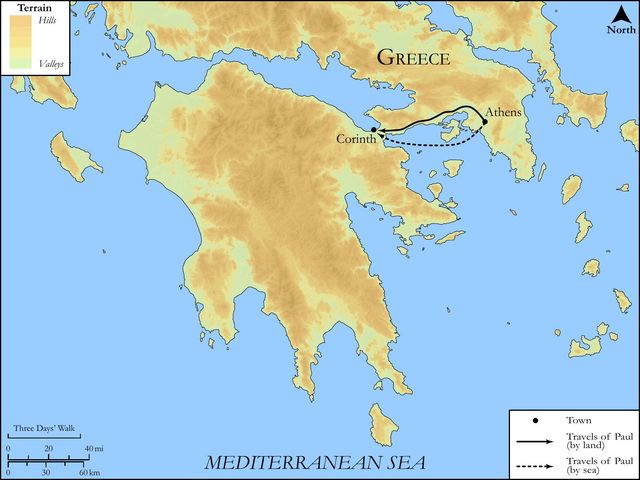
Acts 18:1
- ΜετὰMetaAnd afterG3326PREPPreposition
- δὲdenowG1161CONJConjunction
- ταῦταtautathese thingsG3778D-APNDemonstrative pronoun Accusative Plural Neuter
- χωρισθεὶςchōristheishaving departedG5563V-APP-NSMVerb Aorist Passive Participle Nominative Singular Masculine
- ὁho<the>G3588T-NSMDefinite article Nominative Singular Masculine
- ΠαῦλοςPaulosPaulG3972N-NSM-PNoun Nominative Singular Masculine Individual
- ἐκekfromG1537PREPPreposition
- τῶνtōn<the>G3588T-GPFDefinite article Genitive Plural Feminine
- ἈθηνῶνAthēnōnAthensG116N-GPF-LNoun Genitive Plural Feminine Location
- ἦλθενēlthenhe cameG2064V-2AAI-3SVerb 2nd Aorist Active Indicative 3rd Singular
- εἰςeistoG1519PREPPreposition
- ΚόρινθονKorinthonCorinthG2882N-ASF-LNoun Accusative Singular Feminine Location
English is a literal word-by-word gloss of the Greek, not the KJV's wording. Why?
This is the original text the KJV's translators worked from — each Greek word with its own literal English meaning in this verse, prepared by scholars at Tyndale House, Cambridge. The KJV translates whole sentences, not word by word, so its wording differs: one Greek word can become several English words, and the KJV may choose “charity” where the gloss reads “love”. Both are faithful — they answer different questions. For the KJV's own rendering, switch to the KJV text.
Details
See on the biblical-era map
Study this verse
Public-domain commentary
Matthew Henry
From his Commentary on the Whole Bible. Henry comments on passages, not single verses — this entry covers Acts 18:1–6. His three-level outline is real structure in the source text, so it is rendered as structure.
We do not find that Paul was much persecuted at Athens, nor that he was driven thence by any ill usage, as he was from those places where the Jews had or could make any interest; but this reception at Athens being cold, and little prospect of doing good there, he departed from Athens, leaving the care of those there who believed with Dionysius; and thence he came to Corinth, where he was now instrumental in planting a church that became on many accounts considerable. Corinth was the chief city of Achaia, now a province of the empire, a rich and splendid city. Non cuivis homini contingit adire Corinthum - It is not permitted every man to see Corinth. The country thereabouts at this day is called the Morea. Now here we have,
I.Paul working for his living, Act 18:2, Act 18:3.
1.Though he was bred a scholar, yet he was master of a handicraft trade. He was a tent-maker, an upholsterer; he made tents for the use of soldiers and shepherds, of cloth or stuff, or (as some say tents were then generally made) of leather or skins, as the outer covering of the tabernacle. Hence to live in tents was to live sub pellibus - under skins. Dr. Lightfoot shows that it was the custom of the Jews to bring up their children to some trade, yea, though they gave them learning or estates. Rabbi Judah says, "He that teaches not his son a trade is as if he taught him to be a thief." And another says, "He that has a trade in his hand is as a vineyard that is fenced." An honest trade, by which a man may get his bread, is not to be looked upon by any with contempt. Paul, though a Pharisee, and bred up at the feet of Gamaliel, yet, having in his youth learned to make tents, did not by disuse lose the art.
2.Though he was entitled to a maintenance from the churches he had planted, and from the people to whom he preached, yet he worked at his calling to get bread, which is more to his praise who did not ask for supplies than to theirs who did not supply him unasked, knowing what straits he was reduced to. See how humble Paul was, and wonder that so great a man could stoop so low; but he had learned condescension of his Master, who came not to be ministered to, but to minister. See how industrious he was, and how willing to take pains. He that had so much excellent work to do with his mind, yet, when there was occasion, did not think it below him to work with his hands. Even those that are redeemed from the curse of the law are not exempt from that sentence, In the sweat of thy face thou shalt eat bread. See how careful Paul was to recommend his ministry, and to prevent prejudices against it, even the most unjust and unreasonable; he therefore maintained himself with his own labour that he might not make the gospel of Christ burdensome, Co2 11:7, etc.; Th2 3:8, Th2 3:9.
3.Though we may suppose he was master of his trade, yet he did not disdain to work at journey-work: He wrought with Aquila and Priscilla, who were of that calling, so that he got no more than day-wages, a bare subsistence. Poor tradesmen must be thankful if their callings bring them in a maintenance for themselves and their families, though they cannot do as the rich merchants that raise estates by their callings.
4.Though he was himself a great apostle, yet he chose to work with Aquila and Priscilla, because he found them to be very intelligent in the things of God, as appears afterwards (Act 18:26), and he owns that they had been his helpers in Christ Jesus, Rom 16:3. This is an example to those who are going to service to seek for those services in which they may have the best help for their souls. Choose to work with those that are likely to be helpers in Christ Jesus. It is good to be in company and to have conversation with those that will further us in the knowledge of Christ, and to put ourselves under the influence of such as are resolved that they will serve the Lord. Concerning this Aquila we are here told,
(1.)That he was a Jew, but born in Pontus, Act 18:2. Many of the Jews of the dispersion were seated in that country, as appears Pe1 1:1.
(2.)That he was lately come from Italy to Corinth. It seems he often changed his habitation; this is not the world we can propose ourselves a settlement in.
(3.)That the reason of his leaving Italy was because by a late edict of the emperor Claudius Caesar all Jews were banished from Rome; for the Jews were generally hated, and every occasion was taken to put hardship and disgrace upon them. God's heritage was as a speckled bird, the birds round about were against her, Jer 12:9. Aquila, though a Christian, was banished because he had been a Jew; and the Gentiles had such confused notions of the thing that they could not distinguish between a Jew and a Christian. Suetonius, in the life of Claudius, speaks of this decree in the ninth year of his reign, and says, The reason was because the Jews were a turbulent people - assiduo tumultuantes; and that it was impulsore Christo - upon the account of Christ; some zealous for him, others bitter against him, which occasioned great heats, such as gave umbrage to the government, and provoked the emperor, who was a timorous jealous man, to order them all to be gone. If Jews persecute Christians, it is not strange if heathens persecute them both.
II.We have here Paul preaching to the Jews, and dealing with them to bring them to the faith of Christ, both the native Jews and the Greeks, that is, those that were more or less proselyted to the Jewish religion, and frequented their meetings.
1.He reasoned with them in the synagogue publicly every sabbath. See in what way the apostles propagated the gospel, not by force and violence, by fire and sword, not by demanding an implicit consent, but by fair arguing; they drew with the cords of a man, gave a reason for what they said, and gave a liberty to object against it, having satisfactory answers ready. God invites us to come and reason with him (Isa 1:18), and challenges sinners to produce their cause, and bring forth their strong reasons, Isa 41:21. Paul was a rational as well as a scriptural preacher.
2.He persuaded them - epeithe. It denotes,
(1.)The urgency of his preaching. He did not only dispute argumentatively with them, but he followed his arguments with affectionate persuasions, begging of them for God's sake, for their own soul's sake, for their children's sake, not to refuse the offer of salvation made to them. Or,
(2.)The good effect of his preaching. He persuaded them, that is, he prevailed with them; so some understand it. In sententiam suam adducebat - He brought them over to his own opinion. Some of them were convinced by his reasonings, and yielded to Christ.
3.He was yet more earnest in this matter when his fellow-labourers, his seconds, came up with him (Act 18:5): When Silas and Timothy had come from Macedonia, and had brought him good tidings from the churches there, and were ready to assist him here, and strengthened his hands, then Paul was more than before pressed in spirit, which made him more than ever pressing in his preaching. He was grieved for the obstinacy and infidelity of his countrymen the Jews, was more intent than ever upon their conversion, and the love of Christ constrained him to it (Co2 5:14): it is the word that is used here, it pressed him in spirit to it. And, being thus pressed, he testified to the Jews with all possible solemnity and seriousness, as that which he was perfectly well assured of himself, and attested to them as a faithful saying, and worthy of all acceptation, that Jesus is the Christ, the Messiah promised to the fathers and expected by them.
III.We have him here abandoning the unbelieving Jews, and turning from them to the Gentiles, as he had done in other places, Act 18:6.
1.Many of the Jews, and indeed the most of them, persisted in their contradiction to the gospel of Christ, and would not yield to the strongest reasonings nor the most winning persuasions; they opposed themselves and blasphemed; they set themselves in battle array (so the word signifies) against the gospel; they joined hand in hand to stop the progress of it. They resolved they would not believe it themselves, and would do all they could to keep others from believing it. They could not argue against it, but what was wanting in reason they made up in ill language: they blasphemed, spoke reproachfully of Christ, and in him of God himself, as Rev 13:5, Rev 13:6. To justify their infidelity, they broke out into downright blasphemy.
2.Paul hereupon declared himself discharged from them, and left them to perish in their unbelief. He that was pressed in spirit to testify to them (Act 18:5), when they opposed that testimony, and persisted in their opposition, was pressed in spirit to testify against them (Act 18:6), and his zeal herein also he showed by a sign: he shook his raiment, shaking off the dust from it (as before they shook off the dust from their feet, Act 13:51), for a testimony against them. thus he cleared himself from them, but threatened the judgments of God against them. As Pilate by washing his hands signified the devolving of the guilt of Christ's blood from himself upon the Jews, so Paul by shaking his raiment signified what he said, if possible to affect them with it.
(1.)He had done his part, and was clean from the blood of their souls; he had, like a faithful watchman, given them warning, and thereby had delivered his soul, though he could not prevail to deliver theirs. He had tried all methods to work upon them, but all in vain, so that if they perish in their unbelief their blood is not to be required at his hands; here, and Act 20:26, he plainly refers to Eze 33:8, Eze 33:9. It is very comfortable to a minister to have the testimony of his conscience for him, that he has faithfully discharged his trust by warning sinners.
(2.)They would certainly perish if they persisted in their unbelief, and the blame would lie wholly upon themselves: "Your blood be upon your own heads, you will be your own destroyers, your nation will be ruined in this world, and particular persons will be ruined in the other world, and you alone shall bear it." If any thing would frighten them at last into a compliance with the gospel, surely this would.
3.Having given them over, yet he does not give over his work. Though Israel be not gathered, Christ and his gospel shall be glorious: Henceforth I will go unto the Gentiles; and the Jews cannot complain, for they had the first offer, and a fair one, made to them. The guests that were first invited will not come, and the provision must not be lost; guests must be had therefore from the highways and the hedges. "We would have gathered the Jews (Mat 23:37), would have healed them (Jer 51:9), and they would not; but Christ must not be a head without a body, nor a foundation without a building, and therefore, if they will not, we must try whether others will." Thus the fall and diminishing of the Jews became the riches of the Gentiles; and Paul said this to their faces, not only because it was what he could justify, but to provoke them to jealousy, Rom 11:12, Rom 11:14.
Historical interpretation
Historical reception
1 surviving comment on this verse from the historical church.
What can be the reason that, having persuaded some so far as to say that they would hear him again, and there being no dangers, Paul is so in haste to leave Athens? Probably he knew that he should do them no great good; moreover he was led by the Spirit to Corinth. For the Athenians, although fond of hearing strange things, nevertheless did not attend to him; for this was not their study, but only to be always having something to say; which was the cause that made them hold off from him. It seemed to Paul sufficient to have cast the seeds of the doctrines. To Corinth then, as I said, he was led by the Spirit, in which city he was to abide.
Continue studying Acts 18:1 across the web’s major study libraries — every link below opens this exact verse, chapter, or book on the destination site.
Read & Compare
 BibleGatewayThis verse in more than 200 translations and 70 languages.
 Bible.comThe YouVersion reader — hundreds of translations, reading plans, and highlights.
 ESV.orgCrossway's official English Standard Version reader.
 NET BibleThe NET translation with 60,000+ translators' notes on every rendering decision.
 STEP BibleTyndale House's free study tool — original text, vocabulary, and scholarly resources.
 BibliaLogos Bible Software's free web reader.
 USCCBThe New American Bible (Revised Edition) with the U.S. bishops' study notes.
Commentaries
 BibleHub CommentariesDozens of classic commentaries on this verse, gathered on one page.
 StudyLightMore than 100 commentary sets — the largest collection on the web.
 BibleRefPlain-English commentary on what this verse means, verse by verse.
 Enduring WordDavid Guzik's free commentary on this chapter, widely used by Bible teachers.
 Bible Study ToolsVerse commentary alongside Greek and Hebrew study aids.
Original Language & Research
- BibleHub InterlinearThe verse word by word — original language, transliteration, and English.
- BibleHub LexiconEvery word's original-language definition and Strong's entry.
 Blue Letter BibleDeep-study tools — Strong's numbers, concordance, and word studies.
 CNTR CollationThe earliest Greek manuscripts of this verse, collated letter by letter.
Sermons, Hymns & Audio


TrulyRandomVerse is not affiliated with these sites and doesn’t control their content. They’re linked because they’re genuinely useful.
Summary
Acts 18:1 marks a crucial geographical and spiritual transition in Paul's second missionary journey. Having completed his engagement in Athens, a city steeped in philosophical discourse but largely resistant to the Gospel, Paul strategically relocates to Corinth. This bustling, cosmopolitan port city, renowned for its commercial prowess and pervasive immorality, presented a new and distinct challenge, yet also a fertile ground for the establishment of a vibrant Christian community.
Context
ShowHideLiterary Context
This verse serves as a direct narrative continuation from the events detailed in Acts 17. Paul's ministry in Athens, particularly his famous address on Mars' Hill, yielded limited immediate results, with only a few individuals, such as Dionysius the Areopagite and a woman named Damaris, embracing the faith (Acts 17:32-34). The phrase "After these things" signals the conclusion of that particular phase of ministry and the deliberate movement to a new location. Luke's concise reporting highlights the ongoing, dynamic nature of Paul's Spirit-led mission, always pressing forward to new territories.
Historical & Cultural Context
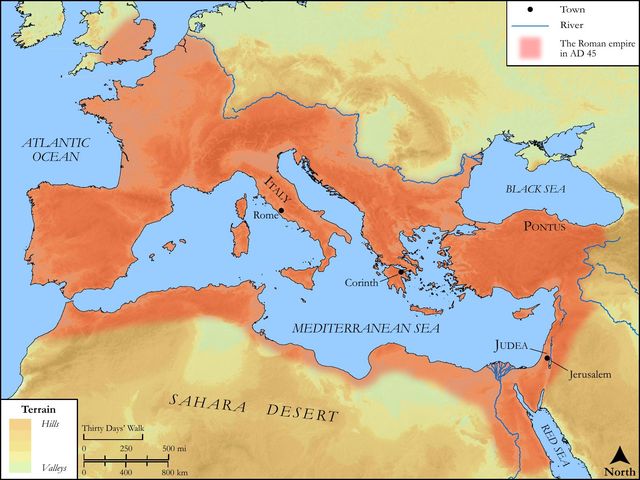
Corinth, at the time of Paul's arrival, was a thriving Roman provincial capital and the most important city in Greece. Strategically situated on the Isthmus of Corinth, it controlled vital land and sea trade routes between the Aegean and Adriatic seas. This commercial prosperity, however, was intertwined with a notorious reputation for moral decadence and diverse pagan worship, including the infamous temple of Aphrodite. Its population was a melting pot of Romans, Greeks, Jews, and various other ethnicities, making it a challenging but highly influential center. Paul's decision to come to Corinth was not arbitrary; it was a strategic move to plant the Gospel in a city whose cultural and economic influence could facilitate its wider dissemination throughout the Roman Empire.
Key Themes
ShowHideActs 18:1 contributes to several overarching themes within the book of Acts and Paul's ministry. Firstly, it underscores the theme of Missionary Progress and Perseverance, demonstrating Paul's unwavering commitment to spreading the Gospel despite varied responses and challenging environments, as seen in his continuous movement from city to city. Secondly, it highlights Divine Guidance in Evangelism, as Paul's movements, though seemingly strategic, were ultimately directed by God's providence, leading him to key urban centers like Corinth where a significant church would be established, as evidenced by his later epistles of 1 Corinthians and 2 Corinthians. Lastly, the verse implicitly showcases the Universal Reach of the Gospel, emphasizing that the message of Christ is for all people, regardless of their intellectual background (Athens) or moral condition (Corinth).
Exposition and Analysis
ShowHideKey Word Analysis
ShowHideMeaning "to place room between, i.e. part; reflexively, to go away." This word emphasizes Paul's active decision to separate himself from Athens, marking a definitive end to his ministry there and initiating a new phase. It's not a passive withdrawal but a purposeful movement.
Referring to the capital of Greece, named after the goddess of wisdom. This name evokes the city's identity as a center of philosophy, intellectualism, and idolatry, providing a stark contrast to the commercial and morally lax environment of Corinth. Paul's departure from Athens signifies a shift from a context of intellectual debate to one of pervasive sensuality.
The name of a prominent city in Greece. Its mention immediately brings to mind its reputation as a wealthy, strategic port city notorious for its immorality and diverse pagan cults. Paul's arrival here sets the stage for a ministry that would directly confront these cultural realities, leading to the formation of a church that would grapple with significant ethical and theological challenges.
Verse Breakdown
ShowHide"After these things"
This introductory phrase, a common narrative marker (Greek: metá taûta), serves as a temporal connector, indicating that the events of Paul's ministry in Athens have concluded. It signifies a sequential progression in the missionary journey, signaling a shift in location and focus.
"Paul departed from Athens"
This clause highlights Paul's agency and the completion of his work in the intellectual capital. His departure was a deliberate act, not merely a casual move, signifying the strategic nature of his missionary endeavors. It implies a sense of concluding one phase of ministry, regardless of the perceived success or lack thereof, and readiness for the next.
"and came to Corinth"
This final clause identifies Paul's new destination. His arrival in Corinth marks the beginning of a significant and challenging period of ministry, one that would lead to the establishment of a foundational church in a highly influential, yet morally complex, urban center.
Literary Devices
ShowHideLuke's concise report in Acts 18:1 effectively uses several literary devices. The primary device is Transition, as the verse serves as a narrative bridge, smoothly moving the story from Paul's Athenian ministry to his arrival in Corinth. This transition is marked by the phrase "After these things," which acts as a clear narrative signpost. There is also an implicit Juxtaposition between Athens and Corinth; while not explicitly stated, the reader familiar with the preceding chapter understands the stark contrast between Athens, a city of philosophical discourse and intellectual pride, and Corinth, a city known for its commercialism and pervasive immorality. This contrast highlights the diverse environments the Gospel penetrates. Furthermore, Luke employs Conciseness, delivering a pivotal geographical shift in a remarkably brief statement, characteristic of his economical yet impactful narrative style in Acts.
Theological and Thematic Connections
ShowHidePaul's movement from Athens to Corinth, as recorded in this verse, powerfully illustrates the dynamic and Spirit-led nature of early Christian missions. It underscores the theological truth that God's kingdom is not confined to specific cultural or intellectual strongholds but is intended to permeate every facet of human society, regardless of its moral or philosophical climate. Paul's perseverance, his willingness to leave a place of limited receptivity for a new, challenging, yet strategically vital location, reflects a deep trust in divine guidance and the universal power of the Gospel to transform lives. This continuous forward movement, even in the face of varying degrees of success, epitomizes the relentless advance of God's redemptive plan through His chosen instruments.
Reflection and Application
ShowHideActs 18:1 offers profound insights for contemporary believers regarding perseverance, divine leading, and strategic engagement in ministry. Just as Paul moved from Athens, where intellectualism often overshadowed spiritual hunger, to Corinth, a city grappling with profound moral issues, we too are called to be flexible and responsive to God's direction. This verse challenges us to consider whether we are willing to "depart" from comfortable or familiar settings, or even from ministries that seem to yield little fruit, if God is calling us to new, potentially more challenging, but strategically vital fields. It reminds us that God's work often involves transitions, new beginnings, and a willingness to step into environments that desperately need the light of the Gospel, regardless of their reputation. Our mission is not always about immediate visible success, but about faithful obedience to the Spirit's leading, trusting that God will bring forth fruit in His time and in His way.
Questions for Reflection
ShowHideFAQ
ShowHideWhy did Paul leave Athens, and was his ministry there considered a failure?
ShowHidePaul's departure from Athens was likely a combination of strategic decision and divine leading, not necessarily an admission of failure. While the immediate results in Athens, as recorded in Acts 17:32-34, showed limited conversions compared to other cities, some individuals did believe, and the seed of the Gospel was sown in a highly influential intellectual center. Paul consistently moved to new cities, driven by the Spirit's direction and a strategic vision to spread the Gospel as widely as possible. His ministry was about planting churches and proclaiming the message, not solely about the number of immediate converts in any single location. Moving to Corinth, a major commercial hub, was a strategic choice to reach a different, yet equally influential, segment of the Roman world.
What was the significance of Paul choosing Corinth as his next destination?
ShowHideCorinth was a city of immense strategic importance for the spread of the Gospel. As a major Roman provincial capital and a bustling port city, it was a crossroads of trade, culture, and diverse populations. Its wealth attracted people from all over the Roman Empire, and its influence extended far beyond its borders. While it was notorious for its rampant immorality and diverse pagan cults, this very characteristic made it a prime target for the transformative power of the Gospel. Establishing a strong church in Corinth meant that the message could naturally radiate outwards through its extensive commercial and social networks. Paul's lengthy stay there (18 months, Acts 18:11) and the subsequent letters he wrote to the Corinthian church (1 Corinthians and 2 Corinthians) underscore its critical role in early Christianity.
Christ-Centered Fulfillment
ShowHidePaul's journey from Athens to Corinth, a movement driven by divine purpose and strategic foresight, profoundly illustrates the Christ-centered nature of the apostolic mission. Just as Christ himself "came not to be served but to serve, and to give his life as a ransom for many" (Mark 10:45), Paul's relentless itinerancy reflects the expansive and self-giving heart of the Gospel. His mission to reach every corner of the world, from the intellectual elite of Athens to the morally compromised populace of Corinth, is a direct fulfillment of Christ's Great Commission to "go and make disciples of all nations" (Matthew 28:18-20). The very act of bringing the Gospel to a city like Corinth, infamous for its sin, underscores the transformative power of Christ's cross and resurrection, which alone can reconcile humanity to God. Paul's work in Corinth ultimately points to the universal Lordship of Christ, before whom "every knee should bow, in heaven and on earth and under the earth" (Philippians 2:9-11). The establishment of a church in such a challenging environment is a testament to the fact that the Gospel "is the power of God for salvation to everyone who believes" (Romans 1:16), demonstrating that Christ's redemptive work extends to all, regardless of their past or present circumstances.