


2 Timothy 4:20
- ἜραστοςErastosErastusG2037N-NSM-PNoun Nominative Singular Masculine Individual
- ἔμεινενemeinenremainedG3306V-AAI-3SVerb Aorist Active Indicative 3rd Singular
- ἐνeninG1722PREPPreposition
- Κορίνθῳ·KorinthōCorinthG2882N-DSF-LNoun Dative Singular Feminine Location
- ΤρόφιμονTrophimonTrophimusG5161N-ASM-PNoun Accusative Singular Masculine Individual
- δὲdehoweverG1161CONJConjunction
- ἀπέλιπονapeliponI leftG620V-2AAI-1SVerb 2nd Aorist Active Indicative 1st Singular
- ἐνeninG1722PREPPreposition
- ΜιλήτῳMilētōMiletusG3399N-DSF-LNoun Dative Singular Feminine Location
- ἀσθενοῦνταasthenountaailingG770V-PAP-ASMVerb Present Active Participle Accusative Singular Masculine
English is a literal word-by-word gloss of the Greek, not the KJV's wording. Why?
This is the original text the KJV's translators worked from — each Greek word with its own literal English meaning in this verse, prepared by scholars at Tyndale House, Cambridge. The KJV translates whole sentences, not word by word, so its wording differs: one Greek word can become several English words, and the KJV may choose “charity” where the gloss reads “love”. Both are faithful — they answer different questions. For the KJV's own rendering, switch to the KJV text.
Details
See on the biblical-era map

Study this verse
Public-domain commentary
Matthew Henry
From his Commentary on the Whole Bible. Henry comments on passages, not single verses — this entry covers 2 Timothy 4:16–22. His three-level outline is real structure in the source text, so it is rendered as structure.
Here, I. He gives Timothy an account of his own present circumstances.
1.He had lately been called to appear before the emperor, upon his appeal to Caesar; and then no man stood with him (Ti2 4:16), to plead his cause, to bear testimony for him, or so much as to keep him in countenance, but all men forsook him. This was strange, that so good a man as Paul should have nobody to own him, even at Rome, where there were many Christians, whose faith was spoken of throughout the world, Rom 1:8. But men are but men. The Christians at Rome were forward to go and meet him (Acts 28); but when it came to the pinch, and they would be in danger of suffering with him, then they all forsook him. He prays that God would not lay it to their charge, intimating that it was a great fault, and God might justly be angry with them, but he prays God to forgive them. See what a distinction is put between sins of presumption and sins of infirmity. Alexander the coppersmith, who maliciously withstood Paul, he prays against: The Lord reward him according to his works; but respecting these Christians, who through weakness shrunk from Paul in time of trial, he says, The Lord lay it not to their charge. Observe,
(1.)Paul had his trials in his friends' forsaking him in a time of danger as well as in the opposition made by enemies: all forsook him.
(2.)It was their sin not to appear for the good apostle, especially at his first answer; but it was a sin of weakness, and therefore the more excusable. Yet,
(3.)God might lay it to their charge, but Paul endeavours to prevent it by his earnest prayers: Let it not be laid to their charge.
2.Notwithstanding this God stood by him (Ti2 4:17), gave him extraordinary wisdom and courage, to enable him to speak so much the better himself. When he had nobody to keep him in countenance, God made his face to shine. - That by me the preaching might be fully known, that is, "God brought me out from that difficulty that I might preach the gospel, which is my business." Nay, it should seem, that he might preach the gospel at that time; for Paul knew how to preach at the bar as well as in the pulpit. And that all the Gentiles might hear; the emperor himself and the great men who would never have heard Paul preach if he had not been brought before them. And I was delivered out of the mouth of the lion, that is, of Nero (as some think) or some other judge. Some understand it only as a proverbial form of speech, to signify that he was in imminent danger. And the Lord shall deliver me from every evil work. See how Paul improved his experiences: "He that delivered doth deliver, and we trust he will yet deliver, will deliver me from every evil work, from any ill done to me by others. And shall preserve me to his heavenly kingdom." And for this he gives glory to God, rejoicing in hope of the glory of God. Observe,
(1.)If the Lord stand by us, he will strengthen us, in a time of difficulty and danger, and his presence will more than supply every one's absence.
(2.)When the Lord preserves his servants from great and imminent danger, it is for eminent work and service. Paul was preserved that by him the preaching might be fully known, etc.
(3.)Former deliverances should encourage future hopes.
(4.)There is a heavenly kingdom, to which the Lord will preserve his faithful witnessing or suffering servants.
(5.)We ought to give God the glory of all past, present, and future deliverances: To whom be glory for ever and ever. Amen.
II.He sends salutations to Aquila, and Priscilla, and the household of Onesiphorus, Ti2 4:19.
He mentions his leaving Trophimus sick at Miletum (Ti2 4:20), by which it appears that though the apostles healed all manner of diseases miraculously, for the confirmation of their doctrine, yet they did not exert that power upon their own friends, lest it should have looked like a collusion.
III.He hastens Timothy to come to him before winter (Ti2 4:21), because he longed to see him, and because in the winter the journey or voyage would be more dangerous.
IV.He sends commendations to him from Eubulus, Pudens, Linus, Claudia, and all the brethren.
One of the heathen writers at this time mentions one Pudens and his wife Claudia, and says the Claudia was a Briton, whence some have gathered that it was this Pudens, and that Claudia here was his wife, and that they were eminent Christians at Rome.
V.He concludes with a prayer, that the Lord Jesus would be with his spirit.
We need no more to make us happy than to have the Lord Jesus Christ with our spirits; for in him all spiritual blessings are summed up. And it is the best prayer we can put up for our friends, that the Lord Jesus Christ may be with their spirits, to sanctify and save them, and at last to receive them to himself; as Stephen the proto-martyr prayed, Lord Jesus, receive my spirit, Act 7:59. "Lord Jesus, receive that spirit which thou hast been with while it was united to the body; do not now leave it in its separate state." Grace be with you. Amen. This was our apostle's token in every epistle; so he wrote. The grace of our Lord Jesus Christ be with you all. Amen, Th2 3:17, Th2 3:18. And if grace be with us here to convert and change us, to make us holy, to keep us humble, and to enable us to persevere to the end, glory will crown us hereafter: for the Lord is a sun, and a shield; the Lord will give grace and glory, and no good thing will he withhold from those that walk uprightly. O Lord of hosts, blessed is the man that trusteth in thee, Psa 84:11, Psa 84:12. Now unto the King eternal, immortal, invisible, the only wise God our Saviour, be honour and glory for ever and ever. Amen.
Historical interpretation
Six Centuries of Reception
2 surviving comments on this verse. Each one is dated, so this reads as a timeline rather than a list.
Select a marker to jump to its quote. Markers stagger vertically where authors wrote within a few decades of each other.
"Salute Priscilla and Aquila, and the household of Onesiphorus." For he was then in Rome, of whom he said "The Lord grant unto him that he may find mercy of the Lord in that day." (2 Tim. i. 18.) By this naming of him, he makes those of his household also more zealous in such good actions. "Salute Priscilla and Aquila." These are they of whom he makes continual mention, with whom too he had lodged, and who had taken Apollos to them. He names the woman first, as being I suppose more zealous, and more faithful, for she had then received Apollos; or it might be done indifferently. And it was to them no slight consolation to be thus saluted. It conveyed a demonstration of esteem and love, and a participation in much grace. For the bare salutation of that holy and blessed man was sufficient to fill with grace him who received it. "Erastus abode at Corinth: but Trophimus have I left at Miletum sick." This Trophimus and Tychicus, we know from the book of the Acts, sailed away with him from Judea, and were everywhere his companions, perhaps as being more zealous than the rest. "Trophimus I have left at Miletum sick." Why then didst thou not heal him, instead of leaving him? The Apostles could not do everything, or they did not dispense miraculous gifts upon all occasions, lest more should be ascribed to them than was right. "Do thy diligence to come before winter. Eubulus greeteth thee, and Pudens, and Linus, and Claudia, and all the brethren." This Linus, some say, was second Bishop of the Church of Rome after Peter.
Priscilla and Aquila greet you, and the household of Onesiphorus. Erastus stayed in Corinth. I left Trophimus sick in Miletus. Make every effort to come before winter. Eubulus and Pudens and Linus greet you, as does Claudia, and all the brothers.
These are the ones whom Paul continually remembers among the tentmakers, from among whom he also stayed with and often mention. But he first remembers the woman, as more trustworthy and earnest. For she also instructed Apollo. He offers a greeting, both comforting at the same time, and also showing honor and love through this, and the greater things, having been filled with much grace, the one being addressed.
and the household of Onesiphorus. For Onesiphorus was in Rome. Therefore, Paul greets those in his house, stirring up zeal similar to that of Onesiphorus.
Erastus stayed in Corinth. Since Paul did not remember these things before, now he remembers, in order to show that he is isolated on all sides and needs Timothy.
I left Trophimus sick in Miletus. Miletus is near Ephesus. Therefore, when he sailed to Judea, Paul left him in Miletus, or after arriving in Rome, again in these parts, we do not have information to say.
sick. Why then did he not heal him, but let him be? Because the saints did not do everything, so that they would not be considered better than human nature.
Make every effort to come before winter. "Until then," Paul says, "while I live, so that you do not see me having been delayed by the winter."
and Linus. They say that this Linus became the second bishop of Rome after Peter.
as does Claudia. Do you see how even women have been fierce and passionate, crucified to the world? Indeed, this kind is in no way inferior to men, provided they desire it.
and all the brothers. Those mentioned by name were more fervent in faith.
Continue studying 2 Timothy 4:20 across the web’s major study libraries — every link below opens this exact verse, chapter, or book on the destination site.
Read & Compare
 BibleGatewayThis verse in more than 200 translations and 70 languages.
 Bible.comThe YouVersion reader — hundreds of translations, reading plans, and highlights.
 ESV.orgCrossway's official English Standard Version reader.
 NET BibleThe NET translation with 60,000+ translators' notes on every rendering decision.
 STEP BibleTyndale House's free study tool — original text, vocabulary, and scholarly resources.
 BibliaLogos Bible Software's free web reader.
 USCCBThe New American Bible (Revised Edition) with the U.S. bishops' study notes.
Commentaries
 BibleHub CommentariesDozens of classic commentaries on this verse, gathered on one page.
 StudyLightMore than 100 commentary sets — the largest collection on the web.
 BibleRefPlain-English commentary on what this verse means, verse by verse.
 Enduring WordDavid Guzik's free commentary on this chapter, widely used by Bible teachers.
 Bible Study ToolsVerse commentary alongside Greek and Hebrew study aids.
Original Language & Research
- BibleHub InterlinearThe verse word by word — original language, transliteration, and English.
- BibleHub LexiconEvery word's original-language definition and Strong's entry.
 Blue Letter BibleDeep-study tools — Strong's numbers, concordance, and word studies.
 CNTR CollationThe earliest Greek manuscripts of this verse, collated letter by letter.
Sermons, Hymns & Audio


TrulyRandomVerse is not affiliated with these sites and doesn’t control their content. They’re linked because they’re genuinely useful.
Summary
In the concluding remarks of his final epistle, the Apostle Paul provides a concise personal update to Timothy regarding two of their mutual companions: Erastus, who remained in Corinth, and Trophimus, whom Paul had to leave behind in Miletus due to illness. This brief, seemingly mundane detail offers a poignant glimpse into the practical realities, challenges, and deep human connections that characterized early Christian ministry, even amidst Paul's own impending martyrdom.
Context
ShowHideLiterary Context
This verse is situated within the highly personal and urgent final chapter of Paul's Second Epistle to Timothy, often considered Paul's last will and testament. Written from a Roman prison, likely just before his execution, the letter is saturated with Paul's pastoral heart, his charge to Timothy to "preach the word" (2 Timothy 4:2), and a sense of impending departure. In 2 Timothy 4, Paul transitions from theological exhortation to practical instructions, warnings against false teachers, and a series of personal requests and greetings. The mention of Erastus and Trophimus, alongside other personal notes like the request for his cloak and parchments (2 Timothy 4:13), serves to underscore the authenticity of the letter and the very real human network that supported Paul's ministry, even in its final, most challenging phase. These details are not incidental but highlight the ongoing, dynamic nature of their shared mission and the practical challenges faced by early Christian workers.
Historical & Cultural Context
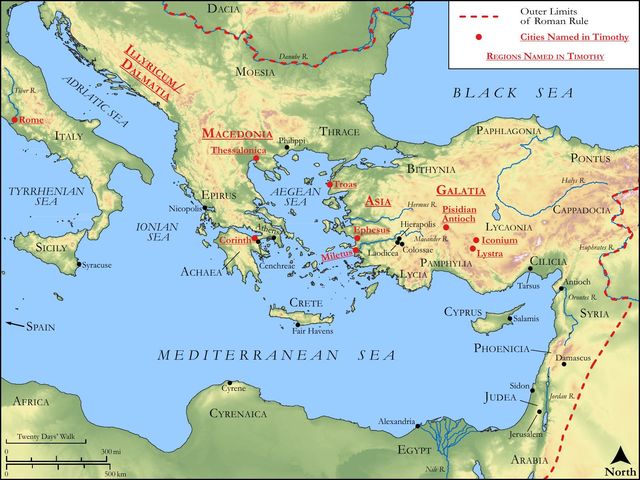
The locations mentioned, Corinth and Miletus, were significant urban centers in the Roman Empire. Corinth, a bustling port city in Greece, was a strategic hub for trade and culture, where Paul had spent considerable time establishing a vibrant church. Erastus, possibly a public official there (Romans 16:23), remaining in such a city suggests continued ministry or a settled role within the Christian community. Miletus, a prominent port city on the coast of Asia Minor, south of Ephesus, was a common stop for maritime travel. Travel in the ancient world was arduous and fraught with dangers, including illness, which was a constant threat due to poor sanitation and lack of advanced medicine. Trophimus, an Ephesian Gentile Christian, had been a faithful companion to Paul on his third missionary journey (Acts 20:4). His illness at Miletus highlights the physical toll of missionary work and the vulnerability of even dedicated servants of God to common human ailments. Paul's decision to leave him behind was a practical necessity, not an abandonment, reflecting the realities of travel and care in that era.
Key Themes
ShowHideThis brief verse contributes to several overarching themes within 2 Timothy and Paul's broader theology. Firstly, it powerfully illustrates The Human Element and Frailty in Ministry. Despite Paul's apostolic authority and spiritual gifts, he and his companions were subject to human limitations, including sickness and the logistical challenges of travel. This grounds ministry in reality, reminding us that God uses imperfect, vulnerable people. Secondly, it highlights Paul's Pastoral Heart and Concern for Fellow Workers. Even facing his own imminent death, Paul's attention to the well-being and whereabouts of Erastus and Trophimus demonstrates his deep care for his team, emphasizing the importance of community, mutual support, and practical love within the body of Christ, a theme echoed in Philippians 2:25-30. Finally, these specific, verifiable details contribute to the Authenticity and Credibility of Paul's Epistles. Such personal notes, easily confirmed or refuted by contemporaries, lend historical weight and a genuine, personal touch to Paul's inspired writings, reinforcing their truthfulness and the real-world context of early Christianity.
Exposition and Analysis
ShowHideKey Word Analysis
ShowHideThis primary verb signifies "to stay (in a given place, state, relation or expectancy)." For Erastus, it implies a settled presence in Corinth, suggesting he remained there either for continued ministry, personal reasons, or perhaps a specific assignment, rather than being merely passing through. It conveys a sense of stability or continuation of his activity in that significant city.
Derived from ἀπό (from) and λείπω (to leave), this word means "to leave behind (passively, remain); by implication, to forsake." In the context of Trophimus, it indicates that Paul had to separate from him, leaving him behind in Miletus. The implication is that this was a necessary action due to Trophimus's condition, rather than a deliberate choice to abandon him, highlighting a forced separation due to circumstances.
This term, meaning "to be feeble (in any sense)," clearly describes Trophimus's physical condition. It denotes a state of weakness or illness. The use of this word underscores the practical challenges and physical vulnerabilities faced by early missionaries, even those closely associated with an apostle like Paul, who was often instrumental in miraculous healings.
Verse Breakdown
ShowHide"Erastus abode at Corinth"
This clause provides a succinct update on Erastus, indicating his settled presence in the important city of Corinth. It suggests a continued engagement or residence there, perhaps in his role as a public official or in ongoing ministry within the thriving Christian community Paul had established. The brevity implies Timothy would understand the significance of Erastus's location.
"but Trophimus have I left at Miletum sick"
This second clause, introduced by the adversative particle "but" (G1161, dé), contrasts Trophimus's situation with Erastus's. It reveals a more challenging circumstance: Paul was compelled to leave Trophimus behind in Miletus because he was ill. This highlights the unexpected setbacks and physical hardships encountered during their missionary journeys, demonstrating Paul's practical care for his companion even when it meant separation.
Literary Devices
ShowHideThe verse, though brief, employs several significant literary devices. Conciseness is paramount, as Paul conveys vital information about two individuals in a single, compact sentence, typical of the concluding remarks in his epistles. This brevity also lends itself to Realism, presenting a raw, unvarnished glimpse into the practical difficulties of early Christian ministry—illness, travel logistics, and the need for companions to be left behind. The mention of Trophimus's sickness also functions as a form of Understatement, as Paul, who often performed miraculous healings, simply states that he "left" Trophimus "sick," without elaboration or a miraculous resolution. This stark reality underscores the human limitations even of apostles and the sovereign will of God in matters of healing. Furthermore, the verse acts as a Personal Anecdote, grounding the grand theological themes of the letter in the everyday lives and relationships of real people, thereby enhancing the authenticity and relatable nature of Paul's final message to Timothy.
Theological and Thematic Connections
ShowHideThis seemingly minor logistical update carries profound theological weight, reminding us that God's grand redemptive plan unfolds through the lives of ordinary, vulnerable human beings. It underscores the reality of human frailty and suffering, even among the most dedicated servants of God. Paul, despite his apostolic authority and experience with divine power, did not always miraculously heal his companions, highlighting the mysterious interplay between divine sovereignty and human experience, including illness. This verse implicitly teaches that faithful ministry involves not only spiritual power but also practical care, empathy, and resilience in the face of physical setbacks. It affirms that God's work progresses even through the mundane realities and challenges of life, and that true Christian community involves bearing one another's burdens.
Reflection and Application
ShowHideThe brief mention of Erastus and Trophimus in 2 Timothy 4:20 offers a powerful lesson in empathy, resilience, and the practicalities of Christian service. It compels us to remember that ministry is not always glamorous or spiritually exhilarating; it often involves mundane logistics, unexpected setbacks, and the painful reality of human suffering. Paul's simple statement about Trophimus's illness serves as a poignant reminder that even those called to great things are not immune to physical ailments, and that true compassion involves acknowledging and responding to the practical needs of our fellow workers. It challenges us to cultivate a community where care for one another's well-being, both physical and spiritual, is paramount. Moreover, it normalizes the experience of weakness and dependence, encouraging us to lean on God's strength even when human limitations are apparent, trusting that His power is made perfect in our weakness. This verse invites us to embrace the full spectrum of human experience within our faith journey, recognizing that God is present and at work even in our vulnerabilities.
Questions for Reflection
ShowHideFAQ
ShowHideWhy didn't Paul heal Trophimus, given his miraculous healing abilities?
ShowHideThis is a common and insightful question. While Paul certainly possessed the gift of healing and performed many miracles throughout his ministry (e.g., Acts 14:8-10 and Acts 19:11-12), the Bible indicates that not every illness encountered by Paul or his companions was miraculously cured. There are several possible reasons: (1) God's sovereign will: Miracles were not performed on demand or for every situation but according to God's specific purpose and timing. (2) The nature of apostolic gifts: While powerful, these gifts operated within God's wisdom, not as an automatic, constant ability to eradicate all suffering. (3) Theological purpose: Sometimes, God allows suffering and weakness (as with Paul's "thorn in the flesh" in 2 Corinthians 12:7-10) to demonstrate His power through human weakness, to prevent pride, or for other redemptive purposes. Paul's decision to leave Trophimus sick underscores the reality of human vulnerability and the fact that even apostles operated within human limitations, trusting in God's broader plan.
Who were Erastus and Trophimus, and why are they mentioned?
ShowHideErastus and Trophimus were two of Paul's trusted companions and fellow workers in the early Christian movement. Erastus is mentioned elsewhere as the city treasurer of Corinth (Romans 16:23), indicating a person of some standing who likely played a significant role in the Corinthian church. Trophimus was an Ephesian Gentile Christian who accompanied Paul on his third missionary journey (Acts 20:4) and was even falsely accused of defiling the temple with Paul in Jerusalem, leading to Paul's arrest (Acts 21:29). They are mentioned in 2 Timothy 4:20 as brief, personal updates to Timothy, providing a glimpse into the practical realities of Paul's ministry network, his ongoing concern for his team, and the challenges of travel and health in the ancient world. These details add a layer of authenticity and personal connection to Paul's final letter.
Christ-Centered Fulfillment
ShowHideWhile 2 Timothy 4:20 is a seemingly mundane logistical note, it subtly points to Christ in profound ways. Paul's practical concern for Trophimus's illness mirrors the compassion of Christ, who consistently demonstrated care for the sick and suffering during His earthly ministry, taking on our infirmities (Matthew 8:16-17). The reality of Trophimus's sickness, and Paul's inability (or God's choice not) to miraculously heal him in this instance, highlights the shared humanity of Christ, who "in every respect has been tempted as we are, yet without sin" (Hebrews 4:15). Furthermore, the very concept of faithful companions enduring hardship for the sake of the gospel, even suffering illness, reflects the path of the Suffering Servant, Jesus Christ, who endured the ultimate suffering to accomplish redemption (Isaiah 53:4-5). Ultimately, while Trophimus remained sick at Miletus, the greater narrative of Christ's victory over sin, sickness, and death assures believers of a future where "He will wipe away every tear from their eyes, and death shall be no more, neither shall there be mourning, nor crying, nor pain anymore" (Revelation 21:4). Thus, even in the midst of human frailty and the temporary setbacks of ministry, the hope of the gospel, centered on Christ's ultimate triumph, shines through.