


2 Timothy 4:21
- ΣπούδασονSpoudasondo be eagerG4704V-AAM-2SVerb Aorist Active Imperative 2nd Singular
- πρὸprobeforeG4253PREPPreposition
- χειμῶνοςcheimōnoswinterG5494N-GSMNoun Genitive Singular Masculine
- ἐλθεῖνeltheinto comeG2064V-2AANVerb 2nd Aorist Active Infinitive
- ἈσπάζεταίAspazetaiGreetsG782V-PNI-3SVerb Present Middle Or Passive Deponent Indicative 3rd Singular
- σεseyouG4771P-2ASPersonal pronoun Accusative 2nd Singular
- ΕὔβουλοςEuboulosEubulusG2103N-NSM-PNoun Nominative Singular Masculine Individual
- καὶkaiandG2532CONJConjunction
- ΠούδηςPoudēsPudensG4227N-NSM-PNoun Nominative Singular Masculine Individual
- καὶkaiandG2532CONJConjunction
- ΛίνοςLinosLinusG3044N-NSM-PNoun Nominative Singular Masculine Individual
- καὶkaiandG2532CONJConjunction
- ΚλαυδίαKlaudiaClaudiaG2803N-NSF-PNoun Nominative Singular Feminine Individual
- καὶkaiandG2532CONJConjunction
- οἱhoitheG3588T-NPMDefinite article Nominative Plural Masculine
- ἀδελφοὶadelphoibrothersG80N-NPMNoun Nominative Plural Masculine
- πάντεςpantesallG3956A-NPMAdjective Nominative Plural Masculine
English is a literal word-by-word gloss of the Greek, not the KJV's wording. Why?
This is the original text the KJV's translators worked from — each Greek word with its own literal English meaning in this verse, prepared by scholars at Tyndale House, Cambridge. The KJV translates whole sentences, not word by word, so its wording differs: one Greek word can become several English words, and the KJV may choose “charity” where the gloss reads “love”. Both are faithful — they answer different questions. For the KJV's own rendering, switch to the KJV text.
Details
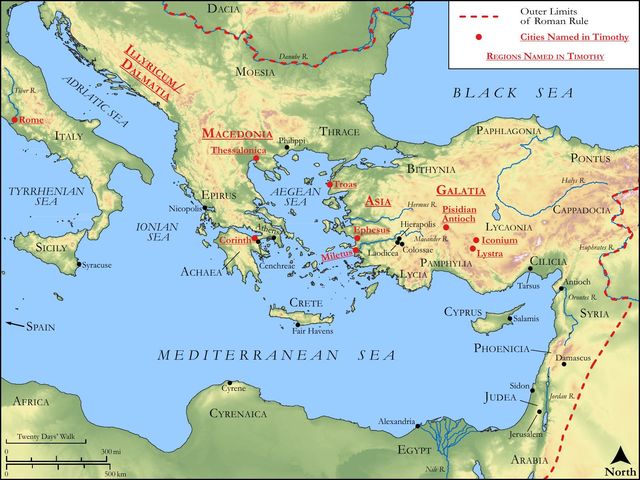
See on the biblical-era map

Study this verse
Public-domain commentary
Matthew Henry
From his Commentary on the Whole Bible. Henry comments on passages, not single verses — this entry covers 2 Timothy 4:16–22. His three-level outline is real structure in the source text, so it is rendered as structure.
Here, I. He gives Timothy an account of his own present circumstances.
1.He had lately been called to appear before the emperor, upon his appeal to Caesar; and then no man stood with him (Ti2 4:16), to plead his cause, to bear testimony for him, or so much as to keep him in countenance, but all men forsook him. This was strange, that so good a man as Paul should have nobody to own him, even at Rome, where there were many Christians, whose faith was spoken of throughout the world, Rom 1:8. But men are but men. The Christians at Rome were forward to go and meet him (Acts 28); but when it came to the pinch, and they would be in danger of suffering with him, then they all forsook him. He prays that God would not lay it to their charge, intimating that it was a great fault, and God might justly be angry with them, but he prays God to forgive them. See what a distinction is put between sins of presumption and sins of infirmity. Alexander the coppersmith, who maliciously withstood Paul, he prays against: The Lord reward him according to his works; but respecting these Christians, who through weakness shrunk from Paul in time of trial, he says, The Lord lay it not to their charge. Observe,
(1.)Paul had his trials in his friends' forsaking him in a time of danger as well as in the opposition made by enemies: all forsook him.
(2.)It was their sin not to appear for the good apostle, especially at his first answer; but it was a sin of weakness, and therefore the more excusable. Yet,
(3.)God might lay it to their charge, but Paul endeavours to prevent it by his earnest prayers: Let it not be laid to their charge.
2.Notwithstanding this God stood by him (Ti2 4:17), gave him extraordinary wisdom and courage, to enable him to speak so much the better himself. When he had nobody to keep him in countenance, God made his face to shine. - That by me the preaching might be fully known, that is, "God brought me out from that difficulty that I might preach the gospel, which is my business." Nay, it should seem, that he might preach the gospel at that time; for Paul knew how to preach at the bar as well as in the pulpit. And that all the Gentiles might hear; the emperor himself and the great men who would never have heard Paul preach if he had not been brought before them. And I was delivered out of the mouth of the lion, that is, of Nero (as some think) or some other judge. Some understand it only as a proverbial form of speech, to signify that he was in imminent danger. And the Lord shall deliver me from every evil work. See how Paul improved his experiences: "He that delivered doth deliver, and we trust he will yet deliver, will deliver me from every evil work, from any ill done to me by others. And shall preserve me to his heavenly kingdom." And for this he gives glory to God, rejoicing in hope of the glory of God. Observe,
(1.)If the Lord stand by us, he will strengthen us, in a time of difficulty and danger, and his presence will more than supply every one's absence.
(2.)When the Lord preserves his servants from great and imminent danger, it is for eminent work and service. Paul was preserved that by him the preaching might be fully known, etc.
(3.)Former deliverances should encourage future hopes.
(4.)There is a heavenly kingdom, to which the Lord will preserve his faithful witnessing or suffering servants.
(5.)We ought to give God the glory of all past, present, and future deliverances: To whom be glory for ever and ever. Amen.
II.He sends salutations to Aquila, and Priscilla, and the household of Onesiphorus, Ti2 4:19.
He mentions his leaving Trophimus sick at Miletum (Ti2 4:20), by which it appears that though the apostles healed all manner of diseases miraculously, for the confirmation of their doctrine, yet they did not exert that power upon their own friends, lest it should have looked like a collusion.
III.He hastens Timothy to come to him before winter (Ti2 4:21), because he longed to see him, and because in the winter the journey or voyage would be more dangerous.
IV.He sends commendations to him from Eubulus, Pudens, Linus, Claudia, and all the brethren.
One of the heathen writers at this time mentions one Pudens and his wife Claudia, and says the Claudia was a Briton, whence some have gathered that it was this Pudens, and that Claudia here was his wife, and that they were eminent Christians at Rome.
V.He concludes with a prayer, that the Lord Jesus would be with his spirit.
We need no more to make us happy than to have the Lord Jesus Christ with our spirits; for in him all spiritual blessings are summed up. And it is the best prayer we can put up for our friends, that the Lord Jesus Christ may be with their spirits, to sanctify and save them, and at last to receive them to himself; as Stephen the proto-martyr prayed, Lord Jesus, receive my spirit, Act 7:59. "Lord Jesus, receive that spirit which thou hast been with while it was united to the body; do not now leave it in its separate state." Grace be with you. Amen. This was our apostle's token in every epistle; so he wrote. The grace of our Lord Jesus Christ be with you all. Amen, Th2 3:17, Th2 3:18. And if grace be with us here to convert and change us, to make us holy, to keep us humble, and to enable us to persevere to the end, glory will crown us hereafter: for the Lord is a sun, and a shield; the Lord will give grace and glory, and no good thing will he withhold from those that walk uprightly. O Lord of hosts, blessed is the man that trusteth in thee, Psa 84:11, Psa 84:12. Now unto the King eternal, immortal, invisible, the only wise God our Saviour, be honour and glory for ever and ever. Amen.
Historical interpretation
Six Centuries of Reception
4 surviving comments on this verse. Each one is dated, so this reads as a timeline rather than a list.
Select a marker to jump to its quote. Markers stagger vertically where authors wrote within a few decades of each other.
Of Alexandria, Annianus was the first, ordained by Mark the evangelist; the second Avilius by Luke, who was also an evangelist. Of the church of Rome, Linus the son of Claudia was the first, ordained by Paul;
"Salute Priscilla and Aquila, and the household of Onesiphorus." For he was then in Rome, of whom he said "The Lord grant unto him that he may find mercy of the Lord in that day." (2 Tim. i. 18.) By this naming of him, he makes those of his household also more zealous in such good actions. "Salute Priscilla and Aquila." These are they of whom he makes continual mention, with whom too he had lodged, and who had taken Apollos to them. He names the woman first, as being I suppose more zealous, and more faithful, for she had then received Apollos; or it might be done indifferently. And it was to them no slight consolation to be thus saluted. It conveyed a demonstration of esteem and love, and a participation in much grace. For the bare salutation of that holy and blessed man was sufficient to fill with grace him who received it. "Erastus abode at Corinth: but Trophimus have I left at Miletum sick." This Trophimus and Tychicus, we know from the book of the Acts, sailed away with him from Judea, and were everywhere his companions, perhaps as being more zealous than the rest. "Trophimus I have left at Miletum sick." Why then didst thou not heal him, instead of leaving him? The Apostles could not do everything, or they did not dispense miraculous gifts upon all occasions, lest more should be ascribed to them than was right. "Do thy diligence to come before winter. Eubulus greeteth thee, and Pudens, and Linus, and Claudia, and all the brethren." This Linus, some say, was second Bishop of the Church of Rome after Peter.
As if to say: Do not grieve which removes oneself from a settled position. The Lord is with you: And he did not say, with you, but, with your spirit, so there's a double of assistance with the grace of the Spirit, also to assist him. It was written to Timothy from Rome. He wrote the letter while he was in prison in Rome, together with the first letter that he wrote to him, and from the feet of perfection. For I am already being poured out as a drink offering, and the time of my departure has come (2 Tim 4:6).
Priscilla and Aquila greet you, and the household of Onesiphorus. Erastus stayed in Corinth. I left Trophimus sick in Miletus. Make every effort to come before winter. Eubulus and Pudens and Linus greet you, as does Claudia, and all the brothers.
These are the ones whom Paul continually remembers among the tentmakers, from among whom he also stayed with and often mention. But he first remembers the woman, as more trustworthy and earnest. For she also instructed Apollo. He offers a greeting, both comforting at the same time, and also showing honor and love through this, and the greater things, having been filled with much grace, the one being addressed.
and the household of Onesiphorus. For Onesiphorus was in Rome. Therefore, Paul greets those in his house, stirring up zeal similar to that of Onesiphorus.
Erastus stayed in Corinth. Since Paul did not remember these things before, now he remembers, in order to show that he is isolated on all sides and needs Timothy.
I left Trophimus sick in Miletus. Miletus is near Ephesus. Therefore, when he sailed to Judea, Paul left him in Miletus, or after arriving in Rome, again in these parts, we do not have information to say.
sick. Why then did he not heal him, but let him be? Because the saints did not do everything, so that they would not be considered better than human nature.
Make every effort to come before winter. "Until then," Paul says, "while I live, so that you do not see me having been delayed by the winter."
and Linus. They say that this Linus became the second bishop of Rome after Peter.
as does Claudia. Do you see how even women have been fierce and passionate, crucified to the world? Indeed, this kind is in no way inferior to men, provided they desire it.
and all the brothers. Those mentioned by name were more fervent in faith.
Continue studying 2 Timothy 4:21 across the web’s major study libraries — every link below opens this exact verse, chapter, or book on the destination site.
Read & Compare
 BibleGatewayThis verse in more than 200 translations and 70 languages.
 Bible.comThe YouVersion reader — hundreds of translations, reading plans, and highlights.
 ESV.orgCrossway's official English Standard Version reader.
 NET BibleThe NET translation with 60,000+ translators' notes on every rendering decision.
 STEP BibleTyndale House's free study tool — original text, vocabulary, and scholarly resources.
 BibliaLogos Bible Software's free web reader.
 USCCBThe New American Bible (Revised Edition) with the U.S. bishops' study notes.
Commentaries
 BibleHub CommentariesDozens of classic commentaries on this verse, gathered on one page.
 StudyLightMore than 100 commentary sets — the largest collection on the web.
 BibleRefPlain-English commentary on what this verse means, verse by verse.
 Enduring WordDavid Guzik's free commentary on this chapter, widely used by Bible teachers.
 Bible Study ToolsVerse commentary alongside Greek and Hebrew study aids.
Original Language & Research
- BibleHub InterlinearThe verse word by word — original language, transliteration, and English.
- BibleHub LexiconEvery word's original-language definition and Strong's entry.
 Blue Letter BibleDeep-study tools — Strong's numbers, concordance, and word studies.
 CNTR CollationThe earliest Greek manuscripts of this verse, collated letter by letter.
Sermons, Hymns & Audio


TrulyRandomVerse is not affiliated with these sites and doesn’t control their content. They’re linked because they’re genuinely useful.
Summary
This poignant verse, found at the very close of Paul's final epistle, conveys an urgent personal request from the imprisoned Apostle to his beloved spiritual son, Timothy, to hasten his journey to Rome before the onset of winter. Following this plea, Paul includes warm greetings from specific individuals—Eubulus, Pudens, Linus, and Claudia—and "all the brethren," offering a tender glimpse into the vital network of Christian fellowship and mutual support that sustained believers amidst the trials of early ministry.
Context
ShowHideLiterary Context
This verse is situated in the concluding remarks of 2 Timothy, Paul's last known letter, penned from a Roman prison likely just prior to his martyrdom. The entire chapter pulsates with a profound sense of urgency and finality. Paul has just delivered a solemn charge to Timothy to preach the word, be ready in season and out of season, and to fulfill his ministry even as Paul himself faces his imminent departure (Paul declares, “I am already being poured out as a drink offering, and the time of my departure has come”). The request for Timothy to come, along with the mention of various individuals, underscores Paul's deep personal longing for companionship and support in his final days, contrasting with the desertion he experienced from some others mentioned earlier in the chapter (e.g., Demas, who loved this present world).
Historical & Cultural Context
Paul's imprisonment in Rome, likely under Nero, was severe, with limited freedoms. Travel in the ancient world, especially during winter, was perilous and often impossible. Sea voyages were particularly dangerous due to storms and unpredictable weather, making Paul's plea to "come before winter" a practical necessity rather than a mere preference. Land travel was also significantly hampered by snow, ice, and impassable roads. The mention of specific individuals like Eubulus, Pudens, Linus, and Claudia, along with "all the brethren," reflects the vibrant, though often underground, Christian community in Rome. These names, likely prominent members, indicate the existence of a network of believers who supported Paul during his incarceration, providing a sense of family and solidarity in a hostile environment, much like the community described in Romans 16.
Key Themes
ShowHideThis verse contributes to several overarching themes in 2 Timothy and Paul's broader theology. Firstly, it highlights the urgency of ministry and personal connection, emphasizing Paul's fervent desire for Timothy's presence, not just for practical reasons but for spiritual and emotional support in his final hours. This deep bond between mentor and disciple is a recurring motif, mirroring Paul's fatherly affection for Timothy throughout the letter. Secondly, it powerfully illustrates the theme of Christian fellowship and mutual support, showcasing the vital role of community even in the face of persecution. The greetings from "all the brethren" underscore the reality of the universal church, where believers are interconnected and called to bear one another's burdens, as exhorted in Galatians 6:2. Lastly, the practical instruction regarding winter travel subtly points to the realities and practicalities of incarnational ministry, reminding us that spiritual work is often intertwined with mundane logistical considerations and the limitations of the physical world.
Exposition and Analysis
ShowHideKey Word Analysis
ShowHideThis verb means "to use speed, to make effort, be prompt or earnest." Paul is not merely suggesting Timothy come, but earnestly urging him to "make haste," "exert himself," or "be diligent" in his efforts to arrive. It conveys a strong sense of urgency and Paul's fervent desire for a swift reunion.
This word refers to a storm (as pouring rain) and, by implication, the rainy season or winter. Its inclusion highlights the practical and dangerous realities of ancient travel. Paul's request is time-sensitive, recognizing that the onset of winter would make Timothy's journey, especially by sea, exceedingly difficult or impossible due to severe weather conditions.
This verb means "to enfold in the arms, to salute, or to welcome." It signifies a warm, affectionate greeting, more than a mere formality. The use of this word emphasizes the genuine affection and solidarity among the believers in Rome, extending their love and support to Timothy through Paul's letter.
Verse Breakdown
ShowHide"Do thy diligence to come before winter."
This is Paul's direct, urgent, and personal appeal to Timothy. The imperative "Do thy diligence" (spoudason) conveys a strong sense of urgency, indicating Paul's deep longing for Timothy's presence. The phrase "before winter" highlights the practical constraints of travel in the ancient world, where harsh weather could render journeys impossible, underscoring the time-sensitive nature of Paul's request.
"Eubulus greeteth thee, and Pudens, and Linus, and Claudia, and all the brethren."
This segment shifts from Paul's personal plea to a collective expression of Christian fellowship. The specific naming of individuals—Eubulus, Pudens, Linus, and Claudia—underscores the personal connections and the vibrant community that surrounded Paul even in his imprisonment. The addition of "and all the brethren" broadens the scope, indicating that the entire local Christian community in Rome extends its warm greetings and solidarity to Timothy, reinforcing the bonds of spiritual kinship.
Literary Devices
ShowHideThe verse primarily employs Enumeration through the listing of specific names (Eubulus, Pudens, Linus, Claudia), which serves to personalize the greetings and demonstrate the breadth of the Christian community in Rome. The urgent tone of Paul's opening plea, "Do thy diligence to come before winter," creates a sense of Pathos, appealing to Timothy's affection and sense of duty by highlighting Paul's vulnerable situation and pressing need for companionship. The entire verse functions as a Personal Postscript, a common feature in ancient letters, adding a warm, human touch to a letter that is otherwise deeply theological and instructional. The contrast between Paul's impending death and the ongoing fellowship of believers also subtly employs Juxtaposition, highlighting the enduring nature of the church community despite individual suffering.
Theological and Thematic Connections
ShowHideThis seemingly simple verse is rich with theological implications, underscoring the profound importance of Christian fellowship and the practical outworking of love within the body of Christ. Paul's urgent request for Timothy's presence highlights the human need for companionship and support, even for a spiritual giant facing martyrdom. It reminds us that ministry is not a solitary endeavor but a communal one, sustained by mutual encouragement and practical assistance. The greetings from the Roman believers affirm the reality of the church as a family, bound by spiritual ties that transcend geographical distance and challenging circumstances. This communal aspect reflects the New Testament emphasis on the church as the body of Christ, where each member is vital and interconnected.
Reflection and Application
ShowHidePaul's final words to Timothy in this verse offer a powerful reminder that even in the most profound spiritual battles, human connection and practical support are indispensable. We are called to cultivate genuine, loving relationships within the Christian community, recognizing that we are interdependent members of the body of Christ. This means actively seeking to understand and meet the needs of our brothers and sisters, especially those facing hardship, isolation, or the end of their earthly journey. Just as Paul urged diligence in Timothy's travel, we too should be diligent in our responsiveness to the needs of others, not allowing practical obstacles or personal convenience to hinder our acts of love and service. Furthermore, the greetings from the Roman believers challenge us to foster a culture of mutual encouragement and solidarity, ensuring that no one feels alone in their faith journey.
Questions for Reflection
ShowHideFAQ
ShowHideWhy was Paul so urgent about Timothy coming "before winter"?
ShowHidePaul's urgency was a practical necessity due to the severe limitations and dangers of ancient travel. During winter, sea voyages were often suspended or extremely hazardous because of violent storms, making shipwrecks common. Land routes could also become impassable due to snow, ice, and flooding. Paul, imprisoned and aware of his impending execution (as indicated in 2 Timothy 4:6-8), desperately desired to see Timothy one last time. Delaying until after winter might mean they would never reunite. This practical concern highlights that even spiritual giants like Paul operated within the realities of their physical world.
Who are Eubulus, Pudens, Linus, and Claudia mentioned in this verse?
ShowHideThese individuals were likely prominent members of the Christian community in Rome who were close to Paul during his final imprisonment. While the Bible provides limited information about them beyond their names here, their inclusion indicates their presence and solidarity with Paul. Tradition suggests that Linus may have been the first bishop of Rome after Peter and Paul, though this is not explicitly stated in Scripture. Their names signify the vibrant, diverse, and interconnected network of believers who supported one another during a time of intense persecution, embodying the spirit of Christian fellowship (as seen in Romans 16, where Paul also lists many individuals).
What is the significance of these personal greetings in Paul's final letter?
ShowHideThe personal greetings serve several significant purposes. Firstly, they underscore the deep personal bonds Paul shared with his fellow believers, even in his final moments. Despite his suffering, Paul remained connected to the Christian family. Secondly, they demonstrate the reality of Christian fellowship and mutual support within the early church. These individuals were likely ministering to Paul in prison, and their greetings to Timothy reinforce the idea of a shared spiritual family. Thirdly, they provide a tangible link between Paul, Timothy, and the broader Roman church, emphasizing the unity of the body of Christ. It reminds us that ministry is not a solitary endeavor but a communal one, sustained by mutual love and encouragement, a theme Paul often emphasized (e.g., 1 Corinthians 12:26-27).
Christ-Centered Fulfillment
ShowHideWhile 2 Timothy 4:21 is a personal and practical instruction, it beautifully reflects the Christ-centered nature of Christian community and service. Paul's earnest plea for Timothy's presence before winter, driven by love and urgency, mirrors the Lord Jesus' own deep care for His disciples and His desire for intimate fellowship, as expressed in His High Priestly Prayer for their unity (see John 17:20-23). The diligence Paul requests from Timothy is a reflection of the diligence and faithfulness Christ exemplified in His earthly ministry, always pressing forward to accomplish the Father's will, even unto death (Philippians 2:8). Furthermore, the greetings from Eubulus, Pudens, Linus, Claudia, and "all the brethren" point to the beautiful reality of the church as the body of Christ, where individual members are bound together by their common Lord. This fellowship is a direct result of Christ's reconciling work, breaking down barriers and creating one new humanity (as taught in Ephesians 2:14-16). Ultimately, the hope of reunion, whether in this life or the next, finds its ultimate fulfillment in the glorious return of Christ, when all believers will be gathered to Him forever (see 1 Thessalonians 4:16-17). Thus, even in a simple farewell, we glimpse the profound relational and communal truths established and sustained by Christ Himself.