


2 Timothy 4:9
Bible text: King James Version (1769 Blayney text) · Public domain
Bible text: Berean Standard Bible · Public domain
Bible text: American Standard Version (1901) · Public domain
Bible text: World English Bible, Messianic edition · Public domain
Bible text: Geneva Bible (1599) · Public domain
Bible text: Young's Literal Translation · Public domain
- ΣπούδασονSpoudasondo be diligentG4704V-AAM-2SVerb Aorist Active Imperative 2nd Singular
- ἐλθεῖνeltheinto comeG2064V-2AANVerb 2nd Aorist Active Infinitive
- πρόςprostoG4314PREPPreposition
- μεmemeG3165P-1ASPersonal pronoun Accusative 1st Singular
- ταχέωςtacheōssoonG5030ADVAdverb
English is a literal word-by-word gloss of the Greek, not the KJV's wording. Why?
This is the original text the KJV's translators worked from — each Greek word with its own literal English meaning in this verse, prepared by scholars at Tyndale House, Cambridge. The KJV translates whole sentences, not word by word, so its wording differs: one Greek word can become several English words, and the KJV may choose “charity” where the gloss reads “love”. Both are faithful — they answer different questions. For the KJV's own rendering, switch to the KJV text.
Details
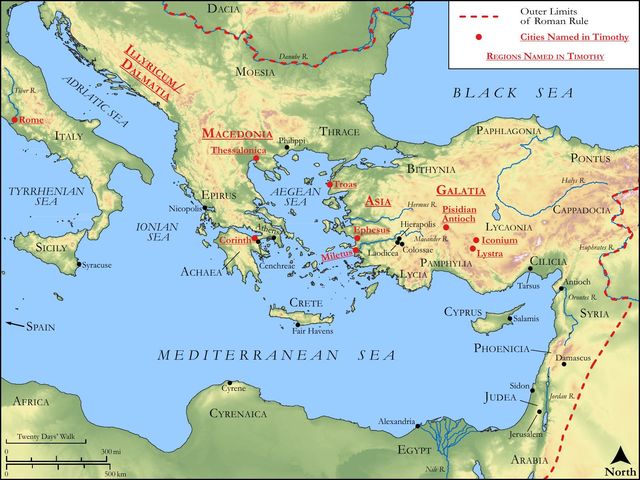
See on the biblical-era maps

Study this verse
Public-domain commentary
Matthew Henry
From his Commentary on the Whole Bible. Henry comments on passages, not single verses — this entry covers 2 Timothy 4:9–15.
Here are divers particular matters which Paul mentions to Timothy, now at the closing of the epistle. 1. He bids him hasten to him, if possible (Ti2 4:9): So thy diligence to come shortly to me. For Timothy was an evangelist, one who was not a fixed pastor of any one place, but attended the motions of the apostles, to build upon their foundation. Paul wanted Timothy's company and help; and the reason he gives is because several had left him (Ti2 4:10); one from an ill principle, namely, Demas, who abides under an ill name for it: Demas hath forsaken me, having loved this present world. He quitted Paul and his interest, either for fear of suffering (because Paul was now a prisoner, and he was afraid o coming into trouble upon his account) or being called off from his ministry by secular affairs, in which he entangled himself; his first love to Christ and his gospel was forsaken and forgotten, and he fell in love with the world. Note, Love to this present world is often the cause of apostasy from the truths and ways of Jesus Christ. He has gone off, has departed to Thessalonica, called thither perhaps by trade, or by some other worldly business. Crescens had gone one way and Titus another way. Luke however remained with Paul (Ti2 4:11, Ti2 4:12), and was not this enough? Paul did not think it so; he loved the company of his friends. 2. He speaks respectfully concerning Mark: He is profitable to me for the ministry. It is supposed that this Mark was he about whom Paul and Barnabas had contended, Act 15:39. Paul would not take him with him to the work, because he had once flinched and drawn back: but now, says he, Take Mark, and bring him with thee. By this it appears that Paul was now reconciled to Mark, and had a better opinion of him than he had had formerly. This teaches us to be of a forgiving spirit; we must not therefore disclaim for ever making use of those that are profitable and useful, though they may have done amiss. 3. Paul orders Timothy to come to him, bids him as he came through Troas to bring with him thence those things which he had left behind him there (Ti2 4:13), the cloak he had left there, which, it may be, Paul had the more occasion for in a cold prison. It is probable that it was the habit Paul usually wore, a plain dress. Some read it, the roll of parchment I left at Troas; others, the desk that I left. Paul was guided by divine inspiration, and yet he would have his books with him. Whereas he had exhorted Timothy to give attendance to reading, so he did himself, though he was now ready to be offered. As long as we live, we must be still learning. But especially the parchments, which some think were the originals of his epistles; others think they were the skins of which he made his tents, whereby he obtained a livelihood, working with his own hands. 4. He mentions Alexander, and the mischief that he had done him, Ti2 4:14, Ti2 4:15. This is he who is spoken of Act 19:33. It should seem, he had been a professor of the Christian religion, a forward professor, for he was there particularly maligned by the worshippers of Diana, and yet he did Paul much evil. Paul was in as much danger from false brethren (Co2 11:26) as from open enemies. Paul foretels that God would reckon with him. It is a prophetical denunciation of the just judgment of God that would befall him: The Lord will reward him according to his works. He cautions Timothy to take heed of him: "Of whom be thou aware also, that he do not, under pretence of friendship, betray thee to mischief." It is dangerous having any thing to do with those who would be enemies to such a man as Paul. Observe, (1.) Some who were once Paul's hearers and admirers did not give him reason to remember them with much pleasure; for one forsook him, and another did him much evil, and greatly withstood his words. Yet, (2.) At the same time he mentions some with pleasure; the badness of some did not make him forget the goodness of others; such as Timothy, Titus, Mark, and Luke. (3.) The apostle has left a brand on the names and memory of two persons; the one is Demas, who forsook him, having loved the present world, and the other is Alexander, who greatly withstood his words. (4.) God will reward evil-doers, particularly apostates, according to their works. (5.) Of such as are of Alexander's spirit and temper we should beware; for they will do us no good, but all the mischief that is in their power.
Historical interpretation
Six Centuries of Reception
3 surviving comments on this verse. Each one is dated, so this reads as a timeline rather than a list.
Select a marker to jump to its quote. Markers stagger vertically where authors wrote within a few decades of each other.
It is worth while to enquire why he calls Timothy to him, inasmuch as he was intrusted with a Church, and a whole nation. It was not from arrogance. For Paul was ready to come to him; for we find him saying, "But if I tarry long, that thou mayest know how thou oughtest to behave thyself in the house of God." (1 Tim. iii. 15.) But he was withholden by a strong necessity. He was no longer matter of his own movements. He was in prison, and had been confined by Nero, and was all but on the point of death. That this might not happen before he saw his disciple, he therefore sends for him, desiring to see him before he dies, and perhaps to deliver much in charge to him. Wherefore he says, "Hasten to come to me before the winter." "For Demas hath forsaken me, having loved this present world." He does not say, "That I may see thee before I depart this life," which would have grieved him, but "because I am alone," he says, "and have no one to help or support me." "For Demas hath forsaken me, having loved this present world, and is departed to Thessalonica"; that is, having loved his own ease and security from danger, he has chosen rather to live luxuriously at home, than to suffer hardships with me, and share my present danger. He has blamed him alone, not for the sake of blaming him, but to confirm us, that we may not be effeminate in declining toils and dangers, for this is, "having loved this present world." "Only Luke is with me." For he adhered to him inseparably. It was he who wrote the Gospel, and the General Acts; he was devoted to labors, and to learning, and a man of fortitude. "Take Mark, and bring him with thee, for he is profitable to me for the ministry." It is not for his own relief, but for the ministry of the Gospel that he wanted him. For though imprisoned, he did not cease to preach. "The cloak that I left at Troas with Carpus, when thou comest bring with thee, and the books, but especially the parchments." The word here translated "cloak" may mean a garment, or, as some say, a bag, in which the books were contained. But what had he to do with books, who was about to depart and go to God? He needed them much, that he might deposit them in the hands of the faithful, who would retain them in place of his own teaching.
That is, for relaxation and luxery.
I urged you to come to me quickly.
For what reason does Paul call Timothy to himself to whom the Church of Ephesus had been entrusted? Since Paul being in prison, he was not able to leave. Therefore, he wishes Timothy to come to him, both because he is alone, and because he had given him certain instructions.
come to me quickly. Paul did not say: Meanwhile, while I am still alive: for he did not want to sadden Timothy.
Continue studying 2 Timothy 4:9 across the web’s major study libraries — every link below opens this exact verse, chapter, or book on the destination site.
Read & Compare
 BibleGatewayThis verse in more than 200 translations and 70 languages.
 Bible.comThe YouVersion reader — hundreds of translations, reading plans, and highlights.
 ESV.orgCrossway's official English Standard Version reader.
 NET BibleThe NET translation with 60,000+ translators' notes on every rendering decision.
 STEP BibleTyndale House's free study tool — original text, vocabulary, and scholarly resources.
 BibliaLogos Bible Software's free web reader.
 USCCBThe New American Bible (Revised Edition) with the U.S. bishops' study notes.
Commentaries
 BibleHub CommentariesDozens of classic commentaries on this verse, gathered on one page.
 StudyLightMore than 100 commentary sets — the largest collection on the web.
 BibleRefPlain-English commentary on what this verse means, verse by verse.
 Enduring WordDavid Guzik's free commentary on this chapter, widely used by Bible teachers.
 Bible Study ToolsVerse commentary alongside Greek and Hebrew study aids.
Original Language & Research
- BibleHub InterlinearThe verse word by word — original language, transliteration, and English.
- BibleHub LexiconEvery word's original-language definition and Strong's entry.
 Blue Letter BibleDeep-study tools — Strong's numbers, concordance, and word studies.
 CNTR CollationThe earliest Greek manuscripts of this verse, collated letter by letter.
Sermons, Hymns & Audio


TrulyRandomVerse is not affiliated with these sites and doesn’t control their content. They’re linked because they’re genuinely useful.
Summary
In the Apostle Paul, facing imminent martyrdom in a Roman prison, issues a direct and urgent command to his beloved spiritual son, Timothy, urging him to make every effort to come to him quickly. This heartfelt plea reveals Paul's deep need for companionship and support in his final days, highlighting the profound value of personal fellowship and mutual care within the Christian community, even for a spiritual giant like Paul.
Context
ShowHideLiterary Context
2 Timothy is widely understood as Paul's final inspired letter, written from a Roman prison cell shortly before his execution. The immediate context of chapter 4 is Paul's poignant farewell and final instructions to Timothy, his trusted protege and leader of the church in Ephesus. Paul has just issued a solemn charge to Timothy to "preach the word; be instant in season, out of season; reprove, rebuke, exhort with all longsuffering and doctrine" (2 Timothy 4:2). He then reflects on his own impending death, stating, "For I am now ready to be offered, and the time of my departure is at hand" (2 Timothy 4:6). Against this backdrop of a final charge and personal reflection on martyrdom, Paul's urgent request for Timothy's presence in verse 9 underscores his human vulnerability and desire for companionship, especially as he notes the desertion of some former colleagues like Demas (2 Timothy 4:10).
Historical & Cultural Context
Paul was imprisoned in Rome, likely under Emperor Nero, a period known for its severe persecution of Christians. Roman prisons were harsh, often cold, damp, and solitary, especially for those awaiting execution. Travel in that day was arduous and time-consuming, involving significant planning, expense, and often danger. Paul's request for Timothy to "come shortly" implies a challenging journey that would require considerable diligence and prioritization on Timothy's part. Timothy, as a young leader in the prominent city of Ephesus, would have had significant responsibilities, making such a sudden departure a considerable undertaking. The cultural value of personal presence and face-to-face interaction was paramount in a world without modern communication, making Paul's desire for Timothy's physical presence deeply significant for comfort and final instructions.
Key Themes
ShowHideThis verse contributes to several overarching themes in 2 Timothy and Paul's broader theology. It highlights the theme of spiritual mentorship and legacy, as Paul, the seasoned apostle, pours his final wisdom into Timothy, his spiritual son (2 Timothy 2:2). It also emphasizes the importance of Christian fellowship and mutual support, demonstrating that even great spiritual leaders are not exempt from human needs for companionship and encouragement, especially in times of suffering or isolation. The urgency ("shortly") underscores the theme of perseverance and diligence in ministry and personal relationships, urging Timothy to act decisively. Finally, it subtly touches on the theme of Paul's faithfulness unto death, as he faces his end with courage but also with a human desire for beloved company.
Exposition and Analysis
ShowHideKey Word Analysis
ShowHideThis verb, translated "do thy diligence," carries the meaning of "to use speed," "to make effort," "to be prompt or earnest," and "to apply oneself diligently." It implies a sense of urgency, zeal, and earnest commitment. Paul is not merely suggesting a visit but is commanding Timothy to exert every effort and prioritize this journey. It's about making haste with purpose and earnestness.
This primary verb means "to come or go" and is used in a wide variety of applications, both literally and figuratively. In this context, it refers to Timothy's physical journey and arrival to Paul's location. The imperative mood of the verb, combined with the adverb "shortly," emphasizes the directness and urgency of Paul's command for Timothy to initiate and complete this travel.
This adverb means "briefly," "speedily," "rapidly," "quickly," "soon," or "suddenly." When coupled with "do thy diligence," it intensifies the command, indicating that Paul desires Timothy's arrival without delay. It's not a casual invitation but an urgent summons, reflecting Paul's awareness of his limited time and pressing need.
Verse Breakdown
ShowHide"Do thy diligence"
This opening phrase is an imperative command, conveying Paul's earnest and urgent desire. It calls for Timothy to exert maximum effort, prioritize this task above others, and act with a sense of zeal and commitment. It's a strong exhortation to make every possible arrangement to fulfill the request.
"to come shortly"
This specifies the action and its timeframe. Timothy is to embark on a journey to Paul, and he is to do so without delay. The adverb "shortly" emphasizes the critical nature of the timing, indicating Paul's awareness of his rapidly approaching end and his pressing need for Timothy's presence before it's too late.
"unto me"
This identifies the destination and the object of Paul's desire. Paul, in his Roman prison, is the one in need of Timothy's presence. This phrase highlights the personal and relational aspect of the request, underscoring Paul's deep affection for Timothy and his longing for companionship in his final, isolated moments.
Literary Devices
ShowHideThe verse employs several literary devices to convey its profound message. The most prominent is the Imperative Mood ("Do thy diligence"), which functions as a direct command, underscoring the urgency and non-negotiable nature of Paul's request. This is further intensified by the adverb Urgency ("shortly" or "quickly"), which emphasizes the immediacy required for Timothy's journey. The entire verse also serves as a Personal Appeal, revealing Paul's vulnerability and deep emotional connection to Timothy. It's not merely an instruction but a heartfelt plea from a spiritual father to his beloved son, demonstrating the human need for companionship even in the face of martyrdom.
Theological and Thematic Connections
ShowHide2 Timothy 4:9 serves as a powerful testament to the enduring importance of Christian fellowship and the human need for companionship, even for those as spiritually mature and resolute as the Apostle Paul. Despite his profound faith and anticipation of glory, Paul, in his final moments, still longed for the physical presence and comfort of a trusted friend and spiritual son. This highlights that Christian maturity does not negate our need for community and mutual support; rather, it often deepens our appreciation for it. It underscores the biblical principle that believers are called to bear one another's burdens (Galatians 6:2) and to be present for one another in times of need, demonstrating practical love and compassion.
Reflection and Application
ShowHidePaul's urgent plea to Timothy in 2 Timothy 4:9 serves as a profound reminder of the irreplaceable value of personal presence and diligent care within the body of Christ. In a world increasingly dominated by digital communication, this verse challenges us to prioritize physical presence and genuine, empathetic connection with fellow believers, especially those who are isolated, suffering, or in their final seasons of life. It calls us to cultivate a spirit of responsiveness and diligence, echoing Paul's "do thy diligence," when we perceive a need for support, comfort, or companionship among our spiritual family. This isn't merely about convenience but about sacrificial love that makes time, expends effort, and overcomes obstacles to be "unto" another in their moment of need, embodying the mutual care that defines true Christian community.
Questions for Reflection
ShowHideFAQ
ShowHideWhy was Paul so urgent in his request for Timothy to come "shortly"?
ShowHidePaul's urgency stemmed from several critical factors. First, he was in a Roman prison, likely facing imminent execution under Emperor Nero, and he knew his time was short, as he states just a few verses earlier: "For I am now ready to be offered, and the time of my departure is at hand" (2 Timothy 4:6). Second, he was experiencing significant loneliness and isolation. Some companions had deserted him (e.g., Demas, 2 Timothy 4:10), and others were on missions elsewhere (e.g., Crescens to Galatia, Titus to Dalmatia, 2 Timothy 4:10). He specifically mentions that only Luke was with him (2 Timothy 4:11). Third, Paul likely desired Timothy's presence for final personal fellowship, perhaps to impart last instructions or simply to have the comfort of his beloved spiritual son's company in his final moments. He also requested his cloak and books (2 Timothy 4:13), suggesting practical needs as well.
Christ-Centered Fulfillment
ShowHideWhile 2 Timothy 4:9 is a deeply personal and human request, it resonates with profound Christ-centered truths. Paul's vulnerability and need for companionship in his final hours echo the humanity of Christ, who, even in His divine nature, experienced the need for fellowship and support, particularly in His darkest hour in Gethsemane (Matthew 26:38-40). Just as Paul longed for Timothy's presence, so too does Christ, through His Spirit, desire our diligent pursuit of Him, urging us to "come" to Him for rest and life (Matthew 11:28). Furthermore, Paul's example of seeking fellowship, even in suffering, foreshadows the ultimate fellowship we find in Christ—a bond forged by His sacrifice that unites us not only with God but also with one another as members of His body, the Church (Ephesians 4:15-16). Christ Himself is the ultimate fulfillment of our need for companionship and support, for He has promised never to leave us nor forsake us (Hebrews 13:5), and through Him, we are called to extend that same diligent, loving presence to one another, reflecting His own sacrificial care for His people.