


2 Timothy 4:22
Bible text: King James Version (1769 Blayney text) · Public domain
Bible text: King James Version with Strong's numbers · Public domain
Bible text: Berean Standard Bible · Public domain
Bible text: American Standard Version (1901) · Public domain
Bible text: World English Bible, Messianic edition · Public domain
Bible text: Geneva Bible (1599) · Public domain
Bible text: Young's Literal Translation · Public domain
- ὉHoTheG3588T-NSMDefinite article Nominative Singular Masculine
- κύριοςkuriosLordG2962N-NSM-TNoun Nominative Singular Masculine Title
- ἸησοῦςIēsousJesusG2424N-NSM-PNoun Nominative Singular Masculine Individual
- ΧριστὸςChristosChristG5547N-NSM-TNoun Nominative Singular Masculine Title
- μετὰmeta[be] withG3326PREPPreposition
- τοῦtoutheG3588T-GSNDefinite article Genitive Singular Neuter
- πνεύματόςpneumatosspiritG4151N-GSNNoun Genitive Singular Neuter
- σουsouof youG4771P-2GSPersonal pronoun Genitive 2nd Singular
- ἡhē<the>G3588T-NSFDefinite article Nominative Singular Feminine
- χάριςcharisGrace [be]G5485N-NSFNoun Nominative Singular Feminine
- μεθ᾽meth᾽withG3326PREPPreposition
- ὑμῶνhumōnyou allG4771P-2GPPersonal pronoun Genitive 2nd Plural
- ἀμήνamēnAmenG281INJ-HEBInterjection
- πρόςprostoG4314PREPPreposition
- ΤιμόθεονTimotheonTimothyG5095N-ASM-PNoun Accusative Singular Masculine Individual
- δευτέρᾳdeuterasecond [epistle]G1208A-NSFAdjective Nominative Singular Feminine
- τῆςtēsof theG3588T-GSFDefinite article Genitive Singular Feminine
- ἘφεσίωνEphesiōnEphesianG2180A-GPM-LGAdjective Genitive Plural Masculine Location Gentilic
- ἐκκλησίαςekklēsiaschurchG1577N-GSFNoun Genitive Singular Feminine
- πρῶτονprōtonfirstG4413A-ASM-SAdjective Accusative Singular Masculine Superlative
- ἐπίσκοπονepiskoponoverseerG1985N-ASMNoun Accusative Singular Masculine
- χειροτονηθένταcheirotonēthentahaving been chosenG5500V-APP-ASMVerb Aorist Passive Participle Accusative Singular Masculine
- ἐγράφηegraphēIt was writtenG1125V-2API-3SVerb 2nd Aorist Passive Indicative 3rd Singular
- ἀπόapofromG575PREPPreposition
- ῬώμηςRhōmēsRomeG4516N-GSF-LNoun Genitive Singular Feminine Location
- ὅτεhotewhenG3753PREPPreposition
- ἐκekfromG1537PREPPreposition
- δευτέρουdeuterousecond timeG1208A-GSNAdjective Genitive Singular Neuter
- παρέστηparestēstoodG3936V-2AAI-3SVerb 2nd Aorist Active Indicative 3rd Singular
- ΠαῦλοςPaulosPaulG3972N-NSM-PNoun Nominative Singular Masculine Individual
- τῷtō<the>G3588T-DSMDefinite article Dative Singular Masculine
- ΚαίσαρίKaisaribefore CaesarG2541N-DSM-TNoun Dative Singular Masculine Title
- ΝέρωνιNerōniNeroG3505N-DSM-PNoun Dative Singular Masculine Individual
English is a literal word-by-word gloss of the Greek, not the KJV's wording. Why?
This is the original text the KJV's translators worked from — each Greek word with its own literal English meaning in this verse, prepared by scholars at Tyndale House, Cambridge. The KJV translates whole sentences, not word by word, so its wording differs: one Greek word can become several English words, and the KJV may choose “charity” where the gloss reads “love”. Both are faithful — they answer different questions. For the KJV's own rendering, switch to the KJV text.
Details
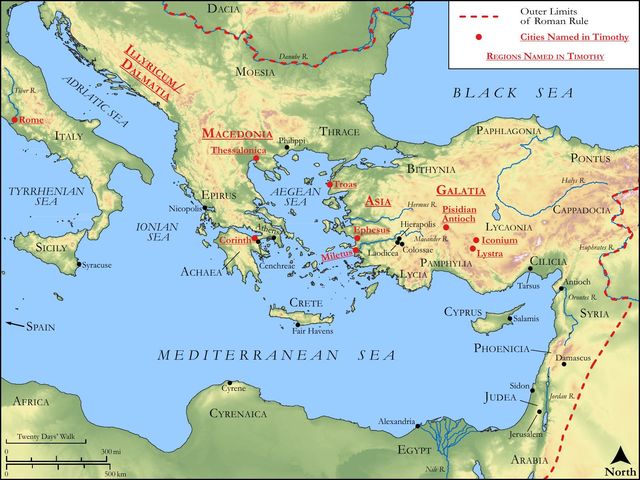
See on the biblical-era maps

Study this verse
Public-domain commentary
Matthew Henry
From his Commentary on the Whole Bible. Henry comments on passages, not single verses — this entry covers 2 Timothy 4:16–22. His three-level outline is real structure in the source text, so it is rendered as structure.
Here, I. He gives Timothy an account of his own present circumstances.
1.He had lately been called to appear before the emperor, upon his appeal to Caesar; and then no man stood with him (Ti2 4:16), to plead his cause, to bear testimony for him, or so much as to keep him in countenance, but all men forsook him. This was strange, that so good a man as Paul should have nobody to own him, even at Rome, where there were many Christians, whose faith was spoken of throughout the world, Rom 1:8. But men are but men. The Christians at Rome were forward to go and meet him (Acts 28); but when it came to the pinch, and they would be in danger of suffering with him, then they all forsook him. He prays that God would not lay it to their charge, intimating that it was a great fault, and God might justly be angry with them, but he prays God to forgive them. See what a distinction is put between sins of presumption and sins of infirmity. Alexander the coppersmith, who maliciously withstood Paul, he prays against: The Lord reward him according to his works; but respecting these Christians, who through weakness shrunk from Paul in time of trial, he says, The Lord lay it not to their charge. Observe,
(1.)Paul had his trials in his friends' forsaking him in a time of danger as well as in the opposition made by enemies: all forsook him.
(2.)It was their sin not to appear for the good apostle, especially at his first answer; but it was a sin of weakness, and therefore the more excusable. Yet,
(3.)God might lay it to their charge, but Paul endeavours to prevent it by his earnest prayers: Let it not be laid to their charge.
2.Notwithstanding this God stood by him (Ti2 4:17), gave him extraordinary wisdom and courage, to enable him to speak so much the better himself. When he had nobody to keep him in countenance, God made his face to shine. - That by me the preaching might be fully known, that is, "God brought me out from that difficulty that I might preach the gospel, which is my business." Nay, it should seem, that he might preach the gospel at that time; for Paul knew how to preach at the bar as well as in the pulpit. And that all the Gentiles might hear; the emperor himself and the great men who would never have heard Paul preach if he had not been brought before them. And I was delivered out of the mouth of the lion, that is, of Nero (as some think) or some other judge. Some understand it only as a proverbial form of speech, to signify that he was in imminent danger. And the Lord shall deliver me from every evil work. See how Paul improved his experiences: "He that delivered doth deliver, and we trust he will yet deliver, will deliver me from every evil work, from any ill done to me by others. And shall preserve me to his heavenly kingdom." And for this he gives glory to God, rejoicing in hope of the glory of God. Observe,
(1.)If the Lord stand by us, he will strengthen us, in a time of difficulty and danger, and his presence will more than supply every one's absence.
(2.)When the Lord preserves his servants from great and imminent danger, it is for eminent work and service. Paul was preserved that by him the preaching might be fully known, etc.
(3.)Former deliverances should encourage future hopes.
(4.)There is a heavenly kingdom, to which the Lord will preserve his faithful witnessing or suffering servants.
(5.)We ought to give God the glory of all past, present, and future deliverances: To whom be glory for ever and ever. Amen.
II.He sends salutations to Aquila, and Priscilla, and the household of Onesiphorus, Ti2 4:19.
He mentions his leaving Trophimus sick at Miletum (Ti2 4:20), by which it appears that though the apostles healed all manner of diseases miraculously, for the confirmation of their doctrine, yet they did not exert that power upon their own friends, lest it should have looked like a collusion.
III.He hastens Timothy to come to him before winter (Ti2 4:21), because he longed to see him, and because in the winter the journey or voyage would be more dangerous.
IV.He sends commendations to him from Eubulus, Pudens, Linus, Claudia, and all the brethren.
One of the heathen writers at this time mentions one Pudens and his wife Claudia, and says the Claudia was a Briton, whence some have gathered that it was this Pudens, and that Claudia here was his wife, and that they were eminent Christians at Rome.
V.He concludes with a prayer, that the Lord Jesus would be with his spirit.
We need no more to make us happy than to have the Lord Jesus Christ with our spirits; for in him all spiritual blessings are summed up. And it is the best prayer we can put up for our friends, that the Lord Jesus Christ may be with their spirits, to sanctify and save them, and at last to receive them to himself; as Stephen the proto-martyr prayed, Lord Jesus, receive my spirit, Act 7:59. "Lord Jesus, receive that spirit which thou hast been with while it was united to the body; do not now leave it in its separate state." Grace be with you. Amen. This was our apostle's token in every epistle; so he wrote. The grace of our Lord Jesus Christ be with you all. Amen, Th2 3:17, Th2 3:18. And if grace be with us here to convert and change us, to make us holy, to keep us humble, and to enable us to persevere to the end, glory will crown us hereafter: for the Lord is a sun, and a shield; the Lord will give grace and glory, and no good thing will he withhold from those that walk uprightly. O Lord of hosts, blessed is the man that trusteth in thee, Psa 84:11, Psa 84:12. Now unto the King eternal, immortal, invisible, the only wise God our Saviour, be honour and glory for ever and ever. Amen.
Historical interpretation
Six Centuries of Reception
2 surviving comments on this verse. Each one is dated, so this reads as a timeline rather than a list.
Select a marker to jump to its quote. Markers stagger vertically where authors wrote within a few decades of each other.
"The Lord Jesus Christ be with thy spirit." There can be no better prayer than this. Grieve not for my departure. The Lord will be with thee. And he says, not "with thee," but "with thy spirit." Thus there is a twofold assistance, the grace of the Spirit, and God helping it. And otherwise God will not be with us, if we have not spiritual grace. For if we be deserted by grace, how shall He be with us? "Grace be with us. Amen." Thus he prays for himself too, that they may always be well-pleasing to Him, that they may have grace together with the spiritual gift, for where this is, nothing will be grievous. For as he who beholds the king, and is in favor with him, is sensible of no uneasiness; so though our friends forsake us, though we be overtaken by calamity, we shall feel no distress, if that grace be with us and fortify us.
The Lord Jesus Christ be with your spirit. Grace be with us all. Amen.
The Lord Jesus Christ be with your spirit. The help is twofold, that of Christ and that of the Holy Spirit, as if Paul were saying, With the coming of the Holy Spirit which you now have. Let also the Lord Jesus Christ be with you. Since this is with you, you will not suffer at my departure. Or that it is not possible to enjoy the presence of Christ without being endowed with spiritual grace, so as to be, in relation to this interpretation, with your spirit, that is, with spiritual grace.
Grace be with us. And Paul prays for himself, either so that he may always be grateful, or so that he may always have a spiritual gift.
Finished, with divine help, of the later Epistle to Timothy.
It was written from the city of Rome, when Paul was brought before Nero Caesar the Roman for the second time.
Continue studying 2 Timothy 4:22 across the web’s major study libraries — every link below opens this exact verse, chapter, or book on the destination site.
Read & Compare
 BibleGatewayThis verse in more than 200 translations and 70 languages.
 Bible.comThe YouVersion reader — hundreds of translations, reading plans, and highlights.
 ESV.orgCrossway's official English Standard Version reader.
 NET BibleThe NET translation with 60,000+ translators' notes on every rendering decision.
 STEP BibleTyndale House's free study tool — original text, vocabulary, and scholarly resources.
 BibliaLogos Bible Software's free web reader.
 USCCBThe New American Bible (Revised Edition) with the U.S. bishops' study notes.
Commentaries
 BibleHub CommentariesDozens of classic commentaries on this verse, gathered on one page.
 StudyLightMore than 100 commentary sets — the largest collection on the web.
 BibleRefPlain-English commentary on what this verse means, verse by verse.
 Enduring WordDavid Guzik's free commentary on this chapter, widely used by Bible teachers.
 Bible Study ToolsVerse commentary alongside Greek and Hebrew study aids.
Original Language & Research
- BibleHub InterlinearThe verse word by word — original language, transliteration, and English.
- BibleHub LexiconEvery word's original-language definition and Strong's entry.
 Blue Letter BibleDeep-study tools — Strong's numbers, concordance, and word studies.
 CNTR CollationThe earliest Greek manuscripts of this verse, collated letter by letter.
Sermons, Hymns & Audio


TrulyRandomVerse is not affiliated with these sites and doesn’t control their content. They’re linked because they’re genuinely useful.
Summary
Paul concludes his final inspired letter to Timothy with a profound and tender benediction, encapsulating the core spiritual realities that sustain Christian life and ministry. This verse serves as a heartfelt prayer and a powerful theological statement, invoking the intimate presence of the Lord Jesus Christ with Timothy's spirit and the sustaining power of divine grace upon him and, by extension, the entire community of believers. It is a solemn affirmation of God's faithfulness and the enduring source of strength in the face of adversity, expressed through Paul's final, poignant "Amen."
Context
ShowHideLiterary Context
This verse marks the concluding words of Paul's Second Epistle to Timothy, a letter widely considered to be Paul's last canonical writing. The preceding chapters are filled with Paul's earnest exhortations to Timothy to remain steadfast in sound doctrine, to endure hardship, to preach the Word, and to guard the deposit of faith against false teachers. Chapter 4, in particular, intensifies this urgency, as Paul charges Timothy "before God and the Lord Jesus Christ" to fulfill his ministry 2 Timothy 4:1-5. Paul then reflects on his own impending death, declaring his readiness to be "poured out as a drink offering" and affirming his faithful completion of the race 2 Timothy 4:6-8. The verse immediately before this benediction contains Paul's final personal greetings and instructions, emphasizing his loneliness and desire for Timothy's presence, along with practical requests 2 Timothy 4:9-21. Thus, 2 Timothy 4:22 serves as a deeply personal and spiritually resonant farewell, a final blessing from a spiritual father to his beloved son in the faith.
Historical & Cultural Context
Paul wrote 2 Timothy from a Roman prison, likely during his second and final imprisonment under Emperor Nero. This period was marked by intense persecution of Christians following the Great Fire of Rome in A.D. 64, for which Nero scapegoated the Christians. Paul was awaiting trial, and his tone throughout the letter indicates his awareness that his execution was imminent 2 Timothy 4:6. Timothy, on the other hand, was a younger leader, possibly prone to timidity 2 Timothy 1:7, and was facing significant challenges in Ephesus, including the rise of false teachers 2 Timothy 2:16-18 and the general pressures of leading the church in a hostile pagan environment. The cultural context demanded courage, steadfastness in the face of suffering, and unwavering commitment to the truth of the Gospel. Paul's benediction, therefore, is not merely a polite closing but a powerful spiritual endowment, providing Timothy with the ultimate source of strength and comfort in a perilous time.
Key Themes
ShowHideThe overarching themes of 2 Timothy include the preservation and proclamation of sound doctrine 2 Timothy 1:13-14, endurance in suffering for the Gospel 2 Timothy 2:3, faithfulness in ministry 2 Timothy 4:5, and the divine enablement through God's grace. This final verse powerfully synthesizes these themes. The wish for "The Lord Jesus Christ [be] with thy spirit" speaks directly to the theme of divine presence and empowerment, essential for Timothy to withstand the pressures and fulfill his calling. The desire for "Grace [be] with you" underscores that all effective ministry and steadfastness flow from God's unmerited favor and enabling power, not human strength or merit. The concluding "Amen" serves as a solemn affirmation of the truth and efficacy of these spiritual realities, reinforcing the letter's emphasis on the certainty of God's promises and the ultimate triumph of His will, even in the face of Paul's impending martyrdom.
Exposition and Analysis
ShowHideKey Word Analysis
ShowHideThis term (G2962) signifies supreme authority and control, often used as a respectful title for a master or, most significantly, for God Himself. In the context of "The Lord Jesus Christ," it emphasizes Jesus' divine sovereignty and His rightful position as the ultimate authority over all things, including Timothy's life and ministry. It underscores that the presence invoked is not merely a comforting thought, but the active, authoritative presence of the resurrected Christ.
The word (G4151) refers to a current of air, breath, or breeze, but figuratively and most importantly here, it denotes the rational soul, the vital principle, or the innermost being of a human. In a theological sense, it can refer to the Holy Spirit or the human spirit. Here, "thy spirit" points to Timothy's deepest inner self, the core of his being where communion with God occurs. Paul's prayer is for Christ's intimate, indwelling presence to permeate and empower Timothy's spiritual life, not just his external circumstances.
This term (G5485) signifies graciousness, favor, or a gift, especially the divine influence upon the heart and its reflection in life. It encompasses God's unmerited favor, His benevolent power, and the spiritual strength He provides. In this benediction, it is a comprehensive blessing for divine enablement, reminding Timothy and the church that their endurance, service, and very salvation are sustained by God's undeserved kindness and empowering presence.
Verse Breakdown
ShowHide"The Lord Jesus Christ [be] with thy spirit"
This opening clause is a profound and deeply personal benediction. It is not merely a wish for external protection or success, but for the intimate, indwelling presence of Jesus Christ within Timothy's innermost being—his spirit. This emphasizes the spiritual nature of the Christian life and ministry, where strength, comfort, and guidance are derived from a living, personal relationship with the risen Lord. It highlights the reality of Christ's active communion with the believer at the deepest level, providing an internal source of power and resilience for the challenges Timothy faced.
"Grace [be] with you"
This second clause expands the blessing beyond Timothy's individual spirit to encompass him more broadly ("you," plural, implying Timothy and those with him, or the church he served). "Grace" here signifies God's unmerited favor, His divine enablement, and the spiritual resources necessary for life and ministry. It is a comprehensive blessing that acknowledges human weakness and dependence on God's benevolent power. This grace is the foundation for salvation, the strength for endurance, and the empowerment for effective service, reminding believers that all their efforts are sustained by God's generous provision.
"Amen"
This concluding word, transliterated from Hebrew, functions as a solemn affirmation, meaning "so be it," "truly," or "let it be established." It expresses Paul's heartfelt sincerity, his confidence in the truth of his blessing, and his fervent prayer that these spiritual realities—Christ's presence and God's grace—would indeed be manifested in Timothy's life and in the lives of the believers. It serves as a powerful seal, underscoring the certainty and divine authority of the preceding benediction.
Literary Devices
ShowHidePaul employs several literary devices in this concise benediction. The primary device is Benediction, a formal blessing or invocation of divine favor, which is characteristic of Pauline epistles' closings. This specific benediction is deeply Personal and Intimate, as evidenced by the address to "thy spirit," highlighting the profound spiritual bond between Paul, Timothy, and Christ. The use of Repetition of "be with" (implied in the KJV, explicit in Greek) emphasizes the desired presence of Christ and grace. The concluding "Amen" serves as a powerful Affirmation and Seal, lending solemnity and certainty to the prayer. Furthermore, the entire verse functions as a form of Apostolic Blessing, where Paul, as an apostle, imparts spiritual good and invokes divine power upon his spiritual son and the church.
Theological and Thematic Connections
ShowHideThis concluding benediction in 2 Timothy 4:22 profoundly connects to foundational Christian theology. The invocation of "The Lord Jesus Christ [be] with thy spirit" speaks directly to the doctrine of the indwelling Christ and the Holy Spirit, emphasizing the personal and intimate relationship between God and the believer. It underscores that true spiritual strength and guidance come not from external circumstances or human wisdom, but from the internal presence of the divine. The prayer for "Grace [be] with you" highlights the centrality of God's unmerited favor as the sole basis for salvation, sanctification, and ministry. It reminds us that all our spiritual vitality and capacity for service are entirely dependent on God's benevolent power, freely given. This grace is the wellspring of endurance, hope, and faithfulness, particularly crucial in times of trial and persecution. The "Amen" serves as a theological affirmation of God's faithfulness to His promises and the certainty of His active involvement in the lives of His people.
Reflection and Application
ShowHidePaul's final words to Timothy in 2 Timothy 4:22 offer timeless encouragement and a profound model for Christian living and ministry today. In an age often marked by self-reliance and external validation, this verse powerfully reorients our focus to the internal and divine sources of strength. It reminds us that our deepest battles are fought and won in the spiritual realm, sustained by the intimate presence of the Lord Jesus Christ within our spirits. This presence is not a passive comfort but an active, empowering force that enables us to face challenges, endure suffering, and faithfully fulfill our callings. Furthermore, the emphasis on "grace" underscores our absolute dependence on God's unmerited favor for every aspect of our lives—from salvation to daily perseverance and effective service. We are called to live in constant awareness of and reliance upon this divine grace, recognizing that our abilities and accomplishments are ultimately gifts from God. This verse serves as a beautiful benediction for personal prayer, communal worship, and farewells, invoking the essential blessings of Christ's presence and God's sustaining grace upon all believers.
Questions for Reflection
ShowHideFAQ
ShowHideWhy does Paul specifically pray for Christ to be "with thy spirit" rather than just "with you"?
ShowHidePaul's specificity in praying for Christ to be "with thy spirit" (Greek: pneûma) highlights the deeply personal and internal nature of the divine-human relationship. The "spirit" in this context refers to the innermost part of a person, the core of their being where they commune with God and where the Holy Spirit indwells. It emphasizes that the strength, comfort, and guidance Timothy needed were not merely external circumstances or superficial blessings, but a profound, animating presence within his very spiritual essence. This distinguishes it from a general blessing for well-being, focusing instead on the source of spiritual vitality and resilience, which is crucial for enduring hardship and faithfully fulfilling ministry, as Paul had exhorted throughout 2 Timothy.
What is the significance of the word "Amen" at the end of Paul's letter?
ShowHideThe word "Amen" (G281, from Hebrew) is a powerful and fitting conclusion to Paul's final letter. It is not merely a polite closing but a solemn affirmation, meaning "so be it," "truly," or "let it be established." In this context, it serves several significant purposes: First, it expresses Paul's heartfelt sincerity and earnestness in his benediction, underscoring that his prayer for Christ's presence and grace is deeply genuine. Second, it functions as a confirmation of the truth and certainty of the spiritual realities he has invoked; Paul is confident that God will indeed grant these blessings. Third, it acts as a seal on the entire letter, affirming the divine authority and truthfulness of all the instructions, warnings, and theological insights contained within 2 Timothy. It invites the reader, including Timothy, to concur with the truth and efficacy of the preceding words.
Christ-Centered Fulfillment
ShowHideThe benediction in 2 Timothy 4:22 finds its ultimate fulfillment and deepest meaning in the person and work of Jesus Christ. The prayer for "The Lord Jesus Christ [be] with thy spirit" points directly to the New Covenant reality of Christ's indwelling presence, made possible through His atoning death, resurrection, and the sending of the Holy Spirit. Jesus Himself promised His disciples, "I am with you always, even to the end of the age" Matthew 28:20, and He assured them of the coming Helper, the Spirit of Truth, who would abide with them forever John 14:16-18. This intimate, spiritual presence of Christ, mediated by the Holy Spirit, is the very source of the believer's strength, comfort, and ability to live a godly life. Furthermore, the emphasis on "Grace [be] with you" is profoundly Christ-centered, for Jesus Christ is the embodiment of God's grace. "For the law was given through Moses; grace and truth came through Jesus Christ" John 1:17. It is through His sacrifice that we receive unmerited favor, forgiveness of sins Ephesians 1:7, and access to God's empowering presence Romans 5:2. Thus, Paul's final blessing is a powerful declaration of the Christian's complete reliance on Christ—His presence for inner vitality and His grace for all spiritual enablement—a truth fully realized in the finished work of the Savior.