


2 Timothy 4:2
Bible text: King James Version (1769 Blayney text) · Public domain
Bible text: Berean Standard Bible · Public domain
Bible text: American Standard Version (1901) · Public domain
Bible text: World English Bible, Messianic edition · Public domain
Bible text: Geneva Bible (1599) · Public domain
Bible text: Young's Literal Translation · Public domain
- κήρυξονkēruxondo preachG2784V-AAM-2SVerb Aorist Active Imperative 2nd Singular
- τὸνtontheG3588T-ASMDefinite article Accusative Singular Masculine
- λόγονlogonwordG3056N-ASMNoun Accusative Singular Masculine
- ἐπίστηθιepistēthido be readyG2186V-2AAM-2SVerb 2nd Aorist Active Imperative 2nd Singular
- εὐκαίρωςeukairōsin seasonG2122ADVAdverb
- ἀκαίρωςakairōs[and] out of seasonG171ADVAdverb
- ἔλεγξονelegxondo convictG1651V-AAM-2SVerb Aorist Active Imperative 2nd Singular
- ἐπιτίμησονepitimēsondo rebukeG2008V-AAM-2SVerb Aorist Active Imperative 2nd Singular
- παρακάλεσονparakaleson[and] do exhortG3870V-AAM-2SVerb Aorist Active Imperative 2nd Singular
- ἐνenwithG1722PREPPreposition
- πάσῃpasēcompleteG3956A-DSFAdjective Dative Singular Feminine
- μακροθυμίᾳmakrothumiapatienceG3115N-DSFNoun Dative Singular Feminine
- καὶkaiandG2532CONJConjunction
- διδαχῇdidachēawith instructionG1322N-DSFNoun Dative Singular Feminine
English is a literal word-by-word gloss of the Greek, not the KJV's wording. Why?
This is the original text the KJV's translators worked from — each Greek word with its own literal English meaning in this verse, prepared by scholars at Tyndale House, Cambridge. The KJV translates whole sentences, not word by word, so its wording differs: one Greek word can become several English words, and the KJV may choose “charity” where the gloss reads “love”. Both are faithful — they answer different questions. For the KJV's own rendering, switch to the KJV text.
Details
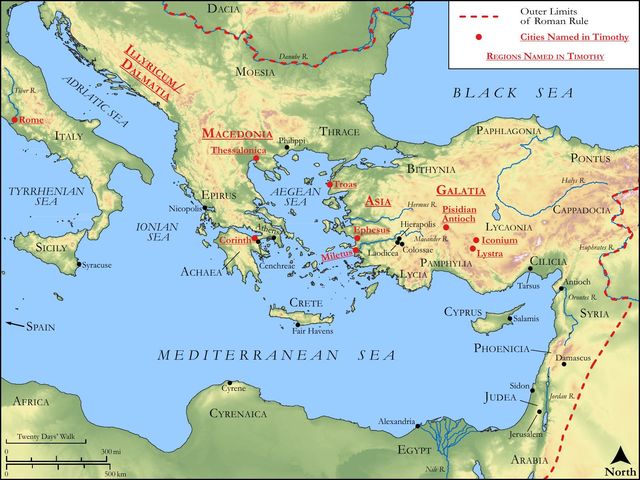
See on the biblical-era maps

Study this verse
Public-domain commentary
Matthew Henry
From his Commentary on the Whole Bible. Henry comments on passages, not single verses — this entry covers 2 Timothy 4:1–8. His four-level outline is real structure in the source text, so it is rendered as structure.
Observe, I. How awfully this charge is introduced (Ti2 4:1): I charge thee before God, and the Lord Jesus Christ, who shall judge the quick and the dead at his appearing and his kingdom. Observe, The best of men have need to be awed into the discharge of their duty. The work of a minister is not an indifferent thing, but absolutely necessary. Woe be to him if he preach not the gospel, Co1 9:16. To induce him to faithfulness, he must consider, 1. That the eye of God and Jesus Christ was upon him: I charge thee before God and the Lord Jesus Christ; that is, "as thou tenderest the favour of God and Jesus Christ; as thou wilt approve thyself to God and Jesus Christ, by the obligations both of natural and revealed religion; as thou wilt make due returns to the God who made thee and the Lord Jesus Christ who redeemed thee." 2. He charges him as he will answer it at the great day, reminding him of the judgment to come, which is committed to the Lord Jesus. He shall judge the quick and the dead at his appearing and his kingdom, that is, when he appears in his kingdom. It concerns all, both ministers and people, seriously to consider the account that they must shortly give to Jesus Christ of all the trusts reposed in them. Christ shall judge the quick and the dead, that is, those that at the last day shall be found alive, and those who shall be raised to life out of the grave. Note, (1.) The Lord Jesus Christ shall judge the quick and the dead. God hath committed all judgment unto the Son, and hath appointed him the Judge of quick and dead, Act 10:42. (2.) He will appear; he will come the second time, and it will be a glorious appearance, as the word epiphaniea signifies. (3.) Then his kingdom shall appear in its glory: At his appearing and kingdom; for he will then appear in his kingdom, sitting on a throne, to judge the world.
II.What is the matter of the charge, Ti2 4:2-5. He is charged,
1.To preach the word. This is ministers' business; a dispensation is committed to them. It is not their own notions and fancies that they are to preach, but the pure plain word of God; and they must not corrupt it, but as of sincerity, but as of God, in the sight of God, they speak in Christ, Co2 2:17.
2.To urge what he preached, and to press it with all earnestness upon his hearers: "Be instant in season and out of season, reprove, rebuke, exhort; do this work with all fervency of spirit. Call upon those under thy charge to take heed of sin, to do their duty: call upon them to repent, and believe, and live a holy life, and this both in season and out of season. In season, when they are at leisure to hear thee, when some special opportunity offers itself of speaking to them with advantage. Nay, do it out of season, even when there is not that apparent probability of fastening something upon them, because thou dost not know but the Spirit of God may fasten upon them; for the wind bloweth where it listeth; and in the morning we must sow our seed, and in the evening not withhold our hand," Ecc 11:6. We must do it in season, that is, let slip no opportunity; and do it out of season, that is, not shift off the duty, under pretence that it is out of season.
3.He must tell people of their faults: "Reprove them, rebuke them. Convince wicked people of the evil and danger of their wicked courses. Endeavour, by dealing plainly with them, to bring them to repentance. Rebuke them with gravity and authority, in Christ's name, that they may take thy displeasure against them as an indication of God's displeasure."
4.He must direct, encourage, and quicken those who began well. "Exhort them (persuade them to hold on, and endure to the end) and this with all long-suffering and doctrine." (1.) He must do it very patiently: With all long-suffering. "If thou do not see the effect of thy labours presently, yet do not therefore give up the cause; be not weary of speaking to them." While God shows to them all long-suffering, let ministers exhort with all long-suffering. (2.) He must do it rationally, not with passion, but with doctrine, that is, "In order to the reducing of them to good practices, instil into them good principles. Teach them the truth as it is in Jesus, reduce them to a firm belief of it, and this will be a means both to reclaim them from evil and to bring them to good." Observe, [1.] A minister's work has various parts: he is to preach the word, to reprove, rebuke, and exhort. [2.] He is to be very diligent and careful; he must be instant in season and out of season; he must spare no pains nor labour, but must be urgent with them to take care of their souls and their eternal concerns.
5.He must watch in all things. "Seek an opportunity of doing them a kindness; let no fair occasion slip, through thy negligence. Watch to thy work; watch against the temptations of Satan, by which thou mayest be diverted from it; watch over the souls of those who are committed to thy charge."
6.He must count upon afflictions, and endure them, make the best of them. Kakopathēson, endure patiently. "Be not discouraged by the difficulties thou meetest with, but bear them with an evenness of spirit. Inure thyself to hardships."
7.He must remember his office, and discharge its duties: Do the work of an evangelist. The office of the evangelist was, as the apostles' deputies, to water the churches that they planted. They were not settled pastors, but for some time resided in, and presided over, the churches that the apostles had planted, till they were settled under a standing ministry. This was Timothy's work.
8.He must fulfil his ministry: Make full proof of it. It was a great trust that was reposed in him, and therefore he must answer it, and perform all the parts of his office with diligence and care. Observe,
(1.)A minister must expect afflictions in the faithful discharge of his duty.
(2.)He must endure them patiently, like a Christian hero.
(3.)These must not discourage him in his work, for he must do his work, and fulfil his ministry.
(4.)The best way to make full proof of our ministry is to fulfil it, to fill it up in all its parts with proper work.
III.The reasons to enforce the charge.
1.Because errors and heresies were likely to creep into the church, by which the minds of many professing Christians would be corrupted (Ti2 4:3, Ti2 4:4): "For the time will come when they will not endure sound doctrine. Therefore improve the present time, when they will endure it. Be busy now, for it is seedtime; when the fields are white unto the harvest, put in the sickle, for the present gale of opportunity will be soon over. They will not endure sound doctrine. There will be those who will heap to themselves corrupt teachers, and will turn away their ears from the truth; and therefore secure as many as thou canst, that, when these storms and tempests do arise, they may be well fixed, and their apostasy may be prevented." People must hear, and ministers must preach, for the time to come, and guard against the mischiefs that are likely to arise hereafter, though they do not yet arise. They will turn away their ears from the truth; they will grow weary of the old plain gospel of Christ, and then they will be greedy of fables, and take pleasure in them, and God will give them up to those strong delusions, because they received not the truth in the love of it, Th2 2:11, Th2 2:12. Observe,
(1.)These teachers were of their own heaping up, and not of God's sending; but they chose them, to gratify their lusts, and to please their itching ears.
(2.)People do so when they will not endure sound doctrine, that preaching which is searching, plain, and to the purpose; then they will have teachers of their own.
(3.)There is a wide difference between the word of God and the word of such teachers; the one is sound doctrine, the word of truth, the other is only fables.
(4.)Those that are turned unto fables first turn away their ears from the truth, for they cannot hear and mind both, any more than they can serve two masters. Nay, further, it is said, They shall be turned unto fables. God justly suffers those to turn to fables who grow weary of the truth, and gives them up to be led aside from the truth by fables.
2.Because Paul for his part had almost done his work: Do thou make full proof of thy ministry, for I am now ready to be offered, Ti2 4:6. And,
(1.)"Therefore there will be the more occasion for thee." When labourers are removed out of the vineyard, it is no time for those to loiter that are left behind, but to double their diligence. The fewer hands there are to work the more industrious those hands must be that are at work.
(2.)"I have done the work of my day and generation; do thou in like manner do the work of thy day and generation."
(3.)The comfort and cheerfulness of Paul, in the prospect of his approaching departure, might encourage Timothy to the utmost industry, and diligence, and seriousness in his work. Paul was an old soldier of Jesus Christ, Timothy was but newly enlisted. "Come," says Paul, "I have found our Master kind and the cause good; I can look back upon my warfare with a great deal of pleasure and satisfaction; and therefore be not afraid of the difficulties thou must meet with. The crown of life is as sure to thee as if it were already upon thy head; and therefore endure afflictions, and make full proof of thy ministry." The courage and comfort of dying saints and ministers, and especially dying martyrs, are a great confirmation of the truth of the Christian religion, and a great encouragement to living saints and ministers in their work. Here the apostle looks forward, upon his death approaching: I am now ready to be offered. The Holy Ghost witnessed in every city that bonds and afflictions did abide him, Act 20:23. He was now at Rome, and it is probable that he had particular intimations from the Spirit that there he should seal the truth with his blood; and he looks upon it now as near at hand: I am already poured out; so it is in the original, ēdē spendomai; that is, I am already a martyr in affection. It alludes to the pouring out of the drink-offerings; for the blood of the martyrs, though it was not a sacrifice of atonement, was a sacrifice of acknowledgment to the honour of the grace of God and his truths. Observe,
[1.]With what pleasure he speaks of dying. He calls it his departure; though it is probable that he foresaw he must die a violent bloody death, yet he calls it his departure, or his release. Death to a good man is his release from the imprisonment of this world and his departure to the enjoyments of another world; he does not cease to be, but is only removed from one world to another.
[2.]With what pleasure he looks back upon the life he had lived (Ti2 4:7): I have fought a good fight, I have finished my course, etc. He did not fear death, because he had the testimony of his conscience that by the grace of God he had in some measure answered the ends of living. As a Christian, as a minister, he had fought a good fight. He had done the service, gone through the difficulties of his warfare, and had been instrumental in carrying on the glorious victories of the exalted Redeemer over the powers of darkness. His life was a course, and he had now finished it; as his warfare was accomplished, so his race was run. "I have kept the faith. I have kept the doctrines of the gospel, and never betrayed any of them." Note, First, The life of a Christian, but especially of a minister, is a warfare and a race, sometimes compared to the one in the scripture, and sometimes to the other. Secondly, It is a good fight, a good warfare; the cause is good, and the victory is sure, if we continue faithful and courageous. Thirdly, We must fight this good fight; we must fight it out, and finish our course; we must not give over till we are made more than conquerors through him who hath loved us, Rom 8:37. Fourthly, It is a great comfort to a dying saint, when he can look back upon his past life and say with our apostle, "I have fought, etc. I have kept the faith, the doctrine of faith and the grace of faith." Towards the end of our days to be able to speak in this manner, what comfort, unspeakable comfort, will it afford! Let it then be our constant endeavour, by the grace of God, that we may finish our course with joy, Act 20:24.
[3.]With what pleasure he looks forward to the life he was to live hereafter (Ti2 4:8): Henceforth there is laid up for me a crown of righteousness, etc. He had lost for Christ, but he was sure he should not lose by him, Phi 3:8. Let this encourage Timothy to endure hardness as a good soldier of Jesus Christ that there is a crown of life before us, the glory and joy of which will abundantly recompense all the hardships and toils of our present warfare. Observe, It is called a crown of righteousness, because it will be the recompence of our services, which God is not unrighteous to forget; and because our holiness and righteousness will there be perfected, and will be our crown. God will give it as a righteous Judge, who will let none love by him. And yet this crown of righteousness was not peculiar to Paul, as if it belonged only to apostles and eminent ministers and martyrs, but to all those also that love his appearing. Observe, It is the character of all the saints that they love the appearing of Jesus Christ: they loved his first appearing, when he appeared to take away sin by the sacrifice of himself (Heb 9:26); they love to think of it; they love his second appearing at the great day; love it, and long for it: and, with respect to those who love the appearing of Jesus Christ, he shall appear to their joy; there is a crown of righteousness reserved for them, which shall then be given them, Heb 9:28. We learn hence, First, The Lord is the righteous Judge, for his judgment is according to truth. Secondly, The crown of believers is a crown of righteousness, purchased by the righteousness of Christ, and bestowed as the reward of the saints' righteousness. Thirdly, This crown, which believers shall wear, is laid up for them; they have it not at present, for here they are but heirs; they have it not in possession, and yet it is sure, for it is laid up for them. Fourthly, The righteous Judge will give it to all who love, prepare, and long for his appearing. Surely I come quickly. Amen, even so come, Lord Jesus.
Historical interpretation
Six Centuries of Reception
14 surviving comments on this verse. Each one is dated, so this reads as a timeline rather than a list.
Select a marker to jump to its quote. Markers stagger vertically where authors wrote within a few decades of each other.
It is our duty and obligation to remember and heed the special day of Easter Sunday every year. St. Paul taught his disciple Timothy to be aware of dates, saying, “Stand ready in season and out of season.” Paul wrote that, of course, so that Timothy would do things when they were supposed to be done and avoid the blame for doing things at the wrong time.
Hence the Apostle says, "What will ye, shall I come unto you with a rod, or in love, and in the spirit of meekness." First he speaks of a rod, and as with the rod of an almond tree had smitten the wanderers, that he might afterwards comfort them with the spirit of meekness. Just so did meekness restore the man whom the rod had driven from the Divine sacraments. To his disciple too he gave the same injunctions, "Reprove, beseech, rebuke." Here are two harsh terms and one gentle; but they are only harsh, that they may themselves be softened. For like as bitter food or drink becomes sweet to these bodies which are laden with excess of gall, and on the other hand sweet repasts are bitter to them, so also when the mind is wounded it languishes under the flattering touch of pleasure, but is healed again by the bitterness of correction.
Therefore, let food, and bathing, and banqueting, and the other necessities of life have a definite time. But let instruction about the love of truth from above have no set hour—let all the time belong to it. "In season, out of season, reprove, entreat, rebuke," Scripture says. And the prophet, "On his law he will meditate day and night." And Moses too asked the Jews to do this continually.
"Preach the word: be instant in season, out of season; reprove, rebuke, exhort with all longsuffering and doctrine." What means "in season, out of season"? That is, have not any limited season: let it always be thy season, not only in peace and security, and when sitting in the Church. Whether thou be in danger, in prison, in chains, or going to thy death, at that very time reprove. Withhold not rebuke, for reproof is then most seasonable, when thy rebuke will be most successful, when the reality is proved. "Exhort," he says. After the manner of physicians, having shown the wound, he gives the incision, he applies the plaster. For if you omit either of these, the other becomes useless. If you rebuke without convicting, you will seem to be rash, and no one will tolerate it, but after the matter is proved, he will submit to rebuke: before, he will be headstrong. And if you convict and rebuke, but vehemently, and do not apply exhortation, all your labor will be lost. For conviction is intolerable in itself if consolation be not mingled with it. As if incision, though salutary in itself, have not plenty of lenitives to assuage the pain, the patient cannot endure cutting and hacking, so it is in this matter. "With all longsuffering and doctrine." For he that reproves is required to be longsuffering, that he may not believe hastily, and rebuke needs consolation, that it may be received as it ought. And why to "longsuffering" does he add "doctrine"? "Not as in anger, not as in hatred, not as insulting over him, not as having caught an enemy. Far be these things from thee." But how? As loving as sympathizing with him, as more distressed than himself at his grief, as melted at his sufferings? "With all longsuffering and doctrine." No ordinary teaching is implied.
Preaching is always appropriate, whether to those who hear willingly or not.
The opportune time for preaching and teaching is when the sinner needs the prophylaxis that will lead him to repentance. The sinner will be helped at exactly the right moment between the intention to sin and the commission of sin and will turn to penitence instead.
Every occasion constitutes an opportune time for preaching.
“Reprove” applies to those who persist in their sin, that they might be led to understand it as sin. “Rebuke” is aimed at those actually engaging in sin. “Exhort” is directed to those who might be led back to their former state after penitence.
I know that it is written, “In the multitude of words you shall not avoid sin.” But would that I were to speak only by preaching your word and by praising you, Lord! Not only would I avoid sin, but I would obtain a good reward, no matter how many words I spoke in this way. For the blessed Paul would not command a sin to his own true son in the faith, to whom he wrote, “Preach the word, be urgent in season, out of season.” For are we to say that a man did not speak many words, who not only in season but also out of season did not keep silent, O Lord, respecting your word? But they were not many, therefore, because they were only what was necessary.
Every occasion is appropriate for teaching, so long as this is done boldly and with forethought.
In his teaching the abbot is ever to observe this rule of the apostle: “Reprove, beseech, correct.” This consists in a judicious timing: to mix gentleness with sternness—at one time to show the severity of a master, at another the tenderness of a father. Use rigor with the irregular and the turbulent, but win to better things the obedient, mild and patient.
Pastoral guides must also see to it with careful concern that not only should nothing evil proceed from their lips but that not even what is proper be said in excess or in a slovenly manner. Often the force of what is said is wasted when it is enfeebled in the hearts of the hearers by a careless and offensive torrent of words. Indeed, this sort of loquacity defiles the speaker himself, inasmuch as it takes no notice of the practical needs of the hearer.… Thus Paul also, admonishing his disciple to be constant in preaching, said: I charge you before God and Jesus Christ, who shall judge the living and the dead, by his coming and his kingdom: preach the word, be instant in season, out of season. When he was about to say “out of season,” he premised it with “in season,” for if being in season is not combined with being out of season, the preaching destroys itself in the mind of the hearer by its worthlessness.
That is to say, do not think its not time to preach, always let it be that time for you, not just in peace or in gladness, nor should you teach only in Church while you are being censored, but even if you are in prison laying in chains, do not cease preaching.
Preach the word; be prepared in season and out of season; correct, rebuke and encourage—with great patience and careful instruction.
Preach the word. But what then is the obstacle? Do not hide the message, but proclaim it.
be prepared. That is, repeat, look around and watch that no one sins. And do this promptly, untimely, that is, do not have a fixed and definite time for this, but at all times, even if it is not convenient, manage. And if you find, Paul says, someone sinning, correct. For nothing ought to be done before you have convinced: and after you have shown him to be guilty, rebuke.
Find fault, blame. Then after the wound, apply a remedy. For Paul says, "encourage," so that such a person is not swallowed up by excessive grief.
with great patience. For the matter requires patience, so that one should not simply trust those who speak, but come through every investigation and the test of time to the truth.
and careful instruction. Paul says to admonish along with the rebuke, as one lays it upon a child, not as one punishing an enemy, for he knows when encouragement has more power than rebuke.
About those who were devising new things to oppose Timothy.
Continue studying 2 Timothy 4:2 across the web’s major study libraries — every link below opens this exact verse, chapter, or book on the destination site.
Read & Compare
 BibleGatewayThis verse in more than 200 translations and 70 languages.
 Bible.comThe YouVersion reader — hundreds of translations, reading plans, and highlights.
 ESV.orgCrossway's official English Standard Version reader.
 NET BibleThe NET translation with 60,000+ translators' notes on every rendering decision.
 STEP BibleTyndale House's free study tool — original text, vocabulary, and scholarly resources.
 BibliaLogos Bible Software's free web reader.
 USCCBThe New American Bible (Revised Edition) with the U.S. bishops' study notes.
Commentaries
 BibleHub CommentariesDozens of classic commentaries on this verse, gathered on one page.
 StudyLightMore than 100 commentary sets — the largest collection on the web.
 BibleRefPlain-English commentary on what this verse means, verse by verse.
 Enduring WordDavid Guzik's free commentary on this chapter, widely used by Bible teachers.
 Bible Study ToolsVerse commentary alongside Greek and Hebrew study aids.
Original Language & Research
- BibleHub InterlinearThe verse word by word — original language, transliteration, and English.
- BibleHub LexiconEvery word's original-language definition and Strong's entry.
 Blue Letter BibleDeep-study tools — Strong's numbers, concordance, and word studies.
 CNTR CollationThe earliest Greek manuscripts of this verse, collated letter by letter.
Sermons, Hymns & Audio


TrulyRandomVerse is not affiliated with these sites and doesn’t control their content. They’re linked because they’re genuinely useful.
Summary
Second Timothy 4:2 delivers a powerful and urgent mandate from the Apostle Paul to his spiritual son, Timothy, encapsulating the core responsibilities of faithful Christian ministry. It charges him to diligently proclaim God's Word, maintaining constant readiness regardless of circumstances, and to employ a multifaceted approach of correction, warning, and encouragement, all executed with unwavering patience and grounded firmly in sound biblical teaching. This verse stands as a timeless directive for all who are called to handle and communicate divine truth.
Context
ShowHideLiterary Context
This verse is situated within Paul's final, poignant letter to Timothy, written from a Roman prison cell as Paul anticipates his imminent execution. The preceding chapter, 2 Timothy 3, warns of the spiritual decline and apostasy that will characterize the "last days," emphasizing the importance of remaining faithful to the Scriptures as the ultimate source of truth and guidance. Following this somber warning, Paul issues a solemn, almost testamentary charge to Timothy in 2 Timothy 4:1-5, urging him to fulfill his ministry despite the impending difficulties. Verse 2, therefore, serves as the practical outworking of the principles laid down in chapter 3, providing the specific actions Timothy must take to combat error and uphold truth. It is a direct command to active, persistent, and biblically-rooted ministry in a challenging environment.
Historical & Cultural Context
Timothy served as Paul's trusted associate and was likely ministering in Ephesus, a prominent city known for its diverse religious practices, philosophical schools, and a significant Christian community that faced internal and external pressures. The Roman Empire, under Nero, was increasingly hostile towards Christians, and Paul himself was a prisoner. Within the church, false teachers were emerging, promoting doctrines that deviated from apostolic teaching (e.g., 1 Timothy 1:3-7). In this context, Paul's charge underscores the critical need for authoritative, clear, and consistent proclamation of the gospel. The cultural landscape demanded a bold and unwavering witness, even when it was unpopular or dangerous. The emphasis on "doctrine" (teaching) was crucial in a world where various philosophies and myths competed for allegiance, ensuring that the Christian message remained distinct and true to its divine origin.
Key Themes
ShowHide2 Timothy 4:2 contributes significantly to several overarching themes in 2 Timothy and Paul's broader theology. Firstly, it highlights the supremacy and authority of God's Word, presenting it as the indispensable content of all Christian ministry. The command "Preach the word" grounds all pastoral activity in divine revelation, not human wisdom. Secondly, it underscores the urgency and diligence required in ministry, captured by the phrase "be instant in season, out of season," which speaks to an unwavering commitment irrespective of convenience or receptiveness. Thirdly, the verse delineates the multifaceted nature of pastoral care, encompassing both corrective (reprove, rebuke) and encouraging (exhort) aspects. This demonstrates a holistic approach to spiritual formation. Finally, it emphasizes the essential character qualities of a faithful minister: "longsuffering" (patience) in dealing with difficult people and situations, and adherence to "doctrine" (sound teaching), ensuring that all ministry is biblically informed and robust, as seen throughout Paul's letters, such as in Titus 2:1.
Exposition and Analysis
ShowHideKey Word Analysis
ShowHideFrom the provided Strong's data, this word means "to herald (as a public crier), especially divine truth (the gospel)." It signifies a public, authoritative proclamation, not merely a private sharing of opinion. The image is of a herald announcing a king's decree, implying that the message comes with divine authority and is to be delivered boldly and clearly. It's not about inventing new ideas but faithfully declaring what has already been revealed.
This term means "to stand upon, i.e. be present (in various applications, friendly or otherwise, usually literal); --assault, come (in, to, unto, upon), be at hand (instant), present, stand (before, by, over)." In this context, it conveys a sense of readiness, urgency, and being "on the spot." It implies a state of constant preparedness and vigilance, ready to act or speak at any moment, without delay or hesitation, whether the circumstances are favorable or not.
Derived from the verb "to teach," this word refers to "instruction (the act or the matter)." It encompasses both the act of teaching and the content of what is taught. Here, it emphasizes that all reproof, rebuke, and exhortation must be grounded in and consistent with sound, biblical instruction. It highlights the intellectual and theological integrity required for effective ministry, ensuring that all pastoral interventions are rooted in God's revealed truth.
Verse Breakdown
ShowHide"Preach the word;"
This is the foundational command. "The word" (lógos) refers specifically to God's revealed truth, the gospel, and the entirety of Scripture. The command to "preach" (kērýssō) implies a public, authoritative proclamation of this divine message, not merely an academic discussion or private sharing. It is the central duty of a minister.
"be instant in season, out of season;"
This phrase emphasizes the urgency and constant readiness required. To be "instant" (ephístēmi) means to be prepared, to stand by, to be "on the spot." "In season" (eukaírōs) means opportunely or conveniently, while "out of season" (akaírōs) means inopportunely or inconveniently. Together, they convey the idea that the minister must always be ready to proclaim the Word, regardless of whether the timing is favorable, the audience is receptive, or personal circumstances are ideal. It demands persistent diligence and a willingness to transcend personal comfort or societal trends.
"reprove, rebuke, exhort"
These three verbs describe the different facets of applying the Word. "Reprove" (elénchō) means to convict or expose error, often leading to conviction of sin. "Rebuke" (epitimáō) is a stronger term, meaning to sternly warn, censure, or admonish, often with a sense of forbidding wrong behavior. "Exhort" (parakaléō) means to encourage, comfort, or urge forward. This triad shows that faithful ministry involves both confrontation of sin and error, and the building up and encouragement of believers, providing a balanced approach to spiritual care.
"with all longsuffering and doctrine."
These are the essential qualities that must accompany the minister's actions. "Longsuffering" (makrothymía) signifies patience, endurance, and forbearance, especially when dealing with difficult people, slow progress, or repeated failures. It underscores the need for grace and perseverance. "Doctrine" (didachḗ) refers to sound teaching or instruction. This ensures that all reproof, rebuke, and exhortation are not based on personal opinion or emotion, but are firmly rooted in and consistent with the established truths of God's Word, providing a solid, objective foundation for ministry.
Literary Devices
ShowHideThe verse employs several powerful literary devices to convey its urgent and comprehensive message. The predominant device is the Imperative Mood, seen in "Preach," "be instant," "reprove," "rebuke," and "exhort." This direct, commanding tone underscores the non-negotiable nature and divine authority of Paul's charge to Timothy. Parallelism is evident in the triad "reprove, rebuke, exhort," which outlines the diverse yet complementary functions of ministry, showing a balanced approach to spiritual formation and correction. Further Contrast is used in "in season, out of season," highlighting the unwavering commitment required of the minister, regardless of favorable or unfavorable circumstances. Finally, the phrase "with all longsuffering and doctrine" utilizes Emphasis through the word "all" (pâs), stressing the comprehensive and absolute necessity of these two accompanying qualities for effective and godly ministry.
Theological and Thematic Connections
ShowHideThis verse profoundly articulates the essence of a biblically faithful ministry, emphasizing that its content, urgency, and methodology are divinely ordained. It underscores the inherent power and authority of God's Word, which is not merely human wisdom but the very breath of God (2 Timothy 3:16). The charge to "preach the word" positions the Scriptures as the central, non-negotiable foundation for all Christian proclamation and teaching. The inclusion of "reprove, rebuke, exhort" demonstrates that true pastoral care is holistic, encompassing both the challenging work of confronting sin and error, and the nurturing work of encouragement and spiritual growth. This balance is crucial for the spiritual health of individuals and the church body. Moreover, the call for "longsuffering and doctrine" highlights the divine character required of those who minister: patience reflecting God's own forbearance, and adherence to truth reflecting God's unchanging nature. This ministry is not about popularity or personal charisma, but about faithful stewardship of divine revelation, even when it is difficult or unpopular.
Reflection and Application
ShowHideSecond Timothy 4:2 is not merely a historical directive to a specific individual but a timeless blueprint for all who are called to handle and communicate God's truth, whether in formal ministry, personal evangelism, or discipleship. It challenges us to consider the centrality of Scripture in our lives and ministries: Is God's Word truly the foundation of what we believe, teach, and live? The command to be "instant in season, out of season" calls for a radical readiness, urging us to seize every opportunity to share the gospel and apply biblical truth, even when it is inconvenient, uncomfortable, or met with resistance. It reminds us that our commitment to God's truth should transcend personal preference or societal trends. Furthermore, the balance of "reprove, rebuke, exhort" teaches us the nuanced nature of spiritual care. We are to be courageous in confronting sin and error, yet compassionate and encouraging in building up believers, always operating with the patience that reflects God's own character and with an unwavering commitment to sound doctrine. This verse compels us to examine our own diligence, courage, patience, and biblical grounding in our service to Christ and others.
Questions for Reflection
ShowHideFAQ
ShowHideWhat does "in season, out of season" truly mean for the average believer?
ShowHideFor the average believer, "in season, out of season" means maintaining a constant readiness and willingness to speak about Christ and apply biblical truth, regardless of the perceived appropriateness or convenience of the moment. "In season" refers to opportune times when people might be more receptive or circumstances are favorable (e.g., a spiritual conversation with a friend, a Bible study). "Out of season" refers to times that might seem inconvenient, difficult, or even unwelcome (e.g., speaking truth when it's unpopular, sharing the gospel in a hostile environment, or enduring personal hardship while still testifying to God's faithfulness). It's a call to persistent, unwavering commitment to the mission of God, not limited by personal comfort or external receptivity, as exemplified by Paul's own tireless ministry (e.g., 2 Corinthians 11:23-28).
Is this command primarily for pastors or for all Christians?
ShowHideWhile 2 Timothy 4:2 is a direct charge to Timothy, a pastor and leader, the principles it embodies are applicable to all Christians. Every believer is called to be a witness for Christ (Acts 1:8) and to be prepared to give an answer for the hope they have (1 Peter 3:15). While not all are called to formal preaching, all are called to live out and articulate the "word" in their spheres of influence. This includes sharing the gospel, discipling others, and applying biblical truth in daily life, always with patience and sound understanding of doctrine. The methods of "reprove, rebuke, exhort" can be practiced in various relationships, such as parenting, mentorship, or peer accountability, always rooted in God's Word.
How do "reprove," "rebuke," and "exhort" differ, and why are all three necessary?
ShowHideThese three terms represent a spectrum of pastoral and relational engagement, all necessary for holistic spiritual formation. "Reprove" (elénchō) means to expose or convict of error or sin, often gently, leading to self-realization or conviction. It aims to bring light to what is wrong. "Rebuke" (epitimáō) is a stronger, more direct warning or censure, often against a persistent sin or false teaching. It carries a sense of stern disapproval and a call to cease the wrong action. "Exhort" (parakaléō) means to encourage, comfort, or urge forward in righteous living. It builds up, motivates, and provides spiritual support. All three are necessary because human spiritual growth involves both correction from error and encouragement towards righteousness. Without reproof and rebuke, sin and false teaching fester. Without exhortation, there is no motivation or comfort for the difficult journey of discipleship. Jesus Himself demonstrated all three, both rebuking the Pharisees (Matthew 23:13-36) and exhorting His disciples to love and perseverance (John 13:34-35).
Christ-Centered Fulfillment
ShowHideSecond Timothy 4:2 finds its ultimate fulfillment and perfect embodiment in the person and ministry of Jesus Christ, the Living Word. He is the supreme example of one who "preached the word" (lógos), not merely speaking about God, but being God's very self-revelation (John 1:1). Jesus was perpetually "instant in season, out of season," tirelessly proclaiming the good news of the Kingdom of God, whether welcomed in synagogues or rejected in the wilderness (Luke 4:43). He taught multitudes on hillsides and engaged individuals at wells, always ready to deliver divine truth, even when it led to opposition or His eventual crucifixion. Furthermore, Jesus perfectly demonstrated the balance of "reproving, rebuking, and exhorting." He fearlessly reproved the hypocrisy of the Pharisees (Matthew 23:13-36), rebuked Peter for his misguided counsel (Matthew 16:23), and constantly exhorted His disciples to faith, love, and perseverance (John 14:1). All of His ministry was conducted "with all longsuffering," enduring the contradiction of sinners and the slowness of His disciples (Hebrews 12:3), and perfectly aligned with divine "doctrine," for He spoke only what the Father commanded (John 12:49). Thus, the charge to Timothy, and to all believers, is ultimately a call to imitate Christ, who perfectly fulfilled the mandate to proclaim God's truth with unwavering faithfulness, patience, and divine authority.