


Matthew 16:23
Bible text: King James Version (1769 Blayney text) · Public domain
Bible text: King James Version with Strong's numbers · Public domain
Bible text: Berean Standard Bible · Public domain
Bible text: American Standard Version (1901) · Public domain
Bible text: World English Bible, Messianic edition · Public domain
Bible text: Geneva Bible (1599) · Public domain
Bible text: Young's Literal Translation · Public domain
- ὉHo<the>G3588T-NSMDefinite article Nominative Singular Masculine
- δὲdeAndG1161CONJConjunction
- στραφεὶςstrapheishaving turnedG4762V-2APP-NSMVerb 2nd Aorist Passive Participle Nominative Singular Masculine
- εἶπενeipenHe saidG2036V-2AAI-3SVerb 2nd Aorist Active Indicative 3rd Singular
- τῷtō<the>G3588T-DSMDefinite article Dative Singular Masculine
- Πέτρῳ·Petrōto PeterG4074N-DSM-PNoun Dative Singular Masculine Individual
- ὕπαγεhupagedo goG5217V-PAM-2SVerb Present Active Imperative 2nd Singular
- ὀπίσωopisōbehindG3694PREPPreposition
- μουmouMeG3165P-1GSPersonal pronoun Genitive 1st Singular
- σατανᾶsatanaSatan!G4567N-VSM-TNoun Vocative Singular Masculine Person Gentilic
- σκάνδαλονskandalonA stumbling blockG4625N-NSNNoun Nominative Singular Neuter
- εἶeiyou areG1510V-PAI-2SVerb Present Active Indicative 2nd Singular
- ἐμοῦemouto meG1473S-1SGSNPossessive pronoun Genitive 1st Person Singular Neuter
- ὅτιhotiForG3754CONJConjunction
- οὐounotG3756PRT-NNegative Particle Negative
- φρονεῖςphroneisyour thoughts are ofG5426V-PAI-2SVerb Present Active Indicative 2nd Singular
- τὰtathoseG3588T-APNDefinite article Accusative Plural Neuter
- τοῦtou<the>G3588T-GSMDefinite article Genitive Singular Masculine
- θεοῦtheouof GodG2316N-GSM-TNoun Genitive Singular Masculine Title
- ἀλλὰallabutG235CONJConjunction
- τὰta[of] the [things]G3588T-APNDefinite article Accusative Plural Neuter
- τῶνtōn<the>G3588T-GPMDefinite article Genitive Plural Masculine
- ἀνθρώπωνanthrōpōnof menG444N-GPMNoun Genitive Plural Masculine
English is a literal word-by-word gloss of the Greek, not the KJV's wording. Why?
This is the original text the KJV's translators worked from — each Greek word with its own literal English meaning in this verse, prepared by scholars at Tyndale House, Cambridge. The KJV translates whole sentences, not word by word, so its wording differs: one Greek word can become several English words, and the KJV may choose “charity” where the gloss reads “love”. Both are faithful — they answer different questions. For the KJV's own rendering, switch to the KJV text.
Details
See on the biblical-era maps
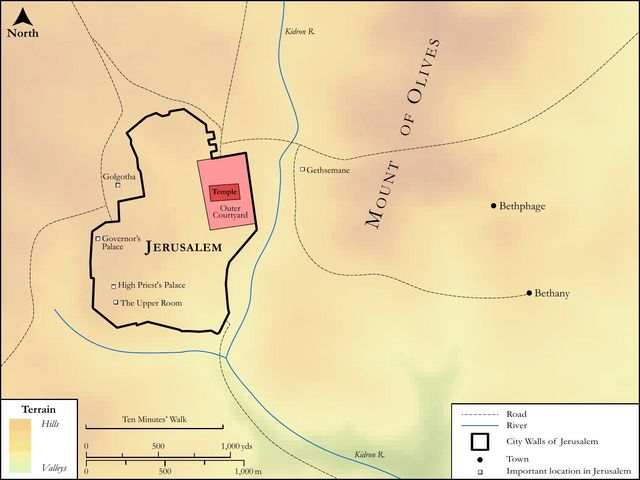
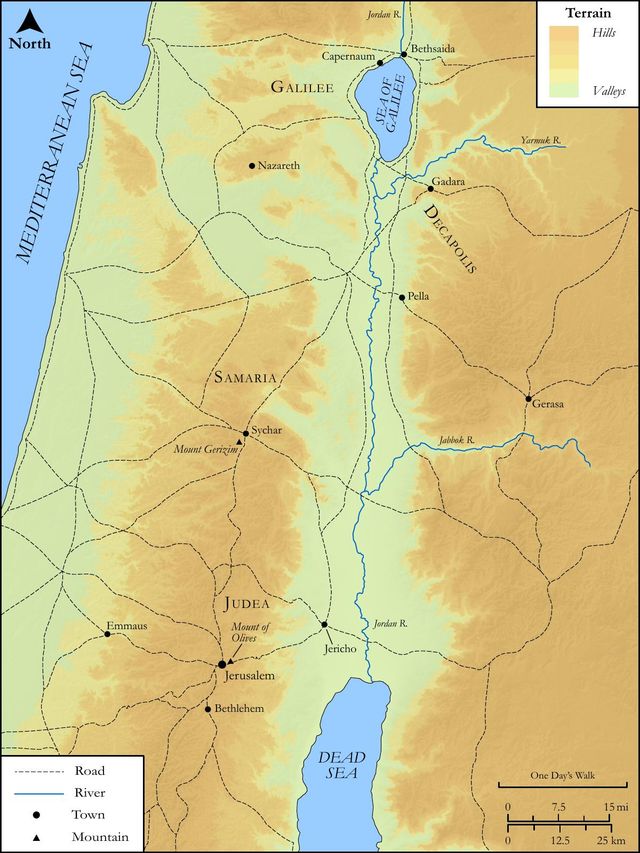

Study this verse
Public-domain commentary
Matthew Henry
From his Commentary on the Whole Bible. Henry comments on passages, not single verses — this entry covers Matthew 16:21–23. His four-level outline is real structure in the source text, so it is rendered as structure.
We have here Christ's discourse with his disciples concerning his own sufferings; in which observe,
I.Christ's foretelling of his sufferings.
Now he began to do it, and from this time he frequently spake of them. Some hints he had already given of his sufferings, as when he said, Destroy this temple: when he spake of the Son of man being lifted up, and of eating his flesh, and drinking his blood: but now he began to show it, to speak plainly and expressly of it. Hitherto he had not touched upon this, because the disciples were weak, and could not well bear the notice of a thing so very strange, and so very melancholy; but now that they were more ripe in knowledge, and strong in faith, he began to tell them this. Note, Christ reveals his mind to his people gradually, and lets in light as they can bear it, and are fit to receive it.
From that time, when they had made that full confession of Christ, that he was the Son of God, then he began to show them this. When he found them knowing in one truth, he taught them another; for to him that has, shall be given. Let them first be established in the principles of the doctrine of Christ, and then go on to perfection, Heb 6:1. If they had not been well grounded in the belief of Christ's being the Son of God, it would have been a great shaking to their faith. All truths are not to be spoken to all persons at all times, but such as are proper and suitable to their present state. Now observe,
1.What he foretold concerning his sufferings, the particulars and circumstances of them, and all surprising.
(1.)The place where he should suffer. He must go to Jerusalem, the head city, the holy city, and suffer there. Though he lived most of his time in Galilee, he must die at Jerusalem; there all the sacrifices were offered, there therefore he must die, who is the great sacrifice.
(2.)The persons by whom he should suffer; the elders, and chief priests, and scribes; these made up the great sanhedrim, which sat at Jerusalem, and was had in veneration by the people. Those that should have been most forward in owning and admiring Christ, were the most bitter in persecuting him. It was strange that men of knowledge in the scripture, who professed to expect the Messiah's coming, and pretended to have something sacred in their character, should use him thus barbarously when he did come. It was the Roman power that condemned and crucified Christ, but he lays it at the door of the chief priests and scribes, who were the first movers.
(3.)What he should suffer; he must suffer many things, and be killed. His enemies' insatiable malice, and his own invincible patience, appear in the variety and multiplicity of his sufferings (he suffered many things) and in the extremity of them; nothing less than his death would satisfy them, he must be killed. The suffering of many things, if not unto death, is more tolerable; for while there is life, there is hope; and death, without such prefaces, would be less terrible; but he must first suffer many things, and then be killed.
(4.)What should be the happy issue of all his sufferings; he shall be raised again the third day. As the prophets, so Christ himself, when he testified beforehand his sufferings, testified withal the glory that should follow, Pe1 1:11. His rising again the third day proved him to be the Son of God, notwithstanding his sufferings; and therefore he mentions that, to keep up their faith. When he spoke of the cross and the shame, he spoke in the same breath of the joy set before him, in the prospect of which he endured the cross, and despised the shame. Thus we must look upon Christ's suffering for us, trace in it the way to his glory; and thus we must look upon our suffering for Christ, look through it to the recompence of reward. If we suffer with him, we shall reign with him.
2.Why he foretold his sufferings.
(1.)To show that they were the product of an eternal counsel and consent; were agreed upon between the Father and the Son from eternity; Thus is behoved Christ to suffer. The matter was settled in the determinate counsel and foreknowledge, in pursuance of his own voluntary susception and undertaking for our salvation; his sufferings were no surprise to him, did not come upon him as a snare, but he had a distinct and certain foresight of them, which greatly magnifies his love, Joh 18:4.
(2.)To rectify the mistakes which his disciples had imbibed concerning the external pomp and power of his kingdom. Believing him to be the Messiah, they counted upon nothing but dignity and authority in the world; but here Christ reads them another lesson, tells them of the cross and sufferings; nay, that the chief priests and the elders, whom, it is likely, they expected to be the supports of the Messiah's kingdom, should be its great enemies and persecutors; this would give them quite another idea of that kingdom which they themselves had preached the approach of; and it was requisite that this mistake should be rectified. Those that follow Christ must be dealt plainly with, and warned not to expect great things in this world.
(3.)It was to prepare them for the share, at least, of sorrow and fear, which they must have in his sufferings. When he suffered many things, the disciples could not but suffer some; if their Master be killed, they will be seized with terror; let them know it before, that they may provide accordingly, and, being fore-warned, may be fore-armed.
II.The offence which Peter took at this he said, Be it far from thee, Lord:
probably he spake the sense of the rest of the disciples, as before, for he was chief speaker. He took him, and began to rebuke him. Perhaps Peter was a little elevated with the great things Christ had how said unto him, which made him more bold with Christ than did become him; so hard is it to keep the spirit low and humble in the midst of great advancements!
1.It did not become Peter to contradict his Master, or take upon him to advise him; he might have wished, that, if it were possible, this cup might pass away, without saying so peremptorily, This shall not be, when Christ had said, It must be. Shall any teach God knowledge? He that reproveth God, let him answer it. Note, When God's dispensations are either intricate or cross to us, it becomes us silently to acquiesce in, and not to prescribe to, the divine will; God knows what he has to do, without our teaching. Unless we know the mind of the Lord, it is not for us to be his counsellors, Rom 11:34.
2.It savoured much of fleshly wisdom, for him to appear so warmly against suffering, and to startle thus at the offence of the cross. It is the corrupt part of us, that is thus solicitous to sleep in a whole skin. We are apt to look upon sufferings as they relate to this present life, to which they are uneasy; but there are other rules to measure them by, which, if duly observed, will enable us cheerfully to bear them, Rom 8:18. See how passionately Peter speaks: "Be it far from thee, Lord. God forbid, that thou shouldst suffer and be killed; we cannot bear the thoughts of it." Master, spare thyself: so it might be read; hileōs soî kurie - "Be merciful to thyself, and then no one else can be cruel to thee; pity thyself, and then this shall not be to thee." He would have Christ to dread suffering as much as he did; but we mistake, if we measure Christ's love and patience by our own. He intimates, likewise, the improbability of the thing, humanly speaking; "This shall not be unto thee. It is impossible that one who hath so great an interest in the people as thou hast, should be crushed by the elders, who fear the people: this can never be; we that have followed thee, will fight for thee, if occasion be; and there are thousands that will stand by us."
III.Christ's displeasure against Peter for this suggestion of his, Mat 16:23.
We do not read of any thing said or done by any of his disciples, at any time, that he resented so much as this, though they often offended.
Observe, 1. How he expressed his displeasure: He turned upon Peter, and (we may suppose) with a frown said, Get thee behind me, Satan. He did not so much as take time to deliberate upon it, but gave an immediate reply to the temptation, which was such as made it to appear how ill he took it. Just now, he had said, Blessed art thou, Simon, and had even laid him in his bosom; but here, Get thee behind me, Satan; and there was cause for both. Note, A good man may by a surprise of temptation soon grow very unlike himself. He answered him as he did Satan himself, Mat 4:10. Note, (1.) It is the subtlety of Satan, to send temptations to us by the unsuspected hands of our best and dearest friends. Thus he assaulted Adam by Eve, Job by his wife, and here Christ by his beloved Peter. It concerns us therefore not to be ignorant of his devices, but to stand against his wiles and depths, by standing always upon our guard against sin, whoever moves us to it. Even the kindnesses of our friends are often abused by Satan, and made use of as temptations to us. (2.) Those who have their spiritual senses exercised, will be aware of the voice of Satan, even in a friend, a disciple, a minister, that dissuades them from their duty. We must not regard who speaks, so much as what is spoken; we should learn to know the devil's voice when he speaks in a saint as well as when he speaks in a serpent. Whoever takes us off from that which is good, and would have us afraid of doing too much for God, speaks Satan's language. (3.) We must be free and faithful in reproving the dearest friend we have, that saith or doth amiss, though it may be under colour of kindness to us. We must not compliment, but rebuke, mistaken courtesies. Faithful are the wounds of a friend. Such smitings must be accounted kindnesses, Psa 141:5. (4.) Whatever appears to be a temptation to sin, must be resisted with abhorrence, and not parleyed with.
2.What was the ground of this displeasure; why did Christ thus resent a motion that seemed not only harmless, but kind? Two reasons are given:
(1.)Thou art an offence to me - Skandalon mou ei - Thou art my hindrance (so it may be read); "thou standest in my way." Christ was hastening on in the work of our salvation, and his heart was so much upon it, that he took it ill to be hindered, or tempted to start back from the hardest and most discouraging part of his undertaking. So strongly was he engaged for our redemption, that they who but indirectly endeavoured to divert him from it, touched him in a very tender and sensible part. Peter was not so sharply reproved for disowning and denying his Master in his sufferings as he was for dissuading him from them; though that was the defect, this the excess, of kindness. It argues a very great firmness and resolution of mind in any business, when it is an offence to be dissuaded, and a man will not endure to hear any thing to the contrary; like that of Ruth, Entreat me not to leave thee. Note, Our Lord Jesus preferred our salvation before his own ease and safety; for even Christ pleased not himself (Rom 15:3); he came into the world, not to spare himself, as Peter advised, but to spend himself.
See why he called Peter Satan, when he suggested this to him; because, whatever stood in the way of our salvation, he looked upon as coming from the devil, who is a sworn enemy to it. The same Satan that afterward entered into Judas, maliciously to destroy him in his undertaking, here prompted Peter plausibly to divert him from it. Thus he changes himself into an angel of light.
Thou art an offence to me. Note, [1.] Those that engage in any great good work must expect to meet with hindrance and opposition from friends and foes, from within and from without. [2.] Those that obstruct our progress in any duty must be looked upon as an offence to us. Then we do the will of God as Christ did, whose meat and drink it was to do it, when it is a trouble to us to be solicited from our duty. Those that hinder us from doing or suffering for God, when we are called to it, whatever they are in other things in that they are Satans, adversaries to us.
(2.)Thou savourest not the things that are of God, but those that are of men. Note,
[1.]The things that are of God, that is, the concerns of his will and glory, often clash and interfere with the things that are of men, that is, with our own wealth, pleasure, and reputation. While we mind Christian duty as out way and work, and the divine favour as our end and portion, we savour the things of God; but if these be minded, the flesh must be denied, hazards must be run and hardships borne; and here is the trial which of the two we savour.
[2.]Those that inordinately fear, and industriously decline suffering for Christ, when they are called to it, savour more of the things of man than of the things of God; they relish those things more themselves, and make it appear to others that they do so.
Historical interpretation
Nine Centuries of Reception
12 surviving comments on this verse. Each one is dated, so this reads as a timeline rather than a list.
Select a marker to jump to its quote. Markers stagger vertically where authors wrote within a few decades of each other.
And if even then a Prodicus or Valentinus stood by, suggesting that one must not confess on the earth before men, and must do so the less in truth, that God may not (seem to) thirst for blood, and Christ for a repayment of suffering, as though He besought it with the view of obtaining salvation by it for Himself also, he would have immediately heard from the servant of God what the devil had from the Lord: "Get thee behind me, Satan; thou art an offence unto me. It is written, Thou shalt worship the Lord thy God, and Him only shalt thou serve." But even now it will be right that he hear it, seeing that, long after, he has poured forth these poisons, which not even thus are to injure readily any of the weak ones, if any one in faith will drink, before being hurt, or even immediately after, this draught of ours.
Responding to Peter’s ignorance as one opposing God, Jesus said, “Satan,” which is Hebrew for opponent. If he had not spoken to him from ignorance nor of the living God when he said, “Never, Lord! This must never happen to you!” then he would not have said to him “Get behind me,” as if speaking to someone who had given up being behind him and following him. Neither would he have called him “Satan.” Satan had overpowered the one following Jesus in order to turn him aside from following him and from being behind the Son of God, to make him, because of ignorant words, worthy of being called “Satan” and a scandal to the Son of God, “not thinking in the ways of God but of humans.”
What he intended when he forbade them to publicly declare him Christ is clarified in part by “From that time Jesus began to show his disciples how he must go to Jerusalem and suffer many things from the elders” and the following thoughts. At the right time and in the right way, he proclaimed to those who knew that Jesus was Christ, Son of the living God (the Father had revealed this to them), that rather than believing in Jesus Christ already crucified, they should believe in Jesus Christ soon to be crucified. So also, instead of believing in Jesus Christ already risen from the dead, they should believe in “Jesus Christ soon to be raised from the dead.”“Having put off from himself the principalities and powers, he made a show of them openly, triumphing over them in the cross.” If anyone is ashamed of the cross of Christ, he is ashamed of the agency by which these powers were defeated. The one who both believes and is assured of these things should, more appropriately, glory in the cross of our Lord and Savior Jesus Christ. Through that cross, when Christ was crucified, the principalities (among them, I think, was also the prince of this world) were publicly humiliated and paraded before the eyes of the believing world.
And observe that it is not said,' He began to say,' or 'to teach,' but to show; for as things are said to be shown to the sense, so the things which Christ spake are said to be shown by Him. Nor indeed do I think, that to those who saw Him suffering many things in the flesh, were those things which they saw so shown as this representation in words showed to the disciples the mystery of the passion and resurrection of Christ. At that time, indeed, He only began to show them, and afterwards when they were more able to receive it, He showed them more fully; for all that Jesus began to do, that He accomplished. He must needs go to Jerusalem, to be put to death indeed in the Jerusalem which is below, but to rise again and reign in the heavenly Jerusalem. But when Christ rose again, and others were risen with Him, they no longer sought the Jerusalem which is beneath, or the house of prayer in it, but that which is above. He suffers many things from the elders of the earthly Jerusalem, that He may be glorified by those heavenly elders who receive His mercies. He rose again from the dead on the third day, that He may deliver from the evil one, and purchase for such as are so delivered this gift, that they be baptized in spirit, soul, and body, in the name of the Father, and the Son, and the Holy Spirit, who are three days perpetually present to those that through them have been made children of light.
While Christ was yet speaking the beginnings of the things which He was showing unto them, Peter considered them unworthy of the Son of the living God. And forgetting that the Son of the living God does nothing, and acts in no way worthy of blame, he began to rebuke Him; and this is what is said, And Peter took him, and began to rebuke him.
As though Christ Himself had needed a propitiation. His affection Christ allows, but charges him with ignorance; as it follows, He turned and said unto Peter, Get thee behind me, Satan, thou art an offence unto me.
Yet the words in which Peter and those in which Satan are rebuked, are not, as is commonly thought, the same; to Peter it is said, Get thee behind me, Satan; that is, follow me, thou that art contrary to my will; to the Devil it is said, Go thy way, Satan, understanding not 'behind me,' but 'into everlasting fire.' He said therefore to Peter, Get thee behind me, as to one who through ignorance was ceasing to walk after Christ. And He called him Satan, as one, who through ignorance had somewhat contrary to God. But he is blessed to whom Christ turns, even though He turn in order to rebuke him. But why said He to Peter, Thou art an offence unto me, (Ps. 119:165.) when in the Psalm it is said, Great peace have they that love thy law, and there is no offence to them? It must be answered, that not only is Jesus not offended, but neither is any man who is perfect in the love of God; and yet he who does or speaks any thing of the nature of an offence, may be an offence even to one who is incapable of being offended. Or he may hold every disciple that sinneth as an offence, as Paul speaks, Who is offended, and I burn not?. (2 Cor. 11:29.)
When, contrary to what he had hoped, Peter heard this, he was troubled. For the revelation had exhibited Christ as Son of God and the living God, on the one hand. Yet on the other hand, he was found to be preparing for the dreadful events of the Passion. In rebuking Peter, Christ brings to light his own righteous judgment. When Peter confessed Christ, Christ praised him. But when he was irrationally terrified, Christ rebuked him, acting without respect of persons.
The Lord, knowing the suggestion of the craft of the devil, says to Peter, Get thee behind me; that is, that he should follow the example of His passion; but to him by whom this expression was suggested, He turns and says, Satan, thou art an offence unto me. For we cannot suppose that the name of Satan, and the sin of being an offence, would be imputed to Peter after those so great declarations of blessedness and power that had been granted him.
He however, to signify that He is far from coming to the passion against His will, both rebuked Peter, and called him Satan.
Let them hear, as many as are ashamed of the suffering of the cross of Christ. For if the chief apostle, even before he had learnt all distinctly, was called Satan for feeling this, what excuse can they have, who after so abundant proof deny His economy? I say, when he who had been so blessed, who made such a confession, has such words addressed to him; consider what they will suffer, who after all this deny the mystery of the cross.
And He said not, "Satan spake by thee," but, "Get thee behind me, Satan." For indeed it was a desire of the adversary that Christ should not suffer. Therefore with such great severity did He rebuke him, as knowing that both he and the rest are especially afraid of this, and will not easily receive it.
Therefore He also reveals the thoughts of his mind, saying, "Thou savorest not the things that be of God, but those that be of men."
But what means, "Thou savorest not the things that be of God, but those that be of men"? Peter examining the matter by human and earthly reasoning, accounted it disgraceful to Him and an unmeet thing. Touching him therefore sharply, He saith, "My passion is not an unmeet thing, but thou givest this sentence with a carnal mind; whereas if thou hadst hearkened to my sayings in a godly manner, disengaging thyself from thy carnal understanding, thou wouldest know that this of all things most becometh me. For thou indeed supposest that to suffer is unworthy of me; but I say unto thee, that for me not to suffer is of the devil's mind;" by the contrary statements repressing his alarm.
Thus as John, accounting it unworthy of Christ to be baptized by him, was persuaded of Christ to baptize Him, He saying, "Thus it becometh us," and this same Peter too, forbidding Him to wash his feet, by the words, "Thou hast no part with me, unless I wash thy feet;" even so here too He restrained him by the mention of the opposite, and by the severity of the reproof repressed his fear of suffering.
For what wonder is it that this should befal Peter, who had never received a revelation concerning these things? For that you may learn that that confession which he made concerning Christ was not spoken of himself, observe how in these things which had not been revealed to him, he is at a loss. Estimating the things of Christ by human and earthly principles, he judged it mean and unworthy of Him that He should suffer. Therefore the Lord added, For thou savourest not the things that be of God, but the things that be of men.
Peter was for twenty-four years Bishop of the Church of Rome. We cannot doubt that, amongst other things necessary for the instruction of the church, he himself delivered to them the treasury of the sacred books, which, no doubt, had even then begun to be read under his presidency and teaching.
(Verse 22, 23.) And Peter took him aside and began to rebuke him, saying: Lord, be it far from you, this shall not happen to you. But he turned and said to Peter: Get behind me, Satan, you are a hindrance to me, for you are not setting your mind on the things of God, but on the things of man. We have often said that Peter had great zeal and love for the Lord Savior. Therefore, after his confession, when he said: You are the Christ, the Son of the living God, and heard the Savior's response: Blessed are you, Simon Barjona, because flesh and blood did not reveal this to you, but my Father who is in heaven, he suddenly hears from the Lord that he must go to Jerusalem, suffer many things from the elders and scribes, and be killed, and on the third day rise again. He does not want his confession to be destroyed; he does not think it is possible for the Son of God to be killed. And he takes him into his affection, or leads him separately, so that he does not appear to accuse the teacher in front of the other disciples, and he begins to rebuke him out of love and desire, saying: Lord, be it far from you; or as it is better in Greek, ἵλεώς σοι, Κύριε, οὐ μὴ ἔσται σοι τοῦτο, which means, be propitious to yourself, Lord, this shall not happen to you; it cannot happen, and my ears do not accept that the Son of God should be killed. To whom the Lord, turning, said: Go behind me, Satan, you are a stumbling block to me. Satan is interpreted as adversary or opposer. Because you speak contrary to my will, you must be called adversary. Many believe that it was not Peter who was rebuked, but the opposing spirit who suggested these words to the Apostle. But to me, this Apostolic error, coming from a feeling of piety, will never seem like an incentive of the devil: Go behind me, Satan. The devil says: Go away. Peter hears: Go away from me, that is, follow my opinion: for you do not understand the things that are of God, but those that are of men. It is my will, and the Father's (whose will I have come to do (John VI)) that I should die for the salvation of men, while you, considering only your own will, do not want a grain of wheat to fall to the ground, so that it may bring forth many fruits (John XII). Let the wise reader inquire how, after such great blessedness: Blessed are you, Simon Barjona; and: You are Peter; and on this rock I will build my Church; and the gates of hell shall not prevail against it; and: I will give you the keys of the kingdom of heaven; and: Whatever you bind on earth shall be bound in heaven, and whatever you loose on earth shall be loosed in heaven; now let him hear: Go away from me, Satan, you are a stumbling block to me? But what kind of sudden conversion is this, that after so great rewards, he is called Satan? But if he considers who is asking this, he will understand that Peter received that blessing and beatitude, and power, and edification upon the Church, promised for the future, not given in the present. I will build, he says, my Church upon you and the gates of hell shall not prevail against it. And: I will give you the keys of the kingdom of heaven. All these things are for the future, which if he had immediately given them to him, the error of wrong opinion would have never found a place in him.
We have often said that Peter had too hot a zeal, and a very great affection towards the Lord the Saviour. Therefore after that his confession, and the reward of which he had heard from the Saviour, he would not have that his confession destroyed, and thought it impossible that the Son of God could be put to death, but takes Him to him affectionately, or takes Him aside that he may not seem to be rebuking his Master in the presence of his fellow disciples, and begins to chide Him with the feeling of one that loved Him, and to contradict Him, and say, Be it far from thee, Lord; or as it is better in the Greek, ἵλεώς σοι Κύριε, οὐ μὴ ἔσται σοι τοῦτο, that is, Be propitious to Thyself, Lord, this shall not be unto Thee.
But to me this error of the Apostle, proceeding from the warmth of his affection, will never seem a suggestion of the devil. Let the thoughtful reader consider that that blessedness of power was promised to Peter in time to come, not given him at the time present; had it been conveyed to him immediately, the error of a false confession would never have found place in him.
As much as to say; It is of My will, and of the Father's will, that I should die for the salvation of men; you considering only your own will would not that the grain of wheat should fall into the ground, that it may bring forth much fruit; therefore as you speak what is opposed to My will, you ought to be called My adversary. For Satan is interpreted 'adverse' or 'contrary.'
. When Peter spoke rightly, Christ called him blessed, but when he was irrationally dismayed, and did not want Him to suffer, then Christ rebuked him and said, "Get thee behind Me, Satan." "Satan" means "the adversary." "Get thee behind Me," that is, do not oppose Me, but follow My will. He calls Peter this because Satan, too, did not wish Christ to suffer. What He is saying, then, is this: with human reasoning you think that suffering does not befit Me, but you fail to understand that by this means God is accomplishing salvation and that this, on the contrary, greatly befits Me.
Continue studying Matthew 16:23 across the web’s major study libraries — every link below opens this exact verse, chapter, or book on the destination site.
Read & Compare
 BibleGatewayThis verse in more than 200 translations and 70 languages.
 Bible.comThe YouVersion reader — hundreds of translations, reading plans, and highlights.
 ESV.orgCrossway's official English Standard Version reader.
 NET BibleThe NET translation with 60,000+ translators' notes on every rendering decision.
 STEP BibleTyndale House's free study tool — original text, vocabulary, and scholarly resources.
 BibliaLogos Bible Software's free web reader.
 USCCBThe New American Bible (Revised Edition) with the U.S. bishops' study notes.
Commentaries
 BibleHub CommentariesDozens of classic commentaries on this verse, gathered on one page.
 StudyLightMore than 100 commentary sets — the largest collection on the web.
 BibleRefPlain-English commentary on what this verse means, verse by verse.
 Enduring WordDavid Guzik's free commentary on this chapter, widely used by Bible teachers.
 Bible Study ToolsVerse commentary alongside Greek and Hebrew study aids.
Original Language & Research
- BibleHub InterlinearThe verse word by word — original language, transliteration, and English.
- BibleHub LexiconEvery word's original-language definition and Strong's entry.
 Blue Letter BibleDeep-study tools — Strong's numbers, concordance, and word studies.
 CNTR CollationThe earliest Greek manuscripts of this verse, collated letter by letter.
Sermons, Hymns & Audio


TrulyRandomVerse is not affiliated with these sites and doesn’t control their content. They’re linked because they’re genuinely useful.
Summary
Matthew 16:23 records one of the most abrupt and severe rebukes Jesus delivers to Peter, immediately following Peter's profound confession of Jesus as the Christ. Jesus' sharp words, "Get thee behind me, Satan: thou art an offence unto me: for thou savourest not the things that be of God, but those that be of men," highlight the stark opposition between divine will and human understanding, particularly concerning the necessity of Christ's suffering and death for the redemption of humanity. This pivotal moment underscores the constant spiritual battle against anything that would divert God's redemptive plan.
Context
ShowHideLiterary Context
This verse is strategically placed within a critical section of Matthew's Gospel, forming a stark contrast to the preceding verses. Just moments before, in Matthew 16:16, Peter makes the monumental confession, "Thou art the Christ, the Son of the living God." Jesus responds by blessing Peter and declaring that He will build His church upon this foundational truth (Matthew 16:18). However, immediately after this high point, Jesus begins to reveal the uncomfortable truth of His impending suffering, death, and resurrection in Jerusalem (Matthew 16:21). Peter, unable to reconcile the idea of a suffering Messiah with his prevailing expectation of a conquering king, takes Jesus aside and presumptuously rebukes Him, saying, "Be it far from thee, Lord: this shall not be unto thee" (Matthew 16:22). It is this well-intentioned but profoundly misguided attempt to divert Jesus from His divine mission that elicits the Lord's severe response in verse 23.
Historical & Cultural Context
First-century Judaism was deeply steeped in messianic expectation, largely influenced by Old Testament prophecies of a glorious, conquering king who would liberate Israel from foreign oppression and establish an earthly kingdom. Concepts of a suffering Messiah, though present in passages like Isaiah 53, were not widely understood or accepted. The disciples, including Peter, shared this common cultural expectation, envisioning Jesus as the political liberator who would overthrow Roman rule. Peter's rebuke of Jesus in Matthew 16:22 stemmed directly from this cultural lens, where suffering and death were seen as antithetical to messianic glory. Jesus' response challenges this deeply ingrained human and cultural understanding, asserting the divine necessity of the cross, which was a "stumbling block" to the Jews and "foolishness" to the Gentiles, as later articulated in 1 Corinthians 1:23.
Key Themes
ShowHideMatthew 16:23 powerfully contributes to several overarching themes within the Gospel and broader biblical narrative. Firstly, it highlights the clash between divine will and human understanding, emphasizing that God's ways are often contrary to human logic and desire for comfort or earthly glory. Peter's human perspective, focused on avoiding suffering, directly opposes God's sovereign plan for salvation through the cross. Secondly, the passage underscores the absolute necessity of the cross as the central and indispensable element of God's redemptive work. Any attempt to circumvent this path, even by a beloved disciple, is seen as an act of opposition to God's will. Thirdly, it reveals the reality of spiritual warfare and temptation, demonstrating that opposition to God's plan can come from unexpected sources, even through well-meaning individuals who unwittingly become instruments of the adversary. This echoes Satan's earlier attempts to tempt Jesus to avoid the cross in Matthew 4:1-11. Finally, this incident serves as a prelude to Jesus' teaching on the nature of true discipleship, which immediately follows in Matthew 16:24-28, emphasizing self-denial and a willingness to embrace suffering for Christ's sake.
Exposition and Analysis
ShowHideKey Word Analysis
ShowHideThis word (G4567) is of Chaldean origin, meaning "the accuser" or "adversary." While it is the proper name for the devil, Jesus uses it here not to equate Peter with the devil, but to identify the source and nature of the temptation Peter was presenting. Peter, by seeking to dissuade Jesus from the path of suffering, was unwittingly acting as an agent or instrument of the adversary, whose ultimate goal was to thwart God's redemptive plan through the cross.
This term (G4625) literally refers to a "trap-stick" or "snare," and figuratively means a "stumbling block" or "cause of displeasure/sin." Peter's words were not merely an annoyance; they constituted a serious obstacle, a temptation that could cause Jesus to deviate or "stumble" from the divinely appointed path of suffering and death necessary for salvation. It implies a moral snare or an impediment to righteousness.
This verb (G5426) means "to exercise the mind," "to entertain or have a sentiment or opinion," or "to be (mentally) disposed." It implies a deep-seated mindset or a focus of one's affections and thoughts. Jesus' accusation means Peter's thoughts, desires, and understanding were aligned with human perspectives, comfort, and worldly glory, rather than with the divine, self-sacrificial plan of God. Peter's mind was set on human ways of thinking.
Verse Breakdown
ShowHide"But he turned, and said unto Peter"
This opening clause highlights the abruptness and directness of Jesus' response. The phrase "he turned" (G4762, stréphō) suggests a sharp pivot, indicating the severity of the situation and Jesus' immediate recognition of the spiritual danger. The direct address "unto Peter" emphasizes that this rebuke is personal, yet also indicative of Peter's pivotal role and the magnitude of his error despite his recent confession.
"Get thee behind me, Satan"
This is the core of the rebuke, echoing Jesus' earlier confrontation with the devil in the wilderness (Matthew 4:10). "Get thee behind me" (G5217, hypágō) is a command to withdraw or depart, signifying a forceful rejection of the temptation. By addressing Peter as "Satan," Jesus identifies the ultimate source of the suggestion – the adversary who seeks to undermine God's plan. It's not a condemnation of Peter's person, but of the spirit influencing his words at that moment.
"thou art an offence unto me"
This clause clarifies why Peter is being rebuked. Peter's well-intentioned intervention is a "stumbling block" (G4625, skándalon) to Jesus. His words present a temptation to avoid the suffering that is central to God's redemptive purpose. This reveals the spiritual danger of even well-meaning human counsel when it opposes God's revealed will.
"for thou savourest not the things that be of God, but those that be of men"
This final clause provides the reason for Peter's error and the essence of the conflict. "Savourest" (G5426, phronéō) indicates Peter's mindset, his alignment of thought and desire. His mind is not set on "the things that be of God" (G2316, theós), which refers to God's divine plan, wisdom, and sovereign will, particularly concerning the cross. Instead, his mindset is aligned with "those that be of men" (G444, ánthrōpos), meaning human logic, earthly desires, and a worldly perspective that shies away from suffering and seeks glory without sacrifice.
Literary Devices
ShowHideMatthew 16:23 is rich in literary devices that amplify its impact. The most striking is Apostrophe, where Jesus directly addresses Peter as "Satan." This is a rhetorical device where a speaker addresses an absent person, an abstract idea, or a thing, but here it's used to address Peter in a way that identifies the source of the temptation, not Peter's personal identity. It functions as a powerful Metaphor or Symbolism, where Peter, in that moment, represents the adversarial force attempting to divert Jesus from His mission. This highlights the spiritual nature of the conflict. Furthermore, the verse employs stark Antithesis or Contrast in the phrase "the things that be of God, but those that be of men." This sharp juxtaposition emphasizes the fundamental difference between divine wisdom and human folly, divine purpose and human preference, and serves to underscore the profound spiritual truth Jesus is conveying. The abruptness of Jesus' "turned, and said" also functions as Dramatic Irony, as the reader knows the full scope of God's plan, while Peter does not, making his misguided intervention all the more poignant.
Theological and Thematic Connections
ShowHideMatthew 16:23 serves as a profound theological statement on the absolute necessity of the cross in God's redemptive plan and the constant spiritual battle against anything that would undermine it. It underscores that God's ways are often antithetical to human reasoning and comfort. Peter's well-intentioned but human-centered perspective becomes a "stumbling block" because it opposes the divine wisdom that ordained suffering as the path to glory. This passage reveals that genuine faith and discipleship require aligning one's mind with God's will, even when it involves hardship and self-denial, rather than succumbing to the temptation of an easier, human-preferred path. It also highlights the insidious nature of temptation, which can arise even from those closest to us, subtly attempting to derail divine purposes.
Reflection and Application
ShowHideMatthew 16:23 offers timeless lessons for every follower of Christ. It challenges us to constantly examine the source and nature of our thoughts, desires, and even our most well-intentioned advice. Are we truly aligning our minds with "the things that be of God," or are we inadvertently "savouring the things that be of men"—prioritizing comfort, worldly success, or human logic over God's often counter-intuitive and sacrificial path? This passage calls us to a radical submission to God's will, even when it involves hardship and self-denial, or challenges our preconceived notions of how God should work. It reminds us that the path of true discipleship often involves embracing the cross, dying to self, and trusting God's sovereign plan, even when it appears to lead through hardship. We must cultivate spiritual discernment to recognize and resist temptations, whether they come from overt evil or from the subtle, well-meaning but misguided counsel of those around us, ensuring our hearts and minds are always set on God's divine purposes.
Questions for Reflection
ShowHideFAQ
ShowHideWhy did Jesus call Peter "Satan" if Peter was a disciple?
ShowHideJesus did not call Peter "Satan" to imply that Peter literally was the devil or that he was permanently possessed. Rather, Jesus was identifying the source and nature of the temptation Peter was presenting. The Greek word for "Satan" (G4567, Satanâs) means "adversary" or "opponent." In that moment, Peter, despite his good intentions, was acting as an adversary to God's divine plan for Jesus to suffer and die. Just as Satan tempted Jesus in the wilderness to avoid the cross (Matthew 4:1-11), Peter's words were a similar temptation, a "stumbling block" (Matthew 16:23) that sought to divert Jesus from His redemptive mission. Jesus was rebuking the spirit of opposition, not condemning Peter's person. This highlights how even well-meaning individuals can unwittingly become instruments of temptation when their thoughts align with human desires rather than God's will.
What does it mean to "savourest not the things that be of God, but those that be of men"?
ShowHideTo "savourest" (G5426, phronéō) means to set one's mind on, to be intent on, or to have a particular mindset or disposition. When Jesus says Peter "savourest not the things that be of God, but those that be of men," He is pointing out that Peter's thoughts, desires, and understanding were aligned with human perspectives, earthly comfort, and worldly glory, rather than with God's divine wisdom and sovereign plan. "The things that be of God" refer to God's will, His eternal purposes, and His divine wisdom, particularly concerning the necessity of Christ's suffering and death for salvation. "Those that be of men" refer to human logic, natural inclinations, and a worldview that seeks to avoid hardship or achieve glory without sacrifice. Peter's mindset was focused on a humanly conceived Messiah who would conquer politically, rather than a divinely appointed Messiah who would suffer and die to redeem humanity, as prophesied in Isaiah 53.
Christ-Centered Fulfillment
ShowHideMatthew 16:23, though a severe rebuke to Peter, profoundly underscores the absolute centrality of Christ's suffering and death to God's redemptive plan, revealing the very heart of Christ's mission. Jesus' unwavering commitment to the cross, even in the face of temptation from His closest disciple, demonstrates His perfect obedience to the Father's will. This passage foreshadows the ultimate victory of Christ over Satan, not by avoiding the cross, but precisely by embracing it. The "offence" Peter presented was a temptation for Jesus to deviate from the path that would ultimately crush the head of the serpent (Genesis 3:15) and disarm the powers of darkness (Colossians 2:15). By rejecting Peter's human counsel, Jesus affirmed that His kingdom would not be established through worldly power or avoidance of suffering, but through sacrificial love that conquers sin and death. His resolve here points directly to His ultimate triumph on the cross, where He became the Lamb of God who takes away the sin of the world (John 1:29), and through death, destroyed "him that had the power of death, that is, the devil" (Hebrews 2:14). Thus, this moment, though painful for Peter, highlights Christ's resolute fulfillment of God's redemptive purpose through the cross, securing salvation for all who believe.