


Romans 8:7
Bible text: King James Version (1769 Blayney text) · Public domain
Bible text: Berean Standard Bible · Public domain
Bible text: American Standard Version (1901) · Public domain
Bible text: World English Bible, Messianic edition · Public domain
Bible text: Geneva Bible (1599) · Public domain
Bible text: Young's Literal Translation · Public domain
- διότιdiotibecauseG1360CONJConjunction
- τὸtotheG3588T-NSNDefinite article Nominative Singular Neuter
- φρόνημαphronēmamindG5427N-NSNNoun Nominative Singular Neuter
- τῆςtēsof theG3588T-GSFDefinite article Genitive Singular Feminine
- σαρκὸςsarkosfleshG4561N-GSFNoun Genitive Singular Feminine
- ἔχθραechthra[is] hostilityG2189N-NSFNoun Nominative Singular Feminine
- εἰςeistowardG1519PREPPreposition
- θεόν·theonGodG2316N-ASM-TNoun Accusative Singular Masculine Title
- τῷtō<the>G3588T-DSMDefinite article Dative Singular Masculine
- γὰρgarforG1063CONJConjunction
- νόμῳnomōthe lawG3551N-DSMNoun Dative Singular Masculine
- τοῦtou<the>G3588T-GSMDefinite article Genitive Singular Masculine
- θεοῦtheouof GodG2316N-GSM-TNoun Genitive Singular Masculine Title
- οὐχouchnotG3756PRT-NNegative Particle Negative
- ὑποτάσσεταιhupotassetaiit is subjectG5293V-PPI-3SVerb Present Passive Indicative 3rd Singular
- οὐδὲoudenor evenG3761CONJ-NConjunction Negative
- γὰρgarforG1063CONJConjunction
- δύναται·dunataican it [be]G1410V-PNI-3SVerb Present Middle Or Passive Deponent Indicative 3rd Singular
English is a literal word-by-word gloss of the Greek, not the KJV's wording. Why?
This is the original text the KJV's translators worked from — each Greek word with its own literal English meaning in this verse, prepared by scholars at Tyndale House, Cambridge. The KJV translates whole sentences, not word by word, so its wording differs: one Greek word can become several English words, and the KJV may choose “charity” where the gloss reads “love”. Both are faithful — they answer different questions. For the KJV's own rendering, switch to the KJV text.
Details
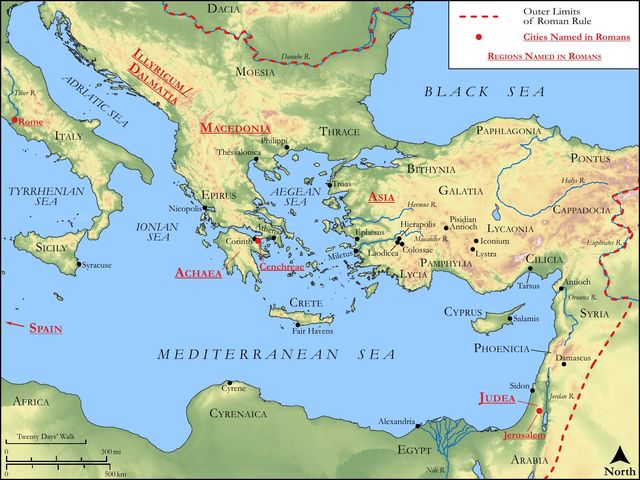
See on the biblical-era maps

Study this verse
Public-domain commentary
Matthew Henry
From his Commentary on the Whole Bible. Henry comments on passages, not single verses — this entry covers Romans 8:1–9. His four-level outline is real structure in the source text, so it is rendered as structure.
I.The apostle here beings with one signal privilege of true Christians, and describes the character of those to whom it belongs:
There is therefore now no condemnation to those that are in Christ Jesus, Rom 8:1. This is his triumph after that melancholy complaint and conflict in the foregoing chapter - sin remaining, disturbing, vexing, but, blessed be God, not ruining. The complaint he takes to himself, but humbly transfers the comfort with himself to all true believers, who are all interested in it.
1.It is the unspeakable privilege and comfort of all those that are in Christ Jesus that there is therefore now no condemnation to them. He does not say, "There is no accusation against them," for this there is; but the accusation is thrown out, and the indictment quashed. He does not say, "There is nothing in them that deserves condemnation," for this there is, and they see it, and own it, and mourn over it, and condemn themselves for it; but it shall not be their ruin. He does not say, "There is no cross, no affliction to them or no displeasure in the affliction," for this there may be; but no condemnation. They may be chastened of the Lord, but not condemned with the world. Now this arises from their being in Christ Jesus; by virtue of their union with him through faith they are thus secured. They are in Christ Jesus, as in their city of refuge, and so are protected from the avenger of blood. He is their advocate, and brings them off. There is therefore no condemnation, because they are interested in the satisfaction that Christ by dying made to the law. In Christ, God does not only not condemn them, but is well pleased with them, Mat 17:5.
2.It is the undoubted character of all those who are so in Christ Jesus as to be freed from condemnation that they walk not after the flesh but after the Spirit. Observe, The character is given from their walk, not from any one particular act, but from their course and way. And the great question is, What is the principle of the walk, the flesh or the spirit, the old or the new nature, corruption or grace? Which of these do we mind, for which of these doe we make provision, by which of these are we governed, which of these do we take part with?
II.This great truth, thus laid down, he illustrates in the following verses; and shows how we come by this great privilege, and how we may answer this character.
1.How we come by these privileges - the privilege of justification, that there is no condemnation to us - the privilege of sanctification, that we walk after the Spirit, and not after the flesh, which is no less our privilege than it is our duty. How comes it about?
(1.)The law could not do it, Rom 8:3. It could neither justify nor sanctify, neither free us from the guilt nor from the power of sin, having not the promises either of pardon or grace. The law made nothing perfect: It was weak. Some attempt the law made towards these blessed ends, but, alas! it was weak, it could not accomplish them: yet that weakness was not through any defect in the law, but through the flesh, through the corruption of human nature, by which we became incapable either of being justified or sanctified by the law. We had become unable to keep the law, and, in case of failure, the law, as a covenant of works, made no provision, and so left us as it found us. Or understand it of the ceremonial law; that was a plaster not wide enough for the wound, it could never take away sin, Heb 10:4.
(2.)The law of the Spirit of life in Christ Jesus does it, Rom 8:2. The covenant of grace made with us in Christ is a treasury of merit and grace, and thence we receive pardon and a new nature, are freed from the law of sin and death, that is, both from the guilt and power of sin - from the course of the law, and the dominion of the flesh. We are under another covenant, another master, another husband, under the law of the Spirit, the law that gives the Spirit, spiritual life to qualify us for eternal. The foundation of this freedom is laid in Christ's undertaking for us, of which he speaks Rom 8:3, God sending his own Son. Observe, When the law failed, God provided another method. Christ comes to do that which the law could not do. Moses brought the children of Israel to the borders of Canaan, and then died, and left them there; but Joshua did that which Moses could not do, and put them in possession of Canaan. Thus what the law could not do Christ did. The best exposition of this verse we have Heb 10:1-10. To make the sense of the words clear, which in our translation is a little intricate, we may read it thus, with a little transposition: - God sending his own Son in the likeness of sinful flesh, and a sacrifice for sin, condemned sin in the flesh, which the law could not do, in that it was weak through the flesh, etc., Rom 8:4. Observe,
[1.]How Christ appeared: In the likeness of sinful flesh. Not sinful, for he was holy, harmless, undefiled; but in the likeness of that flesh which was sinful. He took upon him that nature which was corrupt, though perfectly abstracted from the corruptions of it. His being circumcised, redeemed, baptized with John's baptism, bespeaks the likeness of sinful flesh. The bitings of the fiery serpents were cured by a serpent of brass, which had the shape, through free from the venom, of the serpents that bit them. It was great condescension that he who was God should be made in the likeness of flesh; but much greater that he who was holy should be made in the likeness of sinful flesh. And for sin, - here the best Greek copies place the comma. God sent him, en homoiōmati sarkos hamartias, kai peri hamartias - in the likeness of sinful flesh, and as a sacrifice for sin. The Septuagint call a sacrifice for sin no more than peri hamartias - for sin; so Christ was a sacrifice; he was sent to be so, Heb 9:26.
[2.]What was done by this appearance of his: Sin was condemned, that is, God did therein more than ever manifest his hatred of sin; and not only so, but for all that are Christ's both the damning and the domineering power of sin is broken and taken out of the way. He that is condemned can neither accuse nor rule; his testimony is null, and his authority null. Thus by Christ is sin condemned; though it live and remain, its life in the saints is still but like that of a condemned malefactor. it was by the condemning of sin that death was disarmed, and the devil, who had the power of death, destroyed. The condemning of sin saved the sinner from condemnation. Christ was made sin for us (Co2 5:21), and, being so made, when he was condemned sin was condemned in the flesh of Christ, condemned in the human nature: So was sanctification made to divine justice, and way made for the salvation of the sinner.
[3.]The happy effect of this upon us (Rom 8:4): That the righteousness of the law might be fulfilled in us. Both in our justification and in our sanctification, the righteousness of the law if fulfilled. A righteousness of satisfaction for the breach of the law is fulfilled by the imputation of Christ's complete and perfect righteousness, which answers the utmost demands of the law, as the mercy-seat was as long and as broad as the ark. A righteousness of obedience to the commands of the law is fulfilled in us, when by the Spirit the law of love is written upon the heart, and that love is the fulfilling of the law, Rom 13:10. Though the righteousness of the law is not fulfilled by us, yet, blessed be God, it is fulfilled in us; there is that to be found upon and in all true believers which answers the intention of the law. Us who walk not after the flesh, but after the Spirit. This is the description of all those that are interested in this privilege - they act from spiritual and not from carnal principles; as for others, the righteousness of the law will be fulfilled upon them in their ruin. Now,
2.Observe how we may answer to this character, Rom 8:5, etc.
(1.)By looking to our minds. How may we know whether we are after the flesh or after the Spirit? By examining what we mind, the things of the flesh or the things of the spirit. Carnal pleasure, worldly profit and honour, the things of sense and time, are the things of the flesh, which unregenerate people mind. The favour of God, the welfare of the soul, the concerns of eternity, are the things of the Spirit, which those that are after the Spirit do mind. The man is as the mind is. The mind is the forge of thoughts. As he thinketh in his heart, so is he, Pro 23:7. Which way do the thoughts move with most pleasure? On what do they dwell with most satisfaction? The mind is the seat of wisdom. Which way go the projects and contrivances? whether are we more wise for the world or for our souls? phronousi ta tēs sarkos - they savour the things of the flesh; so the word is rendered, Mat 16:23. It is a great matter what our savour is, what truths, what tidings, what comforts, we do most relish, and are most agreeable to us. Now, to caution us against this carnal-mindedness, he shows the great misery and malignity of it, and compares it with the unspeakable excellency and comfort of spiritual-mindedness.
[1.]It is death, Rom 8:6. It is spiritual death, the certain way to eternal death. It is the death of the soul; for it is its alienation from God, in union and communion with whom the life of the soul consists. A carnal soul is a dead soul, dead as a soul can die. She that liveth in pleasure is dead (Ti1 5:6), not only dead in law as guilty, but dead in state as carnal. Death includes all misery; carnal souls are miserable souls. But to be spiritually minded, phronēma tou pneumatos - a spiritual savour (the wisdom that is from above, a principle of grace) is life and peace; it is the felicity and happiness of the soul. The life of the soul consists in its union with spiritual things by the mind. A sanctified soul is a living soul, and that life is peace; it is a very comfortable life. All the paths of spiritual wisdom are paths of peace. It is life and peace in the other world, as well as in this. Spiritual-mindedness is eternal life and peace begun, and an assuring earnest of the perfection of it.
[2.]It is enmity to God (Rom 8:7), and this is worse than the former. The former speaks the carnal sinner a dead man, which is bad; but this speaks him a devil of a man. It is not only an enemy, but enmity itself. It is not only the alienation of the soul from God, but the opposition of the soul against God; it rebels against his authority, thwarts his design, opposes his interest, spits in his face, spurns at his bowels. Can there be a greater enmity? An enemy may be reconciled, but enmity cannot. How should this humble us for and warn us against, carnal-mindedness! Shall we harbour and indulge that which is enmity to God our creator, owner, ruler, and benefactor? To prove this, he urges that it is not subject to the law of God, neither indeed can be. The holiness of the law of God, and the unholiness of the carnal mind, are as irreconcilable as light and darkness. The carnal man may, by the power of divine grace, be made subject to the law of God, but the carnal mind never can; this must be broken and expelled. See how wretchedly the corrupt will of man is enslaved to sin; as far as the carnal mind prevails, there is no inclination to the law of God; therefore wherever there is a change wrought it is by the power of God's grace, not by the freedom of man's will. Hence he infers (Rom 8:8), Those that are in the flesh cannot please God. Those that are in a carnal unregenerate state, under the reigning power of sin, cannot do the things that please God, wanting grace, the pleasing principle, and an interest in Christ, the pleasing Mediator. The very sacrifice of the wicked is an abomination, Pro 15:8. Pleasing God is our highest end, of which those that are in the flesh cannot but fall short; they cannot please him, nay, they cannot but displease him. We may know our state and character,
(2.)By enquiring whether we have the Spirit of God and Christ, or not (Rom 8:9): You are not in the flesh, but in the Spirit. This expresses states and conditions of the soul vastly different. All the saints have flesh and spirit in them; but to be in the flesh and to be in the Spirit are contrary. It denotes our being overcome and subdued by one of these principles. As we say, A man is in love, or in drink, that is, overcome by it. Now the great question is whether we are in the flesh or in the Spirit; and how may we come to know it? Why, by enquiring whether the Spirit of God dwell in us. The Spirit dwelling in us is the best evidence of our being in the Spirit, for the indwelling is mutual (Jo1 4:16): Dwelleth in God, and God in him. The Spirit visits many that are unregenerate with his motions, which they resist and quench; but in all that are sanctified he dwells; there he resides and rules. He is there as a man at his own house, where he is constant and welcome, and has the dominion. Shall we put this question to our own hearts, Who dwells, who rules, who keeps house, here? Which interest has the ascendant? To this he subjoins a general rule of trial: If any man has not the Spirit of Christ, he is none of his. To be Christ's (that is, to be a Christian indeed, one of his children, his servants, his friends, in union with him) is a privilege and honour which many pretend to that have no part nor lot in the matter. None are his but those that have his Spirit; that is,
[1.]That are spirited as he was spirited-are meek, and lowly, and humble, and peaceable, and patient, and charitable, as he was. We cannot tread in his steps unless we have his spirit; the frame and disposition of our souls must be conformable to Christ's pattern.
[2.]That are actuated and guided by the Holy Spirit of God, as a sanctifier, teacher, and comforter. Having the Spirit of Christ is the same with having the Spirit of God to dwell in us. But those two come much to one; for all that are actuated by the Spirit of God as their rule are conformable to the spirit of Christ as their pattern. Now this description of the character of those to whom belongs this first privilege of freedom from condemnation is to be applied to all the other privileges that follow.
Historical interpretation
Nine Centuries of Reception
5 surviving comments on this verse. Each one is dated, so this reads as a timeline rather than a list.
Select a marker to jump to its quote. Markers stagger vertically where authors wrote within a few decades of each other.
As long as the flesh lives … it is not possible for the pleasing and perfect will of God to be done expeditiously in the life of the believer.
"Because the carnal mind is enmity against God:" and this is worse than death. Then to show how it is at once death and enmity; "for it is not subject to the Law of God," he says, "neither indeed can be." But be not troubled at hearing the "neither indeed can be." For this difficulty admits of an easy solution. For what he here names "carnal mindedness" is the reasoning that is earthly, gross, and eager-hearted after the things of this life and its wicked doings. It is of this he says "neither yet can" it "be subject" to God. And what hope of salvation is there left, if it be impossible for one who is bad to become good? This is not what he says. Else how would Paul have become such as he was? how would the (penitent) thief, or Manasses, or the Ninevites, or how would David after falling have recovered himself? How would Peter after the denial have raised himself up? How could he that had lived in fornication have been enlisted among Christ's fold? How could the Galatians who had "fallen from grace" have attained their former dignity again? What he says then is not that it is impossible for a man that is wicked to become good, but that it is impossible for one who continues wicked to be subject to God. Yet for a man to be changed, and so become good, and subject to Him, is easy. For he does not say that man cannot be subject to God, but, wicked doing cannot be good. As if he had said, fornication cannot be chastity, nor vice virtue. And this it says in the Gospel also, "A corrupt tree cannot bring forth good fruit," not to bar the change from virtue to vice, but to say how incapable continuance in vice is of bringing forth good fruits. For He does not say that an evil tree cannot become a good one, but that bring forth good fruit it cannot, while it continues evil. For that it can be changed, He shows from this passage, and from another parable, when He introduces the tares as becoming wheat, on which score also He forbids their being rooted up; "Lest," He says, "ye root up also the wheat with them"; that is, that which will spring from them.
The flesh is not in itself hostile to God, as the Manichaeans say, but the carnal mind is. For everything which is not subject is hostile, and anyone who wants to clear himself may sometimes go beyond the limit of the old law. Paul says that this carnal wisdom can never be subject to the law of God in order to call men back from the desires of the flesh.
Paul explains why he said “hostile” so that no one should think that there is some nature derived from an opposing principle which God did not create and which fights against him. An enemy of God is one who does not submit to his law and who behaves this way because of the wisdom of the flesh. This means that he seeks worldly goods and is afraid of worldly evils. The normal definition of wisdom is to seek what is good and avoid what is evil. Therefore the apostle is right to describe the wisdom of the flesh as the longing for “goods” which do not remain with a man and when there is a fear for losing those things which one day will have to be left behind anyway. Wisdom of this kind cannot submit to the law of God. It must be destroyed so that the wisdom of the Spirit, which does not place its hope in worldly goods nor is afraid of worldly evils, may take its place. For the one nature of the soul has both the wisdom of the flesh when it follows lower things and the wisdom of the Spirit when it chooses higher things, just as the one nature of water freezes in the cold and melts in the heat.
In the preceding section [n. 612] the Apostle had presupposed that the prudence of the flesh is death, and here he intends to prove this. And first, he proves it; 308 secondly, he shows that the believers to whom he writes are immune to such prudence, there [v. 9; n. 625] at But you are not in the flesh. In regard to the first he does two things. First, he proves his statement about prudence of the flesh in the abstract; secondly, he applies what he had said about prudence of the flesh to those who follow prudence of the flesh, there [v. 8; n. 624] at And those who are in the flesh. In regard to the first he sets out three middle [terms], each of which proves the one before it. 620. Using the first middle, he proves something stated earlier [n. 617], namely, that the prudence of the flesh is death, in the following way: He that is hostile to God incurs death: "But as for those enemies of mine, who did not want me to reign over them, bring them here and slay them before me" (Lk 19:27); and this because God is our life: "For he is your life" (Dt 30:20). And so, he that is hostile to God incurs death; but the wisdom of the flesh is hostile to God. Therefore, the prudence of the flesh is the cause of death. 621. Here it should be noted that what he earlier called the prudence of the flesh he now calls the wisdom of the flesh, not because prudence and wisdom are absolutely the same but because wisdom in human matters is prudence: "Wisdom is prudence to a man" (Pr 10:23). To understand this it should be recognized that one who knows the highest cause on which all things depend is called wise in the strict sense. But the supreme cause absolutely of all things is God. Therefore, wisdom in the strict sense is knowledge of divine things, as Augustine says in The Trinity: "Yet among the mature we do impart 309 wisdom" (1 Cor 2:6). Now one who knows the highest cause in a particular genus is said to be wise in that genus. For example, in the art of building it is not the man who knows how to cut wood and stones but the one who conceives and plans the house who is called wise; for the entire building depends on him. Hence the Apostle says in 1 Cor 3(:10), "As a wise architect I have laid the foundation." Thus, therefore, one is called wise in human matters who has a good understanding about the goal of human life and regulates the whole of human life accordingly, which pertains to prudence. And thus the wisdom of the flesh is the same as the prudence of the flesh, about which James 3(:15) says that it is "not such as comes down from above, but is earthly, unspiritual, devilish." This wisdom is said to be hostile to God, because it inclines a man against God’s law: "Running stubbornly against him with a thick-bossed shield" (Jb 15:26). 622. To prove this he uses another middle, adding: it is not subject to the law of God. For a person cannot hate God according to what he is in himself, since God is the very essence of goodness; but a sinner hates God inasmuch as some precept of the divine law is contrary to his will, as an adulterer hates God inasmuch as he hates the precept: "You shall not commit adultery." And so all sinners, inasmuch as they are unwilling to submit to God’s law, are hostile to God: "Should you love those who hate the Lord?" (2 Chr 19:2). Hence, he has satisfactorily proved that the prudence or wisdom of the flesh is hostile to God, because it is not subject to the law of God. 310 623. He proves this [argument] through a third middle [term], saying: nor can it be. For the prudence of the flesh is a form of vice, as is clear from what has been said. But although a person subject to a vice can be freed from it and submit to God, as it says above (6:18): "Having been set free from sin, you have become slaves of righteousness," the vice itself cannot submit to God, since the vice itself is a turning away from God or from God’s law; just as something black can become white, but the blackness itself can never become white: "An evil tree cannot bear good fruit" (Mt 7:18). From this it is clear that the Manicheans were not correct in using these words to support their error, for they wished by these words to show that the nature of the flesh is not from God, since it is hostile to God and cannot be subject to God. For the Apostle is not dealing here with the flesh, which is a creature of God, but of the prudence of the flesh, which is a human vice, as has been said. 624. Then when he says And those who are in the flesh, he applies what he had said about prudence of the flesh to men whom the prudence of the flesh rules, saying: Those who are in the flesh, i.e., who follow the desires of the flesh by the prudence of the flesh, so long as they are this way cannot please God, because, as it says in Ps 147(:11), "The Lord takes pleasure in those who fear him." Hence those who do not submit to him cannot please him, so long as they remain such. But they can cease to be in the flesh according to the manner described and then they will be pleasing to God. 625. Then when he says But you, he shows that those to whom he is speaking are immune from the prudence of the flesh. In regard to this he does three things. First, he 311 describes the state of believers, saying: But you are not in the flesh. This makes it clear that he is not speaking about the nature of the flesh. For the Romans, to whom he was speaking, were mortal men clothed in flesh. Rather, he is taking flesh for the vices of the flesh, as in 1 Cor 15(:50), "Flesh and blood cannot inherit the kingdom of God." Hence he says You are not in the flesh, i.e., you are not in the vices of the flesh as though living according to the flesh: "Living in the flesh, we do not wage war according to the flesh" (2 Cor 10:3). But in the spirit, i.e., you follow the spirit: "I was in the spirit on the Lord’s day" (Rev 1:10). 626. Secondly, he appends a condition, saying: if the Spirit of God dwells in you, namely, through love: "You are God’s temple, and God’s Spirit dwells in you" (1 Cor 3:16). He appends this condition because, even though they received the Holy Spirit in baptism, they might through a later sin have lost the Holy Spirit. Concerning this it says in Wis 1(:5) that [the Holy Spirit] "will not abide when iniquity comes in." 627. Thirdly, he shows that this condition should be found in them, saying: Now if anyone does not have not the Spirit of Christ, he is not his. For just as that is not a bodily member which is not enlivened by the body’s spirit, so he is not Christ’s member who does not have the Spirit of Christ: "By this we know that we abide in him, because he has given us of his own Spirit" (1 Jn 4:13). It should be noted that the Spirit of Christ and of God the Father is the same; but he is called the Spirit of God the Father inasmuch as he proceeds from the Father, and the Spirit of Christ inasmuch as he proceeds from the Son. Hence the Lord always ascribes him to both, as in John 14(:26), "But the Counselor, the Holy Spirit, whom the Father 312 will send in my name" and again: "When the Counselor comes whom I will send to you from the Father" (Jn 15:26). 628. Then [n. 595] when he says But if Christ, he shows that through the grace of Christ or through the Holy Spirit we are freed from punishment. And first, he shows that we are freed by the Holy Spirit in the future from bodily death; secondly that in the meantime the Holy Spirit helps us against the infirmities of the present life, there [v. 26; n. 686] at Similarly the Spirit; Concerning the first he does three things. First, he sets out what he intends; Secondly, he draws a corollary from this, there [n. 631] at Therefore, brethren; Thirdly, he proves his proposition, there [v. 14; n. 634] at For all who are led. In regard to the first it should be recalled that above he mentioned the Spirit of God and the Spirit of Christ, although it is one and the same Spirit. First, therefore, he shows what we obtain from the Spirit inasmuch as he is the Spirit of Christ; secondly, inasmuch as he is the Spirit of God the Father, there [v. 11; n. 630] at And if the Spirit of him. 629. He says, therefore: We have said that if one does not have the Spirit of Christ, he does not belong to him; hence, since you belong to Christ, you have the Spirit of Christ and Christ himself dwelling in you through faith: "That Christ may dwell in your hearts through faith" (Eph 3:17). But if Christ is thus in you, you should be conformed to Christ. 313 Now Christ so came into the world that as far as the Spirit was concerned, he was full of grace and truth, but as for the body, he had the likeness of sinful flesh, as was stated above. Hence this should also be in you, that your body indeed, because of sin which still remains in your flesh is dead, i.e., subject to the necessity death: "In whatsoever day you eat it, you shall die the death" (Gen 2:17), i.e., subject to the necessity of death; but the spirit lives, being recalled from sin: "Be renewed in the spirit of your minds" (Eph 4:23); it lives with the life of grace because of justification, through which it is justified by God: "The life I now live in the flesh I live by faith in the Son of sod" (Gal 2:20); "The just man lives by faith" (Rom 1:17). 630. Then when he says And if the Spirit, he shows what we obtain from the Holy Spirit inasmuch as he is the Spirit of the Father, saying: If the Spirit of him, namely, of God the Father, who raised Jesus from the dead dwells in you: "But do thou, O Lord, be gracious to me and raise me up" (Ps 41:10); "Him God raised from the dead" (Acts 3:14). Although Christ rose by his own power, because the power of the Father and of the Son is the same, it follows that what God the Father did in Christ, he can also do in us. And this is what he says: He who raised Jesus Christ from the dead will enliven your mortal bodies. He does not say "dead" but "mortal," because in the resurrection there will be taken away from our bodies not only that they are dead, i.e., necessarily having to die, but also that they are mortal, i.e., capable of dying, as was Adam’s body before sin. For after the resurrection our bodies will be wholly immortal: "Thy dead shall live, their bodies shall rise" (Is 26:19); "After two days he will revive us" (Hos 6:2). 314 And this because of his indwelling Spirit in you, i.e., in virtue of the Spirit dwelling in you: "Thus says the Lord God to these bones: Behold I will cause breath to enter you, and you shall live" (Ezek 37:5). And this is because of his indwelling Spirit, i.e., on account of the dignity our bodies have from being receptacles of the Holy Spirit: "Do you not know that your body is a temple of the Holy Spirit?" (1 Cor 6:19). Those indeed whose bodies were not temples of the Spirit will also rise, but their bodies will be able to suffer. 631. Then when he says Therefore, brethren, he draws a corollary from the foregoing. And first, he sets out a conclusion; secondly, he gives the reason, there [v. 13; n. 633] at For if. First, therefore, he says: We have said that many benefits flow to us through the Holy Spirit and that from the prudence of the flesh follows death; therefore, we are debtors, not to the flesh, but to the Holy Spirit on account of the benefits received from him, to live according to the Spirit and not according to the flesh: "If we live by the Spirit, let us also walk by the Spirit" (Gal 5:25). 633. Then when he says For if you live according to the flesh, he gives the reason for the above conclusion. And first, as to the flesh, saying: If you live according to the flesh, namely, by following the desires of the flesh, you will die, namely, the death of guilt in the present and the death of damnation in the future: "She who is self-indulgent is dead even while she lives" (1 Tim 5:6). 315 Secondly, he gives a reason as to the spirit, saying: but if by the Spirit you mortify the deeds of the flesh, i.e., deeds which flow from the desires of the flesh, you will live, namely, the life of grace in the present and the life of glory in the future: "Put to death what is earthly in you" (Col 3:5); "Those who belong to Christ Jesus have crucified their flesh with its passions and desires" (Gal 5:24).
Continue studying Romans 8:7 across the web’s major study libraries — every link below opens this exact verse, chapter, or book on the destination site.
Read & Compare
 BibleGatewayThis verse in more than 200 translations and 70 languages.
 Bible.comThe YouVersion reader — hundreds of translations, reading plans, and highlights.
 ESV.orgCrossway's official English Standard Version reader.
 NET BibleThe NET translation with 60,000+ translators' notes on every rendering decision.
 STEP BibleTyndale House's free study tool — original text, vocabulary, and scholarly resources.
 BibliaLogos Bible Software's free web reader.
 USCCBThe New American Bible (Revised Edition) with the U.S. bishops' study notes.
Commentaries
 BibleHub CommentariesDozens of classic commentaries on this verse, gathered on one page.
 StudyLightMore than 100 commentary sets — the largest collection on the web.
 BibleRefPlain-English commentary on what this verse means, verse by verse.
 Enduring WordDavid Guzik's free commentary on this chapter, widely used by Bible teachers.
 Bible Study ToolsVerse commentary alongside Greek and Hebrew study aids.
Original Language & Research
- BibleHub InterlinearThe verse word by word — original language, transliteration, and English.
- BibleHub LexiconEvery word's original-language definition and Strong's entry.
 Blue Letter BibleDeep-study tools — Strong's numbers, concordance, and word studies.
 CNTR CollationThe earliest Greek manuscripts of this verse, collated letter by letter.
Sermons, Hymns & Audio


TrulyRandomVerse is not affiliated with these sites and doesn’t control their content. They’re linked because they’re genuinely useful.
Summary
Romans 8:7 profoundly articulates the inherent and active opposition of the unregenerate human mind to God. It asserts that the "carnal mind," representing the human intellect, will, and affections operating independently of divine influence, is not merely indifferent but fundamentally hostile towards God. This deep-seated antagonism renders it incapable of submitting to God's righteous law, underscoring humanity's complete spiritual inability and desperate need for divine transformation.
Context
ShowHideLiterary Context
Romans 8:7 is a pivotal statement within Paul's extended theological argument in Romans 8, which masterfully contrasts life "in the flesh" with life "in the Spirit." Immediately preceding this verse, Paul declares in Romans 8:6 that "to be carnally minded is death; but to be spiritually minded is life and peace." Romans 8:7 directly explains why the carnal mind leads to death: because it is fundamentally at odds with God Himself and His righteous standards. This verse thus serves as the theological bedrock for understanding the absolute necessity of the Holy Spirit's indwelling for genuine spiritual life, obedience, and reconciliation with God, setting the stage for Paul's subsequent exposition on the Spirit's liberating work.
Historical & Cultural Context
Paul's letter to the Romans was addressed to a diverse community of believers in the heart of the Roman Empire, comprising both Jewish and Gentile converts. For Jewish believers, the concept of "the Law of God" was central to their identity and covenant relationship, yet they struggled with its demands, as highlighted in Romans 7. For Gentiles, who came from various pagan backgrounds, the idea of a singular, holy God and His universal moral law was a radical concept. Paul's assertion in Romans 8:7 speaks to a universal human condition, transcending cultural or ethnic distinctions: the fallen human nature, apart from Christ, is inherently rebellious against divine authority, regardless of one's background or understanding of the Law.
Key Themes
ShowHideThis verse contributes significantly to several major themes within Romans and broader biblical theology. It deepens the understanding of Humanity's Fallen Condition, emphasizing that sin is not merely a collection of wrong actions but a state of being, a mindset ("carnal mind") that is inherently hostile to God. This theme is foundational to Paul's argument for the necessity of justification by faith in Romans 3:23. Furthermore, it highlights the Inability of the Law to Save or Sanctify, demonstrating that while the Law reveals God's righteousness and exposes sin, it cannot transform the heart or enable obedience because the carnal mind is incapable of submission. This sets up the crucial role of the Holy Spirit's Empowering Work, as it is only through the Spirit that believers can overcome the flesh and live in obedience to God, a central promise of the New Covenant in passages like Ezekiel 36:26-27.
Exposition and Analysis
ShowHideKey Word Analysis
ShowHideAs used here, sárx (G4561) refers not merely to the physical body but to human nature in its fallen, unregenerate state, characterized by its frailties, passions, and moral weakness. It signifies the human disposition apart from the Spirit of God, oriented towards self and sin, rather than God and righteousness.
The term phrónēma (G5427) denotes a mental inclination, disposition, or purpose. It encompasses the thoughts, attitudes, intentions, and affections that spring from one's inner being. Thus, "carnal mind" refers to the entire orientation of the unregenerate person's inner life – their way of thinking, desiring, and purposing – which is dominated by the flesh.
Échthra (G2189) signifies hostility, hatred, or antagonism. It describes a state of being an enemy, a profound spiritual alienation and active opposition. This is not passive indifference but an inherent, deep-seated animosity towards God and His ways.
The verb dýnamai (G1410) means "to be able" or "to be possible." In the negative ("neither indeed can be"), it emphasizes an absolute, inherent inability. The carnal mind is not merely unwilling to submit to God's law; it is fundamentally incapable of doing so, highlighting the radical nature of humanity's fallenness.
Verse Breakdown
ShowHide"Because the carnal mind is enmity against God:"
This opening clause presents the fundamental problem: the core disposition of the unregenerate human being is not neutral or even passively disobedient, but actively hostile toward God. This "mind of the flesh" (as phrónēma sarcos might be literally translated) is characterized by a deep-seated antagonism, a state of being an enemy of the Creator, arising from its inherent self-orientation and rebellion against divine authority.
"for it is not subject to the law of God,"
This clause explains the practical manifestation of that enmity. Because the carnal mind is hostile to God, it naturally refuses to submit to His revealed will, which is embodied in the Law. "Not subject" implies an active resistance and unwillingness to place oneself under the authority or guidance of God's commands, viewing them as burdensome or contrary to its own desires.
"neither indeed can be."
This final, powerful assertion underscores the absolute spiritual incapacity of the carnal mind. It is not merely a matter of unwillingness that could be overcome by greater effort or better teaching; it is an inherent inability. The unregenerate human will, intellect, and affections, left to themselves, are fundamentally incapable of aligning with, submitting to, or truly obeying God's perfect and holy standards. This highlights the profound spiritual deadness and total depravity that necessitates divine intervention for any genuine spiritual change.
Literary Devices
ShowHideRomans 8:7 employs several powerful literary devices to convey its profound theological truth. Personification is evident as "the carnal mind" is presented as an active agent, possessing "enmity" and being "not subject" to the law, as if it were a conscious entity with its own will and disposition. This gives the abstract concept of a fallen mindset a vivid, almost adversarial quality. The phrase "neither indeed can be" utilizes Absolute Language and a form of Hyperbole to emphasize the complete and utter inability of the carnal mind. It's not just difficult or unlikely; it is fundamentally impossible, underscoring the radical nature of human depravity. The verse also relies on Contrast, implicitly building upon the preceding verse (Romans 8:6) where the "carnal mind" is juxtaposed with the "spiritual mind," highlighting the diametrically opposed outcomes of each. Finally, the concept of "flesh" (sárx) functions as a Metonymy or Metaphor for the entire unregenerate human nature, encompassing not just physical desires but the whole being's orientation away from God.
Theological and Thematic Connections
ShowHideRomans 8:7 serves as a stark theological statement on the depth of human depravity and the radical nature of sin. It teaches that the problem of sin is not merely external (bad actions) but internal (a corrupt nature and mind). This inherent hostility and inability of the carnal mind underscore the biblical doctrine of total depravity, which asserts that every part of the human being—mind, will, and emotions—is affected by sin, rendering humanity incapable of pleasing God or seeking Him on its own terms. This profound spiritual incapacity highlights the absolute necessity of God's sovereign grace and the regenerating work of the Holy Spirit to transform the human heart and enable genuine obedience and reconciliation. Without this divine intervention, humanity remains in a state of spiritual death, alienated from its Creator.
Reflection and Application
ShowHideRomans 8:7 offers a sobering mirror, reflecting the true condition of humanity apart from God's transforming grace. For the believer, it cultivates profound humility and gratitude, reminding us that our ability to love, obey, and even desire God is a gift of His Spirit, not a natural human capacity. This understanding should lead us to greater dependence on the Holy Spirit for daily sanctification, recognizing that the battle against the "flesh" is an ongoing reality, as the remnants of our old nature continue to contend against the Spirit's leading. For those who do not yet know Christ, this verse illuminates the spiritual barrier that separates them from God, emphasizing that the issue is not merely ignorance or lack of effort, but a fundamental enmity that only divine intervention can overcome. It compels us to share the Gospel with urgency and compassion, knowing that only through Christ can a new mind and heart be given, capable of submitting to God and experiencing His life and peace.
Questions for Reflection
ShowHideFAQ
ShowHideWhat exactly is the "carnal mind" and how does it differ from the physical brain?
ShowHideThe "carnal mind" (Greek: phrónēma sarcos) in Romans 8:7 refers not to the physical brain, but to the entire disposition, inclination, and mindset of humanity as it exists apart from the regenerating work of God's Spirit. It encompasses the intellect, will, emotions, and desires when they are oriented towards self and sin, rather than towards God and His righteousness. It's the natural, fallen human way of thinking and valuing, which is inherently rebellious and self-serving. It stands in direct contrast to the "spiritual mind" (phrónēma pneumatos) mentioned in Romans 8:6, which is the mind transformed and guided by the Holy Spirit.
Does Romans 8:7 mean that unregenerate people are incapable of doing anything good or moral in society?
ShowHideRomans 8:7 describes a spiritual inability concerning God's law and a relationship with Him, not necessarily a total absence of civil or relational good. Unregenerate people can certainly perform acts that are beneficial to society, exhibit kindness, and adhere to moral codes. This is often attributed to God's common grace, where He restrains evil and enables a measure of order and goodness in the world (Matthew 5:45). However, from a biblical perspective, even these "good" acts, when not motivated by love for God and performed in faith, do not earn salvation or truly please God in the ultimate sense, because the underlying "carnal mind" remains hostile to God's ultimate authority and purpose (Isaiah 64:6). The inability in Romans 8:7 refers to a spiritual incapacity to genuinely submit to God's law from a transformed heart or to achieve righteousness that meets His divine standard.
How does one overcome the "carnal mind" if it "neither indeed can be" subject to God's law?
ShowHideOvercoming the "carnal mind" is not a matter of human effort or willpower, but a divine work of regeneration and sanctification. Since the carnal mind is inherently incapable of submitting to God, the solution lies in receiving a new mind and a new heart. This transformation occurs through faith in Jesus Christ, by which a person is born again by the Holy Spirit (John 3:3-8). The Holy Spirit then indwells the believer, empowering them to live according to God's will and to walk "not after the flesh, but after the Spirit" (Romans 8:4). While the struggle with the remnants of the flesh continues (Galatians 5:17), the believer now has the capacity and desire, through the Spirit, to obey God's law, a capacity that was entirely absent in the carnal mind.
Christ-Centered Fulfillment
ShowHideRomans 8:7 starkly presents the human dilemma: a mind inherently hostile to God, utterly incapable of submitting to His law. This profound spiritual deadness and enmity find their ultimate solution and fulfillment in Jesus Christ. He is the one who perfectly fulfilled the law, not merely by external adherence but by a perfectly obedient and loving heart, demonstrating what it means to be truly "subject to the law of God" (Matthew 5:17). More critically, Christ's atoning death on the cross addresses the very "enmity" that separates humanity from God. Through His sacrifice, He reconciled us to God "when we were enemies" (Romans 5:10), effectively breaking the power of the carnal mind's hostility. His resurrection and ascension then paved the way for the outpouring of the Holy Spirit, who indwells believers, empowering them with a new nature and a "spiritual mind" that is capable of loving God and obeying His commands (Romans 8:9-11). Thus, what was impossible for the carnal mind becomes possible through Christ, as He provides both the perfect righteousness that satisfies the law's demands and the transforming Spirit who enables a life of genuine submission and peace with God (Romans 8:1-4).