


Luke 4:43
Bible text: King James Version (1769 Blayney text) · Public domain
Bible text: Berean Standard Bible · Public domain
Bible text: American Standard Version (1901) · Public domain
Bible text: World English Bible, Messianic edition · Public domain
Bible text: Geneva Bible (1599) · Public domain
Bible text: Young's Literal Translation · Public domain
- ὁho<the>G3588T-NSMDefinite article Nominative Singular Masculine
- δὲdeButG1161CONJConjunction
- εἶπενeipenHe saidG2036V-2AAI-3SVerb 2nd Aorist Active Indicative 3rd Singular
- πρὸςprostoG4314PREPPreposition
- αὐτοὺςautousthemG846P-APMPersonal pronoun Accusative Plural Masculine
- ὅτιhotithatG3754CONJConjunction
- καὶkaiAlsoG2532CONJConjunction
- ταῖςtaisto theG3588T-DPFDefinite article Dative Plural Feminine
- ἑτέραιςheteraisotherG2087A-DPFAdjective Dative Plural Feminine
- πόλεσινpolesintownsG4172N-DPFNoun Dative Plural Feminine
- εὐαγγελίσασθαίeuangelisasthaito evangeliseG2097V-AMNVerb Aorist Middle Infinitive
- μεmeMeG3165P-1ASPersonal pronoun Accusative 1st Singular
- δεῖdeiit behoovesG1163V-PAI-3SVerb Present Active Indicative 3rd Singular
- τὴνtēnof theG3588T-ASFDefinite article Accusative Singular Feminine
- βασιλείανbasileiankingdomG932N-ASFNoun Accusative Singular Feminine
- τοῦtou<the>G3588T-GSMDefinite article Genitive Singular Masculine
- θεοῦtheouof GodG2316N-GSM-TNoun Genitive Singular Masculine Title
- ὅτιhotibecauseG3754CONJConjunction
- ἐπὶepiforG1909PREPPreposition
- τοῦτοtoutothisG3778D-ASNDemonstrative pronoun Accusative Singular Neuter
- ἀπεστάληνapestalēnhave I been sent forthG649V-2API-1SVerb 2nd Aorist Passive Indicative 1st Singular
English is a literal word-by-word gloss of the Greek, not the KJV's wording. Why?
This is the original text the KJV's translators worked from — each Greek word with its own literal English meaning in this verse, prepared by scholars at Tyndale House, Cambridge. The KJV translates whole sentences, not word by word, so its wording differs: one Greek word can become several English words, and the KJV may choose “charity” where the gloss reads “love”. Both are faithful — they answer different questions. For the KJV's own rendering, switch to the KJV text.
Details
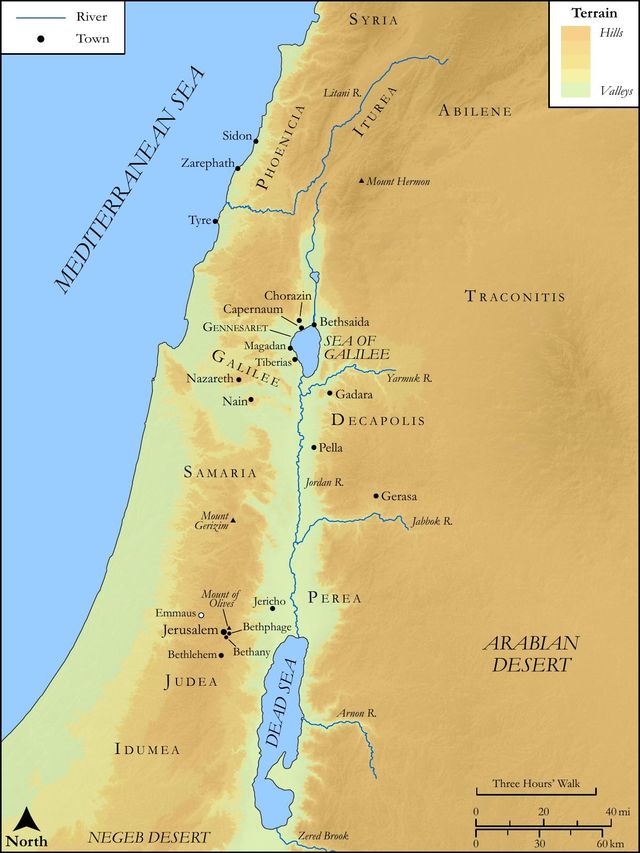
See on the biblical-era maps
Study this verse
Public-domain commentary
Matthew Henry
From his Commentary on the Whole Bible. Henry comments on passages, not single verses — this entry covers Luke 4:31–44. His four-level outline is real structure in the source text, so it is rendered as structure.
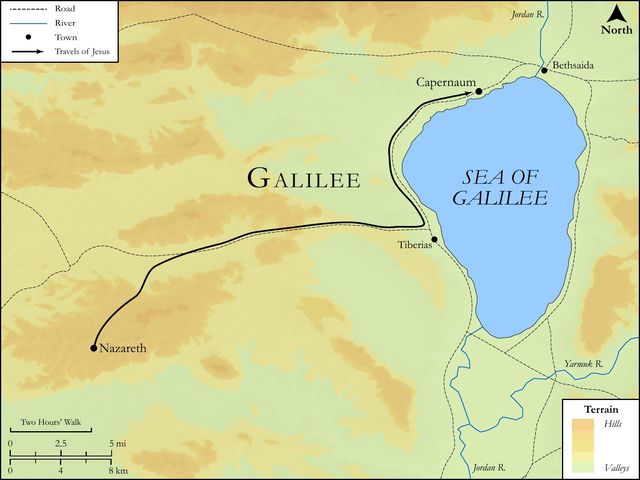
When Christ was expelled Nazareth, he came to Capernaum, another city of Galilee. The account we have in these verses of his preaching and miracles there we had before, Mar 1:21, etc. Observe,
I.His preaching:
He taught them on the sabbath days, Luk 4:31. In hearing the word preached, as an ordinance of God, we worship God, and it is a proper work for sabbath days. Christ's preaching much affected the people (Luk 4:32); they were astonished at his doctrine, there was weight in every word he said, and admirable discoveries were made to them by it. The doctrine itself was astonishing, and not only as it came from one that had not had a liberal education. His word was with power; there was a commanding force in it, and a working power went along with it to the conscience of men. The doctrine Paul preached hereby proved itself to be of God, that it came in demonstration of the Spirit and of power.
II.His miracles. Of these we have here,
1.Two particularly specified, showing Christ to be,
(1.)A controller and conqueror of Satan, in the world of mankind, and in the souls of people, by his power to cast him out of the bodies of those he had taken possession of; for for this purpose was he manifested, that he might destroy the works of the devil.
Observe, [1.] The devil is an unclean spirit, his nature directly contrary to that of the pure and holy God, and degenerated from what it was at first. [2.] This unclean spirit works in the children of men; in the souls of many, as then in men's bodies. [3.] It is possible that those who are very much under the power and working of Satan may yet be found in the synagogue, among the worshippers of God. [4.] Even the devils know and believe that Jesus Christ is the Holy One of God, is sent of God, and is a Holy One. [5.] They believe and tremble. This unclean spirit cried out with a loud voice, under a certain fearful looking for of judgment, and apprehensive that Christ was now come to destroy him. Unclean spirits are subject to continual frights. [6.] The devils have nothing to do with Jesus Christ, nor desire to have any thing to do with him; for he took not on him the nature of angels. [7.] Christ has the devil under check: He rebuked him, saying, Hold thy peace; and this word he spoke with power; phimōthēti - Be muzzled, Christ did not only enjoin him silence, but stopped his mouth, and forced him to be silent against his will. [8.] In the breaking of Satan's power, both the enemy that is conquered shows his malice, and Christ, the conqueror, shows his over-ruling grace. Here, First, The devil showed what he would have done, when he threw the man in the midst, with force and fury, as if he would have dashed him to pieces. But, Secondly, Christ showed what a power he had over him, in that he not only forced him to leave him, but to leave him without so much as hurting him, without giving him a parting blow, a parting gripe. Whom Satan cannot destroy, he will do all the hurt he can to; but this is a comfort, he can harm them no further than Christ permits; nay, he shall not do them any real harm. He came out, and hurt him not; that is, the poor man was perfectly well in an instant, though the devil left him with so much rage that all that were present thought he had torn him to pieces. [9.] Christ's power over devils was universally acknowledged and adored, Luk 4:36. No one doubted the truth of the miracle; it was evident beyond contradiction, nor was any thing suggested to diminish the glory of it, for they were all amazed, saying, What a word is this! They that pretended to cast out devils did it with abundance of charms and spells, to pacify the devil, and lull him asleep, as it were; but Christ commanded them with authority and power, which they could not gainsay or resist. Even the prince of the power of the air is his vassal, and trembles before him. [10.] This, as much as any thing, gained Christ a reputation, and spread his fame. This instance of his power, which many now-a-days make light of, was then, by them that were eye-witnesses of it (and those no fools either, but men of penetration), magnified, and was looked upon as greatly magnifying him (Luk 4:37); upon the account of this, the fame of him went out, more than ever, into every place of the country round about. Our Lord Jesus, when he set out at first in his public ministry, was greatly talked of, more than afterwards, when people's admiration wore off with the novelty of the thing.
(2.)Christ showed himself to be a healer of diseases. In the former, he struck at the root of man's misery, which was Satan's enmity, the origin of all the mischief: in this, he strikes at one of the most spreading branches of it, one of the most common calamities of human life, and that is bodily diseases, which came in with sin, are the most common and sensible corrections for it in this life, and contribute as much as any thing towards the making of our few days full of trouble. These our Lord Jesus came to take away the sting of, and, as an indication of that intention, when he was on earth, chose to confirm his doctrine by such miracles, mostly, as took away the diseases themselves. Of all bodily diseases none are more common or fatal to grown people than fevers; these come suddenly, and suddenly cut off the number of men's months in the midst; they are sometimes epidemical, and slay their thousands in a little time. Now here we have Christ's curing a fever with a word's speaking; the place was in Simon's house, his patient was Simon's wife's mother, Luk 4:38, Luk 4:39. Observe,
[1.]Christ is a guest that will pay well for his entertainment; those that bid him welcome into their hearts and houses shall be no losers by him; he comes with healing.
[2.]Even families that Christ visits may be visited with sickness. Houses that are blessed with his distinguishing favours are liable to the common calamities of this life. Simon's wife's mother was ill of a fever. Lord, behold, he whom thou lovest is sick.
[3.]Even good people may sometimes be exercised with the sharpest afflictions, more grievous than others: She was taken with a great fever, very acute, and high, and threatening; perhaps it seized her head, and made her delirious. The most gentle fevers may by degrees prove dangerous; but this was at first a great fever.
[4.]No age can exempt from diseases. It is probable that Peter's mother-in-law was in years, and yet in a fever.
[5.]When our relations are sick, we ought to apply ourselves to Christ, by faith and prayer, on their account: They besought him for her; and there is a particular promise that the prayer of faith shall benefit the sick.
[6.]Christ has a tender concern for his people when they are in sickness and distress: He stood over her, as one concerned for her, and compassionating her case.
[7.]Christ had, and still has, a sovereign power over bodily diseases: He rebuked the fever, and with a word's speaking commanded it away, and it left her. He saith to diseases, Go, and they go; Come, and they come; and can still rebuke fevers, even great fevers.
[8.]This proves Christ's cures to be miraculous, that they were done in an instant: Immediately she arose.
[9.]Where Christ gives a new life, in recovery from sickness, he designs and expects that it should be a new life indeed, spent more than ever in his service, to his glory. If distempers be rebuked, and we arise from a bed of sickness, we must set ourselves to minister to Jesus Christ.
[10.]Those that minister to Christ must be ready to minister to all that are his for his sake: She ministered to them, not only to him that had cured her, but to them that had besought him for her. We must study to be grateful to those that have prayed for us.
2.A general account given by wholesale of many other miracles of the same kind, which Christ did.
(1.)He cured many that were diseased, even all without exception that made their application to him, and it was when the sun was setting (Luk 4:40); in the evening of that sabbath day which he had spent in the synagogue. Note, It is good to do a full sabbath day's work, to abound in the work of the day, in some good work or other, even till sun-set; as those that call the sabbath, and the business of it, a delight. Observe, He cured all that were sick, poor as well as rich, and though they were sick of divers diseases; so that there was no room to suspect that he had only a specific for some one disease. He had a remedy for every malady. The sign he used in healing was laying his hands on the sick; not lifting up his hands for them, for he healed as having authority. He healed by his own power. And thus he would put honour upon that sign which was afterwards used in conferring the Holy Ghost.
(2.)He cast the devil out of many that were possessed, Luk 4:41. Confessions were extorted from the demoniacs. They said, Thou art Christ the Son of God, but they said it crying with rage and indignation; it was a confession upon the rack, and therefore was not admitted in evidence. Christ rebuked them, and did not suffer them to say that they knew him to be the Christ, that it might appear, beyond all contradiction, that he had obtained a conquest over them, and not made a compact with them.
3.Here is his removal from Capernaum, Luk 4:42, Luk 4:43.
(1.)He retired for awhile into a place of solitude. It was but a little while that he allowed himself for sleep; not only because a little served him, but because he was content with a little, and never indulged himself in ease; but, when it was day, he went into a desert place, not to live constantly like a hermit, but to be sometimes alone with God, as even those should be, and contrive to be, that are most engaged in public work, or else their work will go on but poorly, and they will find themselves never less alone than when thus alone.
(2.)He returned again to the places of concourse and to the work he had to do there. Though a desert place may be a convenient retreat, yet it is not a convenient residence, because we were not sent into this world to live to ourselves, no, not to the best part of ourselves only, but to glorify God and do good in our generation.
[1.]He was earnestly solicited to stay at Capernaum. The people were exceedingly fond of him; I doubt, more because he had healed their sick than because he had preached repentance to them. They sought him, enquired which way he went; and, though it was in a desert place, they came unto him. A desert is no desert if we be with Christ there. They detained him that he should not depart from them, so that if he would go it should not be for want of invitation. His old neighbours at Nazareth had driven him from them, but his new acquaintances at Capernaum were very importunate for his continuance with them. Note, It ought not to discourage the ministers of Christ that some reject them, for they will meet with others that will welcome them and their message.
[2.]He chose rather to diffuse the light of his gospel to many places than to fix it to one, that no one might pretend to be a mother-church to the rest. Though he was welcome at Capernaum, and had done abundance of good there, yet he is sent to preach the gospel to other cities also; and Capernaum must not insist upon his stay there. They that enjoy the benefit of the gospel must be willing that others also should share in that benefit, and not covet the monopoly of it; and those ministers who are not driven from one place may yet be drawn to another by a prospect of greater usefulness. Christ, though he preached not in vain in the synagogue at Capernaum, yet would not be tied to that, but preached in the synagogues of Galilee, Luk 4:44. Bonum est sui diffusivum - What is good is self-diffusive. It is well for us that our Lord Jesus has not tied himself to any one place or people, but, wherever two or three are gathered in his name, he will be in the midst of them: and even in Galilee of the Gentiles his special presence is in the Christian synagogues.
Historical interpretation
Eleven Centuries of Reception
4 surviving comments on this verse. Each one is dated, so this reads as a timeline rather than a list.
Select a marker to jump to its quote. Markers stagger vertically where authors wrote within a few decades of each other.
“He departed, and went into a desert place.” This was, indeed, the Creator’s customary region. It was proper that the Word should there appear in body, where before he had appeared in a cloud. To the gospel also was suitable that condition of place which had once been prophesied for the law. “Let the wilderness and the solitary place, therefore, be glad and rejoice”; so had Isaiah promised.
When he had bestowed sufficient favour upon the people by miracles, it was necessary for Him to depart. For miracles are always thought greater when the worker is gone, since they themselves are then the more heeded, and have in their turn a voice; as it is said, But when it was day, he departed, and went.
(Hom. 25. in Matt.) The Pharisees indeed, seeing how that the miracles themselves published His fame, were offended at His power. But the people hearing His words, assented and followed; as it is said, And the multitudes sought him, not indeed any of the chief priests, or scribes, but all those who had not been blackened with the dark stain of malice, and preserved their consciences unhurt.
(Hom. 48. in Matt.) Observe also, that He might, by abiding in the same place, have drawn all men over to Himself. He did not however do so, giving us an example to go about and seek those who are perishing, as the shepherd his lost sheep, and as the physician the sick. For by recovering one soul, we may be able to blot out a thousand sins. Hence also it follows, And he was preaching in the synagogues of Galilee. He frequently indeed went to the synagogues, to show them that He was no deceiver. For if He were constantly to dwell in the desolate places, they would spread abroad that He was concealing Himself.
But if the sun-setting mystically expresses the death of our Lord, the returning day denotes His resurrection, (the light of which being made manifest, He is sought for by the multitudes of believers, and being found in the desert of the Gentiles He is held back by them, lest He should depart;) especially as this took place on the first day of the week, on which day the Resurrection was celebrated.
(Victor Antiochenus.) He went also into the desert, as Mark says, and prayed; not that he needed prayer, but as an example to us of good works.
(ut sup.) Now when Mark says that the Apostles came to him, saying, All seek thee, but Luke, that the people came, there is no difference between them, for the people came to Him following in the footsteps of the Apostles. But the Lord rejoiced in being held back, yet bid them let Him go, that others also might partake of His teaching, as the time of His presence would not last long; as it follows, And he said unto them, I must preach the kingdom of God to other cities also, &c. Mark says, Unto this I came, showing the loftiness of His divine nature, and His voluntary emptying Himself of it. But Luke says, Unto this am I sent, showing His incarnation, and calling also the decree of the Father, a sending Him forth; and one simply says, To preach, the other added, the kingdom of God, which is Christ Himself.
Continue studying Luke 4:43 across the web’s major study libraries — every link below opens this exact verse, chapter, or book on the destination site.
Read & Compare
 BibleGatewayThis verse in more than 200 translations and 70 languages.
 Bible.comThe YouVersion reader — hundreds of translations, reading plans, and highlights.
 ESV.orgCrossway's official English Standard Version reader.
 NET BibleThe NET translation with 60,000+ translators' notes on every rendering decision.
 STEP BibleTyndale House's free study tool — original text, vocabulary, and scholarly resources.
 BibliaLogos Bible Software's free web reader.
 USCCBThe New American Bible (Revised Edition) with the U.S. bishops' study notes.
Commentaries
 BibleHub CommentariesDozens of classic commentaries on this verse, gathered on one page.
 StudyLightMore than 100 commentary sets — the largest collection on the web.
 BibleRefPlain-English commentary on what this verse means, verse by verse.
 Enduring WordDavid Guzik's free commentary on this chapter, widely used by Bible teachers.
 Bible Study ToolsVerse commentary alongside Greek and Hebrew study aids.
Original Language & Research
- BibleHub InterlinearThe verse word by word — original language, transliteration, and English.
- BibleHub LexiconEvery word's original-language definition and Strong's entry.
 Blue Letter BibleDeep-study tools — Strong's numbers, concordance, and word studies.
 CNTR CollationThe earliest Greek manuscripts of this verse, collated letter by letter.
Sermons, Hymns & Audio


TrulyRandomVerse is not affiliated with these sites and doesn’t control their content. They’re linked because they’re genuinely useful.
Summary
Luke 4:43 encapsulates Jesus' profound self-awareness of His divine mission, revealing His unwavering commitment to proclaiming the Kingdom of God beyond the confines of a single city. Despite the enthusiastic desire of the Capernaum crowds to retain Him, Jesus clearly articulates that His ministry is not bound by local popularity or human expectation, but is an expansive, divinely ordained commission to announce God's sovereign rule to all who would hear.
Context
ShowHideLiterary Context
This verse immediately follows a period of intense and highly successful ministry in Capernaum. In Luke 4:31-32, Jesus taught in the synagogue with unparalleled authority, astonishing the people. He then demonstrated this authority by casting out a demon from a man in the synagogue, followed by a series of miraculous healings, including Simon's mother-in-law and many others who were brought to Him at sunset (Luke 4:40-41). The cumulative effect of these powerful acts led the crowds to seek Him out early in the morning, attempting to detain Him and prevent His departure. Jesus' response in Luke 4:43 serves as a pivotal moment, shifting the narrative from local acclaim to the broader scope of His calling, explaining why He must move on.
Historical & Cultural Context
Jesus' ministry unfolded in Galilee, a region known for its diverse population and a mix of Jewish and Gentile influences. Capernaum, a bustling fishing village on the Sea of Galilee, served as a de facto base for much of His early Galilean ministry. The Jewish people of this era lived under Roman occupation, and there was a widespread expectation of a Messiah who would deliver them, often envisioned in political or military terms. Jesus, however, consistently redefined the Messiah's role and the nature of His kingdom, emphasizing a spiritual reign rather than an earthly one. His itinerant ministry, moving from town to town, was characteristic of many ancient teachers and prophets, but His message and authority set Him apart. The synagogue was the central place for teaching and worship, making His powerful teaching there particularly significant.
Key Themes
ShowHideLuke 4:43 powerfully contributes to several overarching themes in Luke's Gospel. Firstly, the Centrality of the Kingdom of God is paramount; Jesus' entire ministry is framed by His announcement and inauguration of God's active reign. This theme is introduced early in Luke 4:43 and continues throughout the Gospel, defining the purpose of His miracles, parables, and teachings. Secondly, the Divine Purpose and Commission of Jesus is emphasized. His declaration, "for therefore am I sent," underscores that His actions are not arbitrary but are part of a preordained, divine plan from the Father, a theme echoed in other Gospels, such as John 3:17. Thirdly, the Expansive Nature of the Gospel is highlighted by Jesus' commitment to "other cities also," foreshadowing the universal reach of the good news that would eventually extend to all nations, as commissioned in Acts 1:8. Finally, Jesus' decision to move on despite local popularity illustrates the theme of Prioritizing God's Will Over Human Acclaim, a consistent pattern in His life and ministry.
Exposition and Analysis
ShowHideKey Word Analysis
ShowHideThis word signifies a divine necessity or obligation. It indicates that Jesus' mission was not a matter of personal preference or human choice, but a binding imperative from God. It conveys a sense of divine compulsion and destiny, highlighting that His actions were in perfect alignment with the Father's will and eternal plan.
Derived from "good" (eu) and "message" (angelos), this verb literally means "to announce good news" or "to evangelize." It emphasizes that the core of Jesus' message was not a set of rules or a philosophy, but a declaration of joyful, salvific tidings—the arrival of God's redemptive reign. It points to the inherently positive and transformative nature of His proclamation.
This term means "to send out, especially on a mission or with authority." It underscores Jesus' role as the Father's authoritative messenger and representative. The word is closely related to "apostle" (apostolos), meaning "one who is sent." Jesus is the ultimate "sent one," embodying the Father's purpose and power in His mission to establish the Kingdom.
Verse Breakdown
ShowHide"And he said unto them,"
This introductory phrase sets the scene for Jesus' authoritative declaration. It signifies a direct communication from Jesus to the crowds who were attempting to detain Him, providing a clear explanation for His actions and intentions.
"I must preach the kingdom of God"
This is the core of Jesus' self-definition and mission statement. The "must" (deî) reveals divine compulsion, not human desire. "The kingdom of God" is the central theme of Jesus' ministry, referring to God's active, sovereign rule breaking into human history through Jesus' person and work, bringing salvation, healing, and restoration. It is the good news (euangelízō) that He is commissioned to proclaim.
"to other cities also:"
This phrase highlights the expansive and universal nature of Jesus' mission. His ministry was not to be confined to one locality, no matter how successful or popular, but was intended to extend widely. It foreshadows the global reach of the Gospel message.
"for therefore am I sent."
This concluding clause provides the ultimate divine rationale for His mission. It reiterates His identity as the Father's appointed messenger, emphasizing that His entire purpose and presence on earth are rooted in this divine commission. His being "sent" (apostéllō) implies authority, purpose, and a specific task to fulfill.
Literary Devices
ShowHideLuke 4:43 prominently features Direct Speech, as Jesus' words are quoted verbatim, lending immediate authority and clarity to His declaration of purpose. The verse also employs Emphasis through the use of "must" (deî), underscoring the divine necessity and non-negotiable nature of His mission. Furthermore, there is Thematic Repetition of the "kingdom of God" throughout Luke's Gospel, making this verse a foundational statement of Jesus' central message. The phrase "for therefore am I sent" serves as a powerful Statement of Purpose and Divine Mandate, framing Jesus' entire ministry as a fulfillment of God's will.
Theological and Thematic Connections
ShowHideLuke 4:43 stands as a foundational theological statement, articulating the very essence of Jesus' earthly ministry: the inauguration and proclamation of the Kingdom of God. This concept is not merely a future hope but a present reality breaking into the world through Jesus' person, teachings, and miracles. His declaration of being "sent" underscores His unique relationship with the Father and His divine authority, positioning Him as the ultimate messenger of God's redemptive plan. The expansive nature of His mission, extending "to other cities also," reveals God's universal love and desire for all people to hear and respond to the good news of His reign. This verse firmly establishes that Jesus' primary allegiance was to the Father's will, not to human expectations or localized success, setting a precedent for all who follow Him.
Reflection and Application
ShowHideLuke 4:43 offers profound insights for contemporary believers, challenging us to align our lives with God's ultimate purpose rather than being swayed by external pressures or personal comfort. Just as Jesus recognized His divine mandate to proclaim the Kingdom of God broadly, we too are called to discern and pursue God's unique mission for our lives, understanding that our purpose extends beyond our immediate circles. This verse reminds us that the message of God's active reign and redemptive work is not confined to one place or group but is meant to be shared expansively, compelling us to participate in the ongoing mission of sharing the Gospel to "other cities also," whether literally or figuratively, by expanding our reach and influence. Ultimately, Jesus' unwavering focus on the Father's will, even when it meant moving on from places of success, serves as a powerful model for prioritizing divine assignment above all else, fostering a spirit of obedience and selfless dedication in our walk of faith.
Questions for Reflection
ShowHideFAQ
ShowHideWhat is the "Kingdom of God" that Jesus preached?
ShowHideThe "Kingdom of God" (or "Kingdom of Heaven" in Matthew) is the central theme of Jesus' ministry, referring not primarily to a geographical territory or a future political realm, but to the active, sovereign rule and reign of God. Jesus announced that this reign was breaking into human history in a new and powerful way through His own person, teachings, and miraculous works. It encompasses God's redemptive plan for humanity, His spiritual presence, and the ultimate triumph of His will. It is both a present reality that believers can experience now and a future hope that will be fully realized at Christ's return. Jesus' parables, such as those found in Luke 8:4-15, often illustrate the nature and growth of this Kingdom.
Why did Jesus insist on leaving Capernaum when the people wanted Him to stay?
ShowHideJesus' decision to leave Capernaum, despite the crowds' desire to detain Him, demonstrates His unwavering commitment to His divine mission over local popularity or human comfort. As He states in Luke 4:43, He "must preach the kingdom of God to other cities also: for therefore am I sent." His mission was not to settle in one place and become a local celebrity, but to widely proclaim the good news of God's reign across Galilee and beyond. This act underscores His obedience to the Father's will and the expansive, universal nature of the Gospel message, which was not meant to be confined but to spread.
What does it mean that Jesus was "sent"?
ShowHideWhen Jesus says, "for therefore am I sent," He is declaring His divine commission and unique identity as the Father's authoritative messenger. The Greek word for "sent" (apostéllō) implies being dispatched with a specific purpose and authority. This highlights that Jesus' ministry was not self-initiated but was a direct mandate from God the Father. It emphasizes His role as the ultimate "apostle" (one who is sent), embodying God's will and power. This concept is central to understanding Jesus' person and work, as seen in passages like John 5:30 and John 8:42.
Christ-Centered Fulfillment
ShowHideLuke 4:43, with Jesus' declaration, "I must preach the kingdom of God to other cities also: for therefore am I sent," finds its profound Christ-centered fulfillment in the entirety of His redemptive work. This verse encapsulates Jesus' divine self-awareness as the inaugurator and embodiment of God's sovereign rule. He is not merely a messenger but the very King of this Kingdom, whose arrival marks the decisive breaking in of God's reign. The "good news" He preaches is ultimately Himself—His life, death, and resurrection. His being "sent" culminates in His ultimate mission to lay down His life as the Lamb of God who takes away the sin of the world, thereby establishing the Kingdom through His atoning sacrifice on the cross and His victorious resurrection. This act of being "sent" by the Father, obedient even to death, redeems humanity from the power of sin and death. Furthermore, His commitment to "other cities also" foreshadows the Great Commission, where He sends His disciples into all the world to continue proclaiming the Kingdom, empowered by His Spirit. Thus, Luke 4:43 is not just a statement of intent but a prophetic utterance fulfilled in Jesus' complete work of salvation, making Him the very center and substance of the Kingdom He came to preach.