


Luke 4:37
Bible text: King James Version (1769 Blayney text) · Public domain
Bible text: Berean Standard Bible · Public domain
Bible text: American Standard Version (1901) · Public domain
Bible text: World English Bible, Messianic edition · Public domain
Bible text: Geneva Bible (1599) · Public domain
Bible text: Young's Literal Translation · Public domain
- ΚαὶKaiAndG2532CONJConjunction
- ἐξεπορεύετοexeporeuetowas spreadingG1607V-INI-3SVerb Imperfect Middle Or Passive Deponent Indicative 3rd Singular
- ἦχοςēchos[the] reportG2279N-NSMNoun Nominative Singular Masculine
- περὶpericoncerningG4012PREPPreposition
- αὐτοῦautouHimG846P-GSMPersonal pronoun Genitive Singular Masculine
- εἰςeisintoG1519PREPPreposition
- πάνταpantaeveryG3956A-ASMAdjective Accusative Singular Masculine
- τόπονtoponplaceG5117N-ASMNoun Accusative Singular Masculine
- τῆςtēsof theG3588T-GSFDefinite article Genitive Singular Feminine
- περιχώρουperichōrousurrounding regionG4066N-GSFNoun Genitive Singular Feminine
English is a literal word-by-word gloss of the Greek, not the KJV's wording. Why?
This is the original text the KJV's translators worked from — each Greek word with its own literal English meaning in this verse, prepared by scholars at Tyndale House, Cambridge. The KJV translates whole sentences, not word by word, so its wording differs: one Greek word can become several English words, and the KJV may choose “charity” where the gloss reads “love”. Both are faithful — they answer different questions. For the KJV's own rendering, switch to the KJV text.
Details
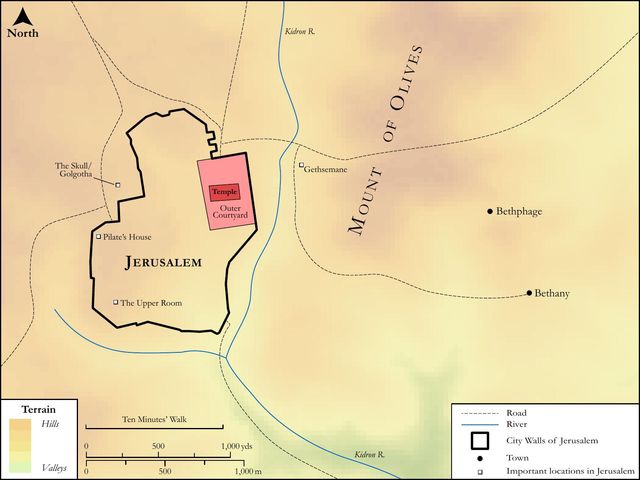
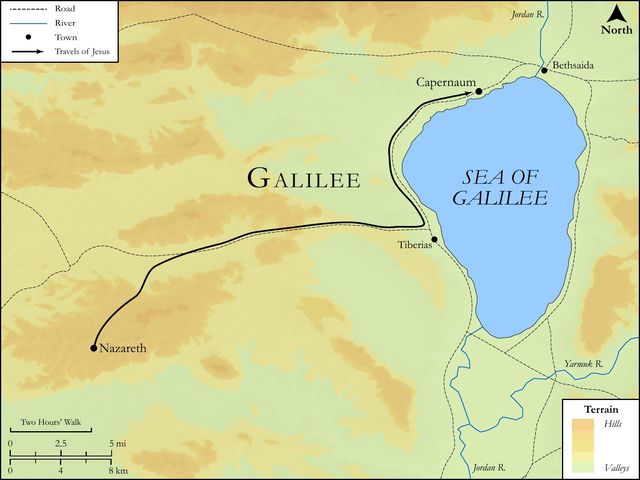
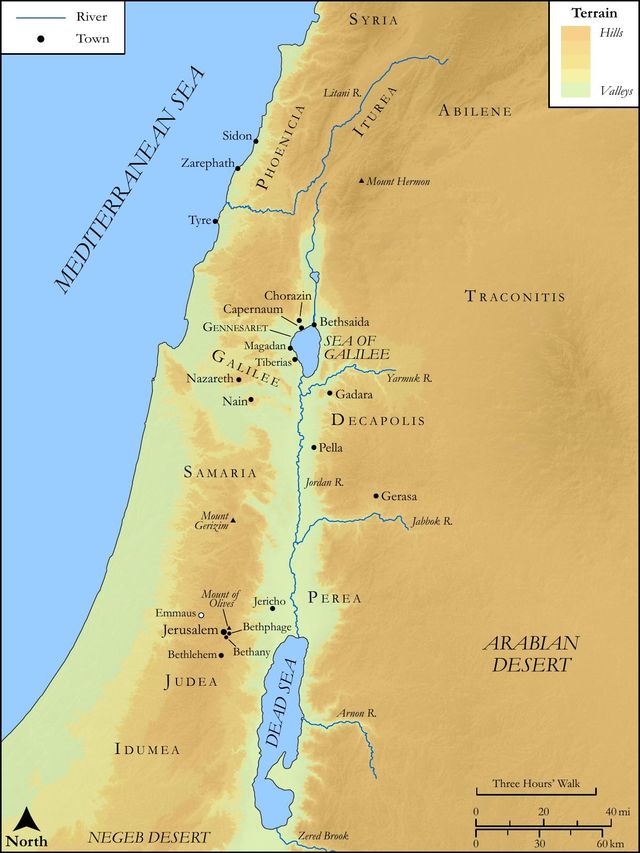
See on the biblical-era maps
Study this verse
Public-domain commentary
Matthew Henry
From his Commentary on the Whole Bible. Henry comments on passages, not single verses — this entry covers Luke 4:31–44. His four-level outline is real structure in the source text, so it is rendered as structure.
When Christ was expelled Nazareth, he came to Capernaum, another city of Galilee. The account we have in these verses of his preaching and miracles there we had before, Mar 1:21, etc. Observe,
I.His preaching:
He taught them on the sabbath days, Luk 4:31. In hearing the word preached, as an ordinance of God, we worship God, and it is a proper work for sabbath days. Christ's preaching much affected the people (Luk 4:32); they were astonished at his doctrine, there was weight in every word he said, and admirable discoveries were made to them by it. The doctrine itself was astonishing, and not only as it came from one that had not had a liberal education. His word was with power; there was a commanding force in it, and a working power went along with it to the conscience of men. The doctrine Paul preached hereby proved itself to be of God, that it came in demonstration of the Spirit and of power.
II.His miracles. Of these we have here,
1.Two particularly specified, showing Christ to be,
(1.)A controller and conqueror of Satan, in the world of mankind, and in the souls of people, by his power to cast him out of the bodies of those he had taken possession of; for for this purpose was he manifested, that he might destroy the works of the devil.
Observe, [1.] The devil is an unclean spirit, his nature directly contrary to that of the pure and holy God, and degenerated from what it was at first. [2.] This unclean spirit works in the children of men; in the souls of many, as then in men's bodies. [3.] It is possible that those who are very much under the power and working of Satan may yet be found in the synagogue, among the worshippers of God. [4.] Even the devils know and believe that Jesus Christ is the Holy One of God, is sent of God, and is a Holy One. [5.] They believe and tremble. This unclean spirit cried out with a loud voice, under a certain fearful looking for of judgment, and apprehensive that Christ was now come to destroy him. Unclean spirits are subject to continual frights. [6.] The devils have nothing to do with Jesus Christ, nor desire to have any thing to do with him; for he took not on him the nature of angels. [7.] Christ has the devil under check: He rebuked him, saying, Hold thy peace; and this word he spoke with power; phimōthēti - Be muzzled, Christ did not only enjoin him silence, but stopped his mouth, and forced him to be silent against his will. [8.] In the breaking of Satan's power, both the enemy that is conquered shows his malice, and Christ, the conqueror, shows his over-ruling grace. Here, First, The devil showed what he would have done, when he threw the man in the midst, with force and fury, as if he would have dashed him to pieces. But, Secondly, Christ showed what a power he had over him, in that he not only forced him to leave him, but to leave him without so much as hurting him, without giving him a parting blow, a parting gripe. Whom Satan cannot destroy, he will do all the hurt he can to; but this is a comfort, he can harm them no further than Christ permits; nay, he shall not do them any real harm. He came out, and hurt him not; that is, the poor man was perfectly well in an instant, though the devil left him with so much rage that all that were present thought he had torn him to pieces. [9.] Christ's power over devils was universally acknowledged and adored, Luk 4:36. No one doubted the truth of the miracle; it was evident beyond contradiction, nor was any thing suggested to diminish the glory of it, for they were all amazed, saying, What a word is this! They that pretended to cast out devils did it with abundance of charms and spells, to pacify the devil, and lull him asleep, as it were; but Christ commanded them with authority and power, which they could not gainsay or resist. Even the prince of the power of the air is his vassal, and trembles before him. [10.] This, as much as any thing, gained Christ a reputation, and spread his fame. This instance of his power, which many now-a-days make light of, was then, by them that were eye-witnesses of it (and those no fools either, but men of penetration), magnified, and was looked upon as greatly magnifying him (Luk 4:37); upon the account of this, the fame of him went out, more than ever, into every place of the country round about. Our Lord Jesus, when he set out at first in his public ministry, was greatly talked of, more than afterwards, when people's admiration wore off with the novelty of the thing.
(2.)Christ showed himself to be a healer of diseases. In the former, he struck at the root of man's misery, which was Satan's enmity, the origin of all the mischief: in this, he strikes at one of the most spreading branches of it, one of the most common calamities of human life, and that is bodily diseases, which came in with sin, are the most common and sensible corrections for it in this life, and contribute as much as any thing towards the making of our few days full of trouble. These our Lord Jesus came to take away the sting of, and, as an indication of that intention, when he was on earth, chose to confirm his doctrine by such miracles, mostly, as took away the diseases themselves. Of all bodily diseases none are more common or fatal to grown people than fevers; these come suddenly, and suddenly cut off the number of men's months in the midst; they are sometimes epidemical, and slay their thousands in a little time. Now here we have Christ's curing a fever with a word's speaking; the place was in Simon's house, his patient was Simon's wife's mother, Luk 4:38, Luk 4:39. Observe,
[1.]Christ is a guest that will pay well for his entertainment; those that bid him welcome into their hearts and houses shall be no losers by him; he comes with healing.
[2.]Even families that Christ visits may be visited with sickness. Houses that are blessed with his distinguishing favours are liable to the common calamities of this life. Simon's wife's mother was ill of a fever. Lord, behold, he whom thou lovest is sick.
[3.]Even good people may sometimes be exercised with the sharpest afflictions, more grievous than others: She was taken with a great fever, very acute, and high, and threatening; perhaps it seized her head, and made her delirious. The most gentle fevers may by degrees prove dangerous; but this was at first a great fever.
[4.]No age can exempt from diseases. It is probable that Peter's mother-in-law was in years, and yet in a fever.
[5.]When our relations are sick, we ought to apply ourselves to Christ, by faith and prayer, on their account: They besought him for her; and there is a particular promise that the prayer of faith shall benefit the sick.
[6.]Christ has a tender concern for his people when they are in sickness and distress: He stood over her, as one concerned for her, and compassionating her case.
[7.]Christ had, and still has, a sovereign power over bodily diseases: He rebuked the fever, and with a word's speaking commanded it away, and it left her. He saith to diseases, Go, and they go; Come, and they come; and can still rebuke fevers, even great fevers.
[8.]This proves Christ's cures to be miraculous, that they were done in an instant: Immediately she arose.
[9.]Where Christ gives a new life, in recovery from sickness, he designs and expects that it should be a new life indeed, spent more than ever in his service, to his glory. If distempers be rebuked, and we arise from a bed of sickness, we must set ourselves to minister to Jesus Christ.
[10.]Those that minister to Christ must be ready to minister to all that are his for his sake: She ministered to them, not only to him that had cured her, but to them that had besought him for her. We must study to be grateful to those that have prayed for us.
2.A general account given by wholesale of many other miracles of the same kind, which Christ did.
(1.)He cured many that were diseased, even all without exception that made their application to him, and it was when the sun was setting (Luk 4:40); in the evening of that sabbath day which he had spent in the synagogue. Note, It is good to do a full sabbath day's work, to abound in the work of the day, in some good work or other, even till sun-set; as those that call the sabbath, and the business of it, a delight. Observe, He cured all that were sick, poor as well as rich, and though they were sick of divers diseases; so that there was no room to suspect that he had only a specific for some one disease. He had a remedy for every malady. The sign he used in healing was laying his hands on the sick; not lifting up his hands for them, for he healed as having authority. He healed by his own power. And thus he would put honour upon that sign which was afterwards used in conferring the Holy Ghost.
(2.)He cast the devil out of many that were possessed, Luk 4:41. Confessions were extorted from the demoniacs. They said, Thou art Christ the Son of God, but they said it crying with rage and indignation; it was a confession upon the rack, and therefore was not admitted in evidence. Christ rebuked them, and did not suffer them to say that they knew him to be the Christ, that it might appear, beyond all contradiction, that he had obtained a conquest over them, and not made a compact with them.
3.Here is his removal from Capernaum, Luk 4:42, Luk 4:43.
(1.)He retired for awhile into a place of solitude. It was but a little while that he allowed himself for sleep; not only because a little served him, but because he was content with a little, and never indulged himself in ease; but, when it was day, he went into a desert place, not to live constantly like a hermit, but to be sometimes alone with God, as even those should be, and contrive to be, that are most engaged in public work, or else their work will go on but poorly, and they will find themselves never less alone than when thus alone.
(2.)He returned again to the places of concourse and to the work he had to do there. Though a desert place may be a convenient retreat, yet it is not a convenient residence, because we were not sent into this world to live to ourselves, no, not to the best part of ourselves only, but to glorify God and do good in our generation.
[1.]He was earnestly solicited to stay at Capernaum. The people were exceedingly fond of him; I doubt, more because he had healed their sick than because he had preached repentance to them. They sought him, enquired which way he went; and, though it was in a desert place, they came unto him. A desert is no desert if we be with Christ there. They detained him that he should not depart from them, so that if he would go it should not be for want of invitation. His old neighbours at Nazareth had driven him from them, but his new acquaintances at Capernaum were very importunate for his continuance with them. Note, It ought not to discourage the ministers of Christ that some reject them, for they will meet with others that will welcome them and their message.
[2.]He chose rather to diffuse the light of his gospel to many places than to fix it to one, that no one might pretend to be a mother-church to the rest. Though he was welcome at Capernaum, and had done abundance of good there, yet he is sent to preach the gospel to other cities also; and Capernaum must not insist upon his stay there. They that enjoy the benefit of the gospel must be willing that others also should share in that benefit, and not covet the monopoly of it; and those ministers who are not driven from one place may yet be drawn to another by a prospect of greater usefulness. Christ, though he preached not in vain in the synagogue at Capernaum, yet would not be tied to that, but preached in the synagogues of Galilee, Luk 4:44. Bonum est sui diffusivum - What is good is self-diffusive. It is well for us that our Lord Jesus has not tied himself to any one place or people, but, wherever two or three are gathered in his name, he will be in the midst of them: and even in Galilee of the Gentiles his special presence is in the Christian synagogues.
Historical interpretation
Seven Centuries of Reception
10 surviving comments on this verse. Each one is dated, so this reads as a timeline rather than a list.
Select a marker to jump to its quote. Markers stagger vertically where authors wrote within a few decades of each other.
What irreverent men do not believe, the spirits see—that he is God. So they flee and fall down at his feet, saying just what they uttered when he was in the body.
(ad Epise. Æg. et Lib.) He spoke of Him not as a Holy One of God, as if He were like to the other saints, but as being in a remarkable manner the Holy One, with the addition of the article. For He is by nature holy by partaking of whom all others are called holy. Nor again did He speak this as if He knew it, but He pretended to know it.
(ut sup.) Although he confessed the truth he controlled his tongue, lest with the truth he should also publish his own disgrace, which should teach us not to care for such, although they speak the truth, for we who know the divine Scripture, must not be taught by the devil, as it follows: And Jesus rebuked him, saying, Be silent, &c.
Even when the demons spoke the truth, for they spoke the truth when they said, “Thou are the Son of God,” the Lord himself silenced them and forbade them to speak. He did this to keep them from sowing their own wickedness in the midst of the truth. He also wished us to get used to never listening to them even though they seem to speak the truth. LIFE OF ST.
He describes the works of divine healing begun on the sabbath day, to show from the outset that the new creation began where the old creation ceased. He showed us that the Son of God is not under the law but above the law, and that the law will not be destroyed but fulfilled. For the world was not made through the law but by the Word, as we read: “By the Word of the Lord were the heavens established.” Thus the law is not destroyed but fulfilled, so that the renewal of humankind, already in error, may occur. The apostle too says, “Stripping yourselves of the old man, put on the new, who was created according to Christ.” He fittingly began on the sabbath, that he may show himself as Creator. He completed the work that he had already begun by weaving together works with works.
St. Luke did well to first set before us the man freed from a spirit of wickedness, then substituted the healing of a woman. The Lord had come to heal both sexes, and man must first be cured because he was created first. But woman, who had sinned by an uncertain mind rather than depravity, must not be overlooked.
Neither indignation at their treatment, nor displeasure at their wickedness, caused our Lord to abandon Judæa, but unmindful of His injuries, and remembering mercy, at one time by teaching, at another by healing, He softens the hearts of this unbelieving people, as it is said, And he went down to Capernaum.
The work of divine healing commenced on the sabbath, signifying thereby that he began anew where the old creation ceased, in order that He might declare at the very beginning that the Son of God was not under the Law, but above the Law. Rightly also He began on the sabbath, that He might show Himself the Creator, who interweaves His works one within another, and follows up that which He had before begun; just as a builder determining to reconstruct a house, begins to pull down the old one, not from the foundation, but from the top, so as to apply his hand first to that part, where he had before left off. Holy men may through the word of God deliver from evil spirits, but to bid the dead rise again, is the work of Divine power alone.
It ought not to shock any one that the devil is mentioned in this book as the first to have spoken the name of Jesus of Nazareth. For Christ received not from him that name which an Angel brought down from heaven to the Virgin. The devil is of such effrontery, that he is the first to use a thing among men and bring it as something new to them, that he may strike people with terror at his power. Hence it follows: For I know thee who thou art, the Holy One of God.
In a mystery, the man in the synagogue with the unclean spirit is the Jewish people, which being fast bound in the wiles of the devil, defiled its vaunted cleanliness of body by the pollution of the heart. And truly it had an unclean spirit, because it had lost the Holy Spirit. For the devil entered whence Christ had gone out.
The devil wished also to disturb the order of things, and to deprive the Apostles of their dignity, and to incline the many to obey Him.
“Now Simon’s mother-in-law was kept in her bed sick with a fever.” May Christ come to our house and enter in and by his command cure the fever of our sins. Each one of us is sick with a fever. When-ever I give way to anger, I have a fever. There are as many fevers as there are faults and vices. Let us beg the apostles to intercede for us with Jesus, that he may come to us and touch our hand. If he does so, at once our fever is gone. He is an excellent physician and truly the chief Physician. Moses is a physician. Isaiah is a physician. All the saints are physicians, but he is the chief Physician.
The word of the teacher is with power, when he performs that which he teaches. But he who by his actions belies what he preaches is despised.
As if he said, Abstain a while from troubling me, thou who hast no fellowship with our designs.
But by the permission of God, the man who was to be delivered from the devil is thrown into the midst, that the power of the Saviour being manifested might bring over many to the way of salvation. As it follows: And when he had thrown him in the midst. But this seems to be opposed to Mark, who says, And the unclean spirit tearing him, and crying with a loud voice, went out of him, unless we understand that Mark meant by tearing him the same as Luke by these words, And when he had thrown him in the midst, so that what follows, and hurt him not, might be understood to mean, that that twisting of limbs, and sore troubling, did not weaken him, as is often the case when devils depart from a man, leaving him with limbs cut and torn off. Well then do they wonder at such complete restoration of health. For it follows: And fear came upon all.
Holy men were able by the word of God to cast out devils, but the Word Himself does mighty works by His own power.
As if they said, What is this word by which he commands, Go out, and he went out?
We must know also that many now have devils, namely, such as fulfil the desires of devils, as the furious have the dæmon of anger; and so of the rest. But the Lord came into the synagogue when the thoughts of the man were collected, and then says to the dæmon that dwelt there, Hold thy peace, and immediately throwing him into the middle he departs out of him. For it becomes not a man always to be angry, (that is, like the brutes,) nor always to be without anger, (for that is want of feeling,) but he must take the middle path, and have anger against what is evil; and so the man is thrown into the midst when the unclean spirit departs from him.
Continue studying Luke 4:37 across the web’s major study libraries — every link below opens this exact verse, chapter, or book on the destination site.
Read & Compare
 BibleGatewayThis verse in more than 200 translations and 70 languages.
 Bible.comThe YouVersion reader — hundreds of translations, reading plans, and highlights.
 ESV.orgCrossway's official English Standard Version reader.
 NET BibleThe NET translation with 60,000+ translators' notes on every rendering decision.
 STEP BibleTyndale House's free study tool — original text, vocabulary, and scholarly resources.
 BibliaLogos Bible Software's free web reader.
 USCCBThe New American Bible (Revised Edition) with the U.S. bishops' study notes.
Commentaries
 BibleHub CommentariesDozens of classic commentaries on this verse, gathered on one page.
 StudyLightMore than 100 commentary sets — the largest collection on the web.
 BibleRefPlain-English commentary on what this verse means, verse by verse.
 Enduring WordDavid Guzik's free commentary on this chapter, widely used by Bible teachers.
 Bible Study ToolsVerse commentary alongside Greek and Hebrew study aids.
Original Language & Research
- BibleHub InterlinearThe verse word by word — original language, transliteration, and English.
- BibleHub LexiconEvery word's original-language definition and Strong's entry.
 Blue Letter BibleDeep-study tools — Strong's numbers, concordance, and word studies.
 CNTR CollationThe earliest Greek manuscripts of this verse, collated letter by letter.
Sermons, Hymns & Audio


TrulyRandomVerse is not affiliated with these sites and doesn’t control their content. They’re linked because they’re genuinely useful.
Summary
Luke 4:37 serves as a pivotal summary statement, encapsulating the immediate and profound impact of Jesus' early ministry, particularly following His authoritative teaching and miraculous exorcism in the synagogue of Capernaum. This verse vividly portrays how the news of His unprecedented power and divine authority resonated like an echoing sound, spreading rapidly and organically throughout the entire Galilean region, establishing His burgeoning reputation and drawing widespread attention to His presence and works.
Context
ShowHideLiterary Context
This verse immediately follows a series of astonishing events in Capernaum. In Luke 4:31-32, Jesus teaches in the synagogue with an authority that profoundly impresses His audience, contrasting sharply with the conventional teaching of the scribes. This authoritative teaching is then powerfully demonstrated when He encounters a man possessed by an unclean spirit. With a simple, direct command, Jesus casts out the demon, silencing it and liberating the man. The people's astonished reaction, as recorded in Luke 4:36, underscores the unique nature of His power over evil forces. Verse 37, therefore, functions as a narrative bridge, illustrating the direct and inevitable consequence of these miraculous displays: a widespread dissemination of His fame, setting the stage for the broader Galilean ministry that follows.
Historical & Cultural Context
First-century Galilee was a bustling, diverse region, a crossroads of Jewish and Gentile cultures, though Capernaum itself was predominantly Jewish. Synagogues were not merely places of worship but central hubs for community life, teaching, and legal matters. News in this era traveled primarily by word of mouth, through travelers, merchants, and local gossip. The rapid spread of Jesus' "fame" (Greek: ēchos) highlights the extraordinary nature of His deeds; such events would have been the subject of intense discussion and immediate relay across villages and towns. The concept of a prophet or miracle-worker gaining a following was not entirely new, but the authority and power Jesus demonstrated, particularly over demons, would have been perceived as uniquely significant within the Jewish understanding of divine intervention and messianic expectation.
Key Themes
ShowHideLuke 4:37 contributes significantly to several overarching themes in Luke's Gospel. Firstly, it emphasizes Jesus' Divine Authority, showcasing that His power is not merely human but originates from God, extending over spiritual realms and human infirmity. This authority is a recurring motif, from His teaching to His healing ministry, as seen in passages like Luke 5:24. Secondly, the verse highlights the Rapid Proclamation of the Gospel, albeit in its nascent form. The spontaneous spread of Jesus' reputation demonstrates how God's work, when powerfully displayed, naturally generates its own momentum, drawing people to witness and hear more. This foreshadows the later, intentional spread of the gospel by His disciples as commanded in Acts 1:8. Finally, it underscores Jesus' Public Recognition and the beginning of His widespread appeal. This early fame sets the stage for the large crowds that would follow Him throughout His ministry, as depicted in Luke 6:17-19.
Exposition and Analysis
ShowHideKey Word Analysis
ShowHideThis word literally means "a loud or confused noise," "roar," or "sound," and figuratively, "a rumor." Its use here suggests that the news of Jesus' deeds was not merely a quiet report but a resounding, echoing sound that reverberated throughout the region, creating a palpable buzz and drawing widespread attention. It implies an almost audible impact of His ministry.
This verb means "to depart, be discharged, proceed, project." It conveys the idea of something actively issuing forth or spreading from a source. In this context, it vividly describes the dynamic and expansive movement of Jesus' reputation, not passively received but actively emanating from Capernaum into the surrounding areas.
This term denotes "around the region" or "circumjacent," often implying the vicinity or surrounding territory. It emphasizes the geographical scope of Jesus' burgeoning renown, indicating that His impact was not confined to a single town but radiated outwards, encompassing the entire surrounding countryside of Galilee.
Verse Breakdown
ShowHide"And the fame of him"
This phrase introduces the central subject of the verse: Jesus' reputation. The word "fame" (Greek: ēchos) carries the connotation of a powerful, echoing sound, suggesting that the news of Jesus' actions resonated loudly and widely, not just as a quiet report but as a significant, attention-grabbing phenomenon. It implies that His identity and deeds were becoming a prominent topic of discussion.
"went out"
This verb (Greek: ekporeúomai) signifies an active, dynamic spread. It's not that people merely heard about Him, but that His reputation actively emanated, proceeded, and diffused from Capernaum. This conveys the organic and unstoppable nature of the news, propelled by the astonishment and excitement of those who witnessed His authority.
"into every place"
This highlights the comprehensive reach of His fame. The Greek word for "every" (Greek: pâs) emphasizes totality, indicating that no locality within the designated region was untouched by the news. It underscores the widespread nature of His recognition, suggesting that His name was becoming known in every village and settlement.
"of the country round about"
This specifies the geographical extent of the spread. The "country round about" (Greek: períchōros) refers to the entire circumjacent region, particularly Galilee. This phrase confirms that Jesus' influence was not limited to Capernaum but was radiating throughout the broader Galilean countryside, establishing Him as a figure of regional, not merely local, significance.
Literary Devices
ShowHideLuke 4:37 effectively employs several literary devices to convey the magnitude of Jesus' impact. The use of Hyperbole is evident in the phrase "every place of the country round about," which, while indicating a vast spread, might not imply literal, exhaustive coverage of every single nook and cranny, but rather emphasizes the overwhelming and pervasive nature of His fame. The word "fame" itself, derived from ēchos (sound/echo), functions as Metonymy, where the effect (the resounding report) stands in for the cause (Jesus' powerful deeds). This also creates vivid Imagery of an echoing sound, suggesting a reverberation that fills the air and permeates the region, making the news of Jesus inescapable. The verse's concise nature, following detailed accounts of miracles, acts as a Summary Statement, efficiently consolidating the immediate public reaction and setting the stage for subsequent narratives of His ministry's expansion.
Theological and Thematic Connections
ShowHideLuke 4:37 powerfully illustrates the inherent dynamism of divine truth and power. When God acts decisively through His chosen instruments, the impact is not confined but naturally propagates, drawing attention to His presence and purposes. This "fame" is not for Jesus' self-aggrandizement but serves as a divine advertisement, preparing hearts and minds for the full revelation of the Kingdom of God. It underscores the principle that authentic encounters with God's authority inevitably lead to widespread testimony and recognition, demonstrating the irresistible nature of God's redemptive work in the world. This early spread of His renown foreshadows the universal reach of the gospel message.
Reflection and Application
ShowHideLuke 4:37 reminds us that genuine encounters with the living God have an inherent, expansive quality. When God's power and truth are manifest in our lives, our communities, or our churches, the "fame" – the testimony, the impact, the observable transformation – naturally begins to "go out." This isn't about seeking personal recognition, but about allowing the light of Christ to shine so brightly through us that it draws others to Him. Our transformed lives, our acts of compassion, our bold proclamation of the gospel, and the authentic love within our Christian communities become the "echo" that reverberates through our spheres of influence. Just as Jesus' early ministry in Capernaum could not be contained, so too should the work of the Holy Spirit within us be a compelling force that attracts and invites others to experience the life-changing power of God. We are called to be conduits of this divine fame, living in such a way that the world cannot help but notice the difference Christ makes.
Questions for Reflection
ShowHideFAQ
ShowHideWhat was the primary cause of Jesus' widespread fame at this point in His ministry?
ShowHideThe primary cause of Jesus' widespread fame, as described in Luke 4:37, was His unprecedented authority demonstrated through both His teaching and His miraculous deeds. Specifically, the immediate context highlights His powerful teaching in the synagogue of Capernaum, which astonished the people because it was unlike that of the scribes (Luke 4:31-32), followed by His authoritative exorcism of an unclean spirit with a simple command (Luke 4:33-36). These astonishing displays of divine power and unique authority over spiritual forces were the direct catalysts for His rapidly spreading reputation throughout the region.
Christ-Centered Fulfillment
ShowHideLuke 4:37, depicting the rapid spread of Jesus' fame, foreshadows the ultimate and universal reach of the gospel that would emanate from His completed work. The "fame" that "went out into every place of the country round about" was merely a precursor to the global proclamation of His name and saving power. This early recognition of Jesus' authority over demons and disease pointed to His true identity as the Messiah, the Son of God, who came to destroy the works of the devil (1 John 3:8). His earthly renown, born of miracles, laid the groundwork for the spiritual fame that would follow His death, resurrection, and ascension, when His name would be exalted above every name (Philippians 2:9-11). The local "echo" of His power in Galilee ultimately expanded into the worldwide "sound" of the gospel, inviting all nations to believe in the Lamb of God who takes away the sin of the world (John 1:29). Thus, this verse subtly points to the expansive nature of God's redemptive plan, culminating in Christ's universal Lordship and the global impact of His saving grace.