


Luke 4:41
- ἐξήρχετοexērchetoWere going outG1831V-INI-3SVerb Imperfect Middle Or Passive Deponent Indicative 3rd Singular
- δὲdenowG1161CONJConjunction
- καὶkaialsoG2532CONJConjunction
- δαιμόνιαdaimoniademonsG1140N-NPNNoun Nominative Plural Neuter
- ἀπὸapofromG575PREPPreposition
- πολλῶνpollōnmanyG4183A-GPMAdjective Genitive Plural Masculine
- κραυγάζονταkraugazontashouting outG2905V-PAP-NPNVerb Present Active Participle Nominative Plural Neuter
- καὶkaiandG2532CONJConjunction
- λέγονταlegontasayingG3004V-PAP-NPNVerb Present Active Participle Nominative Plural Neuter
- ὅτιhotithatG3754CONJConjunction
- σὺsuYou yourselfG4771P-2NSPersonal pronoun Nominative 2nd Singular
- εἶeiareG1510V-PAI-2SVerb Present Active Indicative 2nd Singular
- ὁho<the>G3588T-NSMDefinite article Nominative Singular Masculine
- χριστὸςchristosChristG5547N-NSM-TNoun Nominative Singular Masculine Title
- ὁhotheG3588T-NSMDefinite article Nominative Singular Masculine
- υἱὸςhuiosSonG5207N-NSMNoun Nominative Singular Masculine
- τοῦtou<the>G3588T-GSMDefinite article Genitive Singular Masculine
- θεοῦtheouof GodG2316N-GSM-TNoun Genitive Singular Masculine Title
- καὶkaiAndG2532CONJConjunction
- ἐπιτιμῶνepitimōnrebuking [them]G2008V-PAP-NSMVerb Present Active Participle Nominative Singular Masculine
- οὐκouknotG3756PRT-NNegative Particle Negative
- εἴαeiawas He allowingG1439V-IAI-3SVerb Imperfect Active Indicative 3rd Singular
- αὐτὰautathemG846P-APNPersonal pronoun Accusative Plural Neuter
- λαλεῖνlaleinto speakG2980V-PANVerb Present Active Infinitive
- ὅτιhotibecauseG3754CONJConjunction
- ᾔδεισανēdeisanthey knewG1492V-2LAI-3PVerb Pluperfect Active Indicative 3rd Plural
- τὸνtontheG3588T-ASMDefinite article Accusative Singular Masculine
- χριστὸνchristonChristG5547N-ASM-TNoun Accusative Singular Masculine Title
- αὐτὸνautonHimG846P-ASMPersonal pronoun Accusative Singular Masculine
- εἶναιeinaito beG1511V-PANVerb Present Active Infinitive
English is a literal word-by-word gloss of the Greek, not the KJV's wording. Why?
This is the original text the KJV's translators worked from — each Greek word with its own literal English meaning in this verse, prepared by scholars at Tyndale House, Cambridge. The KJV translates whole sentences, not word by word, so its wording differs: one Greek word can become several English words, and the KJV may choose “charity” where the gloss reads “love”. Both are faithful — they answer different questions. For the KJV's own rendering, switch to the KJV text.
Details
See on the biblical-era map

Study this verse
Public-domain commentary
Matthew Henry
From his Commentary on the Whole Bible. Henry comments on passages, not single verses — this entry covers Luke 4:31–44. His four-level outline is real structure in the source text, so it is rendered as structure.
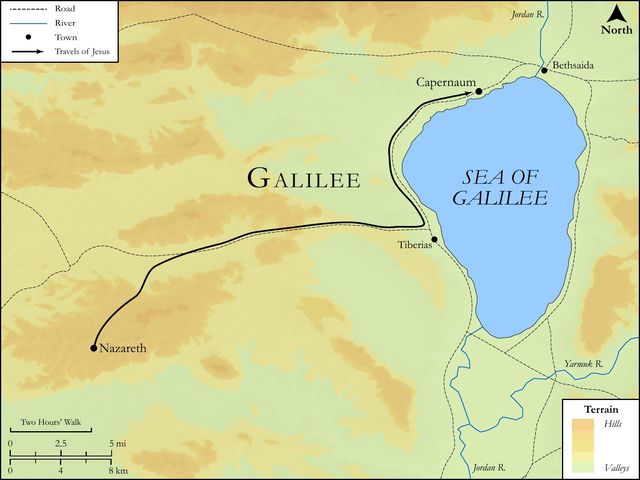
When Christ was expelled Nazareth, he came to Capernaum, another city of Galilee. The account we have in these verses of his preaching and miracles there we had before, Mar 1:21, etc. Observe,
I.His preaching:
He taught them on the sabbath days, Luk 4:31. In hearing the word preached, as an ordinance of God, we worship God, and it is a proper work for sabbath days. Christ's preaching much affected the people (Luk 4:32); they were astonished at his doctrine, there was weight in every word he said, and admirable discoveries were made to them by it. The doctrine itself was astonishing, and not only as it came from one that had not had a liberal education. His word was with power; there was a commanding force in it, and a working power went along with it to the conscience of men. The doctrine Paul preached hereby proved itself to be of God, that it came in demonstration of the Spirit and of power.
II.His miracles. Of these we have here,
1.Two particularly specified, showing Christ to be,
(1.)A controller and conqueror of Satan, in the world of mankind, and in the souls of people, by his power to cast him out of the bodies of those he had taken possession of; for for this purpose was he manifested, that he might destroy the works of the devil.
Observe, [1.] The devil is an unclean spirit, his nature directly contrary to that of the pure and holy God, and degenerated from what it was at first. [2.] This unclean spirit works in the children of men; in the souls of many, as then in men's bodies. [3.] It is possible that those who are very much under the power and working of Satan may yet be found in the synagogue, among the worshippers of God. [4.] Even the devils know and believe that Jesus Christ is the Holy One of God, is sent of God, and is a Holy One. [5.] They believe and tremble. This unclean spirit cried out with a loud voice, under a certain fearful looking for of judgment, and apprehensive that Christ was now come to destroy him. Unclean spirits are subject to continual frights. [6.] The devils have nothing to do with Jesus Christ, nor desire to have any thing to do with him; for he took not on him the nature of angels. [7.] Christ has the devil under check: He rebuked him, saying, Hold thy peace; and this word he spoke with power; phimōthēti - Be muzzled, Christ did not only enjoin him silence, but stopped his mouth, and forced him to be silent against his will. [8.] In the breaking of Satan's power, both the enemy that is conquered shows his malice, and Christ, the conqueror, shows his over-ruling grace. Here, First, The devil showed what he would have done, when he threw the man in the midst, with force and fury, as if he would have dashed him to pieces. But, Secondly, Christ showed what a power he had over him, in that he not only forced him to leave him, but to leave him without so much as hurting him, without giving him a parting blow, a parting gripe. Whom Satan cannot destroy, he will do all the hurt he can to; but this is a comfort, he can harm them no further than Christ permits; nay, he shall not do them any real harm. He came out, and hurt him not; that is, the poor man was perfectly well in an instant, though the devil left him with so much rage that all that were present thought he had torn him to pieces. [9.] Christ's power over devils was universally acknowledged and adored, Luk 4:36. No one doubted the truth of the miracle; it was evident beyond contradiction, nor was any thing suggested to diminish the glory of it, for they were all amazed, saying, What a word is this! They that pretended to cast out devils did it with abundance of charms and spells, to pacify the devil, and lull him asleep, as it were; but Christ commanded them with authority and power, which they could not gainsay or resist. Even the prince of the power of the air is his vassal, and trembles before him. [10.] This, as much as any thing, gained Christ a reputation, and spread his fame. This instance of his power, which many now-a-days make light of, was then, by them that were eye-witnesses of it (and those no fools either, but men of penetration), magnified, and was looked upon as greatly magnifying him (Luk 4:37); upon the account of this, the fame of him went out, more than ever, into every place of the country round about. Our Lord Jesus, when he set out at first in his public ministry, was greatly talked of, more than afterwards, when people's admiration wore off with the novelty of the thing.
(2.)Christ showed himself to be a healer of diseases. In the former, he struck at the root of man's misery, which was Satan's enmity, the origin of all the mischief: in this, he strikes at one of the most spreading branches of it, one of the most common calamities of human life, and that is bodily diseases, which came in with sin, are the most common and sensible corrections for it in this life, and contribute as much as any thing towards the making of our few days full of trouble. These our Lord Jesus came to take away the sting of, and, as an indication of that intention, when he was on earth, chose to confirm his doctrine by such miracles, mostly, as took away the diseases themselves. Of all bodily diseases none are more common or fatal to grown people than fevers; these come suddenly, and suddenly cut off the number of men's months in the midst; they are sometimes epidemical, and slay their thousands in a little time. Now here we have Christ's curing a fever with a word's speaking; the place was in Simon's house, his patient was Simon's wife's mother, Luk 4:38, Luk 4:39. Observe,
[1.]Christ is a guest that will pay well for his entertainment; those that bid him welcome into their hearts and houses shall be no losers by him; he comes with healing.
[2.]Even families that Christ visits may be visited with sickness. Houses that are blessed with his distinguishing favours are liable to the common calamities of this life. Simon's wife's mother was ill of a fever. Lord, behold, he whom thou lovest is sick.
[3.]Even good people may sometimes be exercised with the sharpest afflictions, more grievous than others: She was taken with a great fever, very acute, and high, and threatening; perhaps it seized her head, and made her delirious. The most gentle fevers may by degrees prove dangerous; but this was at first a great fever.
[4.]No age can exempt from diseases. It is probable that Peter's mother-in-law was in years, and yet in a fever.
[5.]When our relations are sick, we ought to apply ourselves to Christ, by faith and prayer, on their account: They besought him for her; and there is a particular promise that the prayer of faith shall benefit the sick.
[6.]Christ has a tender concern for his people when they are in sickness and distress: He stood over her, as one concerned for her, and compassionating her case.
[7.]Christ had, and still has, a sovereign power over bodily diseases: He rebuked the fever, and with a word's speaking commanded it away, and it left her. He saith to diseases, Go, and they go; Come, and they come; and can still rebuke fevers, even great fevers.
[8.]This proves Christ's cures to be miraculous, that they were done in an instant: Immediately she arose.
[9.]Where Christ gives a new life, in recovery from sickness, he designs and expects that it should be a new life indeed, spent more than ever in his service, to his glory. If distempers be rebuked, and we arise from a bed of sickness, we must set ourselves to minister to Jesus Christ.
[10.]Those that minister to Christ must be ready to minister to all that are his for his sake: She ministered to them, not only to him that had cured her, but to them that had besought him for her. We must study to be grateful to those that have prayed for us.
2.A general account given by wholesale of many other miracles of the same kind, which Christ did.
(1.)He cured many that were diseased, even all without exception that made their application to him, and it was when the sun was setting (Luk 4:40); in the evening of that sabbath day which he had spent in the synagogue. Note, It is good to do a full sabbath day's work, to abound in the work of the day, in some good work or other, even till sun-set; as those that call the sabbath, and the business of it, a delight. Observe, He cured all that were sick, poor as well as rich, and though they were sick of divers diseases; so that there was no room to suspect that he had only a specific for some one disease. He had a remedy for every malady. The sign he used in healing was laying his hands on the sick; not lifting up his hands for them, for he healed as having authority. He healed by his own power. And thus he would put honour upon that sign which was afterwards used in conferring the Holy Ghost.
(2.)He cast the devil out of many that were possessed, Luk 4:41. Confessions were extorted from the demoniacs. They said, Thou art Christ the Son of God, but they said it crying with rage and indignation; it was a confession upon the rack, and therefore was not admitted in evidence. Christ rebuked them, and did not suffer them to say that they knew him to be the Christ, that it might appear, beyond all contradiction, that he had obtained a conquest over them, and not made a compact with them.
3.Here is his removal from Capernaum, Luk 4:42, Luk 4:43.
(1.)He retired for awhile into a place of solitude. It was but a little while that he allowed himself for sleep; not only because a little served him, but because he was content with a little, and never indulged himself in ease; but, when it was day, he went into a desert place, not to live constantly like a hermit, but to be sometimes alone with God, as even those should be, and contrive to be, that are most engaged in public work, or else their work will go on but poorly, and they will find themselves never less alone than when thus alone.
(2.)He returned again to the places of concourse and to the work he had to do there. Though a desert place may be a convenient retreat, yet it is not a convenient residence, because we were not sent into this world to live to ourselves, no, not to the best part of ourselves only, but to glorify God and do good in our generation.
[1.]He was earnestly solicited to stay at Capernaum. The people were exceedingly fond of him; I doubt, more because he had healed their sick than because he had preached repentance to them. They sought him, enquired which way he went; and, though it was in a desert place, they came unto him. A desert is no desert if we be with Christ there. They detained him that he should not depart from them, so that if he would go it should not be for want of invitation. His old neighbours at Nazareth had driven him from them, but his new acquaintances at Capernaum were very importunate for his continuance with them. Note, It ought not to discourage the ministers of Christ that some reject them, for they will meet with others that will welcome them and their message.
[2.]He chose rather to diffuse the light of his gospel to many places than to fix it to one, that no one might pretend to be a mother-church to the rest. Though he was welcome at Capernaum, and had done abundance of good there, yet he is sent to preach the gospel to other cities also; and Capernaum must not insist upon his stay there. They that enjoy the benefit of the gospel must be willing that others also should share in that benefit, and not covet the monopoly of it; and those ministers who are not driven from one place may yet be drawn to another by a prospect of greater usefulness. Christ, though he preached not in vain in the synagogue at Capernaum, yet would not be tied to that, but preached in the synagogues of Galilee, Luk 4:44. Bonum est sui diffusivum - What is good is self-diffusive. It is well for us that our Lord Jesus has not tied himself to any one place or people, but, wherever two or three are gathered in his name, he will be in the midst of them: and even in Galilee of the Gentiles his special presence is in the Christian synagogues.
Historical interpretation
Seventeen Centuries of Reception
14 surviving comments on this verse. Each one is dated, so this reads as a timeline rather than a list.
Select a marker to jump to its quote. Markers stagger vertically where authors wrote within a few decades of each other.
Accordingly, wicked spirits (just in the manner of our former example) used to go forth with a testimony, exclaiming, "Thou art the Son of God," -of what God, is clear enough from the case itself.
What irreverent men do not believe, the spirits see—that he is God. So they flee and fall down at his feet, saying just what they uttered when he was in the body.
Even when the demons spoke the truth, for they spoke the truth when they said, “Thou are the Son of God,” the Lord himself silenced them and forbade them to speak. He did this to keep them from sowing their own wickedness in the midst of the truth. He also wished us to get used to never listening to them even though they seem to speak the truth. LIFE OF ST.
He describes the works of divine healing begun on the sabbath day, to show from the outset that the new creation began where the old creation ceased. He showed us that the Son of God is not under the law but above the law, and that the law will not be destroyed but fulfilled. For the world was not made through the law but by the Word, as we read: “By the Word of the Lord were the heavens established.” Thus the law is not destroyed but fulfilled, so that the renewal of humankind, already in error, may occur. The apostle too says, “Stripping yourselves of the old man, put on the new, who was created according to Christ.” He fittingly began on the sabbath, that he may show himself as Creator. He completed the work that he had already begun by weaving together works with works.
St. Luke did well to first set before us the man freed from a spirit of wickedness, then substituted the healing of a woman. The Lord had come to heal both sexes, and man must first be cured because he was created first. But woman, who had sinned by an uncertain mind rather than depravity, must not be overlooked.
But in what follows, And he rebuking them suffered them not to speak, mark the humility of Christ, who would not let the unclean spirits make Him manifest. For it was not fit that they should usurp the glory of the Apostolical office, nor did it become the mysteries of Christ to be made public by impure tongues.
“Now Simon’s mother-in-law was kept in her bed sick with a fever.” May Christ come to our house and enter in and by his command cure the fever of our sins. Each one of us is sick with a fever. When-ever I give way to anger, I have a fever. There are as many fevers as there are faults and vices. Let us beg the apostles to intercede for us with Jesus, that he may come to us and touch our hand. If he does so, at once our fever is gone. He is an excellent physician and truly the chief Physician. Moses is a physician. Isaiah is a physician. All the saints are physicians, but he is the chief Physician.
Let us therefore receive Jesus. For when He has visited us, we carry Him in our heart and mind; He will then extinguish the flames of our unlicensed pleasures, and will make us whole, so that we minister unto Him, that is, do things well-pleasing to Him.
But although as God He was able to drive away diseases by His word, He nevertheless touches them, showing that His flesh was powerful to apply remedies, since it was the flesh of God; for as fire, when applied to a brazen vessel, imprints on it the effect of its own heat, so the omnipotent Word of God, when He united to Himself in real assumption a living virgin temple, endued with understanding, implanted in it a participation of His own power. May He also touch us, nay rather may we touch Him, that He may deliver us from the infirmities of our souls as well as the assaults of the evil spirit and pride! For it follows, And devils also came out.
Jesus laid his hands upon the sick one by one and freed them from their malady. He demonstrated that the holy flesh, which he had made his own and endowed with godlike power, possessed the active presence of the might of the Word. He intended us to learn that, although the only-begotten Word of God became like us, yet he is nonetheless God. He wants us to know that he is easily able, even by his own flesh, to accomplish all things. His body was the instrument by which he performed miracles.
Jesus, then, entered Peter's house, where a woman was lying stretched upon a bed, exhausted with a violent fever. As God, he might have said, "Put away the disease, arise," but he adopted a different course of action. As a proof that his own flesh possessed the power of healing, because it is the flesh of God, he touched her hand. "Immediately," it says, "the fever left her." Let us therefore also receive Jesus. When he has entered into us and we have received him into mind and heart, then he will quench the fever of unbefitting pleasures. He will raise us up and make us strong, even in spiritual things, so that we might serve him by performing those things that please him. But observe again, I ask, how great is the usefulness of the touch of his holy flesh. For it both drives away diseases of various kinds, and a crowd of demons, and overthrows the power of the devil. It heals a very great multitude of people in one moment of time. Although he was able to perform these miracles by a word and the preference of his will, yet to teach us something useful for us, he also lays his hands upon the sick. For it was necessary, most necessary, for us to learn that the holy flesh which he had made his own was endowed with the activity of the power of the Word by his having implanted in it a godlike might. Let it then take hold of us, or rather let us take hold of it by the mystical "giving of thanks." May we do this so that it might free us also from the sicknesses of the soul, and from the assault and violence of demons.
He would not permit the unclean demons to confess him. It was not right for them to usurp the glory of the apostolic office or to talk of the mystery of Christ with polluted tongues. Yes, nothing they say is true. Let no one trust them. Light cannot be recognized with the help of darkness, as the disciple of Christ teaches us, where he says, "What accord has Christ with Belial? Or what has a believer in common with an unbeliever?"
The devils confess the Son of God, and as it is afterwards said, they knew him to be Christ; for when the devil saw Him distressed by fasting, he perceived Him to be truly man, but when he prevailed not in his trial he doubted whether or not He were the Son of God, but now by the power of Christ's miracles he either perceived or suspected Him to be the Son of God. He did not then persuade the Jews to crucify Him because he thought Him not to be Christ or the Son of God, but because he did not foresee that by this death he himself would be condemned. Of this mystery hidden from the world the Apostle says, that none of the princes of this world knew, for if they had known they would never have crucified the Lord of Glory. (1 Cor. 2:8.)
But the Apostles themselves are commanded to be silent concerning Him, lest by proclaiming His divine Majesty, the dispensation of His Passion should be delayed.
Demons also went out from many, crying out and saying: "You are the Son of God." And rebuking them, he would not allow them to speak, because they knew he was the Christ. Demons confessed the Son of God, and, as the evangelist bears witness, they knew he was the Christ. For the devil, having recognized a man exhausted by fasting for forty days, and being unable to tempt him, even to find out if he were the Son of God, now, through the power of signs, either understood or rather suspected that he was the Son of God. Therefore, he did not persuade the Jews to crucify him because he thought he was not Christ or the Son of God, but because he did not foresee that he would be condemned by his death. Indeed, about this mystery hidden from ages, the Apostle says: "None of the rulers of this age understood it; for if they had, they would not have crucified the Lord of glory" (1 Cor. 2). And why the Lord forbids demons to speak about him, the Psalmist reveals, who says: "To the sinner, however, God said: Why do you recount my ordinances?" (Psalm 49) and so on: lest anyone, while hearing the preacher, follow the one who errs. For the devil is an unworthy teacher, who often mixes falsehood with truth, to cover the testimony of fraud with the appearance of truth. But at other times, not only demons who unwillingly confessed are commanded to be silent about Christ, but also those who willingly wanted to confess after being healed by him. Indeed, even the apostles, who were to preach about him throughout the whole world after the resurrection, were absolutely commanded to be silent about him before his passion, lest, once his divine majesty was proclaimed, the dispensation of the passion be deferred, and, with the passion delayed, the salvation of the world, which was to come through this, be denied.
We must observe the zeal of the multitude, who after the sun had set bring their sick unto Him, not deterred by the lateness of the day; as it is said, Now when the sun was setting, they brought their sick.
Because, "praise is not seemly in the mouth of a sinner." Or, because He did not wish to inflame the envy of the Jews by being praised of all.
There is an activity of God displayed throughout creation, a wholesale activity let us say which men refuse to recognize. The miracles done by God incarnate, living as a man in Palestine, perform the very same things as this wholesale activity, but at a different speed and on a smaller scale. One of their chief purposes is that men, having seen a thing done by personal power on the small scale, may recognize, when they see the same thing done on the large scale, that the power behind it is also personal – is indeed the very same person who lived among us two thousand years ago. The miracles in fact are a retelling in small letters of the very same story which is written across the whole world in letters too large for some of us to see...
The miracles of healing fall into the same pattern. This is sometimes obscured for us by the somewhat magical view we tend to take of ordinary medicine. The doctors themselves do not take this view. The magic is not in the medicine but in the patient’s body. What the doctor does is to stimulate Nature’s functions in the body, or to remove hindrances. In a sense, though we speak for convenience of healing a cut, every cut heals itself; no dressing will make skin grow over a cut on a corpse. That same mysterious energy which we call gravitational when it steers the planets and biochemical when it heals a body is the efficient cause of all recoveries, and if God exists, that energy, directly or indirectly, is His. All who are cured are cured by Him, the healer within. But once He did it visibly, a Man meeting a man. Where He does not work within us in this mode, the organism dies. Hence Christ’s one miracle of destruction is also in harmony with God’s wholesale activity. His bodily hand held out in symbolic wrath blasted a single fig tree; but no tree died that year in Palestine, or any year, or in any land, or even ever will, save because He has done something, or (more likely) ceased to do something, to it.
Continue studying Luke 4:41 across the web’s major study libraries — every link below opens this exact verse, chapter, or book on the destination site.
Read & Compare
 BibleGatewayThis verse in more than 200 translations and 70 languages.
 Bible.comThe YouVersion reader — hundreds of translations, reading plans, and highlights.
 ESV.orgCrossway's official English Standard Version reader.
 NET BibleThe NET translation with 60,000+ translators' notes on every rendering decision.
 STEP BibleTyndale House's free study tool — original text, vocabulary, and scholarly resources.
 BibliaLogos Bible Software's free web reader.
 USCCBThe New American Bible (Revised Edition) with the U.S. bishops' study notes.
Commentaries
 BibleHub CommentariesDozens of classic commentaries on this verse, gathered on one page.
 StudyLightMore than 100 commentary sets — the largest collection on the web.
 BibleRefPlain-English commentary on what this verse means, verse by verse.
 Enduring WordDavid Guzik's free commentary on this chapter, widely used by Bible teachers.
 Bible Study ToolsVerse commentary alongside Greek and Hebrew study aids.
Original Language & Research
- BibleHub InterlinearThe verse word by word — original language, transliteration, and English.
- BibleHub LexiconEvery word's original-language definition and Strong's entry.
 Blue Letter BibleDeep-study tools — Strong's numbers, concordance, and word studies.
 CNTR CollationThe earliest Greek manuscripts of this verse, collated letter by letter.
Sermons, Hymns & Audio


TrulyRandomVerse is not affiliated with these sites and doesn’t control their content. They’re linked because they’re genuinely useful.
Summary
Luke 4:41 vividly portrays Jesus' profound authority over the spiritual realm as demons are expelled from many individuals, simultaneously confessing His divine identity as "Christ the Son of God." This verse not only underscores the pervasive nature of demonic oppression in the world Jesus entered but also highlights His deliberate control over the timing and manner of His messianic revelation, as He silences the demons, refusing to allow their testimony to validate His person or mission.
Context
ShowHideLiterary Context
This verse concludes a remarkable day of ministry for Jesus in Capernaum, following His powerful teaching in the synagogue (Luke 4:31-32) where He cast out an unclean spirit with astonishing authority (Luke 4:33-36). Immediately prior, Luke recounts Jesus' healing of Simon's mother-in-law of a high fever (Luke 4:38-39), which then led to a multitude of sick and demon-possessed people being brought to Him at sunset (Luke 4:40). Luke 4:41 serves as a summary statement, emphasizing the widespread nature of His exorcism ministry that evening, distinct from the individual case in the synagogue. It sets the stage for Jesus' subsequent departure to preach in other towns, indicating that His mission was not confined to one location but was expansive (Luke 4:42-44).
Historical & Cultural Context
First-century Jewish society, particularly in Galilee, was deeply aware of spiritual forces, both benevolent and malevolent. Illness and various afflictions were often attributed to demonic influence, and exorcism was a recognized, though often ineffectual, practice. The presence of "devils" (demons) coming out of "many" reflects the prevalent belief in and experience of demonic oppression. The title "Christ the Son of God" would have resonated with Jewish messianic expectations, though often misunderstood in political or nationalistic terms. Jesus' actions challenged the existing spiritual hierarchies and demonstrated a power far surpassing that of contemporary exorcists or religious leaders, who typically invoked God's name, whereas Jesus commanded with inherent authority.
Key Themes
ShowHideLuke 4:41 contributes significantly to several key themes within Luke's Gospel. Firstly, it powerfully establishes Jesus' supreme authority over all creation, including the spiritual realm, a theme consistently demonstrated throughout His ministry. Secondly, it highlights the theme of demonic recognition of Jesus' true identity, contrasting sharply with the often-misguided or slow understanding of His human contemporaries. The demons, supernatural beings, inherently knew He was the Messiah, the Son of God. Thirdly, the verse exemplifies the Messianic Secret, a recurring motif where Jesus deliberately controls the revelation of His identity. By silencing the demons, Jesus prevents a premature or misunderstood proclamation of His messiahship, ensuring that His mission is defined by His own terms, culminating in His suffering, death, and resurrection, rather than by sensational displays of power or a politically charged understanding of the Messiah (Mark 1:24-25).
Exposition and Analysis
ShowHideKey Word Analysis
ShowHideThis term refers to a demonic being or an evil spirit, distinct from diabolos (Satan). The use of the plural "devils" (KJV) or "demons" (modern translations) emphasizes that Jesus' authority extended over a multitude of malevolent spiritual entities, not just singular cases. Their expulsion signifies the inbreaking of God's kingdom and the subjugation of the forces of darkness under Jesus' divine power.
This verb signifies a strong command, a severe warning, or a silencing. It denotes an authoritative act of censure or prohibition. When Jesus "rebuked" the demons, He was not merely scolding them but exercising direct, decisive, and inherent authority to silence and control them. This same word is used when Jesus commanded the wind and waves to be still (Luke 8:24) or when He rebuked Peter (Matthew 16:22).
This verb, often used in past tenses, implies a deep, inherent, and certain knowledge, not merely a superficial understanding. The demons "knew" Jesus was the Christ, the Son of God, not through deduction or observation, but through an intrinsic recognition of His divine nature. Their knowledge was not salvific but a recognition born of fear and subjugation, acknowledging the power that would ultimately defeat them.
Verse Breakdown
ShowHide"And devils also came out of many, crying out, and saying, Thou art Christ the Son of God."
This clause describes the widespread and dramatic nature of Jesus' exorcism ministry. The demons, recognizing Jesus' supreme authority, were compelled to exit their human hosts. Their "crying out" indicates distress and compulsion, while their confession, "Thou art Christ the Son of God," is a profound, albeit forced, declaration of Jesus' true identity, acknowledging His messianic role and divine sonship. This confession is ironic, as those who are inherently evil speak ultimate truth about Jesus.
"And he rebuking [them] suffered them not to speak: for they knew that he was Christ."
This second clause reveals Jesus' intentional control over the revelation of His identity. Despite the demons' accurate confession, Jesus "rebuked" and "suffered them not to speak." This silencing was not because their statement was false, but precisely because "they knew that he was Christ." Jesus did not want His messiahship proclaimed by demonic sources, nor did He want His mission to be misunderstood as merely a display of power or a political uprising, which a public declaration by demons might have fueled. His authority extended not only to casting them out but also to controlling their speech.
Literary Devices
ShowHideLuke 4:41 employs several significant literary devices. Irony is prominent, as the malevolent spiritual beings, the "devils" or demons, are the ones who accurately identify Jesus as "Christ the Son of God," a truth often missed or misunderstood by human observers. This highlights the supernatural nature of Jesus' identity and the inherent recognition of it by spiritual forces. Antithesis is also present in the contrast between the demons' compelled confession of truth and Jesus' deliberate silencing of that truth. This underscores Jesus' sovereignty not only over spiritual beings but also over the timing and manner of His own revelation. The repetition of "Christ" at the beginning and end of the verse emphasizes Jesus' messianic identity as the central point of contention and recognition.
Theological and Thematic Connections
ShowHideLuke 4:41 powerfully affirms Jesus' absolute sovereignty over the spiritual realm, demonstrating that His kingdom is breaking into the world with power, dismantling the dominion of darkness. The demons' recognition of Jesus as "Christ the Son of God" underscores His unique divine nature and messianic office, confirming that He is indeed the promised deliverer. However, Jesus' decision to silence them reveals a crucial aspect of His redemptive strategy: the timing and nature of His messianic revelation were under His divine control, preventing misunderstanding and ensuring that His mission would culminate in the cross and resurrection, not merely in sensational displays of power. This act of silencing also teaches that while truth may be spoken by unexpected sources, God does not rely on or endorse the testimony of evil for His purposes.
Reflection and Application
ShowHideLuke 4:41 serves as a profound reassurance for believers today, affirming that Jesus Christ possesses ultimate and unchallenged authority over all spiritual forces of evil. In a world where spiritual warfare is a reality, this verse reminds us that we do not face the powers of darkness alone or without a champion. Jesus' power is not diminished; He remains sovereign over every demonic entity and every oppressive spiritual influence. Furthermore, Jesus' strategic silencing of the demons teaches us important lessons about divine timing and the nature of truth. It reminds us that God's purposes unfold according to His perfect will, not through sensationalism or premature declarations. We are called to trust in His sovereignty, to rely on His power when facing spiritual opposition, and to discern the source of truth, knowing that even accurate statements can come from unholy origins. Our confidence rests not in the recognition of evil spirits, but in the revealed truth of God's Word and the Holy Spirit's testimony.
Questions for Reflection
ShowHideFAQ
ShowHideWhy did Jesus not allow the demons to speak, even though they were speaking the truth about His identity?
ShowHideJesus silenced the demons for several crucial reasons, primarily related to the "Messianic Secret" and the integrity of His mission. First, Jesus did not want His divine identity and messianic role proclaimed by demonic sources. The testimony of evil spirits, even if accurate, would have tainted the purity of His message and potentially led to misunderstanding or misinterpretation of His mission. Second, a public declaration by demons could have fueled popular expectations of a political or military Messiah, diverting attention from His true purpose of spiritual redemption through suffering and sacrifice. Jesus sought to control the timing and nature of His revelation, ensuring that people understood His messiahship through His teachings, miracles, and ultimately, His death and resurrection, rather than through sensationalistic or premature announcements (see Mark 8:29-33). His authority extended not only to casting out demons but also to commanding their silence.
Christ-Centered Fulfillment
ShowHideLuke 4:41 is a powerful demonstration of Christ's ultimate victory over the forces of darkness, foreshadowing His complete triumph on the cross and through His resurrection. The expulsion of "devils" from "many" is a tangible manifestation of the inbreaking of God's kingdom, where the dominion of Satan is being systematically dismantled by the presence and power of the King. Jesus, as "Christ the Son of God," is revealed as the one whose authority is inherent and absolute, not derived. This authority culminates in His atoning death, where He disarmed the spiritual powers and authorities, triumphing over them by the cross (Colossians 2:15). His silencing of the demons, who knew His identity, underscores that His messianic mission was not about sensationalism or political uprising, but about a deeper, spiritual deliverance achieved through humility and sacrifice. Ultimately, this verse points to Jesus as the conquering King who came to destroy the works of the devil (1 John 3:8), establishing a new covenant where believers are liberated from the power of darkness and transferred into the kingdom of His beloved Son (Colossians 1:13). His present reign ensures that all spiritual opposition is ultimately subject to His sovereign will, and His final return will bring about the complete and eternal subjugation of every foe (Revelation 20:10).