


Mark 1:24
Bible text: King James Version (1769 Blayney text) · Public domain
Bible text: King James Version with Strong's numbers · Public domain
Bible text: Berean Standard Bible · Public domain
Bible text: American Standard Version (1901) · Public domain
Bible text: World English Bible, Messianic edition · Public domain
Bible text: Geneva Bible (1599) · Public domain
Bible text: Young's Literal Translation · Public domain
- λέγων·legōnsayingG3004V-PAP-NSMVerb Present Active Participle Nominative Singular Masculine
- ἔαeahaG1436INJInterjection
- τίtiWhatG5101I-NSNInterrogative pronoun Nominative Singular Neuter
- ἡμῖνhēminto usG3165P-1DPPersonal pronoun Dative 1st Plural
- καὶkaiandG2532CONJConjunction
- σοίsoito YouG4771P-2DSPersonal pronoun Dative 2nd Singular
- ἸησοῦIēsouJesusG2424N-VSM-PNoun Vocative Singular Masculine Person Gentilic
- Ναζαρηνέ;Nazarēneof Nazareth?G3479A-VSM-LGAdjective Vocative Singular Masculine Location Gentilic
- ἦλθεςēlthesDid You comeG2064V-2AAI-2SVerb 2nd Aorist Active Indicative 2nd Singular
- ἀπολέσαιapolesaito destroyG622V-AANVerb Aorist Active Infinitive
- ἡμᾶς;hēmasus?G3165P-1APPersonal pronoun Accusative 1st Plural
- οἶδάoidaI knowG1492V-RAI-1SVerb Perfect Active Indicative 1st Singular
- σεseYouG4771P-2ASPersonal pronoun Accusative 2nd Singular
- τίςtiswhoG5101I-NSMInterrogative pronoun Nominative Singular Masculine
- εἶeiareG1510V-PAI-2SVerb Present Active Indicative 2nd Singular
- ὁhotheG3588T-NSMDefinite article Nominative Singular Masculine
- ἅγιοςhagiosHoly [One]G40A-NSMAdjective Nominative Singular Masculine
- τοῦtou<the>G3588T-GSMDefinite article Genitive Singular Masculine
- θεοῦtheouof God!G2316N-GSM-TNoun Genitive Singular Masculine Title
English is a literal word-by-word gloss of the Greek, not the KJV's wording. Why?
This is the original text the KJV's translators worked from — each Greek word with its own literal English meaning in this verse, prepared by scholars at Tyndale House, Cambridge. The KJV translates whole sentences, not word by word, so its wording differs: one Greek word can become several English words, and the KJV may choose “charity” where the gloss reads “love”. Both are faithful — they answer different questions. For the KJV's own rendering, switch to the KJV text.
Details
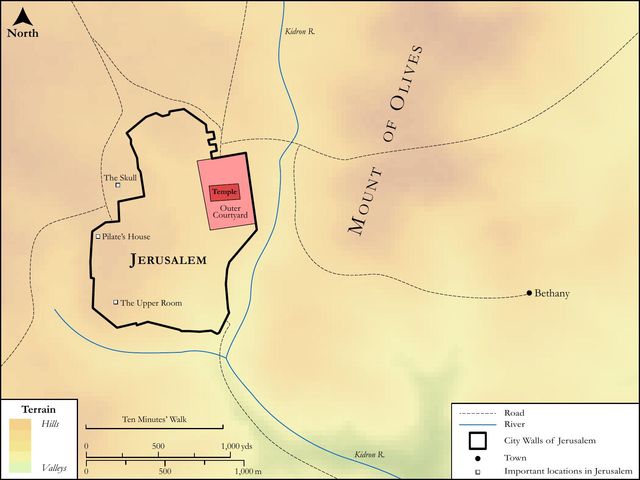
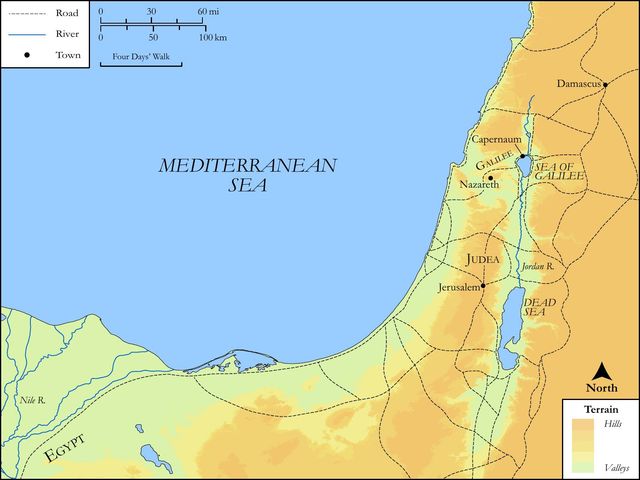
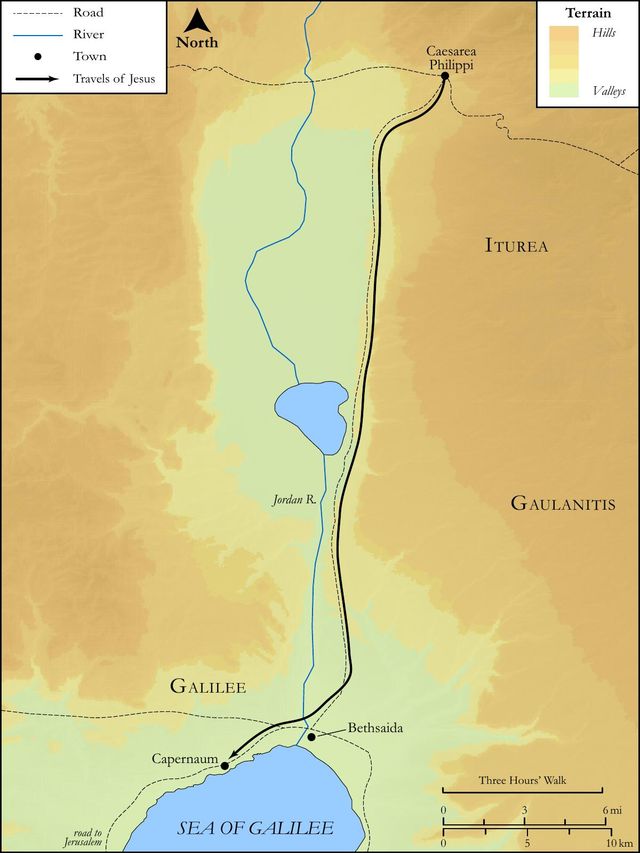
See on the biblical-era maps
Study this verse
Public-domain commentary
Matthew Henry
From his Commentary on the Whole Bible. Henry comments on passages, not single verses — this entry covers Mark 1:23–28. His three-level outline is real structure in the source text, so it is rendered as structure.
As soon as Christ began to preach, he began to work miracles for the confirmation of his doctrine; and they were such as intimated the design and tendency of his doctrine, which were to conquer Satan, and cure sick souls.
In these verses, we have,
I.Christ's casting the devil out of a man that was possessed, in the synagogue at Capernaum.
This passage was not related in Matthew, but is afterward in Luk 4:33. There was in the synagogue a man with an unclean spirit, en pneumati akathartō - in an unclean spirit; for the spirit had the man in his possession, and led him captive at his will. So the whole world is said to lie en tō ponerō - in the wicked one. And some have thought it more proper to say, The body is in the soul, because it is governed by it, than the soul in the body. He was in the unclean spirit, as a man is said to be in a fever, or in a frenzy, quite overcome by it. Observe, The devil is here called an unclean spirit, because he has lost all the purity of his nature, because he acts in direct opposition to the Holy Spirit of God, and because with his suggestions he pollutes the spirits of men. This man was in the synagogue; he did not come either to be taught or to be healed, but, as some think, to confront Christ and oppose him, and hinder people from believing on him. Now here we have,
1.The rage which the unclean spirit expressed at Christ; He cried out, as one in an agony, at the presence of Christ, and afraid of being dislodged; thus the devils believe and tremble, have a horror of Christ, but no hope in him, nor reverence for him. We are told what he said, Mar 1:24, where he doth not go about to capitulate with him, or make terms (so far was he from being in league or compact with him), but speaks as one that knew his doom.
(1.)He calls him Jesus of Nazareth; for aught that appears, he was the first that called him so, and he did it with design to possess the minds of the people with low thoughts of him, because no good thing was expected out of Nazareth; and with prejudices against him as a Deceiver, because every body knew the Messiah must be of Bethlehem.
(2.)Yet a confession is extorted from him - that he is the holy One of God, as was from the damsel that had the spirit of divination concerning the apostles - that they were the servants of the most high God, Act 16:16, Act 16:17. Those who have only a notion of Christ - that he is the holy One of God, and have no faith in him, or love to him, go no further than the devil doth.
(3.)He in effect acknowledgeth that Christ was too hard for him, and that he could not stand before the power of Christ; "Let us alone; for if thou take us to task, we are undone, thou canst destroy us." This is the misery of those wicked spirits, that they persist in their rebellion, and yet know it will end in their destruction.
(4.)He desires to have nothing to do with Jesus Christ; for he despairs of being saved by him, and dreads being destroyed by him. "What have we to do with thee? If thou wilt let us alone, we will let thee alone." See whose language they speak, that say to the Almighty, Depart from us. This, being an unclean spirit, therefore hated and dreaded Christ, because he knew him to be a holy One; for the carnal mind is enmity against God, especially against his holiness.
2.The victory which Jesus Christ obtained over the unclean spirit; for this purpose was the Son of God manifested, that he might destroy the works of the devil, and so he makes it to appear; nor will he be turned back from prosecuting this war, either by his flatteries or by his menaces. It is in vain for Satan to beg and pray, Let us alone; his power must be broken, and the poor man must be relieved; and therefore,
(1.)Jesus commands. As he taught, so he healed, with authority. Jesus rebuked him; he chid him and threatened him, imposed silence upon him; Hold thy peace; phimōthēti - be muzzled. Christ has a muzzle for that unclean spirit when he fawns as well as when he barks; such acknowledgments of him as this was, Christ disdains, so far is he from accepting them. Some confess Christ to be the holy One of God, that under the cloak of that profession they may carry on malicious mischievous designs; but their confession is doubly an abomination to the Lord Jesus, as it sues in his name for a license to sin, and shall therefore be put to silence and shame. But this is not all, he must not only hold his peace, but he must come out of the man; this was it he dreaded - his being restrained from doing further mischief. But,
(2.)The unclean spirit yields, for there is no remedy (Mar 1:26); He tore him, put him into a strong convulsion; that one could have thought he had been pulled in pieces; when he would not touch Christ, in fury at him he grievously disturbed this poor creature. Thus, when Christ by his grace delivers poor souls out of the hands of Satan, it is not without a grievous toss and tumult in the soul; for that spiteful enemy will disquiet those whom he cannot destroy. He cried with a loud voice, to frighten the spectators, and make himself seem terrible, as if he would have it thought that though he was conquered, he was but just conquered, and that he hopes to rally again, and recover his ground.
II.The impression which this miracle made upon the minds of the people, Mar 1:27, Mar 1:28.
1.It astonished them that saw it; They were all amazed. It was evident, beyond contradiction, that the man was possessed - witness the tearing of him, and the loud voice with which the spirit cried; it was evident that he was forced out by the authority of Christ; this was surprising to them, and put them upon considering with themselves, and enquiring of one another, "What is this new doctrine? For it must certainly be of God, which is thus confirmed. He hath certainly an authority to command us, who hath ability to command even the unclean spirits, and they cannot resist him, but are forced to obey him." The Jewish exorcists pretended by charm or invocation to drive away evil spirits; but this was quite another thing, with authority he commands them. Surely it is our interest to make him our Friend, who has the control of infernal spirits.
2.It raised his reputation among all that heard it; Immediately his fame spread abroad into the whole adjacent region of Galilee, which was a third part of the land of Canaan. The story was presently got into every one's mouth, and people wrote it to their friends all the country over, together with the remark made upon it, What new doctrine is this? So that it was universally concluded, that he was a Teacher come from God, and under that character he shone more bright than if he had appeared in all the external pomp and power which the Jews expected their Messiah to appear in; and thus he prepared his own way, now that John, who was his harbinger, was clapped up; and the fame of this miracle spread the further, because as yet the Pharisees, who envied his fame, and laboured to eclipse it, had not advanced their blasphemous suggestion, that he cast out devils by compact with the prince of the devils.
Historical interpretation
Twelve Centuries of Reception
16 surviving comments on this verse. Each one is dated, so this reads as a timeline rather than a list.
Select a marker to jump to its quote. Markers stagger vertically where authors wrote within a few decades of each other.
Moreover, Capernaum is mystically interpreted the town of consolation, and the sabbath as rest. The man with an evil spirit is healed by rest and consolation, that the place and time may agree with his healing. This man with an unclean spirit is the human race, in which uncleanness reigned from Adam to Moses; for they sinned without law, and perished without law. (v. Rom. 5:14. 2:12) And he, knowing the Holy One of God, is ordered to hold his peace, for they knowing God did not glorify him as God, but rather served the creature than the Creator. (1:21.25) The spirit tearing the man came out of him. When salvation is near, temptation is at hand also. Pharaoh, when about to leti Israel go, pursues Israel; the devil, when despised, rises up to create scandals.
There was concealed from the ruler of this world the virginity of Mary and the birth of our Lord, and the three renowned mysteries which were done in the tranquillity of God from the star. And here, at the manifestation of the Son, magic began to be destroyed, and all bonds were loosed; and the ancient kingdom and the error of evil was destroyed. Henceforward all things were moved together, and the destruction of death was devised, and there was the commencement of that which was perfected in God.
Even the demons cried out, on beholding the Son: “I know who you are, the Holy One of God.” Later the devil looking at him and tempting him, would say: “If you are the Son of God.” All of these thus recognized the Son and the Father, yet without believing. So it was fitting that the truth should receive testimony from all, and should become a means of judgment for the salvation not only of those who believe, but also for the condemnation of those who do not believe. The result is that all should be fairly judged, and that the faith in the Father and Son should be a matter of decision for all, so that one means of salvation should be established for all, receiving testimony from all, both from those belonging to it who were its friends, and by those having no connection with it who were its enemies. For that evidence is most trustworthy and true which elicits even from its adversaries striking testimonies on its behalf.
Satan likewise knew Him to be this in his temptations: "Since Thou art the Son of God." This, accordingly, the devils also acknowledge Him to be: "we know Thee, who Thou art, the Holy Son of God." His "Father" He Himself adores.
I do not accept the devil’s testimony but his confession. The devil spoke unwillingly, being compelled and tormented.
Does no demon call upon God’s name? did not the demons say, “We know who you are, O Holy One of God?” did they not say to Paul: “these men are the servants of the Most High God?” They did, but only upon scourging, only upon compulsion, never of their own will, never without being trounced.
Those words show clearly that the demons had much knowledge, but entirely lacked love. They dreaded receiving their punishment from him. They did not love the righteousness that was in him. He made himself known to them to the extent he willed; and he willed to be made known to the extent that was fitting. But he was not made known to them as he is known to the holy angels, who enjoy participation in his eternity, in that he is the Word of God. To the demons he is known as he had to be made known, by striking terror into them, for his purpose was to free from their tyrannical power all who were predestined for his kingdom and glory, which is eternally true and truly eternal. Therefore, he did not make himself known to the demons as the life eternal, and the unchangeable light which illuminates his true worshipers, whose hearts are purified by faith in him so that they see that light. He was known to the demons through certain temporal effects of his power, the signs of his hidden presence, which could be more evident to their senses, even those of malignant spirits, than to the weak perception of human beings.
(de Civ. Dei, ix. 21) Moreover, how great is the power which the lowliness of God, appearing in the form of a servant, has over the pride of devils, the devils themselves know so well, that they express it to the same Lord clothed in the weakness of flesh. For there follows, And he cried out, saying, What have we to do with thee, Jesus of Nazareth, &c. For it is evident in these words that there was in them knowledge, but there was not charity; and the reason was, that they feared their punishment from Him, and loved not the righteousness in Him.
(ubi sup.) For He was known to them in that degree in which He wished to be known; and He wished as much as was fitting. He was not known to them as to the holy Angels, who enjoy Him by partaking of His eternity according as He is the Word of God; but as He was to be made known in terror, to those beings from whose tyrannical power He was about to free the predestinate. He was known therefore to the devils, not in that He is eternal Life, but by some temporal effects of His Power, which might be more clear to the angelic senses of even bad spirits than to the weakness of men.
Call to mind with me the time when Peter was praised and called blessed. Was it because he merely said, “You are the Christ, the Son of the living God”? No, he who pronounced him blessed regarded not merely the sound of his words, but the affections of his heart. Compare that with the words of the demons who said almost the same thing: “We know who you are, the Son of God,” just as Peter had confessed him as “Son of God.” So what is the difference? Peter spoke in love, but the demons in fear.… So tell us how faith is to be defined, if even the devils can believe and tremble? Only the faith that works by love is faith.
Unclean spirits knew that Jesus Christ would come. They had heard it from the angels, they had heard it from the prophets, so they were expecting him to come. For if not, why did they cry out, “What have we to do with you? Have you come to destroy us before the time? We know who you are, the holy one of God.” .
Faith is mighty, but without love it profits nothing. The devils confessed Christ, but lacking charity it availed nothing. They said, “What have we to do with you?” They confessed a sort of faith, but without love. Hence they were devils. Do not boast of that faith that puts you on the same level with the devils.
(Vict. Ant. e Cat. in Marc.) The word Spirit is applied to an Angel, the air, the soul, and even the Holy Ghost. Lest therefore by the sameness of the name we should fall into error, he adds, unclean. And he is called unclean on account of his impiousness and far removal from God, and because he employs himself in all unclean and wicked works.
(Vict. Ant. e Cat. in Marc.) Or else the devil so speaks, as if he said, 'by taking away uncleanness, and giving to the souls of men divine knowledge, Thou allowest us no place in men.'
(Vict. Ant. e Cat. in Marc.) As if he said, Methinks that Thou art come; for he had not a firm and certain knowledge of the coming of God. But he calls Him holy not as one of many, for every prophet was also holy, but he proclaims that He was the One holy; by the article in Greek he shows Him to be the One, but by his fear he shows Him to be Lord of all.
(Vict. Ant. e Cat. in Marc.) Further, the Truth did not wish to have the witness of unclean spirits; wherefore there follows, And Jesus threatened him, saying, &c. Whence a healthful precept is given to us; let us not believe devils, howsoever they may proclaim the truth. It goes on, And the unclean spirit tearing him, &c. For, because the man spoke as one in his senses and uttered his words with discretion, lest it should be thought that he put together his words not from the devil but out of his own heart, He permitted the man to be torn by the devil, that He might show that it was the devil who spoke.
(in Marc. i. 7) Since by the envy of the devil death first entered into the world, it was right that the medicine of healing should first work against the author of death; and therefore it is said, And there was in their synagogue a man, &c.
(ubi sup.) For the devils, seeing the Lord on the earth, thought that they were immediately to be judged.
(ubi sup.) But it may appear to be a discrepancy, that he should have gone out of him, tearing him, or, as some copies have it, vexing him, when, according to Luke, he did not hurt him. But Luke himself says, When he had, cast him into the midst, he came out from him, without hurting him. (Luke 4:35) Wherefore it is inferred that Mark meant by vexing or tearing him, what Luke expresses, in the words, When he had cast him into the midst; so that what he goes on to say, And did not hurt him, may be understood to mean, that the tossing of his limbs and vexing, did not weaken him, as devils are wont to come out even with the cutting off and tearing away of limbs. But seeing the power of the miracle, they wonder at the newness of our Lord's doctrine, and are roused to search into what they had heard by what they had seen. Wherefore there follows, And they all wondered &c. For miracles were done that they might more firmly believe the Gospel of the kingdom of God, which was being preached, since those who were promising heavenly joys to men on earth, were showing forth heavenly things and divine works even on earth. For before (as the Evangelist says) He was teaching them as one who had power, and now, as the crowd witnesses, with power He commands the evil spirits, and they obey Him. (1 John 5:20. John 17:3) It goes on, And immediately His fame spread abroad, &c.
And there was in their synagogue a man with an unclean spirit, etc. This is not a confession of the will, which follows the reward of confessing, but an extortion of necessity, which compels the guilty to confess. And just as if runaway slaves, after a long time, see their master, they fear nothing but whips, so also the demons, seeing the Lord suddenly dwelling on earth, believed that he had come to judge them. The presence of the Savior is torment for demons. And Jesus rebuked him saying: Be silent, and come out of the man. For by the envy of the devil death entered into the world (Wisdom XII), therefore against the author of death itself, the medicine of salvation ought to work first: first the serpent's tongue, so that it may not spread poison further, be shut; then the woman, who was first seduced, be cured from the fever of carnal desire; thirdly, the man, who heard the words of his badly advising wife, be cleansed from the leprosy of his error, so that the order of restoration in the Lord may be the same as the fall in the first parents: And the unclean spirit, convulsing him and crying out with a loud voice, came out of him. Luke says of the unclean spirit that it came out of the man without harming him. Therefore, it can seem contrary, how according to Mark, he convulsed (or as some manuscripts have, threw him down), yet he did not harm him according to Luke. But Luke also says: And having thrown him in the midst, the demon went out of him, and did not harm him (Luke IV). Hence, it is understood that Mark said convulsing him, or throwing him down, in the same sense that Luke said he threw him in the midst, so that what Luke follows with, and did not harm him, is understood that this tossing and vexation of the limbs did not injure him, as demons usually exit, even tearing away or dislocating some limbs.
For to come out of man the devil considers as his own perdition; for devils are ruthless, thinking that they suffer some evil, so long as they are not troubling men. There follows, I know that thou art the Holy One of God.
That they might know, when they saw it, from how great an evil the man was freed, and on account of the miracle might believe.
(non occ.) For those things which men wonder at they soon divulge, for out of the abundance of the heart the mouth speaketh. (Mat. 12:24)
Continue studying Mark 1:24 across the web’s major study libraries — every link below opens this exact verse, chapter, or book on the destination site.
Read & Compare
 BibleGatewayThis verse in more than 200 translations and 70 languages.
 Bible.comThe YouVersion reader — hundreds of translations, reading plans, and highlights.
 ESV.orgCrossway's official English Standard Version reader.
 NET BibleThe NET translation with 60,000+ translators' notes on every rendering decision.
 STEP BibleTyndale House's free study tool — original text, vocabulary, and scholarly resources.
 BibliaLogos Bible Software's free web reader.
 USCCBThe New American Bible (Revised Edition) with the U.S. bishops' study notes.
Commentaries
 BibleHub CommentariesDozens of classic commentaries on this verse, gathered on one page.
 StudyLightMore than 100 commentary sets — the largest collection on the web.
 BibleRefPlain-English commentary on what this verse means, verse by verse.
 Enduring WordDavid Guzik's free commentary on this chapter, widely used by Bible teachers.
 Bible Study ToolsVerse commentary alongside Greek and Hebrew study aids.
Original Language & Research
- BibleHub InterlinearThe verse word by word — original language, transliteration, and English.
- BibleHub LexiconEvery word's original-language definition and Strong's entry.
 Blue Letter BibleDeep-study tools — Strong's numbers, concordance, and word studies.
 CNTR CollationThe earliest Greek manuscripts of this verse, collated letter by letter.
Sermons, Hymns & Audio


TrulyRandomVerse is not affiliated with these sites and doesn’t control their content. They’re linked because they’re genuinely useful.
Summary
Mark 1:24 captures a pivotal moment in Jesus' early ministry, where an unclean spirit, speaking through a possessed man in the synagogue at Capernaum, immediately recognizes Jesus' divine identity and authority. This dramatic confrontation serves as a powerful public declaration of Jesus' unique status as the "Holy One of God" and His inherent power over the forces of evil, revealing the spiritual realm's acute awareness of His presence and purpose even before many humans grasped it.
Context
ShowHideLiterary Context
This verse is embedded within the opening chapter of Mark's Gospel, which rapidly introduces Jesus' ministry. It immediately follows Jesus' authoritative teaching in the synagogue, where the people were "astonished at his doctrine: for he taught them as one that had authority, and not as the scribes" (Mark 1:22). The sudden outburst from the demon-possessed man directly interrupts the worship service, highlighting the disruptive nature of evil in the presence of divine holiness. This exorcism is the first public demonstration of Jesus' power over evil spirits in Mark, serving as a concrete manifestation of the authority He had just displayed in His teaching. It sets the stage for a series of healing and exorcism accounts that underscore Jesus' dominion over sickness and spiritual oppression throughout Mark's Gospel.
Historical & Cultural Context
First-century Jewish society, particularly in Galilee, was deeply immersed in a worldview that acknowledged the reality of spiritual forces, both good and evil. Demonic possession was a recognized phenomenon, often associated with physical ailments or mental distress, and exorcism was practiced by various individuals, though often through ritualistic means or incantations. Capernaum, a bustling fishing town on the Sea of Galilee, was a significant center for Jesus' early ministry, serving as His "home base" (Mark 2:1). Synagogues were not merely places of worship but also community centers where teaching, discussion, and healing sometimes occurred. The Sabbath, the day this event takes place, was a sacred day of rest and worship, making the demon's public disruption even more shocking and the display of Jesus' power more profound against the backdrop of religious observance.
Key Themes
ShowHideMark 1:24 powerfully contributes to several key themes in Mark's Gospel. Firstly, it immediately establishes Jesus' Authority not only over human teaching but also over the supernatural realm. His command is effective, demonstrating a power far beyond that of any scribe or traditional exorcist. Secondly, the passage highlights the theme of Jesus' Identity. While humans are still grappling with who Jesus is, the unclean spirit unequivocally declares Him to be "the Holy One of God," a title that points to His unique divine nature and special relationship with the Father. This supernatural recognition foreshadows the "Messianic Secret" theme in Mark, where Jesus often silences demons and even disciples from proclaiming His full identity prematurely (Mark 1:34 and Mark 3:11-12). Finally, the verse clearly introduces the theme of Spiritual Warfare, portraying the direct conflict between the kingdom of God, embodied in Jesus, and the kingdom of darkness. The demon's fear of destruction reveals its awareness of Jesus' ultimate purpose to dismantle the works of the devil (1 John 3:8).
Exposition and Analysis
ShowHideKey Word Analysis
ShowHideThis word, an apparent imperative of eáō, functions as an interjection expressing alarm, protest, or indignation, akin to "Aha!" or "Let it be!" In this context, it conveys the demon's immediate, startled reaction to Jesus' presence, a desperate plea for Jesus to cease His intrusion into their domain and leave them undisturbed. It signifies a recognition of Jesus' power and an immediate, visceral recoil from His holiness.
Derived from a primary verb meaning "to see," this word, when used in the perfect tense as it is here, carries the implication of "to know" or "to be aware." The demon's declaration, "I know thee," is not mere intellectual assent but a profound, experiential recognition of Jesus' true nature, a supernatural insight into His identity that transcends human understanding. It implies an awareness of Jesus' divine origin and purpose.
This term, meaning "sacred," "pure," or "consecrated," describes Jesus' unique and inherent holiness, setting Him apart from all creation and especially from the realm of evil. When combined with "of God," it signifies Jesus' divine purity, His special relationship with God, and His consecration for a divine mission. It is a title of profound theological weight, recognizing Jesus' unblemished nature and His unique status as God's chosen and consecrated agent.
Verse Breakdown
ShowHide"Saying, Let [us] alone;"
The unclean spirit, speaking through the possessed man, immediately reacts with a desperate, almost panicked exclamation. This is not a request but a demand, revealing its profound discomfort and fear in the presence of Jesus. It signifies the demon's recognition of Jesus' inherent power and the threat He poses to its dominion.
"what have we to do with thee, thou Jesus of Nazareth?"
This rhetorical question expresses antagonism and a desire for separation. It's a common idiom indicating a lack of common ground or a hostile disengagement. The demon acknowledges Jesus by His earthly name and origin, "Jesus of Nazareth," yet simultaneously challenges His presence, implying that Jesus' arrival disrupts their established order.
"art thou come to destroy us?"
This question reveals the demon's acute awareness of Jesus' ultimate mission and its own impending doom. It recognizes Jesus as an existential threat, implying that His purpose is to dismantle the power and influence of evil spirits. This highlights the eschatological dimension of Jesus' ministry, bringing about the defeat of Satan and his forces.
"I know thee who thou art, the Holy One of God."
Despite its hostility, the demon is compelled to confess Jesus' true identity. This is a profound, supernatural declaration, contrasting sharply with the human confusion surrounding Jesus' identity at this early stage. The title "Holy One of God" signifies Jesus' unique purity, divine nature, and special relationship with the Father, affirming His divine authority and sacred mission.
Literary Devices
ShowHideMark 1:24 employs several significant literary devices. The Dramatic Irony is prominent, as the unclean spirit, an agent of darkness, declares Jesus' true identity as the "Holy One of God" before many human characters fully grasp it. This creates a powerful contrast between spiritual awareness and human ignorance. The demon's outburst serves as Foreshadowing, hinting at the ongoing spiritual conflict that will characterize Jesus' ministry and ultimately culminate in His victory over evil. The repeated use of direct address and questions ("what have we to do with thee?", "art thou come to destroy us?") creates a sense of Dialogue and immediate confrontation, drawing the reader into the intensity of the scene. Furthermore, the demon's compelled confession of Jesus' divine title functions as an Epiphany, a sudden manifestation of Jesus' true nature, even if it comes from an unexpected and unwilling source.
Theological and Thematic Connections
ShowHideMark 1:24 profoundly underscores Jesus' inherent authority and divine identity, revealing that even the forces of darkness are compelled to acknowledge His unique status. The demon's immediate recognition of Jesus as the "Holy One of God" serves as a powerful, albeit unwilling, testimony to His divine nature and His mission to confront and overcome evil. This encounter sets a precedent for Jesus' ministry, demonstrating that His authority extends beyond mere teaching to absolute dominion over spiritual powers, affirming His role as the sovereign Lord who has come to reclaim creation from the grip of sin and darkness. It reminds us that spiritual realities are profound and that Jesus' presence fundamentally challenges the domain of evil.
Reflection and Application
ShowHideThe confrontation in Mark 1:24 offers profound reassurance and practical insight for believers today. It vividly reminds us that Jesus possesses ultimate and unchallenged authority over all spiritual forces, including those that seek to oppress, deceive, or harm. The demon's panicked cry and compelled confession demonstrate that no power, visible or invisible, can stand against the presence and command of Christ. This truth should instill courage and confidence in believers, knowing that we serve a God who is sovereign over all spiritual realms. While spiritual warfare is a reality, this passage assures us that the victory has already been secured through Christ. Our role is to stand firm in His authority, recognizing that the very forces of evil acknowledge His Lordship. This foundational understanding empowers us to live without fear, trusting in Jesus' protective power and His ultimate triumph over all darkness.
Questions for Reflection
ShowHideFAQ
ShowHideWhy did the demon recognize Jesus when many people did not?
ShowHideThe Scriptures often portray spiritual beings, both angelic and demonic, as having a heightened awareness of spiritual realities and divine identity compared to humans. Unlike humans, who often rely on physical sight and intellectual reasoning, demons operate in the spiritual realm and have direct knowledge of God's power and presence. The unclean spirit in Mark 1:24 immediately recognized Jesus' divine nature and authority because it was a spiritual being confronting the very source of holiness and power that threatened its existence. This supernatural recognition serves to underscore Jesus' true identity for the human audience, even if they initially struggled to comprehend it.
Christ-Centered Fulfillment
ShowHideMark 1:24, with the demon's unwilling confession of Jesus as "the Holy One of God" and its fearful question, "art thou come to destroy us?", powerfully foreshadows the ultimate Christ-centered fulfillment of God's redemptive plan. This early confrontation demonstrates that Jesus' very presence inaugurated the decisive battle against the kingdom of darkness. The demon's recognition of Jesus' holiness and its fear of destruction point directly to the cross and resurrection, where Jesus, the truly "Holy One," would decisively defeat sin, death, and the devil. The author of Hebrews declares that Jesus "shared in their humanity so that by his death he might break the power of him who holds the power of death—that is, the devil—and free those who all their lives were held in slavery by their fear of death" (Hebrews 2:14-15). The demon's question, "art thou come to destroy us?", finds its ultimate answer in Christ's atoning work, which disarmed the powers and authorities of darkness, making a public spectacle of them by triumphing over them at the cross (Colossians 2:15). Thus, the demon's forced confession in Capernaum serves as an early, prophetic glimpse into the victory of Christ, who, as the Holy One of God, came not merely to teach or heal, but to utterly destroy the works of the devil and establish His eternal kingdom (1 John 3:8).