


Mark 1:26
- καὶkaiAndG2532CONJConjunction
- σπαράξανsparaxanhaving thrown into convulsionsG4682V-AAP-NSNVerb Aorist Active Participle Nominative Singular Neuter
- αὐτὸνautonhimG846P-ASMPersonal pronoun Accusative Singular Masculine
- τὸtotheG3588T-NSNDefinite article Nominative Singular Neuter
- πνεῦμαpneumaspiritG4151N-NSNNoun Nominative Singular Neuter
- τὸto<the>G3588T-NSNDefinite article Nominative Singular Neuter
- ἀκάθαρτονakathartonuncleanG169A-NSNAdjective Nominative Singular Neuter
- καὶkaiandG2532CONJConjunction
- φωνῆσανphōnēsanhaving shoutedG5455V-AAP-NSNVerb Aorist Active Participle Nominative Singular Neuter
- φωνῇphōnēain a voiceG5456N-DSFNoun Dative Singular Feminine
- μεγάλῃmegalēloudG3173A-DSFAdjective Dative Singular Feminine
- ἐξῆλθενexēlthenit came forthG1831V-2AAI-3SVerb 2nd Aorist Active Indicative 3rd Singular
- ἐξexout ofG1537PREPPreposition
- αὐτοῦautouhimG846P-GSMPersonal pronoun Genitive Singular Masculine
English is a literal word-by-word gloss of the Greek, not the KJV's wording. Why?
This is the original text the KJV's translators worked from — each Greek word with its own literal English meaning in this verse, prepared by scholars at Tyndale House, Cambridge. The KJV translates whole sentences, not word by word, so its wording differs: one Greek word can become several English words, and the KJV may choose “charity” where the gloss reads “love”. Both are faithful — they answer different questions. For the KJV's own rendering, switch to the KJV text.
Details
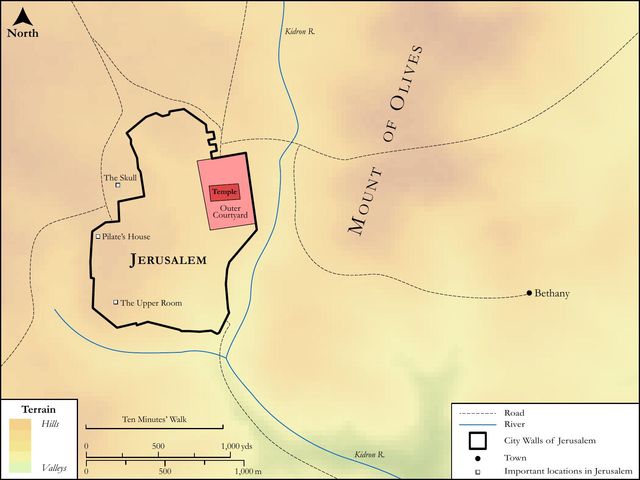
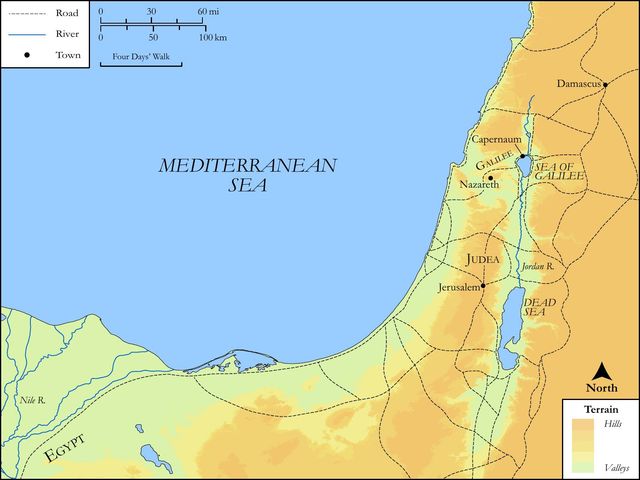
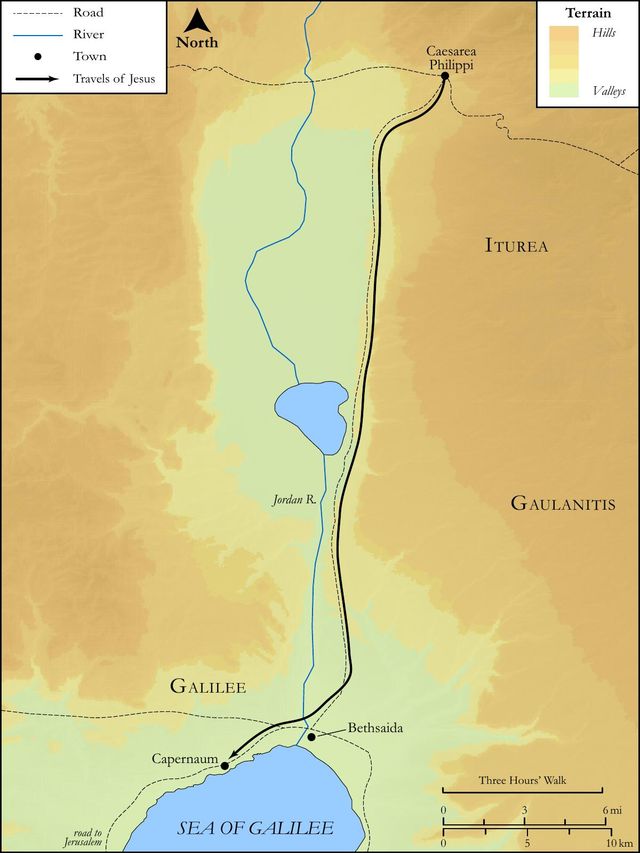
See on the biblical-era map
Study this verse
Public-domain commentary
Matthew Henry
From his Commentary on the Whole Bible. Henry comments on passages, not single verses — this entry covers Mark 1:23–28. His three-level outline is real structure in the source text, so it is rendered as structure.
As soon as Christ began to preach, he began to work miracles for the confirmation of his doctrine; and they were such as intimated the design and tendency of his doctrine, which were to conquer Satan, and cure sick souls.
In these verses, we have,
I.Christ's casting the devil out of a man that was possessed, in the synagogue at Capernaum.
This passage was not related in Matthew, but is afterward in Luk 4:33. There was in the synagogue a man with an unclean spirit, en pneumati akathartō - in an unclean spirit; for the spirit had the man in his possession, and led him captive at his will. So the whole world is said to lie en tō ponerō - in the wicked one. And some have thought it more proper to say, The body is in the soul, because it is governed by it, than the soul in the body. He was in the unclean spirit, as a man is said to be in a fever, or in a frenzy, quite overcome by it. Observe, The devil is here called an unclean spirit, because he has lost all the purity of his nature, because he acts in direct opposition to the Holy Spirit of God, and because with his suggestions he pollutes the spirits of men. This man was in the synagogue; he did not come either to be taught or to be healed, but, as some think, to confront Christ and oppose him, and hinder people from believing on him. Now here we have,
1.The rage which the unclean spirit expressed at Christ; He cried out, as one in an agony, at the presence of Christ, and afraid of being dislodged; thus the devils believe and tremble, have a horror of Christ, but no hope in him, nor reverence for him. We are told what he said, Mar 1:24, where he doth not go about to capitulate with him, or make terms (so far was he from being in league or compact with him), but speaks as one that knew his doom.
(1.)He calls him Jesus of Nazareth; for aught that appears, he was the first that called him so, and he did it with design to possess the minds of the people with low thoughts of him, because no good thing was expected out of Nazareth; and with prejudices against him as a Deceiver, because every body knew the Messiah must be of Bethlehem.
(2.)Yet a confession is extorted from him - that he is the holy One of God, as was from the damsel that had the spirit of divination concerning the apostles - that they were the servants of the most high God, Act 16:16, Act 16:17. Those who have only a notion of Christ - that he is the holy One of God, and have no faith in him, or love to him, go no further than the devil doth.
(3.)He in effect acknowledgeth that Christ was too hard for him, and that he could not stand before the power of Christ; "Let us alone; for if thou take us to task, we are undone, thou canst destroy us." This is the misery of those wicked spirits, that they persist in their rebellion, and yet know it will end in their destruction.
(4.)He desires to have nothing to do with Jesus Christ; for he despairs of being saved by him, and dreads being destroyed by him. "What have we to do with thee? If thou wilt let us alone, we will let thee alone." See whose language they speak, that say to the Almighty, Depart from us. This, being an unclean spirit, therefore hated and dreaded Christ, because he knew him to be a holy One; for the carnal mind is enmity against God, especially against his holiness.
2.The victory which Jesus Christ obtained over the unclean spirit; for this purpose was the Son of God manifested, that he might destroy the works of the devil, and so he makes it to appear; nor will he be turned back from prosecuting this war, either by his flatteries or by his menaces. It is in vain for Satan to beg and pray, Let us alone; his power must be broken, and the poor man must be relieved; and therefore,
(1.)Jesus commands. As he taught, so he healed, with authority. Jesus rebuked him; he chid him and threatened him, imposed silence upon him; Hold thy peace; phimōthēti - be muzzled. Christ has a muzzle for that unclean spirit when he fawns as well as when he barks; such acknowledgments of him as this was, Christ disdains, so far is he from accepting them. Some confess Christ to be the holy One of God, that under the cloak of that profession they may carry on malicious mischievous designs; but their confession is doubly an abomination to the Lord Jesus, as it sues in his name for a license to sin, and shall therefore be put to silence and shame. But this is not all, he must not only hold his peace, but he must come out of the man; this was it he dreaded - his being restrained from doing further mischief. But,
(2.)The unclean spirit yields, for there is no remedy (Mar 1:26); He tore him, put him into a strong convulsion; that one could have thought he had been pulled in pieces; when he would not touch Christ, in fury at him he grievously disturbed this poor creature. Thus, when Christ by his grace delivers poor souls out of the hands of Satan, it is not without a grievous toss and tumult in the soul; for that spiteful enemy will disquiet those whom he cannot destroy. He cried with a loud voice, to frighten the spectators, and make himself seem terrible, as if he would have it thought that though he was conquered, he was but just conquered, and that he hopes to rally again, and recover his ground.
II.The impression which this miracle made upon the minds of the people, Mar 1:27, Mar 1:28.
1.It astonished them that saw it; They were all amazed. It was evident, beyond contradiction, that the man was possessed - witness the tearing of him, and the loud voice with which the spirit cried; it was evident that he was forced out by the authority of Christ; this was surprising to them, and put them upon considering with themselves, and enquiring of one another, "What is this new doctrine? For it must certainly be of God, which is thus confirmed. He hath certainly an authority to command us, who hath ability to command even the unclean spirits, and they cannot resist him, but are forced to obey him." The Jewish exorcists pretended by charm or invocation to drive away evil spirits; but this was quite another thing, with authority he commands them. Surely it is our interest to make him our Friend, who has the control of infernal spirits.
2.It raised his reputation among all that heard it; Immediately his fame spread abroad into the whole adjacent region of Galilee, which was a third part of the land of Canaan. The story was presently got into every one's mouth, and people wrote it to their friends all the country over, together with the remark made upon it, What new doctrine is this? So that it was universally concluded, that he was a Teacher come from God, and under that character he shone more bright than if he had appeared in all the external pomp and power which the Jews expected their Messiah to appear in; and thus he prepared his own way, now that John, who was his harbinger, was clapped up; and the fame of this miracle spread the further, because as yet the Pharisees, who envied his fame, and laboured to eclipse it, had not advanced their blasphemous suggestion, that he cast out devils by compact with the prince of the devils.
Historical interpretation
Eight Centuries of Reception
6 surviving comments on this verse. Each one is dated, so this reads as a timeline rather than a list.
Select a marker to jump to its quote. Markers stagger vertically where authors wrote within a few decades of each other.
Moreover, Capernaum is mystically interpreted the town of consolation, and the sabbath as rest. The man with an evil spirit is healed by rest and consolation, that the place and time may agree with his healing. This man with an unclean spirit is the human race, in which uncleanness reigned from Adam to Moses; for they sinned without law, and perished without law. (v. Rom. 5:14. 2:12) And he, knowing the Holy One of God, is ordered to hold his peace, for they knowing God did not glorify him as God, but rather served the creature than the Creator. (1:21.25) The spirit tearing the man came out of him. When salvation is near, temptation is at hand also. Pharaoh, when about to leti Israel go, pursues Israel; the devil, when despised, rises up to create scandals.
(Vict. Ant. e Cat. in Marc.) The word Spirit is applied to an Angel, the air, the soul, and even the Holy Ghost. Lest therefore by the sameness of the name we should fall into error, he adds, unclean. And he is called unclean on account of his impiousness and far removal from God, and because he employs himself in all unclean and wicked works.
(Vict. Ant. e Cat. in Marc.) Or else the devil so speaks, as if he said, 'by taking away uncleanness, and giving to the souls of men divine knowledge, Thou allowest us no place in men.'
(Vict. Ant. e Cat. in Marc.) As if he said, Methinks that Thou art come; for he had not a firm and certain knowledge of the coming of God. But he calls Him holy not as one of many, for every prophet was also holy, but he proclaims that He was the One holy; by the article in Greek he shows Him to be the One, but by his fear he shows Him to be Lord of all.
(Vict. Ant. e Cat. in Marc.) Further, the Truth did not wish to have the witness of unclean spirits; wherefore there follows, And Jesus threatened him, saying, &c. Whence a healthful precept is given to us; let us not believe devils, howsoever they may proclaim the truth. It goes on, And the unclean spirit tearing him, &c. For, because the man spoke as one in his senses and uttered his words with discretion, lest it should be thought that he put together his words not from the devil but out of his own heart, He permitted the man to be torn by the devil, that He might show that it was the devil who spoke.
(in Marc. i. 7) Since by the envy of the devil death first entered into the world, it was right that the medicine of healing should first work against the author of death; and therefore it is said, And there was in their synagogue a man, &c.
(ubi sup.) For the devils, seeing the Lord on the earth, thought that they were immediately to be judged.
(ubi sup.) But it may appear to be a discrepancy, that he should have gone out of him, tearing him, or, as some copies have it, vexing him, when, according to Luke, he did not hurt him. But Luke himself says, When he had, cast him into the midst, he came out from him, without hurting him. (Luke 4:35) Wherefore it is inferred that Mark meant by vexing or tearing him, what Luke expresses, in the words, When he had cast him into the midst; so that what he goes on to say, And did not hurt him, may be understood to mean, that the tossing of his limbs and vexing, did not weaken him, as devils are wont to come out even with the cutting off and tearing away of limbs. But seeing the power of the miracle, they wonder at the newness of our Lord's doctrine, and are roused to search into what they had heard by what they had seen. Wherefore there follows, And they all wondered &c. For miracles were done that they might more firmly believe the Gospel of the kingdom of God, which was being preached, since those who were promising heavenly joys to men on earth, were showing forth heavenly things and divine works even on earth. For before (as the Evangelist says) He was teaching them as one who had power, and now, as the crowd witnesses, with power He commands the evil spirits, and they obey Him. (1 John 5:20. John 17:3) It goes on, And immediately His fame spread abroad, &c.
And there was in their synagogue a man with an unclean spirit, etc. This is not a confession of the will, which follows the reward of confessing, but an extortion of necessity, which compels the guilty to confess. And just as if runaway slaves, after a long time, see their master, they fear nothing but whips, so also the demons, seeing the Lord suddenly dwelling on earth, believed that he had come to judge them. The presence of the Savior is torment for demons. And Jesus rebuked him saying: Be silent, and come out of the man. For by the envy of the devil death entered into the world (Wisdom XII), therefore against the author of death itself, the medicine of salvation ought to work first: first the serpent's tongue, so that it may not spread poison further, be shut; then the woman, who was first seduced, be cured from the fever of carnal desire; thirdly, the man, who heard the words of his badly advising wife, be cleansed from the leprosy of his error, so that the order of restoration in the Lord may be the same as the fall in the first parents: And the unclean spirit, convulsing him and crying out with a loud voice, came out of him. Luke says of the unclean spirit that it came out of the man without harming him. Therefore, it can seem contrary, how according to Mark, he convulsed (or as some manuscripts have, threw him down), yet he did not harm him according to Luke. But Luke also says: And having thrown him in the midst, the demon went out of him, and did not harm him (Luke IV). Hence, it is understood that Mark said convulsing him, or throwing him down, in the same sense that Luke said he threw him in the midst, so that what Luke follows with, and did not harm him, is understood that this tossing and vexation of the limbs did not injure him, as demons usually exit, even tearing away or dislocating some limbs.
For to come out of man the devil considers as his own perdition; for devils are ruthless, thinking that they suffer some evil, so long as they are not troubling men. There follows, I know that thou art the Holy One of God.
That they might know, when they saw it, from how great an evil the man was freed, and on account of the miracle might believe.
(non occ.) For those things which men wonder at they soon divulge, for out of the abundance of the heart the mouth speaketh. (Mat. 12:24)
Continue studying Mark 1:26 across the web’s major study libraries — every link below opens this exact verse, chapter, or book on the destination site.
Read & Compare
 BibleGatewayThis verse in more than 200 translations and 70 languages.
 Bible.comThe YouVersion reader — hundreds of translations, reading plans, and highlights.
 ESV.orgCrossway's official English Standard Version reader.
 NET BibleThe NET translation with 60,000+ translators' notes on every rendering decision.
 STEP BibleTyndale House's free study tool — original text, vocabulary, and scholarly resources.
 BibliaLogos Bible Software's free web reader.
 USCCBThe New American Bible (Revised Edition) with the U.S. bishops' study notes.
Commentaries
 BibleHub CommentariesDozens of classic commentaries on this verse, gathered on one page.
 StudyLightMore than 100 commentary sets — the largest collection on the web.
 BibleRefPlain-English commentary on what this verse means, verse by verse.
 Enduring WordDavid Guzik's free commentary on this chapter, widely used by Bible teachers.
 Bible Study ToolsVerse commentary alongside Greek and Hebrew study aids.
Original Language & Research
- BibleHub InterlinearThe verse word by word — original language, transliteration, and English.
- BibleHub LexiconEvery word's original-language definition and Strong's entry.
 Blue Letter BibleDeep-study tools — Strong's numbers, concordance, and word studies.
 CNTR CollationThe earliest Greek manuscripts of this verse, collated letter by letter.
Sermons, Hymns & Audio


TrulyRandomVerse is not affiliated with these sites and doesn’t control their content. They’re linked because they’re genuinely useful.
Summary
Mark 1:26 powerfully culminates the dramatic exorcism in the Capernaum synagogue, vividly depicting the violent, yet ultimately submissive, expulsion of an unclean spirit by Jesus' authoritative command. This pivotal moment not only showcases Jesus' unparalleled power over demonic forces but also serves as a foundational demonstration of His divine authority and the inbreaking of God's kingdom, leaving onlookers astonished and spreading His fame throughout the region.
Context
ShowHideLiterary Context
This verse is the climactic moment of Jesus' first recorded exorcism in Mark's Gospel, immediately following His initial teaching in the Capernaum synagogue on the Sabbath. The preceding verses establish Jesus' unique teaching authority, which astonished the crowds because it was "as one having authority, and not as the scribes" (Mark 1:22). The sudden interruption by a man possessed by an unclean spirit, who recognized Jesus as "the Holy One of God" (Mark 1:24), sets the stage for a direct confrontation. Jesus' immediate and terse command to the spirit—"Hold thy peace, and come out of him" (Mark 1:25)—underscores His absolute control, leading directly to the spirit's violent but obedient departure described in verse 26. The subsequent verses detail the profound amazement of the crowd and the rapid spread of Jesus' fame (Mark 1:27-28).
Historical & Cultural Context
First-century Jewish society, particularly in Galilee, was deeply immersed in a worldview that acknowledged the reality of spiritual forces, both benevolent and malevolent. Demonic possession was understood as a tangible affliction, often manifesting in physical or mental distress, and it was commonly believed that certain individuals, like exorcists, could cast out these spirits. However, traditional exorcism practices often involved elaborate rituals, incantations, or the invocation of a higher power. Jesus' method, in stark contrast, was remarkably direct and unmediated: a simple, authoritative command. This radical departure from conventional practices, coupled with the immediate and undeniable results, profoundly challenged the established religious authority and perceptions, highlighting a new and unprecedented source of power in the person of Jesus. The setting of the synagogue on the Sabbath further emphasizes the public and religious significance of this event, as it occurred in a sacred space on a holy day.
Key Themes
ShowHideMark 1:26 powerfully contributes to several overarching themes in Mark's Gospel. Foremost is the theme of Jesus' Supreme Authority (Exousia), particularly over the forces of evil. Unlike the scribes who taught based on tradition, Jesus acts with inherent power, demonstrating that His kingdom is breaking into the world with decisive force, directly confronting and overcoming the dominion of Satan. This event also highlights the Reality and Hostility of Demonic Activity, affirming the existence of spiritual entities that oppose God and afflict humanity. The spirit's violent reaction underscores its malevolence and its desperate, though futile, resistance to divine power. Finally, the passage emphasizes Dramatic Deliverance, portraying the physical manifestation of the spiritual battle. The "tearing" and "loud cry" are not merely incidental details but serve to underscore the intensity of the spiritual conflict and the undeniable, visible triumph of Jesus' power, leaving no doubt about the authenticity and efficacy of His work, a theme echoed throughout His ministry of healing and liberation, as seen in the broader narrative of Mark's Gospel.
Exposition and Analysis
ShowHideKey Word Analysis
ShowHideThis adjective, derived from a negative particle and a word meaning "cleansed," signifies impurity. In this context, it refers to a spiritual impurity, specifically a demonic entity. It denotes something ceremonially, morally, or specially (demonic) defiled, highlighting the nature of the spirit as antithetical to God's holiness and order.
This verb describes a violent, convulsive action, akin to mangling or rending. It vividly portrays the physical trauma inflicted upon the possessed man as the spirit was forcibly expelled. It suggests a spasmodic contraction or seizure, emphasizing the struggle and the raw power involved in the spirit's departure, a final act of defiance and pain before yielding to Jesus' command.
This primary verb means "to croak" or "screen," generally implying a loud, often desperate or exclamatory call. Here, it describes the spirit's final, piercing shriek. This "loud voice" (G3173, mégas + G5456, phōnḗ) indicates a powerful, audible expression of distress, anger, or perhaps a final, futile protest as it was forced to relinquish its hold.
The verb exérchomai means "to issue forth," "depart," or "go out," while the preposition ek denotes origin, "from" or "out of." Together, they emphasize the complete and definitive expulsion of the spirit from the man. This is not a partial or temporary departure, but a full and irreversible exit, signifying the total victory of Jesus' authority over the demonic presence.
Verse Breakdown
ShowHide"And when the unclean spirit had torn him,"
This clause describes the immediate physical manifestation of the spirit's violent departure. The verb "torn" (ἐσπάραξεν, esparaxen) indicates a severe convulsion or seizure, a final, destructive act by the spirit as it was forced to leave its host. This physical reaction underscores the intense spiritual battle and the malevolent nature of the spirit, which seeks to inflict harm even in its defeat. It was not a peaceful exit but a dramatic, visible struggle.
"and cried with a loud voice,"
This phrase details the audible manifestation of the spirit's expulsion. The "loud voice" (φωνῇ μεγάλῃ, phōnē megalē) suggests a shriek, a wail, or a guttural cry of protest, pain, or defiance. It is the spirit's final, desperate expression of its unwilling submission to Jesus' command, a public acknowledgment of His superior power even as it departs. This loud cry would have been heard by all in the synagogue, further emphasizing the reality and drama of the exorcism.
"he came out of him."
This concluding clause states the definitive outcome: the spirit's complete and irreversible exit from the man. Despite the violent tearing and loud cry, the spirit ultimately obeyed Jesus' command. This simple statement confirms Jesus' absolute authority and the immediate efficacy of His word. The man is now free, delivered from the oppressive spiritual presence, marking a clear and undeniable victory for Jesus.
Literary Devices
ShowHideMark 1:26 employs several powerful literary devices to convey its profound message. Dramatic Irony is evident as the unclean spirit, a malevolent entity, recognizes Jesus' true identity as "the Holy One of God" (Mark 1:24) before the human characters fully grasp who He is. This heightens the tension and underscores Jesus' divine nature. The vivid description of the spirit "tearing" the man and "crying with a loud voice" before departing is a prime example of Pathos, evoking a sense of suffering and the desperate struggle against an overwhelming force, while simultaneously highlighting the destructive nature of the demonic. This imagery also serves as Foreshadowing, hinting at the greater spiritual conflict and ultimate triumph of Christ over all forces of evil, including sin and death. The entire scene is a powerful Symbolism of Jesus' authority over chaos and spiritual darkness, signifying the inbreaking of God's kingdom and the beginning of the end for Satan's dominion.
Theological and Thematic Connections
ShowHideMark 1:26 is a foundational text for understanding Jesus' identity and mission. It establishes His absolute and inherent authority (Greek: exousia) over the spiritual realm, demonstrating that He is not merely a prophet or a healer, but the Son of God with power to confront and defeat the forces of darkness. This event signals the decisive incursion of God's kingdom into the world, directly challenging Satan's dominion. The violent reaction of the unclean spirit, though a display of its malevolence, ultimately serves to magnify Jesus' power, proving that even the most formidable spiritual adversaries are utterly subject to His command. This victory is not just over a single demon, but a microcosm of Christ's ultimate triumph over all principalities and powers, laying the groundwork for His redemptive work on the cross and resurrection.
Reflection and Application
ShowHideMark 1:26 offers profound and enduring truths for believers today. It serves as a powerful reminder that Jesus Christ possesses absolute authority over every form of spiritual darkness and oppression. In a world that often struggles with unseen forces, both spiritual and pervasive, this verse provides immense reassurance that no power, no addiction, no stronghold is too formidable for Christ to overcome. For those who feel trapped or oppressed, it points to the deliverer who speaks with a word of power, bringing freedom and restoration. It also calls believers to a greater awareness of spiritual warfare, not to fear it, but to stand firm in the victory already secured by Christ. We are reminded that through Him, we too have been given authority to overcome evil, not in our own strength, but by relying on His name and His Spirit. This passage encourages us to trust in His sovereign control, to seek His deliverance in our struggles, and to live in the freedom that His triumph provides, knowing that His power is still at work.
Questions for Reflection
ShowHideFAQ
ShowHideWas the man physically harmed by the spirit's departure, given the description "torn him"?
ShowHideThe Greek word "torn" (sparássō) indeed suggests a violent physical convulsion or seizure. While it indicates a traumatic, painful, and perhaps frightening experience for the man, it does not necessarily imply lasting physical injury. Instead, it vividly portrays the spirit's final, desperate act of malevolence and resistance before being forced out by Jesus' command. The immediate result was the man's complete liberation, not sustained harm. The tearing was a manifestation of the spirit's power and its unwilling submission, not a permanent injury to the man. The subsequent verses in Mark 1:27-28 focus on the astonishment of the crowd at Jesus' authority, implying a complete and successful deliverance, not a lingering state of injury for the man.
Why did the unclean spirit cry out with a loud voice before leaving?
ShowHideThe spirit's loud cry serves multiple purposes. Theologically, it is a final, desperate protest and an unwilling acknowledgment of Jesus' supreme authority. It underscores the spirit's defeat and its forced expulsion, demonstrating that it did not leave willingly but was compelled by a power greater than itself. Dramatically, the "loud voice" adds to the intensity and public spectacle of the event, ensuring that all witnesses understood the reality of the spiritual battle and the undeniable power of Jesus. It also highlights the malevolent nature of the spirit, which seeks to cause chaos and fear even in its final moments of retreat. This public display of submission, though violent, confirmed Jesus' power to the onlookers, as seen in their reaction in Mark 1:27.
Christ-Centered Fulfillment
ShowHideMark 1:26, with its vivid portrayal of Jesus' authoritative deliverance, is a powerful foretaste of His ultimate Christ-centered fulfillment. This dramatic exorcism is not merely an isolated miracle but a microcosm of Jesus' entire redemptive mission: to confront and utterly defeat the powers of darkness that hold humanity captive. The "unclean spirit" represents the dominion of sin and death, which entered the world through the fall and enslaved humanity. Jesus' command, "he came out of him," foreshadows His decisive victory over Satan and his kingdom, achieved definitively through His atoning death and glorious resurrection. Just as the man in the synagogue was freed from the immediate oppression of the spirit, so too does Christ's work on the cross liberate all who believe from the spiritual bondage of sin and the fear of death, as articulated in Hebrews 2:14-15. The tearing and loud cry of the spirit, though violent, ultimately signify its forced submission, mirroring the public triumph of Christ over "the rulers and authorities" whom He "disarmed" and "put to open shame" on the cross (Colossians 2:15). This event thus points to Jesus as the true liberator, the Son of God who appeared "to destroy the works of the devil" (1 John 3:8), offering not just temporary relief but eternal freedom and new life in His kingdom.