


Mark 1:34
Bible text: King James Version (1769 Blayney text) · Public domain
Bible text: King James Version with Strong's numbers · Public domain
Bible text: Berean Standard Bible · Public domain
Bible text: American Standard Version (1901) · Public domain
Bible text: World English Bible, Messianic edition · Public domain
Bible text: Geneva Bible (1599) · Public domain
Bible text: Young's Literal Translation · Public domain
- καὶkaiAndG2532CONJConjunction
- ἐθεράπευσενetherapeusenHe healedG2323V-AAI-3SVerb Aorist Active Indicative 3rd Singular
- πολλοὺςpollousmanyG4183A-APMAdjective Accusative Plural Masculine
- κακῶςkakōssickG2560ADVAdverb
- ἔχονταςechontasbeingG2192V-PAP-APMVerb Present Active Participle Accusative Plural Masculine
- ποικίλαιςpoikilaisof variousG4164A-DPFAdjective Dative Plural Feminine
- νόσοιςnosoisdiseasesG3554N-DPFNoun Dative Plural Feminine
- καὶkaiandG2532CONJConjunction
- δαιμόνιαdaimoniademonsG1140N-APNNoun Accusative Plural Neuter
- πολλὰpollamanyG4183A-APNAdjective Accusative Plural Neuter
- ἐξέβαλενexebalenHe cast outG1544V-2AAI-3SVerb 2nd Aorist Active Indicative 3rd Singular
- καὶkaiAndG2532CONJConjunction
- οὐκouknotG3756PRT-NNegative Particle Negative
- ἤφιενēphienHe was allowingG863V-IAI-3SVerb Imperfect Active Indicative 3rd Singular
- λαλεῖνlaleinto speakG2980V-PANVerb Present Active Infinitive
- τὰtatheG3588T-APNDefinite article Accusative Plural Neuter
- δαιμόνιαdaimoniademonsG1140N-APNNoun Accusative Plural Neuter
- ὅτιhotibecauseG3754CONJConjunction
- ᾔδεισανēdeisanthey knewG1492V-2LAI-3PVerb Pluperfect Active Indicative 3rd Plural
- αὐτόνautonHimG846P-ASMPersonal pronoun Accusative Singular Masculine
English is a literal word-by-word gloss of the Greek, not the KJV's wording. Why?
This is the original text the KJV's translators worked from — each Greek word with its own literal English meaning in this verse, prepared by scholars at Tyndale House, Cambridge. The KJV translates whole sentences, not word by word, so its wording differs: one Greek word can become several English words, and the KJV may choose “charity” where the gloss reads “love”. Both are faithful — they answer different questions. For the KJV's own rendering, switch to the KJV text.
Details
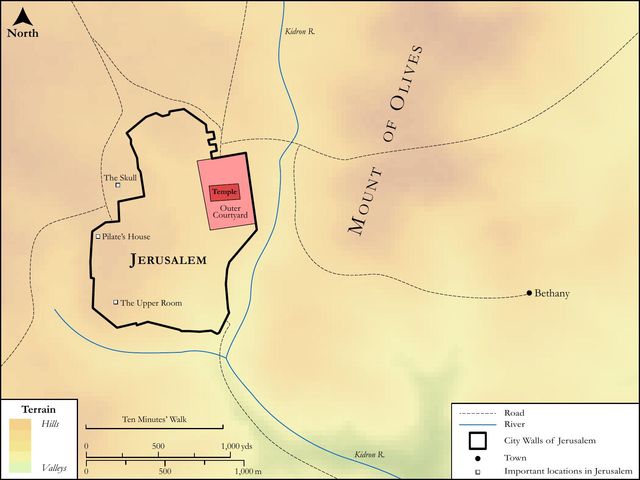
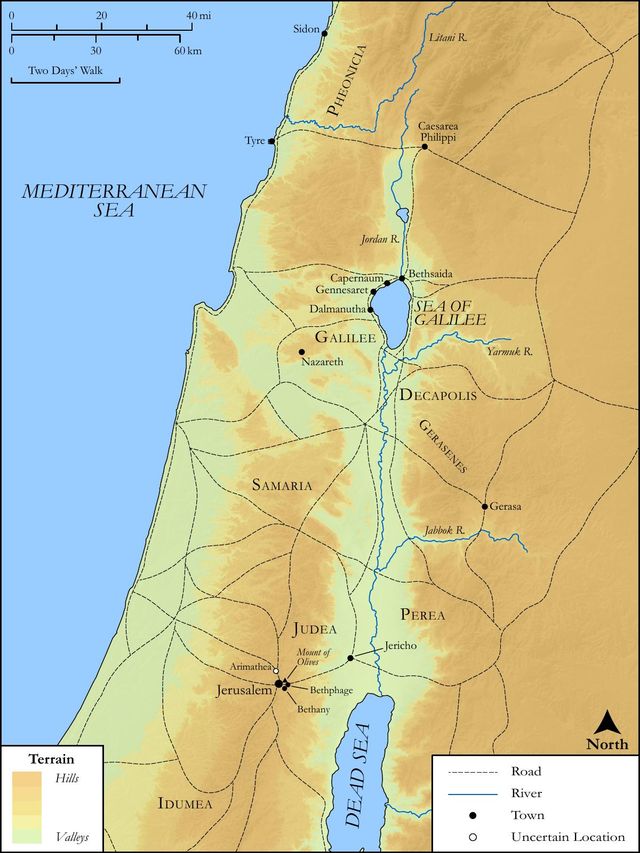
See on the biblical-era maps
Study this verse
Public-domain commentary
Matthew Henry
From his Commentary on the Whole Bible. Henry comments on passages, not single verses — this entry covers Mark 1:29–39. His three-level outline is real structure in the source text, so it is rendered as structure.
In these verses, we have,
I.A particular account of one miracle that Christ wrought, in the cure of Peter's wife's mother, who was ill of a fever. This passage we had before, in Matthew. Observe,
1.When Christ had done that which spread his fame throughout all parts, he did not then sit still, as some think that they may lie in bed when their name is up. No, he continued to do good, for that was it he aimed at, and not his own honour. Nay, those who are in reputation, had need be busy and careful to keep it up.
2.When he came out of the synagogue, where he had taught and healed with a divine authority, yet he conversed familiarly with the poor fishermen that attended him, and did not think it below him. Let the same mind, the same lowly mind, be in us, that was in him.
3.He went into Peter's house, probably invited thither to such entertainment as a poor fisherman could give him, and he accepted of it. The apostles left all for Christ; so far as that what they had should not hinder them from him, yet not so, but that they might use it for him.
4.He cured his mother-in-law, who was sick. Wherever Christ comes, he comes to do good, and will be sure to pay richly for his entertainment. Observe, How complete the cure was; when the fever left her, it did not, as usual, leave her weak, but the same hand that healed her, strengthened her, so that she was able to minister to them; the cure is in order to that, to fit for action, that we may minister to Christ, and to those that are his for his sake.
II.A general account of many cures he wrought - diseases healed, devils expelled.
It was on the evening of the sabbath, when the sun did set, or was set; perhaps many scrupled bringing their sick to him, till the sabbath was over, but their weakness therein was no prejudice to them in applying to Christ. Though he proved it lawful to heal on the sabbath days, yet, if any stumbled at it, they were welcome at another time. Now observe,
1.How numerous the patients were; All the city was gathered at the door, as beggars for a dole. That one cure in the synagogue occasioned this crowding after him. Others speeding well with Christ should quicken us in our enquiries after him. Now the Sun of righteousness rises with healing under his wings; to him shall the gathering of the people be. Observe, How Christ was flocked after in a private house, as well as in the synagogue; wherever he is, there let his servants, his patients, be. And in the evening of the sabbath, when the public worship is over, we must continue our attendance upon Jesus Christ; he healed, as Paul preached, publicly, and from house to house.
2.How powerful the Physician was; he healed all that were brought to him, though ever so many. Nor was it some one particular disease, that Christ set up for the cure of, but he healed those that were sick of divers diseases, for his word was a panpharmacon - a salve for every sore. And that miracle particularly which he wrought in the synagogue, he repeated in the house at night; for he cast out many devils, and suffered not the devils to speak, for he made them know who he was, and that silenced them. Or, He suffered them not to say that they knew him (so it may be read); he would not permit any more of them to say, as they did (Mar 1:24), I know thee, who thou art.
III.His retirement to his private devotion (Mar 1:35); He prayed, prayed alone; to set us an example of secret prayer.
Though as God he was prayed to, as man he prayed. Though he was glorifying God, and doing good, in his public work, yet he found time to be alone with his Father; and thus it became him to fulfil all righteousness. Now observe,
1.The time when Christ prayed.
(1.)It was in the morning, the morning after the sabbath day. Note, When a sabbath day is over and past, we must not think that we may intermit our devotion till the next sabbath: no, though we go not to the synagogue, we must go to the throne of grace, every day in the week; and the morning after the sabbath particularly, that we may preserve the good impressions of the day. This morning was the morning of the first day of the week, which afterward he sanctified, and made remarkable, by another sort of rising early.
(2.)It was early, a great while before day. When others were asleep in their beds, he was praying, as a genuine Son of David, who seeks God early, and directs his prayer in the morning; nay, and at midnight will rise to give thanks. It has been said, The morning is a friend to the Muses - Aurora Musis amica; and it is no less so to the Graces. When our spirits are most fresh and lively, then we should take time for devout exercises. He that is the first and best, ought to have the first and best.
2.The place where he prayed; He departed into a solitary place, either out of town, or some remote garden or out-building. Though he was in no danger of distraction, or of temptation to vain-glory, yet he retired, to set us an example to his own rule, When thou prayest enter into thy closet. Secret prayer must be made secretly. Those that have the most business in public, and of the best kind, must sometimes be alone with God; must retire into solitude, there to converse with God, and keep up communion with him.
IV.His return to his public work.
The disciples thought they were up early, but found their Master was up before them, and they enquired which way he went, followed him to his solitary place, and there found him at prayer, Mar 1:36, Mar 1:37. They told him that he was much wanted, that there were a great many patients waiting for him; All men seek for thee. They were proud that their Master was become so popular already, and would have him appear in public, yet more in that place, because it was their own city; and we are apt to be partial to the places we know and are interested in. "No," saith Christ, "Capernaum must not have the monopoly of the Messiah's preaching and miracles. Let us go into the next towns, the villages that lie about here, that I may preach there also, and work miracles there, for therefore came I forth, not to be constantly resident in one place, but to go about doing good." Even the inhabitants of the villages in Israel shall rehearse the righteous acts of the Lord, Jdg 5:11. Observe, Christ had still an eye to the end wherefore he came forth, and closely pursued that; nor will he be drawn by importunity, or the persuasions of his friends, to decline from that; for (Mar 1:39) he preached in their synagogues throughout all Galilee, and, to illustrate and confirm his doctrine, he cast out devils. Note, Christ's doctrine is Satan's destruction.
Historical interpretation
Fifteen Centuries of Reception
7 surviving comments on this verse. Each one is dated, so this reads as a timeline rather than a list.
Select a marker to jump to its quote. Markers stagger vertically where authors wrote within a few decades of each other.
(Pseudo Aug. Quæst. e Vet. et Nov. Test. xvi.) For the devils knew that He was the Christ, who had been promised by the Law: for they saw in Him all the signs, which had been foretold by the Prophets; but they were ignorant of His divinity, as also were their princes, for if they had known it, they would not have crucified the Lord of glory. (1 Cor. 2:8)
But the door of the kingdom, morally, is repentance and faith, which works health for various diseases; for divers are the vices, with which the city of this world is sick.
(Vict. Ant. e Cat. in Marc.) Now in that he says many, all are to be understood according to the Scripture mode of expression.
(Vict. Ant. e Cat. in Marc.) And Luke does not contradict this, when he says, that devils came out of many, crying out and saying, Thou art Christ the Son of God: (Luke 4:41) for he subjoins, And he rebuking them, suffered them not to speak; for Mark, who passes over many things for the sake of brevity, speaks about what happened subsequently to the abovementioned words.
(ubi sup.) For, Him whom the devil had known as a man, wearied by His forty days' fast, without being able by tempting Him to prove whether He was the Son of God, he now by the power of His miracles understood or rather suspected to be the Son of God. The reason therefore why he persuaded the Jews to crucify Him, was not because he did not think that He was the Son of God, but because he did not foresee that he himself was to be condemned by Christ's death.
(ubi sup.) Again, in a mystical sense, the setting of the sun signifies the passion of Him, who said, As long as I am in the world, I am the light of the world. (John 9:5) And when the sun was going down, more demoniacs and sick persons were healed than before: because He who living in the flesh for a time taught a few Jews, has transmitted the gifts of faith and health to all the Gentiles throughout the world.
And he cast out many demons, etc. Luke writes more openly about these things: "Indeed, demons were coming out of many, crying out and saying: 'You are the Son of God.' And he rebuking them, would not allow them to speak, because they knew him to be the Christ" (Luke IV). Therefore the demons confessed the Son of God; and they knew him to be the Christ, because the devil knew him as a man fatigued by a forty-day fast, but could not ascertain by temptation whether he was also the Son of God; now through the power of signs he either understood or rather suspected he was the Son of God. He did not persuade the Jews to crucify him because he thought he was neither Christ nor the Son of God, but because he did not foresee that he would be damned by his death. Indeed, the Apostle says about this mystery hidden from ages that none of the rulers of this age knew it. For if they had known, they would never have crucified the Lord of glory (1 Cor. II). But the Psalmist makes clear why the Lord prevents demons from speaking, saying: "To the sinner, however, God said: Why do you declare my statutes and take my covenant in your mouth? You have hated discipline" (Psalm XLIX), and so on. Lest anyone following the preacher hears the errant. For the devil is an evil teacher, who often mixes falsehood with truth, so as to cover the testimony of deceit with the appearance of truth.
Because the multitude thought that it was not lawful to heal on the sabbath day, they waited for the evening, to bring those who were to be healed to Jesus. Wherefore it is said, And at even, when the sun had set. There follows, and he healed many that were vexed with divers diseases.
Or he says many, because there were some faithless persons, who could not at all be cured on account of their unfaithfulness. Therefore He healed many of those who were brought, that is, all who had faith. It goes on, and cast out many devils.
Furthermore, the reason that He forbade the devils to speak, was to teach us not to believe them, even if they say true. For if once they find persons to believe them, they mingle truth with falsehood.
There is an activity of God displayed throughout creation, a wholesale activity let us say which men refuse to recognize. The miracles done by God incarnate, living as a man in Palestine, perform the very same things as this wholesale activity, but at a different speed and on a smaller scale. One of their chief purposes is that men, having seen a thing done by personal power on the small scale, may recognize, when they see the same thing done on the large scale, that the power behind it is also personal – is indeed the very same person who lived among us two thousand years ago. The miracles in fact are a retelling in small letters of the very same story which is written across the whole world in letters too large for some of us to see...
The miracles of healing fall into the same pattern. This is sometimes obscured for us by the somewhat magical view we tend to take of ordinary medicine. The doctors themselves do not take this view. The magic is not in the medicine but in the patient’s body. What the doctor does is to stimulate Nature’s functions in the body, or to remove hindrances. In a sense, though we speak for convenience of healing a cut, every cut heals itself; no dressing will make skin grow over a cut on a corpse. That same mysterious energy which we call gravitational when it steers the planets and biochemical when it heals a body is the efficient cause of all recoveries, and if God exists, that energy, directly or indirectly, is His. All who are cured are cured by Him, the healer within. But once He did it visibly, a Man meeting a man. Where He does not work within us in this mode, the organism dies. Hence Christ’s one miracle of destruction is also in harmony with God’s wholesale activity. His bodily hand held out in symbolic wrath blasted a single fig tree; but no tree died that year in Palestine, or any year, or in any land, or even ever will, save because He has done something, or (more likely) ceased to do something, to it.
Continue studying Mark 1:34 across the web’s major study libraries — every link below opens this exact verse, chapter, or book on the destination site.
Read & Compare
 BibleGatewayThis verse in more than 200 translations and 70 languages.
 Bible.comThe YouVersion reader — hundreds of translations, reading plans, and highlights.
 ESV.orgCrossway's official English Standard Version reader.
 NET BibleThe NET translation with 60,000+ translators' notes on every rendering decision.
 STEP BibleTyndale House's free study tool — original text, vocabulary, and scholarly resources.
 BibliaLogos Bible Software's free web reader.
 USCCBThe New American Bible (Revised Edition) with the U.S. bishops' study notes.
Commentaries
 BibleHub CommentariesDozens of classic commentaries on this verse, gathered on one page.
 StudyLightMore than 100 commentary sets — the largest collection on the web.
 BibleRefPlain-English commentary on what this verse means, verse by verse.
 Enduring WordDavid Guzik's free commentary on this chapter, widely used by Bible teachers.
 Bible Study ToolsVerse commentary alongside Greek and Hebrew study aids.
Original Language & Research
- BibleHub InterlinearThe verse word by word — original language, transliteration, and English.
- BibleHub LexiconEvery word's original-language definition and Strong's entry.
 Blue Letter BibleDeep-study tools — Strong's numbers, concordance, and word studies.
 CNTR CollationThe earliest Greek manuscripts of this verse, collated letter by letter.
Sermons, Hymns & Audio


TrulyRandomVerse is not affiliated with these sites and doesn’t control their content. They’re linked because they’re genuinely useful.
Summary
Mark 1:34 encapsulates a pivotal moment in Jesus' early ministry in Capernaum, vividly portraying His comprehensive authority over both physical ailments and demonic oppression. Following a busy Sabbath day, as evening fell, a multitude gathered at Peter's house, bringing the sick and demon-possessed. Jesus responded with boundless compassion and divine power, healing a wide array of diseases and casting out numerous evil spirits. Crucially, He silenced the demons, who, recognizing His true identity, were forbidden to speak, thereby demonstrating His strategic control over the revelation of His messianic mission.
Context
ShowHideLiterary Context
Mark 1:34 concludes a remarkably intense and authoritative day for Jesus in Capernaum, serving as a powerful demonstration of His burgeoning ministry. Immediately preceding this verse, Jesus had taught in the synagogue with unprecedented authority, astonishing His audience, and dramatically cast out an unclean spirit from a man, establishing His dominion over spiritual forces. Following this public display, He moved to Simon Peter's house, where He privately healed Peter's mother-in-law of a fever. The transition from the Sabbath to evening (sunset) is crucial, as it marked the end of the Sabbath's restrictions, allowing people to travel and bring the sick for healing without violating the law. This verse, therefore, depicts the culmination of a day marked by divine power, compassion, and the initial unveiling of Jesus' unique identity and mission.
Historical & Cultural Context
First-century Jewish society, particularly in Galilee, was deeply religious and keenly aware of spiritual forces. Sickness and demon possession were often attributed to sin, divine judgment, or the direct influence of evil spirits. Capernaum, a bustling fishing village on the Sea of Galilee, served as Jesus' early ministry base, making it a natural focal point for His activities. The end of the Sabbath at sunset was a significant cultural marker, as it permitted activities forbidden on the holy day, such as carrying the sick or performing extensive healing. The widespread belief in demons and the pervasive nature of illness meant that large crowds would naturally flock to anyone demonstrating the power to alleviate such suffering. The people's desperation and their immediate response to Jesus' earlier miracles underscore the societal need and the profound impact of His healing ministry.
Key Themes
ShowHideMark 1:34 contributes significantly to several overarching themes in Mark's Gospel and the broader biblical narrative. Foremost is the theme of Jesus' unparalleled authority, demonstrated not only in His teaching but powerfully in His dominion over both physical disease and malevolent spiritual forces. This verse highlights His comprehensive healing ministry, showcasing His compassion and ability to address all forms of human suffering. It also reinforces the inbreaking of the Kingdom of God, as Jesus' actions directly confront and dismantle the kingdom of darkness. A critical theme underscored here is the Messianic Secret, where Jesus deliberately silences the demons who recognize Him as the Son of God. This strategic suppression of His identity, also seen in Mark 1:25, Mark 3:11-12, and Mark 8:30, suggests Jesus' desire to control the timing and nature of His revelation, ensuring His messiahship is understood through His suffering and resurrection, not through sensational or politically charged proclamations.
Exposition and Analysis
ShowHideKey Word Analysis
ShowHideThis verb signifies to "wait upon menially," and by extension, to "relieve of disease" or "cure." It implies a careful, attentive ministration to the sick. In the context of Jesus' actions, it speaks to His compassionate engagement with human suffering, not merely a distant act of power, but a personal and thorough restoration of health.
This term refers to "demonic beings" or "evil spirits." It does not refer to Satan himself, but to the numerous lesser, malevolent spiritual entities that serve him. The repeated use of this plural noun emphasizes the pervasive presence of spiritual evil and the multitude of encounters Jesus had with these forces, underscoring His consistent and overwhelming victory over them.
This primary verb, used in its perfect tense in this context, denotes a direct, intuitive, and complete knowledge, rather than knowledge gained through learning or experience. It highlights the supernatural awareness of the demons, who, unlike many humans, immediately recognized Jesus' divine identity and authority, even before His disciples fully grasped it.
Verse Breakdown
ShowHide"And he healed many that were sick of divers diseases"
This clause emphasizes the vast scope and variety of Jesus' healing ministry. "Many" (Greek: polys) indicates a large number of individuals, and "divers diseases" (Greek: poikilos nósos) signifies a wide range of ailments, from common fevers to more severe or chronic conditions. This demonstrates Jesus' universal compassion and His power to overcome every form of physical suffering, leaving no malady beyond His reach.
"and cast out many devils"
Following the healing, this phrase highlights Jesus' equally potent authority over the spiritual realm. "Cast out" (Greek: ekbállō) is a strong verb, implying a forceful expulsion or ejection. The presence of "many devils" (Greek: polys daimónion) underscores the pervasive nature of demonic activity in the world and Jesus' consistent, decisive victory over these dark forces, asserting His dominion over Satan's kingdom.
"and suffered not the devils to speak, because they knew him"
This final clause introduces the significant theme of the "Messianic Secret." "Suffered not" (Greek: ouk aphíēmi) conveys Jesus' deliberate and firm prohibition. The reason for this silencing is explicitly stated: "because they knew him" (Greek: hóti eídō autós). The demons, possessing supernatural knowledge, recognized Jesus as the Son of God, the Messiah. Jesus' command to silence them was a strategic move to control the timing and nature of His messianic revelation, preventing a premature or politically misconstrued understanding of His identity and mission, which was ultimately to be defined by His suffering and resurrection, not by sensational proclamations from evil spirits.
Literary Devices
ShowHideMark 1:34 is rich in literary devices that amplify its theological message. The use of Hyperbole or Generalization in "many" and "divers diseases" effectively conveys the overwhelming scale of Jesus' healing ministry, suggesting that no one was turned away and no illness was beyond His power. The strong verb "cast out" (Greek: ekbállō) functions as Vivid Imagery, painting a picture of forceful expulsion and Jesus' decisive authority over the demonic realm. The entire verse, particularly the silencing of the demons, serves as Foreshadowing for the "Messianic Secret," a recurring motif in Mark's Gospel where Jesus deliberately manages the revelation of His identity. There is also an implicit Contrast between the demons' supernatural knowledge of Jesus' true identity and their forced silence, highlighting Jesus' sovereign control over even His adversaries' testimony.
Theological and Thematic Connections
ShowHideMark 1:34 profoundly illustrates Jesus' divine authority and compassionate nature, revealing Him as the one who inaugurates God's kingdom by directly confronting the forces of evil and suffering. His ability to heal "divers diseases" and "cast out many devils" demonstrates His comprehensive dominion over both the physical and spiritual realms, signifying that He is not merely a prophet or a healer, but the Son of God with ultimate power. This verse establishes Jesus as the Great Physician and the Conqueror of darkness, fulfilling ancient prophecies regarding the Messiah's power to bring liberation and restoration. It underscores the reality of spiritual warfare and Jesus' decisive victory over the powers that hold humanity captive, offering a glimpse into the redemptive work He came to accomplish.
Reflection and Application
ShowHideMark 1:34 offers profound reassurance and guidance for believers today. It vividly portrays Jesus' boundless compassion and His absolute authority over every form of human suffering and spiritual oppression. In a world still plagued by illness, disease, and the insidious influence of evil, this verse reminds us that Jesus remains the sovereign Lord, capable of bringing healing and liberation. It calls us to place our trust in His power, knowing that no sickness is too great and no spiritual darkness is too strong for Him to overcome. Furthermore, Jesus' strategic silencing of the demons teaches us the importance of discerning the source and nature of truth. His desire for His identity to be understood through His character, actions, and ultimately His sacrificial work, rather than through sensational or distorted testimonies, highlights the need for a deep, humble, and biblically informed understanding of who He is. We are invited to follow Him, not for spectacle, but for genuine transformation and participation in His ongoing work of bringing light and healing to a broken world.
Questions for Reflection
ShowHideFAQ
ShowHideWhy did Jesus heal "many" but not "all" in Capernaum?
ShowHideThe text states Jesus "healed many" and "cast out many devils," implying a vast number but not necessarily every single person present. The Gospels often use "many" (Greek: polys) to indicate a large, significant quantity without necessarily meaning "all." While Jesus certainly possessed the power to heal everyone, the focus of the narrative is on demonstrating His authority and the inbreaking of the Kingdom of God, rather than a statistical account of every individual healed. Furthermore, Jesus' ministry was not solely about physical healing but about proclaiming the good news of the Kingdom and calling people to repentance and faith, as seen in Mark 1:38. His primary mission was spiritual, with physical healing serving as a powerful sign of His divine identity and the holistic restoration He offers.
What is the significance of Jesus silencing the demons?
ShowHideJesus' silencing of the demons is a key aspect of the "Messianic Secret" in Mark's Gospel. The demons, being supernatural beings, recognized Jesus' true identity as the Son of God (e.g., Mark 1:24). However, Jesus consistently commanded them not to speak. This was likely for several reasons:
How does this event connect to Old Testament prophecies?
ShowHideWhile Mark 1:34 itself does not explicitly cite an Old Testament prophecy, the parallel account in Matthew 8:16-17 directly connects Jesus' healing ministry to Isaiah 53:4. Isaiah 53 describes the Suffering Servant who "bore our griefs and carried our sorrows." Matthew interprets this as Jesus taking on the infirmities and diseases of the people through His healing work. This connection highlights that Jesus' acts of compassion and power were not random but were part of God's redemptive plan, fulfilling the prophetic expectations of the Messiah who would bring healing and deliverance to His people.
Christ-Centered Fulfillment
ShowHideMark 1:34, with its vivid portrayal of Jesus' comprehensive authority over sickness and demonic forces, serves as a powerful Christ-centered fulfillment of God's promise to redeem and restore His creation. Jesus' healing of "divers diseases" and casting out of "many devils" is not merely an act of compassion, but a tangible demonstration of the inbreaking of God's Kingdom, directly confronting and dismantling the kingdom of darkness. Every healing and every exorcism was a signpost pointing to the ultimate victory Jesus would achieve over sin, death, and the devil. His authority in Capernaum foreshadows His ultimate triumph on the cross, where He disarmed the spiritual powers and authorities, making a public spectacle of them (Colossians 2:15). The silencing of the demons, who knew His true identity, underscores that His messiahship would not be defined by sensationalism or political power, but by His humble obedience to the Father, leading to His sacrificial death and glorious resurrection. Through His atoning work, Jesus, the Lamb of God, truly takes away the sin of the world (John 1:29), destroying the works of the devil (1 John 3:8) and offering ultimate healing and liberation from the bondage of sin and death (Hebrews 2:14-15). His early ministry in Mark 1:34 is a preview of the new heavens and new earth, where God will wipe away every tear, and there will be no more death, sorrow, crying, or pain (Revelation 21:4).