


Mark 1:33
- καὶkaiAndG2532CONJConjunction
- ἦνēnwasG1510V-IAI-3SVerb Imperfect Active Indicative 3rd Singular
- ὅληholēallG3650A-NSFAdjective Nominative Singular Feminine
- ἡhētheG3588T-NSFDefinite article Nominative Singular Feminine
- πόλιςpoliscityG4172N-NSFNoun Nominative Singular Feminine
- ἐπισυνηγμένηepisunēgmenēgatheredG1996V-RPP-NSFVerb Perfect Passive Participle Nominative Singular Feminine
- πρὸςprosatG4314PREPPreposition
- τὴνtēntheG3588T-ASFDefinite article Accusative Singular Feminine
- θύρανthurandoorG2374N-ASFNoun Accusative Singular Feminine
English is a literal word-by-word gloss of the Greek, not the KJV's wording. Why?
This is the original text the KJV's translators worked from — each Greek word with its own literal English meaning in this verse, prepared by scholars at Tyndale House, Cambridge. The KJV translates whole sentences, not word by word, so its wording differs: one Greek word can become several English words, and the KJV may choose “charity” where the gloss reads “love”. Both are faithful — they answer different questions. For the KJV's own rendering, switch to the KJV text.
Details
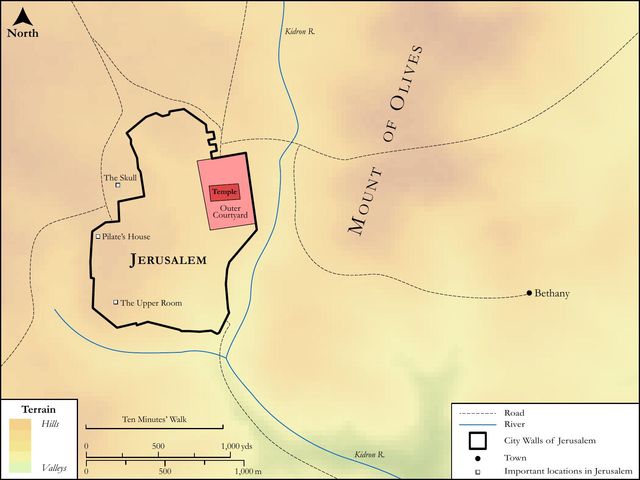
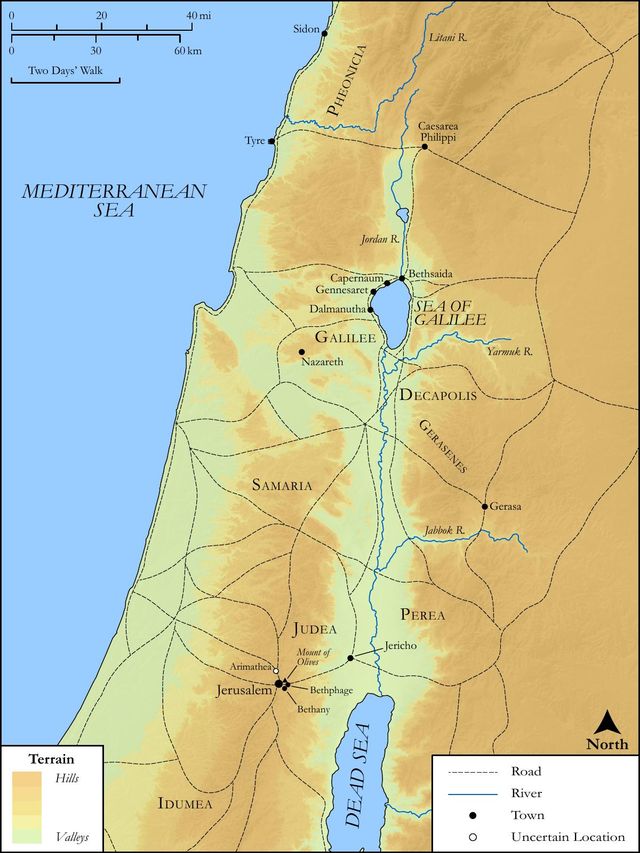
See on the biblical-era map
Study this verse
Public-domain commentary
Matthew Henry
From his Commentary on the Whole Bible. Henry comments on passages, not single verses — this entry covers Mark 1:29–39. His three-level outline is real structure in the source text, so it is rendered as structure.
In these verses, we have,
I.A particular account of one miracle that Christ wrought, in the cure of Peter's wife's mother, who was ill of a fever. This passage we had before, in Matthew. Observe,
1.When Christ had done that which spread his fame throughout all parts, he did not then sit still, as some think that they may lie in bed when their name is up. No, he continued to do good, for that was it he aimed at, and not his own honour. Nay, those who are in reputation, had need be busy and careful to keep it up.
2.When he came out of the synagogue, where he had taught and healed with a divine authority, yet he conversed familiarly with the poor fishermen that attended him, and did not think it below him. Let the same mind, the same lowly mind, be in us, that was in him.
3.He went into Peter's house, probably invited thither to such entertainment as a poor fisherman could give him, and he accepted of it. The apostles left all for Christ; so far as that what they had should not hinder them from him, yet not so, but that they might use it for him.
4.He cured his mother-in-law, who was sick. Wherever Christ comes, he comes to do good, and will be sure to pay richly for his entertainment. Observe, How complete the cure was; when the fever left her, it did not, as usual, leave her weak, but the same hand that healed her, strengthened her, so that she was able to minister to them; the cure is in order to that, to fit for action, that we may minister to Christ, and to those that are his for his sake.
II.A general account of many cures he wrought - diseases healed, devils expelled.
It was on the evening of the sabbath, when the sun did set, or was set; perhaps many scrupled bringing their sick to him, till the sabbath was over, but their weakness therein was no prejudice to them in applying to Christ. Though he proved it lawful to heal on the sabbath days, yet, if any stumbled at it, they were welcome at another time. Now observe,
1.How numerous the patients were; All the city was gathered at the door, as beggars for a dole. That one cure in the synagogue occasioned this crowding after him. Others speeding well with Christ should quicken us in our enquiries after him. Now the Sun of righteousness rises with healing under his wings; to him shall the gathering of the people be. Observe, How Christ was flocked after in a private house, as well as in the synagogue; wherever he is, there let his servants, his patients, be. And in the evening of the sabbath, when the public worship is over, we must continue our attendance upon Jesus Christ; he healed, as Paul preached, publicly, and from house to house.
2.How powerful the Physician was; he healed all that were brought to him, though ever so many. Nor was it some one particular disease, that Christ set up for the cure of, but he healed those that were sick of divers diseases, for his word was a panpharmacon - a salve for every sore. And that miracle particularly which he wrought in the synagogue, he repeated in the house at night; for he cast out many devils, and suffered not the devils to speak, for he made them know who he was, and that silenced them. Or, He suffered them not to say that they knew him (so it may be read); he would not permit any more of them to say, as they did (Mar 1:24), I know thee, who thou art.
III.His retirement to his private devotion (Mar 1:35); He prayed, prayed alone; to set us an example of secret prayer.
Though as God he was prayed to, as man he prayed. Though he was glorifying God, and doing good, in his public work, yet he found time to be alone with his Father; and thus it became him to fulfil all righteousness. Now observe,
1.The time when Christ prayed.
(1.)It was in the morning, the morning after the sabbath day. Note, When a sabbath day is over and past, we must not think that we may intermit our devotion till the next sabbath: no, though we go not to the synagogue, we must go to the throne of grace, every day in the week; and the morning after the sabbath particularly, that we may preserve the good impressions of the day. This morning was the morning of the first day of the week, which afterward he sanctified, and made remarkable, by another sort of rising early.
(2.)It was early, a great while before day. When others were asleep in their beds, he was praying, as a genuine Son of David, who seeks God early, and directs his prayer in the morning; nay, and at midnight will rise to give thanks. It has been said, The morning is a friend to the Muses - Aurora Musis amica; and it is no less so to the Graces. When our spirits are most fresh and lively, then we should take time for devout exercises. He that is the first and best, ought to have the first and best.
2.The place where he prayed; He departed into a solitary place, either out of town, or some remote garden or out-building. Though he was in no danger of distraction, or of temptation to vain-glory, yet he retired, to set us an example to his own rule, When thou prayest enter into thy closet. Secret prayer must be made secretly. Those that have the most business in public, and of the best kind, must sometimes be alone with God; must retire into solitude, there to converse with God, and keep up communion with him.
IV.His return to his public work.
The disciples thought they were up early, but found their Master was up before them, and they enquired which way he went, followed him to his solitary place, and there found him at prayer, Mar 1:36, Mar 1:37. They told him that he was much wanted, that there were a great many patients waiting for him; All men seek for thee. They were proud that their Master was become so popular already, and would have him appear in public, yet more in that place, because it was their own city; and we are apt to be partial to the places we know and are interested in. "No," saith Christ, "Capernaum must not have the monopoly of the Messiah's preaching and miracles. Let us go into the next towns, the villages that lie about here, that I may preach there also, and work miracles there, for therefore came I forth, not to be constantly resident in one place, but to go about doing good." Even the inhabitants of the villages in Israel shall rehearse the righteous acts of the Lord, Jdg 5:11. Observe, Christ had still an eye to the end wherefore he came forth, and closely pursued that; nor will he be drawn by importunity, or the persuasions of his friends, to decline from that; for (Mar 1:39) he preached in their synagogues throughout all Galilee, and, to illustrate and confirm his doctrine, he cast out devils. Note, Christ's doctrine is Satan's destruction.
Historical interpretation
Fifteen Centuries of Reception
6 surviving comments on this verse. Each one is dated, so this reads as a timeline rather than a list.
Select a marker to jump to its quote. Markers stagger vertically where authors wrote within a few decades of each other.
(Pseudo Aug. Quæst. e Vet. et Nov. Test. xvi.) For the devils knew that He was the Christ, who had been promised by the Law: for they saw in Him all the signs, which had been foretold by the Prophets; but they were ignorant of His divinity, as also were their princes, for if they had known it, they would not have crucified the Lord of glory. (1 Cor. 2:8)
But the door of the kingdom, morally, is repentance and faith, which works health for various diseases; for divers are the vices, with which the city of this world is sick.
(Vict. Ant. e Cat. in Marc.) Now in that he says many, all are to be understood according to the Scripture mode of expression.
(Vict. Ant. e Cat. in Marc.) And Luke does not contradict this, when he says, that devils came out of many, crying out and saying, Thou art Christ the Son of God: (Luke 4:41) for he subjoins, And he rebuking them, suffered them not to speak; for Mark, who passes over many things for the sake of brevity, speaks about what happened subsequently to the abovementioned words.
(ubi sup.) For, Him whom the devil had known as a man, wearied by His forty days' fast, without being able by tempting Him to prove whether He was the Son of God, he now by the power of His miracles understood or rather suspected to be the Son of God. The reason therefore why he persuaded the Jews to crucify Him, was not because he did not think that He was the Son of God, but because he did not foresee that he himself was to be condemned by Christ's death.
(ubi sup.) Again, in a mystical sense, the setting of the sun signifies the passion of Him, who said, As long as I am in the world, I am the light of the world. (John 9:5) And when the sun was going down, more demoniacs and sick persons were healed than before: because He who living in the flesh for a time taught a few Jews, has transmitted the gifts of faith and health to all the Gentiles throughout the world.
Because the multitude thought that it was not lawful to heal on the sabbath day, they waited for the evening, to bring those who were to be healed to Jesus. Wherefore it is said, And at even, when the sun had set. There follows, and he healed many that were vexed with divers diseases.
Or he says many, because there were some faithless persons, who could not at all be cured on account of their unfaithfulness. Therefore He healed many of those who were brought, that is, all who had faith. It goes on, and cast out many devils.
Furthermore, the reason that He forbade the devils to speak, was to teach us not to believe them, even if they say true. For if once they find persons to believe them, they mingle truth with falsehood.
There is an activity of God displayed throughout creation, a wholesale activity let us say which men refuse to recognize. The miracles done by God incarnate, living as a man in Palestine, perform the very same things as this wholesale activity, but at a different speed and on a smaller scale. One of their chief purposes is that men, having seen a thing done by personal power on the small scale, may recognize, when they see the same thing done on the large scale, that the power behind it is also personal – is indeed the very same person who lived among us two thousand years ago. The miracles in fact are a retelling in small letters of the very same story which is written across the whole world in letters too large for some of us to see...
The miracles of healing fall into the same pattern. This is sometimes obscured for us by the somewhat magical view we tend to take of ordinary medicine. The doctors themselves do not take this view. The magic is not in the medicine but in the patient’s body. What the doctor does is to stimulate Nature’s functions in the body, or to remove hindrances. In a sense, though we speak for convenience of healing a cut, every cut heals itself; no dressing will make skin grow over a cut on a corpse. That same mysterious energy which we call gravitational when it steers the planets and biochemical when it heals a body is the efficient cause of all recoveries, and if God exists, that energy, directly or indirectly, is His. All who are cured are cured by Him, the healer within. But once He did it visibly, a Man meeting a man. Where He does not work within us in this mode, the organism dies. Hence Christ’s one miracle of destruction is also in harmony with God’s wholesale activity. His bodily hand held out in symbolic wrath blasted a single fig tree; but no tree died that year in Palestine, or any year, or in any land, or even ever will, save because He has done something, or (more likely) ceased to do something, to it.
Continue studying Mark 1:33 across the web’s major study libraries — every link below opens this exact verse, chapter, or book on the destination site.
Read & Compare
 BibleGatewayThis verse in more than 200 translations and 70 languages.
 Bible.comThe YouVersion reader — hundreds of translations, reading plans, and highlights.
 ESV.orgCrossway's official English Standard Version reader.
 NET BibleThe NET translation with 60,000+ translators' notes on every rendering decision.
 STEP BibleTyndale House's free study tool — original text, vocabulary, and scholarly resources.
 BibliaLogos Bible Software's free web reader.
 USCCBThe New American Bible (Revised Edition) with the U.S. bishops' study notes.
Commentaries
 BibleHub CommentariesDozens of classic commentaries on this verse, gathered on one page.
 StudyLightMore than 100 commentary sets — the largest collection on the web.
 BibleRefPlain-English commentary on what this verse means, verse by verse.
 Enduring WordDavid Guzik's free commentary on this chapter, widely used by Bible teachers.
 Bible Study ToolsVerse commentary alongside Greek and Hebrew study aids.
Original Language & Research
- BibleHub InterlinearThe verse word by word — original language, transliteration, and English.
- BibleHub LexiconEvery word's original-language definition and Strong's entry.
 Blue Letter BibleDeep-study tools — Strong's numbers, concordance, and word studies.
 CNTR CollationThe earliest Greek manuscripts of this verse, collated letter by letter.
Sermons, Hymns & Audio


TrulyRandomVerse is not affiliated with these sites and doesn’t control their content. They’re linked because they’re genuinely useful.
Summary
Mark 1:33 vividly captures the overwhelming public response to Jesus's burgeoning ministry in Capernaum, depicting an entire city converging upon the house where Jesus was staying. This scene immediately follows a day of intense ministry, including powerful teaching, exorcism, and healing, showcasing the magnetic effect of Jesus's divine authority and compassion on a populace desperate for relief and spiritual truth.
Context
ShowHideLiterary Context
This verse is a climactic summary of the immediate impact of Jesus's ministry in Capernaum, following a profoundly busy day. Earlier in the day, Jesus had taught with unparalleled authority in the synagogue, astonishing the crowds, and dramatically cast out an unclean spirit from a man, demonstrating His power over demonic forces (Mark 1:21-27). Immediately after leaving the synagogue, He went to Simon and Andrew's house, where He healed Simon's mother-in-law of a severe fever with a simple touch (Mark 1:29-31). Mark 1:32 notes that "when evening came, after the sun had set," people began bringing all who were sick or demon-possessed to Jesus. This timing is crucial, as the Sabbath ended at sunset, allowing people to travel and bring their sick without violating religious law. Verse 33 then describes the culmination of this influx: the entire city gathered at the door.
Historical & Cultural Context
Capernaum was a thriving fishing village and a significant customs post on the Sea of Galilee, making it a bustling center of activity and a strategic location for Jesus's early ministry. The widespread presence of sickness, disease, and demon possession was a stark reality in the ancient world, often without effective medical remedies, leading to profound suffering and social ostracism. People would gather at the homes of respected teachers or healers, often at the entrance, as a sign of respect and eager anticipation. The mention of the Sabbath ending is vital; Jewish law prohibited carrying burdens or engaging in healing work on the Sabbath, so people waited until sunset to bring their afflicted loved ones to Jesus. This mass gathering at a private residence underscores the desperate hope and immediate recognition of Jesus's unique power that had rapidly spread through the community.
Key Themes
ShowHideMark 1:33 powerfully contributes to several key themes within the Gospel of Mark. It highlights Jesus's Divine Authority and Power, as the sheer volume of people seeking healing and deliverance underscores the widespread recognition of His supernatural capabilities, which had been demonstrated throughout Mark 1. The scene also emphasizes the Overwhelming Human Need for physical healing and spiritual liberation, reflecting the pervasive suffering and oppression prevalent in society that only Jesus could address. Furthermore, it illustrates the Immediate and Magnetic Impact of Jesus's Ministry, showing how His presence and works instantly drew immense crowds, setting the stage for the constant public demand and lack of privacy that would characterize much of His earthly ministry, as seen in passages like Mark 1:35-37.
Exposition and Analysis
ShowHideKey Word Analysis
ShowHideFrom the same root as "polemos" (war) or "polys" (many), this word refers to a town, properly one with walls, of varying size. In Mark 1:33, "all the city" (πᾶσα ἡ πόλις, pasa hē pólis) is likely a hyperbole, signifying not literally every single inhabitant, but an immense, unprecedented throng. It conveys the idea that the entire community, or at least a significant and representative portion, was present, underscoring the widespread impact of Jesus's ministry.
Derived from "epi" (upon) and "synagō" (to collect), this verb means "to collect upon the same place." It emphasizes a deliberate and concentrated assembly. The imperfect tense (was gathered) suggests an ongoing process or state, highlighting the continuous influx of people drawn to Jesus, creating a dense crowd at the door. It implies a spontaneous, yet focused, convergence.
Apparently a primary word, referring to a portal or entrance, whether the opening itself or the closure. In this context, it refers to the literal entrance of the house where Jesus was staying (likely Peter's home). The "door" becomes a symbolic focal point, representing accessibility to Jesus, the point of contact between desperate humanity and the divine healer, and the boundary between the private space and the public clamor.
Verse Breakdown
ShowHide"And all the city"
This phrase, as noted in the key word analysis, employs hyperbole to convey the extraordinary magnitude of the crowd. It signifies that news of Jesus's powerful teaching, exorcism, and healing had spread like wildfire throughout Capernaum, captivating the attention and hope of the entire community. It suggests a collective, unified response of the populace to Jesus's presence.
"was gathered together"
This clause describes the active and persistent convergence of the people. The use of the imperfect tense in Greek (G2258 ēn with G1996 episynágō) implies a continuous process—people kept arriving and accumulating. It paints a picture of a dense, expectant crowd, drawn by a common purpose: to seek Jesus. This gathering was not accidental but a deliberate movement towards the source of healing and hope.
"at the door"
This specific detail grounds the otherwise hyperbolic description. The "door" of the house (likely Peter's) became the epicenter of this massive gathering. It signifies the people's desire for proximity and access to Jesus. It also suggests a scene of intense anticipation, perhaps with individuals pressing forward, vying for a glimpse or a moment with the healer. The door represents the point of intersection between Jesus's private space and the public's desperate need.
Literary Devices
ShowHideMark 1:33 is rich in Vivid Imagery, painting a clear and immediate picture of a bustling, expectant crowd. The phrase "all the city" is a powerful example of Hyperbole, a deliberate exaggeration not meant to be taken literally, but to emphasize the immense scale and widespread nature of the public's response to Jesus. While not every single person in Capernaum was physically present, the expression conveys the idea that the entire community was represented or affected by this event. Furthermore, the use of "the city" to refer to its inhabitants can be seen as a form of Synecdoche, where a part (the city as a place) stands in for the whole (its people). This literary choice underscores the collective movement and unified focus of the populace. The detail "at the door" provides a specific, tangible focal point for this overwhelming scene, making the imagery even more immediate and impactful.
Theological and Thematic Connections
ShowHideMark 1:33 serves as a powerful testament to the immediate and undeniable impact of Jesus's ministry, revealing the profound spiritual and physical needs of humanity and the divine compassion that draws people to the Savior. The sheer volume of people flocking to Jesus underscores His unique authority and power, which transcends human limitations and offers genuine hope in a world plagued by suffering. This scene foreshadows Jesus's ongoing mission to heal, deliver, and teach, demonstrating that where the authentic presence of God is manifested, humanity will inevitably be drawn, seeking solace, truth, and transformation. It highlights the principle that divine power and love are inherently magnetic, drawing those in need to the source of life.
Reflection and Application
ShowHideThe scene at the door in Capernaum is a timeless reminder of humanity's deep-seated needs and the magnetic power of authentic divine presence. Just as the city flocked to Jesus, so too does the world today groan under the weight of physical ailments, emotional brokenness, and spiritual emptiness. This verse challenges us to consider our own response to Jesus: do we approach Him with the same urgency and desperation as those in Capernaum, recognizing Him as the ultimate source of healing and hope? It also calls us to cultivate a compassionate heart, seeing the "city gathered at the door" in our own communities—those silently suffering, those seeking answers, those longing for genuine connection. As followers of Christ, we are called to embody His love and truth, becoming channels through which His light can shine, drawing others to the "door" of salvation and the transformative power of the Gospel. Our lives should reflect the magnetic presence of Christ, making Him accessible to a world still desperately seeking what only He can offer.
Questions for Reflection
ShowHideFAQ
ShowHideWhy was "all the city" gathered at the door, and is this literal?
ShowHideThe phrase "all the city" (KJV) or "the whole city" (NIV) is best understood as a hyperbole, a common literary device in ancient texts to emphasize a large, representative gathering rather than a literal headcount of every single inhabitant. It signifies that an immense and unprecedented crowd had converged. The reason for this gathering was the rapid spread of news about Jesus's powerful ministry in Capernaum, particularly His teaching with authority, the dramatic exorcism in the synagogue (Mark 1:21-27), and the healing of Simon Peter's mother-in-law (Mark 1:29-31). People were desperate for healing from physical ailments and deliverance from spiritual oppression, and Jesus had proven Himself to be uniquely capable of providing both. The timing, "when evening came, after the sun had set" (Mark 1:32), was also crucial, as it marked the end of the Sabbath, allowing people to travel and bring their sick without violating religious law.
What is the significance of the crowd gathering "at the door"?
ShowHideThe specific detail of the crowd gathering "at the door" is highly significant. It indicates the literal entrance of the house where Jesus was staying, likely Peter's home. This location highlights several aspects: it signifies the people's intense desire for proximity and access to Jesus, pressing as close as possible to the source of healing. It also underscores the intimacy and personal nature of Jesus's ministry, as He was ministering from a private residence rather than a public forum. The "door" becomes a powerful symbol of the point of contact between the desperate needs of humanity and the divine power and compassion of Jesus. It suggests a scene of eager anticipation, perhaps with individuals vying for a glimpse, a touch, or a word from the one who could bring relief.
Christ-Centered Fulfillment
ShowHideMark 1:33, with its depiction of an entire city converging on Jesus, powerfully foreshadows the ultimate Christ-centered fulfillment of God's redemptive plan. Jesus is presented not merely as a local healer, but as the divine magnet, drawing all people to Himself. This immediate and overwhelming response in Capernaum is a microcosm of the universal drawing power of the Son of God, who declared, "And I, when I am lifted up from the earth, will draw all people to myself" (John 12:32). He is the ultimate "door" through whom humanity gains access to God, salvation, and eternal life, as He Himself proclaimed, "I am the door. If anyone enters by me, he will be saved and will go in and out and find pasture" (John 10:9). The physical healing and deliverance from evil spirits witnessed in Capernaum point to Jesus's greater work as the Lamb of God who takes away the sin of the world (John 1:29), offering spiritual healing and liberation from the bondage of sin and death. This scene anticipates the global mission of the Church, empowered by the Spirit, to continue drawing people from every "city" and nation to the saving grace found only in Christ, the one true healer and deliverer, who remains accessible to all who come to His "door" in faith.