


Mark 1:32
- ὈψίαςOpsiasWhen eveningG3798A-GSFAdjective Genitive Singular Feminine
- δὲdenowG1161CONJConjunction
- γενομένηςgenomenēshaving comeG1096V-2ADP-GSFVerb 2nd Aorist Middle Deponent Participle Genitive Singular Feminine
- ὅτεhotewhenG3753PREPPreposition
- ἔδυeduwent downG1416V-2AAI-3SVerb 2nd Aorist Active Indicative 3rd Singular
- ὁhotheG3588T-NSMDefinite article Nominative Singular Masculine
- ἥλιοςhēliossunG2246N-NSMNoun Nominative Singular Masculine
- ἔφερονepheronthey were bringingG5342V-IAI-3PVerb Imperfect Active Indicative 3rd Plural
- πρὸςprostoG4314PREPPreposition
- αὐτὸνautonHimG846P-ASMPersonal pronoun Accusative Singular Masculine
- πάνταςpantasallG3956A-APMAdjective Accusative Plural Masculine
- τοὺςtousthoseG3588T-APMDefinite article Accusative Plural Masculine
- κακῶςkakōssickG2560ADVAdverb
- ἔχονταςechontasbeingG2192V-PAP-APMVerb Present Active Participle Accusative Plural Masculine
- καὶkaiandG2532CONJConjunction
- τοὺςtousthoseG3588T-APMDefinite article Accusative Plural Masculine
- δαιμονιζομένους·daimonizomenousbeing demonisedG1139V-PNP-APMVerb Present Middle Or Passive Deponent Participle Accusative Plural Masculine
English is a literal word-by-word gloss of the Greek, not the KJV's wording. Why?
This is the original text the KJV's translators worked from — each Greek word with its own literal English meaning in this verse, prepared by scholars at Tyndale House, Cambridge. The KJV translates whole sentences, not word by word, so its wording differs: one Greek word can become several English words, and the KJV may choose “charity” where the gloss reads “love”. Both are faithful — they answer different questions. For the KJV's own rendering, switch to the KJV text.
Details
See on the biblical-era map
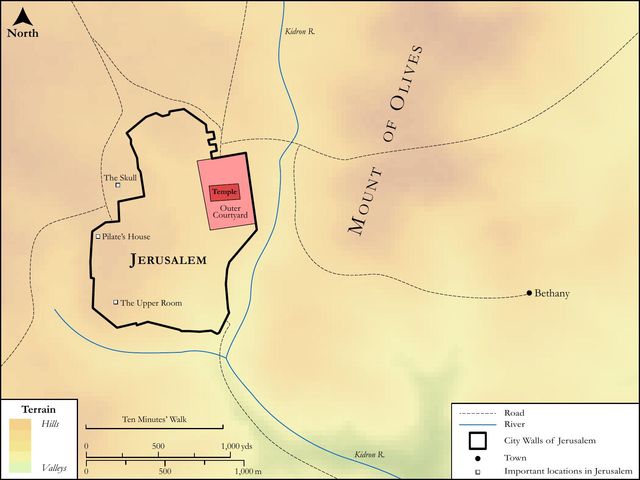
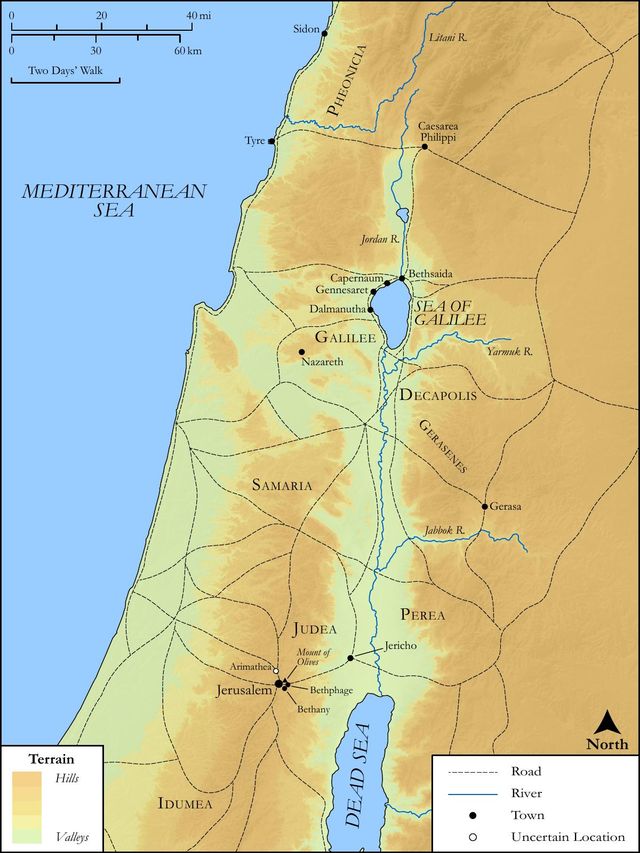
Study this verse
Public-domain commentary
Matthew Henry
From his Commentary on the Whole Bible. Henry comments on passages, not single verses — this entry covers Mark 1:29–39. His three-level outline is real structure in the source text, so it is rendered as structure.
In these verses, we have,
I.A particular account of one miracle that Christ wrought, in the cure of Peter's wife's mother, who was ill of a fever. This passage we had before, in Matthew. Observe,
1.When Christ had done that which spread his fame throughout all parts, he did not then sit still, as some think that they may lie in bed when their name is up. No, he continued to do good, for that was it he aimed at, and not his own honour. Nay, those who are in reputation, had need be busy and careful to keep it up.
2.When he came out of the synagogue, where he had taught and healed with a divine authority, yet he conversed familiarly with the poor fishermen that attended him, and did not think it below him. Let the same mind, the same lowly mind, be in us, that was in him.
3.He went into Peter's house, probably invited thither to such entertainment as a poor fisherman could give him, and he accepted of it. The apostles left all for Christ; so far as that what they had should not hinder them from him, yet not so, but that they might use it for him.
4.He cured his mother-in-law, who was sick. Wherever Christ comes, he comes to do good, and will be sure to pay richly for his entertainment. Observe, How complete the cure was; when the fever left her, it did not, as usual, leave her weak, but the same hand that healed her, strengthened her, so that she was able to minister to them; the cure is in order to that, to fit for action, that we may minister to Christ, and to those that are his for his sake.
II.A general account of many cures he wrought - diseases healed, devils expelled.
It was on the evening of the sabbath, when the sun did set, or was set; perhaps many scrupled bringing their sick to him, till the sabbath was over, but their weakness therein was no prejudice to them in applying to Christ. Though he proved it lawful to heal on the sabbath days, yet, if any stumbled at it, they were welcome at another time. Now observe,
1.How numerous the patients were; All the city was gathered at the door, as beggars for a dole. That one cure in the synagogue occasioned this crowding after him. Others speeding well with Christ should quicken us in our enquiries after him. Now the Sun of righteousness rises with healing under his wings; to him shall the gathering of the people be. Observe, How Christ was flocked after in a private house, as well as in the synagogue; wherever he is, there let his servants, his patients, be. And in the evening of the sabbath, when the public worship is over, we must continue our attendance upon Jesus Christ; he healed, as Paul preached, publicly, and from house to house.
2.How powerful the Physician was; he healed all that were brought to him, though ever so many. Nor was it some one particular disease, that Christ set up for the cure of, but he healed those that were sick of divers diseases, for his word was a panpharmacon - a salve for every sore. And that miracle particularly which he wrought in the synagogue, he repeated in the house at night; for he cast out many devils, and suffered not the devils to speak, for he made them know who he was, and that silenced them. Or, He suffered them not to say that they knew him (so it may be read); he would not permit any more of them to say, as they did (Mar 1:24), I know thee, who thou art.
III.His retirement to his private devotion (Mar 1:35); He prayed, prayed alone; to set us an example of secret prayer.
Though as God he was prayed to, as man he prayed. Though he was glorifying God, and doing good, in his public work, yet he found time to be alone with his Father; and thus it became him to fulfil all righteousness. Now observe,
1.The time when Christ prayed.
(1.)It was in the morning, the morning after the sabbath day. Note, When a sabbath day is over and past, we must not think that we may intermit our devotion till the next sabbath: no, though we go not to the synagogue, we must go to the throne of grace, every day in the week; and the morning after the sabbath particularly, that we may preserve the good impressions of the day. This morning was the morning of the first day of the week, which afterward he sanctified, and made remarkable, by another sort of rising early.
(2.)It was early, a great while before day. When others were asleep in their beds, he was praying, as a genuine Son of David, who seeks God early, and directs his prayer in the morning; nay, and at midnight will rise to give thanks. It has been said, The morning is a friend to the Muses - Aurora Musis amica; and it is no less so to the Graces. When our spirits are most fresh and lively, then we should take time for devout exercises. He that is the first and best, ought to have the first and best.
2.The place where he prayed; He departed into a solitary place, either out of town, or some remote garden or out-building. Though he was in no danger of distraction, or of temptation to vain-glory, yet he retired, to set us an example to his own rule, When thou prayest enter into thy closet. Secret prayer must be made secretly. Those that have the most business in public, and of the best kind, must sometimes be alone with God; must retire into solitude, there to converse with God, and keep up communion with him.
IV.His return to his public work.
The disciples thought they were up early, but found their Master was up before them, and they enquired which way he went, followed him to his solitary place, and there found him at prayer, Mar 1:36, Mar 1:37. They told him that he was much wanted, that there were a great many patients waiting for him; All men seek for thee. They were proud that their Master was become so popular already, and would have him appear in public, yet more in that place, because it was their own city; and we are apt to be partial to the places we know and are interested in. "No," saith Christ, "Capernaum must not have the monopoly of the Messiah's preaching and miracles. Let us go into the next towns, the villages that lie about here, that I may preach there also, and work miracles there, for therefore came I forth, not to be constantly resident in one place, but to go about doing good." Even the inhabitants of the villages in Israel shall rehearse the righteous acts of the Lord, Jdg 5:11. Observe, Christ had still an eye to the end wherefore he came forth, and closely pursued that; nor will he be drawn by importunity, or the persuasions of his friends, to decline from that; for (Mar 1:39) he preached in their synagogues throughout all Galilee, and, to illustrate and confirm his doctrine, he cast out devils. Note, Christ's doctrine is Satan's destruction.
Historical interpretation
Fifteen Centuries of Reception
7 surviving comments on this verse. Each one is dated, so this reads as a timeline rather than a list.
Select a marker to jump to its quote. Markers stagger vertically where authors wrote within a few decades of each other.
(Pseudo Aug. Quæst. e Vet. et Nov. Test. xvi.) For the devils knew that He was the Christ, who had been promised by the Law: for they saw in Him all the signs, which had been foretold by the Prophets; but they were ignorant of His divinity, as also were their princes, for if they had known it, they would not have crucified the Lord of glory. (1 Cor. 2:8)
But the door of the kingdom, morally, is repentance and faith, which works health for various diseases; for divers are the vices, with which the city of this world is sick.
(Vict. Ant. e Cat. in Marc.) Now in that he says many, all are to be understood according to the Scripture mode of expression.
(Vict. Ant. e Cat. in Marc.) And Luke does not contradict this, when he says, that devils came out of many, crying out and saying, Thou art Christ the Son of God: (Luke 4:41) for he subjoins, And he rebuking them, suffered them not to speak; for Mark, who passes over many things for the sake of brevity, speaks about what happened subsequently to the abovementioned words.
(ubi sup.) For, Him whom the devil had known as a man, wearied by His forty days' fast, without being able by tempting Him to prove whether He was the Son of God, he now by the power of His miracles understood or rather suspected to be the Son of God. The reason therefore why he persuaded the Jews to crucify Him, was not because he did not think that He was the Son of God, but because he did not foresee that he himself was to be condemned by Christ's death.
(ubi sup.) Again, in a mystical sense, the setting of the sun signifies the passion of Him, who said, As long as I am in the world, I am the light of the world. (John 9:5) And when the sun was going down, more demoniacs and sick persons were healed than before: because He who living in the flesh for a time taught a few Jews, has transmitted the gifts of faith and health to all the Gentiles throughout the world.
But when evening had come and the sun had set, they brought to him, etc. The setting of the sun signifies the passion and death of him who said: "As long as I am in the world, I am the light of the world" (John IX). And when the sun sets, more demoniacs than before, more sick are healed. Because while temporarily living in the flesh, he taught a few Jews, but after the defeat of the kingdom of death, he transmitted the gifts of faith and salvation to all the peoples of the world. To whom the Psalmist sings as if to the heralds of life and light: "Prepare the way for him who rides upon the sunset" (Psalm LXVII). For the Lord ascends over the sunset, because from where he lay in suffering, from there he manifested his greater glory by rising.
Because the multitude thought that it was not lawful to heal on the sabbath day, they waited for the evening, to bring those who were to be healed to Jesus. Wherefore it is said, And at even, when the sun had set. There follows, and he healed many that were vexed with divers diseases.
Or he says many, because there were some faithless persons, who could not at all be cured on account of their unfaithfulness. Therefore He healed many of those who were brought, that is, all who had faith. It goes on, and cast out many devils.
Furthermore, the reason that He forbade the devils to speak, was to teach us not to believe them, even if they say true. For if once they find persons to believe them, they mingle truth with falsehood.
There is an activity of God displayed throughout creation, a wholesale activity let us say which men refuse to recognize. The miracles done by God incarnate, living as a man in Palestine, perform the very same things as this wholesale activity, but at a different speed and on a smaller scale. One of their chief purposes is that men, having seen a thing done by personal power on the small scale, may recognize, when they see the same thing done on the large scale, that the power behind it is also personal – is indeed the very same person who lived among us two thousand years ago. The miracles in fact are a retelling in small letters of the very same story which is written across the whole world in letters too large for some of us to see...
The miracles of healing fall into the same pattern. This is sometimes obscured for us by the somewhat magical view we tend to take of ordinary medicine. The doctors themselves do not take this view. The magic is not in the medicine but in the patient’s body. What the doctor does is to stimulate Nature’s functions in the body, or to remove hindrances. In a sense, though we speak for convenience of healing a cut, every cut heals itself; no dressing will make skin grow over a cut on a corpse. That same mysterious energy which we call gravitational when it steers the planets and biochemical when it heals a body is the efficient cause of all recoveries, and if God exists, that energy, directly or indirectly, is His. All who are cured are cured by Him, the healer within. But once He did it visibly, a Man meeting a man. Where He does not work within us in this mode, the organism dies. Hence Christ’s one miracle of destruction is also in harmony with God’s wholesale activity. His bodily hand held out in symbolic wrath blasted a single fig tree; but no tree died that year in Palestine, or any year, or in any land, or even ever will, save because He has done something, or (more likely) ceased to do something, to it.
Continue studying Mark 1:32 across the web’s major study libraries — every link below opens this exact verse, chapter, or book on the destination site.
Read & Compare
 BibleGatewayThis verse in more than 200 translations and 70 languages.
 Bible.comThe YouVersion reader — hundreds of translations, reading plans, and highlights.
 ESV.orgCrossway's official English Standard Version reader.
 NET BibleThe NET translation with 60,000+ translators' notes on every rendering decision.
 STEP BibleTyndale House's free study tool — original text, vocabulary, and scholarly resources.
 BibliaLogos Bible Software's free web reader.
 USCCBThe New American Bible (Revised Edition) with the U.S. bishops' study notes.
Commentaries
 BibleHub CommentariesDozens of classic commentaries on this verse, gathered on one page.
 StudyLightMore than 100 commentary sets — the largest collection on the web.
 BibleRefPlain-English commentary on what this verse means, verse by verse.
 Enduring WordDavid Guzik's free commentary on this chapter, widely used by Bible teachers.
 Bible Study ToolsVerse commentary alongside Greek and Hebrew study aids.
Original Language & Research
- BibleHub InterlinearThe verse word by word — original language, transliteration, and English.
- BibleHub LexiconEvery word's original-language definition and Strong's entry.
 Blue Letter BibleDeep-study tools — Strong's numbers, concordance, and word studies.
 CNTR CollationThe earliest Greek manuscripts of this verse, collated letter by letter.
Sermons, Hymns & Audio


TrulyRandomVerse is not affiliated with these sites and doesn’t control their content. They’re linked because they’re genuinely useful.
Summary
Mark 1:32 vividly portrays the immense popular response to Jesus's early ministry in Capernaum. Following a day of authoritative teaching and miraculous healings, the entire town converged upon Him at sunset, bringing all who suffered from physical ailments and demonic oppression. This scene powerfully underscores Jesus's divine authority over sickness and evil spirits, His boundless compassion for humanity, and the desperate need for His transformative power.
Context
ShowHideLiterary Context
This verse immediately follows a whirlwind day of ministry for Jesus in Capernaum. Mark's Gospel emphasizes Jesus's authority from the outset, first through His teaching in the synagogue, which astonished the crowds because He taught "as one that had authority, and not as the scribes" (Mark 1:22). This was swiftly followed by the dramatic exorcism of an unclean spirit in the synagogue, further solidifying His unique power and spreading His fame "immediately throughout all the region round about Galilee" (Mark 1:28). Directly before the scene in verse 32, Jesus had moved from the synagogue to Simon Peter's house, where He healed Peter's mother-in-law of a fever, who then immediately served them (Mark 1:29-31). Thus, Mark 1:32 is the culmination of a day marked by extraordinary displays of divine power, setting the stage for the widespread public demand for Jesus's healing touch.
Historical & Cultural Context
The phrase "at even, when the sun did set" is crucial for understanding the timing of this event. In Jewish tradition, the Sabbath day officially ended at sunset on Saturday. During the Sabbath, strict prohibitions were in place against various forms of work, including carrying burdens, traveling long distances, and engaging in certain types of healing, particularly if it was not life-threatening. The people of Capernaum, respecting these Mosaic laws, waited until the Sabbath formally concluded before bringing their sick and demon-possessed loved ones to Jesus. This demonstrates their deep reverence for the law, even as their desperate need and burgeoning faith in Jesus's power compelled them to act the moment it was permissible. Capernaum itself was a bustling fishing village on the Sea of Galilee, a strategic location that allowed news of Jesus's miracles to spread rapidly throughout the region.
Key Themes
ShowHideMark 1:32 contributes significantly to several overarching themes in Mark's Gospel. Firstly, it highlights Jesus's Unrivaled Authority over all forms of suffering, whether physical illness or spiritual oppression. The sheer number of people brought to Him testifies to a widespread recognition of His unique power, far surpassing that of any conventional healer or religious leader. Secondly, the verse underscores Jesus's Profound Compassion for humanity. Despite an undoubtedly exhausting day of ministry, Jesus does not turn anyone away, demonstrating His tireless willingness to minister to the desperate and suffering. This aligns with the broader theme of Jesus's ministry as one of mercy and restoration, as seen in other healing narratives throughout Mark's Gospel. Thirdly, the specific timing of the event, at the End of the Sabbath, subtly introduces the theme of Jesus's relationship to the Mosaic Law. While the people waited for the Sabbath to end, Jesus would later challenge rigid interpretations of Sabbath laws, asserting that "the Sabbath was made for man, and not man for the Sabbath" (Mark 2:27). Finally, the explicit mention of "them that were possessed with devils" affirms the Reality of Spiritual Warfare and Jesus's absolute dominion over demonic forces, a recurring motif in Mark's portrayal of Jesus as the strong man who binds the strong man (Mark 3:27).
Exposition and Analysis
ShowHideKey Word Analysis
ShowHideThis word refers to the late part of the day, specifically the afternoon or nightfall. Its use here precisely marks the transition from the Sabbath day to the new day, indicating the cultural and religious significance of the timing. The people waited until the Sabbath officially ended at sunset to bring their sick, demonstrating their adherence to the law before seeking Jesus's healing.
Literally meaning "badly" or "grievously," this adverb describes the state of those who were suffering physically. It encompasses a wide range of ailments, from minor sicknesses to severe illnesses, indicating the comprehensive nature of the suffering brought to Jesus. This term highlights the pervasive human experience of physical brokenness that Jesus came to address.
This term, a middle voice form, means "to be exercised by a daemon" or "to be under the influence of demons." It distinctly refers to individuals afflicted by evil spirits, differentiating their condition from purely physical illnesses. The presence of such individuals underscores the spiritual battle Jesus was engaged in, demonstrating His authority not only over physical ailments but also over the forces of darkness.
Verse Breakdown
ShowHide"And at even, when the sun did set"
This phrase establishes the precise timing of the event, marking the end of the Sabbath day. It signifies the moment when Jewish law permitted activities like carrying the sick and seeking healing, which were restricted on the Sabbath. This detail highlights the people's respect for the law even as their desperation for Jesus's power grew.
"they brought unto him all that were diseased"
This clause describes the general populace bringing those suffering from various physical ailments to Jesus. The word "all" (Greek, pâs) suggests a vast multitude, indicating the widespread nature of sickness and the collective hope placed in Jesus as the Great Healer. It emphasizes the comprehensive scope of Jesus's healing ministry.
"and them that were possessed with devils"
This second category of individuals brought to Jesus specifically refers to those afflicted by demonic forces. This inclusion underscores Jesus's unique authority over the spiritual realm, distinguishing Him from ordinary healers. It highlights the dual nature of human suffering—physical and spiritual—both of which Jesus came to conquer.
Literary Devices
ShowHideMark 1:32 employs several powerful literary devices to convey its message. The use of Hyperbole is evident in the phrase "all that were diseased, and them that were possessed with devils," suggesting that virtually the entire town, or at least a significant portion, gathered at Peter's door. This exaggeration emphasizes the overwhelming need and the widespread recognition of Jesus's power. Symbolism is present in the "sunset," which not only marks the end of the Sabbath but also metaphorically represents the dawning of a new era—one where the light of Christ's healing and deliverance breaks through the darkness of human suffering and spiritual oppression. The vivid imagery of the crowd converging on Jesus's location creates a sense of Urgency and Drama, highlighting the immediate and pressing demand for His ministry. Furthermore, the Juxtaposition of physical illness ("diseased") and spiritual affliction ("possessed with devils") underscores the comprehensive nature of Jesus's redemptive work, demonstrating His authority over both the material and immaterial realms of human existence.
Theological and Thematic Connections
ShowHideMark 1:32 serves as a powerful testament to Jesus's multifaceted ministry, revealing Him as the divine physician and deliverer. It underscores the pervasive brokenness of humanity—both physically and spiritually—and highlights the desperate need for a Savior who possesses ultimate authority over all forms of suffering and evil. The scene demonstrates Jesus's boundless compassion, as He tirelessly ministers to the masses, embodying God's loving desire to restore and heal His creation. This gathering at sunset also foreshadows the universal appeal of the Gospel, where people from all walks of life, burdened by various afflictions, are drawn to the liberating power of Christ. It paints a picture of the kingdom of God breaking into the world, bringing light and healing to those in darkness.
Reflection and Application
ShowHideThe scene in Mark 1:32 offers profound encouragement and a timeless invitation for believers today. Just as the people of Capernaum, burdened by every conceivable physical and spiritual ailment, flocked to Jesus, we are likewise called to bring our entire selves—our sicknesses, our anxieties, our spiritual struggles, and our deepest needs—to Him. This verse reminds us that Jesus is not only capable but also profoundly willing to meet us in our brokenness. His compassion is undiminished, and His power remains absolute. We are encouraged to approach Him with the same urgency and faith demonstrated by the crowds, knowing that no problem is too great for His healing touch and liberating power. It challenges us to reflect on areas of our lives where we might be holding back from His complete sovereignty and to consider how we might bring others, like the people of Capernaum, into His healing presence through prayer, witness, and service.
Questions for Reflection
ShowHideFAQ
ShowHideWhy did the people wait until "even, when the sun did set" to bring the sick to Jesus?
ShowHideThe timing was crucial because it marked the official end of the Sabbath day. According to Jewish law, many activities, including carrying burdens (like sick people) and extensive healing, were prohibited on the Sabbath. The people, out of respect for the law, waited until sunset on Saturday, when the Sabbath concluded, to bring their sick and demon-possessed loved ones to Jesus. This demonstrates their adherence to religious customs while simultaneously highlighting their urgent faith in Jesus's healing power. This detail is also seen in Luke 4:40.
Christ-Centered Fulfillment
ShowHideMark 1:32, with its depiction of Jesus's comprehensive healing and deliverance ministry, powerfully foreshadows His ultimate redemptive work on the cross and His ongoing reign as Lord. The crowds bringing "all that were diseased, and them that were possessed with devils" to Jesus points to the universal scope of human brokenness—physical, spiritual, and moral—which only Christ can fully address. His power over sickness and demons in Capernaum was not merely a display of miraculous ability but a tangible manifestation of the kingdom of God breaking into a fallen world, signaling the defeat of sin, sickness, and Satan. The New Testament consistently portrays Jesus as the one who came "to destroy the works of the devil" (1 John 3:8) and who bore our infirmities and carried our diseases (Matthew 8:17). His healing ministry in Mark 1:32 is a microcosm of His greater mission: to offer spiritual healing and eternal life through His atoning sacrifice, ultimately conquering death itself (1 Corinthians 15:26). Through His resurrection, Jesus secured victory over all the powers of darkness and offers complete restoration to all who believe, fulfilling the deepest longings expressed by the desperate crowds in Capernaum.