


Matthew 8:16
Bible text: King James Version (1769 Blayney text) · Public domain
Bible text: King James Version with Strong's numbers · Public domain
Bible text: Berean Standard Bible · Public domain
Bible text: American Standard Version (1901) · Public domain
Bible text: World English Bible, Messianic edition · Public domain
Bible text: Geneva Bible (1599) · Public domain
Bible text: Young's Literal Translation · Public domain
- ὈψίαςOpsiasWhen eveningG3798A-GSFAdjective Genitive Singular Feminine
- δὲdenowG1161CONJConjunction
- γενομένηςgenomenēshaving comeG1096V-2ADP-GSFVerb 2nd Aorist Middle Deponent Participle Genitive Singular Feminine
- προσήνεγκανprosēnegkanthey broughtG4374V-AAI-3PVerb Aorist Active Indicative 3rd Plural
- αὐτῷautōto HimG846P-DSMPersonal pronoun Dative Singular Masculine
- δαιμονιζομένουςdaimonizomenousbeing demonisedG1139V-PNP-APMVerb Present Middle Or Passive Deponent Participle Accusative Plural Masculine
- πολλούςpollousmanyG4183A-APMAdjective Accusative Plural Masculine
- καὶkaiandG2532CONJConjunction
- ἐξέβαλενexebalenHe cast outG1544V-2AAI-3SVerb 2nd Aorist Active Indicative 3rd Singular
- τὰtatheG3588T-APNDefinite article Accusative Plural Neuter
- πνεύματαpneumataspiritsG4151N-APNNoun Accusative Plural Neuter
- λόγῳlogōby a wordG3056N-DSMNoun Dative Singular Masculine
- καὶkaiandG2532CONJConjunction
- πάνταςpantasallG3956A-APMAdjective Accusative Plural Masculine
- τοὺςtousthoseG3588T-APMDefinite article Accusative Plural Masculine
- κακῶςkakōssickG2560ADVAdverb
- ἔχονταςechontasbeingG2192V-PAP-APMVerb Present Active Participle Accusative Plural Masculine
- ἐθεράπευσενetherapeusenHe healedG2323V-AAI-3SVerb Aorist Active Indicative 3rd Singular
English is a literal word-by-word gloss of the Greek, not the KJV's wording. Why?
This is the original text the KJV's translators worked from — each Greek word with its own literal English meaning in this verse, prepared by scholars at Tyndale House, Cambridge. The KJV translates whole sentences, not word by word, so its wording differs: one Greek word can become several English words, and the KJV may choose “charity” where the gloss reads “love”. Both are faithful — they answer different questions. For the KJV's own rendering, switch to the KJV text.
Details
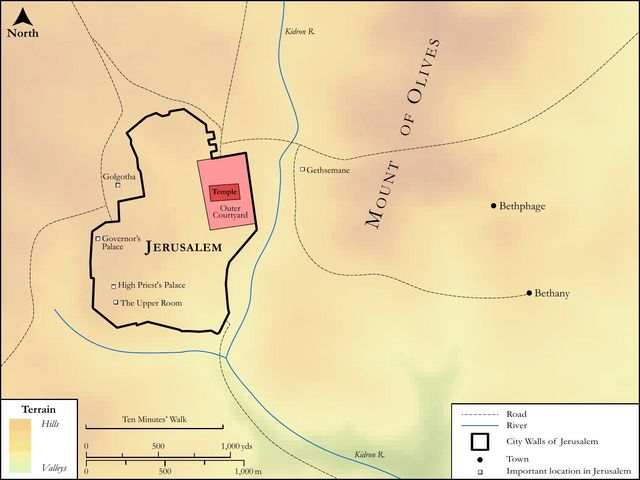
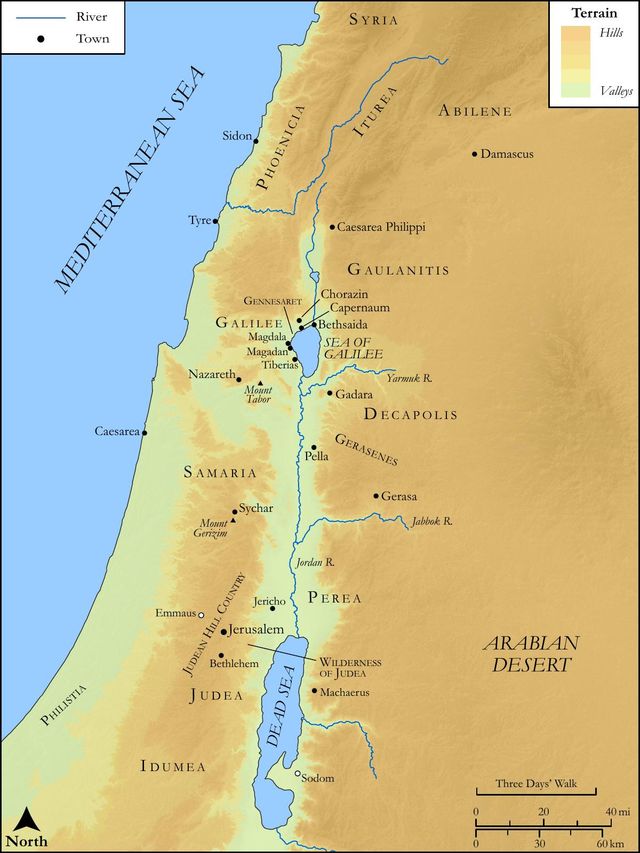
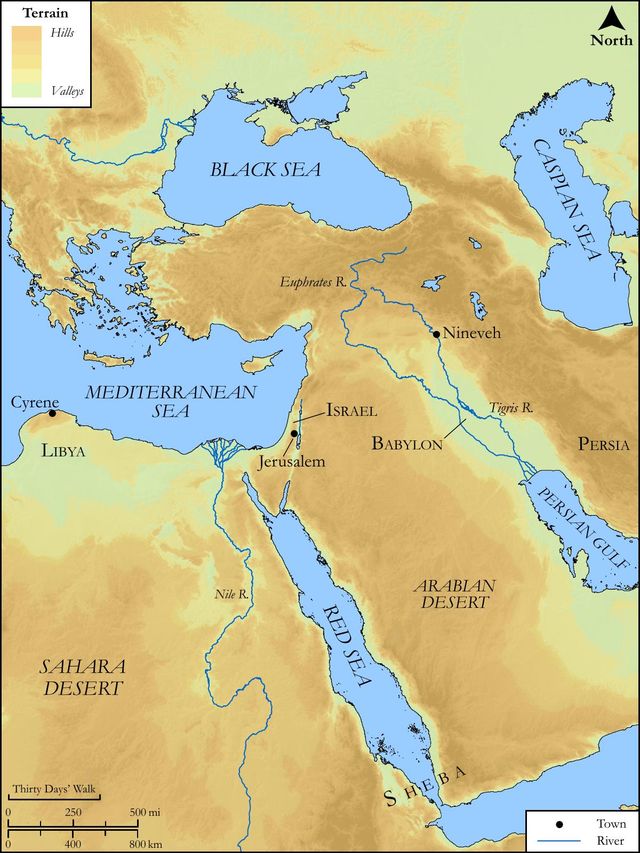
See on the biblical-era maps
Study this verse
Public-domain commentary
Matthew Henry
From his Commentary on the Whole Bible. Henry comments on passages, not single verses — this entry covers Matthew 8:14–17. His four-level outline is real structure in the source text, so it is rendered as structure.
They who pretend to be critical in the Harmony of the evangelists, place this passage, and all that follows to the end of ch. 9 before the sermon on the mount, according to the order which Mark and Luke observe in placing it. Dr. Lightfoot places only this passage before the sermon on the mount, and Mat 8:18, etc. after. Here we have,
I.A particular account of the cure of Peter's wife's mother, who was ill of a fever; in which observe,
1.The case, which was nothing extraordinary; fevers are the most common distempers; but, the patient being a near relation of Peter's, it is recorded as an instance of Christ's peculiar care of, and kindness to, the families of his disciples. Here we find,
(1.)That Peter had a wife, and yet was called to be an apostle of Christ; and Christ countenanced the marriage state, by being thus kind to his wife's relations. The church of Rome, therefore, which forbids ministers to marry, goes contrary to that apostle from whom they pretend to derive an infallibility.
(2.)That Peter had a house, though Christ had not, Mat 8:20. Thus was the disciple better provided for than his Lord.
(3.)That he had a house at Capernaum, though he was originally of Bethsaida; it is probably, he removed to Capernaum, when Christ removed thither, and made that his principal residence. Note, It is worth while to change our quarters, that we may be near to Christ, and have opportunities of converse with him. When the ark removes, Israel must remove and go after it.
(4.)That he had his wife's mother with him in his family, which is an example to yoke-fellows to be kind to one another's relations as their own. Probably, this good woman was old, and yet was respected and taken care of, as old people ought to be, with all possible tenderness.
(5.)That she lay ill of a fever. Neither the strength of youth, nor the weakness and coldness of age, will be a fence against diseases of this kind. The palsy was a chronical disease, the fever an acute disease, but both were brought to Christ.
2.The cure, Mat 8:15.
(1.)How it was effected; He touched her hand; not to know the disease, as the physicians do, by the pulse, but to heal it. This was an intimation of his kindness and tenderness; he is himself touched with the feeling of our infirmities; it likewise shows the way of spiritual healing, by the exerting of the power of Christ with his word, and the application of Christ to ourselves. The scripture speaks the word, the Spirit gives the touch, touches the heart, touches the hand.
(2.)How it was evidenced: this showed that the fever left her, she arose, and ministered to them. By this it appears,
[1.]That the mercy was perfected. They that recover from fevers by the power of nature are commonly weak and feeble, and unfit for business a great while after; to show therefore that this cure was above the power of nature, she was immediately so well as to go about the business of the house.
[2.]That the mercy was sanctified; and the mercies that are so are indeed perfected. Though she was thus dignified by a peculiar favour, yet she does not assume importance, but is as ready to wait at table, if there be occasion, as any servant. They must be humble whom Christ has honoured; being thus delivered, she studies what she shall render. It is very fit that they whom Christ hath healed should minister unto him, as his humble servants, all their days.
II.Here is a general account of the many cures that Christ wrought.
This cure of Peter's mother-in-law brought him abundance of patients. "He healed such a one; why not me? Such a one's friend, why not mine?" Now we are here told,
1.What he did, Mat 8:16.
(1.)He cast out devils; cast out the evil spirits with his word. There may be much of Satan's agency, by the divine permission, in those diseases of which natural causes may be assigned, as in Job's boils, especially in the diseases of the mind; but, about the time of Christ's being in the world, there seems to have been more than ordinary letting loose of the devil, to possess and vex the bodies of people; he came, having great wrath, for he knew that his time was short; and God wisely ordered it so, that Christ might have the fairer and more frequent opportunities of showing his power over Satan, and the purpose and design of his coming into the world, which was to disarm and dispossess Satan, to break his power, and to destroy his works; and his success was as glorious as his design was gracious.
(2.)He healed all that were sick; all without exception, though the patient was ever so mean, and the case ever so bad.
2.How the scripture was herein fulfilled, v. 17. The accomplishment of the Old Testament prophecies was the great thing Christ had in his eye, and the great proof of his being the Messiah: among other things, it was written of him (Isa 53:4), Surely he hath borne our griefs, and carried our sorrows: it is referred to, Pe1 2:24, and there it is construed, he hath borne our sins; here it is referred to, and is construed, he hath borne our sicknesses; our sins make our sicknesses our griefs; Christ bore away sin by the merit of his death, and bore away sickness by the miracles of his life; nay, though those miracles are ceased, we may say, that he bore our sicknesses then, when he bore our sins in his own body upon the tree; for sin is both the cause and the sting of sickness. Many are the diseases and calamities to which we are liable in the body: and there is more, in this one line of the gospels, to support and comfort us under them, than in all the writings of the philosophers - that Jesus Christ bore our sicknesses, and carried our sorrows; he bore them before us; though he was never sick, yet he was hungry, and thirsty, and weary, and troubled in spirit, sorrowful and very heavy; he bore them for us in his passion, and bears them with us in compassion, being touched with the feeling of our infirmities: and thus he bears them off from us, and makes them sit light, if it be not our own fault. Observe how emphatically it is expressed here: Himself took our infirmities, and bare our sicknesses; he was both able and willing to interpose in that matter, and concerned to deal with our infirmities and sicknesses, as our Physician; that part of the calamity of the human nature was his particular care, which he evidenced by his great readiness to cure diseases; and he is no less powerful, no less tender now, for we are sure that never were any the worse for going to heaven.
Historical interpretation
Sixteen Centuries of Reception
10 surviving comments on this verse. Each one is dated, so this reads as a timeline rather than a list.
Select a marker to jump to its quote. Markers stagger vertically where authors wrote within a few decades of each other.
And by the passion of His body, according to the words of the Prophet, He absorbed all the infirmities of human weakness.
"When the even was come, they brought unto Him many that were possessed with devils: and He cast out the spirits from them with a word, and healed all that were sick: that it might be fulfilled which was spoken by the Prophet Esaias, that He took our infirmities, and bare our sicknesses."
Seest thou the multitude, by this time growing in faith? For not even when the time pressed could they endure to depart, nor did they account it unseasonable to bring their sick to Him at eventide.
But mark, I pray thee, how great a multitude of persons healed the evangelists pass quickly over, not mentioning one by one, and giving us an account of them, but in one word traversing an unspeakable sea of miracles. Then lest the greatness of the wonder should drive us again to unbelief, that even so great a people and their various diseases should be delivered and healed by Him in one moment of time, He brings in the prophet also to bear witness to what is going on: indicating the abundance of the proof we have, in every case, out of the Scriptures; such, that from the miracles themselves we have no more; and He saith, that Esaias also spake of these things; "He took our infirmities, and bare our sicknesses." He said not, "He did them away," but "He took and bare them;" which seems to me to be spoken rather of sins, by the prophet, in harmony with John, where he saith, "Behold the Lamb of God, that beareth the sin of the world."
How then doth the evangelist here apply it to diseases? Either as rehearsing the passage in the historical sense, or to show that most of our diseases arise from sins of the soul. For if the sum of all, death itself, hath its root and foundation from sin, much more the majority of our diseases also: since our very capability of suffering did itself originate there.
Because the multitude of believers was now very great, they would not depart from Christ, though time pressed; but in the evening they bring unto Him the sick. When it was evening, they brought unto him many that had dœmons.
Observe how great a multitude of cured the Evangelist here runs through, not relating the case of each, but in one word introducing an innumerable flood of miracles. That the greatness of the miracle should not raise unbelief that so much people and so various diseases could be healed in so short a space, he brings forward the Prophet to bear witness to the things that were done, That it might be fulfilled which was spoken by Esaias the Prophet, saying, Himself took our infirmities.
The Prophet seems to have meant this of sins; how then does the Evangelist explain it of bodily diseases? It should be understood, that either he cites the text literally, or he intends to inculcate that most of our bodily diseases have their origin in sins of the soul; for death itself has its root in sin.
(Vers. 16-18.) But when evening came, they brought to him many who were demon-possessed; and he cast out the spirits with a word, and healed all who were sick. This was to fulfill what was spoken through the prophet Isaiah: “He took up our infirmities and carried our diseases.” And seeing great crowds around him, Jesus gave orders to go to the other side. Everyone is healed not in the morning, not in the afternoon, but in the evening, when the sun is setting: when a grain of wheat dies in the ground in order to bring forth many fruits (John 12).
It should be noted, that all the sick were healed not in the morning nor at noon, but rather about sunset; as a corn of wheat dies in the ground that it may bring forth much fruit.
(Cons. Ev. ii. 22.) The words, Now when it was evening, show that the evening of the same day is meant. This would not have been implied, had it been only when it was evening.
Why didn’t anyone bring them by day? Maybe it was out of respect for the scribes and Pharisees, or like Nicodemus, from embarrassment at their infirmities. Maybe it was because the sick people had no one to carry them to Jesus.
Christ the Son of God, the Author of human salvation, the fount and source of all goodness, furnished heavenly medicine, He cast out the spirits with a word, and healed all that were sick. Dæmons and diseases He sent away with a word, that by these signs, and mighty works, He might show that He was come for the salvation of the human race.
He took the infirmity of human nature so as to make us strong who had before been weak.
Took them not that He should have them Himself, but that He should take them away from us; and bare our sicknesses, in that what we were too weak to bear. He should bear for us.
Sunset shadows forth the passion and death of Him Who said, While I am in the world, I am the light of the world. (John 9:5.) Who while He lived temporally in the flesh, taught only a few of the Jews; but having trodden under foot the kingdom of death, promised the gifts of faith to all the Gentiles throughout the world.
There is an activity of God displayed throughout creation, a wholesale activity let us say which men refuse to recognize. The miracles done by God incarnate, living as a man in Palestine, perform the very same things as this wholesale activity, but at a different speed and on a smaller scale. One of their chief purposes is that men, having seen a thing done by personal power on the small scale, may recognize, when they see the same thing done on the large scale, that the power behind it is also personal – is indeed the very same person who lived among us two thousand years ago. The miracles in fact are a retelling in small letters of the very same story which is written across the whole world in letters too large for some of us to see...
The miracles of healing fall into the same pattern. This is sometimes obscured for us by the somewhat magical view we tend to take of ordinary medicine. The doctors themselves do not take this view. The magic is not in the medicine but in the patient’s body. What the doctor does is to stimulate Nature’s functions in the body, or to remove hindrances. In a sense, though we speak for convenience of healing a cut, every cut heals itself; no dressing will make skin grow over a cut on a corpse. That same mysterious energy which we call gravitational when it steers the planets and biochemical when it heals a body is the efficient cause of all recoveries, and if God exists, that energy, directly or indirectly, is His. All who are cured are cured by Him, the healer within. But once He did it visibly, a Man meeting a man. Where He does not work within us in this mode, the organism dies. Hence Christ’s one miracle of destruction is also in harmony with God’s wholesale activity. His bodily hand held out in symbolic wrath blasted a single fig tree; but no tree died that year in Palestine, or any year, or in any land, or even ever will, save because He has done something, or (more likely) ceased to do something, to it.
Continue studying Matthew 8:16 across the web’s major study libraries — every link below opens this exact verse, chapter, or book on the destination site.
Read & Compare
 BibleGatewayThis verse in more than 200 translations and 70 languages.
 Bible.comThe YouVersion reader — hundreds of translations, reading plans, and highlights.
 ESV.orgCrossway's official English Standard Version reader.
 NET BibleThe NET translation with 60,000+ translators' notes on every rendering decision.
 STEP BibleTyndale House's free study tool — original text, vocabulary, and scholarly resources.
 BibliaLogos Bible Software's free web reader.
 USCCBThe New American Bible (Revised Edition) with the U.S. bishops' study notes.
Commentaries
 BibleHub CommentariesDozens of classic commentaries on this verse, gathered on one page.
 StudyLightMore than 100 commentary sets — the largest collection on the web.
 BibleRefPlain-English commentary on what this verse means, verse by verse.
 Enduring WordDavid Guzik's free commentary on this chapter, widely used by Bible teachers.
 Bible Study ToolsVerse commentary alongside Greek and Hebrew study aids.
Original Language & Research
- BibleHub InterlinearThe verse word by word — original language, transliteration, and English.
- BibleHub LexiconEvery word's original-language definition and Strong's entry.
 Blue Letter BibleDeep-study tools — Strong's numbers, concordance, and word studies.
 CNTR CollationThe earliest Greek manuscripts of this verse, collated letter by letter.
Sermons, Hymns & Audio


TrulyRandomVerse is not affiliated with these sites and doesn’t control their content. They’re linked because they’re genuinely useful.
Summary
Matthew 8:16 presents a vivid scene of Jesus' evening ministry in Capernaum, immediately following His healing of Peter's mother-in-law. As the Sabbath day concluded at sunset, a large multitude of people, many afflicted by demonic possession and various illnesses, were brought to Him. In a powerful demonstration of His divine authority and boundless compassion, Jesus effortlessly cast out the evil spirits with a mere command—His word—and completely healed every single person who was sick, showcasing His comprehensive power over both spiritual oppression and physical infirmity.
Context
ShowHideLiterary Context
Matthew 8:16 serves as a climactic summary statement within a series of miraculous healings and demonstrations of Jesus' authority. The chapter begins with Jesus' descent from the mountain after delivering the Sermon on the Mount, immediately followed by three distinct healing narratives: the cleansing of a leper (Matthew 8:1-4), the healing of the centurion's servant (Matthew 8:5-13), and the healing of Peter's mother-in-law (Matthew 8:14-15). This verse consolidates multiple acts of healing and deliverance into a single powerful scene, emphasizing the widespread impact of Jesus' ministry. It directly precedes the evangelist's theological commentary in Matthew 8:17, which explicitly connects Jesus' healing work to the fulfillment of Isaiah's prophecy regarding bearing our infirmities, thus providing a theological framework for the preceding miracles.
Historical & Cultural Context
The phrase "When the even was come" (ὀψίας δὲ γενομένης, opsias de genomenēs) is highly significant, indicating the twilight hours after the conclusion of the Sabbath day. According to Jewish law, particularly the oral traditions of the Pharisees, various forms of work (melakha) were prohibited on the Sabbath, including healing, carrying burdens, and extensive travel. While Jesus often challenged the rigid interpretations of Sabbath laws by healing on the Sabbath (e.g., Matthew 12:9-14), the people, out of reverence for the law or perhaps to avoid conflict, waited until sunset on Saturday, when the Sabbath officially ended, to bring their sick and demon-possessed to Him. This timing highlights their desperate need, their immense faith in Jesus' power, and their adherence to the cultural and religious norms of the day, even as they sought a divine intervention that transcended those norms.
Key Themes
ShowHideThis verse powerfully reinforces several overarching themes in Matthew's Gospel and Jesus' ministry. Foremost is the theme of Jesus' Divine Authority and Sovereignty, demonstrated by His effortless command over both physical ailments and demonic forces. His ability to "cast out the spirits with [his] word" (as noted in Matthew 8:16) underscores that His power is inherent, not derived, echoing the creative power of God's word in Genesis 1:3. This display of power is also inextricably linked to His Boundless Compassion and Universal reach, as He "healed all that were sick" (Matthew 8:16), demonstrating His willingness to minister to everyone in need, regardless of their condition. Furthermore, the emphasis on Deliverance from Evil through the expulsion of "devils" highlights the spiritual dimension of His ministry and the triumph of God's kingdom over the forces of darkness, a recurring motif throughout the Gospels (e.g., Mark 1:27).
Exposition and Analysis
ShowHideKey Word Analysis
ShowHideThis verb describes a state of being afflicted or controlled by a demon. It signifies a profound spiritual bondage, where an individual's will and body are subjected to an evil spirit. The presence of "devils" (demons) indicates a direct confrontation with the forces of evil, against which Jesus demonstrates supreme authority.
This term literally means "to throw out," "to eject," or "to drive out." It conveys a forceful, decisive, and authoritative expulsion, not a gentle persuasion. Jesus' use of this word emphasizes His absolute power over the demonic realm, indicating that these spirits had no choice but to obey His command and depart.
In this context, logos refers to Jesus' spoken command, His authoritative utterance. It signifies that His power is inherent and expressed through His very speech, requiring no physical contact, ritual, or external aid. This highlights the divine nature of His authority, where His word carries the power of creation and sovereign command, bringing about immediate and complete results.
Verse Breakdown
ShowHide"When the even was come"
This phrase precisely dates the event to the twilight hours following the conclusion of the Sabbath day. As Jewish law prohibited certain activities, including healing and carrying the sick, on the Sabbath, the crowds waited until sunset to bring their afflicted loved ones to Jesus, demonstrating both their desperate need and their respect for the religious customs of the time.
"they brought unto him many that were possessed with devils"
This highlights the widespread spiritual oppression prevalent in that era and the recognition by the people that Jesus possessed unique power over these malevolent entities. The sheer number of those brought underscores the immense suffering and the profound hope placed in Jesus as the deliverer from spiritual bondage.
"and he cast out the spirits with [his] word"
This is a pivotal declaration of Jesus' divine authority. He did not engage in elaborate rituals or prolonged struggles; His mere spoken command, His "word" (logos), was sufficient to forcefully expel the demonic spirits. This demonstrates His intrinsic power over the supernatural realm, showcasing His sovereignty over evil.
"and healed all that were sick"
This statement emphasizes the comprehensive and universal nature of Jesus' healing ministry. Not some, not most, but "all" who were sick were healed, regardless of the nature or severity of their illness. This underscores His boundless compassion and His complete power over every form of physical infirmity, leaving no one unaddressed among those to Him.
Literary Devices
ShowHideMatthew 8:16 employs several literary devices to powerfully convey its message. The use of Hyperbole or Generalization is evident in the phrases "many that were possessed with devils" and "healed all that were sick." While perhaps not literally every single person in Capernaum was brought to Him, these phrases emphasize the vast scope and completeness of Jesus' ministry, demonstrating His widespread impact and the comprehensive nature of His healing and deliverance. Contrast is effectively used to highlight Jesus' unique power: the overwhelming suffering and spiritual bondage of the people are set against the effortless and instantaneous authority of Jesus' word. The phrase "with his word" functions as a powerful Emphasis, underscoring that Jesus' power is inherent and divine, not reliant on external means or rituals. This concise statement of His authoritative command serves as a powerful testament to His identity, setting the stage for the explicit Fulfillment Language found in the subsequent verse, Matthew 8:17, which interprets these actions as the realization of Isaiah's prophecy.
Theological and Thematic Connections
ShowHideMatthew 8:16 profoundly reveals Jesus' identity as the promised Messiah, demonstrating His comprehensive authority over all forms of human suffering—physical, spiritual, and even demonic. His ability to heal "all that were sick" and "cast out the spirits with [his] word" signifies the inauguration of God's kingdom, where the reign of sin, sickness, and Satan is being decisively overthrown. This passage underscores the holistic nature of salvation in Christ, which addresses not only the spiritual need for forgiveness but also the tangible realities of human brokenness. It portrays Jesus as the compassionate King who actively intervenes in the lives of His people, bringing restoration and liberation. The effortless nature of His miracles, particularly the power of His spoken word, points to His divine nature and inherent power, echoing the creative power of God in the Old Testament.
Reflection and Application
ShowHideMatthew 8:16 offers profound and enduring encouragement for believers in every generation. It serves as a powerful reminder that Jesus Christ remains the sovereign Lord over all sickness, spiritual oppression, and the forces of evil. Just as He met the desperate needs of the crowds in Capernaum with boundless compassion and undeniable power, His ability to heal and deliver remains undiminished today. This passage invites us to approach Him with unwavering faith, bringing our own physical ailments, emotional burdens, and spiritual struggles before Him, confident in His willingness and ability to intervene. It challenges us to trust not in human remedies alone, but in the inherent power of His word, which is living and active, capable of bringing about profound transformation and liberation in our lives and circumstances. Moreover, it calls us to embody His compassion, recognizing the suffering around us and pointing others to the only One who can offer true healing and deliverance.
Questions for Reflection
ShowHideFAQ
ShowHideWhy did the people wait until "the even was come" to bring the sick to Jesus?
ShowHideThe phrase "When the even was come" (ὀψίας δὲ γενομένης) refers to the conclusion of the Sabbath day. According to Jewish law and tradition, particularly as interpreted by the Pharisees, various activities were prohibited on the Sabbath, including carrying burdens, engaging in strenuous work, and possibly even extensive healing, though Jesus often challenged these interpretations by healing on the Sabbath (e.g., Matthew 12:9-14). Out of respect for these customs, or perhaps simply to avoid conflict, the people waited until after sunset on Saturday, when the Sabbath officially ended, to bring their sick and demon-possessed loved ones to Jesus, indicating their eagerness and desperation for His healing touch.
What does "possessed with devils" imply about the nature of these afflictions?
ShowHideThe term "possessed with devils" (δαιμονίζομαι, daimonízomai) indicates a state where an individual is under the direct influence or control of malevolent spiritual entities, or demons. This was distinct from mere physical illness, though it could manifest with physical symptoms (e.g., muteness, blindness, convulsions as seen in Matthew 9:32-33 or Matthew 17:14-18). Jesus' ministry frequently involved casting out demons, demonstrating His authority over the kingdom of darkness and His mission to liberate humanity from spiritual bondage, signifying the inauguration of God's kingdom.
How did Jesus "cast out the spirits with his word"?
ShowHideThis phrase emphasizes the inherent and absolute authority of Jesus. Unlike exorcists who might employ elaborate rituals, incantations, or physical struggles, Jesus simply spoke. His "word" (λόγος, logos) carried divine power, instantly compelling the demons to depart. This demonstrates that His authority was intrinsic to His being as the Son of God, echoing the creative power of God's word in Genesis 1 where God spoke creation into existence. His command was sufficient, immediate, and irresistible to the forces of evil.
Christ-Centered Fulfillment
ShowHideMatthew 8:16, while a historical account of Jesus' earthly ministry, finds its ultimate Christ-centered fulfillment in the person and work of Jesus as the incarnate Son of God who came to decisively conquer sin, sickness, and Satan. His effortless expulsion of demons "with his word" and the comprehensive healing of "all that were sick" are not merely isolated acts of compassion but powerful manifestations of His messianic identity and the dawn of God's kingdom. This scene foreshadows His ultimate victory over all powers of darkness on the cross, where He disarmed principalities and powers (Colossians 2:15). Furthermore, His bearing of our infirmities, explicitly linked to Isaiah 53:4 in the very next verse (Matthew 8:17), points to His substitutionary atonement, where He took upon Himself the full weight of human brokenness, including the curse of sickness and the bondage of sin. Through His death and resurrection, Jesus secured not only spiritual salvation but also the promise of future bodily resurrection and complete restoration, making Him the ultimate Healer and Deliverer for all who believe in His name (Romans 8:11).