


Exodus 15:26
Bible text: King James Version (1769 Blayney text) · Public domain
Bible text: King James Version with Strong's numbers · Public domain
Bible text: Berean Standard Bible · Public domain
Bible text: American Standard Version (1901) · Public domain
Bible text: World English Bible, Messianic edition · Public domain
Bible text: Geneva Bible (1599) · Public domain
Bible text: Young's Literal Translation · Public domain
- וַיֹּאמֶרvai·yo·Merand he saidH559Conj-w ¦ V-Qal-ConsecImperf-3msVerb Qal Consecutive Imperfect 3rd Singular Masculineוַandיֹּאמֶרhe said
- אִם'im<if>H518PrtParticle Conditional
- שָׁמוֹעַsha·Mo·a'certainly [if] <to listen>H8085V-Qal-InfAbsVerb Qal Infinitive Absolute
- תִּשְׁמַעtish·Ma'you will listenH8085V-Qal-Imperf-2msVerb Qal Imperfect 2nd Singular Masculine
- לְקוֹלle·Kolto [the] voice ofH6963Prep-l ¦ N-mscNoun Singular Masculine Constructלְtoקוֹל[the] voice of
- יְהוָהYah·wehYahwehH3068N-properNoun Proper Title
- אֱלֹהֶיךָ'e·lo·Hei·khayour GodH430N-mpc ¦ 2msNoun Plural Masculine ConstructאֱלֹהֶיGodךָyour
- וְהַיָּשָׁרve·hai·ya·Sharand the rightH3477Conj-w ¦ Art ¦ Adj-msAdjective Singular Masculine Absoluteוְandהַtheיָּשָׁרright
- בְּעֵינָיוbe·'ei·Navin his viewH5869Prep-b ¦ N-fdc ¦ 3msNoun Dual Feminine Constructבְּinעֵינָיviewוhis
- תַּעֲשֶׂהta·'a·Sehyou will doH6213V-Qal-Imperf-2msVerb Qal Imperfect 2nd Singular Masculine
- וְהַאֲזַנְתָּve·ha·'a·zan·Taand you will give earH238Conj-w ¦ V-Hiphil-ConsecPerf-2msVerb Hiphil Consecutive Perfect 2nd Singular Masculineוְandהַאֲזַנְתָּyou will give ear
- לְמִצְוֹתָיוle·mitz·vo·Tavto his commandmentsH4687Prep-l ¦ N-fpc ¦ 3msNoun Plural Feminine Constructלְtoמִצְוֹתָיcommandmentsוhis
- וְשָׁמַרְתָּve·sha·mar·Taand you will keepH8104Conj-w ¦ V-Qal-ConsecPerf-2msVerb Qal Consecutive Perfect 2nd Singular Masculineוְandשָׁמַרְתָּyou will keep
- כָּלkolallH3605N-mscNoun Singular Masculine Construct
- חֻקָּיוchu·Kavhis decreesH2706N-mpc ¦ 3msNoun Plural Masculine Constructחֻקָּיdecreesוhis
- כָּלkalanyH3605N-mscNoun Singular Masculine Construct
- הַמַּחֲלָהha·ma·cha·Lah<the> sicknessH4245Art ¦ N-fsNoun Singular Feminine Absoluteהַ<the>מַּחֲלָהsickness
- אֲשֶׁר'a·SherwhichH834RelParticle Relative
- שַׂמְתִּיSam·tiI putH7760V-Qal-Perf-1csVerb Qal Perfect 1st Singular common gender
- בְמִצְרַיִםve·mitz·Ra·yimon EgyptH4714Prep-b ¦ N-properNoun Proper LocationבְonמִצְרַיִםEgypt
- לֹאlo'notH3808NegParticle Negative
- אָשִׂים'a·SimI will putH7760V-Qal-Imperf-1csVerb Qal Imperfect 1st Singular common gender
- עָלֶיךָ'a·Lei·khaon youH5921Prep ¦ 2msPreposition Definiteעָלֶיonךָyou
- כִּיkiforH3588PrtParticle Conditional
- אֲנִי'a·NiIH589Pro-1csPronoun Personal 1st Singular common gender
- יְהוָהYah·weh[am] YahwehH3068N-properNoun Proper Title
- רֹפְאֶךָro·fe·'E·kha[who] heals youH7495V-Qal-Prtcpl-ms ¦ 2msVerb Qal Participle Singular Masculine Constructרֹפְאֶ[who] healsךָyou
English is a literal word-by-word gloss of the Hebrew, not the KJV's wording. Why?
This is the original text the KJV's translators worked from — each Hebrew word with its own literal English meaning in this verse, prepared by scholars at Tyndale House, Cambridge. The KJV translates whole sentences, not word by word, so its wording differs: one Hebrew word can become several English words, and the KJV may choose “the LORD” where the gloss reads “Yahweh”. Both are faithful — they answer different questions. For the KJV's own rendering, switch to the KJV text.
Details
See on the biblical-era maps

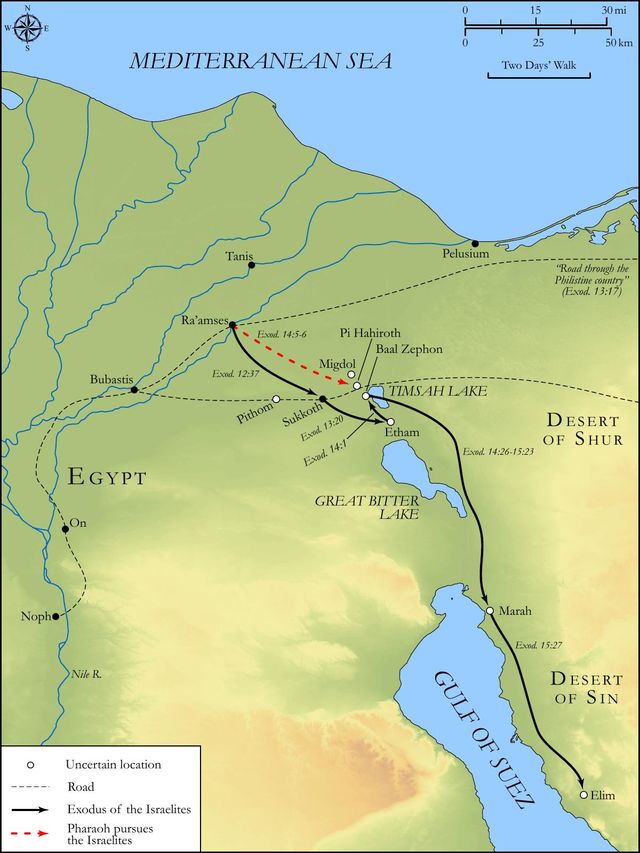
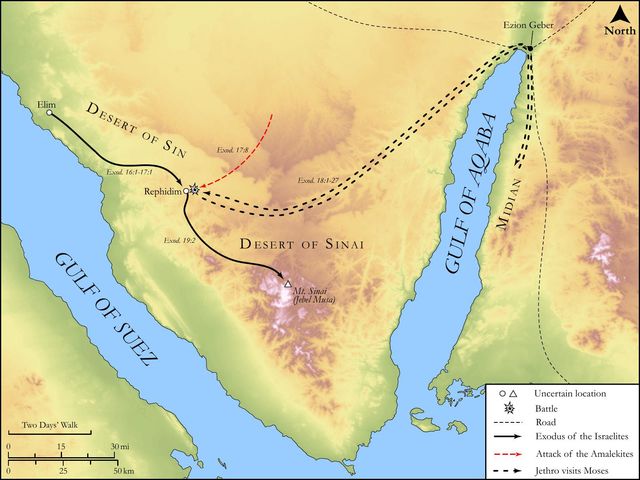
Study this verse
Public-domain commentary
Matthew Henry
From his Commentary on the Whole Bible. Henry comments on passages, not single verses — this entry covers Exodus 15:22–27. His three-level outline is real structure in the source text, so it is rendered as structure.
It should seem, it was with some difficulty that Moses prevailed with Israel to leave that triumphant shore on which they sang the foregoing song. They were so taken up with the sight, or with the song, or with the spoiling of the dead bodies, that they cared not to go forward, but Moses with much ado brought them from the Red Sea into a wilderness. The pleasures of our way to Canaan must not retard our progress, but quicken it, though we have a wilderness before us. Now here we are told,
I.That in the wilderness of Shur they had no water, Exo 15:22.
This was a sore trial to the young travellers, and a diminution to their joy; thus God would train them up to difficulties. David, in a dry and thirsty land where no water is, reaches forth towards God, Psa 63:1.
II.That at Marah they had water, but it was bitter, so that though they had been three days without water they could not drink it, because it was extremely unpleasant to the taste or was likely to be prejudicial to their health, or was so brackish that it rather increased their thirst than quenched it, Exo 15:23. Note, God can embitter that to us from which we promise ourselves most satisfaction, and often does so in the wilderness of this world, that our wants and disappointments in the creature may drive us to the Creator, in whose favour alone true comfort is to be had. Now in this distress,
1.The people fretted and quarrelled with Moses, as if he had done ill by them. What shall we drink? is all their clamour, Exo 15:24. Note, The greatest joys and hopes are soon turned into the greatest griefs and fears with those that live by sense only, and not by faith.
2.Moses prayed: He cried unto the Lord, Exo 15:25. The complaints which they brought to him he brought to God, on whom, notwithstanding his elevation, Moses owned a constant dependence. Note, It is the greatest relief of the cares of magistrates and ministers, when those under their charge make them uneasy, that they may have recourse to God by prayer: he is the guide of the church's guides and to him, as the Chief Shepherd, the under-shepherds must upon all occasions apply.
3.God provided graciously for them. He directed Moses to a tree, which he cast into the waters, in consequence of which, all of a sudden, they were made sweet. Some think this wood had a peculiar virtue in it for this purpose, because it is said, God showed him the tree. God is to be acknowledged, not only in the creating of things useful for man, but in discovering their usefulness. Or perhaps this was only a sign, and not at all a means, of the cure, any more than the brazen serpent, or Elisha's casting one cruse full of salt into the waters of Jericho. Some make this tree typical of the cross of Christ, which sweetens the bitter waters of affliction to all the faithful, and enables them to rejoice in tribulation. The Jews' tradition is that the wood of this tree was itself bitter, yet it sweetened the waters of Marah; the bitterness of Christ's sufferings and death alters the property of ours.
4.Upon this occasion, God came upon terms with them, and plainly told them, now that they had got clear of the Egyptians, and had entered into the wilderness, that they were upon their good behaviour, and that according as they carried themselves so it would be well or ill with them: There he made a statute and an ordinance, and settled matters with them. There he proved them, that is, there he put them upon the trial, admitted them as probationers for his favour. In short, he tells them, Exo 15:26,
(1.)What he expected from them, and that was, in one word, obedience. They must diligently hearken to his voice, and give ear to his commandments, that they might know their duty, and not transgress through ignorance; and they must take care in every thing to do that which was right in God's sight, and to keep all his statutes. They must not think, now that they were delivered from their bondage in Egypt, that they had no lord over them, but were their own masters; no, therefore they must look upon themselves as God's servants, because he had loosed their bonds, Psa 116:16; Luk 1:74, Luk 1:75.
(2.)What they might then expect from him: I will put none of these diseases upon thee, that is, "I will not bring upon thee any of the plagues of Egypt." This intimates that, if they were rebellious and disobedient, the very plagues which they had seen inflicted upon their enemies should be brought upon them; so it is threatened, Deu 28:60. God's judgments upon Egypt, as they were mercies to Israel, opening the way to their deliverance, so they were warnings to Israel, and designed to awe them into obedience. Let not the Israelites think, because God had thus highly honoured them in the great things he had done for them, and had proclaimed them to all the world his favourites, that therefore he would connive at their sins and let them do as they would. No, God is no respecter of persons; a rebellious Israelite shall fare no better than a rebellious Egyptian; and so they found, to their cost, before the got to Canaan. "But, if thou wilt be obedient, thou shalt be safe and happy;" the threatening is implied only, but the promise is expressed: "I am the Lord that healeth thee, and will take care of thy comfort wherever thou goest." Note, God is the great physician. If we be kept well, it is he that keeps us; if we be made well, it is he that restores us; he is our life, and the length of our days.
III.That at Elim they had good water, and enough of it, Exo 15:27.
Though God may, for a time, order his people to encamp by the waters of Marah, yet that shall not always be their lot. See how changeable our condition is in this world, from better to worse, from worse to better. Let us therefore learn both how to be abased and how to abound, to rejoice as though we rejoiced not when we are full, and to weep as though we wept not when we are emptied. Here were twelve wells for their supply, one for every tribe, that they might not strive for water, as their fathers had sometimes done; and, for their pleasure, there were seventy palm-trees, under the shadow of which their great men might repose themselves. Note, God can find places of refreshment for his people even in the wilderness of this world, wells in the valley of Baca, lest they should faint in their mind with perpetual fatigue: yet, whatever our delights may be in the land of our pilgrimage, we must remember that we do but encamp by them for a time, that here we have no continuing city.
Continue studying Exodus 15:26 across the web’s major study libraries — every link below opens this exact verse, chapter, or book on the destination site.
Read & Compare
 BibleGatewayThis verse in more than 200 translations and 70 languages.
 Bible.comThe YouVersion reader — hundreds of translations, reading plans, and highlights.
 ESV.orgCrossway's official English Standard Version reader.
 NET BibleThe NET translation with 60,000+ translators' notes on every rendering decision.
 STEP BibleTyndale House's free study tool — original text, vocabulary, and scholarly resources.
 BibliaLogos Bible Software's free web reader.
 USCCBThe New American Bible (Revised Edition) with the U.S. bishops' study notes.
Commentaries
 BibleHub CommentariesDozens of classic commentaries on this verse, gathered on one page.
 StudyLightMore than 100 commentary sets — the largest collection on the web.
 BibleRefPlain-English commentary on what this verse means, verse by verse.
 Enduring WordDavid Guzik's free commentary on this chapter, widely used by Bible teachers.
 Bible Study ToolsVerse commentary alongside Greek and Hebrew study aids.
Original Language & Research
- BibleHub InterlinearThe verse word by word — original language, transliteration, and English.
- BibleHub LexiconEvery word's original-language definition and Strong's entry.
 Blue Letter BibleDeep-study tools — Strong's numbers, concordance, and word studies.
 SefariaThe Hebrew text with Rashi and centuries of Jewish commentary.
Sermons, Hymns & Audio


TrulyRandomVerse is not affiliated with these sites and doesn’t control their content. They’re linked because they’re genuinely useful.
Summary
Exodus 15:26 presents a foundational covenantal declaration from God to the Israelites, delivered immediately after their miraculous Red Sea deliverance and the provision of sweet water at Marah. This pivotal verse outlines a conditional promise of divine protection from the very diseases inflicted upon Egypt, contingent upon Israel's diligent and comprehensive obedience to God's voice, commandments, and statutes. Central to this promise is God's profound self-revelation as "the LORD that healeth thee," introducing His character as Yahweh Ropheka, signifying His holistic capacity and covenantal commitment to be the comprehensive Healer and Restorer of His people's well-being.
Context
ShowHideLiterary Context
This verse is strategically positioned at a crucial juncture in the Israelites' nascent journey as a redeemed people. It immediately follows their awe-inspiring passage through the Red Sea, where God unequivocally demonstrated His sovereign power over both nature and their oppressors (Exodus 14:21-31). This epic deliverance was celebrated with the triumphant Song of Moses and Miriam (Exodus 15:1-19), a testament to God's might. However, the euphoria quickly gave way to complaint when they encountered the bitter waters of Marah. God, in His gracious provision, instructed Moses to cast a tree into the water, miraculously making it sweet (Exodus 15:23-25). Exodus 15:26 then serves as God's immediate covenantal instruction and promise following this demonstration of both judgment and provision. It acts as a foundational declaration, setting the stage for the more extensive legal and moral codes to be revealed at Mount Sinai, emphasizing that the relationship God desires with His newly redeemed people is one of responsive obedience, linking their physical and spiritual well-being directly to their alignment with His divine will.
Historical & Cultural Context
The Israelites were undergoing a profound transformation, transitioning from centuries of chattel slavery in Egypt to becoming a distinct, covenant nation under God's direct rule. They were in the harsh, testing environment of the wilderness, a place that necessitated absolute reliance on divine provision and protection. Having just witnessed the devastating plagues God brought upon Egypt, which included various forms of disease and affliction, the promise of protection from "these diseases" would have resonated deeply, underscoring God's distinct care for Israel and His sovereign power over health and sickness. In the law of Moses, disease was associated with divine displeasure or curses for disobedience, while health and prosperity were indicators of divine favor. Thus, God's declaration as "the LORD that healeth thee" was not merely a medical statement but a profound theological assertion of His unique identity as the benevolent, life-giving deity who actively intervenes for the holistic well-being of His chosen people, in stark contrast to the impotent, often capricious, gods of Egypt. This verse firmly establishes the conditional nature of the Old Covenant, where blessings and curses were directly tied to obedience and disobedience, a principle extensively elaborated in Deuteronomy 28.
Key Themes
ShowHideExodus 15:26 contributes significantly to several overarching themes within the book of Exodus and the Pentateuch. Firstly, it highlights the theme of Covenantal Relationship, establishing the reciprocal nature of God's interaction with Israel: His promises of blessing and protection are contingent upon their faithful obedience. Secondly, it introduces the theme of Divine Providence and Protection, demonstrating God's active role in safeguarding His people from harm, specifically from the afflictions He brought upon their enemies. Thirdly, and most profoundly, it reveals the theme of God as Healer and Restorer (Yahweh Ropheka), emphasizing His character as the source of all well-being—physical, spiritual, and communal. This theme is further developed as God provides manna, water, and guidance, continually sustaining His people in the wilderness, as seen in passages like Exodus 16 and Exodus 17. Finally, it reinforces the theme of Obedience as a Path to Blessing, a recurring motif throughout the Old Testament, where adherence to God's revealed will is presented as the pathway to flourishing and experiencing His favor.
Exposition and Analysis
ShowHideKey Word Analysis
ShowHideThis primitive root means "to hear intelligently," often with the strong implication of attention and obedience. When used in the infinitive absolute construction, as in "diligently hearken," it intensifies the verb, conveying the sense of hearing "attentively," "carefully," or "continually." It demands not merely a passive reception of sound but an active, intentional, and sustained commitment to listening to, understanding, and acting upon God's voice. This emphasizes a deep, wholehearted engagement with divine instruction, moving beyond mere intellectual assent to practical application.
This primitive root means "to mend (by stitching)," and figuratively, "to cure" or "to make whole." While it certainly encompasses physical healing from sickness, its semantic range is much broader. It can refer to the restoration of land, the mending of broken relationships, the spiritual renewal of a soul, or the comprehensive well-being of a nation. In the context of "the LORD that healeth thee" (Yahweh Ropheka), it signifies God's holistic capacity to bring complete restoration—physical, spiritual, emotional, and social—to His people, addressing all forms of brokenness and infirmity. It speaks to His character as the one who makes all things whole.
This term refers to an "enactment" or "decree." It denotes an established rule, ordinance, or law that is fixed and binding. In this context, "all his statutes" refers to the comprehensive body of divine laws and regulations that God would reveal to Israel, designed to govern their conduct, worship, and societal structure. Keeping these statutes implies adherence to the entirety of God's revealed will, underscoring the comprehensive nature of the obedience required for the covenant relationship.
Verse Breakdown
ShowHide"And said, If thou wilt diligently hearken to the voice of the LORD thy God, and wilt do that which is right in his sight, and wilt give ear to his commandments, and keep all his statutes"
This opening protasis (the "if" clause) lays out the comprehensive conditions for God's promise. The repeated emphasis on "diligently hearken" (active, continuous listening), "do that which is right in his sight" (moral uprightness according to divine standards), "give ear to his commandments" (attentive reception and internalization of specific instructions), and "keep all his statutes" (faithful adherence to the entirety of God's laws) underscores the holistic nature of the required obedience. It demands a total alignment of intellect, will, and action with God's revealed truth, signifying a life lived in continuous, active submission to His authority.
"I will put none of these diseases upon thee, which I have brought upon the Egyptians"
This apodosis (the "then" clause) presents the immediate and tangible promise contingent on Israel's obedience. "These diseases" directly references the plagues and afflictions God had recently inflicted upon the Egyptians, serving as powerful demonstrations of His judgment and sovereignty. The promise here is one of divine protection and exemption from such calamities, highlighting God's distinctive care for His covenant people. It serves as a potent reminder of His power over life and death, health and sickness, and His ability to shield those who walk in His ways from the very judgments He inflicts upon the disobedient.
"for I [am] the LORD that healeth thee"
This concluding declaration provides the divine rationale and self-revelation behind the promise. God identifies Himself by a profound covenant name: Yahweh Ropheka (or Jehovah Rapha), "The LORD who heals you." This is not merely a statement of ability but an unveiling of His inherent character and covenant commitment. He is not just a God who can heal, but One whose very nature and redemptive purpose are to bring healing, restoration, and wholeness to His people. This revelation assures Israel that His promise of protection is rooted in His benevolent being as their powerful and ever-present Healer.
Literary Devices
ShowHideExodus 15:26 is rich in literary devices that amplify its theological significance and rhetorical power. The most prominent is the Conditional Covenant structure, clearly articulated by the "If...then" formulation ("If thou wilt... I will"). This establishes a direct cause-and-effect relationship between Israel's obedience and God's promised blessing, foundational to the Old Covenant. There is also a strong element of Contrast or Antithesis, setting Israel apart from Egypt. God explicitly states He will not inflict "these diseases" upon Israel, which He did bring upon the Egyptians, highlighting His selective judgment and distinct covenantal favor for His people. The verse features a significant Divine Name Revelation, as God introduces Himself as Yahweh Ropheka ("the LORD that healeth thee"), a profound theological unveiling of His character as the Great Healer and a foundational aspect of His relationship with Israel. Furthermore, the use of Repetition and Synonymy in the opening clause ("diligently hearken," "do that which is right," "give ear," "keep all his statutes") serves to emphasize the comprehensive and continuous nature of the required obedience, reinforcing the idea that true devotion involves both attentive hearing and faithful doing.
Theological and Thematic Connections
ShowHideExodus 15:26 profoundly establishes God's character as Yahweh Ropheka, the LORD who heals. This revelation transcends mere physical health, encompassing a holistic understanding of well-being—spiritual, emotional, and physical wholeness—that is intrinsically linked to a covenant relationship with God. It underscores the profound principle that human flourishing is deeply intertwined with diligent obedience to divine instruction, not as a means to earn favor, but as a response of trust and love that aligns one's life with the very source of all life and blessing. While the specific terms of the Old Covenant tied physical health directly to specific acts of obedience, the underlying theological truth remains: God is the ultimate source of all healing and restoration, and a life lived in harmony with His will often brings about greater well-being. This verse reveals God's deep desire for His people's complete restoration and His active, benevolent involvement in every dimension of their lives.
Reflection and Application
ShowHideExodus 15:26 offers timeless principles for believers today, reminding us that God remains Yahweh Ropheka, the Healer, whose character is unchanging. While we live under the New Covenant of grace, the call to "diligently hearken" to God's voice and "do that which is right in his sight" remains a vital aspect of our relationship with Him. This involves actively listening to His Word through diligent study, seeking His will through prayer, and striving to live in obedience not out of legalism, but out of a grateful response to His redeeming love. Embracing God as our comprehensive Healer encourages us to trust Him with all aspects of our well-being—physical, mental, emotional, and spiritual. It challenges us to consider how our choices and our alignment with God's principles can contribute to a more flourishing life, recognizing that true wholeness and health come ultimately from Him. This verse invites us to cultivate a posture of attentive obedience, knowing that our loving God desires our complete restoration, protection, and flourishing in every area of our lives.
Questions for Reflection
ShowHideFAQ
ShowHideIs this verse a guarantee that obedient Christians will never get sick?
ShowHideNo, this verse is not a blanket guarantee that obedient Christians will never experience sickness. It was given within the specific context of the Old Covenant to ancient Israel, promising protection from the specific diseases God had inflicted upon the Egyptians as part of His judgment and their unique covenant relationship. While God is indeed our Healer, and obedience often brings blessings, including improved well-being, sickness and suffering are still part of living in a fallen world, even for believers. The New Testament shows that even faithful apostles like Paul experienced physical ailments and advised others like Timothy on their health issues. God's healing in the New Covenant is often holistic, encompassing spiritual and emotional restoration, and sometimes physical, but it is not always immediate or in the way we expect, nor does it negate the realities of a broken world.
What does "the LORD that healeth thee" mean beyond physical healing?
ShowHideThe Hebrew word râphâʼ (healeth) has a broad meaning that extends far beyond mere physical recovery. When God declares Himself as Yahweh Ropheka, He is revealing His character as the One who brings complete wholeness and restoration to every dimension of human existence. This includes spiritual healing from the brokenness of sin and alienation from God, emotional healing from trauma, grief, and pain, mental healing from distress and anxiety, and relational healing by mending fractured relationships within families and communities. God is able to heal the brokenhearted and bind up their wounds, restore the soul, and bring profound peace to troubled minds. His healing is comprehensive, addressing every facet of human brokenness and bringing us back into alignment with His original design for flourishing.
How does "diligently hearken" apply to believers today?
ShowHideFor believers today, "diligently hearken" means actively and intentionally listening to God's voice as revealed in the Bible, through prayer, and by the Holy Spirit's guidance. It's not just passive hearing but an attentive, continuous engagement with God's Word, seeking to understand His will and apply it to our lives. This involves consistent study of Scripture, meditating on its truths, and allowing it to transform our thoughts and actions. It's a posture of humble submission and eager obedience, recognizing that Jesus said, "If you love me, you will keep my commandments". Our obedience is a response of love and trust to the One who has already healed us spiritually through His grace, demonstrating our commitment to follow Him and walk in His ways.
Christ-Centered Fulfillment
ShowHideExodus 15:26 finds its ultimate and most profound fulfillment in Jesus Christ, who is the perfect embodiment of Yahweh Ropheka. While the Old Covenant promised protection from disease based on conditional obedience, Jesus came to address the deepest root cause of all human brokenness and suffering: sin and its pervasive consequences. He is the Great Physician who not only healed countless physical ailments during His earthly ministry, demonstrating His divine power over sickness and death, but more importantly, He offered spiritual healing and forgiveness of sins, which is the most fundamental and comprehensive form of restoration. The prophet Isaiah foretold that the Messiah would bear our griefs and carry our sorrows, and that by His stripes, we are healed—a prophecy explicitly linked to Jesus' healing ministry and His atoning work in Matthew 8:16-17. Through His atoning sacrifice on the cross, Jesus took upon Himself the full weight of humanity's sin and its devastating consequences, including disease and death, providing the ultimate healing for our souls and the glorious promise of future bodily resurrection and complete wholeness. His resurrection is the definitive victory over all infirmity, guaranteeing that in the new heavens and new earth, there will be no more death, sorrow, crying, or pain, for the former things will have passed away. Thus, Jesus is the comprehensive Healer who brings not just temporary physical relief but eternal spiritual and physical restoration to all who believe.