


Exodus 15:25
Bible text: King James Version (1769 Blayney text) · Public domain
Bible text: King James Version with Strong's numbers · Public domain
Bible text: Berean Standard Bible · Public domain
Bible text: American Standard Version (1901) · Public domain
Bible text: World English Bible, Messianic edition · Public domain
Bible text: Geneva Bible (1599) · Public domain
Bible text: Young's Literal Translation · Public domain
- וַיִּצְעַקvai·yitz·'Akand he cried outH6817Conj-w ¦ V-Qal-ConsecImperf-3msVerb Qal Consecutive Imperfect 3rd Singular Masculineוַandיִּצְעַקhe cried out
- אֶל'eltoH413PrepPreposition
- יְהוָהYah·wehYahwehH3068N-properNoun Proper Title
- וַיּוֹרֵהוּvai·yo·Re·huand he showed himH3384Conj-w ¦ V-Hiphil-ConsecImperf-3ms ¦ 3msVerb Hiphil Consecutive Imperfect 3rd Singular Masculineוַandיּוֹרֵhe showedהוּhim
- יְהוָהYah·wehYahwehH3068N-properNoun Proper Title
- עֵץ'Etza treeH6086N-msNoun Singular Masculine Absolute
- וַיַּשְׁלֵךְvai·yash·leKhand he threw [it]H7993Conj-w ¦ V-Hiphil-ConsecImperf-3msVerb Hiphil Consecutive Imperfect 3rd Singular Masculineוַandיַּשְׁלֵךְhe threw [it]
- אֶל'elintoH413PrepPreposition
- הַמַּיִםha·Ma·yimthe watersH4325Art ¦ N-mpNoun Plural Masculine Absoluteהַtheמַּיִםwaters
- וַיִּמְתְּקוּvai·yim·te·Kuand they became sweetH4985Conj-w ¦ V-Qal-ConsecImperf-3mpVerb Qal Consecutive Imperfect 3rd Plural Masculineוַandיִּמְתְּקוּthey became sweet
- הַמָּיִםha·Ma·yimthe watersH4325Art ¦ N-mpNoun Plural Masculine Absoluteהַtheמָּיִםwaters
- שָׁםshamthereH8033AdvAdverb
- שָׂםsamhe madeH7760V-Qal-Perf-3msVerb Qal Perfect 3rd Singular Masculine
- לוֹlofor <the> itPrep-l ¦ 3msSuffix Personal 3rd Singular Masculineלfor <the>וֹit
- חֹקchoka decreeH2706N-msNoun Singular Masculine Absolute
- וּמִשְׁפָּטu·mish·Patand a customH4941Conj-w ¦ N-msNoun Singular Masculine Absoluteוּandמִשְׁפָּטa custom
- וְשָׁםve·Shamand thereH8033Conj-w ¦ AdvAdverbוְandשָׁםthere
- נִסָּהוּni·Sa·huhe put to [the] test itH5254V-Piel-Perf-3ms ¦ 3msVerb Piel Perfect 3rd Singular Masculineנִסָּhe put to [the] testהוּit
English is a literal word-by-word gloss of the Hebrew, not the KJV's wording. Why?
This is the original text the KJV's translators worked from — each Hebrew word with its own literal English meaning in this verse, prepared by scholars at Tyndale House, Cambridge. The KJV translates whole sentences, not word by word, so its wording differs: one Hebrew word can become several English words, and the KJV may choose “the LORD” where the gloss reads “Yahweh”. Both are faithful — they answer different questions. For the KJV's own rendering, switch to the KJV text.
Details
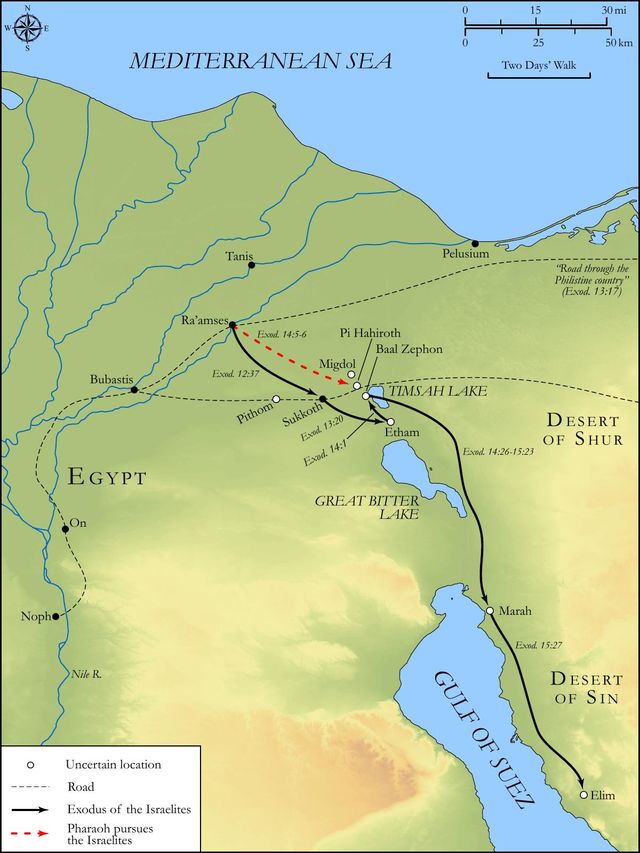
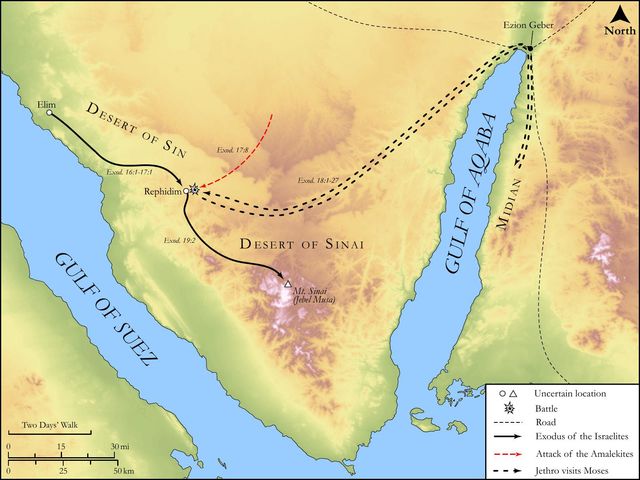
See on the biblical-era maps

Study this verse
Public-domain commentary
Matthew Henry
From his Commentary on the Whole Bible. Henry comments on passages, not single verses — this entry covers Exodus 15:22–27. His three-level outline is real structure in the source text, so it is rendered as structure.
It should seem, it was with some difficulty that Moses prevailed with Israel to leave that triumphant shore on which they sang the foregoing song. They were so taken up with the sight, or with the song, or with the spoiling of the dead bodies, that they cared not to go forward, but Moses with much ado brought them from the Red Sea into a wilderness. The pleasures of our way to Canaan must not retard our progress, but quicken it, though we have a wilderness before us. Now here we are told,
I.That in the wilderness of Shur they had no water, Exo 15:22.
This was a sore trial to the young travellers, and a diminution to their joy; thus God would train them up to difficulties. David, in a dry and thirsty land where no water is, reaches forth towards God, Psa 63:1.
II.That at Marah they had water, but it was bitter, so that though they had been three days without water they could not drink it, because it was extremely unpleasant to the taste or was likely to be prejudicial to their health, or was so brackish that it rather increased their thirst than quenched it, Exo 15:23. Note, God can embitter that to us from which we promise ourselves most satisfaction, and often does so in the wilderness of this world, that our wants and disappointments in the creature may drive us to the Creator, in whose favour alone true comfort is to be had. Now in this distress,
1.The people fretted and quarrelled with Moses, as if he had done ill by them. What shall we drink? is all their clamour, Exo 15:24. Note, The greatest joys and hopes are soon turned into the greatest griefs and fears with those that live by sense only, and not by faith.
2.Moses prayed: He cried unto the Lord, Exo 15:25. The complaints which they brought to him he brought to God, on whom, notwithstanding his elevation, Moses owned a constant dependence. Note, It is the greatest relief of the cares of magistrates and ministers, when those under their charge make them uneasy, that they may have recourse to God by prayer: he is the guide of the church's guides and to him, as the Chief Shepherd, the under-shepherds must upon all occasions apply.
3.God provided graciously for them. He directed Moses to a tree, which he cast into the waters, in consequence of which, all of a sudden, they were made sweet. Some think this wood had a peculiar virtue in it for this purpose, because it is said, God showed him the tree. God is to be acknowledged, not only in the creating of things useful for man, but in discovering their usefulness. Or perhaps this was only a sign, and not at all a means, of the cure, any more than the brazen serpent, or Elisha's casting one cruse full of salt into the waters of Jericho. Some make this tree typical of the cross of Christ, which sweetens the bitter waters of affliction to all the faithful, and enables them to rejoice in tribulation. The Jews' tradition is that the wood of this tree was itself bitter, yet it sweetened the waters of Marah; the bitterness of Christ's sufferings and death alters the property of ours.
4.Upon this occasion, God came upon terms with them, and plainly told them, now that they had got clear of the Egyptians, and had entered into the wilderness, that they were upon their good behaviour, and that according as they carried themselves so it would be well or ill with them: There he made a statute and an ordinance, and settled matters with them. There he proved them, that is, there he put them upon the trial, admitted them as probationers for his favour. In short, he tells them, Exo 15:26,
(1.)What he expected from them, and that was, in one word, obedience. They must diligently hearken to his voice, and give ear to his commandments, that they might know their duty, and not transgress through ignorance; and they must take care in every thing to do that which was right in God's sight, and to keep all his statutes. They must not think, now that they were delivered from their bondage in Egypt, that they had no lord over them, but were their own masters; no, therefore they must look upon themselves as God's servants, because he had loosed their bonds, Psa 116:16; Luk 1:74, Luk 1:75.
(2.)What they might then expect from him: I will put none of these diseases upon thee, that is, "I will not bring upon thee any of the plagues of Egypt." This intimates that, if they were rebellious and disobedient, the very plagues which they had seen inflicted upon their enemies should be brought upon them; so it is threatened, Deu 28:60. God's judgments upon Egypt, as they were mercies to Israel, opening the way to their deliverance, so they were warnings to Israel, and designed to awe them into obedience. Let not the Israelites think, because God had thus highly honoured them in the great things he had done for them, and had proclaimed them to all the world his favourites, that therefore he would connive at their sins and let them do as they would. No, God is no respecter of persons; a rebellious Israelite shall fare no better than a rebellious Egyptian; and so they found, to their cost, before the got to Canaan. "But, if thou wilt be obedient, thou shalt be safe and happy;" the threatening is implied only, but the promise is expressed: "I am the Lord that healeth thee, and will take care of thy comfort wherever thou goest." Note, God is the great physician. If we be kept well, it is he that keeps us; if we be made well, it is he that restores us; he is our life, and the length of our days.
III.That at Elim they had good water, and enough of it, Exo 15:27.
Though God may, for a time, order his people to encamp by the waters of Marah, yet that shall not always be their lot. See how changeable our condition is in this world, from better to worse, from worse to better. Let us therefore learn both how to be abased and how to abound, to rejoice as though we rejoiced not when we are full, and to weep as though we wept not when we are emptied. Here were twelve wells for their supply, one for every tribe, that they might not strive for water, as their fathers had sometimes done; and, for their pleasure, there were seventy palm-trees, under the shadow of which their great men might repose themselves. Note, God can find places of refreshment for his people even in the wilderness of this world, wells in the valley of Baca, lest they should faint in their mind with perpetual fatigue: yet, whatever our delights may be in the land of our pilgrimage, we must remember that we do but encamp by them for a time, that here we have no continuing city.
Historical interpretation
Two Centuries of Reception
4 surviving comments on this verse. Each one is dated, so this reads as a timeline rather than a list.
Select a marker to jump to its quote. Markers stagger vertically where authors wrote within a few decades of each other.
Again, water is restored from its defect to its native grace of “sweetness” by the tree of Moses. That tree was Christ, restoring of himself the veins of what had been envenomed and bitter nature into the all-salutary waters of baptism.
Marah was a fountain of most bitter water. Moses cast wood into it and it became sweet. For water without the preaching of the cross of the Lord is of no avail for future salvation. But after it has been consecrated by the mystery of the saving cross, it is made suitable for the use of the spiritual laver and of the cup of salvation. As then Moses, that is, the prophet, cast wood into that fountain, so too the priest utters over this font the proclamation of the Lord’s cross, and the water is made sweet for the purpose of grace.
As wood sweetens Marah so that seventy palm trees are watered by its streams, so the cross makes the waters of the law lifegiving to the seventy who are Christ’s apostles.
In this mystical number, I say, the children of Israel, arriving at Marah and being unable to draw the water because of its bitterness (for the well had water but no sweetness, and it was pleasing to the eye but polluted to the taste), drank water that became sweet and mild as soon as wood was thrown into it by Moses. The sacrament of the wood removed the harshness that the noxious water bore. I believe that this happened as a sign, for I think that the bitter water of Marah is the Old Testament law, which was harsh before it was tempered by the Lord’s cross.
Continue studying Exodus 15:25 across the web’s major study libraries — every link below opens this exact verse, chapter, or book on the destination site.
Read & Compare
 BibleGatewayThis verse in more than 200 translations and 70 languages.
 Bible.comThe YouVersion reader — hundreds of translations, reading plans, and highlights.
 ESV.orgCrossway's official English Standard Version reader.
 NET BibleThe NET translation with 60,000+ translators' notes on every rendering decision.
 STEP BibleTyndale House's free study tool — original text, vocabulary, and scholarly resources.
 BibliaLogos Bible Software's free web reader.
 USCCBThe New American Bible (Revised Edition) with the U.S. bishops' study notes.
Commentaries
 BibleHub CommentariesDozens of classic commentaries on this verse, gathered on one page.
 StudyLightMore than 100 commentary sets — the largest collection on the web.
 BibleRefPlain-English commentary on what this verse means, verse by verse.
 Enduring WordDavid Guzik's free commentary on this chapter, widely used by Bible teachers.
 Bible Study ToolsVerse commentary alongside Greek and Hebrew study aids.
Original Language & Research
- BibleHub InterlinearThe verse word by word — original language, transliteration, and English.
- BibleHub LexiconEvery word's original-language definition and Strong's entry.
 Blue Letter BibleDeep-study tools — Strong's numbers, concordance, and word studies.
 SefariaThe Hebrew text with Rashi and centuries of Jewish commentary.
Sermons, Hymns & Audio


TrulyRandomVerse is not affiliated with these sites and doesn’t control their content. They’re linked because they’re genuinely useful.
Summary
Exodus 15:25 chronicles a pivotal moment at Marah, where the newly liberated Israelites, having just celebrated their Red Sea deliverance, encountered undrinkable bitter waters. In response to Moses' desperate cry, the Lord miraculously revealed a tree, which, when cast into the water, transformed it into sweet, potable water. This event not only showcased God's immediate and compassionate provision in the harsh wilderness but also served as a foundational occasion for Him to establish His divine statutes and ordinances, thereby initiating a period of testing and covenant formation with His people, revealing their hearts and shaping their dependence on Him.
Context
ShowHideLiterary Context
Exodus 15:25 is strategically placed immediately following the triumphant Song of Moses and Miriam, a powerful liturgical celebration of God's miraculous deliverance of Israel through the Red Sea. This hymn marks the culmination of the Exodus narrative, signifying a definitive break from Egyptian bondage. However, the euphoria of salvation quickly gives way to the harsh realities and immediate challenges of wilderness travel. The three-day journey from the Red Sea to Marah, without finding potable water, precipitates the people's first significant complaint against Moses and, by extension, against God, as recorded in Exodus 15:24. The incident at Marah thus serves as a critical narrative transition, shifting the focus from the initial triumph of salvation to the subsequent challenges of living by faith, enduring trials, and embracing divine law and provision in the wilderness. It sets the stage for the deeper covenant relationship to be forged at Sinai.
Historical & Cultural Context
The Sinai Peninsula, through which the Israelites journeyed, is an arid and unforgiving landscape, characterized by scarce and often brackish water sources. The very name "Marah," meaning "bitterness," accurately reflects the undrinkable nature of the water encountered, underscoring the severity of the life-threatening challenge faced by such a vast multitude. For the nomadic patriarchs and their descendants, the provision of water was a primary concern, and the LORD's ability to provide sustenance in the wilderness was a testament to His power and care for His people. This event, however, transcends mere physical provision. It reflects God's unique intention to not only sustain His people physically but also to govern them morally and spiritually. The immediate sequence of miraculous provision followed by the giving of "statute and ordinance" highlights God's pedagogical purpose, preparing Israel for the more extensive covenant legislation and the establishment of a holy nation at Mount Sinai.
Key Themes
ShowHideThe incident at Marah contributes significantly to several overarching themes in Exodus and the broader Pentateuch. Firstly, it powerfully reinforces the theme of Divine Provision and Faithfulness, demonstrating God's unwavering commitment to sustain His people even in the direst circumstances, fulfilling His promises despite their complaints. Secondly, it introduces the crucial theme of Testing and Obedience, revealing God's method of using challenging situations to refine His people's character, expose their hearts, and teach them absolute dependence on Him (Deuteronomy 8:2-3). Thirdly, Marah marks the nascent stages of Covenant Formation and Divine Law, where God begins to establish the ethical and spiritual framework for His relationship with Israel, laying the groundwork for the comprehensive legal codes to be given at Mount Sinai. Finally, the transformation of bitter water into sweet water serves as a potent symbol of God's Redemptive Power and Transformation, illustrating His ability to turn desperate situations into moments of grace and to transform a rebellious people into one that is consecrated to Him.
Exposition and Analysis
ShowHideKey Word Analysis
ShowHideThis is the sacred, covenantal name of God, often translated as "Jehovah" or "the Lord." Derived from the Hebrew verb "to be" (הָיָה, hâyâh), it signifies God's self-existence, eternal nature, and His active presence as the covenant-keeping God who is always faithful to His promises. In Exodus 15:25, Moses cries out to Yᵉhôvâh, and it is Yᵉhôvâh who responds, underscoring that the miracle and the subsequent legislation flow directly from His covenant character and authority.
From the root meaning "to engrave" or "to enact," chôq refers to an appointed rule, decree, or prescribed boundary. It denotes something fixed, established, or ordained, often carrying a sense of divine prescription or an unchangeable law. Its usage here signifies the beginning of God's formal, explicit establishment of His will and expectations for Israel, setting forth the foundational principles that would govern their life as His chosen people.
This verb means "to test," "to try," or "to prove." It implies a process of examination designed to reveal the true nature, character, or faithfulness of an individual or group. In this context, God "proved" Israel not because He was ignorant of their hearts, but to expose their spiritual condition to themselves, to deepen their dependence on Him, and to provide an opportunity for them to grow in trust and obedience. It is a pedagogical act, designed for their spiritual development and refinement.
Verse Breakdown
ShowHide"And he cried unto the LORD;"
This opening phrase immediately establishes Moses' role as the divinely appointed intercessor. Faced with the people's murmuring and the dire, life-threatening situation of undrinkable water, Moses does not resort to human solutions or despair. Instead, he turns directly and urgently to God in prayer. This act of "crying out" (from H6817, tsâʻaq, meaning "to shriek" or "to call out") highlights the desperation of the moment and Moses' complete reliance on divine intervention, setting a powerful example for leadership and faith.
"and the LORD shewed him a tree, [which] when he had cast into the waters, the waters were made sweet:"
This clause describes the miraculous core of the event. God's response to Moses' cry is immediate and specific: He "shewed" (H3384, yârâh, meaning "to point out" or "to instruct") Moses a particular tree. The efficacy of the tree in transforming the bitter waters into sweet, potable water is not attributed to any inherent magical property of the wood itself, but solely to God's divine instruction and power working through it. The tree serves as a tangible, divinely appointed instrument, demonstrating God's supernatural ability to transform and heal the seemingly impossible.
"there he made for them a statute and an ordinance, and there he proved them,"
This crucial concluding clause reveals the profound theological purpose behind the miracle at Marah. The physical provision of water is immediately followed by the establishment of divine law ("statute" - H2706, chôq; "ordinance" - H4941, mishpâṭ). This signifies that God's deliverance and provision are inextricably linked to His covenantal expectations and His desire to govern His people morally and spiritually. The phrase "there he proved them" (H5254, nâçâh) indicates that the entire incident—the initial hardship, the people's complaint, God's miraculous solution, and the subsequent giving of law—was a test. It was an opportunity for Israel to demonstrate and develop their faith and obedience, revealing their character and preparing them for a deeper, more mature relationship with their covenant God.
Literary Devices
ShowHideExodus 15:25 masterfully employs several significant literary devices to convey its profound theological message. Symbolism is central, with the "bitter waters" of Marah representing not only the immediate physical hardship but also the spiritual bitterness of the Israelites' complaining hearts, their lack of trust, and the inherent brokenness of a fallen world. The "tree" shown by the Lord functions as a potent symbol of divine intervention, healing, and transformation, foreshadowing later biblical imagery where a tree is associated with life, wisdom, and redemption. The transformation of bitter water into sweet water serves as a powerful metaphor for God's ability to turn desperate, seemingly irremediable situations into moments of grace, provision, and restoration. This act also functions as a type or foreshadowing, where God's pattern of testing, providing, and establishing covenant law in the wilderness anticipates His ongoing work with His people throughout salvation history, ultimately culminating in the redemptive work of Christ. The narrative also creates a striking contrast between the triumphant "Song of Moses" (Exodus 15:1-21) and the immediate descent into complaint and hardship at Marah, highlighting the fragility of human joy and the constant need for divine sustenance and guidance.
Theological and Thematic Connections
ShowHideExodus 15:25 profoundly illustrates God's multifaceted character as a faithful provider, a sovereign Lord, and a covenant-making God. The miracle at Marah demonstrates His immediate and compassionate response to His people's distress, even when their complaints are rooted in faithlessness and impatience. More than merely a physical provision, the event serves as a foundational moment for the establishment of divine law, revealing that God's salvation is not simply freedom from bondage but freedom for obedience within a covenant relationship. The testing at Marah underscores God's pedagogical purpose in the wilderness: to reveal His people's hearts, to teach them dependence and obedience, and to shape them into a nation that trusts and follows Him. This pattern of testing, provision, and the giving of law is central to Israel's wilderness experience and sets the stage for their identity as God's chosen people, preparing them for the greater covenant at Sinai and their role as a light to the nations.
Reflection and Application
ShowHideThe narrative of Marah in Exodus 15:25 offers profound and timeless lessons for believers navigating the "wildernesses" of their own lives. When confronted with bitter circumstances—whether they be personal trials, relational conflicts, financial hardship, or societal challenges—our natural inclination, much like the Israelites, might be to complain, despair, or seek immediate, self-reliant solutions. However, Moses' immediate and appropriate response to cry out to the Lord provides a powerful model for us. It reminds us that our first and most effective recourse is always to turn to God in prayer, acknowledging our helplessness and His omnipotence. Just as God miraculously transformed the bitter waters into sweet, He is capable of transforming our most difficult situations, often in unexpected ways, revealing His provision, grace, and unfathomable power. Furthermore, the passage teaches us that these "bitter" experiences are often divine opportunities for God to test and refine our faith, to deepen our reliance on Him, and to reveal His statutes and ordinances for our lives. Our willingness to trust and obey Him, even when the path is unclear or painful, is crucial for experiencing His ongoing guidance, healing, and the sweet fruit of His transforming presence.
Questions for Reflection
ShowHideFAQ
ShowHideWhy did God "prove" or test the Israelites at Marah?
ShowHideGod "proved" or tested the Israelites at Marah not because He was unaware of their hearts, but to reveal their character to themselves and to others, and to provide an opportunity for them to grow in faith and obedience. This testing was a crucial part of their spiritual formation as a nation. It served to expose their lack of trust and their tendency to complain, even after witnessing the miraculous deliverance at the Red Sea. By demonstrating His power to provide in a seemingly impossible situation, God aimed to build their reliance on Him and to establish the foundation for His covenant laws. This pattern of testing and provision is a recurring theme throughout the wilderness narrative, designed to teach Israel that man does not live by bread alone, but by every word that comes from the mouth of the LORD.
What is the significance of the "tree" in this miracle?
ShowHideThe significance of the "tree" lies not in any inherent magical property of the wood itself, but in its role as a divinely appointed instrument for God's miraculous intervention. God "shewed" Moses a specific tree, implying a direct revelation and instruction. When Moses cast it into the bitter waters, they were made sweet by God's power, not by the tree's natural properties. The tree thus serves as a tangible symbol of God's ability to transform and heal, turning what is bitter and unusable into something life-giving. The identity of the tree is not specified, which emphasizes that the power resided in God's command and action, not in the object itself. This event powerfully foreshadows later biblical themes where a tree is associated with life and healing, ultimately pointing to the cross of Christ as the ultimate source of spiritual transformation and healing.
Christ-Centered Fulfillment
ShowHideExodus 15:25, with its narrative of bitter waters made sweet by a divinely appointed tree, finds profound Christ-centered fulfillment. The bitter waters of Marah powerfully symbolize the pervasive curse of sin, the brokenness of a fallen world, and the spiritual death that humanity, in its own strength, is utterly incapable of remedying. Just as Moses, as an intercessor, cried out to God for a solution to an impossible situation, so too does humanity require a divine mediator and a supernatural intervention. The "tree" that transformed the waters at Marah profoundly foreshadows the cross of Christ, the ultimate "tree" upon which the Lamb of God bore our sins and tasted the bitterness of death for us. Through His sacrificial death on the cross, Jesus transforms the bitterness of sin, judgment, and eternal separation into the sweetness of salvation, forgiveness, and eternal life. He is the living water who truly quenches our deepest spiritual thirst, and His atoning work makes sweet what was inherently bitter and deadly. Furthermore, the "statute and ordinance" given at Marah, which served to test Israel's obedience, are perfectly fulfilled in Christ. He not only perfectly kept the law but also established the new covenant, where His Spirit enables believers to walk in His statutes and keep His rules. Thus, Marah points forward to Christ as our ultimate provision, our divine healing, and the source of our new life under His perfect and transforming grace.