


Revelation 22:2
Bible text: King James Version (1769 Blayney text) · Public domain
Bible text: King James Version with Strong's numbers · Public domain
Bible text: Berean Standard Bible · Public domain
Bible text: American Standard Version (1901) · Public domain
Bible text: World English Bible, Messianic edition · Public domain
Bible text: Geneva Bible (1599) · Public domain
Bible text: Young's Literal Translation · Public domain
- ἐνenInG1722PREPPreposition
- μέσῳmesō[the] middleG3319A-DSNAdjective Dative Singular Neuter
- τῆςtēsof theG3588T-GSFDefinite article Genitive Singular Feminine
- πλατείαςplateiasstreetG4116N-GSFNoun Genitive Singular Feminine
- αὐτῆςautēsof itG846P-GSFPersonal pronoun Genitive Singular Feminine
- καὶkaiandG2532CONJConjunction
- τοῦtouof theG3588T-GSMDefinite article Genitive Singular Masculine
- ποταμοῦpotamouriverG4215N-GSMNoun Genitive Singular Masculine
- ἐντεῦθενenteuthenfrom hereG1782ADVAdverb
- καὶkaiandG2532CONJConjunction
- ἐκεῖθενekeithenfrom thereG1564ADVAdverb
- ξύλονxulon[was a] treeG3586N-NSNNoun Nominative Singular Neuter
- ζωῆςzōēsof lifeG2222N-GSFNoun Genitive Singular Feminine
- ποιοῦνpoiounproducingG4160V-PAP-NSNVerb Present Active Participle Nominative Singular Neuter
- καρποὺςkarpousfruitsG2590N-APMNoun Accusative Plural Masculine
- δώδεκαdōdekatwelveG1427A-NUIAdjective
- κατὰkataaccording toG2596PREPPreposition
- μῆναmēnamonthG3376N-ASMNoun Accusative Singular Masculine
- ἕναhenaoneG1520A-ASMAdjective Accusative Singular Masculine
- ἕκαστονhekastoneachG1538A-ASMAdjective Accusative Singular Masculine
- ἀποδιδοῦνapodidounyieldingG591V-PAP-NSNVerb Present Active Participle Nominative Singular Neuter
- τὸνtontheG3588T-ASMDefinite article Accusative Singular Masculine
- καρπὸνkarponfruitG2590N-ASMNoun Accusative Singular Masculine
- αὐτοῦautouof itG846P-GSNPersonal pronoun Genitive Singular Neuter
- καὶkaiandG2532CONJConjunction
- τὰtatheG3588T-NPNDefinite article Nominative Plural Neuter
- φύλλαphullaleavesG5444N-NPNNoun Nominative Plural Neuter
- τοῦtouof theG3588T-GSNDefinite article Genitive Singular Neuter
- ξύλουxuloutreeG3586N-GSNNoun Genitive Singular Neuter
- εἰςeis[are] forG1519PREPPreposition
- θεραπείανtherapeian[the] healingG2322N-ASFNoun Accusative Singular Feminine
- τῶνtōnof theG3588T-GPNDefinite article Genitive Plural Neuter
- ἐθνῶνethnōnnationsG1484N-GPNNoun Genitive Plural Neuter
English is a literal word-by-word gloss of the Greek, not the KJV's wording. Why?
This is the original text the KJV's translators worked from — each Greek word with its own literal English meaning in this verse, prepared by scholars at Tyndale House, Cambridge. The KJV translates whole sentences, not word by word, so its wording differs: one Greek word can become several English words, and the KJV may choose “charity” where the gloss reads “love”. Both are faithful — they answer different questions. For the KJV's own rendering, switch to the KJV text.
Details
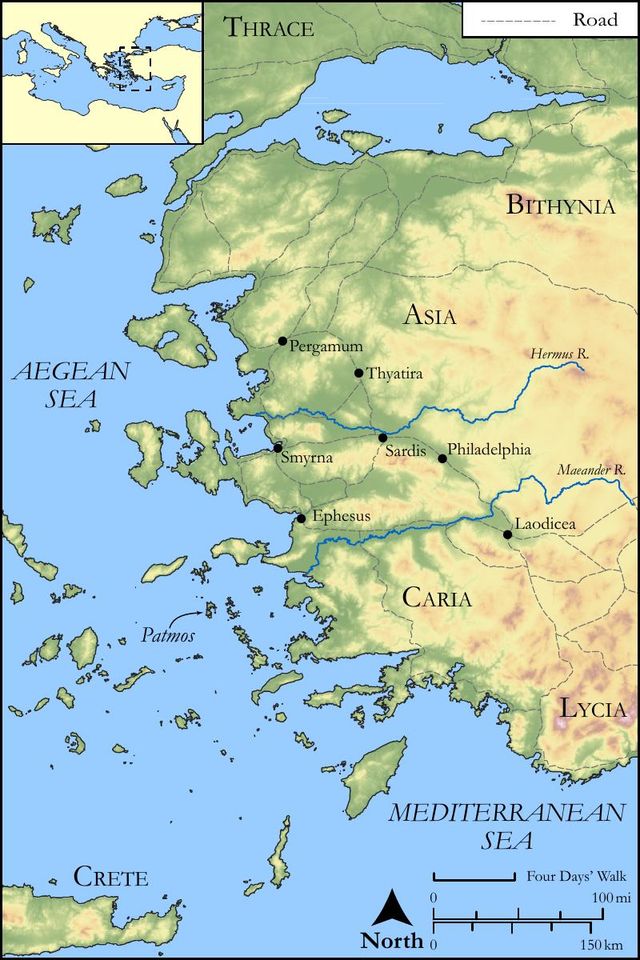
See on the biblical-era maps

Study this verse
Public-domain commentary
Matthew Henry
From his Commentary on the Whole Bible. Henry comments on passages, not single verses — this entry covers Revelation 22:1–5. His three-level outline is real structure in the source text, so it is rendered as structure.
The heavenly state which was before described as a city, and called the new Jerusalem, is here described as a paradise, alluding to the earthly paradise which was lost by the sin of the first Adam; here is another paradise restored by the second Adam. A paradise in a city, or a whole city in a paradise! In the first paradise there were only two persons to behold the beauty and taste the pleasures of it; but in this second paradise whole cities and nations shall find abundant delight and satisfaction. And here observe,
I.The river of paradise.
The earthly paradise was well watered: no place can be pleasant or fruitful that is not so. This river is described,
1.By its fountain-head - the throne of God and the Lamb. All our springs of grace, comfort, and glory, are in God; and all our streams from him are through the mediation of the Lamb.
2.By its quality - pure and clear as crystal. All the streams of earthly comfort are muddy; but these are clear, salutary, and refreshing, giving life, and preserving life, to those who drink of them.
II.The tree of life, in this paradise.
Such a tree there was in the earthly paradise, Gen 2:9. This far excels it. And now, as to this tree, observe,
1.The situation of it - in the midst of the street, and on either side the river; or, as might have been better rendered, in the midst between the terrace-walk and the river. This tree of life is fed by the pure waters of the river that comes from the throne of God. The presence and perfections of God furnish out all the glory and blessedness of heaven.
2.The fruitfulness of this tree.
(1.)It brings forth many sorts of fruit - twelve sorts, suited to the refined taste of all the saints.
(2.)It brings forth fruit at all times - yields its fruit every month. This tree is never empty, never barren; there is always fruit upon it. In heaven there is not only a variety of pure and satisfying pleasures, but a continuance of them, and always fresh.
(3.)The fruit is not only pleasant, but wholesome. The presence of God in heaven is the health and happiness of the saints; there they find in him a remedy for all their former maladies, and are preserved by him in the most healthful and vigorous state.
III.The perfect freedom of this paradise from every thing that is evil (Rev 22:3):
There shall be no more curse; no accursed one - katanathema, no serpent there, as there was in the earthly paradise. Here is the great excellency of this paradise. The devil has nothing to do there; he cannot draw the saints from serving God to be subject to himself, as he did our first parents, nor can he so much as disturb them in the service of God.
IV.The supreme felicity of this paradisiacal state.
1.There the saints shall see the face of God; there they shall enjoy the beatific vision.
2.God will own them, as having his seal and name on their foreheads.
3.They shall reign with him for ever; their service shall be not only freedom but honour and dominion.
4.All this shall be with perfect knowledge and joy. They shall be full of wisdom and comfort, continually walking in the light of the Lord; and this not for a time, but for ever and ever.
Historical interpretation
Seven Centuries of Reception
11 surviving comments on this verse. Each one is dated, so this reads as a timeline rather than a list.
Select a marker to jump to its quote. Markers stagger vertically where authors wrote within a few decades of each other.
The river of life sets forth that the grace of spiritual doctrine flowed through the minds of the faithful, and that manifold flourishing forms of odours germinated therein. The tree of life on either bank sets forth the Advent of Christ, according to the flesh, who satisfied the peoples wasted with famine, that received life from One by the wood of the Cross, with the announcement of God's word.
'And whose leaves never fade.' [Psalm 1:3] The leaves of this tree are by no means useless. Even if one understands Holy Writ only as history, he has something useful for his soul. We read in the Apocalypse of John (a book which, although rejected in these regions, we ought nevertheless to know, because it is accepted and held as canonical throughout the west, and in other Phoenician provinces, and in Egypt, for the ancient churchmen, including Irenaeus, Polycarp, Dionysius, and other Roman expounders of Sacred Scripture, among whom is holy Cyprian, accept and interpret it): 'Behold, I saw a throne set up, and one Lamb and a tree alongside a river, and on both sides of the river was that tree.' [Revelation 22:1-2] This means that the tree 'was both on this side and on that side of the river. 'And this tree,' he says, 'bore fruit and was yielding its twelve fruits for the year according to each month. And it had lean's, too, and the leaves for the healing of the nations.' [Revelation 22:2]
'I saw,' he says, 'a single throne set up.' We believe in the Father, and the Son, and the Holy Spirit, that is true, and that they are a Trinity; nevertheless the kingship is one. 'I saw a single throne set lip, and I saw a single Lamb standing in the presence of the throne.' [Revelation 5:6] This refers to the Incarnation of the Savior. Scripture says: 'Behold the lamb of God, who takes away the sin of the world' [John 1:29] 'And there was a fountain of water coming forth from beneath the middle of the throne' [Revelation 22:1] Notice that it is from the midst of the throne that there issues forth a river of graces. That river does not issue forth from the throne unless the Lamb is standing before it, [Revelation 7:17] for unless we believe in the Incarnation of Christ, we do not receive those graces.
A tree, he says, one lofty tree had been set up. He did not say trees, but only one tree. If there is but one tree how can it be on both sides of the river? If he had said, I saw trees, it would have been possible for some trees to be on one side of the river and other trees on the other side. Actually, one tree is said to be on both sides of the river. One river comes forth from the throne of God - the grace of the Holy Spirit - and this grace of the Holy Spirit is found in the river of the Sacred Scriptures. This river, moreover, has two banks, the Old Testament and the New Testament, and the tree planted on both sides is Christ. During the year, this tree yields twelve fruits, one for each month, but we are unable to receive the fruits except through the apostles. If one approaches the tree through the apostles, he must receive the fruit; he gathers the fruit from the Sacred Scriptures; he grasps the divine meaning abiding within the words. If, therefore, one comes to this tree through the apostles, he gathers its fruit just as we have said. If, indeed, he cannot pluck the fruit, it is because he is still too weak; he is not yet a disciple, but belongs to the throng; he is an outsider, a stranger from the nations. Because he cannot pluck the fruit, he plucks only words, the leaves for the healing of the nations, for it is written: 'and the leaves are for the healing of the nations.' One who belongs to the nations, who is not a disciple, who is as yet only one of the crowd, gathers only leaves from the tree; he receives from Scripture plain words for a healing remedy. Briefly, then, the Scripture says: 'and the leaves of the tree are for the healing of the nations'; in other words, the leaves are medicine. Why have we digressed on the Apocalypse? Simply became of that tree 'that yields its fruit in due season, and whose leaves never fade. Whatever he does, prospers.'
It is speaking of the cross of the Lord. There is no tree that bears fruit in every season except the cross that the faithful, who are made wet by the water of the church’s river, eat. And these [faithful] in turn produce eternal fruit in every season.
By the twelve months he signifies all of time, and to be sure all of eternity. Therefore, where there is an eternal paradise, no aridity will ever be permitted to intrude. Where there is a perfect and certain well-being, absolutely no infirmity enters in. This is what the prophet promised when he said, “They shall obtain joy and gladness, and sorrow and sighing shall flee away.” This is the tree, as we read, which is “planted by streams of water,” and of which Jeremiah says that it “sends out its roots by the stream.” This is to say that it places its hope and trust in the Lord. We may also interpret this passage concerning the river of the water of life to refer to the Lord Jesus Christ, who is himself the fountain of life. For we read of him, “With you is the fountain of life; in your light we shall see light.” He is himself, as we read, “the image of God’s majesty, who is powerful in all things, and remaining in himself renews all things and in every generation rests in holy souls.” And so he is the Fountain who is also the River. He is the Fountain, for he remains in himself inexhaustible, and he is the River because he offers himself generously and perpetually so that the saints might receive of [his] abundance. Where he is called fountain, he is also called a rushing stream. When the psalm says, “You shall give them drink from the river of your delights,” it then continues, “for with you is the fountain of life, and in your light shall we see light.” Moreover, [it says that it flows] through the middle of the street for it is a good that is common to all the saints and that is not denied to any who are worthy, nor is it granted to any who are unworthy.… Indeed, it is in their midst as an undivided patrimony to all who see God. For that reason we read, “Jerusalem, a city whose fellowship is complete within itself.” If the fruit is understood to be the reward of a blissful immortality, then we rightly understand the leaves to be the song of perpetual praise, because for those who sing they fall in the well-being of a happy fate. For there exists the true healing of the nations, there is full redemption, there is eternal happiness.
Concerning wisdom it is said, “She proclaims outside; she raises her voice in the streets, and she cries out on the top of the walls.” And should anyone refuse to come to the marriage of the king, she commands her servants and says, “Go to the streets and byways and invite whomever you meet to the wedding, that my house might be filled.” This water of salvation and the cleansing of grace is described as flowing in the streets.… The two banks of the river are the two Testaments in which the fullness of our salvation is written down. There is the tree of life. There is told [the story] of our Lord Jesus Christ, who is the tree of life: “Through him we live, move, and have our being.” The leaves are his words; they are of use for the health of all nations. The twelve months are the apostles of the Lord, because the Lord himself is the “favorable year of forgiveness.” These are the twelve months, each bringing to the many the fruit of unending preaching out of an abundance of knowledge.
This river waters the saints who are planted alongside it. They are here figuratively called the “tree of life” by virtue of their participation and imitation of him who is the Tree of Life. Moreover, they give forth “twelve fruits,” that is, they unceasingly yield the production of fruit. For there will be there no winter of sin that causes the trees of life to shed their leaves, such as we see now. Rather, the time of the production of fruit by the saints will be complete and uninterrupted, and [this time] is here said to be twelve months. It speaks in these terms equally because of the customary year among us, as well as because of the proclamation of the twelve apostles. This present passage may also be interpreted in another way. “The river” might signify the gifts of the life-giving Spirit, which flow down from the throne of the Father and of the Son, that is, from the ranks of the cherubim, among whom God is enthroned. [This river flows] into the streets of the city, that is, to the full citizenry of the saints, as coming from the first ranks into the second that are made to share in the well-ordered arrangement of the heavenly hierarchy. The “tree of life” signifies Christ, whom we know by the Holy Spirit and through the Spirit. For in him is the Spirit, and he is worshiped in Spirit, and he is the supplier of the Spirit, and through him the twelve fruits of the apostolic chorus give to us the inexhaustible fruit of the knowledge of God, through whom “the acceptable year of the Lord and the day of recompense” foretold by the prophet is proclaimed to us.
The “leaves of the tree,” namely, of Christ, are the more exalted understandings of the divine judgments, even as its “fruits” are the more perfect knowledge that is to be revealed in the age to come. The leaves will be for healing, that is, for the cleansing of the ignorance of those who have been deficient in the exercise of the virtues, for “there is one glory of the sun, and another glory of the moon, and another glory of the stars.” Moreover, “in my Father’s house there are many rooms,” so that one is accounted worthy of less and another of more brightness according to the measure of the works of each. This present passage may also be interpreted otherwise. The “tree of life” produces twelve fruits, namely, the apostolic chorus that shares in him who is truly the Tree of Life, who through his participation in the flesh has given us to share in his deity. Their fruits are those who yield fruit a hundredfold. The leaves are those who yield sixtyfold. These carry to those who come later the illumination of the divine light that they had received from those who had yielded a hundredfold, and they bring healing to those from the nations who yield thirtyfold. For at that time there will be a difference between those who are saved as great as there is a difference between fruit and leaves. Some will be glorified to a lesser extent, some to a greater extent, as it is written. It writes of a “tree” in the singular rather than “trees” in the plural to indicate the unity and harmony of the life which the saints have together.
Bearing twelve kinds of fruits, yielding its fruit every month. In the twelve months, it insinuates all the time of life, namely, that where it is said: And your years will not fail (Ps. CI). And again: From month to month and from Sabbath to Sabbath (Isa. LXVI). Where the face of the Lord is present, eternal health, eternal food of life. It can also be simply understood that through the doctrine of the twelve apostles, the cross of Christ bears fruit.
And the leaves of the tree were for the healing of the nations. If the fruit is taken as the reward of blessed immortality, rightly the leaves are understood as the perpetual song, which falls for the healing of those already singing in happy lot. For there, the true healing of the nations, complete redemption, and eternal happiness.
And on either side of the river was the tree of life. The tree of life is seen around the fountain of life. Whether you interpret it as the glory of the holy cross or the Lord Christ, it is revealed both before baptism in the Old Testament and now, with the mystery of baptism shining, it nourishes the saints with heavenly fruit. For there is no other name under heaven given among men by which we must be saved (Acts IV). The same tree, which John described as flowering in the golden Jerusalem, Moses described in paradise, and Solomon said it is a tree of life to those who embrace it. I believe that this river prefigured the Jordan, beyond which Moses gave the people instructions of salvation, and within which Jesus opened the promised land.
And of the river he says that on this side and on that side there was a tree of life bearing fruit each month. The Lord calls the tree of life, according to what is written by the Proverbs writer concerning wisdom; he says "the tree of life is for all who hold fast to it." (Prov. 3:18) But Paul handed over to us "Christ as God's power and God's wisdom." (1 Cor. 1:24) And he says that not only do the saints possess the riches of Christ's gifts, but they also have and share in him dwelling within them; which is the head of the highest blessedness. But the tree of life is continuous, Christ, and unceasingly brings to completion fruits and gifts to the saints, as if to overtake zeal with zeal and lest they ever be deprived of divine flow.
And he says the leaves of the tree are for the healing of the nations. Leaves of life are the patriarchs attached to Christ and holding him, prophets, apostles, evangelists, martyrs and confessors, and those who in due times officiate at the gospel and pastors of the church, and every righteous soul; who even now heal souls, and to the saints will be an addition of good things.
Continue studying Revelation 22:2 across the web’s major study libraries — every link below opens this exact verse, chapter, or book on the destination site.
Read & Compare
 BibleGatewayThis verse in more than 200 translations and 70 languages.
 Bible.comThe YouVersion reader — hundreds of translations, reading plans, and highlights.
 ESV.orgCrossway's official English Standard Version reader.
 NET BibleThe NET translation with 60,000+ translators' notes on every rendering decision.
 STEP BibleTyndale House's free study tool — original text, vocabulary, and scholarly resources.
 BibliaLogos Bible Software's free web reader.
 USCCBThe New American Bible (Revised Edition) with the U.S. bishops' study notes.
Commentaries
 BibleHub CommentariesDozens of classic commentaries on this verse, gathered on one page.
 StudyLightMore than 100 commentary sets — the largest collection on the web.
 BibleRefPlain-English commentary on what this verse means, verse by verse.
 Enduring WordDavid Guzik's free commentary on this chapter, widely used by Bible teachers.
 Bible Study ToolsVerse commentary alongside Greek and Hebrew study aids.
Original Language & Research
- BibleHub InterlinearThe verse word by word — original language, transliteration, and English.
- BibleHub LexiconEvery word's original-language definition and Strong's entry.
 Blue Letter BibleDeep-study tools — Strong's numbers, concordance, and word studies.
 CNTR CollationThe earliest Greek manuscripts of this verse, collated letter by letter.
Sermons, Hymns & Audio


TrulyRandomVerse is not affiliated with these sites and doesn’t control their content. They’re linked because they’re genuinely useful.
Summary
Revelation 22:2 offers a magnificent glimpse into the New Jerusalem, depicting the restored Tree of Life as central to the eternal city's landscape. Positioned alongside the crystal-clear river of life, this tree symbolizes God's unending provision, bearing a diverse array of fruits monthly, ensuring perpetual sustenance for the redeemed. Crucially, its leaves are designated for the healing of the nations, signifying the complete restoration of all humanity and the undoing of every wound inflicted by sin, culminating in perfect wholeness and unity in God's presence.
Context
ShowHideLiterary Context
This verse is an integral part of the climactic vision in the Book of Revelation, specifically within chapters 21 and 22, which describe the new heaven and new earth and the descent of the New Jerusalem. It immediately follows the depiction of the "pure river of water of life, clear as crystal, proceeding out of the throne of God and of the Lamb" in Revelation 22:1. This establishes a scene of unparalleled divine presence and life-giving abundance. The imagery here intentionally contrasts with the desolation and judgment described earlier in Revelation, presenting the ultimate triumph of God's redemptive plan. It serves as the culmination of biblical history, moving from the lost paradise of Eden to a restored and perfected paradise where God dwells intimately with His people.
Historical & Cultural Context
The imagery of a life-giving river and a tree of life has deep roots in the garden of Eden and in Old Testament prophetic literature. For the original audience, familiar with the Genesis account of humanity's expulsion from Eden and subsequent longing for restoration, the reappearance of the Tree of Life would have resonated profoundly. The concept of "healing for the nations" would have been understood against the backdrop of historical divisions, conflicts, and the spiritual brokenness that plagued humanity. Furthermore, the idea of a perpetual harvest (twelve fruits, every month) would have evoked images of abundant blessing and provision, contrasting sharply with the scarcity and hardship often experienced in that day. The "nations" (Greek: ethnē) would have specifically brought to mind the Gentile world, emphasizing God's universal redemptive scope beyond Israel.
Key Themes
ShowHideRevelation 22:2 contributes significantly to several overarching themes within the book and broader biblical theology. Foremost is the theme of Restoration and New Creation, as the verse directly recalls and surpasses the original Garden of Eden, where access to the Tree of Life was denied after the fall (Genesis 3:24). Here, access is not only restored but made central to the eternal state. Another key theme is Divine Provision and Sustenance, highlighted by the tree's continuous fruit-bearing, symbolizing God's unfailing and abundant care for His redeemed people, free from want or scarcity. Finally, the "healing of the nations" underscores the theme of Universal Reconciliation and Wholeness. This healing extends beyond physical ailments (which are absent in the New Jerusalem, as Revelation 21:4 attests) to encompass the complete spiritual, relational, and societal mending of all the divisions, hostilities, and spiritual wounds that have plagued humanity throughout history. It is the full realization of peace and unity among all redeemed peoples, signifying the final removal of the curse and its effects. This vision echoes prophetic promises of a new covenant and a restored Israel that would bring light to the nations, as seen in passages like Isaiah 60:3 and Ezekiel 47:12.
Exposition and Analysis
ShowHideKey Word Analysis
ShowHideDerived from zaō, meaning "to live," this word refers to life in its fullest sense—not merely biological existence, but spiritual, eternal, and abundant life. In this context, it emphasizes the quality of existence in the New Jerusalem, a life characterized by divine presence, freedom from decay, and perpetual vitality, directly contrasting with the death and corruption of the fallen world. The "Tree of Life" itself is the source and symbol of this unending, vibrant existence.
From therapeuō, meaning "to serve, to heal, to cure." While it can denote medical treatment or cure, in the eschatological context of Revelation 22:2, where sickness and pain are no more (Revelation 21:4), therapeía conveys a deeper, more comprehensive sense of wholeness, restoration, and well-being. It signifies the complete mending of all spiritual, emotional, relational, and societal wounds inflicted by sin, bringing about perfect harmony and reconciliation.
Probably from ethō (habit), referring to a race or tribe, specifically a foreign (non-Jewish) one, often implying pagan. In the New Testament, éthnos frequently refers to the Gentiles, or all non-Israelite peoples. Here, "the nations" signifies the entirety of redeemed humanity from every tribe, tongue, people, and nation (Revelation 7:9), emphasizing the universal scope of God's redemptive work and the complete reconciliation of all peoples under His righteous rule.
Verse Breakdown
ShowHide"In the midst of the street of it, and on either side of the river, [was there] the tree of life"
This clause establishes the prominent, central location of the Tree of Life. "The street of it" (Greek: plateia) refers to the broad main thoroughfare of the New Jerusalem, indicating public access and centrality. The phrase "on either side of the river" suggests that the tree is not a single entity but possibly a continuous grove or a series of trees lining the riverbanks, extending its life-giving presence throughout the city. This imagery emphasizes the omnipresent source of life and sustenance, directly accessible to all inhabitants. The "river" is the pure river of water of life from Revelation 22:1, flowing from God's throne, signifying that all life and blessing originate from God Himself.
"which bare twelve [manner of] fruits, [and] yielded her fruit every month"
This describes the extraordinary productivity and continuous provision of the Tree of Life. "Twelve manner of fruits" signifies a complete variety and abundance, perhaps one for each of the twelve tribes of Israel or the twelve apostles, symbolizing the fullness of God's provision for all His people. The phrase "yielded her fruit every month" (literally, "according to month, its fruit") emphasizes the perpetual, unfailing, and timely nature of this provision. There is no seasonality or scarcity; sustenance is always available, fresh and new, reflecting the eternal and inexhaustible nature of God's blessings.
"and the leaves of the tree [were] for the healing of the nations"
This is a profound statement about the ultimate purpose and effect of God's restoration. While the fruit provides sustenance, the leaves offer "healing" (therapeía). As discussed in Key Word Analysis, this is not physical healing in a place where sickness is absent. Instead, it speaks to the comprehensive spiritual, relational, and societal restoration of all peoples. It signifies the complete undoing of the curse, the mending of all divisions, hostilities, and the deep-seated brokenness that has plagued humanity since the fall. It points to the full reconciliation and unity of all redeemed "nations" (ethnē) in the presence of God, where all past wounds are healed, and perfect peace reigns.
Literary Devices
ShowHideRevelation 22:2 is rich with Symbolism and Allusion. The Tree of Life itself is a potent symbol, directly alluding to the tree in the Garden of Eden (Genesis 2:9), signifying the reversal of the curse and the restoration of humanity's access to eternal life. Its continuous fruit-bearing (Symbolism of perpetual divine provision) and the healing properties of its leaves (Symbolism of comprehensive restoration) further develop this. The river of life is another powerful symbol, representing the Holy Spirit and the life-giving presence of God, echoing similar imagery in Ezekiel 47:1-12 and Psalm 46:4. The phrase "healing of the nations" employs Metonymy, where "healing" represents the complete spiritual and relational wholeness of humanity, not just physical cure. The entire passage uses vivid Imagery to paint a picture of an idyllic, perfectly restored paradise, engaging the reader's senses and imagination to convey the glory of the eternal state. The Contrast between the fallen world's scarcity, division, and suffering and the New Jerusalem's abundance, unity, and wholeness is implicitly powerful throughout the description.
Theological and Thematic Connections
ShowHideRevelation 22:2 stands as a powerful theological statement on the ultimate culmination of God's redemptive plan. It signifies the complete reversal of the Genesis curse, where humanity was expelled from the Tree of Life due to sin. In the New Jerusalem, not only is access restored, but the Tree of Life becomes a central, ever-present source of sustenance and healing, demonstrating God's boundless grace and provision. The "healing of the nations" underscores the universal scope of God's salvation, emphasizing that His redemptive work extends beyond individual salvation to encompass the reconciliation of all peoples and the mending of all the brokenness caused by sin throughout human history. This holistic restoration speaks to God's desire for perfect shalom – peace, wholeness, and flourishing – for His entire creation, culminating in a unified, worshipping community drawn from every corner of the earth.
Reflection and Application
ShowHideRevelation 22:2 offers a profound source of hope and comfort for believers navigating the brokenness of the present world. It assures us that God's ultimate plan is one of perfect restoration, where life flourishes eternally, and all the wounds inflicted by sin—whether personal, relational, or societal—are completely healed. This vision encourages us to persevere through current trials, knowing that a glorious and abundant future awaits, free from scarcity, sickness, or division. It reminds us of God's complete and unfailing provision, assuring us that He will meet every need in the eternal state. Furthermore, the promise of the "healing of the nations" is a powerful call to action in the present. While the ultimate healing is eschatological, it inspires us to participate in God's redemptive work now, pursuing reconciliation, justice, and wholeness in our communities and among diverse peoples, embodying the unity and peace that will characterize the New Jerusalem. It fosters a longing for that day when all things are made new and God's perfect shalom reigns supreme.
Questions for Reflection
ShowHideFAQ
ShowHideWhat does "healing of the nations" mean if there is no sickness in the New Jerusalem?
ShowHideThe "healing of the nations" in Revelation 22:2 refers to a much deeper, more comprehensive restoration than merely physical cure. In the New Jerusalem, Revelation 21:4 explicitly states that there will be no more death, sorrow, crying, or pain, implying the absence of physical ailments. Therefore, the "healing" (Greek: therapeía) points to the complete spiritual, relational, and societal wholeness of humanity. It signifies the undoing of all the divisions, hostilities, spiritual brokenness, and the lingering effects of sin that have plagued humanity throughout history. It is the full reconciliation and unity of all redeemed peoples—from every tribe and tongue—under God's righteous rule, where all past wounds are mended, and perfect peace and harmony reign. It's the ultimate restoration of shalom.
Christ-Centered Fulfillment
ShowHideRevelation 22:2 finds its ultimate Christ-centered fulfillment in Jesus, who is Himself the true and eternal source of life and healing. While the Tree of Life in Eden was guarded after the fall, access to eternal life is now freely offered through Christ's atoning work. He is the "Lamb of God, who takes away the sin of the world!" (John 1:29), whose sacrificial death on the cross opened the way back to God's presence and the Tree of Life. Just as the tree provides continuous fruit, Jesus declares, "I am the bread of life; whoever comes to me shall not hunger, and whoever believes in me shall never thirst" (John 6:35), signifying His perpetual spiritual sustenance for His people. Furthermore, the "healing of the nations" points directly to Christ's universal redemptive work. Through His blood, He has purchased "people for God from every tribe and language and people and nation" (Revelation 5:9), breaking down the dividing wall of hostility (Ephesians 2:14) and bringing reconciliation not only between God and humanity but also among diverse peoples. He is the one who makes "all things new" (Revelation 21:5), ultimately bringing about the complete and glorious restoration envisioned in this verse, where all creation is reconciled to God through Him (Colossians 1:20).