


Ezekiel 47:12
Bible text: King James Version (1769 Blayney text) · Public domain
Bible text: King James Version with Strong's numbers · Public domain
Bible text: Berean Standard Bible · Public domain
Bible text: American Standard Version (1901) · Public domain
Bible text: World English Bible, Messianic edition · Public domain
Bible text: Geneva Bible (1599) · Public domain
Bible text: Young's Literal Translation · Public domain
- וְעַלve·'aland atH5921Conj-w ¦ PrepPrepositionוְandעַלat
- הַנַּחַלha·Na·chalthe riverH5158Art ¦ N-msNoun Singular Masculine Absoluteהַtheנַּחַלriver
- יַעֲלֶהya·'a·Lehit will grow upH5927V-Qal-Imperf-3msVerb Qal Imperfect 3rd Singular Masculine
- עַל'alonH5921PrepPreposition
- שְׂפָתוֹse·fa·Toits bankH8193N-fsc ¦ 3msNoun Singular Feminine Constructשְׂפָתbankוֹits
- מִזֶּהmi·Zehfrom thisH2088Prep-m ¦ PrtParticle Demonstrativeמִfromזֶּהthis
- וּמִזֶּהu·mi·Zehand from thisH2088Conj-w ¦ Prep-m ¦ PrtParticle Demonstrativeוּandמִfromזֶּהthis
- כָּלkoleveryH3605N-mscNoun Singular Masculine Construct
- עֵץ'etztree ofH6086N-mscNoun Singular Masculine Construct
- מַאֲכָלMa·'a·kholfoodH3978N-msNoun Singular Masculine Absolute
- לֹאlo'notH3808NegParticle Negative
- יִבּוֹלyi·Bolit will witherH5034V-Qal-Imperf-3msVerb Qal Imperfect 3rd Singular Masculine
- עָלֵהוּ'a·Le·huits leafageH5929N-msc ¦ 3msNoun Singular Masculine Constructעָלֵleafageהוּits
- וְלֹאve·lo'and notH3808Conj-w ¦ NegParticle Negativeוְandלֹאnot
- יִתֹּםyi·Tomit will be finishedH8552V-Qal-Imperf-3msVerb Qal Imperfect 3rd Singular Masculine
- פִּרְיוֹpir·Yoits fruitH6529N-msc ¦ 3msNoun Singular Masculine Constructפִּרְיfruitוֹits
- לָחֳדָשָׁיוlo·cho·da·Shavto its monthsH2320Prep-l ¦ N-mpc ¦ 3msNoun Plural Masculine Constructלָtoחֳדָשָׁיmonthsוits
- יְבַכֵּרye·va·Kerit will bear early fruitH1069V-Piel-Imperf-3msVerb Piel Imperfect 3rd Singular Masculine
- כִּיkiforH3588PrtParticle Conditional
- מֵימָיוmei·Mavits watersH4325N-mpc ¦ 3msNoun Plural Masculine Constructמֵימָיwatersוits
- מִןminfromH4480PrepPreposition
- הַמִּקְדָּשׁha·mik·Dashthe sanctuaryH4720Art ¦ N-msNoun Singular Masculine Absoluteהַtheמִּקְדָּשׁsanctuary
- הֵמָּהHe·mahtheyH1992Pro-3mpPronoun Personal 3rd Plural Masculine
- יוֹצְאִיםyotz·'Im[are] coming outH3318V-Qal-Prtcpl-mpVerb Qal Participle Plural Masculine Absolute
- וְהָיָהve·ha·yuand it will beH1961Conj-w ¦ V-Qal-ConsecPerf-3msVerb Qal Consecutive Perfect 3rd Singular Masculineוְandהָיָהit will be
- פִרְיוֹfir·Yoits fruitH6529N-msc ¦ 3msNoun Singular Masculine Constructפִרְיfruitוֹits
- לְמַאֲכָלle·ma·'a·Khalfor foodH3978Prep-l ¦ N-msNoun Singular Masculine Absoluteלְforמַאֲכָלfood
- וְעָלֵהוּve·'a·Le·huand its leafageH5929Conj-w ¦ N-msc ¦ 3msNoun Singular Masculine Constructוְandעָלֵleafageהוּits
- לִתְרוּפָהlit·ru·Fah[will be] for healingH8644Prep-l ¦ N-fsNoun Singular Feminine Absoluteלִ[will be] forתְרוּפָהhealing
English is a literal word-by-word gloss of the Hebrew, not the KJV's wording. Why?
This is the original text the KJV's translators worked from — each Hebrew word with its own literal English meaning in this verse, prepared by scholars at Tyndale House, Cambridge. The KJV translates whole sentences, not word by word, so its wording differs: one Hebrew word can become several English words, and the KJV may choose “the LORD” where the gloss reads “Yahweh”. Both are faithful — they answer different questions. For the KJV's own rendering, switch to the KJV text.
Details
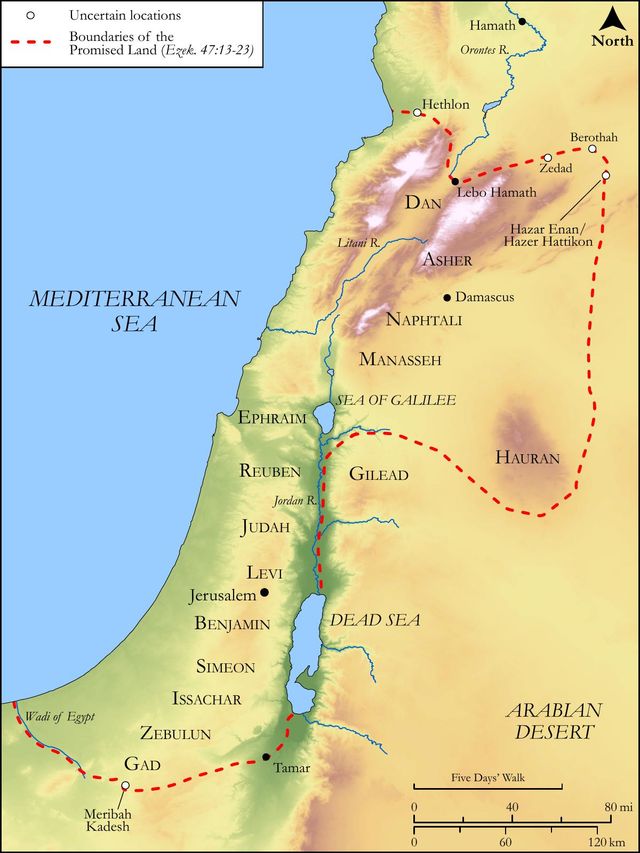
See on the biblical-era map
Study this verse
Public-domain commentary
Matthew Henry
From his Commentary on the Whole Bible. Henry comments on passages, not single verses — this entry covers Ezekiel 47:1–12. His two-level outline is real structure in the source text, so it is rendered as structure.
This part of Ezekiel's vision must so necessarily have a mystical and spiritual meaning that thence we conclude the other parts of his vision have a mystical and spiritual meaning also; for it cannot be applied to the waters brought by pipes into the temple for the washing of the sacrifices, the keeping of the temple clean, and the carrying off of those waters, for that would be to turn this pleasant river into a sink or common sewer. That prophecy, Zac 14:8, may explain it, of living waters that shall go out from Jerusalem, half of them towards the former sea and half of them towards the hinder sea. And there is plainly a reference to this in St. John's vision of a pure river of water of life, Rev 22:1. That seems to represent the glory and joy which are grace perfected. This seems to represent the grace and joy which are glory begun. Most interpreters agree that these waters signify the gospel of Christ, which went forth from Jerusalem, and spread itself into the countries about, and the gifts and powers of the Holy Ghost which accompanied it, and by virtue of which it spread far and produced strange and blessed effects. Ezekiel had walked round the house again and again, and yet did not till now take notice of those waters; for God makes known his mind and will to his people, not all at once, but by degrees. Now observe,
I.The rise of these waters.
He is not put to trace the streams to the fountain, but has the fountain-head first discovered to him (Eze 47:1): Waters issued out from the threshold of the house eastward, and from under the right side of the house, that is, the south side of the alter. And again (Eze 47:2), There ran out waters on the right side, signifying that from Zion should go forth the law and the word of the Lord from Jerusalem, Isa 2:3. There it was that the Spirit was poured out upon the apostles, and endued them with the gift of tongues, that they might carry these waters to all nations. In the temple first they were to stand and preach the words of this life, Act 5:20. They must preach the gospel to all nations, but must begin at Jerusalem, Luk 24:47. But that is not all: Christ is the temple; he is the door; from him those living waters flow, out of his pierced side. It is the water that he gives us that is the well of water which springs up, Joh 4:14. And it is by believing in him that we receive from him rivers of living water; and this spoke he of the Spirit, Joh 7:38, Joh 7:39. The original of these waters was not above-ground, but they sprang up from under the threshold; for the fountain of a believer's life is a mystery; it is hid with Christ in God, Col 3:3. Some observe that they came forth on the right side of the house to intimate that gospel-blessings are right-hand blessings. It is also an encouragement to those who attend at Wisdom's gates, at the posts of her doors, who are willing to lie at the threshold of God's house, as David was, that they lie at the fountainhead of comfort and grace; the very entrance into God's word gives light and life, Psa 119:130. David speaks it to the praise of Zion, All my springs are in thee, Psa 87:7. They came from the side of the altar, for it is in and by Jesus Christ, the great altar (who sanctifies our gifts to God), that God has blessed us with spiritual blessings in holy heavenly places. From God as the fountain, in him as the channel, flows the river which makes glad the city of our God, the holy place of the tabernacles of the Most High, Psa 46:4. But observe how much the blessedness and joy of glorified saints in heaven exceed those of the best and happiest saints on earth; here the streams of our comfort arise from under the threshold; there they proceed from the throne the throne of God and of the Lamb, Rev 22:1.
II.The progress and increase of these waters:
They went forth eastward (Eze 47:3), towards the east country (Eze 47:8), for so they were directed. The prophet and his guide followed the stream as it ran down from the holy mountains, and when they had followed it about a thousand cubits they went over across it, to try the depth of it, and it was to the ankles, Eze 47:3. Then they walked along on the bank of the river on the other side, a thousand cubits more, and then, to try the depth of it, they waded through it the second time, and it was up to their knees, Eze 47:4. They walked along by it a thousand cubits more, and then forded it the third time, and then it was up to their middle - the waters were to the loins. They then walked a thousand cubits further, and attempted to repass it the fourth time, but found it impracticable: The waters had risen, by the addition either of brooks that fell into it above ground or by springs under ground, so that they were waters to swim in, a river that could not be passed over, Eze 47:5. Note,
1.The waters of the sanctuary are running waters, as those of a river, not standing waters, as those of a pond. The gospel, when it was first preached, was still spreading further. Grace in the soul is still pressing forward; it is an active principle, plus ultra - onward still, till it comes to perfection.
2.They are increasing waters. This river, as it runs constantly, so the further it goes the fuller it grows. The gospel-church was very small in its beginnings, like a little purling brook; but by degrees it came to be to the ankles, to the knees: many were added to it daily, and the grain of mustard seed grew up to be a great tree. The gifts of the Spirit increase by being exercised, and grace, where it is true, is growing, like the light of the morning, which shines more and more to the perfect day.
3.It is good for us to follow these waters, and go along with them. Observe the progress of the gospel in the world; observe the process of the work of grace in the heart; attend the motions of the blessed Spirit, and walk after them, under a divine guidance, as Ezekiel here did.
4.It is good to be often searching into the things of God, and trying the depth of them, not only to look on the surface of those waters, but to go to the bottom of them as far as we can, to be often digging, often diving, into the mysteries of the kingdom of heaven, as those who covet to be intimately acquainted with those things.
5.If we search into the things of God, we shall find some things very plain and easy to be understood, as the waters that were but to the ankles, others more difficult, and which require a deeper search, as the water to the knees or the loins, and some quite beyond our reach, which we cannot penetrate into, or account for, but, despairing to find the bottom, must, as St. Paul, sit down at the brink, and adore the depth, Rom 11:33. It has been often said that in the scripture, like these waters of the sanctuary, there are some places so shallow that a lamb may wade through them, and others so deep that an elephant may swim in them. And it is our wisdom, as the prophet here, to begin with that which is most easy, and get our hearts washed with those things before we proceed to that which is dark and hard to be understood; it is good to take our work before us.
III.The extent of this river:
It issues towards the east country, but thence it either divide itself into several streams or fetches a compass, so that it goes down into the desert, and so goes into the sea, either into the dead sea, which lay south-east, or the sea of Tiberias, which lay north-east, or the great sea, which lay west, Eze 47:8. This was accomplished when the gospel was preached with success throughout all the regions of Judea and Samaria (Act 8:1), and afterwards the nations about, nay, and those that lay most emote, even in the isles of the sea, were enlightened and leavened by it. The sound of it went forth to the end of the world; and the enemies of it could no more prevail to stop the progress of it than that of a mighty river.
IV.The healing virtue of this river.
The waters of the sanctuary, wherever they come and have a free course, will be found a wonderful restorative. Being brought forth into the sea, the sulphureous lake of Sodom, that standing monument of divine vengeance, even those waters shall be healed (Eze 47:8), shall become sweet, and pleasant, and healthful. This intimates the wonderful and blessed change that the gospel would make, wheresoever it came in its power, a a great change, in respect both of character and condition, as the turning of the dead sea into a fountain of gardens. When children of wrath became children of love, and those that were dead in trespasses an sins were made alive, then this was fulfilled. The gospel was as that salt which Elisha cast into the spring of the waters of Jericho, with which he healed them, Kg2 2:20, Kg2 2:21. Christ, coming into the world to be its physician, sent his gospel as the great medicine, the panpharmacon; there is in it a remedy for every malady. Nay, wherever these rivers come, they make things to live (Eze 47:9), both plants and animals; they are the water of life, Rev 22:1, Rev 22:17. Christ came, that we might have life and for that end he sends his gospel. Every thing shall live whither the river comes. The grace of God makes dead sinners alive and living saints lively; everything is made fruitful and flourishing by it. But its effect is according as it is received, and as the mind is prepared and disposed to receive it; for (Eze 47:11) with respect to the marshes and miry places thereof, that are settled in the mire of their own sinfulness, and will not be healed, or settled in the moisture of their own righteousness, and think they need no healing, their doom is, They shall not be healed; the same gospel which to others is a savour of life unto life shall to them be a savour of death unto death; they shall be given to salt, to perpetual barrenness, Deu 29:23. Those that will not be watered with the grace of God, and made fruitful, shall be abandoned to their own hearts' lusts, and left for ever unfruitful. He that is filthy, let him be filthy still. Never fruit grow on thee more for ever. They shall be given to salt, that is, to be monuments of divine justice, as Lot's wife that was turned into a pillar of salt, to season others.
V.The great plenty of fish that should be in this river.
Everything living moving thing shall be found here, shall live here (Eze 47:9), shall come on and prosper, shall be the best of the kind, and shall increase greatly; so that there shall be a very great multitude of fish, according to their kinds, as the fish of the great sea, exceedingly many. There shall be as great plenty of the river fish, and as vast shoals of them, as there is of salt-water fish, Eze 47:10. There shall be no great numbers of Christians in the church, and those multiplying like fishes in the rising generations and the dew of their youth. In the creation the waters brought forth the fish abundantly (Gen 1:20, Gen 1:21), and they still live in and by the waters that produced them; so believers are begotten by the word of truth (Jam 1:18), and born by it (Pe1 1:23), that river of God; by it they live, from it they have their maintenance and subsistence; in the waters of the sanctuary they are as in their element, out of them they are as fish upon dry ground; so David was when he thirsted and panted for God, for the living God. Where the fish are known to be in abundance, thither will the fishers flock, and there they will cast their nets; and therefore, to intimate the replenishing of these waters and their being made every way useful, it is here foretold that the fishers shall stand upon the banks of this river, from En-gedi, which lies on the border of the dead sea, to En-eglaim, another city, which joins to that sea, and all along shall spread their nets. The dead sea, which before was shunned as noisome and noxious, shall be frequented. Gospel-grace makes those persons and places which were unprofitable and good for nothing to become serviceable to God and man.
VI.The trees that were on the banks of this river - many trees on the one side and on the other (Eze 47:7), which made the prospect very pleasant and agreeable to the eye; the shelter of these trees also would be a convenience to the fishery. But that is not all (Eze 47:12); they are trees for meat, and the fruit of them shall not be consumed, for it shall produce fresh fruit every month. The leaf shall be for medicine, and it shall not fade, This part of the vision is copied out into St. John's vision very exactly (Rev 22:2), where, on either side of the river, is said to grow the tree of life, which yielded her fruit every month, and the leaves were for the healing of the nations. Christians are supposed to be these trees, ministers especially, trees of righteousness, the planting of the Lord (Isa 61:3), set by the rivers of water, the waters of the sanctuary (Psa 1:3), grafted into Christ the tree of life, and by virtue of their union with him made trees of life too, rooted in him, Col 2:7. There is a great variety of these trees, through the diversity of gifts with which they are endued by that one Spirit who works all in all. They grow on the bank of the river, or they keep close to holy ordinances, and through them derive from Christ sap and virtue. They are fruit-trees, designed, as the fig tree and the olive, with their fruits to honour God and man, Jdg 9:9. The fruit thereof shall be for meat, for the lips of the righteous feed many. The fruits of their righteousness are one way or other beneficial. The very leaves of these trees are for medicine, for bruises and sores, margin. Good Christians with their good discourses, which are as their leaves, as well as with their charitable actions, which are as their fruits, do good to those about them; they strengthen the weak, and bind up the broken-hearted. Their cheerfulness does good like a medicine, not only to themselves, but to others also. They shall be enabled by the grace of God to persevere in their goodness and usefulness; their leaf shall not fade, or lose its medicinal virtue, having not only life in their root, but sap in all their branches; their profession shall not wither (Psa 1:3), neither shall the fruit thereof be consumed; that is, they shall not lose the principle of their fruitfulness, but shall still bring forth fruit in old age, to show that the Lord is upright (Psa 92:14, Psa 92:15), or the reward of their fruitfulness shall abide for ever; they bring forth fruit that shall abound to their account in the great day, fruit to life eternal; that is indeed fruit which shall not be consumed. They bring new fruit according to their months, some in one month and others in another: so that still there shall be one or other found to serve the glory of God for the purpose he designs. Or each one of them shall bring forth fruit monthly, which denotes an abundant disposition to fruit-bearing (they shall never be weary of well-doing), and a very happy climate, such that there shall be a perpetual spring and summer. And the reason of this extraordinary fruitfulness is because their waters issued out of the sanctuary; it is not to be ascribed to any thing in themselves, but to the continual supplies of divine grace, with which they are watered every moment (Isa 27:3); for, whoever planted them, it was that which gave the increase.
Historical interpretation
Historical reception
1 surviving comment on this verse from the historical church.
(Ver. 6 seqq.) And he said to me: You have certainly seen, son of man; and he brought me out, and turned me toward the bank of the river (or the stream). And when I turned (or had turned), behold, on the bank of the river (or the stream) there were very many trees (or very many trees) on both sides. And he said to me: These waters that go out to the hills of the East (or Oriental), and go down to the plains of the desert (or this water that goes out into Galilee, which turns to the East, and goes down to Arabia), shall enter the sea, and shall go out, and the waters shall be healed. And every living creature (or animal) that crawls (or of crawling creatures), wherever the torrent (or river) shall come, shall live; and there shall be very many fish, after these waters come there; and they shall be healed, and all things to which the torrent (or river) shall come shall live. And the fishermen shall stand upon its banks from Engaddi even to Engallim; it shall be a place to spread their nets. The fish of it shall be of very many kinds, like the fish of the great sea, exceeding many. But the marshes that go out of the banks will not be healed, but will be given to the salt marshes. And over the torrent (or river) there shall spring up on its banks on both sides every fruit-bearing tree, its leaf shall not wither (or it shall not grow old): and its fruit shall not fail. Every month they shall bring forth first fruits (or all things shall be renewed); because its waters shall go forth from the sanctuary, and its fruit shall be for food, and its leaves for medicine (or its ascent for health). Although this whole chapter may be lengthy, I wanted to present it all at once so as not to interrupt the reader's understanding and to avoid disrupting the listener's comprehension. First, it should be noted that in Hebrew it is called Nehel () and in Greek it is called χειμάῤῥους, which the Septuagint translates as 'river'. Then, for Galilee, which is called Galila () in Hebrew, Aquila translates it as θίνας, which means 'sand dunes'; Symmachus translates it as μεθόριον, which we can translate as 'border'. Symmachus also transferred to Arabia, which is uninhabitable; Aquila, the low and flat areas; Theodotius, to Araba. Let us therefore say what seems to us in each. That man who was the leader of Ezekiel, advises the prophet to look more closely and see, and to attentively observe the hidden mysteries with the eyes of the mind. He calls the son of man, or in the likeness of the Lord and Savior; and indeed Ezekiel is interpreted as strength, or the kingdom of God: or certainly for the disturbance of human weakness; lest he forget his own condition, while great things are shown to him: and he leads and turns to the bank of the river, so that because he could not cross the middle depth, at least he may recognize those things which are on the banks. And when, he said, I turned, or he turned me, who was the guide and teacher; behold on the river bank, or the stream, many logs, or very many trees on both sides. This torrent, which is carried by the abundance of water like a torrent, and receives rain from the sky, as we mentioned in the previous lesson, is called a river by LXX, because it has perpetual waters: not from rains collected here and there, but from a living and perpetual source. Of which river we read many things in the holy Scriptures; but for the present few things are to be said, and first this: The floods have lifted up, O Lord, the floods have lifted up their voice, the floods have lifted up their waves. (Psalm 93:3) And in Isaiah: I will make a way in the desert and rivers in the wilderness (Isa. XLIII, 19). And in another place of the same book, more clearly: There will appear in Zion a river flowing glorious in a thirsty land (Isa. XLIV, 3). Above this river there were many trees on both sides of the bank; so that between two instruments, the old and the new, the enclosed river would flow. However, there were many wood or rather, very many trees, which I believe abound in various fruits as the Scripture mentions in paradise; and the leading guide and teacher, the prophet, teaches and says: These waters that come out, either into the Galilee of the Gentiles, according to the Septuagint, or (as it is more accurately contained in Hebrew) into the hills of the eastern sand, and they descend to the plains of the desert, or to Arabia, they will enter the sea, or to the ends of the sea, and the waters will be healed. We previously said that waters either signify the grace of baptism or the Evangelical doctrine. If these waters leave the threshold of the Lord's temple and hold fast to the Apostolic discipline, they make the previously barren and infertile hills fruitful and turn everything flat and deserted into a well-watered land, so that they embody the sacrament of the Jordan River. This river, which Elisha cured with Evangelical and Apostolic salt, transformed barrenness and death into abundance and life. Not only did they heal the deserts, but they entered the Dead Sea, a sea in which nothing living could exist, and the most bitter sea, which in Greek is called λίμνην ἀσφαλτῖτιν, that is, the lake of bitumen. And in a wonderful way, the dead waters are healed by the waters of the Gospel, which, because they have nothing living in them, are given the name of death. For they had not known Him who says: I am the way, the truth, and the life (John 14:6). And truly, according to the letter, nothing that breathes and can walk can be found in this sea due to excessive bitterness: not even snails, small worms, eels, and other types of animals or serpents, whose bodies we can know more than their names. Finally, if the Jordan river, swollen by rain, carries fish to this place, they immediately die and float on the oily waters. Since these things have no usefulness, as simple speech testifies, even if they were done, which the foolish superstition of the Jews believes, they will have many fish according to the spiritual understanding of the Lord, when the river is healed, and all things will live to which this river has come; so that fishermen will stand on the shores from Engedi to En-galim: the former means the source or spring of goats, and the latter means the source or spring of calves. For in the beginning, there is the sea of the Dead, where the Jordan enters. And there is En-gedi, where it ends and is consumed. But I believe that the Dead Sea is the one Zacharias speaks of: In that day living water will flow out from Jerusalem, half of it towards the eastern sea and half towards the western sea (Zach. XIV, 8). Daniel also agrees with these words: I saw in my vision by night, and behold, the four winds of heaven were stirring up the great sea (Dan. VII, 2). And David: The waves of the sea are marvelous (Psal. XCII, 4). And from the person of the Savior in the Psalm: Come into the deep sea and the tempest has overwhelmed me (Psalm 68, 2). The King of Egypt also is called the dragon according to the same Ezekiel (Ezekiel 32), who dwells in the sea, and stirs up the rivers as with his horns. And again, This great and spacious sea (Psalm 103, 25). As long as it has not taken in the waters of the river, or the torrent, it kills everything that is in it; but the Lord, of whom it is said, He will strike, and he will heal us after two days, and on the third day we shall rise, and we shall live in his sight (Hosea 6, 23), He speaks in the same Prophet Hosea: I have bound up Ephraim, I have taken him upon my arm, and they have not known, because I have healed them in the corruption of man (Hosea 11, 9); who was wounded for our sins, and weakened for our iniquities. By the discipline of our peace on him, and by his bruises we were healed (Isaiah 53:5). He himself healed this sea, which is very salty and dead with excessive bitterness, by his death. He who says through Isaiah: The Spirit of the Lord is upon me, because he has anointed me; he has sent me to bring good news to the poor; he has sent me to heal the brokenhearted (Isaiah 61:1). Therefore, he also cries out through Jeremiah: Return, O backsliding children, and I will heal your backslidings (Jeremiah 3:22). For the impatient people have said, unable to bear the pain of their wounds any longer: Summer has passed, the harvest is over, and we are not saved. Then the Lord answered them: Is there no balm in Gilead? Is there no physician there? Why then has the healing of the daughter of my people not come (Jeremiah 8:22)? And Jeremiah himself cries out and says: Heal me, O Lord, and I will be healed; save me and I will be saved (Jeremiah 17:14). Finally, the angels who were the protectors of the people of the Jews at that time when the foolish crowd cried out, saying, 'His blood be upon us and upon our children' (Matth. XXVII, 25); and, 'The veil of the temple was torn, and all the Hebrew sacraments were revealed,' they responded to the Lord who was commanding, and said, 'We have cared for Babylon, and she has not been healed: let us leave her' (Jerem. LI, 9), the city of confusion and vices. And Josephus also relates in his History that after the Lord was crucified and the veil of the temple was torn, or the doorpost of the temple collapsed, a voice was heard in the innermost part of the temple of celestial powers, saying, Let us depart from these dwellings. All of this is not said in vain, but necessarily, because the Dead Sea, when the river of the Lord flows into it, is said to be healed. Above this sea, from Engedi, the eye and fountain of the goat, which is always offered for sin at Engallim, the fountain of the calves that are sacrificed to the Lord, and they imitate the calf carrying its horns and hooves, which in the type of the Savior is sacrificed at the altar, there will be fishermen, to whom the Lord Jesus speaks: Come to me, and I will make you fishers of men (Matt. IV, 19): of whom also Jeremiah says: Behold, I will send fishermen (Jer. XVI, 16). And there will be very many species, indeed, genera of fish in the once-dead sea. These fish, at the command of the Lord, were drawn out by Peter to the right side, and they were one hundred fifty-three: so much so that because of their multitude the nets were torn (John 21). However, those who have written about the nature and properties of animals, both in Latin and Greek language, say that there are one hundred fifty-three fishing methods, which were all used by the apostles, and nothing remained uncaught, while both noble and common, rich and poor, and every kind of human being from the sea of this world is drawn out for salvation. But what follows, In its shores and swamps, or in those that extend beyond the shores, the waters will not be healed, covertly shows that those who were not in Noah's ark will perish during the reign of the flood; and those whom the river did not touch will not receive health; but they will be thrown into salt pits, as it is written: When the pestilence rages, the fool becomes wiser (Prov. XIX, 25). For the examples of the wicked educate the good. Whether they are given in the salt ponds, according to what is written in the Gospel: Salt is good; but if the salt has become tasteless, with what will it be seasoned? (Matthew 5:13) so that they may forever lack fruits and vitality. This is also demonstrated by a city that, after its destruction, is sprinkled with salt. But above the torrent or river, on its banks, every fruitful tree, or as they all agree, βρῶσιμον (Al. βρῶμα) which gives food and nourishment and can be eaten, is called in the Hebrew language, Machal, and nothing will decay in it according to the Septuagint, but its fruits will be renewed daily, and its leaves will not wither, and its fruit will not fail; according to what is written in the first psalm. And he shall be like a tree, which is planted near the running waters, that shall bring forth its fruit in due season. And his leaf shall not fall off (Psalm 1:3). Each month, he says, it shall bring forth its firstfruits, or as it is written in the Septuagint: Its fruit shall be its firstfruits in its renewal; so that all the fruits of the believers may be firstfruits, and each month may be assigned to each apostle. And this shall happen, because its waters shall come forth from the sanctuary: Let us not think that the abundance of banks, trees, or months, is the cause and source of such great fruitfulness: because its waters shall come forth from the sanctuary. Therefore it is not of the one who wants or of the one who runs, but of God who shows mercy (Rom. 9:16). The principle of all these trees is the tree of life, which is understood as wisdom, of which it is written: The tree of life is to all who believe in it (Prov. 3). And that which is said: And its fruits shall be for food, and its leaves for medicine, demonstrates the sacraments of the divine books: of which one pertains to the letter, the other to the spirit: so that we may understand simple words in the leaves, and the hidden meaning in the fruits. For just as the knowledge of the Scriptures leads to the kingdom of heaven and provides us with the bread that says, 'I am the bread that came down from heaven' (John 6:41), so do its leaves contain moral doctrine and offer healing, so that they may heal the wounds of sinners. Concerning the leaves, which are called 'Ale' in Hebrew, they were translated by the Septuagint as 'ascension,' because it can also be understood in such a way that after partaking of the nourishment of the fruits, we ascend to heavenly things by the admonitions of the words.
Continue studying Ezekiel 47:12 across the web’s major study libraries — every link below opens this exact verse, chapter, or book on the destination site.
Read & Compare
 BibleGatewayThis verse in more than 200 translations and 70 languages.
 Bible.comThe YouVersion reader — hundreds of translations, reading plans, and highlights.
 ESV.orgCrossway's official English Standard Version reader.
 NET BibleThe NET translation with 60,000+ translators' notes on every rendering decision.
 STEP BibleTyndale House's free study tool — original text, vocabulary, and scholarly resources.
 BibliaLogos Bible Software's free web reader.
 USCCBThe New American Bible (Revised Edition) with the U.S. bishops' study notes.
Commentaries
 BibleHub CommentariesDozens of classic commentaries on this verse, gathered on one page.
 StudyLightMore than 100 commentary sets — the largest collection on the web.
 BibleRefPlain-English commentary on what this verse means, verse by verse.
 Enduring WordDavid Guzik's free commentary on this chapter, widely used by Bible teachers.
 Bible Study ToolsVerse commentary alongside Greek and Hebrew study aids.
Original Language & Research
- BibleHub InterlinearThe verse word by word — original language, transliteration, and English.
- BibleHub LexiconEvery word's original-language definition and Strong's entry.
 Blue Letter BibleDeep-study tools — Strong's numbers, concordance, and word studies.
 SefariaThe Hebrew text with Rashi and centuries of Jewish commentary.
Sermons, Hymns & Audio


TrulyRandomVerse is not affiliated with these sites and doesn’t control their content. They’re linked because they’re genuinely useful.
Summary
Ezekiel 47:12 culminates a profound prophetic vision, depicting a miraculous river that flows from the temple, transforming the barren landscape into a lush, life-sustaining paradise. Along its banks, an abundance of trees flourish, providing perpetual sustenance and healing. This verse vividly portrays divine provision, unending vitality, and the restorative power emanating directly from God's holy presence, foreshadowing a future era of complete blessedness and renewed creation, where all needs are met supernaturally.
Context
ShowHideLiterary Context
Ezekiel 47:12 serves as the climactic description within a detailed vision spanning Ezekiel chapters 40-48, which outlines a new temple, a restored land, and the profound blessings emanating from God's renewed presence among His people. Specifically, Ezekiel 47 focuses on a miraculous river that issues from the temple's threshold, progressively deepening and widening as it flows eastward. This river brings life and healing wherever it goes, transforming the desolate Arabah and even making the Dead Sea fresh and teeming with fish, as described in Ezekiel 47:8-9. Verse 12 highlights the extraordinary, perpetual vegetation that thrives along its banks, emphasizing the unique nature of this divinely sourced water and the promise of future, complete restoration.
Historical & Cultural Context
Ezekiel prophesied during the bleak period of the Babylonian exile (c. 593-571 BC), a time of profound despair for the Jewish people who had lost their temple, their land, and their monarchy. In this context, the grand vision of a new, glorious temple and a revitalized land served as an incredibly powerful message of hope and restoration, assuring the exiles that God had not abandoned His covenant people. The imagery of a life-giving river flowing from a divine source recalls the river that "went out of Eden to water the garden," associated with paradisiacal gardens and divine blessings. However, Ezekiel's vision distinguishes itself by explicitly linking this life-giving flow to the sanctuary of the one true God, emphasizing His unique and sovereign power to bring about ultimate restoration and perpetual life, far surpassing any earthly or mythical ideal.
Key Themes
ShowHideThis verse powerfully contributes to several overarching themes within the book of Ezekiel and the broader biblical narrative. Firstly, it underscores Divine Provision and Abundance, depicting a state where all needs are met perpetually and supernaturally, far beyond natural limitations. The trees' unfading leaves and continuous fruit-bearing symbolize God's ceaseless care and the complete satisfaction found in His presence, contrasting sharply with the scarcity and desolation experienced by the exiles. Secondly, it highlights the Sanctuary as the Source of Life and Healing. The explicit connection between the river's origin in the sanctuary and the trees' life-giving properties, as stated in Ezekiel 47:12b, signifies that all true life, sustenance, and healing flow directly from God's holy presence. This anticipates a future where God's dwelling place is the wellspring of all blessing. Lastly, the imagery evokes a profound theme of Restoration and Paradise Regained, echoing the original Garden of Eden described in Genesis 2:9 and pointing towards a renewed creation where life flourishes without decay or want, a vision of ultimate peace, health, and abundance under God's direct blessing.
Exposition and Analysis
ShowHideKey Word Analysis
ShowHideFrom the root אָכַל (akal), meaning "to eat." This term (H3978) refers broadly to "an eatable," encompassing "provender, flesh, and fruit." In this context, it signifies "food" or "sustenance" in general, not exclusively animal flesh. The trees are designed to provide nourishment, emphasizing the abundant and readily available food source from the river's bounty.
A primitive root (H5034) meaning "to wilt," "to fall away," "fail," or "faint." Figuratively, it can mean "to be foolish" or "wicked." Here, in the context of leaves, it denotes their inability to wither or decay. This highlights the supernatural vitality of the trees, suggesting a perpetual state of freshness and life, immune to the natural processes of decline and death.
A primitive root (H1069) meaning "to burst the womb" or, causatively, "to bear or make early fruit." It implies yielding fruit that is fresh, timely, and continuously renewed, not merely seasonal. This emphasizes the uninterrupted cycle of provision, ensuring a constant supply of ripe produce throughout the year.
Derived from a root related to "healing" (H8644), this term signifies a "remedy" or "medicine." It points to the restorative and curative properties inherent in the leaves of these trees. This suggests a state of perfect well-being and a world free from sickness and infirmity, where even the foliage contributes to health and vitality.
Verse Breakdown
ShowHide"And by the river upon the bank thereof, on this side and on that side, shall grow all trees for meat"
This clause establishes the setting and the primary purpose of the trees. The "river" (Hebrew, nachal' - H5158, a stream or winter torrent) is the source of life, and along its "bank" (Hebrew, sâphâh' - H8193, lip or edge) on both sides, a diverse array of "trees" (Hebrew, ʻêts' - H6086) will flourish. These trees are specifically "for meat" (Hebrew, maʼăkâl' - H3978), indicating their function as a source of sustenance.
"whose leaf shall not fade, neither shall the fruit thereof be consumed"
This describes the miraculous, supernatural properties of these trees. Unlike normal vegetation, their "leaf" (Hebrew, ʻâleh' - H5929) will "not fade" (Hebrew, nâbêl' - H5034), signifying perpetual freshness and vitality. Furthermore, their "fruit" (Hebrew, pᵉrîy' - H6529) will "not be consumed" (Hebrew, tâmam' - H8552, to complete or fail), implying an unending supply that is never depleted.
"it shall bring forth new fruit according to his months"
This elaborates on the continuous nature of the fruit production. The trees will "bring forth new fruit" (Hebrew, bâkar' - H1069, to bear early or first fruit) "according to his months" (Hebrew, chôdesh' - H2320, a new moon or month). This means a fresh yield of fruit will be available every single month, ensuring a constant and reliable food source year-round, transcending natural seasonal cycles.
"because their waters they issued out of the sanctuary"
This clause provides the divine explanation for the trees' extraordinary properties. The life-giving "waters" (Hebrew, mayim' - H4325) that nourish these trees "issued out" (Hebrew, yâtsâʼ' - H3318, to go out or proceed) directly "out of the sanctuary" (Hebrew, miqdâsh' - H4720, a consecrated place or holy temple). This explicitly links the miraculous life and abundance to God's holy presence and His divine power.
"and the fruit thereof shall be for meat, and the leaf thereof for medicine"
This reiterates and expands upon the dual benefits of the trees. The "fruit" (Hebrew, pᵉrîy' - H6529) serves as "meat" (Hebrew, maʼăkâl' - H3978) or food, emphasizing its nourishing quality. Crucially, the "leaf" (Hebrew, ʻâleh' - H5929) is "for medicine" (Hebrew, tᵉrûwphâh' - H8644), indicating its restorative and healing properties, promising complete health and well-being to those who partake.
Literary Devices
ShowHideEzekiel 47:12 is rich in Symbolism, where the river, the trees, their fruit, and their leaves all represent profound theological truths. The river symbolizes divine life, blessing, and God's restorative power, flowing from His very presence. The trees symbolize perpetual life, abundance, and healing, directly sustained by God's grace. The fruit symbolizes unending spiritual and physical nourishment, while the leaves symbolize comprehensive healing and well-being. The passage also employs Hyperbole to emphasize the supernatural nature of this provision; trees that never fade and constantly bear fruit are beyond natural capacity, highlighting the extraordinary power of God. This imagery creates a powerful Edenic resonance, recalling the Garden of Eden with its tree of life and abundant provision, suggesting a return to a paradisiacal state of perfect harmony and blessing, unmarred by decay or disease.
Theological and Thematic Connections
ShowHideEzekiel 47:12 presents a powerful vision of God's ultimate plan for restoration and abundant life, a theme that resonates throughout the biblical narrative. It paints a picture of a renewed creation where the very presence of God, symbolized by the river flowing from the sanctuary, is the source of all vitality, sustenance, and healing. This eschatological vision speaks to God's faithfulness in bringing about a perfect future, where the curses of sin and decay are overcome by His life-giving power. The perpetual fruitfulness and unfading leaves symbolize an eternal state of blessedness, where want and sickness are no more, and life flourishes in its fullest, divinely sustained form, demonstrating God's complete victory over the effects of the fall.
Reflection and Application
ShowHideEzekiel 47:12 offers profound spiritual nourishment and hope for believers today. While the specific imagery points to a future, ultimate fulfillment, the underlying spiritual truths are immediately applicable to our present lives. This verse reminds us that God is the ultimate and inexhaustible source of all true life, sustenance, and healing. Just as the trees in the vision draw their life directly from the sanctuary, so too are believers called to draw their spiritual vitality, nourishment, and healing from God's presence, found supremely in Christ and continually through the indwelling Holy Spirit. It encourages us to cultivate a deep, abiding connection with the Lord, trusting in His never-ending provision and the promise of a glorious future where all things are made new. It challenges us to reflect on where we seek our sustenance and healing, urging us to turn to the divine wellspring rather than fleeting earthly sources, recognizing that true flourishing comes only from Him.
Questions for Reflection
ShowHideFAQ
ShowHideIs the river in Ezekiel 47:12 a literal river, or is it symbolic?
ShowHideBiblical scholars hold varying views. Some interpret it as a literal river that will flow from a rebuilt temple in a future millennial kingdom, bringing physical transformation to the land. Others see it primarily as symbolic, representing the life-giving power and blessings that flow from God's presence, especially in the New Covenant era and ultimately in the new heavens and new earth. The miraculous properties of the river and the trees (unfading leaves, monthly fruit, healing properties) strongly suggest a supernatural, perhaps even idealized, reality that transcends normal physical laws, lending itself to a symbolic interpretation of divine abundance and spiritual vitality. The New Testament's use of this imagery in Revelation 22 leans towards an ultimate, spiritual fulfillment.
What is the significance of the "sanctuary" as the source of the water?
ShowHideThe "sanctuary" (Hebrew, miqdâsh' - H4720) represents the holy dwelling place of God, the epicenter of His presence among His people. Its significance as the source of the life-giving water underscores that all true life, blessing, and healing originate directly from God's presence and His holiness. It emphasizes that divine favor and restoration flow from communion with God. In the Old Testament, the temple was the focal point of God's presence. In the New Testament, this concept expands to Christ Himself as the ultimate temple (John 2:19-21), and believers as His spiritual temple, indwelt by the Holy Spirit (1 Corinthians 3:16).
How does Ezekiel 47:12 connect to the "tree of life" in Revelation 22?
ShowHideThe connection between Ezekiel 47:12 and Revelation 22:1-2 is remarkably strong and widely recognized. Both passages describe a river of life flowing from God's throne/sanctuary, with trees on its banks that bear fruit monthly and whose leaves are for healing. Revelation's "tree of life" is an explicit echo of Ezekiel's trees, portraying the ultimate fulfillment of God's promise of eternal life, perpetual sustenance, and complete healing in the New Jerusalem. This suggests that Ezekiel's vision is not merely about a physical temple but a profound prophetic glimpse into God's ultimate eschatological plan for a renewed creation, where life flourishes eternally in His holy presence, free from the curse of sin and decay.
Christ-Centered Fulfillment
ShowHideEzekiel 47:12 finds its profound Christ-centered fulfillment in Jesus, who is the ultimate source of living water and the embodiment of God's life-giving presence. The river flowing from the sanctuary, bringing life and healing to the desolate, points directly to Christ, from whom "rivers of living water" flow to those who believe in Him (John 7:38). He declared Himself the "bread of life," offering eternal sustenance so that those who come to Him will never hunger (John 6:35). The trees' perpetual fruitfulness and unfading leaves symbolize the eternal life and unending provision found in Christ, contrasting sharply with the fleeting nature of earthly existence and the decay brought by sin. Furthermore, the "leaf thereof for medicine" foreshadows the complete healing—physical, spiritual, and emotional—that Christ provides through His atoning work on the cross. He is the Lamb of God whose sacrifice takes away the sin of the world (John 1:29), ultimately leading to the removal of all curses and the restoration of all things, as vividly depicted in the New Jerusalem where the tree of life's leaves are for the healing of the nations (Revelation 22:2). Thus, Ezekiel's vision is a glorious prophecy of the life, healing, and eternal abundance that flow from God's very presence, fully realized in Jesus Christ and His redemptive work on behalf of humanity.