


Acts 8:1
Bible text: King James Version (1769 Blayney text) · Public domain
Bible text: King James Version with Strong's numbers · Public domain
Bible text: Berean Standard Bible · Public domain
Bible text: American Standard Version (1901) · Public domain
Bible text: World English Bible, Messianic edition · Public domain
Bible text: Geneva Bible (1599) · Public domain
Bible text: Young's Literal Translation · Public domain
- ΣαῦλοςSaulosSaulG4569N-NSM-PNoun Nominative Singular Masculine Individual
- δὲdenowG1161CONJConjunction
- ἦνēnwas thereG1510V-IAI-3SVerb Imperfect Active Indicative 3rd Singular
- συνευδοκῶνsuneudokōnconsentingG4909V-PAP-NSMVerb Present Active Participle Nominative Singular Masculine
- τῇtēato theG3588T-DSFDefinite article Dative Singular Feminine
- ἀναιρέσειanaireseikillingG336N-DSFNoun Dative Singular Feminine
- αὐτοῦautouof himG846P-GSMPersonal pronoun Genitive Singular Masculine
- ἘγένετοEgenetoAroseG1096V-2ADI-3SVerb 2nd Aorist Middle Deponent Indicative 3rd Singular
- δὲdethenG1161CONJConjunction
- ἐνenonG1722PREPPreposition
- ἐκείνῃekeinēthat [very]G1565D-DSFDemonstrative pronoun Dative Singular Feminine
- τῇtēa<the>G3588T-DSFDefinite article Dative Singular Feminine
- ἡμέρᾳhēmeradayG2250N-DSFNoun Dative Singular Feminine
- διωγμὸςdiōgmosa persecutionG1375N-NSMNoun Nominative Singular Masculine
- μέγαςmegasgreatG3173A-NSMAdjective Nominative Singular Masculine
- ἐπὶepiagainstG1909PREPPreposition
- τὴνtēntheG3588T-ASFDefinite article Accusative Singular Feminine
- ἐκκλησίανekklēsianchurchG1577N-ASFNoun Accusative Singular Feminine
- τὴνtēnwhich [was]G3588T-ASFDefinite article Accusative Singular Feminine
- ἐνeninG1722PREPPreposition
- Ἱεροσολύμοις·Hi'erosolumoisJerusalemG2414N-DPN-LNoun Dative Plural Neuter Location
- πάντεςpantesAllG3956A-NPMAdjective Nominative Plural Masculine
- δὲdethenG1161CONJConjunction
- διεσπάρησανdiesparēsanwere scatteredG1289V-2API-3PVerb 2nd Aorist Passive Indicative 3rd Plural
- κατὰkatathroughoutG2596PREPPreposition
- τὰςtastheG3588T-APFDefinite article Accusative Plural Feminine
- χώραςchōrasregionsG5561N-APFNoun Accusative Plural Feminine
- τῆςtēs<the>G3588T-GSFDefinite article Genitive Singular Feminine
- ἸουδαίαςIoudaiasof JudeaG2449N-GSF-LNoun Genitive Singular Feminine Location
- καὶkaiandG2532CONJConjunction
- ΣαμαρείαςSamareiasSamariaG4540N-GSF-LNoun Genitive Singular Feminine Location
- πλὴνplēnexceptG4133PREPPreposition
- τῶνtōntheG3588T-GPMDefinite article Genitive Plural Masculine
- ἀποστόλωνapostolōnapostlesG652N-GPMNoun Genitive Plural Masculine
English is a literal word-by-word gloss of the Greek, not the KJV's wording. Why?
This is the original text the KJV's translators worked from — each Greek word with its own literal English meaning in this verse, prepared by scholars at Tyndale House, Cambridge. The KJV translates whole sentences, not word by word, so its wording differs: one Greek word can become several English words, and the KJV may choose “charity” where the gloss reads “love”. Both are faithful — they answer different questions. For the KJV's own rendering, switch to the KJV text.
Details
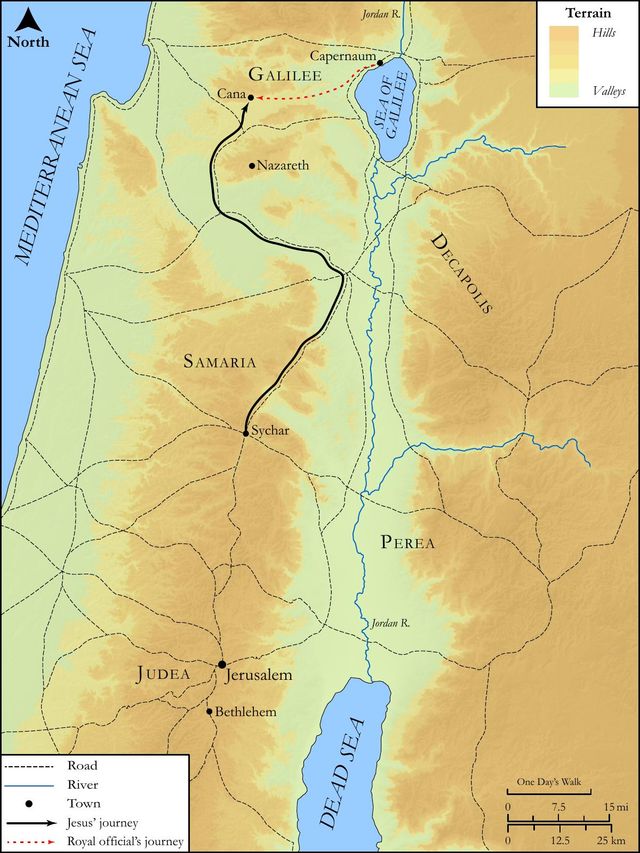
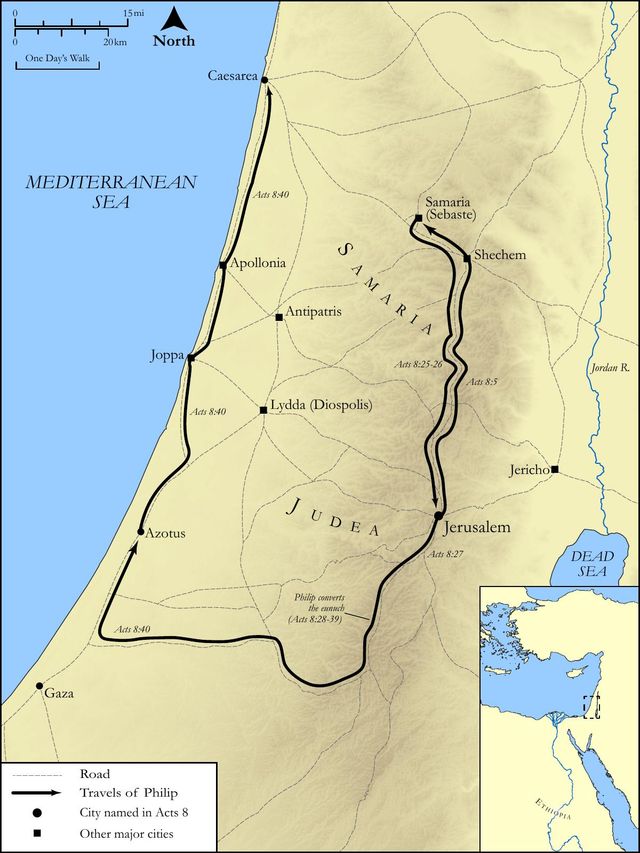
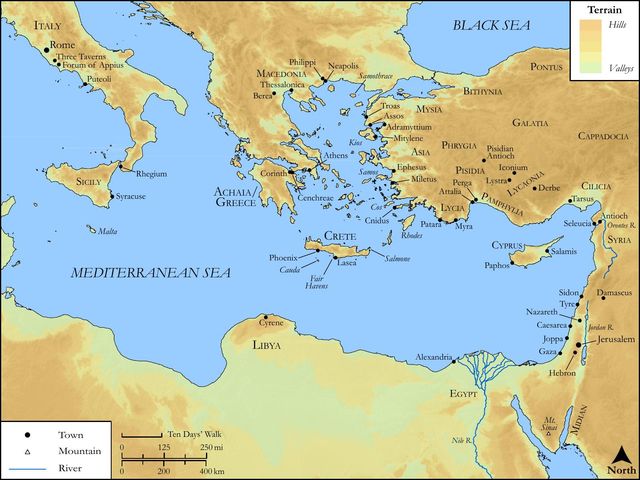
See on the biblical-era maps
Study this verse
Public-domain commentary
Matthew Henry
From his Commentary on the Whole Bible. Henry comments on passages, not single verses — this entry covers Acts 8:1–3. His three-level outline is real structure in the source text, so it is rendered as structure.
In these verses we have,
I.Something more concerning Stephen and his death; how people stood affected to it - variously, as generally in such cases, according to men's different sentiments of things. Christ had said to his disciples, when he was parting with them (Joh 16:20), You shall weep and lament, but the world shall rejoice. Accordingly here is,
1.Stephen's death rejoiced in by one - by many, no doubt, but by one in particular, and that was Saul, who was afterwards called Paul; he was consenting to his death, suneudokōn - he consented to it with delight (so the word signifies); he was pleased with it. He fed his eyes with this bloody spectacle, in hopes it would put a stop to the growth of Christianity. We have reason to think that Paul ordered Luke to insert this, for shame to himself, and glory to free grace. Thus he owns himself guilty of the blood of Stephen, and aggravates it with this, that he did not do it with regret and reluctancy, but with delight and a full satisfaction, like those who not only do such things, but have pleasure in those that do them.
2.Stephen's death bewailed by others (Act 8:2) - devout men, which some understand of those that were properly so called, proselytes, one of whom Stephen himself probably was. Or, it may be taken more largely; some of the church that were more devout and zealous than the rest went and gathered up the poor crushed and broken remains, to which they gave a decent interment, probably in the field of blood, which was bought some time ago to bury strangers in. They buried him solemnly, and made great lamentation over him. Though his death was of great advantage to himself, and great service to the church, yet they bewailed it as a general loss, so well qualified was he for the service, and so likely to be useful both as a deacon and as a disputant. It is a bad symptom if, when such men are taken away, it is not laid to heart. Those devout men paid these their last respects to Stephen,
(1.)To show that they were not ashamed of the cause for which he suffered, nor afraid of the wrath of those that were enemies to it; for, though they now triumph, the cause is a righteous cause, and will be at last a victorious one.
(2.)To show the great value and esteem they had for this faithful servant of Jesus Christ, this first martyr for the gospel, whose memory shall always be precious to them, notwithstanding the ignominy of his death. They study to do honour to him upon whom God put honour.
(3.)To testify their belief and hope of the resurrection of the dead, and the life of the world to come.
II.An account of this persecution of the church, which begins upon the martyrdom of Stephen.
When the fury of the Jews ran with such violence, and to such a height, against Stephen, it could not quickly either stop itself or spend itself. The bloody are often in scripture called blood-thirsty; for when they have tasted blood they thirst for more. One would have thought Stephen's dying prayers and dying comforts should have overcome them, and melted them into a better opinion of Christians and Christianity; but it seems they did not: the persecution goes on; for they were more exasperated when they saw they could prevail nothing, and, as if they hoped to be too hard for God himself, they resolve to follow their blow; and perhaps, because they were none of them struck dead upon the place for stoning Stephen, their hearts were the more fully set in them to do evil. Perhaps the disciples were also the more emboldened to dispute against them as Stephen did, seeing how triumphantly he finished his course, which would provoke them so much the more. Observe,
1.Against whom this persecution was raised: It was against the church in Jerusalem, which is no sooner planted than it is persecuted, as Christ often intimated that tribulation and persecution would arise because of the word. And Christ had particularly foretold that Jerusalem would soon be made too hot for his followers, for that city had been famous for killing the prophets and stoning those that were sent to it, Mat 23:37. It should seem that in this persecution many were put to death, for Paul owns that at this time he persecuted this way unto the death (Act 21:4), and (Act 26:10) that when they were put to death he gave his voice against them.
2.Who was an active man in it; none so zealous, so busy, as Saul, a young Pharisee, Act 8:3. As for Saul (who had been twice mentioned before, and now again for a notorious persecutor) he made havoc of the church; he did all he could to lay it waste and ruin it; he cared not what mischief he did to the disciples of Christ, nor knew when to stop. He aimed at no less than the cutting off of the gospel Israel, that the name of it should be no more in remembrance, Psa 83:4. He was the fittest tool the chief priests could find out to serve their purposes; he was informer-general against the disciples, a messenger of the great council to be employed in searching for meetings, and seizing all that were suspected to favour that way. Saul was bred a scholar, a gentleman, and yet did not think it below him to be employed in the vilest work of that kind.
(1.)He entered into every house, making no difficulty of breaking open doors, night or day, and having a force attending him for that purpose. He entered into every house where they used to hold their meetings, or every house that had any Christians in it, or was thought to have. No man could be secure in his own house, though it was his castle.
(2.)He haled, with the utmost contempt and cruelty, both men and women, dragged them along the streets, without any regard to the tenderness of the weaker sex; he stooped so low as to take cognizance of the meanest that were leavened with the gospel, so extremely bigoted was he.
(3.)He committed them to prison, in order to their being tried and put to death, unless they would renounce Christ; and some, we find, were compelled by him to blaspheme, Act 26:11.
3.What was the effect of this persecution: They were all scattered abroad (Act 8:1), not all the believers, but all the preachers, who were principally struck at, and against whom warrants were issued out to take them up. They, remembering our Master's rule (when they persecute you in one city, flee to another), dispersed themselves by agreement throughout the regions of Judea and of Samaria; not so much for fear of sufferings (for Judea and Samaria were not so far off from Jerusalem but that, if they made a public appearance there, as they determined to do, their persecutors' power would soon reach them there), but because they looked upon this as an intimation of Providence to them to scatter. Their work was pretty well done in Jerusalem, and now it was time to think of the necessities of other places; for their Master had told them that they must be his witnesses in Jerusalem first, and then in all Judea and in Samaria, and then to the uttermost part of the earth (Act 1:8), and this method they observe. Through persecution may not drive us off from our work, yet it may send us, as a hint of Providence, to work elsewhere. The preachers were all scattered except the apostles, who, probably, were directed by the Spirit to continue at Jerusalem yet for some time, they being, by the special providence of God, screened from the storm, and by the special grace of God enabled to face the storm. They tarried at Jerusalem, that they might be ready to go where their assistance was most needed by the other preachers that were sent to break the ice; as Christ ordered his disciples to go to those places where he himself designed to go, Luk 10:1. The apostles continued longer together at Jerusalem than one would have thought, considering the command and commission given them, to go into all the world, and to disciple all nations. See Act 15:6; Gal 1:17. But what was done by the evangelists whom they sent forth was reckoned as done by them.
Historical interpretation
Three Centuries of Reception
5 surviving comments on this verse. Each one is dated, so this reads as a timeline rather than a list.
Select a marker to jump to its quote. Markers stagger vertically where authors wrote within a few decades of each other.
"And Saul was consenting unto his death." Hereupon arises a persecution, and it becomes a great one. "And at that time there was a great persecution against the Church which was at Jerusalem. And they were all scattered abroad throughout the regions of Judea and Samaria, except the Apostles." Mark how once more God permits temptations to arise; mark, and well observe, how the events are ordered by Divine Providence. They were admired because of the signs: being scourged, they were none the worse for it: some were ordained in the matter of the widows: the word increased: once more, God permits a great hindrance to arise. And a persecution of no ordinary kind; for they feared their enemies, now become more daring: and at the same time it is shown that they were but men, these that were afraid, that fled. For, that thou mayest not say after these things that by grace alone they effected what they did, they were also persecuted, and themselves became more timorous, while their adversaries were more daring. "And were all scattered abroad," it says, "except the Apostles." But this was divinely ordered, so that they should no longer all sit there in Jerusalem.
"And they were all scattered abroad throughout the region of Judea and Samaria." And now without scruple they had intercourse with Samaria, whereas it had been said to them, "Go not into the way of the Gentiles, and into any city of the Samaritans enter ye not." "Except the Apostles," it says: they, in this way also, wishing to win the Jews, but not to leave the city, and to be the means of inspiring others with boldness.
"The persecution," say you, "gained strength." True, but at that very time to men possessed before by a hostile power it brought deliverance. For it planted the miracles like a stronghold, in the heart of the enemy's country. Not even the death of Stephen quenched their rage, nay, increased it rather: it scattered wide the teachers, so that the greater became the discipleship.
Now on that day, a great persecution arose in the Church that was in Jerusalem, and all were scattered throughout the regions of Judea and Samaria, except the apostles. If the Church was scattered, the apostles remained in Jerusalem, as Luke tells us, it is evident that he lied who, writing under the name of Melito, bishop of Asia, explains that in the second year after the Lord's ascension, all the apostles were divided to preach in their respective provinces: who all, as the death of the blessed Mother of God approached, were lifted in the clouds and snatched to Jerusalem from the places where they were preaching the word of God, and placed before the door of her house, among whom was also Paul, who, having recently converted from being a persecutor to the faith of Christ, was taken up with Barnabas into the ministry of the Gentiles. This scripture also specifically refers to the Apostle John, that at that time he preached in Ephesus: all of which openly contradicts the words of blessed Luke, who narrates that the apostles, with the other faithful driven out from Jerusalem, remained there and preached everywhere until the Church had peace through all Judea, Samaria, and Galilee. That this could not be accomplished in one year is evident to all. He also clearly indicates that Paul was not ordained with Barnabas into the ministry of the Gentiles in the second year after the Lord’s ascension, but a long time later. Moreover, let us not believe that the blessed Apostle John, to whom the Lord on the cross committed his virgin mother to a virgin, departed after one year and left her alone, and that so much time passed that she feared her body would be burned by enemies after death; and that he, after being taken up in clouds, returned to himself as if negligent or forgetful, and that she anxiously asked him, saying: "I ask you, son John, to remember the word of your master, my Lord Jesus Christ, who commended me to you. Behold, I am called to the way of all the earth. But I have heard the counsel of the Jews saying: Let us wait for the day when she who bore Jesus of Nazareth dies, and let us burn her body; therefore, my son, take care of my funeral." I have taken care to recall these things because I know some who rashly give assent to the aforesaid book against the authority of blessed Luke.
And they were all scattered throughout the regions of Judea and Samaria. This is what the Lord Himself commanded: When they persecute you in one city, flee to another (Matt. X). For it was by His will that the occasion of tribulation became the seed-bed of the Gospel.
Continue studying Acts 8:1 across the web’s major study libraries — every link below opens this exact verse, chapter, or book on the destination site.
Read & Compare
 BibleGatewayThis verse in more than 200 translations and 70 languages.
 Bible.comThe YouVersion reader — hundreds of translations, reading plans, and highlights.
 ESV.orgCrossway's official English Standard Version reader.
 NET BibleThe NET translation with 60,000+ translators' notes on every rendering decision.
 STEP BibleTyndale House's free study tool — original text, vocabulary, and scholarly resources.
 BibliaLogos Bible Software's free web reader.
 USCCBThe New American Bible (Revised Edition) with the U.S. bishops' study notes.
Commentaries
 BibleHub CommentariesDozens of classic commentaries on this verse, gathered on one page.
 StudyLightMore than 100 commentary sets — the largest collection on the web.
 BibleRefPlain-English commentary on what this verse means, verse by verse.
 Enduring WordDavid Guzik's free commentary on this chapter, widely used by Bible teachers.
 Bible Study ToolsVerse commentary alongside Greek and Hebrew study aids.
Original Language & Research
- BibleHub InterlinearThe verse word by word — original language, transliteration, and English.
- BibleHub LexiconEvery word's original-language definition and Strong's entry.
 Blue Letter BibleDeep-study tools — Strong's numbers, concordance, and word studies.
 CNTR CollationThe earliest Greek manuscripts of this verse, collated letter by letter.
Sermons, Hymns & Audio


TrulyRandomVerse is not affiliated with these sites and doesn’t control their content. They’re linked because they’re genuinely useful.
Summary
Acts 8:1 marks a profound turning point in the early Christian church, immediately following the martyrdom of Stephen. This verse details Saul's active approval of Stephen's execution and describes the immediate aftermath: a widespread, severe persecution against the church in Jerusalem. This intense opposition led to the scattering of all believers, except the apostles, throughout the regions of Judea and Samaria, inadvertently fulfilling the divine mandate for the Gospel's expansion beyond its initial confines.
Context
ShowHideLiterary Context
Acts 8:1 directly follows the dramatic account of Stephen's martyrdom in Acts 7, where Stephen delivers a powerful, Spirit-filled defense culminating in a vision of Jesus at the right hand of God. His speech, which critiques the Jewish leadership's resistance to the Holy Spirit and their history of persecuting prophets, provokes their fury, leading to his stoning. Acts 7:58 specifically mentions "a young man named Saul" holding the cloaks of those who stoned Stephen. Therefore, Acts 8:1 serves as a direct narrative bridge, showing the immediate consequence of Stephen's death and Saul's initial, prominent role as an antagonist. It transitions the narrative from the church's growth primarily within Jerusalem (as seen in Acts 2-7 and Acts 4:32-37) to its forced expansion into new territories, setting the stage for the evangelistic efforts of figures like Philip in Acts 8:4-40.
Historical & Cultural Context
The early church in Jerusalem, as depicted in Acts 2-7, experienced phenomenal growth and a strong sense of community. However, this growth also attracted the attention and hostility of the Jewish religious authorities, particularly the Sanhedrin, who viewed the Christian message, especially the resurrection of Jesus and the claims of His Messiahship, as blasphemous and a threat to their established order. Stephen's execution was not an isolated incident but a public act of judicial murder, signaling a severe escalation in this opposition. The "great persecution" mentioned in Acts 8:1 was likely orchestrated by these authorities, possibly with Saul (a zealous Pharisee, as later revealed in Philippians 3:5-6) playing a leading role. Culturally, such persecution aimed to suppress a burgeoning movement by instilling fear and disrupting its organizational structure. Geographically, Judea and Samaria were adjacent regions to Jerusalem, but Samaria, in particular, had a long history of ethnic and religious animosity with the Jews, making the scattering of believers there a significant step in overcoming existing social barriers, as foreshadowed by Jesus's command in Acts 1:8.
Key Themes
ShowHideThis pivotal verse introduces or reinforces several critical themes within the book of Acts. Firstly, it highlights Persecution as a Catalyst for Mission. What was intended to crush the church instead became the means by which the Gospel spread beyond Jerusalem, directly fulfilling Jesus's mandate to His disciples to be His witnesses in Jerusalem, Judea, Samaria, and to the ends of the earth, as recorded in Acts 1:8. Secondly, it establishes Saul's Role as a Primary Antagonist, setting the dramatic stage for his radical conversion from persecutor to apostle, a central narrative in Acts 9. This transformation underscores the theme of Divine Sovereignty and Redemption, demonstrating God's ability to use even the most zealous opponents for His purposes. Finally, the scattering of believers emphasizes the Resilience and Adaptability of the Early Church, showing that despite immense suffering and displacement, the message of Christ continued to be proclaimed, demonstrating the unstoppable nature of God's kingdom.
Exposition and Analysis
ShowHideKey Word Analysis
ShowHideThis word means "to think well of in common, i.e., assent to, feel gratified with." It signifies more than mere passive agreement; it implies active approval, pleasure, or even a shared delight in the action. Saul was not just an observer; he was an enthusiastic supporter and participant by proxy in Stephen's execution, indicating his deep-seated opposition to the Christian faith at this time.
This term refers to "persecution." It denotes a sustained, often violent, hostile pursuit aimed at suppressing or eliminating a group. The use of "great" (G3173, mégas) emphasizes the intensity and widespread nature of this opposition, indicating a deliberate and concerted effort by the Jewish authorities to eradicate the nascent Christian movement from Jerusalem.
Meaning "to sow throughout" or "to distribute in foreign lands." This powerful agricultural metaphor suggests that the forced dispersion of believers was not a defeat but rather like the scattering of seeds. Though painful and disruptive in the short term, this scattering would ultimately lead to growth and the propagation of the Gospel in new territories, transforming a moment of crisis into an opportunity for expansion.
Verse Breakdown
ShowHide"And Saul was consenting unto his death."
This clause immediately links the persecution to Stephen's martyrdom, highlighting Saul's active approval and complicity in the execution. It establishes Saul as a significant figure in the unfolding narrative of opposition against the church, setting the stage for his later conversion.
"And at that time there was a great persecution against the church which was at Jerusalem;"
This phrase marks a pivotal shift, indicating that Stephen's death was not an isolated incident but the catalyst for a widespread and severe assault on the entire Christian community in Jerusalem. The "great persecution" signifies a concerted effort to suppress the movement.
"and they were all scattered abroad throughout the regions of Judaea and Samaria, except the apostles."
This final clause describes the direct consequence of the persecution: the forced dispersion of believers. The phrase "all scattered abroad" emphasizes the comprehensive nature of this dispersion, while the specific mention of "Judaea and Samaria" highlights the geographical expansion beyond Jerusalem. The exception of "the apostles" suggests their strategic decision to remain in Jerusalem, perhaps to maintain leadership and a central point for the eventual re-gathering or continued direction of the scattered church.
Literary Devices
ShowHideLuke employs several literary devices in Acts 8:1 to convey the gravity and significance of this moment. The immediate juxtaposition of "Saul was consenting unto his death" with the "great persecution" creates a sense of causality and dramatic irony. Saul, the zealous persecutor, is unknowingly participating in the very mechanism that will spread the faith he seeks to destroy. The phrase "scattered abroad" functions as a powerful metaphor (specifically, a seed metaphor or agricultural imagery). Just as seeds are scattered to yield a harvest, the believers are dispersed, not to be destroyed, but to take root and bear fruit in new regions, fulfilling the Great Commission. This transformation of adversity into opportunity also exemplifies divine irony, where human malice is subverted by God's sovereign plan. The specific mention of "Judaea and Samaria" provides geographical specificity, grounding the narrative in real-world locations and emphasizing the initial fulfillment of Jesus's prophetic words in Acts 1:8.
Theological and Thematic Connections
ShowHideActs 8:1 profoundly illustrates the theological principle that God often uses adversity and human opposition to advance His divine purposes. What appears to be a devastating setback for the early church—a "great persecution" leading to the scattering of believers—is, in fact, God's sovereign means of fulfilling the Great Commission. The forced dispersion of Christians from Jerusalem directly propels the Gospel beyond its initial Jewish confines, pushing it into Judea and Samaria, and setting the stage for its eventual spread to the "ends of the earth." This demonstrates God's ultimate control over all circumstances, transforming human evil and suffering into opportunities for kingdom expansion and the propagation of His truth.
Reflection and Application
ShowHideActs 8:1 offers a powerful and enduring lesson for believers today: God's purposes are often advanced not in the absence of adversity, but precisely through it. The "great persecution" that scattered the early church, intended to extinguish the nascent Christian movement, instead became the very catalyst for its explosive growth and geographical expansion. This reminds us that our trials, setbacks, and moments of displacement can be sovereignly orchestrated by God to move us into new spheres of influence, new ministries, or new depths of faith. When we face opposition, loss, or forced change, we are called to remember that God is at work, transforming what seems like a disaster into a strategic deployment for His kingdom. Our faithfulness in such times, like that of the scattered believers, becomes a powerful testimony to God's unwavering control and His ability to bring good out of every situation.
Questions for Reflection
ShowHideFAQ
ShowHideWas the persecution in Acts 8:1 the first persecution the early church faced?
ShowHideWhile Acts 8:1 describes a "great persecution," it was not the absolute first. The church had previously faced opposition from the Jewish authorities, including the arrest and questioning of Peter and John in Acts 4 and the apostles being flogged in Acts 5. However, the persecution in Acts 8:1 was distinct in its scale and intensity, being described as "great" and leading to the widespread scattering of believers from Jerusalem, marking a significant escalation in hostility.
Why were the apostles not scattered with the rest of the believers?
ShowHideThe text explicitly states that "they were all scattered abroad... except the apostles." While the exact reason is not given, it is widely understood that the apostles, as the foundational leaders and eyewitnesses of Jesus's resurrection, likely felt a divine imperative to remain in Jerusalem. This decision would have been crucial for maintaining the unity and theological integrity of the nascent church, serving as a central point of authority and a beacon of hope for the scattered believers. Their presence in Jerusalem also ensured continuity and a base for future evangelistic efforts, as Jerusalem remained a vital hub for the early Christian movement.
Christ-Centered Fulfillment
ShowHideActs 8:1, though detailing a moment of intense persecution and scattering, ultimately points to the Christ-centered mission and the sovereign work of God through His Son. The "great persecution" that dispersed the early church from Jerusalem was not a defeat but a strategic outworking of Christ's commission to His disciples in Acts 1:8 to be His witnesses in Jerusalem, Judea, Samaria, and to the ends of the earth. In this sense, the suffering of the church becomes a means for the expansion of Christ's kingdom, demonstrating that no human opposition can thwart God's redemptive plan. Furthermore, the introduction of Saul as a zealous persecutor, "consenting unto his death," foreshadows the dramatic, Christ-centered transformation that awaits him on the road to Damascus, as detailed in Acts 9:1-19. This radical conversion of the church's chief antagonist into its most fervent apostle, Paul, powerfully illustrates the redemptive power of Christ to change hearts and use even those who oppose Him for His glory, ultimately fulfilling His purpose to build His church, against which "the gates of hell shall not prevail" (Matthew 16:18). The suffering of the church, therefore, becomes a testimony to the enduring power and ultimate triumph of the resurrected Christ.