


2 Kings 2:20
Bible text: King James Version (1769 Blayney text) · Public domain
Bible text: Berean Standard Bible · Public domain
Bible text: American Standard Version (1901) · Public domain
Bible text: World English Bible, Messianic edition · Public domain
Bible text: Geneva Bible (1599) · Public domain
Bible text: Young's Literal Translation · Public domain
- וַיֹּאמֶרvai·Yo·merand he saidH559Conj-w ¦ V-Qal-ConsecImperf-3msVerb Qal Consecutive Imperfect 3rd Singular Masculineוַandיֹּאמֶרhe said
- קְחוּke·chufetchH3947V-Qal-Imp-2mpVerb Qal Imperative 2nd Plural Masculine
- לִיlifor mePrep-l ¦ 1csSuffix Personal 1st Singular common genderלִforיme
- צְלֹחִיתtze·lo·Chita jarH6746N-fsNoun Singular Feminine Absolute
- חֲדָשָׁהcha·da·ShahnewH2319Adj-fsAdjective Singular Feminine Absolute
- וְשִׂימוּve·Si·muand putH7760Conj-w ¦ V-Qal-Imp-2mpVerb Qal Imperative 2nd Plural Masculineוְandשִׂימוּput
- שָׁםshamthereH8033AdvAdverb
- מֶלַחMe·lachsaltH4417N-msNoun Singular Masculine Absolute
- וַיִּקְחוּvai·yik·Chuand they took [it]H3947Conj-w ¦ V-Qal-ConsecImperf-3mpVerb Qal Consecutive Imperfect 3rd Plural Masculineוַandיִּקְחוּthey took [it]
- אֵלָיו'e·Lavto himH413Prep ¦ 3msPrepositionאֵלָיtoוhim
English is a literal word-by-word gloss of the Hebrew, not the KJV's wording. Why?
This is the original text the KJV's translators worked from — each Hebrew word with its own literal English meaning in this verse, prepared by scholars at Tyndale House, Cambridge. The KJV translates whole sentences, not word by word, so its wording differs: one Hebrew word can become several English words, and the KJV may choose “the LORD” where the gloss reads “Yahweh”. Both are faithful — they answer different questions. For the KJV's own rendering, switch to the KJV text.
Details
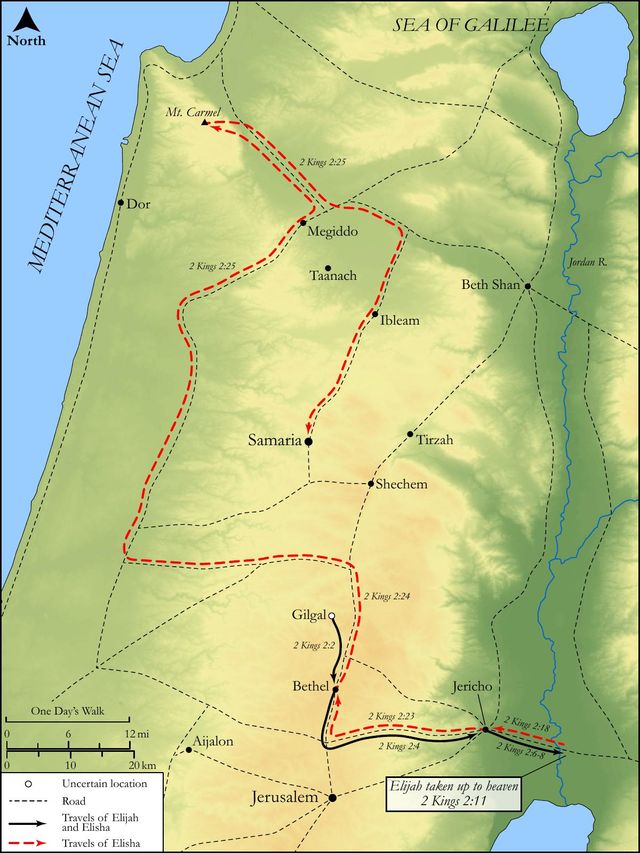
See on the biblical-era map
Study this verse
Public-domain commentary
Matthew Henry
From his Commentary on the Whole Bible. Henry comments on passages, not single verses — this entry covers 2 Kings 2:19–25. His three-level outline is real structure in the source text, so it is rendered as structure.
Elisha had, in this respect, a double portion of Elijah's spirit, that he wrought more miracles than Elijah. Some reckon them in number just double. Two are recorded in these verses - a miracle of mercy to Jericho and a miracle of judgment to Bethel, Psa 101:1.
I.Here is a blessing upon the waters of Jericho, which was effectual to heal them.
Jericho was built in disobedience to a command, in defiance to a threatening, and at the expense of the lives of all the builder's children; yet, when it was built, it was not ordered to be demolished again, nor were God's prophets or people forbidden to dwell in it, but even within those walls that were built by iniquity we find a nursery of piety. Fools, they say, build houses for wise men to dwell in. Here the wealth of the sinner provided a habitation for the just. We find Christ at Jericho, Luk 19:1. Hither Elisha came, to confirm the souls of the disciples with a more particular account of Elijah's translation than their spies, who saw at a distance, could give them. Here he staid while the fifty men were searching for him. And,
1.The men of Jericho represented to him their grievance, Kg2 2:19. God's faithful prophets love to be employed; it is wisdom to make use of them during the little while that their light is with us. They had not applied to Elijah concerning the matter, perhaps because he was not so easy of access as Elisha was; but now, we may hope, by the influence of the divinity-school in their city, they were reformed. The situation was pleasant and afforded a good prospect; but they had neither wholesome water to drink nor fruitful soil to yield them food, and what pleasure could they take in their prospect? Water is a common mercy, which we should estimate by the greatness of the calamity which the want or unwholesomeness of it would be. Some think that it was not all the ground about Jericho that was barren and had bad water, but some one part only, and that where the sons of the prophets had their lodgings, who are here called the men of the city.
2.He soon redressed their grievance. Prophets should endeavour to make every place they come to, some way or other, the better for them, endeavouring to sweeten bitter spirits, and to make barren souls fruitful, by the due application of the word of God. Elisha will heal their waters; but,
(1.)They must furnish him with salt in a new cruse, Kg2 2:20. If salt had been proper to season the water, yet what could so small a quantity do towards it and what the better for being in a new cruse? But thus those that would be helped must be employed and have their faith and obedience tried. God's works of grace are wrought, not by any operations of ours, but in observance of his institutions.
(2.)He cast the salt into the spring of the waters, and so healed the streams and the ground they watered. Thus the way to reform men's lives is to renew their hearts; let those be seasoned with the salt of grace; for out of them are the issues of life. Make the tree good and the fruit will be good. Purify the heart and that will cleanse the hands.
(3.)He did not pretend to do this by his own power, but in God's name: Thus saith the Lord, I have healed these waters. He is but the instrument, the channel through which God is pleased to convey this healing virtue. By doing them this kindness with a Thus saith the Lord, they would be made the more willing hereafter, to receive from him a reproof, admonition, or command, with the same preface. If, in God's name, he can help them, in God's name let him teach and rule them. Thus saith the Lord, out of Elisha's mouth, must, ever after, be of mighty force with them.
(4.)The cure was lasting, and not for the present only: The waters were healed unto this day, Kg2 2:22. What God does shall be for ever, Ecc 3:14. When he, by his Spirit, heals a soul, there shall be no more death nor barrenness; the property is altered: what was useless and offensive becomes grateful and serviceable.
II.Here is a curse upon the children of Bethel, which was effectual to destroy them; for it was not a curse causeless.
At Bethel there was another school of prophets. Thither Elisha went next, in this his primary visitation, and the scholars there no doubt welcomed him with all possible respect, but the townsmen were abusive to him. One of Jeroboam's calves was at Bethel; this they were proud of, and fond of, and hated those that reproved them. The law did not empower them to suppress this pious academy, but we may suppose it was their usual practice to jeer the prophets as they went along the streets, to call them by some nickname or other, that they might expose them to contempt, prejudice their youth against them, and, if possible, drive them out of their town. Had the abuse done to Elisha been the first offence of that kind, it is probable that it would not have been so severely punished. But mocking the messengers of the Lord, and misusing the prophets, was one of the crying sins of Israel, as we find, Ch2 36:16. Now here we have,
1.An instance of that sin. The little children of Bethel, the boys and girls that were playing in the streets (notice, it is likely, having come to the town of his approach), went out to meet him, not with their hosannas, as they ought to have done, but with their scoffs; they gathered about him and mocked him, as if he had been a fool, or one fit to make sport with. Among other things that they used to jeer the prophets with, they had this particular taunt for him, Go up, thou bald head, go up, thou bald head. It is a wicked thing to reproach persons for their natural infirmities or deformities; it is adding affliction to the afflicted; and, if they are as God made them, the reproach reflects upon him. But this was such a thing as scarcely deserved to be called a blemish, and would never have been turned to his reproach if they had had any thing else to reproach him with. It was his character as a prophet that they designed to abuse. The honour God had crowned him with should have been sufficient to cover his bald head and protect him from their scoffs. They bade him go up, perhaps reflecting on the assumption of Elijah: "Thy master," they say, "has gone up; why dost not thou go up after him? Where is the fiery chariot? When shall we be rid of thee too?" These children said as they were taught; they had learned of their idolatrous parents to call foul names and give bad language, especially to prophets. These young cocks, as we say, crowed after the old ones. Perhaps their parents did at this time send them out and set them on, that, if possible, they might keep the prophet out of their town.
2.A specimen of that ruin which came down upon Israel at last, for misusing God's prophets, and of which this was intended to give them fair warning. Elisha heard their taunts, a good while, with patience; but at length the fire of holy zeal for God was kindled in his breast by the continued provocation, and he turned and looked upon them, to try if a grave and severe look would put them out of countenance and oblige them to retire, to see if he could discern in their faces any marks of ingenuousness; but they were not ashamed, neither could they blush; and therefore he cursed them in the name of the Lord, both imprecated and denounced the following judgment, not in personal revenge for the indignity done to himself, but as the mouth of divine justice to punish the dishonour done to God. His summons was immediately obeyed. two she-bears (bears perhaps robbed of their whelps) came out of an adjacent wood, and presently killed forty-two children, Kg2 2:24. Now in this,
(1.)The prophet must be justified, for he did it by divine impulse. Had the curse come from any bad principle God would not have said Amen to it. We may think it would have been better to have called for two rods for the correction of these children than two bears for the destruction of them. But Elisha knew, by the Spirit, the bad character of these children. He knew what a generation of vipers those were, and what mischievous enemies they would be to God's prophets if they should live to be men, who began so early to be abusive to them. He intended hereby to punish the parents and to make them afraid of God's judgments.
(2.)God must be glorified as a righteous God, that hates sin, and will reckon for it, even in little children. Let the wicked wretched brood make our flesh tremble for fear of God. Let little children be afraid of speaking wicked words, for God notices what they say,. Let them not mock any for their defects in mind or body, but pity them rather; especially let them know that it is at their peril if they jeer God's people or ministers, and scoff at any for well-doing. Let parents, that would have comfort in their children, train them up well, and do their utmost betimes to drive out the foolishness that is bound up in their hearts; for, as bishop Hall says, "In vain do we look for good from those children whose education we have neglected; and in vain do we grieve for those miscarriages which our care might have prevented." Elisha comes to Bethel and fears not the revenges of the bereaved parents; God, who bade him do what he did, he knew would bear him out. Thence he goes to Mount Carmel (Kg2 2:25), where it is probable there was a religious house fit for retirement and contemplation. Thence he returned to Samaria, where, being a public place, this father of the prophets might be most serviceable. Bishop Hall observes here, "That he can never be a profitable seer who is either always or never alone."
Historical interpretation
Historical reception
2 surviving comments on this verse. Each one is dated, so this reads as a timeline rather than a list.
Select a marker to jump to its quote. Markers stagger vertically where authors wrote within a few decades of each other.
What should we say about the merits of Elisha? His first praiseworthy deed was his wish to surpass his father in grace, expressed when he asked that more grace be given to him than he knew was found in him who possessed such grace. To be sure, he was greedy to make such a request, but worthy to receive merit. Because Elisha demanded more from his father than he had, his father enabled him to excel in his merits more than he would have otherwise been able to do. When this Elisha came to Jericho after the ascension of his master and was asked by the citizens to remain with them in the city, they said to him: “The location of this city is good, but the water is bad, even causing sterility.” Then Elisha ordered them to give him a clay vessel, and arriving at the source of the waters, he threw the salt kept in the vessel onto the waters and said: “This is what the Lord says: I have healed the waters. No longer will anyone die from them or become sterile. And the waters remain healed to this very day.” Consider then how great the merits of Elisha are! His first stay in the children’s city results in great fruitfulness, for when he removes the sterility of the waters, he enables the succession of heirs. By performing this one deed, he did not merely heal a single person or offer medicine to the house of one person, but restored the people of the entire city. If he had performed this act later, the sterility would have taken its course and the city would have remained without inhabitants once the entire population grew old. So when Elisha healed the waters he also healed the people. And when he blessed the source of the waters, he showed favor to the source of souls. For just as by his sanctifying act water issued forth from the hidden courses in the earth, so healthy offspring came forth from the hidden organs of the womb. Elisha not only blessed the streams that were still being held in the bowels of the springs, but also those that, though still saturated in the damp soil of the earth, would later flow forth little by little. So the Scripture says that Elisha gave his blessing at the source of the water in order that the prophet’s blessing might catch the trickling water before the bosom of the spring encompassed it. Since the holy apostle Paul says that “these things were happening to them as a symbol,” let us look into how this very symbol contains the truth. In other words, let us investigate what the city that suffers from sterility stands for, and what the clay vessel intends to communicate, and finally what it means that scattered salt brings the restoration of health. We read in the writings of the same apostle what is said about the church: “Rejoice, O barren one who does not give birth, break forth and shout you who do not beget children.” Based on this passage, the church is that sterile city, which prior to the arrival of Christ, was not able to produce sons for God while suffering from sterility because of the corruption of the water, that is, the sacrilege of the pagan nations. But when Christ came, assuming a human body as if a fragile vessel, he healed the vices of the waters, that is, “he cut off the sacrileges of the peoples,” and at once, the church, which had been sterile, began to be fruitful.
Let us see what these facts mean, dearly beloved. Elisha, as I have frequently suggested, is the type of our Lord and Savior. That bitter spring seems to signify Adam, from whom the human race has sprung. Before the coming of the true Elisha, that is, our Lord and Savior, the human race remained in barrenness and bitterness through the sin of the first man. Although that new vessel in which salt was thrown represents a type of the apostles, still we can fittingly accept in it the mystery of the Lord’s incarnation. Now salt is put there as wisdom, for we read, “Let all your speech be seasoned with salt.” Moreover, since Christ is not only “the power of God” but also “the wisdom of God,” the body of Christ like a new vessel was filled with the salt of divine wisdom when the Word was made flesh. Furthermore, the new vessel with salt was thrown into the bitter waters by Elisha, and they were changed into sweetness and fruitfulness. Similarly, the new vessel, that is, the incarnate Word, was sent by God the Father to recall the human race like bitter flowing waters to sweetness, to lead it to pure charity from evil habits and sterility of good works and to restore it to the fruitfulness of justice. Truly, brothers, does it not seem to you as though the new vessel full of the salt of divine wisdom was put into the water when Christ the Lord went down into the river to be baptized? Then all the waters were changed into sweetness and were sanctified by that new vessel, that is, the body of Christ. As a result, not only were the waters not sterile, but throughout the world by the grace of baptism they have produced a countless number of Christians like abundant fruit and an exceedingly rich harvest.Although we believe that this truth is fulfilled in things which are seen, still we know that it also takes place spiritually in all people. That the waters signify the people is mentioned in the Apocalypse: “The waters that you saw are peoples and nations.” Moreover, that the vessel with salt that was put in the water represents the apostles is very clearly indicated by our Lord in the Gospel when he says, “You are the salt of the earth.” Therefore, by his grace he made new apostles out of old people and filled them with the salt of his teachings and divine wisdom, sending them to the whole world as to the spring of the entire human race, to remove its barrenness and bitterness. Finally, from the time that the salt of divine wisdom is afforded to human hearts, all bitterness of relations or sterility in good works is known to be removed.
Therefore, dearly beloved, as we mentioned above, understand Christ our Lord in blessed Elisha and the human race in that spring. Recognize clearly the malice of the devil, which served the first man in what was bitter and sterile. In that new vessel that was put in the spring full of salt, devoutly think of Christ’s teaching seasoned with the salt of divine wisdom and through the apostles directed to the human race. We, too, dearly beloved, without any preceding good merits have received such great goods from the Lord through his generous graces and have merited to be changed from bitterness to sweetness, summoned from barrenness to the fruitfulness of good works.
Continue studying 2 Kings 2:20 across the web’s major study libraries — every link below opens this exact verse, chapter, or book on the destination site.
Read & Compare
 BibleGatewayThis verse in more than 200 translations and 70 languages.
 Bible.comThe YouVersion reader — hundreds of translations, reading plans, and highlights.
 ESV.orgCrossway's official English Standard Version reader.
 NET BibleThe NET translation with 60,000+ translators' notes on every rendering decision.
 STEP BibleTyndale House's free study tool — original text, vocabulary, and scholarly resources.
 BibliaLogos Bible Software's free web reader.
 USCCBThe New American Bible (Revised Edition) with the U.S. bishops' study notes.
Commentaries
 BibleHub CommentariesDozens of classic commentaries on this verse, gathered on one page.
 StudyLightMore than 100 commentary sets — the largest collection on the web.
 BibleRefPlain-English commentary on what this verse means, verse by verse.
 Enduring WordDavid Guzik's free commentary on this chapter, widely used by Bible teachers.
 Bible Study ToolsVerse commentary alongside Greek and Hebrew study aids.
Original Language & Research
- BibleHub InterlinearThe verse word by word — original language, transliteration, and English.
- BibleHub LexiconEvery word's original-language definition and Strong's entry.
 Blue Letter BibleDeep-study tools — Strong's numbers, concordance, and word studies.
 SefariaThe Hebrew text with Rashi and centuries of Jewish commentary.
Sermons, Hymns & Audio


TrulyRandomVerse is not affiliated with these sites and doesn’t control their content. They’re linked because they’re genuinely useful.
Summary
In 2 Kings 2:20, the prophet Elisha, newly endowed with Elijah's prophetic mantle, issues a precise command to the distressed men of Jericho: to bring him a new cruse filled with salt. This seemingly simple instruction marks the immediate prelude to his first recorded miracle, a divine act of purification that transforms the city's barren and deadly water supply into a source of life. The verse underscores Elisha's burgeoning authority and the readiness of the people to obey, setting the stage for a powerful demonstration of God's restorative power through His chosen servant.
Context
ShowHideLiterary Context
This verse is situated immediately after the dramatic ascension of Elijah into heaven in 2 Kings 2:11 and Elisha's subsequent reception of a double portion of his spirit and the prophet's mantle in 2 Kings 2:13. Having crossed the Jordan and been recognized by the "sons of the prophets" as Elijah's true successor, Elisha arrives in Jericho. The city's inhabitants immediately approach him with a pressing problem: "The situation of this city is pleasant, as my lord sees, but the water is bad, causing the land to miscarry" (2 Kings 2:19). Elisha's command in 2 Kings 2:20 is his direct, divinely-inspired response to this reported crisis, initiating the miraculous solution detailed in the following verses. It serves as a pivotal moment, validating Elisha's prophetic office and demonstrating God's continued active presence among His people through His new prophet.
Historical & Cultural Context
Jericho, one of the oldest continuously inhabited cities, was strategically located in the Jordan Valley, known for its lushness due to its springs. However, the mention of "bad water" causing "miscarriage" (both of the land's produce and potentially human life) indicates a significant and persistent problem, possibly a natural contamination or even a lingering curse from Joshua's pronouncement against the city's rebuilding in Joshua 6:26. Water sources were absolutely vital for ancient cities, directly impacting agriculture, health, and survival. The people's appeal to Elisha reflects their understanding of a prophet's role as an intermediary between God and humanity, capable of seeking divine intervention for practical problems. The use of a "cruse" (a common household vessel) and "salt" (a ubiquitous commodity used for preservation, seasoning, and purification) grounds the miracle in everyday objects, yet their application here transcends natural properties, highlighting the supernatural nature of God's work.
Key Themes
ShowHideThis verse contributes significantly to several overarching themes within 2 Kings and the broader prophetic narrative. Firstly, it powerfully establishes the theme of Divine Healing and Restoration, showcasing God's ability to reverse barrenness and affliction, transforming sources of death into sources of life. This echoes God's creative and redemptive power seen from Genesis 1 onwards. Secondly, it immediately affirms Elisha's Prophetic Authority and succession, demonstrating that the "spirit of Elijah rests on Elisha" (2 Kings 2:15). This miracle serves as a public validation of his divine calling, much like Elijah's initial miracles. Thirdly, it highlights the Symbolism of Ordinary Means, where God chooses to work through simple, accessible objects like a new cruse and salt, emphasizing that the power resides solely in His divine command and not in the inherent properties of the materials. This theme recurs throughout biblical history, from Moses' staff to Jesus' use of mud and spit. Finally, the "new cruse" can subtly suggest a theme of New Beginnings and the initiation of a fresh work of God through Elisha, bringing radical change and blessing to the community of Jericho.
Exposition and Analysis
ShowHideKey Word Analysis
ShowHideFrom חָדַשׁ; new; fresh, new thing. The emphasis on "new" is significant; it implies a vessel that is untainted, unused, and therefore ritually pure and symbolic of a fresh, unadulterated work of God. It signifies that the miracle is not a continuation of old practices or a re-purposing of something already "used," but a distinct, new act of divine intervention, emphasizing the purity and completeness of the impending healing.
From צָלַח; something prolonged or tall, i.e. a vial or salt-cellar; cruse. Elisha specifically requests a "new" cruse. The choice of a common, yet "new" and untainted, household vessel highlights that God can use ordinary objects as instruments for extraordinary, pure acts of divine intervention. The newness further emphasizes the fresh start and complete transformation God intends to bring to Jericho's water supply.
From מָלַח; properly, powder, i.e. (specifically) salt (as easily pulverized and dissolved); salt(-pit). Salt was a vital commodity, used for preservation, seasoning, and covenant symbolism, as in the "covenant of salt" given to the priests. Paradoxically, in high concentrations, salt makes water undrinkable and can symbolize desolation. Elisha's command to use salt, therefore, highlights a supernatural reversal of natural properties, demonstrating that the power to purify comes not from the salt itself, but from God's sovereign command, which transcends natural laws.
Verse Breakdown
ShowHide"And he said,"
This opening phrase immediately establishes Elisha's active role and authority. His words are not suggestions but commands, indicating that he is acting under divine inspiration and with prophetic power. This is the direct response to the community's plea in the preceding verse, demonstrating his immediate engagement with their problem.
"Bring me a new cruse, and put salt therein."
This is the core of Elisha's instruction. The specificity of "a new cruse" underscores the fresh, pure nature of the divine work. The command to "put salt therein" is counter-intuitive from a natural perspective, as salt typically contaminates fresh water. This seemingly contradictory instruction forces reliance on God's supernatural power rather than human logic or the inherent properties of the materials. The objects themselves are ordinary, but their use in obedience to a divine command makes them instruments of an extraordinary miracle.
"And they brought [it] to him."
This concluding clause is crucial as it demonstrates the immediate and obedient response of the men of Jericho. Their compliance signifies their faith in Elisha's prophetic authority and their desperation for a solution. This obedience is a prerequisite for the miracle that follows, highlighting the interplay between divine command and human receptivity.
Literary Devices
ShowHideThe passage in 2 Kings 2:20 employs several significant literary devices. Symbolism is paramount, with the "new cruse" representing a fresh start, purity, and the initiation of a new work of God through Elisha. The "salt" carries rich symbolic weight, paradoxically used here for purification despite its natural tendency to make water undrinkable in large quantities; it also alludes to preservation and covenant. This paradoxical use of salt is a powerful instance of Irony or Paradox, where the natural properties of a substance are supernaturally reversed to achieve a divine purpose, thereby emphasizing that the power resides solely with God and not in the material itself. The narrative also features Divine Command, as Elisha's simple, direct instructions are the catalyst for the miracle, underscoring God's sovereignty and His ability to work through seemingly humble means. The immediate Obedience of the men of Jericho is also a key narrative element, highlighting their faith and trust in the newly established prophet.
Theological and Thematic Connections
ShowHideThe command in 2 Kings 2:20 serves as a powerful theological statement about God's active involvement in the physical well-being of His people and His ability to bring life out of barrenness. It underscores that God is not distant but intimately concerned with the practical needs of communities. The paradox of using salt to purify water highlights God's power to transcend and even reverse natural laws, demonstrating that His ways are often contrary to human logic, yet always effective. This miracle, Elisha's first significant public act, firmly establishes his prophetic ministry as one characterized by divine healing and restoration, echoing the earlier ministry of Elijah and affirming the continuity of God's redemptive work. It teaches that God can use ordinary objects and obedient individuals to accomplish extraordinary acts of grace and transformation, emphasizing His sovereignty over creation and His desire to bring flourishing where there is decay.
Reflection and Application
ShowHideThe story of Elisha purifying the waters of Jericho, beginning with the simple command in 2 Kings 2:20, offers profound lessons for contemporary believers. It reminds us that God is deeply concerned with the practical and physical realities of our lives and communities, not just our spiritual state. Like the people of Jericho, we often face "bad water" in our world—whether it's oppression, environmental degradation, relational brokenness, or spiritual barrenness. This passage calls us to approach God, through His chosen servants and through prayer, with our real-world problems. Furthermore, it challenges us to consider how God might use seemingly ordinary means or even paradoxical actions to bring about His purposes. Our role is to be obedient to His leading, even when the instructions seem unconventional or illogical from a human perspective. Just as Elisha was an agent of God's healing, we are called to be instruments of His transformative power in our spheres of influence, bringing His life and restoration to a world desperately in need of healing.
Questions for Reflection
ShowHideFAQ
ShowHideWhy did Elisha ask for a "new cruse" and "salt" specifically?
ShowHideElisha's request for a "new cruse" (a small jar) and "salt" was divinely inspired and highly symbolic. The "new" cruse likely signified the fresh, untainted nature of the miracle God was about to perform, emphasizing a new beginning and a pure act of divine intervention, rather than a continuation of old practices. The "salt" is particularly significant due to its paradoxical use. While salt was commonly used for preservation (e.g., Leviticus 2:13) and associated with covenants, in high concentrations, it makes water undrinkable and land barren (e.g., Deuteronomy 29:23). Elisha's use of salt to purify the water highlights that the power was not in the natural properties of the salt, but in God's supernatural intervention, reversing the natural order to bring life and health. It demonstrates God's ability to use even seemingly contradictory means to accomplish His purposes, emphasizing His omnipotence.
Christ-Centered Fulfillment
ShowHideThe miracle of purifying Jericho's waters, initiated by Elisha's command in 2 Kings 2:20, points forward to the ultimate and perfect healing found in Jesus Christ. Just as the "bad water" of Jericho caused barrenness and death, humanity's sin has corrupted the springs of life, leading to spiritual barrenness and death. Jesus, the true and greater Prophet, comes not merely to purify a physical water source but to offer living water that eternally quenches spiritual thirst (John 4:10-14). He is the one who reverses the curse of sin and death, bringing true spiritual life and fruitfulness where there was only barrenness. The "new cruse" and "salt" can be seen as faint shadows of the new covenant established in Christ's blood, which brings about a radical new creation (2 Corinthians 5:17) and purifies us from all unrighteousness (1 John 1:7). He is the ultimate source of healing, making all things new, and transforming the bitter waters of our fallen existence into springs of eternal life (Revelation 21:5-6).