


2 Kings 2:13
Bible text: King James Version (1769 Blayney text) · Public domain
Bible text: Berean Standard Bible · Public domain
Bible text: American Standard Version (1901) · Public domain
Bible text: World English Bible, Messianic edition · Public domain
Bible text: Geneva Bible (1599) · Public domain
Bible text: Young's Literal Translation · Public domain
- וַיָּרֶםvai·Ya·remand he took upH7311Conj-w ¦ V-Hiphil-ConsecImperf-3msVerb Hiphil Consecutive Imperfect 3rd Singular Masculineוַandיָּרֶםhe took up
- אֶת'et<obj.>H853DirObjMParticle Object Indicator
- אַדֶּרֶת'a·De·ret[the] cloak ofH155N-fscNoun Singular Feminine Construct
- אֵלִיָּהוּ'e·li·Ya·huElijahH452N-proper-mNoun Proper Masculine
- אֲשֶׁר'a·SherwhichH834RelParticle Relative
- נָפְלָהna·fe·Lahit had fallenH5307V-Qal-Perf-3fsVerb Qal Perfect 3rd Singular Feminine
- מֵעָלָיוme·'a·Lavfrom on <the> himH5921Prep-m ¦ Prep ¦ 3msPreposition Definiteמֵfromעָלָיon <the>וhim
- וַיָּשָׁבvai·Ya·shovand he went backH7725Conj-w ¦ V-Qal-ConsecImperf-3msVerb Qal Consecutive Imperfect 3rd Singular Masculineוַandיָּשָׁבhe went back
- וַיַּעֲמֹדvai·ya·'a·Modand he stoodH5975Conj-w ¦ V-Qal-ConsecImperf-3msVerb Qal Consecutive Imperfect 3rd Singular Masculineוַandיַּעֲמֹדhe stood
- עַל'alonH5921PrepPreposition
- שְׂפַתse·Fat[the] bank ofH8193N-fscNoun Singular Feminine Construct
- הַיַּרְדֵּןhai·yar·Denthe JordanH3383Art ¦ N-properNoun Proper LocationהַtheיַּרְדֵּןJordan
English is a literal word-by-word gloss of the Hebrew, not the KJV's wording. Why?
This is the original text the KJV's translators worked from — each Hebrew word with its own literal English meaning in this verse, prepared by scholars at Tyndale House, Cambridge. The KJV translates whole sentences, not word by word, so its wording differs: one Hebrew word can become several English words, and the KJV may choose “the LORD” where the gloss reads “Yahweh”. Both are faithful — they answer different questions. For the KJV's own rendering, switch to the KJV text.
Details
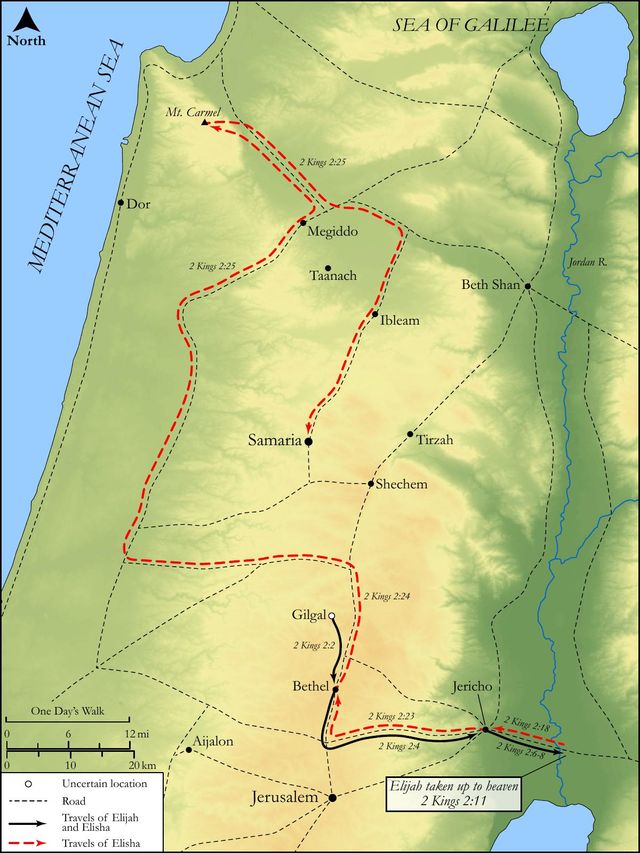
See on the biblical-era map
Study this verse
Public-domain commentary
Matthew Henry
From his Commentary on the Whole Bible. Henry comments on passages, not single verses — this entry covers 2 Kings 2:13–18. His four-level outline is real structure in the source text, so it is rendered as structure.
We have here an account of what followed immediately after the translation of Elijah.
I.The tokens of God's presence with Elisha, and the marks of his elevation into Elijah's room, to be, as he had been, a father to the sons of the prophets, and the chariots and horsemen of Israel.
1.He was possessed of Elijah's mantle, the badge of his office, which, we may suppose, he put on and wore for his master's sake, Kg2 2:13. When Elijah went to heaven, though he did not let fall his body as others do, he let fall his mantle instead of it; for he was unclothed, that he might be clothed upon with immortality: he was going to a world where he needed not the mantle to adorn him, nor to shelter him from the weather, nor to wrap his face in, as Kg1 19:13. He left his mantle as a legacy to Elisha, and, though in itself it was of small value, yet as it was a token of the descent of the Spirit upon him, it was more than if he had bequeathed to him thousands of gold and silver. Elisha took it up, not as a sacred relic to be worshipped, but as a significant garment to be worn, and a recompence to him for his own garments which he had rent. he loved this cloak ever since it was first cast over him, Kg1 19:19. He that then so cheerfully obeyed the summons of it, and became Elihah's servant, is now dignified with it, and becomes his successor. There are remains of great and good men, which, like this mantle, ought to be gathered up and preserved by the survivors, their sayings, their writings, their examples, that, as their works follow them in the reward of them, they may stay behind in the benefit of them.
2.He was possessed of Elijah's power to divide Jordan, Kg2 2:14. Having parted with his father, he returns to his sons in the schools of the prophets. Jordan was between him and them; it had been divided to make way for Elijah to his glory; he will try whether it will divide to make way for him to his business, and by that he will know that God is with him, and that he has the double portion of Elijah's spirit. Elijah's last miracle shall be Elisha's first; thus he begins where Elijah left off and there is no vacancy. In dividing the waters,
(1.)He made use of Elijah's mantle, as Elijah himself had done (Kg2 2:8), to signify that he designed to keep to his master's methods and would not introduce any thing new, as those affect to do that think themselves wiser than their predecessors.
(2.)He applied to Elijah's God: Where is the Lord God of Elijah? He does not ask, "Where is Elijah?" as poring upon the loss of him, as if he could not be easy now that he was gone, - or as doubting of his happy state, as if, like the sons of the prophets here, he knew not what had become of him, - or as curiously enquiring concerning him, and the particular of that state he was removed to (no, that is a hidden life, it does not yet appear what we shall be), - nor as expecting help from him; no, Elijah is happy, but is neither omniscient nor omnipotent; but he asks, Where is the Lord God of Elijah? Now that Elijah was taken to heaven God had abundantly proved himself the God of Elijah; if he had not prepared for him that city, and done better for him there than ever he did for him in this world, he would have been ashamed to be called his God, Heb 11:16; Mat 27:31, Mat 27:32. Now that Elijah was taken to heaven Elisha enquired,
[1.]After God. When our creature-comforts are removed, we have a God to go to, that lives for ever.
[2.]After The God of Elijah, the God that Elijah served, and honoured, and pleaded for, and adhered to when all Israel had deserted him. This honour is done to those who cleave to God in times of general apostasy, that God will be, in a peculiar manner, their God. "The God that owned, and protected, and provided for Elijah, and many ways honoured him, especially now at last, where is he? Lord, am not I promised Elijah's spirit? Make good that promise." The words which next follow in the original, Aph-his - even he, which we join to the following clause, when he also had smitten the waters, some make an answer to this question, Where is Elijah's God? Etiam ille adhuc superest - "He is in being still, and nigh at hand. We have lost Elijah, but we have not lost Elijah's God. He has not forsaken the earth; it is even he that is still with me." Note, First, It is the duty and interest of the saints on earth to enquire after God, and apply to him as the Lord God of the saints that have gone before to heaven, the God of our fathers. Secondly, It is very comfortable to those who enquire of him; it is even he that is in his holy temple (Psa 11:4) and nigh to all who call upon him, Psa 145:18. Thirdly, Those that walk in the spirit and steps of their godly faithful predecessors shall certainly experience the same grace that they experienced; Elijah's God will be Elisha's too. The Lord God of the holy prophets is the same yesterday, today, and for ever; and what will it avail us to have the mantles of those that are gone, their places, their books, if we have not their spirit, their God?
3.He was possessed of Elijah's interest in the sons of the prophets, Kg2 2:15. Some of the fellows of the college at Jericho, who had placed themselves conveniently near Jordan, to see what passed, were surprised to see Jordan divided before Elisha in his return, and took that as a convincing evidence that the spirit of Elijah did rest upon him, and that therefore they ought to pay the same respect and deference to him that they had paid to Elijah. Accordingly they went to meet him, to congratulate him on his safe passage through fire and water, and the honour God had put upon him; and they bowed themselves to the ground before him. They were trained up in the schools; Elisha was taken from the plough; yet when they perceived that God was with him, and that this was the man whom he delighted to honour, they readily submitted to him as their head and father, as the people to Joshua when Moses was dead, Jos 1:17. Those that appear to have God's Spirit and presence with them ought to have our esteem and best affections, notwithstanding the meanness of their extraction and education. This ready submission of the sons of the prophets, no doubt, was a great encouragement to Elisha, and helped to clear his call.
II.The needless search which the sons of the prophets made for Elijah.
1. They suggested that possibly he was dropped, either alive or dead, upon some mountain, or in some valley; and it would be a satisfaction to them if they sent some strong men, whom they had at command, in quest of him, Kg2 2:16. Some of them perhaps started this as a demurrer to the choice of Elisha: "Let us first be sure that Elijah has quite gone. Can we think Elijah thus neglected by heaven, that chosen vessel thus cast away as a vessel in which was no pleasure?" 2. Elisha consented not to their motion till they overcame him with importunity, Kg2 2:17. They urged him till he was ashamed to oppose it any further lest he should be thought wanting in his respect to his old master or loth to resign the mantle again. Wise men may yield to that, for the sake of peace and the good opinion of others, which yet their judgment is against as needless and fruitless. 3. The issue made them as much ashamed of their proposal as they, by their importunity, had made Elisha ashamed of his opposing it. Their messengers, after they had tired themselves with fruitless search, returned with a non est inventus - he is not to be found, and gave Elisha an opportunity of upbraiding his friends with their folly: Did I not say unto you, Go not? Kg2 2:18. This would make them the more willing to acquiesce in his judgment another time. Traversing hills and valleys will never bring us to Elijah, but the imitation of his holy faith and zeal will, in due time.
Historical interpretation
Three Centuries of Reception
2 surviving comments on this verse. Each one is dated, so this reads as a timeline rather than a list.
Select a marker to jump to its quote. Markers stagger vertically where authors wrote within a few decades of each other.
A burdened stomach drags down the heart toward vices and depresses the mind to keep it unable to experience heavenly piety. Scripture tells us, “The corruptible body is a load on the soul, and the earthly habitation presses down the mind that muses on many things.” Hence, the Lord said, too, “Take heed lest your hearts be overburdened with self-indulgence and drunkenness.” Therefore, the stomach should be relieved by the tempering influence of a fast, so that the mind can be unburdened and attend to higher things, rise to virtues and like a winged bird fly in its entirety to the very Author of piety. The case of Elijah proves this. Relieved of bodily weight by continuing that fast that the Lord arranged, he flew to heaven as victor over death.
The prophets proclaimed the mystery of the Lord’s ascension not only by their words but also by their actions. Both Enoch, the seventh [in the line of descent] from Adam, who was transported from the world, and Elijah, who was taken up into heaven, gave evidence that the Lord would ascend above all the heavens.…Elijah presented an image of this festivity of the Lord by a miracle with richer significance. When the time in which he was to be taken away from the world was near, he came to the river Jordan with his disciple Elisha. With his rolled-up cloak he struck the waters, they were divided, and both of them crossed over on dry land. And he said to Elisha, “Ask what you want me to do before I am taken away from you,” and Elisha said, “I entreat you that your spirit may become double in me.” As they went on conversing together, behold, Elijah was suddenly snatched away, and, as the Scripture says, “He ascended as if into heaven.” By this action of his soaring aloft it is meant that [Elijah] was not taken up into heaven itself, as was our Lord, but into the height of the air [above the earth], from where he was borne invisibly to the joys of paradise. Elisha took up the cloak of Elijah that had fallen from him; and, coming to the river Jordan, he struck the water with it, and after calling on God, he divided the water and crossed over.
Let your love take note, my brothers, how the symbolic event agrees point by point with its fulfillment. Elijah came to the river Jordan, and having laid aside his cloak, he struck the waters and divided them. The Lord came to the stream of death, in which the human race ordinarily was immersed, and laying aside from himself for a time the clothing of flesh that he had assumed, struck down death by dying and opened up for us the way to life by rising. The change and decline of our mortal life is properly represented by the river Jordan, since the meaning of Jordan in Latin is “their descent,” and since as the river flows into the Dead Sea, it loses its praiseworthy waters. After [the water of the river] Jordan was divided, Elijah and Elisha crossed over on dry land; by his rising from the dead the Savior bestowed on his faithful ones the hope of rising too. After they had crossed over the river Jordan, Elijah gave Elisha the option of asking for what he wanted. The Lord too, after the glory of his resurrection had been fulfilled, implanted in his disciples a fuller comprehension of what he had promised previously, that “whatever you ask in my name, I will do [for you].” Elisha asked that the spirit of Elijah might become double in him. The disciples, thoroughly instructed by the Lord, desired to receive the promised gift of the Spirit, which would make them capable of preaching not only to the single nation of Judah, which he himself taught when he was present in the flesh, but to all countries throughout the globe as well. Did he not pledge the double grace of his Spirit when he said, “A person who believes in me will himself also do the works that I do, and he will do even greater ones than these”? As Elijah and Elisha were conversing together, a chariot with fiery horses suddenly snatched Elijah as if into heaven. By the chariot and fiery horses we are to understand the angelic powers, of whom it is written, “He makes the angels his spirits and his ministers a burning fire” (Elijah, being an ordinary human being, had need of them to be raised up from the earth). The Lord too was suddenly taken up as he was speaking with his apostles and as they were looking on; although he was not assisted by the help of angels, he was served by an angelic band of companions. He was truly assumed into heaven with the angels also bearing witness to it, for they said [to the apostles], “This Jesus who has been taken up from you into heaven.” When Elijah was raised up to the heavens, he let the cloak with which he had been clothed fall to Elisha. When our Lord ascended into heaven, he left the mysteries of the humanity he had assumed to his disciples, to the entire church in fact, so that it could be sanctified by them and warmed by the power of his love. Elisha took up Elijah’s cloak and struck the waters of the river Jordan with it; and when he called on the God of Elijah, [the waters] were divided, and he crossed over. The apostles and the entire church took up the sacraments of their Redeemer that had been instituted through the apostles, so that, spiritually guided by them and cleansed and consecrated by them, they too learned to overcome death’s assaults by calling on the name of God the Father and to cross over to undying life, spurning the obstacles of death.
Continue studying 2 Kings 2:13 across the web’s major study libraries — every link below opens this exact verse, chapter, or book on the destination site.
Read & Compare
 BibleGatewayThis verse in more than 200 translations and 70 languages.
 Bible.comThe YouVersion reader — hundreds of translations, reading plans, and highlights.
 ESV.orgCrossway's official English Standard Version reader.
 NET BibleThe NET translation with 60,000+ translators' notes on every rendering decision.
 STEP BibleTyndale House's free study tool — original text, vocabulary, and scholarly resources.
 BibliaLogos Bible Software's free web reader.
 USCCBThe New American Bible (Revised Edition) with the U.S. bishops' study notes.
Commentaries
 BibleHub CommentariesDozens of classic commentaries on this verse, gathered on one page.
 StudyLightMore than 100 commentary sets — the largest collection on the web.
 BibleRefPlain-English commentary on what this verse means, verse by verse.
 Enduring WordDavid Guzik's free commentary on this chapter, widely used by Bible teachers.
 Bible Study ToolsVerse commentary alongside Greek and Hebrew study aids.
Original Language & Research
- BibleHub InterlinearThe verse word by word — original language, transliteration, and English.
- BibleHub LexiconEvery word's original-language definition and Strong's entry.
 Blue Letter BibleDeep-study tools — Strong's numbers, concordance, and word studies.
 SefariaThe Hebrew text with Rashi and centuries of Jewish commentary.
Sermons, Hymns & Audio


TrulyRandomVerse is not affiliated with these sites and doesn’t control their content. They’re linked because they’re genuinely useful.
Summary
2 Kings 2:13 powerfully captures the immediate aftermath of Elijah's miraculous ascension, depicting Elisha's pivotal act of taking up the prophet's fallen mantle. This moment is not merely a physical action but a profound spiritual transaction, formally signifying the divine transfer of prophetic authority, anointing, and spiritual inheritance from Elijah to his chosen successor, Elisha, thereby confirming his new role and the divine empowerment bestowed upon him for the continuation of God's redemptive work in Israel.
Context
ShowHideLiterary Context
This verse serves as the crucial transition point in the narrative of prophetic succession. It immediately follows the breathtaking account of Elijah's miraculous ascension into heaven, an event witnessed solely by Elisha. This singular eyewitness account was the prerequisite Elijah had set for Elisha to receive a "double portion" of his spirit, a request made in 2 Kings 2:9. The falling of the mantle, therefore, is the tangible, divinely orchestrated fulfillment of that promise, serving as the visible sign of Elisha's new prophetic office. The verses that follow in 2 Kings 2 immediately detail Elisha's first public act as the new prophet: using the very same mantle to miraculously divide the Jordan River (2 Kings 2:14), mirroring Elijah's last miracle and thereby publicly affirming his divine authority to the observing "sons of the prophets" (2 Kings 2:7).
Historical & Cultural Context
In ancient Israel, prophets held a unique and vital role as God's direct spokespersons, often distinguished by their ascetic lifestyle and distinctive clothing. The "mantle" (adderet) was not merely an ordinary outer garment but a powerful symbol of the prophet's office, authority, and the divine power that rested upon them, as vividly described in 2 Kings 1:8. The concept of succession was paramount for the continuity of leadership, whether in royal dynasties or prophetic schools. Elisha's request for a "double portion" of Elijah's spirit (2 Kings 2:9) was a legal term drawn from inheritance law, signifying the portion of the firstborn son, thus indicating Elisha's desire for the full inheritance of Elijah's prophetic legacy and authority, not necessarily twice the power. The Jordan River itself held profound historical and spiritual significance, having been miraculously crossed by Israel entering the Promised Land under Joshua and by Elijah and Elisha just moments before the ascension. Its symbolic weight made it an ideal location for the public display of transferred power and the inauguration of Elisha's ministry.
Key Themes
ShowHideThe central and overarching theme of this passage is the succession of prophetic authority and the continuity of God's redemptive work. It powerfully illustrates that God does not abandon His people or His purposes; rather, He faithfully raises up and empowers new leaders to carry on His divine agenda. The mantle itself symbolizes divine empowerment and anointing, clearly indicating that the same supernatural power that enabled Elijah's extraordinary ministry is now sovereignly transferred to Elisha. This transfer also serves as a profound confirmation of calling for Elisha; his decisive act of taking up the mantle is a public and personal acceptance of the weighty responsibility and a clear declaration of his readiness to step into the formidable role God had meticulously prepared for him. This moment underscores the profound truth that God's Spirit is sovereignly at work, choosing, equipping, and empowering His servants for His specific purposes, thereby ensuring that His prophetic voice remains active and potent in the world.
Exposition and Analysis
ShowHideKey Word Analysis
ShowHideThis term refers to a large, ample outer garment, often made of animal skin or hair, which became a distinctive mark of prophets like Elijah (2 Kings 1:8). Far more than mere clothing, the addereth symbolized the prophet's office, their divine authority, and the very presence of God's power and anointing upon them. Its "falling" from Elijah and Elisha's subsequent retrieval is a profound visual and spiritual metaphor for the formal transfer of this spiritual inheritance and prophetic office.
This primitive root means "to fall" or "to drop." In this context, the mantle's descent is not accidental but a divinely orchestrated shedding. As Elijah was taken up into heaven, the mantle "fell from him" as a deliberate act of God, signifying the intentional and purposeful passing of the prophetic anointing, authority, and the very essence of Elijah's ministry to Elisha, who was left behind to continue the divine work. It underscores the purposeful nature of the transfer.
This primitive root means "to be high," "to rise," or "to raise." In this causative sense, Elisha's action of "taking up" the mantle signifies an active, intentional, and decisive reception of what was offered. It demonstrates his immediate acceptance of the divine calling, the weighty responsibility, and the supernatural empowerment that accompanied the prophetic office. His action was not a passive observation but an active embrace of his God-given destiny and the commencement of his public ministry.
Verse Breakdown
ShowHide"He took up also the mantle of Elijah that fell from him"
This opening clause immediately highlights Elisha's decisive and intentional action following Elijah's dramatic departure. The "mantle of Elijah," a tangible and potent symbol of the prophet's office and the divine power that rested upon him, is now physically in Elisha's possession. The crucial phrase "that fell from him" emphasizes the divine orchestration of this transfer, ensuring that the anointing was not lost or accidental, but intentionally and sovereignly passed on. This act confirms that Elisha's bold request for a double portion of Elijah's spirit (2 Kings 2:9) has been fully granted, with witnessing the ascension as the divine prerequisite.
"and went back"
Elisha's immediate "going back" signifies a pivotal turning point in his life and ministry. He is no longer merely an observer or a disciple in training; he is now prepared to act decisively in his newly conferred capacity. This return implies a deliberate movement back to the scene of the miraculous crossing of the Jordan, strategically setting the stage for his very first public act as Elijah's successor. It powerfully underscores the seamless continuity of ministry and Elisha's immediate assumption of his weighty prophetic duties.
"and stood by the bank of Jordan"
This specific geographical location is profoundly significant and laden with symbolic meaning. The Jordan River was the very place where Elijah had performed his final miracle, dividing the waters with his mantle (2 Kings 2:8). By returning to this precise spot, Elisha intentionally positions himself to replicate Elijah's miracle, thereby publicly demonstrating that the same divine power and authority that had rested upon Elijah now resided unequivocally in him. It was a strategic and public location for the confirmation of his new prophetic office before the "sons of the prophets" who were watching from afar (2 Kings 2:7).
Literary Devices
ShowHideThe verse employs rich Symbolism, with the "mantle of Elijah" serving as the preeminent symbolic element. It is not merely a piece of fabric but embodies Elijah's prophetic office, his divine authority, and the very power of God that enabled his miraculous ministry. Its falling from the ascending prophet and Elisha's immediate retrieval visually represent the seamless Transfer of Authority and the profound Continuity of God's prophetic work across generations. The narrative also utilizes Juxtaposition, powerfully contrasting Elijah's miraculous, otherworldly departure with Elisha's immediate, grounded, and decisive action of taking up the mantle, thereby emphasizing that while the human vessel changed, the divine power and anointing remained steadfast. Furthermore, Elisha's deliberate act of standing by the Jordan River Foreshadows his subsequent miraculous division of the river (2 Kings 2:14), which serves as the undeniable public confirmation of his anointing and the authoritative inauguration of his prophetic ministry.
Theological and Thematic Connections
ShowHideThis passage profoundly illustrates God's unwavering faithfulness in sustaining His redemptive work through successive generations of leaders. It underscores the vital theological truth that God's eternal purposes are not dependent on any single individual, but rather He sovereignly chooses, equips, and empowers His servants to carry on His divine agenda across time. The transfer of the mantle signifies that divine authority and spiritual anointing are not earned by human merit or effort but are graciously bestowed by God for the faithful fulfillment of His sovereign will. It speaks powerfully to the concept of spiritual inheritance within the body of Christ and the profound responsibility of those who receive such anointing to faithfully steward the gifts, callings, and legacy God places upon them. Elisha's immediate and decisive action models a ready and willing acceptance of God's commission, demonstrating the indispensable necessity of faith, obedience, and promptness in stepping into one's divine destiny.
Reflection and Application
ShowHideElisha's immediate and decisive act of taking up Elijah's mantle serves as a profound and challenging call to every believer to discern, embrace, and faithfully steward the "mantle" or spiritual responsibilities God has uniquely prepared for them. Just as Elisha was called to continue a mighty prophetic ministry, we are all called to actively participate in God's ongoing work in the world, whether through specific leadership roles, the exercise of spiritual gifts, or faithful, everyday service in our vocations and communities. This passage powerfully reminds us that God always equips those He calls, providing the necessary divine empowerment to fulfill His purposes, often far beyond our natural abilities or perceived limitations. It challenges us to step out in audacious faith, trusting that the very same Spirit who enabled Elijah and Elisha will empower us to carry on the legacy of faith, advance His kingdom, and faithfully steward the spiritual inheritance passed down through generations of devoted believers. Our readiness to "take up the mantle" is a testament to our trust in His provision and our commitment to His will.
Questions for Reflection
ShowHideFAQ
ShowHideWhat is the significance of the "mantle" in this passage?
ShowHideThe mantle (adderet, H155) is far more than a simple garment; it is a potent and multi-layered symbol of prophetic authority, divine anointing, and the very presence of God's power. For Elijah, it was an identifying mark of his prophetic office (2 Kings 1:8) and an instrument through which God performed miracles, such as dividing the Jordan River (2 Kings 2:8). When it "fell from him" and Elisha took it up, it symbolized the formal, public, and divinely orchestrated transfer of Elijah's prophetic office and the spiritual power that accompanied it to Elisha, confirming him as the legitimate successor and new leader of the prophetic school. It was a tangible sign of an intangible spiritual reality.
Why did Elisha go back and stand by the bank of the Jordan immediately after taking the mantle?
ShowHideElisha's immediate return to the Jordan River bank was a highly strategic and profoundly symbolic act. It was the very place where Elijah had performed his final miracle, dividing the waters with the mantle (2 Kings 2:8). By returning to this precise location, Elisha was intentionally positioning himself to immediately demonstrate that the same divine power and authority that had rested upon Elijah now resided unequivocally in him. This public display, witnessed by the "sons of the prophets" from afar (2 Kings 2:7), served as undeniable confirmation of his new prophetic office and the successful transfer of the anointing. It was his inaugural act, setting the stage for his own powerful and extensive ministry, beginning with the miraculous division of the Jordan himself (2 Kings 2:14).
Christ-Centered Fulfillment
ShowHideWhile 2 Kings 2:13 details the transfer of prophetic authority from Elijah to Elisha, it ultimately points forward to the ultimate Prophet, Jesus Christ, and the profound transfer of His spiritual authority to His church. Jesus, the Son of God, came embodying the very fullness of God's Spirit and power, performing unparalleled miracles and proclaiming the Kingdom of God with absolute authority (Luke 4:18-19 and John 1:1-18). Just as Elijah ascended to heaven, Jesus also ascended to the Father (Acts 1:9), but He did not leave His disciples without empowerment. Instead, He promised the Holy Spirit, His own divine "mantle" of power, to enable them to continue His work and even perform "greater works" than He did (John 14:12). The coming of the Holy Spirit at Pentecost (Acts 2:1-4) was the ultimate and universal transfer of divine anointing, equipping every believer for ministry and establishing the church as the ongoing manifestation of Christ's presence and power in the world, empowered to be His witnesses "to the ends of the earth" (Acts 1:8). Thus, Elisha's taking up of Elijah's mantle beautifully foreshadows the church's reception of the Holy Spirit, empowering believers to carry on the redemptive mission of Christ until His glorious return.