


1 Kings 19:19
- וַיֵּלֶךְvai·Ye·lekhand he wentH1980Conj-w ¦ V-Qal-ConsecImperf-3msVerb Qal Consecutive Imperfect 3rd Singular Masculineוַandיֵּלֶךְhe went
- מִשָּׁםMi·shomfrom thereH8033Prep-m ¦ AdvAdverbמִfromשָּׁםthere
- וַיִּמְצָאvai·yim·Tza'and he foundH4672Conj-w ¦ V-Qal-ConsecImperf-3msVerb Qal Consecutive Imperfect 3rd Singular Masculineוַandיִּמְצָאhe found
- אֶת'et<obj.>H853DirObjMParticle Object Indicator
- אֱלִישָׁע'e·li·Sha'ElishaH477N-proper-mNoun Proper Masculine
- בֶּןben[the] son ofH1121N-mscNoun Singular Masculine Construct
- שָׁפָטsha·FatShaphatH8202N-proper-mNoun Proper Masculine
- וְהוּאve·Hu'and heH1931Conj-w ¦ Pro-3msPronoun Personal 3rd Singular Masculineוְandהוּאhe
- חֹרֵשׁcho·Resh[was] plowingH2790V-Qal-Prtcpl-msVerb Qal Participle Singular Masculine Absolute
- שְׁנֵיםshe·neimtwo [plus]H8147N-cdNoun Dual common gender Absolute
- עָשָׂר'a·SartenH6240N-csNoun Singular common gender Absolute
- צְמָדִיםtze·ma·DimpairsH6776N-mpNoun Plural Masculine Absolute
- לְפָנָיוle·fa·Nav[were] <to> before himH6440Prep-l ¦ N-mpc ¦ 3msNoun Plural Masculine Constructלְ[were] <to>פָנָיbeforeוhim
- וְהוּאve·Hu'and heH1931Conj-w ¦ Pro-3msPronoun Personal 3rd Singular Masculineוְandהוּאhe
- בִּשְׁנֵיםbish·Neim[was] with two [plus]H8147Prep-b ¦ N-cdNoun Dual common gender Absoluteבִּ[was] withשְׁנֵיםtwo [plus]
- הֶעָשָׂרhe·'a·Sarthe tenH6240Art ¦ N-csNoun Singular common gender Absoluteהֶtheעָשָׂרten
- וַיַּעֲבֹרvai·ya·'a·Vorand he passed onH5674Conj-w ¦ V-Qal-ConsecImperf-3msVerb Qal Consecutive Imperfect 3rd Singular Masculineוַandיַּעֲבֹרhe passed on
- אֵלִיָּהוּ'e·li·Ya·huElijahH452N-proper-mNoun Proper Masculine
- אֵלָיו'e·Lavto himH413Prep ¦ 3msPrepositionאֵלָיtoוhim
- וַיַּשְׁלֵךְvai·yash·Lekhand he threwH7993Conj-w ¦ V-Hiphil-ConsecImperf-3msVerb Hiphil Consecutive Imperfect 3rd Singular Masculineוַandיַּשְׁלֵךְhe threw
- אַדַּרְתּוֹ'a·dar·Tohis cloakH155N-fsc ¦ 3msNoun Singular Feminine Constructאַדַּרְתּcloakוֹhis
- אֵלָיו'e·Lavto himH413Prep ¦ 3msPrepositionאֵלָיtoוhim
English is a literal word-by-word gloss of the Hebrew, not the KJV's wording. Why?
This is the original text the KJV's translators worked from — each Hebrew word with its own literal English meaning in this verse, prepared by scholars at Tyndale House, Cambridge. The KJV translates whole sentences, not word by word, so its wording differs: one Hebrew word can become several English words, and the KJV may choose “the LORD” where the gloss reads “Yahweh”. Both are faithful — they answer different questions. For the KJV's own rendering, switch to the KJV text.
Details
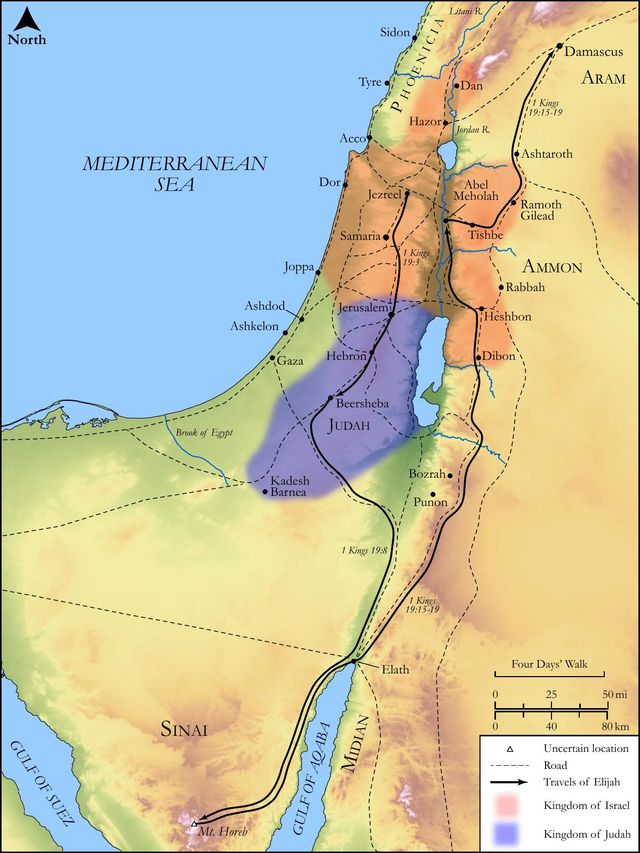
See on the biblical-era map

Study this verse
Public-domain commentary
Matthew Henry
From his Commentary on the Whole Bible. Henry comments on passages, not single verses — this entry covers 1 Kings 19:19–21.
Elisha was named last in the orders God gave to Elijah, but he was first called, for by him the other two were to be called. He must come in Elijah's room; yet Elijah is forward to raise him, and is far from being jealous of his successor, but rejoices to think that he shall leave the work of God in such good hands. Concerning the call of Elisha observe, 1. That it was an unexpected surprising call. Elijah found him by divine direction, or perhaps he was before acquainted with him and knew where to find him. He found him, not in the schools of the prophets, but in the field, not reading, nor praying, nor sacrificing, but ploughing, Kg1 19:19. Though a great man (as appears by his feast, Kg1 19:21), master of the ground, and oxen, and servants, yet he did not think it any disparagement to him to follow his business himself, and not only to inspect his servants, but himself to lay his hand to the plough. Idleness is no man's honour, nor is husbandry any man's disgrace. An honest calling in the world does not at all put us out of the way of our heavenly calling, any more than it did Elisha, who was taken from following the plough the feed Israel and to sow the seed of the word, as the apostles were taken from fishing to catch men. Elisha enquired not after Elijah, but was anticipated with this call. We love God, and choose him, because he chose us, and loved us, first. 2. That it was a powerful call. Elijah did but cast his mantle upon him. (Kg1 19:19), in token of friendship, that he would take him under his care and tuition as he did under his mantle, and to be one with him in the same clothes, or in token of his being clothed with the spirit of Elijah (now he put some of his honour upon him, as Moses on Joshua, Num 27:20); but, when Elijah went to heaven, he had the mantle entire, Kg2 2:13. And immediately he left the oxen to go as they would, and ran after Elijah, and assured him that he would follow him presently, Kg1 19:20. An invisible hand touched his heart, and unaccountably inclined him by a secret power, without any external persuasions, to quit his husbandry and give himself to the ministry. It is in a day of power that Christ's subjects are made willing (Psa 110:3), nor would any come to Christ unless they were thus drawn. Elisha came to a resolution presently, but begged a little time, not to ask leave, but only to take leave, of his parents. This was not an excuse for delay, like his (Luk 9:61) that desired he might bid those farewell that were at home, but only a reservation of the respect and duty he owed to his father and mother. Elijah bade him to back and do it, he would not hinder him; nay, if he would, he might go back, and not return, for any thing he had done to him. He will not force him, nor take him against his will; let him sit down and count the cost, and make it his own act. The efficacy of God's grace preserves the native liberty of man's will, so that those who are good are good of choice and not by constraint, not pressed men, but volunteers. 3. That it was a pleasant and acceptable call to him, which appears by the farewell-feast he made for his family (Kg1 19:21), though he not only quitted all the comforts of his father's house, but exposed himself to the malignity of Jezebel and her party. It was a discouraging time for prophets to set out in. A man that had consulted with flesh and blood would not be fond of Elijah's mantle, nor willing to wear his coat; yet Elisha cheerfully, and with a great deal of satisfaction, leaves all to accompany him. Thus Matthew made a great fast when he left the receipt of custom to follow Christ. 4. That it was an effectual call. Elijah did not stay for him, lest he should seem to compel him, but left him to his own choice, and he soon arose, went after him, and not only associated with him, but ministered to him as his servitor, poured water on his hands, Kg2 3:11. It is of great advantage to young ministers to spend some time under the direction of those that are aged and experienced, whose years teach wisdom, and not to think much, if occasion be, to minister to them. Those that would be fit to teach must have time to learn; and those that hope hereafter to rise and rule must be willing at first to stoop and serve.
Historical interpretation
Nine Centuries of Reception
2 surviving comments on this verse. Each one is dated, so this reads as a timeline rather than a list.
Select a marker to jump to its quote. Markers stagger vertically where authors wrote within a few decades of each other.
“So he set out from there and found Elisha son of Shaphat. He passed by him and threw his mantle over him.” With his mantle Elijah took Elisha from farming to prophesying. From the symbolic point of view, Elisha represents the type of the apostles to whom our Lord said in the Gospel, “So stay here in the city of Jerusalem until you have been clothed with power from high.” Therefore the mantle of Elijah signified the gifts of the Spirit which the apostles would receive.
After receiving the garment from the prophetical hand,
at the same time you have received the privilege,
when you were transformed from worker into a prophet
through the radiance of the Spirit that was glorified.
Since you foreknew, O Christ, the inclination to goodness
Of the heart of Elisha, he has understood with no doubt
The glorious call that you had established and followed it.
Continue studying 1 Kings 19:19 across the web’s major study libraries — every link below opens this exact verse, chapter, or book on the destination site.
Read & Compare
 BibleGatewayThis verse in more than 200 translations and 70 languages.
 Bible.comThe YouVersion reader — hundreds of translations, reading plans, and highlights.
 ESV.orgCrossway's official English Standard Version reader.
 NET BibleThe NET translation with 60,000+ translators' notes on every rendering decision.
 STEP BibleTyndale House's free study tool — original text, vocabulary, and scholarly resources.
 BibliaLogos Bible Software's free web reader.
 USCCBThe New American Bible (Revised Edition) with the U.S. bishops' study notes.
Commentaries
 BibleHub CommentariesDozens of classic commentaries on this verse, gathered on one page.
 StudyLightMore than 100 commentary sets — the largest collection on the web.
 BibleRefPlain-English commentary on what this verse means, verse by verse.
 Enduring WordDavid Guzik's free commentary on this chapter, widely used by Bible teachers.
 Bible Study ToolsVerse commentary alongside Greek and Hebrew study aids.
Original Language & Research
- BibleHub InterlinearThe verse word by word — original language, transliteration, and English.
- BibleHub LexiconEvery word's original-language definition and Strong's entry.
 Blue Letter BibleDeep-study tools — Strong's numbers, concordance, and word studies.
 SefariaThe Hebrew text with Rashi and centuries of Jewish commentary.
Sermons, Hymns & Audio


TrulyRandomVerse is not affiliated with these sites and doesn’t control their content. They’re linked because they’re genuinely useful.
Summary
1 Kings 19:19 recounts the pivotal moment when the prophet Elijah, acting in direct obedience to God's recent commission at Mount Horeb, encounters Elisha, the son of Shaphat. Elisha is discovered diligently engaged in his agricultural work, plowing with an impressive number of oxen. Elijah's silent yet profoundly symbolic act of casting his prophetic mantle upon Elisha serves as a non-verbal summons, initiating the process of Elisha's call to ministry and his eventual succession to Elijah's powerful prophetic office.
Context
ShowHideLiterary Context
This verse immediately follows Elijah's profound encounter with God at Mount Horeb (also known as Sinai) in 1 Kings 19. After his dramatic victory over the prophets of Baal on Mount Carmel and subsequent flight from Queen Jezebel's death threats, Elijah fell into deep despair. God met him not in the powerful wind, earthquake, or fire, but in a "still small voice" (1 Kings 19:12). As part of God's renewed commission to Elijah, he was instructed to anoint Hazael as king over Aram, Jehu as king over Israel, and Elisha as prophet in his place (1 Kings 19:15-17). Thus, 1 Kings 19:19 marks Elijah's immediate and faithful obedience to the divine directive regarding Elisha, setting the stage for one of the Bible's most significant prophetic successions. The narrative continues in 1 Kings 19:20-21, detailing Elisha's decisive response to the call.
Historical & Cultural Context
The setting is the northern kingdom of Israel during the tumultuous reign of King Ahab and Queen Jezebel, a period characterized by widespread Baal worship and severe spiritual apostasy. In this era, prophets served as God's primary spokespersons, often confronting idolatry and calling the nation back to covenant faithfulness. Agriculture was the backbone of the Israelite economy, and plowing with oxen was a common, laborious, and essential task. The mention of "twelve yoke of oxen" indicates that Elisha came from a family of considerable wealth and standing, as such an operation would require significant land, resources, and labor. The "mantle" (Hebrew: addereth) was a distinctive outer garment, often made of animal skin or coarse fabric, worn by prophets as a symbol of their office, authority, and often, their austere lifestyle. Its casting was a culturally understood, non-verbal act of summons or transfer of authority, akin to a formal invitation to apprenticeship or succession.
Key Themes
ShowHideThis verse powerfully encapsulates several key themes. Firstly, it highlights Divine Appointment and Succession, illustrating God's sovereign hand in orchestrating leadership transitions and raising up individuals to carry on His work, even when a seasoned leader like Elijah feels isolated and despondent. Secondly, it underscores the Calling to Ministry from Ordinary Life, showing that God often calls individuals who are faithfully engaged in their daily vocations, demonstrating diligence and responsibility, much like Jesus later called fishermen to be His disciples. Thirdly, the Symbolism of the Prophetic Mantle is central; it represents not merely a piece of clothing but the spiritual authority, anointing, and legacy associated with the prophetic office. Elijah's act is a tangible sign of an intangible spiritual transfer. Finally, the verse speaks to Obedience and Readiness, both on Elijah's part in immediately fulfilling God's command and on Elisha's part (as seen in subsequent verses) in his swift and decisive response to the divine invitation.
Exposition and Analysis
ShowHideKey Word Analysis
ShowHideThis term refers to a distinctive outer garment, often a cloak or robe, worn by prophets. More than just clothing, the ʼadderethʼ was a powerful symbol of the prophetic office, embodying the authority, spiritual power, and divine anointing associated with the prophet. Elijah's mantle, in particular, was known for its miraculous properties (e.g., dividing the Jordan in 2 Kings 2:8). Its casting upon Elisha was a profound, non-verbal act signifying the transfer of this spiritual heritage and the invitation to assume the prophetic role.
This verb describes Elisha's active engagement in his agricultural work. The detail that he was "plowing with twelve yoke of oxen" signifies not only his diligence but also his family's considerable wealth and substantial farming enterprise. Elisha was not idle or waiting for a call; he was found faithfully and industriously performing his daily duties, illustrating that God often calls individuals who are already responsible and productive in their current sphere.
This verb denotes a deliberate and decisive action. Elijah did not merely drop the mantle or hand it over; he "cast" or threw it upon Elisha. This forceful, intentional gesture underscores the urgency and divine authority of the summons. It was a clear, unambiguous, and public declaration of Elijah's intent and God's call, demanding an immediate and decisive response from Elisha.
Verse Breakdown
ShowHide"So he departed thence, and found Elisha the son of Shaphat"
This clause highlights Elijah's immediate obedience to God's command given at Mount Horeb to anoint Elisha. It signifies the beginning of a new chapter in Israel's prophetic history, as Elijah, having recovered from his despair, actively seeks out his divinely appointed successor. Elisha's lineage, "son of Shaphat," identifies him within his community, connecting him to a known family.
"who [was] plowing [with] twelve yoke [of oxen] before him, and he with the twelfth"
This detailed description paints a vivid picture of Elisha's circumstances. He is found not in a temple or a prophetic school, but in the midst of his ordinary, laborious work. The "twelve yoke of oxen" indicates a large-scale agricultural operation, implying Elisha's family was prosperous and that he himself was deeply involved in the family business, even personally guiding the twelfth yoke. This detail underscores the significant personal sacrifice Elisha would make in leaving such a comfortable and established life.
"and Elijah passed by him, and cast his mantle upon him"
This is the climactic moment of the verse. Elijah's action is silent but profoundly symbolic. By "casting his mantle"—the distinctive garment of a prophet—upon Elisha, Elijah performs a non-verbal act of summons and an invitation to apprenticeship, signifying the transfer of prophetic authority and spiritual legacy. It is a powerful visual representation of the divine call, understood by Elisha as a direct invitation to follow and eventually succeed Elijah in his prophetic ministry.
Literary Devices
ShowHideThe verse employs several impactful literary devices. Symbolism is paramount, with the mantle serving as the central symbol of prophetic office, divine authority, and spiritual inheritance. Its casting is a tangible representation of an intangible spiritual transfer. The narrative also uses juxtaposition, contrasting the mundane, laborious act of plowing with the extraordinary, divine call to prophetic ministry. This highlights God's tendency to call individuals from their ordinary lives into extraordinary service. Furthermore, the act of casting the mantle serves as foreshadowing, hinting at Elisha's future role as Elijah's successor and the eventual transfer of a "double portion" of Elijah's spirit, as fully realized in 2 Kings 2.
Theological and Thematic Connections
ShowHideThe calling of Elisha in 1 Kings 19:19 provides profound insight into God's methods of choosing and commissioning His servants. It demonstrates that God's plan for His kingdom is one of continuity and succession, ensuring that His work continues through new generations of faithful individuals. God often calls those who are already diligent and responsible in their current spheres of influence, preparing them for greater tasks. The symbolic act of the mantle underscores the spiritual nature of prophetic authority, which is not self-assumed but divinely bestowed and transferred. This narrative also highlights the cost of discipleship, as Elisha's response (detailed in subsequent verses) involves leaving behind a life of comfort and prosperity for a life of prophetic service, entirely dependent on God.
Reflection and Application
ShowHide1 Kings 19:19 offers a powerful blueprint for understanding divine calling and our response to it. It reminds us that God often finds us not in moments of spiritual ecstasy, but in the midst of our ordinary, daily tasks. Elisha's diligence in plowing demonstrates that faithfulness in small things prepares us for greater responsibilities. The call, though silent and symbolic, was clear and required a decisive response. For us, God's call might come through a quiet prompting, an unexpected opportunity, or the invitation of a spiritual mentor. This narrative challenges us to consider what "yokes of oxen"—what comforts, securities, or established ways of life—we might be called to leave behind to fully embrace God's purpose for us. It also underscores the vital importance of spiritual mentorship and the intentional transfer of wisdom, experience, and anointing from one generation to the next within the body of Christ, ensuring the continuity of God's work in the world.
Questions for Reflection
ShowHideFAQ
ShowHideWhat is the significance of "twelve yoke of oxen"?
ShowHideThe mention of "twelve yoke of oxen" is highly significant for two primary reasons. Firstly, it indicates Elisha's considerable wealth and the substantial nature of his family's agricultural enterprise. Plowing with twelve teams of oxen would require extensive land and a large workforce, placing Elisha among the more prosperous individuals of his time. Secondly, it underscores the magnitude of his sacrifice when he responded to Elijah's call. Elisha was not a poor man with little to lose; he was leaving behind a life of comfort, security, and a prominent livelihood to follow a prophet whose life was often characterized by hardship and transience. This detail emphasizes the costly nature of his discipleship and his radical commitment to God's call.
Why did Elijah "cast his mantle upon him" instead of speaking?
ShowHideElijah's act of casting his mantle was a powerful, non-verbal, symbolic gesture deeply understood within the cultural context of ancient Israel. The mantle was a recognized symbol of prophetic office, authority, and spiritual power. By casting it upon Elisha, Elijah was not merely handing over a piece of clothing; he was performing a clear, unmistakable summons and an invitation to apprenticeship and eventual succession. This action served as a visual and tangible representation of the transfer of spiritual legacy and the divine call to prophetic ministry, requiring no verbal explanation to convey its profound meaning to Elisha. It was an act of commissioning by proxy, under divine instruction.
Did Elisha immediately become a prophet after this?
ShowHideWhile this verse marks Elisha's initial call and the beginning of his prophetic journey, he did not immediately assume the full prophetic office. Instead, he became Elijah's servant and apprentice, following him and ministering to him for a period (as implied in 2 Kings 3:11, where he is described as having "poured water on the hands of Elijah"). This period of discipleship and training was crucial for Elisha's preparation. He fully assumed the mantle of prophetic leadership and received a "double portion" of Elijah's spirit only after Elijah's miraculous ascension into heaven, as vividly described in 2 Kings 2:9-15.
Christ-Centered Fulfillment
ShowHideThe calling of Elisha in 1 Kings 19:19 beautifully foreshadows the ultimate call of God in Jesus Christ. Just as Elijah, in obedience to divine command, sought out his successor, so too does God the Father, through His Son, call individuals into His service. Jesus, the ultimate Prophet (Deuteronomy 18:15), likewise called His disciples from their ordinary vocations, inviting them to leave behind their nets and tax booths to follow Him and become "fishers of men" (Matthew 4:18-22). Elisha's immediate and costly response to Elijah's symbolic mantle mirrors the radical commitment Jesus demands from those who would follow Him, emphasizing that true discipleship often requires leaving behind familiar comforts and priorities (Luke 14:26-27). Furthermore, the transfer of Elijah's mantle and spirit to Elisha finds its ultimate fulfillment in the outpouring of the Holy Spirit upon the church at Pentecost, where Christ, having ascended, poured out His Spirit upon believers, empowering them to continue His ministry and bear witness to Him throughout the world (Acts 2:1-4). Every believer, therefore, receives a "mantle" of spiritual authority and gifting through the indwelling Spirit, commissioned to participate in Christ's ongoing redemptive work.