


2 Kings 2:8
Bible text: King James Version (1769 Blayney text) · Public domain
Bible text: King James Version with Strong's numbers · Public domain
Bible text: Berean Standard Bible · Public domain
Bible text: American Standard Version (1901) · Public domain
Bible text: World English Bible, Messianic edition · Public domain
Bible text: Geneva Bible (1599) · Public domain
Bible text: Young's Literal Translation · Public domain
- וַיִּקַּחvai·yi·Kachand he tookH3947Conj-w ¦ V-Qal-ConsecImperf-3msVerb Qal Consecutive Imperfect 3rd Singular Masculineוַandיִּקַּחhe took
- אֵלִיָּהוּ'e·li·Ya·huElijahH452N-proper-mNoun Proper Masculine
- אֶת'et<obj.>H853DirObjMParticle Object Indicator
- אַדַּרְתּוֹ'a·dar·Tohis cloakH155N-fsc ¦ 3msNoun Singular Feminine Constructאַדַּרְתּcloakוֹhis
- וַיִּגְלֹםvai·yig·Lomand he folded it upH1563Conj-w ¦ V-Qal-ConsecImperf-3msVerb Qal Consecutive Imperfect 3rd Singular Masculineוַandיִּגְלֹםhe folded it up
- וַיַּכֶּהvai·ya·Kehand he struckH5221Conj-w ¦ V-Hiphil-ConsecImperf-3msVerb Hiphil Consecutive Imperfect 3rd Singular Masculineוַandיַּכֶּהhe struck
- אֶת'et<obj.>H853DirObjMParticle Object Indicator
- הַמַּיִםha·Ma·yimthe watersH4325Art ¦ N-mpNoun Plural Masculine Absoluteהַtheמַּיִםwaters
- וַיֵּחָצוּvai·ye·cha·Tzuand they were dividedH2673Conj-w ¦ V-Niphal-ConsecImperf-3mpVerb Niphal Consecutive Imperfect 3rd Plural Masculineוַandיֵּחָצוּthey were divided
- הֵנָּהHe·nahhitherH2008AdvAdverb
- וָהֵנָּהva·He·nahand hitherH2008Conj-w ¦ AdvAdverbוָandהֵנָּהhither
- וַיַּעַבְרוּvai·ya·'av·Ruand they passed overH5674Conj-w ¦ V-Qal-ConsecImperf-3mpVerb Qal Consecutive Imperfect 3rd Plural Masculineוַandיַּעַבְרוּthey passed over
- שְׁנֵיהֶםshe·nei·Hem[the] two of themH8147N-cdc ¦ 3mpNoun Dual common gender Constructשְׁנֵי[the] two ofהֶםthem
- בֶּחָרָבָהbe·cha·ra·Vahon the dry groundH2724Prep-b ¦ N-fsNoun Singular Feminine Absoluteבֶּon theחָרָבָהdry ground
English is a literal word-by-word gloss of the Hebrew, not the KJV's wording. Why?
This is the original text the KJV's translators worked from — each Hebrew word with its own literal English meaning in this verse, prepared by scholars at Tyndale House, Cambridge. The KJV translates whole sentences, not word by word, so its wording differs: one Hebrew word can become several English words, and the KJV may choose “the LORD” where the gloss reads “Yahweh”. Both are faithful — they answer different questions. For the KJV's own rendering, switch to the KJV text.
Details
See on the biblical-era map
Study this verse
Public-domain commentary
Matthew Henry
From his Commentary on the Whole Bible. Henry comments on passages, not single verses — this entry covers 2 Kings 2:1–8. His two-level outline is real structure in the source text, so it is rendered as structure.
Elijah's times, and the events concerning him, are as little dated as those of any great man in scripture; we are not told of his age, nor in what year of Ahab's reign he first appeared, nor in what year of Joram's he disappeared, and therefore cannot conjecture how long he flourished; it is supposed about twenty years in all. Here we are told,
I.That God had determined to take him up into heaven by a whirlwind, Kg2 2:1.
He would do it, and it is probable let him know of his purpose some time before, that he would shortly take him from the world, not by death, but translate him body and soul to heaven, as Enoch was, only causing him to undergo such a change as would be necessary to the qualifying of him to be an inhabitant in that world of spirits, and such as those shall undergo who will be found alive at Christ's coming. It is not for us to say why God would put such a peculiar honour upon Elijah above any other of the prophets; he was a man subject to like passions as we are, knew sin, and yet never tasted death. Wherefore is he thus dignified, thus distinguished, as a man whom the Kings of kings did delight to honour? We may suppose that herein,
1.God looked back upon his past services, which were eminent and extraordinary, and intended a recompence for those and an encouragement to the sons of the prophets to tread in the steps of his zeal and faithfulness, and, whatever it cost them, to witness against the corruptions of the age they lived in.
2.He looked down upon the present dark and degenerate state of the church, and would thus give a very sensible proof of another life after this, and draw the hearts of the faithful few upward towards himself, and that other life.
3.He looked forward to the evangelical dispensation, and, in the translation of Elijah, gave a type and figure of the ascension of Christ and the opening of the kingdom of heaven to all believers. Elijah had, by faith and prayer, conversed much with heaven, and now he is taken thither, to assure us that if we have our conversation in heaven, while we are here on earth, we shall be there shortly, the soul shall (and that is the man) be happy there, there for ever.
II.That Elisha had determined, as long as he continued on earth to cleave to him, and not to leave him.
Elijah seemed desirous to shake him off, would have had him stay behind at Gilgal, at Bethel, at Jericho, Kg2 2:2, Kg2 2:4, Kg2 2:6. Some think out of humility; he knew what glory God designed for him, but would not seem to glory in it, nor desired it should be seen of men (God's favourites covet not to have it proclaimed before them that they are so, as the favourites of earthly princes do), or rather it was to try him, and make his constant adherence to him the more commendable, like Naomi's persuading Ruth to go back. In vain does Elijah entreat him to tarry here and tarry there; he resolves to tarry nowhere behind his master, till he goes to heaven, and leaves him behind on this earth. "Whatever comes of it, I will not leave thee;" and why so? Not only because he loved him, but,
1.Because he desired to be edified by his holy heavenly converse as long as he staid on earth; it had always been profitable, but, we may suppose, was now more so than ever. We should do all the spiritual good we can one to another, and get all we can one by another, while we are together, because we are to be together but a little while.
2.Because he desired to be satisfied concerning his departure, and to see him when he was taken up, that his faith might be confirmed and his acquaintance with the invisible world increased. He had long followed Elijah, and he would not leave him now when he hoped for the parting blessing. Let not those that follow Christ come short by tiring at last.
III.That Elijah, before his departure, visited the schools of the prophets and took leave of them.
It seems that there were such schools in many of the cities of Israel, probably even in Samaria itself. Here we find sons of the prophets, and considerable numbers of them, even at Bethel, where one of the calves was set up, and at Jericho, which was lately built in defiance of a divine curse. At Jerusalem, and in the kingdom of Judah, they had priests and Levites, and the temple-service, the want of which, in the kingdom of Israel, God graciously made up by those colleges, where men were trained up and employed in the exercises of religion and devotion, and whither good people resorted to solemnize the appointed feasts with praying and hearing, when they had not conveniences for sacrifice or incense, and thus religion was kept up in a time of general apostasy. Much of God was among these prophets, and more were the children of the desolate than the children of the married wife. None of all the high priests were comparable to those two great men Elijah and Elisha, who, for aught we know, never attended in the temple at Jerusalem. These seminaries of religion and virtue, which Elijah, it is probable, had been instrumental to found, he now visits, before his departure, to instruct, encourage, and bless them. Note, Those that are going to heaven themselves ought to be concerned for those they leave behind them on earth, and to leave with them their experiences, testimonies, counsels, and prayers, Pe2 1:15. When Christ said, with triumph, Now I am no more in the world, he added, with tenderness, But these are. Father, keep them.
IV.That the sons of the prophets had intelligence (either from Elijah himself, or by the spirit of prophecy in some of their own society), or suspected by the solemnity of Elijah's farewell, that he was now shortly to be removed; and,
1.They told Elisha of it, both at Bethel (Kg2 2:3) and at Jericho (Kg2 2:5): Knowest thou that the Lord will take away thy master from thy head to day? This they said, not as upbraiding him with his loss, or expecting that when his master was gone he would be upon the level with them, but to show how full they were of the thoughts of this matter and big with expectation of the event, and to admonish Elisha to prepare for the loss. Know we not that our nearest relations, and dearest friends, must shortly be taken from us? The Lord will take them; we lose them not till he calls for them whose they are, and who taketh away and none can hinder him. He takes away superiors from our head, inferiors from our feet, equals from our arms; let us therefore carefully do the duty of every relation, that we may reflect upon it with comfort when it comes to be dissolved. Elisha knew it too well, and sorrow had filled his heart upon this account (as the disciples in a like case, Joh 16:6), and therefore he did not need to be told of it, did not care for hearing of it, and would not be interrupted in his contemplations on this great concern, or in the least diverted from his attendance upon his master. I know it; hold you your peace. He speaks not this peevishly, or in contempt of the sons of the prophets, but as one that was himself and would have them composed and sedate, and with an awful silence expecting the event: I know it; be silent, Zac 2:13.
2.They went themselves to be witnesses of it at a distance, though they might not closely attend (Kg2 2:7): Fifty of them stood to view afar off, intending to satisfy their curiosity, but God so ordered it that they might be eye-witnesses of the honour heaven did to that prophet, who was despised and rejected of men. God's works are well worthy our notice; when a door is opened in heaven the call is, Come up hither, come and see.
V.That the miraculous dividing of the river Jordan was the preface to Elijah's translation into the heavenly Canaan, as it had been to the entrance of Israel into the earthly Canaan, Kg2 2:8. He must go on to the other side Jordan to be translated, because it was his native country, and that he might be near the place where Moses died, and that thus honour might be put on that part of the country which was most despised. he and Elisha might have gone over Jordan by a ferry, as other passengers did, but God would magnify Elijah in his exit, as he did Joshua in his entrance, by the dividing of this river, Jos 3:7. As Moses with his rod divided the sea, so Elijah with his mantle divided Jordan, both being the insignia - the badges of their office. These waters of old yielded to the ark, now to the prophet's mantle, which, to those that wanted the ark was an equivalent token of God's presence. When God will take up his faithful ones to heaven death is the Jordan which, immediately before their translation, they must pass through, and they find a way through it, as safe and comfortable way; the death of Christ has divided those waters, that the ransomed of the Lord may pass over. O death! where is thy sting, thy hurt, thy terror?
Historical interpretation
Historical reception
1 surviving comment on this verse from the historical church.
We must note in addition that when Elijah was about to be taken up in a whirlwind as into heaven, he took his sheepskin and rolled it up and struck the water, and it was divided on this side and that, and both crossed, that is to say, himself and Elisha. He was better prepared to be taken up after he was baptized in the Jordan, since Paul, as we explained previously, called the more incredible passage through water a baptism. It is because of this same Jordan that Elisha is capable of receiving the gift that he has desired through Elijah, for he said, “Let a double portion come on me in your spirit.” Perhaps he received the gift in the spirit of Elijah in a double measure on himself because he crossed the Jordan twice, once with Elijah, and a second time when he took the sheepskin of Elijah and struck the water and said, “Where is the Lord, the God of Elijah? And he struck the waters, and they divided on this side and that.”
Continue studying 2 Kings 2:8 across the web’s major study libraries — every link below opens this exact verse, chapter, or book on the destination site.
Read & Compare
 BibleGatewayThis verse in more than 200 translations and 70 languages.
 Bible.comThe YouVersion reader — hundreds of translations, reading plans, and highlights.
 ESV.orgCrossway's official English Standard Version reader.
 NET BibleThe NET translation with 60,000+ translators' notes on every rendering decision.
 STEP BibleTyndale House's free study tool — original text, vocabulary, and scholarly resources.
 BibliaLogos Bible Software's free web reader.
 USCCBThe New American Bible (Revised Edition) with the U.S. bishops' study notes.
Commentaries
 BibleHub CommentariesDozens of classic commentaries on this verse, gathered on one page.
 StudyLightMore than 100 commentary sets — the largest collection on the web.
 BibleRefPlain-English commentary on what this verse means, verse by verse.
 Enduring WordDavid Guzik's free commentary on this chapter, widely used by Bible teachers.
 Bible Study ToolsVerse commentary alongside Greek and Hebrew study aids.
Original Language & Research
- BibleHub InterlinearThe verse word by word — original language, transliteration, and English.
- BibleHub LexiconEvery word's original-language definition and Strong's entry.
 Blue Letter BibleDeep-study tools — Strong's numbers, concordance, and word studies.
 SefariaThe Hebrew text with Rashi and centuries of Jewish commentary.
Sermons, Hymns & Audio


TrulyRandomVerse is not affiliated with these sites and doesn’t control their content. They’re linked because they’re genuinely useful.
Summary
This pivotal verse recounts the miraculous parting of the Jordan River by the prophet Elijah, who uses his prophetic mantle to strike the waters, allowing him and his successor, Elisha, to cross on dry ground. This extraordinary event serves as a profound demonstration of God's sovereign power, a public confirmation of Elijah's divine authority before his imminent ascension, and a significant prelude to the transfer of the prophetic anointing to Elisha, echoing earlier foundational miracles in Israel's history.
Context
ShowHideLiterary Context
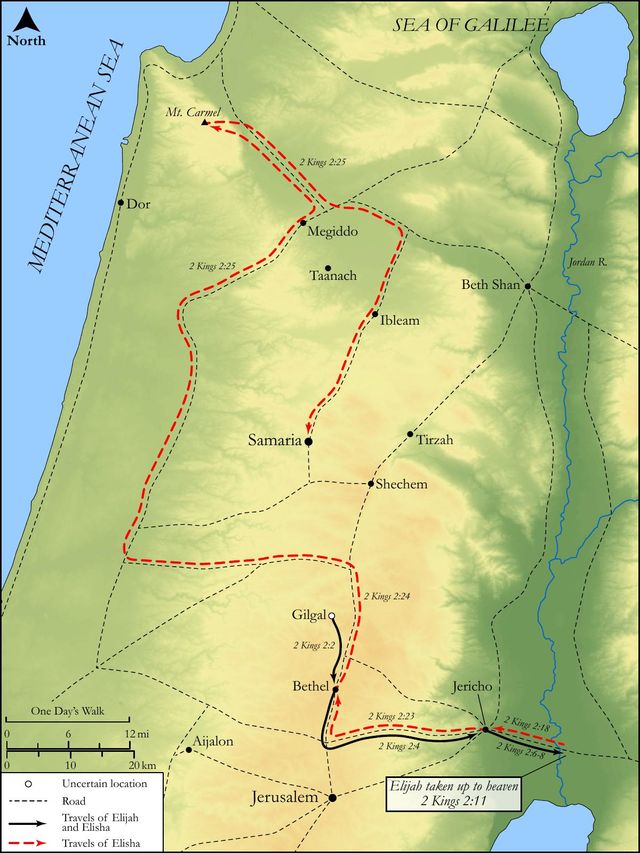
The narrative of 2 Kings 2 marks a critical juncture in Israel's prophetic history, signaling the conclusion of Elijah's earthly ministry and the commencement of Elisha's. Prior to this verse, Elijah has been leading Elisha on a purposeful journey from Gilgal, through Bethel, then to Jericho, and finally to the Jordan River. At each location, Elijah tests Elisha's resolve by suggesting he remain behind, but Elisha's unwavering loyalty and fervent desire for a "double portion" of Elijah's spirit are powerfully demonstrated through his steadfast refusal to leave (2 Kings 2:2-6). The presence of "fifty men of the sons of the prophets" from Jericho, observing from a distance (2 Kings 2:7), underscores that this event is not a private moment but a public, divinely orchestrated demonstration of God's power and the legitimate transfer of prophetic authority. The Jordan crossing immediately precedes Elijah's dramatic ascension into heaven in a whirlwind (2 Kings 2:11), solidifying this miracle as Elijah's final, powerful act of God before his departure.
Historical & Cultural Context
The Jordan River held immense geographical, historical, and symbolic significance in ancient Israel, serving as the eastern boundary of the Promised Land. Its crossing was an event laden with theological weight, most notably recalling the Israelites' miraculous entry into Canaan under Joshua's leadership (Joshua 3). This earlier event, where the waters miraculously stood up in a heap, established the Jordan as a site of divine intervention, where God makes a way for His people. Culturally, the "mantle" (Hebrew: 'adderet) was a distinctive outer garment, often made of animal skin, worn by prophets. It symbolized their office, authority, and divine commission. Its use in performing miracles, as seen here and subsequently by Elisha (2 Kings 2:13-14), visibly underscored the tangible nature of prophetic power and its transfer. The "sons of the prophets" were members of prophetic guilds or schools, indicating an organized prophetic community that recognized and followed key figures like Elijah and Elisha, serving as vital witnesses to divine acts.
Key Themes
ShowHideThis verse powerfully contributes to several overarching themes within 2 Kings and the broader Old Testament narrative. Foremost is the Continuity of Divine Power and Faithfulness, as God demonstrates His unwavering ability to act miraculously, mirroring His interventions during the Exodus at the Red Sea (Exodus 14) and the initial entry into the Promised Land at the Jordan (Joshua 3). It profoundly emphasizes Prophetic Authority and Succession, showcasing Elijah's divinely vested power just before its transfer to Elisha, thereby legitimizing Elisha's future ministry. The mantle's pivotal role underscores the Symbolism of Prophetic Office, acting as a tangible instrument through which God's power is channeled and transferred. Furthermore, the event highlights God Making a Way, illustrating His capacity to transcend natural barriers and overcome seemingly insurmountable obstacles to fulfill His purposes and guide His servants, assuring them of His divine provision.
Exposition and Analysis
ShowHideKey Word Analysis
ShowHideThis term (H155) refers to a wide, ample, or magnificent outer garment, often associated with dignity or authority. In the prophetic context, it served as a distinctive symbol of the prophet's office and divine commission, signifying their separation for God's service and the authority vested in them. Elijah's use of his mantle to perform a miracle indicates that the power is not inherent in the garment itself, but rather flows through the prophet as God's chosen instrument, validating his role as God's representative and the tangible nature of his spiritual authority.
This verb (H5221) implies a forceful, decisive striking or hitting, often with destructive or impactful intent. When applied to the waters, it denotes an authoritative and intentional action, far more than a mere touch. This deliberate "smiting" underscores the prophet's active role in channeling God's power, reminiscent of Moses striking the rock (Exodus 17:6) or the Red Sea with his staff (Exodus 14:16), highlighting the divine command and supernatural force behind the human action.
This verb (H2673) means to cut or split in two, to halve, or to divide into distinct parts. Its use here precisely describes the miraculous separation of the water into two distinct sections, creating a dry path. This specific term emphasizes the supernatural nature of the event, as the natural flow of the river is supernaturally interrupted and held back, demonstrating God's absolute sovereignty and control over the forces of creation.
Verse Breakdown
ShowHide"And Elijah took his mantle"
This opening phrase immediately draws attention to the instrument of the miracle and the divinely appointed agent through whom God acts. The "mantle" is not merely an article of clothing but a potent symbol of Elijah's prophetic office and the divine authority vested in him. His deliberate act of taking it signifies a preparation for a significant, divinely empowered action, a conscious invocation of the power of God.
"and wrapped [it] together"
This action suggests a deliberate, perhaps ritualistic, preparation of the mantle, or simply a practical way to consolidate and wield it effectively for the coming strike. This detail emphasizes the intentionality and solemnity of Elijah's actions as he prepares to channel God's miraculous power, indicating a focused and purposeful engagement with his prophetic office.
"and smote the waters"
This is the decisive, miraculous act. Elijah's authoritative striking of the Jordan's waters with his mantle is the visible manifestation of God's power. It is a commanding gesture, directly mirroring Moses's actions at the Red Sea and Joshua's at the Jordan, establishing a clear link to God's past interventions and confirming the continuity of His miraculous work through His chosen servants.
"and they were divided hither and thither"
The immediate, dramatic, and supernatural consequence of Elijah's action. The waters of the Jordan are miraculously split, creating a clear pathway. The phrase "hither and thither" vividly describes the complete and orderly separation, with the water standing on both sides, defying natural laws and demonstrating God's absolute control over creation.
"so that they two went over on dry ground"
This final clause describes the successful and safe passage of both Elijah and Elisha. The emphasis on "dry ground" echoes the earlier miraculous crossings of the Red Sea and the Jordan, signifying a complete, unhindered, and divinely provided passage. It confirms the purpose of the water's division and highlights the perfection and efficacy of God's miraculous intervention for His servants.
Literary Devices
ShowHideThe verse is rich with Symbolism, particularly in the use of Elijah's mantle. This garment is not merely clothing but a potent symbol of his prophetic office, divine authority, and the very power of God working through him. Its use in performing the miracle underscores the tangible nature of spiritual authority and its transfer. The entire event is a profound Allusion and Typology, intentionally mirroring and echoing the earlier, foundational miracles of the Red Sea crossing under Moses (Exodus 14:21) and the Jordan River crossing under Joshua (Joshua 3:16). This Repetition of divine intervention at a significant boundary highlights the continuity of God's faithfulness and power across generations, positioning Elijah as a figure of comparable stature to Moses and Joshua. The Dramatic Irony is also present, as the "sons of the prophets" watch from a distance, witnessing the miracle but not fully comprehending the imminent ascension, which only Elisha is privy to, underscoring the unique intimacy of Elisha's relationship with Elijah and God's specific plan for succession.
Theological and Thematic Connections
ShowHideThis miraculous crossing of the Jordan River serves as a powerful theological statement about God's absolute sovereignty over creation and His active, faithful involvement in the lives of His chosen servants. It profoundly underscores the theme of divine enablement, demonstrating that no natural barrier, however formidable, can hinder God's purposes or His people when He chooses to act. The event also functions as a final, public validation of Elijah's prophetic authority before his dramatic departure, and crucially, as a preparatory act for the transfer of that authority to Elisha. By performing a miracle reminiscent of Moses and Joshua, Elijah is affirmed as a true prophet in the lineage of Israel's greatest leaders, and the stage is powerfully set for Elisha to inherit this formidable legacy, ensuring the continuity of prophetic ministry and God's active presence in Israel.
Reflection and Application
ShowHideThe scene at the Jordan River is a profound and encouraging reminder that God's power is not constrained by the limitations of the natural world or the seemingly insurmountable obstacles we face. Just as He miraculously made a way through the Red Sea for an entire nation and through the Jordan for His chosen leaders, He remains capable of overcoming the most daunting barriers in our own lives, whether they are physical, emotional, spiritual, or circumstantial. This passage invites us to cultivate a deep and unwavering trust in God's ability to provide a path forward, even when our way seems completely blocked or utterly impossible. It also highlights the profound significance of divine calling and the authority God vests in His chosen instruments. For us, this means recognizing that God still works through people, empowering them with His Spirit for His purposes. The steadfastness of Elisha in following Elijah, desiring a double portion of his spirit, challenges us to pursue God's anointing, presence, and purpose with similar devotion and tenacity, understanding that God faithfully equips those He calls for the specific tasks He sets before them. This miracle serves as a powerful sign of God's enduring faithfulness to His covenant and His people, assuring us that He will always make a way for those who walk in obedience and faith.
Questions for Reflection
ShowHideFAQ
ShowHideWhy was the Jordan River chosen for this miracle, and what is its significance?
ShowHideThe Jordan River holds immense historical and symbolic significance in Israel's history. It was the final barrier the Israelites crossed under Joshua to enter the Promised Land (Joshua 3), an event that itself was a miraculous act of God, establishing God's power to make a way. By performing a similar miracle at the Jordan, Elijah's crossing serves as a powerful echo of these foundational events. It links Elijah's ministry directly to the great acts of God through Moses and Joshua, affirming his status as a true prophet in that lineage and underscoring the continuity of God's work. The Jordan also marks a geographical and spiritual boundary, and its division signifies God's complete control over creation and His ability to make a way where there seems to be none, particularly as Elijah is about to depart the earthly realm and Elisha is to begin his ministry.
What is the significance of Elijah's mantle in this verse and in the broader narrative?
ShowHideThe mantle (Hebrew: 'adderet') was more than just a piece of clothing; it was a potent symbol of Elijah's prophetic office, authority, and the divine anointing upon him. Prophets often wore distinctive garments to signify their calling and separation for God's purposes. When Elijah uses his mantle to strike the waters, it is not the garment itself that possesses inherent power, but rather God's power channeled through His chosen instrument. The mantle's role here powerfully foreshadows its crucial significance immediately after Elijah's ascension, when Elisha picks it up and uses it to perform the very same miracle (2 Kings 2:13-14). This act visibly demonstrates that the prophetic anointing and authority have been transferred to Elisha, establishing him as Elijah's legitimate successor and representing the tangible inheritance of spiritual power and the continuity of God's work through His prophets.
Christ-Centered Fulfillment
ShowHideThe miraculous parting of the Jordan by Elijah, immediately preceding his dramatic ascension, powerfully foreshadows the work and person of Jesus Christ. Just as Elijah's departure marked a profound transition in prophetic ministry, Christ's ascension to the Father (Acts 1:9-11) signified the completion of His earthly redemptive work and the inauguration of a new covenant. Elijah's mantle, symbolizing his authority and the "double portion" of the Spirit passed to Elisha, finds its ultimate fulfillment in Christ's promise to send the Holy Spirit to His disciples (John 14:16-17; Acts 1:8). The Spirit, poured out at Pentecost (Acts 2:1-4), empowers believers with a "double portion" of divine presence and authority, enabling them to carry on Christ's mission with even greater works than He performed, as He Himself declared (John 14:12). The Jordan crossing, a potent symbol of God making a way through impassable barriers, ultimately points to Jesus as the definitive "way, the truth, and the life" (John 14:6), who, through His sacrificial death and glorious resurrection, has opened a new and living way for humanity to access God and enter into His presence (Hebrews 10:19-20).