


2 Kings 2:9
Bible text: King James Version (1769 Blayney text) · Public domain
Bible text: King James Version with Strong's numbers · Public domain
Bible text: Berean Standard Bible · Public domain
Bible text: American Standard Version (1901) · Public domain
Bible text: World English Bible, Messianic edition · Public domain
Bible text: Geneva Bible (1599) · Public domain
Bible text: Young's Literal Translation · Public domain
- וַיְהִיvay·Hiand it wasH1961Conj-w ¦ V-Qal-ConsecImperf-3msVerb Qal Consecutive Imperfect 3rd Singular Masculineוַandיְהִיit was
- כְעָבְרָםkhe·'a·ve·Ramwhen they had passed overH5674Prep-k ¦ V-Qal-Inf ¦ 3mpVerb Qal Infinitive Constructכְwhenעָבְרָhad passed overםthey
- וְאֵלִיָּהוּve·'E·li·Ya·huand ElijahH452Conj-w ¦ N-proper-mNoun Proper MasculineוְandאֵלִיָּהוּElijah
- אָמַר'a·Marhe saidH559V-Qal-Perf-3msVerb Qal Perfect 3rd Singular Masculine
- אֶל'eltoH413PrepPreposition
- אֱלִישָׁע'e·li·Sha'ElishaH477N-proper-mNoun Proper Masculine
- שְׁאַלshe·'AlaskH7592V-Qal-Imp-2msVerb Qal Imperative 2nd Singular Masculine
- מָהmahwhat?H4100InterrogPronoun Interrogative
- אֶעֱשֶׂה'e·'e·sehwill I doH6213V-Qal-Imperf-1csVerb Qal Imperfect 1st Singular common gender
- לָּךְLakhfor youPrep-l ¦ 2msSuffix Personal 2nd Singular Masculineלָּforךְyou
- בְּטֶרֶםbe·Te·rem<in> beforeH2962Prep-b ¦ Adj-csAdjective Numerical Singular common gender Absoluteבְּ<in>טֶרֶםbefore
- אֶלָּקַח'e·la·KachI will be takenH3947V-Niphal-Imperf-1csVerb Niphal Imperfect 1st Singular common gender
- מֵעִמָּךְme·'i·Makhfrom with <the> youH5973Prep-m ¦ Prep ¦ 2msPreposition Definiteמֵfromעִמָּwith <the>ךְyou
- וַיֹּאמֶרvai·Yo·merand he saidH559Conj-w ¦ V-Qal-ConsecImperf-3msVerb Qal Consecutive Imperfect 3rd Singular Masculineוַandיֹּאמֶרhe said
- אֱלִישָׁע'e·li·Sha'ElishaH477N-proper-mNoun Proper Masculine
- וִיהִיvi·hiand may it beH1961Conj-w ¦ V-Qal-Imperf-3msVerb Qal Imperfect 3rd Singular Masculineוִandיהִיmay it be
- נָאna'pleaseH4994PrtParticle Interjection
- פִּיpia mouth ofH6310N-mscNoun Singular Masculine Construct
- שְׁנַיִםshe·Na·yimtwoH8147N-cdNoun Dual common gender Absolute
- בְּרוּחֲךָbe·ru·cha·Khain your spiritH7307Prep-b ¦ N-fsc ¦ 2msNoun Singular Feminine Constructבְּinרוּחֲspiritךָyour
- אֵלָי'e·Laito meH413Prep ¦ 1csPrepositionאֵלָtoיme
English is a literal word-by-word gloss of the Hebrew, not the KJV's wording. Why?
This is the original text the KJV's translators worked from — each Hebrew word with its own literal English meaning in this verse, prepared by scholars at Tyndale House, Cambridge. The KJV translates whole sentences, not word by word, so its wording differs: one Hebrew word can become several English words, and the KJV may choose “the LORD” where the gloss reads “Yahweh”. Both are faithful — they answer different questions. For the KJV's own rendering, switch to the KJV text.
Details
See on the biblical-era map
Study this verse
Public-domain commentary
Matthew Henry
From his Commentary on the Whole Bible. Henry comments on passages, not single verses — this entry covers 2 Kings 2:9–12. His three-level outline is real structure in the source text, so it is rendered as structure.
Here, I. Elijah makes his will, and leaves Elisha his heir, now anointing him to be prophet in his room, more than when he cast his mantle upon him, Kg1 19:19.
1.Elijah, being greatly pleased with the constancy of Elisha's affection and attendance, bade him ask what he should do for him, what blessing he should leave him at parting; he does not say (as bishop Hall observes), "Ask of me when I am gone, in heaven I shall be better able to befriend thee," but, "Ask before I go." Our friends on earth may be spoken to, and can give us an answer, but we know not that we can have access to any friend in heaven but Christ, and God in him. Abraham is ignorant of us.
2.Elisha, having this fair opportunity to enrich himself with the best riches, prays for a double portion of his spirit. He asks not for wealth, nor honour, nor exemption from trouble, but to be qualified for the service of God and his generation, he asks,
(1.)For the Spirit, not that the gifts and graces of the Spirit were in Elijah's power to give, therefore he says not, "Give me the Spirit" (he knew very well it was God's gift), but "Let it be upon me, intercede with God for this for me." Christ bade his disciples ask what they would, not one, but all, and promised to send the Spirit, with much more authority and assurance than Elijah could.
(2.)For his spirit, because he was to be a prophet in his room, to carry on his work, to father the sons of the prophets and face their enemies, because he had the same perverse generation to deal with that he had, so that, if he have not his spirit, he has not strength according to the day.
(3.)For a double portion of his spirit; he does not mean double to what Elijah had, but double to what the rest of the prophets had, from whom so much would not be expected as from Elisha, who had been brought up under Elijah. It is a holy ambition to covet earnestly the best gifts, and those which will render us most serviceable to God and our brethren. Note, We all ought, both ministers and people, to set before us the example of our predecessors, to labour after their spirit, and to be earnest with God for that grace which carried them through their work and enabled them to finish well.
3.Elijah promised him that which he asked, but under two provisos, Kg2 2:10.
(1.)Provided he put a due value upon it and esteem it highly: this he teaches him to do by calling it a hard thing, not too hard for God to do, but too great for him to expect. Those are best prepared for spiritual blessings that are most sensible of their worth and their own unworthiness to receive them.
(2.)Provided he kept close to his master, even to the last, and was observant of him: If thou see me when I am taken from thee, it shall be so, otherwise not. A diligent attendance upon his master's instructions, and a careful observance of his example, particularly now in his last scene, were the condition and would be a proper means of obtaining much of his spirit. Taking strict notice of the manner of his ascension would likewise be of great use to him. The comforts of departing saints, and their experiences, will mightily help both to gild our comforts and to steel our resolutions. Or, perhaps, this was intended only as a sign: "If God favour thee so far as to give thee a sight of me when I ascend, take that for a token that he will do this for thee, and depend upon it." Christ's disciples saw him ascend, and were thereupon assured that they should, in a little time, be filled with his Spirit, Act 1:8. Elisha, we may suppose, hereupon prayed earnestly, Lord, show me this token for good.
II.Elijah is carried up to heaven in a fiery chariot, Kg2 2:11.
Like Enoch, he was translated, that he should not see death; and was (as Mr. Cowley expresses it) the second man that leaped the ditch where all the rest of mankind fell, and went not downward to the sky. Many curious questions might be asked about this matter, which could not be answered. Let it suffice that we are here told,
1.What his Lord, when he came, found him doing. He was talking with Elisha, instructing and encouraging him, directing him in his work, and quickening him to it, for the good of those whom he left behind. He was not meditating nor praying, as one wholly taken up with the world he was going to, but engaged in edifying discourse, as one concerned about the kingdom of God among men. We mistake if we think our preparation for heaven is carried on only by contemplation and the acts of devotion. Usefulness to others will pass as well in our account as any thing. Thinking of divine things is good, but talking of them (if it come from the heart) is better, because for edification, Co1 14:4. Christ ascended as he was blessing his disciples.
2.What convoy his Lord sent for him - a chariot of fire and horses of fire, which appeared either descending upon them from the clouds or (as bishop Patrick thinks) running towards them upon the ground: in this form the angels appeared. The souls of all the faithful are carried by an invisible guard of angels into the bosom of Abraham; but, Elijah being to carry his body with him, this heavenly guard was visible, not in a human shape, as usual, though they might so have borne him up in their arms, or carried him as on eagles' wings, but that would have been to carry him like a child, like a lamp (Isa 40:11, Isa 40:31); they appear in the form of a chariot and horses, that he may ride in state, may ride in triumph, like a prince, like a conqueror, yea, more than a conqueror. The angels are called in scripture cherubim and seraphim, and their appearance here, though it may seem below their dignity, answers to both those names; for (1.) Seraphim signifies fiery, and God is said to make them a flame of fire, Psa 104:4. (2.) Cherubim (as many think) signifies chariots, and they are called the chariots of God (Psa 68:17), and he is said to ride upon a cherub (Psa 18:10), to which perhaps there is an allusion in Ezekiel's vision of four living creatures, and wheels, like horses and chariots; in Zechariah's vision, they are so represented, Zac 1:8; Zac 6:1. Compare Rev 6:2, etc. See the readiness of the angels to do the will go God, even in the meanest services, for the good of those that shall be heirs of salvation. Elijah must remove to the world of angels, and therefore, to show how desirous they were of his company, some of them would come to fetch him. The chariot and horses appeared like fire, not for burning, but brightness, not to torture or consume him, but to render his ascension conspicuous and illustrious in the eyes of those that stood afar off to view it. Elijah had burned with holy zeal for God and his honour, and now with a heavenly fire he was refined and translated.
3.How he was separated from Elisha. This chariot parted them both asunder. Note, The dearest friends must part. Elisha had protested he would not leave him, yet now is left behind by him.
4.Whither he was carried. He went up by a whirlwind into heaven. The fire tends upward; the whirlwind helped to carry him through the atmosphere, out of the reach of the magnetic virtue of this earth, and then how swiftly he ascended through the pure ether to the world of holy and blessed spirits we cannot conceive.
"But where he stopped will ne'er be known,
'Till Phenix-nature, aged grown,
To a better being shall aspire,
Mounting herself, like him, to eternity in fire."
- Cowley
Elijah had once, in a passion, wished he might die; yet God was so gracious to him as not only not to take him at his word then, but to honour him with this singular privilege, that he should never see death; and by this instance, and that of Enoch, (1.) God showed how men should have left the world if they had not sinned, not by death, but by a translation. (2.) He gave a glimpse of that life and immortality which are brought to light by the gospel, of the glory reserved for the bodies of the saints, and the opening of the kingdom of heaven to all believers, as then to Elijah. It was also a figure of Christ's ascension.
III.Elisha pathetically laments the loss of that great prophet, but attends him with an ecomium, Kg2 2:12.
1.He saw it; thus he received the sign by which he was assured of the grant of his request for a double portion of Elijah's spirit. He looked stedfastly towards heaven, whence he was to expect that gift, as the disciples did, Act 1:10. he saw it awhile, but the vision was presently out of his sight; and he saw him no more.
2.He rent his own clothes, in token of the sense he had of his own and the public loss. Though Elijah had gone triumphantly to heaven, yet this world could ill spare him, and therefore his removal ought to be much regretted by the survivors. Surely their hearts are hard whose eyes are dry when God, by taking away faithful useful men, calls for weeping and mourning. Though Elijah's departure made way for Elisha's eminency, especially since he was now sure of a double portion of his spirit, yet he lamented the loss of him, for he loved him, and could have served him for ever.
3.He gave him a very honourable character, as the reason why he thus lamented the loss of him.
(1.)He himself had lost the guide of his youth: My father, my father. He saw his own condition like that of a fatherless child thrown upon the world, and lamented it accordingly. Christ, when he left his disciples, did not leave them orphans (Joh 14:15), but Elijah must.
(2.)The public had lost its best guard; he was the chariot of Israel, and the horsemen thereof. He would have brought them all to heaven, as in this chariot, if it had not been their own fault; they used not chariots and horses in their wars, but Elijah was to them, by his counsels, reproofs, and prayers, better than the strongest force of chariot and horse, and kept off the judgments of God. His departure was like the routing of an army, an irreparable loss. "Better have lost all our men of war than this man of God."
Historical interpretation
Fifteen Centuries of Reception
3 surviving comments on this verse. Each one is dated, so this reads as a timeline rather than a list.
Select a marker to jump to its quote. Markers stagger vertically where authors wrote within a few decades of each other.
We must note in addition that when Elijah was about to be taken up in a whirlwind as into heaven, he took his sheepskin and rolled it up and struck the water, and it was divided on this side and that, and both crossed, that is to say, himself and Elisha. He was better prepared to be taken up after he was baptized in the Jordan, since Paul, as we explained previously, called the more incredible passage through water a baptism. It is because of this same Jordan that Elisha is capable of receiving the gift that he has desired through Elijah, for he said, “Let a double portion come on me in your spirit.” Perhaps he received the gift in the spirit of Elijah in a double measure on himself because he crossed the Jordan twice, once with Elijah, and a second time when he took the sheepskin of Elijah and struck the water and said, “Where is the Lord, the God of Elijah? And he struck the waters, and they divided on this side and that.”
Therefore, he who is everywhere does not dwell in all, and he does not even dwell equally in those in whom he does dwell. Otherwise, what is the meaning of the request made by Elisha that there might be in him double the Spirit of God that was in Elijah? And how is it that among the saints some are more holy than others, except that they have a more abundant indwelling in God? How, then, did we speak the truth when we said above that God is everywhere wholly present if he is more amply present in some, less in others? But it should be noticed with care that we said he is everywhere wholly present in himself, not in things of which some have a greater capacity for him, others less.
Double spirit: A double portion of thy spirit, as the eldest son and heir: or thy spirit which is double in comparison of that which God usually imparteth to his prophets.
Continue studying 2 Kings 2:9 across the web’s major study libraries — every link below opens this exact verse, chapter, or book on the destination site.
Read & Compare
 BibleGatewayThis verse in more than 200 translations and 70 languages.
 Bible.comThe YouVersion reader — hundreds of translations, reading plans, and highlights.
 ESV.orgCrossway's official English Standard Version reader.
 NET BibleThe NET translation with 60,000+ translators' notes on every rendering decision.
 STEP BibleTyndale House's free study tool — original text, vocabulary, and scholarly resources.
 BibliaLogos Bible Software's free web reader.
 USCCBThe New American Bible (Revised Edition) with the U.S. bishops' study notes.
Commentaries
 BibleHub CommentariesDozens of classic commentaries on this verse, gathered on one page.
 StudyLightMore than 100 commentary sets — the largest collection on the web.
 BibleRefPlain-English commentary on what this verse means, verse by verse.
 Enduring WordDavid Guzik's free commentary on this chapter, widely used by Bible teachers.
 Bible Study ToolsVerse commentary alongside Greek and Hebrew study aids.
Original Language & Research
- BibleHub InterlinearThe verse word by word — original language, transliteration, and English.
- BibleHub LexiconEvery word's original-language definition and Strong's entry.
 Blue Letter BibleDeep-study tools — Strong's numbers, concordance, and word studies.
 SefariaThe Hebrew text with Rashi and centuries of Jewish commentary.
Sermons, Hymns & Audio


TrulyRandomVerse is not affiliated with these sites and doesn’t control their content. They’re linked because they’re genuinely useful.
Summary
2 Kings 2:9 captures a profoundly significant moment immediately preceding Elijah's miraculous ascension, wherein the revered prophet offers his faithful disciple, Elisha, a final, momentous request. Elisha's discerning response, a plea for "a double portion of thy spirit," articulates his deep desire not for personal gain, but for the full inheritance of Elijah's prophetic mantle, signaling a divinely orchestrated transfer of spiritual authority and a resolute commitment to continue God's powerful work in Israel.
Context
ShowHideLiterary Context
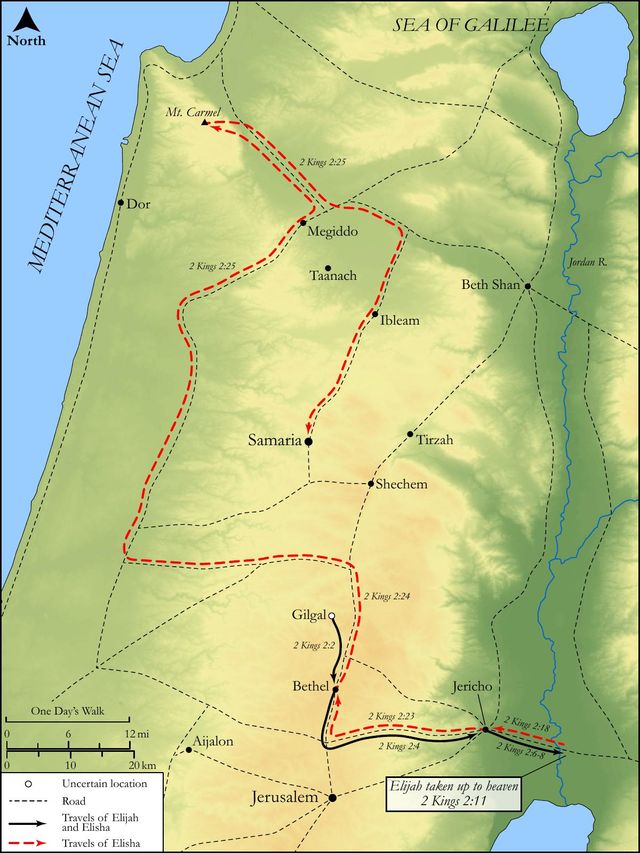
This verse is strategically placed at the dramatic climax of the narrative detailing Elijah's final earthly journey and the transfer of his prophetic authority to Elisha. The preceding verses (2 Kings 2:1-8) meticulously chronicle their path from Gilgal, through Bethel and Jericho, culminating at the Jordan River. At each location, Elijah attempts to dissuade Elisha from following, testing his unwavering loyalty and resolve. Elisha's steadfast refusal, articulated by his repeated oath, "As the LORD liveth, and as thy soul liveth, I will not leave thee" (a declaration found in 2 Kings 2:2, 2 Kings 2:4, and 2 Kings 2:6), underscores his profound devotion and readiness for succession. Their miraculous crossing of the Jordan on dry ground, achieved by Elijah striking the water with his mantle, powerfully echoes the Red Sea crossing under Moses and the Jordan crossing under Joshua, thereby emphasizing Elijah's divine authority and the momentous, divinely ordained transition about to occur. It is immediately after this supernatural event, with the Jordan behind them and Elijah's departure imminent, that the pivotal offer and request of 2 Kings 2:9 take place, setting the stage for Elijah's dramatic ascension in 2 Kings 2:11.
Historical & Cultural Context
The prophetic office in ancient Israel was often characterized by a master-disciple relationship, where younger prophets, frequently referred to as "sons of the prophets," served under and learned from established figures like Elijah. This dynamic highlights the crucial role of mentorship in the transmission of spiritual authority, wisdom, and the prophetic tradition. The concept of a "double portion" (Hebrew: pi shenayim) is deeply rooted in Israelite inheritance law, specifically pertaining to the firstborn son, who was legally entitled to receive twice the inheritance of his siblings, signifying his primary status and responsibility as the family's chief heir (as detailed in Deuteronomy 21:17). This legal precedent is vital for understanding Elisha's request; it indicates not a desire for twice Elijah's power in a quantitative sense, but for the full, primary inheritance of his spiritual father's prophetic office, thereby solidifying his status as Elijah's legitimate and chief successor. Furthermore, the Jordan River itself held immense historical and theological significance, frequently marking transitions, new beginnings, and divine interventions in Israel's history, thus amplifying the momentous nature of this particular event.
Key Themes
ShowHideThis verse powerfully contributes to several overarching themes central to the book of Kings and the broader biblical narrative. Firstly, it profoundly underscores the theme of spiritual succession and divine appointment, illustrating God's chosen method for transferring authority and anointing from one generation of leaders to the next. Elijah, as the seasoned and divinely commissioned prophet, is intentionally preparing and formally commissioning his faithful successor, Elisha, who has diligently served him. Secondly, it highlights the essential theme of dependence on divine empowerment, as Elisha's request is not for earthly riches, fame, or political influence, but for the very "spirit" that enabled Elijah's miraculous, authoritative, and impactful ministry. This reveals Elisha's profound theological understanding that effective service to God is entirely contingent upon supernatural anointing and divine enablement. Lastly, the request for a "double portion" speaks directly to the theme of spiritual inheritance and legacy, positioning Elisha as the legitimate and primary heir to Elijah's prophetic legacy, destined to carry on and even expand upon the work of his spiritual father, as powerfully evidenced by his subsequent ministry marked by numerous and significant miracles.
Exposition and Analysis
ShowHideKey Word Analysis
ShowHideA primitive root meaning "to take (in the widest variety of applications); accept, bring, buy, carry away, drawn, fetch, get, infold, [idiom] many, mingle, place, receive(-ing), reserve, seize, send for, take (away, -ing, up), use, win." In this context, Elijah's use of "taken away" signifies a unique, divinely orchestrated removal or taking, rather than a natural death. It subtly but powerfully foreshadows his extraordinary ascension into heaven without experiencing mortality, as explicitly detailed in 2 Kings 2:11. Elijah's foreknowledge of this imminent, supernatural departure imbues his offer to Elisha with profound weight and finality, marking it as a crucial act of commissioning.
("two") and H6310 ("mouth, portion"). This phrase is central to comprehending the depth of Elisha's request. It literally translates to "two mouths" or "two parts," and within the framework of ancient Israelite inheritance law (Deuteronomy 21:17), it specifically refers to the privilege of the firstborn son receiving twice the inheritance of his siblings. Elisha is not asking for a quantitative doubling of Elijah's power or spiritual capacity, but rather for the full, legitimate inheritance of a spiritual firstborn son, signifying his earnest desire to be recognized as Elijah's principal successor and to fully embody the prophetic office with its attendant responsibilities and authority.
Meaning "wind; by resemblance breath, i.e. a sensible (or even violent) exhalation; figuratively, life, anger, unsubstantiality; by extension, a region of the sky; by resemblance spirit, but only of a rational being (including its expression and functions)." In this profound biblical context, "spirit" refers specifically to the divine anointing and empowering presence of God that rested upon Elijah, enabling him to perform miracles, speak God's word with unparalleled authority, and faithfully carry out his prophetic ministry. It represents the life-giving, supernatural enablement of God, distinct from any inherent human ability. Elisha's request is for this very divine enablement to be transferred to him, acknowledging that his future ministry and effectiveness depend entirely on God's supernatural empowerment.
Verse Breakdown
ShowHide"And it came to pass, when they were gone over"
This opening clause immediately establishes the critical setting following the miraculous crossing of the Jordan River. The river, a potent symbolic boundary in Israelite history, has been supernaturally traversed, signifying a momentous transition point and the culmination of Elijah's earthly journey with Elisha. The divine power that enabled this extraordinary crossing underscores the profound authority of Elijah and the immense spiritual significance of the unfolding moment, preparing the reader for a pivotal exchange.
"that Elijah said unto Elisha, Ask what I shall do for thee, before I be taken away from thee"
Elijah, fully cognizant of his imminent supernatural departure, extends to Elisha a final, weighty, and profoundly significant opportunity. This is far from a casual offer; it serves as a deep test of Elisha's spiritual priorities and a climactic act of mentorship. Elijah's direct question places the burden of the request squarely on Elisha, thereby revealing the depth of Elisha's desire and his understanding of spiritual values. The phrase "taken away" (Hebrew laqach) subtly but clearly hints at Elijah's unique, non-death departure, building anticipation for the miraculous event to follow.
"And Elisha said, I pray thee, let a double portion of thy spirit be upon me"
Elisha's response is immediate, remarkably specific, and spiritually profound. He articulates no desire for personal gain, earthly wealth, or political power. Instead, his plea is for the very essence of Elijah's prophetic anointing. His request for a "double portion" signifies his earnest desire to be recognized as Elijah's principal spiritual heir, inheriting the full measure of his prophetic authority and responsibility. This should be understood not as a literal request for twice the power, but as a plea for the full, legitimate inheritance due to a firstborn son in the prophetic lineage, ensuring the continuity and strength of God's work.
Literary Devices
ShowHideThe passage is rich with several potent literary devices that amplify its theological and narrative impact. Foreshadowing is prominently employed through Elijah's repeated, enigmatic references to being "taken away," which skillfully builds anticipation for his miraculous ascension. The symbolism of the Jordan River crossing is profound, mirroring earlier biblical events such as the Red Sea parting and the Jordan crossing under Joshua, thereby emphasizing divine presence, a new era, and the momentous nature of the prophetic transition. Elijah's mantle, used to part the waters, functions as a powerful symbol of his prophetic authority, a symbol that is later transferred to Elisha, signifying the passing of the spiritual torch. There is also a subtle yet effective irony in Elijah's repeated attempts to dismiss Elisha; these tests, rather than deterring Elisha, ultimately serve to highlight his unwavering loyalty, deep commitment, and spiritual discernment, thereby proving his worthiness for the requested anointing. The entire scene is imbued with palpable dramatic tension, culminating in Elisha's audacious yet humble request and the subsequent miraculous event that validates it.
Theological and Thematic Connections
ShowHideElisha's earnest request for a "double portion of thy spirit" is a profound theological statement concerning the indispensable nature of divine empowerment for effective ministry. It underscores the biblical truth that genuine spiritual effectiveness does not originate from human talent, ambition, or intellectual prowess, but fundamentally from the anointing and power of God's Spirit. Elisha intuitively understood that to faithfully continue Elijah's monumental work, he needed Elijah's God and the same divine enablement that rested upon his master. This foundational principle resonates throughout the entirety of Scripture, consistently emphasizing humanity's absolute dependence on God's Spirit to accomplish His sovereign purposes. It teaches believers that seeking spiritual gifts and God's anointing for service is not merely permissible but a noble and necessary pursuit, provided it is rooted in profound humility, a sincere desire to glorify God, and not self-aggrandizement. The subsequent granting of Elisha's request, powerfully evidenced by his extensive and miraculous ministry, unequivocally affirms God's gracious willingness to equip those who earnestly desire to serve Him with the necessary spiritual resources and supernatural power.
Reflection and Application
ShowHideElisha's audacious yet deeply humble request serves as an enduring and powerful model for believers in every age. In a contemporary world that often champions self-reliance, human ingenuity, and personal achievement, Elisha's example profoundly reminds us that true spiritual impact and lasting fruit flow exclusively from divine empowerment. His singular desire was not for personal glory, earthly riches, or fleeting fame, but for the spiritual capacity and anointing necessary to faithfully continue God's work. This challenges us to critically examine our own deepest desires: what "portion" are we truly seeking in our lives and ministries? Are we content to operate within the confines of our own limited abilities, or do we earnestly long for a deeper, more profound anointing of the Holy Spirit to fulfill God's unique call on our lives? Elisha's unwavering commitment to Elijah, even when tested through multiple opportunities to depart, also powerfully highlights the indispensable importance of faithful discipleship, mentorship, and spiritual accountability within the body of Christ. We are called to serve diligently, to humbly learn from those who have faithfully gone before us, and to be prepared to receive and steward the spiritual inheritance passed down through generations of faith. Ultimately, our effectiveness in ministry, whether manifested in grand public acts or quiet, consistent acts of service, is directly proportional to our reliance on, and fervent pursuit of, God's empowering Spirit.
Questions for Reflection
ShowHideFAQ
ShowHideDid Elisha want twice the power of Elijah?
ShowHideNo, the phrase "double portion" (Hebrew: pi shenayim) in this context does not signify a desire for a literal doubling of miraculous power or spiritual capacity. Instead, it refers to the inheritance right of the firstborn son in ancient Israelite law, as explicitly laid out in Deuteronomy 21:17. The firstborn received a double share of the family's inheritance, symbolizing his primary status and responsibility as the chief heir. Therefore, Elisha was asking to be recognized and empowered as Elijah's principal spiritual heir, inheriting the full measure of his prophetic mantle and authority, thus ensuring the continuity of his master's work as the legitimate and primary successor, rather than simply wanting to perform twice as many miracles.
What does "spirit" mean in Elisha's request?
ShowHideIn this verse, "spirit" (Hebrew: ruach) refers to the divine anointing and empowering presence of God that supernaturally rested upon Elijah. This divine enablement allowed Elijah to perform extraordinary miracles, speak God's word with unparalleled authority, and faithfully carry out his prophetic ministry. It represents the supernatural power and enablement that originates from God, distinct from any human attribute or ability. Elisha was specifically asking for this divine enablement to be transferred to him, recognizing that his future ministry and effectiveness would depend entirely on God's supernatural power and presence, just as Elijah's had.
Christ-Centered Fulfillment
ShowHideElisha's earnest plea for a "double portion of thy spirit" finds its ultimate, glorious, and infinitely superior fulfillment in the person and redemptive work of Jesus Christ, and subsequently, in the abundant outpouring of the Holy Spirit upon the church. While Elisha sought a transfer of prophetic anointing from one human prophet to another, Jesus, the Prophet like Moses and the very Son of God, possesses the Spirit without measure (John 3:34). His entire earthly ministry was profoundly empowered by the Spirit, from His baptism (Matthew 3:16) to His mighty works of healing, deliverance, and teaching. Just as Elijah ascended into heaven and left his mantle as a token of transferred authority, Jesus ascended to the Father, but He did not leave His disciples without divine empowerment. Instead, He promised and subsequently sent the Holy Spirit, His own "Spirit of truth," to indwell, empower, and guide all believers (John 14:16-17; Acts 1:8). The "double portion" Elisha desired, representing the full inheritance of prophetic ministry, is vastly surpassed by the abundant, limitless Spirit poured out at Pentecost, enabling the church to do "greater works" than even Jesus performed during His earthly ministry, precisely because He has ascended to the Father (John 14:12). Thus, Elisha's longing for empowered service prefigures the new covenant reality where every believer, as a child of God adopted through Christ, receives the indwelling Spirit, becoming a spiritual heir to Christ's ongoing mission in the world, equipped for service and witness.