


2 Kings 3:1
- וִיהוֹרָםvi·ho·Ramand JehoramH3088Conj-w ¦ N-proper-mNoun Proper MasculineוִandיהוֹרָםJehoram
- בֶּןben[the] son ofH1121N-mscNoun Singular Masculine Construct
- אַחְאָב'ach·'AvAhabH256N-proper-mNoun Proper Masculine
- מָלַךְma·Lakhhe became kingH4427V-Qal-Perf-3msVerb Qal Perfect 3rd Singular Masculine
- עַל'aloverH5921PrepPreposition
- יִשְׂרָאֵלYis·ra·'ElIsraelH3478N-properNoun Proper Location
- בְּשֹׁמְרוֹןbe·Sho·me·Ronin SamariaH8111Prep-b ¦ N-properNoun Proper LocationבְּinשֹׁמְרוֹןSamaria
- בִּשְׁנַתbish·Natin yearH8141Prep-b ¦ N-fscNoun Singular Feminine Constructבִּinשְׁנַתyear
- שְׁמֹנֶהshe·mo·Neheight-H8083N-csNoun Singular common gender Absolute
- עֶשְׂרֵה'es·RehteenH6240N-csNoun Singular common gender Absolute
- לִיהוֹשָׁפָטli·ho·sha·Fatof JehoshaphatH3092Prep-l ¦ N-proper-mNoun Proper MasculineלִofיהוֹשָׁפָטJehoshaphat
- מֶלֶךְMe·lekh[the] king ofH4428N-mscNoun Singular Masculine Construct
- יְהוּדָהye·hu·DahJudahH3063N-properNoun Proper Location
- וַיִּמְלֹךְvai·yim·Lokhand he reignedH4427Conj-w ¦ V-Qal-ConsecImperf-3msVerb Qal Consecutive Imperfect 3rd Singular Masculineוַandיִּמְלֹךְhe reigned
- שְׁתֵּיםshe·teimtwo [plus]H8147N-fdNoun Dual Feminine Absolute
- עֶשְׂרֵה'es·RehtenH6240N-csNoun Singular common gender Absolute
- שָׁנָהsha·Nahyear[s]H8141N-fsNoun Singular Feminine Absolute
English is a literal word-by-word gloss of the Hebrew, not the KJV's wording. Why?
This is the original text the KJV's translators worked from — each Hebrew word with its own literal English meaning in this verse, prepared by scholars at Tyndale House, Cambridge. The KJV translates whole sentences, not word by word, so its wording differs: one Hebrew word can become several English words, and the KJV may choose “the LORD” where the gloss reads “Yahweh”. Both are faithful — they answer different questions. For the KJV's own rendering, switch to the KJV text.
Details
See on the biblical-era map
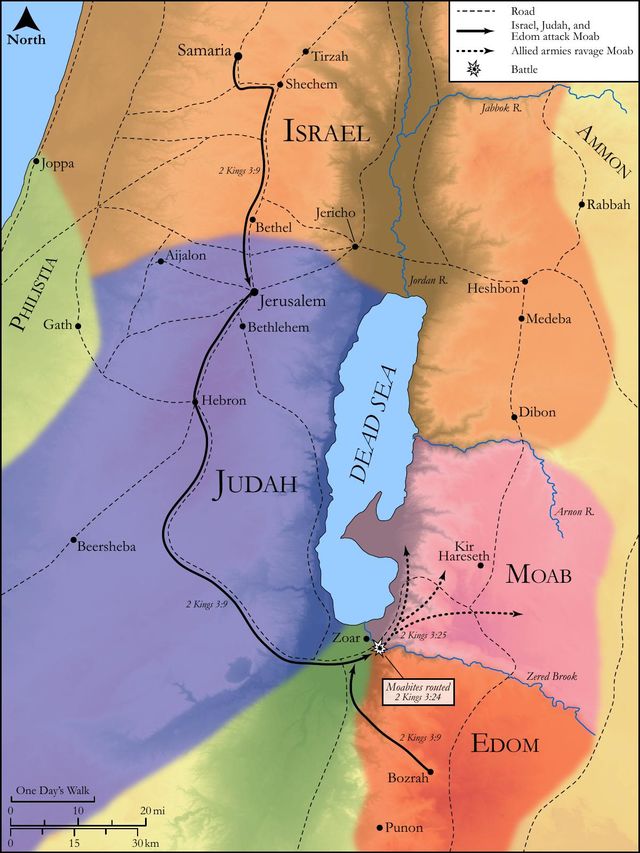
Study this verse
Public-domain commentary
Matthew Henry
From his Commentary on the Whole Bible. Henry comments on passages, not single verses — this entry covers 2 Kings 3:1–5. His two-level outline is real structure in the source text, so it is rendered as structure.
Jehoram, the son of Ahab, and brother of Ahaziah, is here upon the throne of Israel; and, though he was but a bad man, yet two commendable things are here recorded of him: -
I.That he removed his father's idols.
He did evil in many things, but not like his father Ahab or his mother Jezebel, Kg2 3:2. Bad he was, but not so bad, so overmuch wicked, as Solomon speaks, Ecc 7:17. Perhaps Jehoshaphat, though by his alliance with the house of Ahab he made his own family worse, did something towards making Ahab's better. Jehoram saw his father and brother cut off for worshipping Baal, and wisely took warning by God's judgments on them, and put away the image of Baal, resolving to worship the God of Israel only, and consult none but his prophets. So far was well, yet it did not prevent the destruction of Ahab's family, nay, that destruction came in his days, and fell immediately upon him (Kg2 9:24), though he was one of the best of the family, for then the measure of its iniquity was full. Jehoram's reformation was next to none; for,
1.He only put away the image of Baal which his father had made, and this probably in compliment to Jehoshaphat, who otherwise would not have come into confederacy with him, any more than with his brother, Kg1 22:49. But he did not destroy the worship of Baal among the people, for Jehu found it prevalent, Kg2 10:19. It was well to reform his family, but it was not enough; he ought to have used his power for the reforming of his kingdom.
2.When he put away the image of Baal, he adhered to the worship of the calves, that politic sin of Jeroboam, Kg2 3:3. He departed not therefrom, because that was the state engine by which the division between the two tribes was supported. Those do not truly, nor acceptably, repent or reform, who only part with the sins that they lose by, but continue their affection to the sins that they get by.
3.He only put away the image of Baal, he did not break it in pieces, as he ought to have done. He laid it aside for the present, yet not knowing but he might have occasion for it another time; and Jezebel, for reasons of state, was content to worship her Baal in private.
II.That he did what he could to recover his brother's losses.
As he had something more of the religion of an Israelite than his father, so he had something more of the spirit of a king than his brother. Moab rebelled against Israel, immediately upon the death of Ahab, Kg2 1:1. And we do not find that Ahaziah made any attempt to chastise or reduce them, but tamely let go his interest in them, rather than entertain the cares, undergo the fatigues, and run the hazards, of a war with them. His folly and pusillanimity herein, and his indifference to the public good, were the more aggravated because the tribute which the king of Moab paid was a very considerable branch of the revenue of the crown of Israel: 100,000 lambs, and 100,000 wethers, Kg2 3:4. The riches of kings then lay more in cattle than coin, and they thought it not below them to know the state of their flocks and herds themselves, because, as Solomon observes, the crown doth not endure to every generation, Pro 27:23, Pro 27:24. Taxes were then paid not so much in money as in the commodities of the country, which was an ease to the subject, whether it was an advantage to the prince or no. The revolt of Moab was a great loss to Israel, yet Ahaziah sat still in sloth and ease. But an upper chamber in his house proved as fatal to him as the high places of the field could have been (Kg2 1:2), and the breaking of his lattice let into his throne a man of the more active genius, that would not lose the dominion of Moab without making at least one push for its preservation.
Continue studying 2 Kings 3:1 across the web’s major study libraries — every link below opens this exact verse, chapter, or book on the destination site.
Read & Compare
 BibleGatewayThis verse in more than 200 translations and 70 languages.
 Bible.comThe YouVersion reader — hundreds of translations, reading plans, and highlights.
 ESV.orgCrossway's official English Standard Version reader.
 NET BibleThe NET translation with 60,000+ translators' notes on every rendering decision.
 STEP BibleTyndale House's free study tool — original text, vocabulary, and scholarly resources.
 BibliaLogos Bible Software's free web reader.
 USCCBThe New American Bible (Revised Edition) with the U.S. bishops' study notes.
Commentaries
 BibleHub CommentariesDozens of classic commentaries on this verse, gathered on one page.
 StudyLightMore than 100 commentary sets — the largest collection on the web.
 BibleRefPlain-English commentary on what this verse means, verse by verse.
 Enduring WordDavid Guzik's free commentary on this chapter, widely used by Bible teachers.
 Bible Study ToolsVerse commentary alongside Greek and Hebrew study aids.
Original Language & Research
- BibleHub InterlinearThe verse word by word — original language, transliteration, and English.
- BibleHub LexiconEvery word's original-language definition and Strong's entry.
 Blue Letter BibleDeep-study tools — Strong's numbers, concordance, and word studies.
 SefariaThe Hebrew text with Rashi and centuries of Jewish commentary.
Sermons, Hymns & Audio


TrulyRandomVerse is not affiliated with these sites and doesn’t control their content. They’re linked because they’re genuinely useful.
Summary
This foundational verse introduces Jehoram, the son of the infamous King Ahab, as the new monarch of the Northern Kingdom of Israel. It precisely dates the commencement of his twelve-year reign to the eighteenth year of Jehoshaphat, king of Judah, thereby synchronizing the parallel histories of the divided kingdoms and establishing the chronological framework for the significant events that follow, primarily centered in the capital city of Samaria.
Context
ShowHideLiterary Context
2 Kings 3:1 serves as a pivotal transition point, bridging the narrative from the dramatic conclusion of Elijah's ministry and his ascension to heaven in 2 Kings 2 and the early exploits of Elisha, to the reign of a new king in Israel. The preceding chapter, 2 Kings 2, establishes Elisha as Elijah's prophetic successor, setting the stage for his prominent role in Jehoram's reign, particularly in the immediate subsequent narrative of the war against Moab. This verse directly follows the brief and idolatrous reign of Jehoram's brother, Ahaziah, mentioned at the end of 1 Kings 22 and the beginning of 2 Kings 1. The book of Kings maintains a consistent pattern of introducing new monarchs with their regnal years, often synchronized with the reigning monarch of the other kingdom, as seen in 1 Kings 15:1 and 1 Kings 15:25, providing a continuous historical record that grounds the theological narrative.
Historical & Cultural Context
Jehoram's accession occurs within the turbulent period of the Omride dynasty, founded by his grandfather Omri, who established Samaria as the capital (1 Kings 16:24). His father, Ahab, and mother, Jezebel, were infamous for aggressively promoting Baal worship throughout Israel, leading to a profound spiritual crisis and direct confrontation with prophets like Elijah (1 Kings 18). While Jehoram is noted in 2 Kings 3:2 for being less zealous for Baal than his parents, the deep-seated idolatry of the Northern Kingdom remained a significant issue, rooted in the sins of Jeroboam (1 Kings 12:28-30). The synchronism with Jehoshaphat, king of Judah, highlights the continued existence of two separate kingdoms, often with complex political and military relationships, as evidenced by their alliance in the upcoming war against Moab. Samaria, as the capital, was not only a political and military stronghold but also a major center of religious syncretism, reflecting the spiritual struggles and apostasy of the Northern Kingdom.
Key Themes
ShowHideThis verse immediately introduces several key themes that permeate the books of Kings. Firstly, Succession and Continuity is evident, as the narrative meticulously tracks the transfer of power from one monarch to the next, underscoring the ongoing story of Israel's kingship, often marked by both divine appointment and human failure. Secondly, the emphasis on Historical Precision through the synchronism with Jehoshaphat's reign (1 Kings 22:41) highlights the biblical authors' commitment to presenting a reliable and chronologically anchored account of Israel's history. This precision serves to ground the theological message within verifiable historical events. Thirdly, the verse sets the stage for the Consequences of Leadership, particularly the legacy of idolatry inherited from Ahab. While Jehoram's personal character is further detailed in 2 Kings 3:2, his lineage immediately signals the ongoing spiritual struggle in Israel, a struggle that will define much of his reign and the subsequent narrative of the Northern Kingdom, particularly the ongoing conflict between Yahweh and Baal worship.
Exposition and Analysis
ShowHideKey Word Analysis
ShowHideThis name is a theophoric compound derived from "Jehovah" (Yahweh) and "raised" or "exalted," meaning "Jehovah-raised." The irony is striking given his lineage as the son of Ahab and Jezebel, who were notorious for promoting Baal worship and persecuting Yahweh's prophets. While 2 Kings 3:2 indicates Jehoram was not as extreme in his idolatry as his parents, his name stands as a subtle, yet powerful, theological statement: despite the rampant apostasy of the Omride dynasty, Yahweh remains supreme and exalted, sovereign over human kings and their idolatrous practices.
Derived from a root meaning "watch-station," Samaria was a strategically defensible city built on a hill by Omri, Jehoram's grandfather (1 Kings 16:24), serving as the capital of the Northern Kingdom of Israel. Its mention here immediately identifies the seat of Jehoram's power. Theologically, Samaria became synonymous with the Northern Kingdom's spiritual decline and idolatry, often targeted by prophetic condemnation (e.g., Hosea 8:5-6, Amos 3:9-10). Its presence in this verse firmly places Jehoram's reign within this context of political power intertwined with spiritual compromise.
Verse Breakdown
ShowHide"Now Jehoram the son of Ahab began to reign over Israel in Samaria"
This clause introduces the new king, Jehoram, and immediately identifies him by his notorious father, Ahab. This lineage is crucial, as Ahab's reign was marked by intense Baal worship and conflict with the prophets of Yahweh. Jehoram's rule over "Israel" refers specifically to the Northern Kingdom, distinct from Judah. "Samaria" is established as the capital, reinforcing the geographical and political center of his authority and the ongoing spiritual challenges associated with the Omride dynasty.
"the eighteenth year of Jehoshaphat king of Judah"
This precise chronological marker is a "synchronism," a common feature in the books of Kings. It allows the reader to align the parallel histories of the Northern Kingdom (Israel) and the Southern Kingdom (Judah). By linking Jehoram's accession to the eighteenth year of Jehoshaphat, a generally righteous king of Judah, the narrative provides a clear historical anchor, emphasizing the meticulous record-keeping and the interconnectedness of the two kingdoms' histories despite their division.
"and reigned twelve years."
This final clause states the duration of Jehoram's reign. This detail is significant as it frames the period within which the events of 2 Kings 3 and subsequent chapters will unfold. Knowing the length of his reign allows the reader to understand the scope of his impact and the period of Israelite history that his rule encompassed, setting the stage for the prophetic ministry of Elisha and the significant political and military events described in the following narrative.
Literary Devices
ShowHideThe verse employs several key literary devices. Synchronism is prominently featured, as the precise dating of Jehoram's reign by referencing Jehoshaphat's rule provides a crucial chronological anchor, demonstrating the biblical author's commitment to historical accuracy and facilitating the comparison of events in both kingdoms. There is also a subtle Irony in Jehoram's name, "Yahweh is exalted," given his family's deep-seated devotion to Baal. This linguistic irony subtly highlights the enduring sovereignty of Yahweh despite the apostasy of human rulers. Furthermore, the verse functions as a form of Foreshadowing, as Jehoram's introduction, particularly his lineage from Ahab, immediately signals the continued spiritual challenges and the ongoing conflict between Yahweh and Baal worship that will characterize his reign and necessitate the continued prophetic ministry of Elisha.
Theological and Thematic Connections
ShowHideThis seemingly straightforward historical record carries profound theological weight, underscoring God's meticulous oversight of human history and the unfolding of His divine plan through the rise and fall of earthly kings. Even amidst the spiritual decline of the Northern Kingdom and the idolatry of the Omride dynasty, God remains sovereign, orchestrating successions and determining the length of reigns. The synchronism with Jehoshaphat, a more righteous king in Judah, subtly contrasts the spiritual states of the two kingdoms while demonstrating that God's narrative encompasses both. This verse reminds us that no human ruler reigns outside of God's ultimate authority, and their actions, whether righteous or wicked, contribute to the larger tapestry of His redemptive purposes. It highlights the enduring theme of God's covenant faithfulness, even when His people and their leaders are unfaithful, and the ongoing consequences of leadership, both good and bad, on the spiritual health of a nation.
Reflection and Application
ShowHideThe introduction of Jehoram's reign, meticulously dated and connected to his infamous lineage, prompts us to reflect on the enduring impact of legacy and leadership. Just as Jehoram inherited the spiritual and political landscape shaped by his father Ahab, so too do we inherit and contribute to the spiritual climate of our families, communities, and nations. This verse reminds us that God is actively involved in the seemingly mundane details of history, overseeing the rise and fall of leaders, and that His purposes transcend human reigns. It calls us to consider the kind of legacy we are building, whether it points others to God or away from Him. Furthermore, the synchronism with Jehoshaphat encourages us to recognize the interconnectedness of God's people, even across divisions, and to pray for righteous leadership that honors God's name and leads His people in truth. Our lives, like Jehoram's reign, are set within God's sovereign timeline, and we are called to live faithfully within it, understanding that even our seemingly small actions contribute to the larger narrative of God's work in the world.
Questions for Reflection
ShowHideFAQ
ShowHideWho was Jehoram, and what was his relationship to King Ahab?
ShowHideJehoram was the son of King Ahab, one of the most notorious kings of the Northern Kingdom of Israel, infamous for his aggressive promotion of Baal worship alongside his Phoenician wife, Jezebel. Jehoram succeeded his brother, Ahaziah, to the throne. While he was Ahab's son, 2 Kings 3:2 indicates that Jehoram was not as zealous for Baal as his parents, even removing a sacred pillar of Baal that his father had made. However, he still persisted in some of the sinful practices of Jeroboam, the first king of Israel, who introduced calf worship at Dan and Bethel (1 Kings 12:28-30), thereby continuing the spiritual compromise of the Northern Kingdom.
Why is the specific dating ("the eighteenth year of Jehoshaphat king of Judah") important?
ShowHideThis specific dating is a "synchronism," a common and crucial feature in the books of Kings. It is important because it allows readers to precisely align the parallel histories of the divided kingdoms of Israel (North) and Judah (South). By providing this cross-reference to the reign of Jehoshaphat, a king of Judah, the biblical author establishes a clear chronological framework, demonstrating the meticulous record-keeping and historical accuracy of the narrative. This synchronism helps to weave together the two separate historical threads into a single, cohesive account of God's people, emphasizing His sovereign oversight of both kingdoms.
Christ-Centered Fulfillment
ShowHideThe introduction of Jehoram, a king from a lineage steeped in idolatry, yet whose very name means "Yahweh is exalted," subtly points to the ultimate King who truly exalts Yahweh: Jesus Christ. The earthly kings of Israel, even the best among them, were flawed and temporary, their reigns marked by human sin and limited by time, as indicated by Jehoram's "twelve years." This constant cycle of succession and the persistent failure of human kings to fully lead God's people in righteousness underscore the desperate need for a perfect, eternal King. Jesus, the true Son of David (Matthew 1:1), fulfills the ideal kingship that no Israelite monarch could achieve. He is the one whose reign is not for "twelve years" but is eternal and without end (Luke 1:32-33). Unlike Jehoram, who merely removed a pillar of Baal but retained other forms of idolatry, Christ completely overthrows the dominion of sin and idolatry, establishing a kingdom of righteousness and truth (Colossians 1:13-14). He is the true "Yahweh exalted," not just in name, but in His very being and redemptive work, perfectly reflecting the Father's glory (John 1:14) and bringing true spiritual liberation to His people, reigning from His heavenly throne until all enemies are under His feet (1 Corinthians 15:25).