


2 Kings 2:25
Bible text: King James Version (1769 Blayney text) · Public domain
Bible text: Berean Standard Bible · Public domain
Bible text: American Standard Version (1901) · Public domain
Bible text: World English Bible, Messianic edition · Public domain
Bible text: Geneva Bible (1599) · Public domain
Bible text: Young's Literal Translation · Public domain
- וַיֵּלֶךְvai·Ye·lekhand he wentH1980Conj-w ¦ V-Qal-ConsecImperf-3msVerb Qal Consecutive Imperfect 3rd Singular Masculineוַandיֵּלֶךְhe went
- מִשָּׁםmi·Shamfrom thereH8033Prep-m ¦ AdvAdverbמִfromשָּׁםthere
- אֶל'eltoH413PrepPreposition
- הַרhar[the] mountain ofH2022N-mscNoun Singular Masculine Construct
- הַכַּרְמֶלha·kar·Mel<the> CarmelH3760Art ¦ N-properNoun Proper Locationהַ<the>כַּרְמֶלCarmel
- וּמִשָּׁםu·mi·Shamand from thereH8033Conj-w ¦ Prep-m ¦ AdvAdverbוּandמִfromשָּׁםthere
- שָׁבshavhe returnedH7725V-Qal-Perf-3msVerb Qal Perfect 3rd Singular Masculine
- שֹׁמְרוֹןsho·me·RonSamariaH8111N-properNoun Proper Location
English is a literal word-by-word gloss of the Hebrew, not the KJV's wording. Why?
This is the original text the KJV's translators worked from — each Hebrew word with its own literal English meaning in this verse, prepared by scholars at Tyndale House, Cambridge. The KJV translates whole sentences, not word by word, so its wording differs: one Hebrew word can become several English words, and the KJV may choose “the LORD” where the gloss reads “Yahweh”. Both are faithful — they answer different questions. For the KJV's own rendering, switch to the KJV text.
Details
See on the biblical-era map
Study this verse
Public-domain commentary
Matthew Henry
From his Commentary on the Whole Bible. Henry comments on passages, not single verses — this entry covers 2 Kings 2:19–25. His three-level outline is real structure in the source text, so it is rendered as structure.
Elisha had, in this respect, a double portion of Elijah's spirit, that he wrought more miracles than Elijah. Some reckon them in number just double. Two are recorded in these verses - a miracle of mercy to Jericho and a miracle of judgment to Bethel, Psa 101:1.
I.Here is a blessing upon the waters of Jericho, which was effectual to heal them.
Jericho was built in disobedience to a command, in defiance to a threatening, and at the expense of the lives of all the builder's children; yet, when it was built, it was not ordered to be demolished again, nor were God's prophets or people forbidden to dwell in it, but even within those walls that were built by iniquity we find a nursery of piety. Fools, they say, build houses for wise men to dwell in. Here the wealth of the sinner provided a habitation for the just. We find Christ at Jericho, Luk 19:1. Hither Elisha came, to confirm the souls of the disciples with a more particular account of Elijah's translation than their spies, who saw at a distance, could give them. Here he staid while the fifty men were searching for him. And,
1.The men of Jericho represented to him their grievance, Kg2 2:19. God's faithful prophets love to be employed; it is wisdom to make use of them during the little while that their light is with us. They had not applied to Elijah concerning the matter, perhaps because he was not so easy of access as Elisha was; but now, we may hope, by the influence of the divinity-school in their city, they were reformed. The situation was pleasant and afforded a good prospect; but they had neither wholesome water to drink nor fruitful soil to yield them food, and what pleasure could they take in their prospect? Water is a common mercy, which we should estimate by the greatness of the calamity which the want or unwholesomeness of it would be. Some think that it was not all the ground about Jericho that was barren and had bad water, but some one part only, and that where the sons of the prophets had their lodgings, who are here called the men of the city.
2.He soon redressed their grievance. Prophets should endeavour to make every place they come to, some way or other, the better for them, endeavouring to sweeten bitter spirits, and to make barren souls fruitful, by the due application of the word of God. Elisha will heal their waters; but,
(1.)They must furnish him with salt in a new cruse, Kg2 2:20. If salt had been proper to season the water, yet what could so small a quantity do towards it and what the better for being in a new cruse? But thus those that would be helped must be employed and have their faith and obedience tried. God's works of grace are wrought, not by any operations of ours, but in observance of his institutions.
(2.)He cast the salt into the spring of the waters, and so healed the streams and the ground they watered. Thus the way to reform men's lives is to renew their hearts; let those be seasoned with the salt of grace; for out of them are the issues of life. Make the tree good and the fruit will be good. Purify the heart and that will cleanse the hands.
(3.)He did not pretend to do this by his own power, but in God's name: Thus saith the Lord, I have healed these waters. He is but the instrument, the channel through which God is pleased to convey this healing virtue. By doing them this kindness with a Thus saith the Lord, they would be made the more willing hereafter, to receive from him a reproof, admonition, or command, with the same preface. If, in God's name, he can help them, in God's name let him teach and rule them. Thus saith the Lord, out of Elisha's mouth, must, ever after, be of mighty force with them.
(4.)The cure was lasting, and not for the present only: The waters were healed unto this day, Kg2 2:22. What God does shall be for ever, Ecc 3:14. When he, by his Spirit, heals a soul, there shall be no more death nor barrenness; the property is altered: what was useless and offensive becomes grateful and serviceable.
II.Here is a curse upon the children of Bethel, which was effectual to destroy them; for it was not a curse causeless.
At Bethel there was another school of prophets. Thither Elisha went next, in this his primary visitation, and the scholars there no doubt welcomed him with all possible respect, but the townsmen were abusive to him. One of Jeroboam's calves was at Bethel; this they were proud of, and fond of, and hated those that reproved them. The law did not empower them to suppress this pious academy, but we may suppose it was their usual practice to jeer the prophets as they went along the streets, to call them by some nickname or other, that they might expose them to contempt, prejudice their youth against them, and, if possible, drive them out of their town. Had the abuse done to Elisha been the first offence of that kind, it is probable that it would not have been so severely punished. But mocking the messengers of the Lord, and misusing the prophets, was one of the crying sins of Israel, as we find, Ch2 36:16. Now here we have,
1.An instance of that sin. The little children of Bethel, the boys and girls that were playing in the streets (notice, it is likely, having come to the town of his approach), went out to meet him, not with their hosannas, as they ought to have done, but with their scoffs; they gathered about him and mocked him, as if he had been a fool, or one fit to make sport with. Among other things that they used to jeer the prophets with, they had this particular taunt for him, Go up, thou bald head, go up, thou bald head. It is a wicked thing to reproach persons for their natural infirmities or deformities; it is adding affliction to the afflicted; and, if they are as God made them, the reproach reflects upon him. But this was such a thing as scarcely deserved to be called a blemish, and would never have been turned to his reproach if they had had any thing else to reproach him with. It was his character as a prophet that they designed to abuse. The honour God had crowned him with should have been sufficient to cover his bald head and protect him from their scoffs. They bade him go up, perhaps reflecting on the assumption of Elijah: "Thy master," they say, "has gone up; why dost not thou go up after him? Where is the fiery chariot? When shall we be rid of thee too?" These children said as they were taught; they had learned of their idolatrous parents to call foul names and give bad language, especially to prophets. These young cocks, as we say, crowed after the old ones. Perhaps their parents did at this time send them out and set them on, that, if possible, they might keep the prophet out of their town.
2.A specimen of that ruin which came down upon Israel at last, for misusing God's prophets, and of which this was intended to give them fair warning. Elisha heard their taunts, a good while, with patience; but at length the fire of holy zeal for God was kindled in his breast by the continued provocation, and he turned and looked upon them, to try if a grave and severe look would put them out of countenance and oblige them to retire, to see if he could discern in their faces any marks of ingenuousness; but they were not ashamed, neither could they blush; and therefore he cursed them in the name of the Lord, both imprecated and denounced the following judgment, not in personal revenge for the indignity done to himself, but as the mouth of divine justice to punish the dishonour done to God. His summons was immediately obeyed. two she-bears (bears perhaps robbed of their whelps) came out of an adjacent wood, and presently killed forty-two children, Kg2 2:24. Now in this,
(1.)The prophet must be justified, for he did it by divine impulse. Had the curse come from any bad principle God would not have said Amen to it. We may think it would have been better to have called for two rods for the correction of these children than two bears for the destruction of them. But Elisha knew, by the Spirit, the bad character of these children. He knew what a generation of vipers those were, and what mischievous enemies they would be to God's prophets if they should live to be men, who began so early to be abusive to them. He intended hereby to punish the parents and to make them afraid of God's judgments.
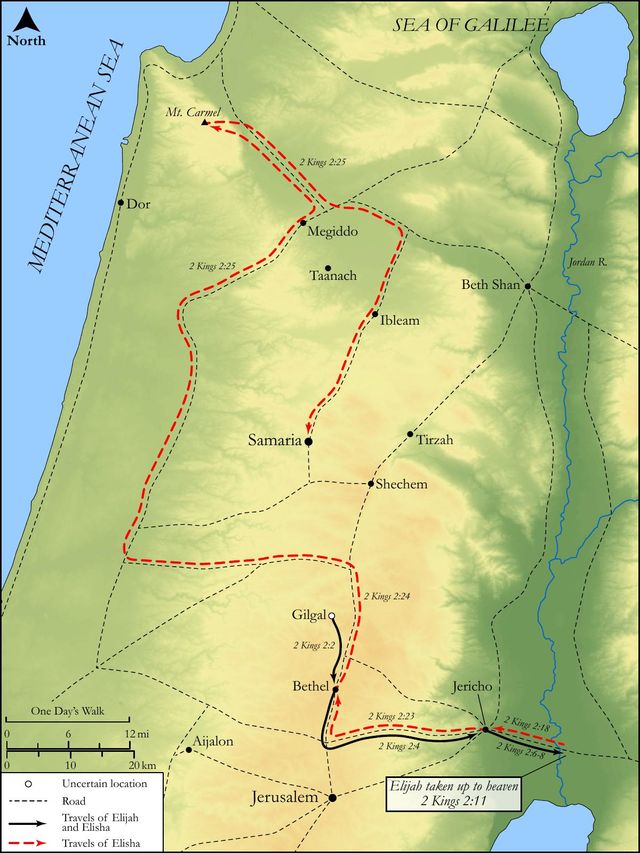
(2.)God must be glorified as a righteous God, that hates sin, and will reckon for it, even in little children. Let the wicked wretched brood make our flesh tremble for fear of God. Let little children be afraid of speaking wicked words, for God notices what they say,. Let them not mock any for their defects in mind or body, but pity them rather; especially let them know that it is at their peril if they jeer God's people or ministers, and scoff at any for well-doing. Let parents, that would have comfort in their children, train them up well, and do their utmost betimes to drive out the foolishness that is bound up in their hearts; for, as bishop Hall says, "In vain do we look for good from those children whose education we have neglected; and in vain do we grieve for those miscarriages which our care might have prevented." Elisha comes to Bethel and fears not the revenges of the bereaved parents; God, who bade him do what he did, he knew would bear him out. Thence he goes to Mount Carmel (Kg2 2:25), where it is probable there was a religious house fit for retirement and contemplation. Thence he returned to Samaria, where, being a public place, this father of the prophets might be most serviceable. Bishop Hall observes here, "That he can never be a profitable seer who is either always or never alone."
Continue studying 2 Kings 2:25 across the web’s major study libraries — every link below opens this exact verse, chapter, or book on the destination site.
Read & Compare
 BibleGatewayThis verse in more than 200 translations and 70 languages.
 Bible.comThe YouVersion reader — hundreds of translations, reading plans, and highlights.
 ESV.orgCrossway's official English Standard Version reader.
 NET BibleThe NET translation with 60,000+ translators' notes on every rendering decision.
 STEP BibleTyndale House's free study tool — original text, vocabulary, and scholarly resources.
 BibliaLogos Bible Software's free web reader.
 USCCBThe New American Bible (Revised Edition) with the U.S. bishops' study notes.
Commentaries
 BibleHub CommentariesDozens of classic commentaries on this verse, gathered on one page.
 StudyLightMore than 100 commentary sets — the largest collection on the web.
 BibleRefPlain-English commentary on what this verse means, verse by verse.
 Enduring WordDavid Guzik's free commentary on this chapter, widely used by Bible teachers.
 Bible Study ToolsVerse commentary alongside Greek and Hebrew study aids.
Original Language & Research
- BibleHub InterlinearThe verse word by word — original language, transliteration, and English.
- BibleHub LexiconEvery word's original-language definition and Strong's entry.
 Blue Letter BibleDeep-study tools — Strong's numbers, concordance, and word studies.
 SefariaThe Hebrew text with Rashi and centuries of Jewish commentary.
Sermons, Hymns & Audio


TrulyRandomVerse is not affiliated with these sites and doesn’t control their content. They’re linked because they’re genuinely useful.
Summary
Second Kings 2:25 meticulously records the initial post-ascension movements of the prophet Elisha, marking the commencement of his independent ministry. Following the dramatic departure of Elijah and a sobering display of prophetic judgment at Bethel, this verse succinctly chronicles Elisha's purposeful journey to the spiritually significant Mount Carmel, a place deeply associated with Elijah's powerful ministry, and his subsequent return to Samaria, the capital of the Northern Kingdom of Israel. This sequence of geographical transitions not only establishes the early scope and trajectory of Elisha's prophetic work but also subtly underscores his assumption of the prophetic mantle and his readiness to engage with the complex spiritual and political realities of his nation.
Context
ShowHideLiterary Context
This verse serves as the concluding statement to a pivotal chapter that marks the seamless and divinely orchestrated transition of prophetic leadership from Elijah to Elisha. Immediately preceding 2 Kings 2:25 is the unsettling account of Elisha's encounter with a group of mocking youths in Bethel, where his prophetic curse, a demonstration of his divine authority and the seriousness of disrespecting God's anointed, led to a severe judgment (2 Kings 2:23-24). This incident, following the powerful confirmation of his anointing at the Jordan River and his recognition by the "sons of the prophets" (2 Kings 2:13-18), firmly establishes Elisha's new identity and the potent nature of his ministry. The journey described in verse 25, therefore, is not merely a travelogue but a narrative continuation, setting the stage for the extensive and impactful prophetic career that unfolds throughout the remainder of the book of 2 Kings.
Historical & Cultural Context
Elisha's ministry unfolds against the backdrop of the Northern Kingdom of Israel, a period characterized by profound spiritual apostasy, particularly the pervasive and state-sponsored worship of Baal, vigorously promoted by the Omride dynasty, notably King Ahab and Queen Jezebel. Samaria, the capital city established by Omri (1 Kings 16:24), was the epicenter of this idolatry, political corruption, and oppression. Mount Carmel, conversely, held immense historical and spiritual significance, being the very site of Elijah's dramatic confrontation and decisive victory over the prophets of Baal, a powerful demonstration of Yahweh's supremacy (1 Kings 18:19-40). For Elisha to travel to Carmel suggests a deliberate act of spiritual alignment, perhaps a period of seeking divine counsel or personal reflection in a place consecrated by Yahweh's power. His subsequent return to Samaria indicates his readiness to engage directly with the spiritual darkness and societal challenges in the very heart of the nation, mirroring Elijah's fearless confrontation of the ruling powers.
Key Themes
ShowHideThe geographical movements of Elisha in 2 Kings 2:25 contribute significantly to several overarching themes prevalent in the book of Kings. Firstly, it powerfully reinforces the theme of Prophetic Succession and Authority, solidifying Elisha's new role as the primary prophet in Israel, now endowed with Elijah's spirit and power. Secondly, his strategic journey from Bethel (a place of judgment) to Carmel (a place of spiritual power and divine encounter) and then to Samaria (the seat of national apostasy) highlights the Strategic Nature of Prophetic Ministry. This sequence suggests a divinely guided balance between drawing strength from God's presence and actively engaging with the spiritual and social realities of the nation. Lastly, Elisha's purposeful movements imply Divine Guidance and Preparation, indicating that his early steps were not aimless but directed by God, preparing him for a long and impactful ministry characterized by numerous miracles, judgments, and acts of deliverance, as seen throughout the subsequent chapters of 2 Kings.
Exposition and Analysis
ShowHideKey Word Analysis
ShowHideThis primitive root signifies not merely physical movement but often implies purposeful progression or a directed journey. In Elisha's case, it underscores that his departure from Bethel was not aimless but part of a divinely guided itinerary. The verb suggests a continuous, active engagement in his new prophetic role, moving from one significant location to another as his ministry begins to unfold.
This refers to Mount Carmel, a prominent mountain range known for its fertility and, more significantly, its association with Elijah's dramatic contest against the prophets of Baal (1 Kings 18). For Elisha to travel to Carmel immediately after Elijah's departure and the Bethel incident suggests a spiritual pilgrimage. It represents a place of solitude, reflection, and perhaps divine confirmation or communion, a spiritual touchstone for Elisha as he assumes the mantle of prophecy and prepares for the challenges ahead.
This root means to turn back or return, indicating a deliberate change of direction back to a previous or designated location. Elisha's "return" to Samaria signifies the culmination of his preparatory phase and the commencement of his active public ministry in the heart of Israel. It implies a readiness to engage with the nation's spiritual and political center, bringing God's word and power directly to the seat of its apostasy.
Verse Breakdown
ShowHide"And he went from thence to mount Carmel,"
This clause describes Elisha's departure from Bethel, the site of the recent judgment upon the mocking youths. His journey to Mount Carmel is highly significant. It was a place of prophetic power and solitude, where Elijah had previously demonstrated God's supremacy over Baal. For Elisha, this journey likely served as a period of spiritual consolidation, reflection, and perhaps receiving further divine instruction or personal communion with God after the intense events of Elijah's ascension and the Bethel judgment. It marks a transition from a public display of authority to a more private, preparatory phase before fully engaging in his public ministry.
"and from thence he returned to Samaria."
Following his time on Mount Carmel, Elisha's return to Samaria, the capital city of the Northern Kingdom of Israel, signals the commencement of his public ministry in the very heart of the nation. Samaria was the center of political power and, critically, the stronghold of Baal worship and idolatry. His presence there indicates his readiness to confront the spiritual challenges of the day, to deliver God's messages, and to perform miracles within the very seat of Israel's apostasy. This movement underscores his commitment to engaging with the people and their rulers, carrying forward the prophetic work initiated by Elijah in the most challenging environment.
Literary Devices
ShowHideThe verse primarily employs Narrative Progression, succinctly charting Elisha's geographical movements to establish the initial trajectory of his ministry. The specific locations, Mount Carmel and Samaria, function as potent Geographical Symbolism. Mount Carmel symbolizes a place of divine encounter, spiritual power, and solitude, recalling Elijah's triumph over Baal worship and representing a source of prophetic strength. Samaria, conversely, symbolizes the center of national life, political power, and pervasive idolatry, representing the challenging and spiritually needy environment where Elisha's public ministry would primarily unfold. The movement between these two distinct locations creates a subtle Juxtaposition, highlighting the dual nature of prophetic ministry: drawing strength from divine presence (Carmel) and then engaging with the challenging realities of a fallen world (Samaria). This concise geographical account thus conveys significant theological and practical implications for Elisha's role as the successor to Elijah.
Theological and Thematic Connections
ShowHideThis verse, though concise, is rich in theological implications, particularly concerning the nature of prophetic ministry and divine calling. Elisha's journey from Bethel to Carmel and then to Samaria illustrates a profound pattern of divine preparation and strategic engagement. It underscores the necessity for those called by God to seek moments of spiritual solitude and communion (represented by Carmel) before or during their public ministry, especially when facing significant spiritual opposition (represented by Samaria). This balance ensures that ministry flows from a deep wellspring of divine power and guidance, rather than mere human effort or ambition. The prophet, as God's representative, must be both deeply rooted in God's presence and relevant to the needs and challenges of society, even in its most rebellious centers. This journey encapsulates the essential rhythm of withdrawal and engagement that characterizes effective spiritual leadership.
Reflection and Application
ShowHideElisha's deliberate movements in 2 Kings 2:25 offer a profound model for spiritual leadership and personal discipleship in any age. His journey to Mount Carmel, a place of spiritual significance and solitude, before returning to the bustling and idolatrous capital of Samaria, speaks to the critical importance of balancing spiritual retreat with active engagement in the world. In our own lives, there is a constant tension between drawing near to God in quiet reflection and stepping out to serve Him in often challenging and spiritually hostile environments. This verse reminds us that true effectiveness in ministry and life does not come from constant activity but from a rhythm of seeking God's face and then faithfully applying His truth in our spheres of influence. It encourages us to prioritize periods of spiritual renewal, whether through prayer, study of God's Word, or quiet contemplation, as essential preparation for the work God calls us to do, even in the "Samarias" of our modern world—places of societal brokenness, spiritual apathy, or outright opposition. This rhythm fosters resilience, clarity, and divine power for the journey ahead.
Questions for Reflection
ShowHideFAQ
ShowHideWhy did Elisha go to Mount Carmel specifically, and what is its significance?
ShowHideElisha's journey to Mount Carmel was highly significant, far beyond mere geographical convenience. Mount Carmel was not just a prominent mountain range but a place deeply associated with Elijah's most dramatic confrontation with the prophets of Baal, where Yahweh's power was unequivocally demonstrated through fire from heaven (1 Kings 18:19-40). For Elisha, going there immediately after Elijah's departure and the incident at Bethel likely served multiple purposes: it was a place of spiritual retreat and solitude where he could reflect on his new prophetic mantle, seek divine guidance, and perhaps commune with God in a place consecrated by powerful divine revelation. It was a symbolic act of aligning himself with the legacy of Elijah and drawing spiritual strength before embarking on his extensive public ministry in a nation steeped in idolatry.
Christ-Centered Fulfillment
ShowHideElisha's journey from Bethel to Mount Carmel and then to Samaria, though a geographical itinerary, prophetically foreshadows aspects of Christ's own ministry and the journey of His followers. Just as Elisha, the anointed prophet, sought a place of spiritual retreat and confirmation (Carmel) before engaging the heart of Israel's apostasy (Samaria), so too did Jesus. After His baptism, which marked the public inauguration of His ministry, Jesus was led by the Spirit into the wilderness for a period of intense spiritual preparation and confrontation with temptation (Matthew 4:1-11). This period of solitude and testing strengthened Him for the arduous task of confronting the spiritual strongholds of His day, ultimately leading Him to Jerusalem, the spiritual and political capital, where He would offer the ultimate sacrifice. Elisha's movement from a place of judgment (Bethel incident) to a place of spiritual power and communion (Carmel) and then to the place of profound need (Samaria) mirrors Christ's mission to bring light to a darkened world, moving from divine communion to active redemptive engagement. This pattern is also seen in Jesus' willingness to minister to the Samaritans, a people often despised by the Jews, demonstrating His mission to reach all, including the spiritual "Samarias" of the world (John 4:1-42). The prophet's journey thus serves as a type, pointing to the greater Prophet whose life perfectly embodied the balance of divine connection and redemptive action, bringing salvation to the ends of the earth.