


1 Kings 18:42
Bible text: King James Version (1769 Blayney text) · Public domain
Bible text: King James Version with Strong's numbers · Public domain
Bible text: Berean Standard Bible · Public domain
Bible text: American Standard Version (1901) · Public domain
Bible text: World English Bible, Messianic edition · Public domain
Bible text: Geneva Bible (1599) · Public domain
Bible text: Young's Literal Translation · Public domain
- וַיַּעֲלֶהvai·ya·'a·Lehand he went upH5927Conj-w ¦ V-Qal-ConsecImperf-3msVerb Qal Consecutive Imperfect 3rd Singular Masculineוַandיַּעֲלֶהhe went up
- אַחְאָב'ach·'AvAhabH256N-proper-mNoun Proper Masculine
- לֶאֱכֹלle·'e·Kholto eatH398Prep-l ¦ V-Qal-InfVerb Qal Infinitive Constructלֶtoאֱכֹלeat
- וְלִשְׁתּוֹתve·lish·Totand to drinkH8354Conj-w ¦ Prep-l ¦ V-Qal-InfVerb Qal Infinitive Constructוְandלִtoשְׁתּוֹתdrink
- וְאֵלִיָּהוּve·'E·li·Ya·huand ElijahH452Conj-w ¦ N-proper-mNoun Proper MasculineוְandאֵלִיָּהוּElijah
- עָלָה'a·Lahhe went upH5927V-Qal-Perf-3msVerb Qal Perfect 3rd Singular Masculine
- אֶל'eltoH413PrepPreposition
- רֹאשׁrosh[the] top ofH7218N-mscNoun Singular Masculine Construct
- הַכַּרְמֶלha·kar·Mel<the> CarmelH3760Art ¦ N-properNoun Proper Locationהַ<the>כַּרְמֶלCarmel
- וַיִּגְהַרvai·yig·Harand he crouchedH1457Conj-w ¦ V-Qal-ConsecImperf-3msVerb Qal Consecutive Imperfect 3rd Singular Masculineוַandיִּגְהַרhe crouched
- אַרְצָה'Ar·tzah[the] ground towardsH776N-fs ¦ SfxNoun Singular Feminine Absoluteאַרְצָ[the] groundהtowards
- וַיָּשֶׂםvai·Ya·semand he putH7760Conj-w ¦ V-Qal-ConsecImperf-3msVerb Qal Consecutive Imperfect 3rd Singular Masculineוַandיָּשֶׂםhe put
- פָּנָיוpa·Navhis faceH6440N-mpc ¦ 3msNoun Plural Masculine Constructפָּנָיfaceוhis
- בֵּיןbeinbetweenH996Adj-mscAdjective Numerical Singular Masculine Construct
- בִּרְכָּיוbe·ra·khovhis kneesH1290N-fdc ¦ 3msNoun Dual Feminine Constructבִּרְכָּיkneesוhis
English is a literal word-by-word gloss of the Hebrew, not the KJV's wording. Why?
This is the original text the KJV's translators worked from — each Hebrew word with its own literal English meaning in this verse, prepared by scholars at Tyndale House, Cambridge. The KJV translates whole sentences, not word by word, so its wording differs: one Hebrew word can become several English words, and the KJV may choose “the LORD” where the gloss reads “Yahweh”. Both are faithful — they answer different questions. For the KJV's own rendering, switch to the KJV text.
Details
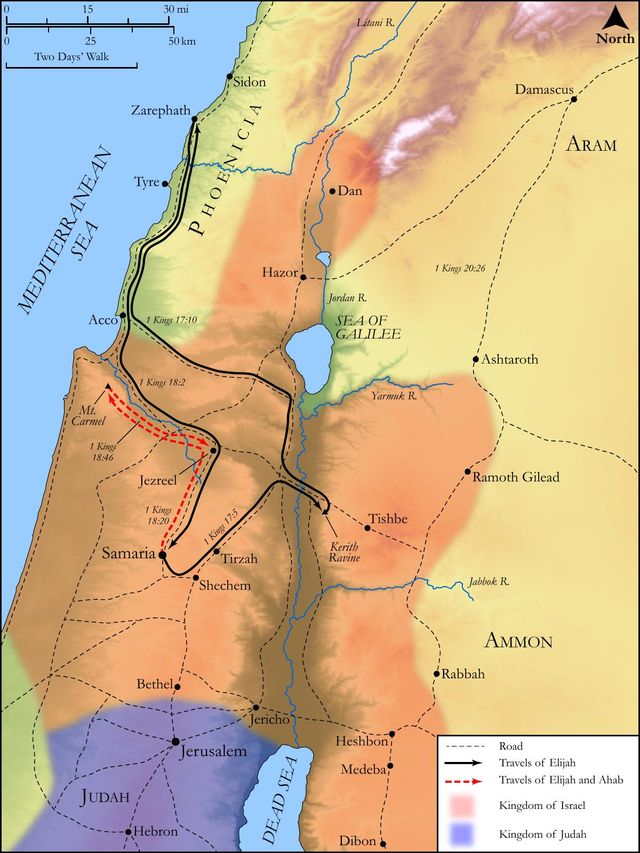
See on the biblical-era maps

Study this verse
Public-domain commentary
Matthew Henry
From his Commentary on the Whole Bible. Henry comments on passages, not single verses — this entry covers 1 Kings 18:41–46. His two-level outline is real structure in the source text, so it is rendered as structure.
Israel being thus far reformed that they had acknowledged the Lord to be God, and had consented to the execution of Baal's prophets, that they might not seduce them any more, though this was far short of a thorough reformation, yet it was so far accepted that God thereupon opened the bottles of heaven, and poured out blessings upon his land, that very evening (as it should seem) on which they did this good work, which should have confirmed them in their reformation; see Hag 2:18, Hag 2:19.
I.Elijah sent Ahab to eat and drink, for joy that God had now accepted his works, and that rain was coming; see Ecc 9:7.
Ahab had continued fasting all day, either religiously, it being a day of prayer, or for want of leisure, it being a day of great expectation; but now let him eat and rink for, though others perceive no sign of it, Elijah, by faith, hears the sound of abundance of rain, Kg1 18:41. God reveals his secrets to his servants the prophets; and yet, without a revelation, we may foresee that when man's judgments run down like a river God's mercy will. Rain is the river of God, Psa 65:9.
II.He himself retired to pray (for though God had promised rain, he must ask it, Zac 10:1), and to give thanks for God's answer by fire, now hoping for an answer by water. What he said we are not told; but,
1.He withdrew to a strange place, to the top of Carmel, which was very high and very private. Hence we read of those that hide themselves in the top of Carmel, Amo 9:3. There he would be alone. Those who are called to appear and act in public for God must yet find time to be private with him and keep up their converse with him in solitude. There he set himself, as it were, upon his watch-tower, like the prophet, Hab 2:1.
2.He put himself into a strange posture. He cast himself down on his knees upon the earth, in token of humility, reverence, and importunity, and put his face between his knees (that is, bowed his head so low that it touched his knees), thus abasing himself in the sense of his own meanness now that God had thus honoured him.
III.He ordered his servant to bring him notice as soon as he discerned a cloud arising out of the sea, the Mediterranean Sea, which he had a large prospect of from the top of Carmel. The sailors at this day call it Cape Carmel. Six times his servant goes to the point of the hill and sees nothing, brings no good news to his master; yet Elijah continues praying, will not be diverted so far as to go and see with his own eyes, but still sends his servant to see if he can discover any hopeful cloud, while he keeps his mind close and intent in prayer, and abides by it, as one that has taken up his father Jacob's resolution, I will not let thee go except thou bless me. Note, Though the answer of our fervent and believing supplications may not come quickly, yet we must continue instant in prayer, and not faint nor desist; for at the end it shall speak and not lie.
IV.A little cloud at length appeared, no bigger than a man's hand, which presently overspread the heavens and watered the earth, Kg1 18:44, Kg1 18:45. Great blessings often arise from small beginnings, and showers of plenty from a cloud of a span long. Let us therefore never despise the day of small things, but hope and wait for great things from it. This was not as a morning cloud, which passes away (though Israel's goodness was so), but one that produced a plentiful rain (Psa 68:9), and an earnest of more.
V.Elijah hereupon hastened Ahab home, and attended him himself.
Ahab rode in his chariot, at ease and in state, Kg1 18:45. Elijah ran on foot before him. If Ahab had paid the respect to Elijah that he deserved he would have taken him into his chariot, as the eunuch did Philip, that he might honour him before the elders of Israel, and confer with him further about the reformation of the kingdom. But his corruptions got the better of his convictions, and he was glad to get clear of him, as Felix of Paul, when he dismissed him, and adjourned his conference with him to a more convenient season. But, since Ahab invites him not to ride with him, he will run before him (Kg1 18:46) as one of his footmen, that he may not seem to be lifted up with the great honour God had put upon him or to abate in his civil respect to his prince, though he reproved him faithfully. God's ministers should make it appear that, how great soever they look when they deliver God's message, yet they are far from affecting worldly grandeur: let them leave that to the kings of the earth.
Historical interpretation
Historical reception
1 surviving comment on this verse from the historical church.
“And Elijah went up to the top of Carmel.” He does not go to Jerusalem in order to offer a sacrifice to the Lord, even though he knows the commandment of the law, which prevents the Jews from sacrificing outside the place that God had appointed as holy for them. He goes up to top of the Carmel in order to ask for rain, even though he knows that Solomon had mentioned the rain in his prayer for the people and the Lord had promised him that he would have given rain to those who prayed to him inside the temple of Jerusalem. Therefore Elijah prayed, so that they might see the miracle, because many of them still had not realized that the famine that overwhelmed them had been sent by the Lord through Elijah, who had prayed to him. In order that the word might confirm that Elijah had bound the heavens and now opened them, it was necessary that the people saw the prophet kneeling down in prayer, in the act of causing the rain to come down through his prayer.
Continue studying 1 Kings 18:42 across the web’s major study libraries — every link below opens this exact verse, chapter, or book on the destination site.
Read & Compare
 BibleGatewayThis verse in more than 200 translations and 70 languages.
 Bible.comThe YouVersion reader — hundreds of translations, reading plans, and highlights.
 ESV.orgCrossway's official English Standard Version reader.
 NET BibleThe NET translation with 60,000+ translators' notes on every rendering decision.
 STEP BibleTyndale House's free study tool — original text, vocabulary, and scholarly resources.
 BibliaLogos Bible Software's free web reader.
 USCCBThe New American Bible (Revised Edition) with the U.S. bishops' study notes.
Commentaries
 BibleHub CommentariesDozens of classic commentaries on this verse, gathered on one page.
 StudyLightMore than 100 commentary sets — the largest collection on the web.
 BibleRefPlain-English commentary on what this verse means, verse by verse.
 Enduring WordDavid Guzik's free commentary on this chapter, widely used by Bible teachers.
 Bible Study ToolsVerse commentary alongside Greek and Hebrew study aids.
Original Language & Research
- BibleHub InterlinearThe verse word by word — original language, transliteration, and English.
- BibleHub LexiconEvery word's original-language definition and Strong's entry.
 Blue Letter BibleDeep-study tools — Strong's numbers, concordance, and word studies.
 SefariaThe Hebrew text with Rashi and centuries of Jewish commentary.
Sermons, Hymns & Audio


TrulyRandomVerse is not affiliated with these sites and doesn’t control their content. They’re linked because they’re genuinely useful.
Summary
1 Kings 18:42 captures a profound spiritual contrast on Mount Carmel, immediately following Yahweh's dramatic vindication over Baal. While King Ahab casually ascends to eat and drink, signaling a return to worldly comfort, Prophet Elijah climbs higher to the summit, adopting an extraordinary posture of intense, humble, and fervent prayer. This verse powerfully illustrates the divergent responses to divine revelation and underscores the essential role of persistent intercession in the unfolding of God's sovereign plan, even after a promise has been declared.
Context
ShowHideLiterary Context
This verse immediately follows the climactic and decisive confrontation on Mount Carmel, a pivotal moment in Israel's spiritual history. Elijah, as the lone prophet of Yahweh, challenged the 450 prophets of Baal and 400 prophets of Asherah to a contest. After their futile attempts, God miraculously consumed Elijah's water-drenched sacrifice with fire from heaven (1 Kings 18:38), unequivocally validating Yahweh as the one true God. Following this divine display, Elijah commanded the people to seize and execute the Baal prophets (1 Kings 18:40). With the spiritual victory secured and the drought's cause addressed, Elijah then declared to Ahab, "Go up, eat and drink, for there is the sound of the roar of a heavy rain" (1 Kings 18:41). Our verse depicts the immediate, contrasting responses to this prophecy and sets the stage for the long-awaited fulfillment of the three-and-a-half-year drought's end, which Elijah himself had initially proclaimed to Ahab in 1 Kings 17:1.
Historical & Cultural Context
The events of 1 Kings 18 unfold during a period of severe spiritual apostasy in the Northern Kingdom of Israel under the reign of King Ahab and his Phoenician queen, Jezebel. They aggressively promoted the worship of Baal, the Canaanite storm and fertility god, leading to a devastating drought, which was understood as divine judgment from Yahweh. Mount Carmel, a prominent and fertile landmark, was a traditional site of worship and often associated with Baal cults, making it the ideal location for a decisive confrontation between Yahweh and Baal. The act of "eating and drinking" for King Ahab signifies a return to normalcy and physical sustenance, a common practice after a significant event, a journey, or a period of fasting. Elijah's posture, "put his face between his knees," while not explicitly detailed elsewhere in the Old Testament as a standard prayer posture, is universally interpreted as an act of profound humility, intense earnestness, and deep spiritual agony or concentration, akin to a woman in labor, signifying the desperate longing for the "birth" of the promised rain.
Key Themes
ShowHideThis verse powerfully contributes to several overarching themes evident throughout the book of 1 Kings and beyond:
Divine Sovereignty and Human Intercession
God had already promised the rain, yet Elijah engaged in fervent prayer for its arrival. This highlights the mysterious yet profound partnership where God's sovereign will often unfolds in response to the believing prayers of His people. It underscores that divine promises are not an excuse for passivity but an invitation to active, persistent, and believing prayer, as seen in James 5:17-18.
Contrast Between Worldly and Spiritual Priorities
Ahab's immediate concern is physical comfort and sustenance ("to eat and to drink"), reflecting a worldly focus despite witnessing an overwhelming display of God's power. In stark contrast, Elijah's immediate action is intense prayer, demonstrating a spiritual priority and deep dependence on God, even after a monumental victory. This contrast reveals the ongoing spiritual battle for the hearts of leaders and the people, and the chasm between carnal and spiritual responses to God's work.
Humility and Persistence in Prayer
Despite having just experienced a monumental triumph and receiving a direct promise from God, Elijah does not become complacent or prideful. His posture of humility and persistence in prayer teaches that spiritual victories should lead to deeper dependence and continued intercession, not to spiritual relaxation or self-congratulation. It emphasizes that the manifestation of God's power often requires human partnership through prayer.
Exposition and Analysis
ShowHideKey Word Analysis
ShowHideFrom a primitive root meaning "to prostrate oneself." In this context, it signifies an intentional act of humbling oneself, assuming a posture of complete submission, reverence, and earnest supplication before God. It is a physical manifestation of deep spiritual humility and intense prayer, indicating a total surrender to the Lord's will and an abandonment of self-reliance, particularly in a moment of profound spiritual travail.
A plural noun (used singularly) meaning "the face (as the part that turns)." It refers to the visible front part of the head, but figuratively, it can represent presence, countenance, or direction. In Elijah's posture, the act of putting his face "between his knees" emphasizes an inward focus, a shutting out of external distractions, and a direct, intense engagement with God in prayer, where his entire being is directed towards the divine.
Derived from the root "to bless," this noun specifically refers to the "knee." Kneeling or bending the knee is a universal posture of reverence, submission, and prayer in Israel and among the nations. The specific detail of Elijah's face being "between his knees" intensifies this imagery of humility and deep prostration, suggesting an almost fetal position of utter dependence and agonizing supplication, as if "birthing" the rain through his fervent prayers.
Verse Breakdown
ShowHide"So Ahab went up to eat and to drink."
This clause describes King Ahab's immediate and mundane response to Elijah's prophecy of impending rain. Having witnessed God's dramatic intervention on Mount Carmel and the execution of the Baal prophets, Ahab's primary concern is to satisfy his physical needs. This action reveals his largely unspiritual disposition, prioritizing comfort and normalcy over deeper reflection, repentance, or communion with God, despite the profound spiritual events he had just experienced. It suggests a lack of true spiritual awakening or transformation.
"And Elijah went up to the top of Carmel;"
In stark contrast to Ahab, Elijah ascends even further up Mount Carmel. This ascent is not merely geographical but profoundly symbolic, representing a spiritual elevation and a move towards deeper, solitary communion with God. The "top of Carmel" becomes a private, consecrated place of intense prayer, setting him apart from the worldly concerns of the king and connecting him more intimately with the divine presence, ready to intercede for the fulfillment of God's word.
"and he cast himself down upon the earth, and put his face between his knees,"
This describes Elijah's extraordinary and unique posture of prayer. "Casting himself down upon the earth" signifies extreme humility, prostration, and complete submission before God. The specific detail of "put his face between his knees" is a powerful and unique image, conveying intense concentration, spiritual agony, and fervent, agonizing intercession. It suggests an all-consuming focus, shutting out all external distractions, and pouring out his soul to God, perhaps even symbolizing the "birth pangs" of the coming rain, a desperate yearning for God's promised intervention to manifest.
Literary Devices
ShowHideThe verse effectively employs Contrast by juxtaposing the actions of King Ahab and Prophet Elijah. Ahab's immediate pursuit of "eat and to drink" highlights his worldly concerns, spiritual apathy, and lack of true repentance, even after witnessing God's miraculous power. In stark opposition, Elijah's ascent and intense prayer posture underscore his profound spiritual focus, deep dependence on God, and unwavering commitment to intercession. This stark contrast serves to emphasize the divergent paths and priorities of a worldly king versus a devoted prophet. Symbolism is also prominent, with Mount Carmel representing a place of divine encounter, spiritual battle, and now, fervent prayer. Elijah's unique prayer posture is highly symbolic of deep humility, fervent intercession, and spiritual travail, anticipating the "birth" of the rain. The "sound of abundance of rain" mentioned in the preceding verse (1 Kings 18:41) functions as Foreshadowing, building anticipation for the fulfillment of God's promise, which Elijah's prayer is instrumental in bringing to pass.
Theological and Thematic Connections
ShowHide1 Kings 18:42 profoundly illustrates the dynamic interplay between divine sovereignty and human responsibility, particularly through the conduit of prayer. God had already declared the coming of rain, yet Elijah engaged in fervent intercession. This is not because God needed convincing or was unaware, but because He sovereignly chooses to work through the prayers of His people, inviting them into partnership with His divine plan and demonstrating His delight in their active faith. Elijah's posture of extreme humility and intense focus underscores that genuine prayer is not a casual request but often a wrestling in the spirit, a deep yearning for God's will to be done on earth as it is in heaven. It teaches that even after receiving a divine promise or experiencing a great spiritual victory, believers are called to persistent, humble dependence on God, acknowledging that all blessings flow from His hand and often through the conduit of believing prayer.
Reflection and Application
ShowHideElijah's actions in 1 Kings 18:42 provide a powerful and challenging model for contemporary believers. In a world often driven by immediate gratification, physical comfort, and a tendency to relax after perceived success, Elijah's example calls us to cultivate a deeper spiritual discipline. After witnessing God's miraculous power, Ahab sought food and drink, prioritizing physical normalcy. In stark contrast, Elijah sought God's face in intense prayer. This contrast compels us to examine our own priorities: Do we quickly return to normalcy and self-indulgence after experiencing God's grace or receiving a divine promise, or are we drawn into deeper, more fervent communion with Him? Elijah's posture of humility and intense prayer, even when a promise has been given, reminds us that prayer is not merely informing God, but aligning ourselves with His will, actively participating in the unfolding of His kingdom, and demonstrating our absolute dependence. It calls us to persist in prayer, even when the answer seems delayed or already assured, recognizing that our intercession is a vital part of God's design for bringing His purposes to fruition and a testament to our faith.
Questions for Reflection
ShowHideFAQ
ShowHideWhy did Elijah pray for rain if God had already promised it in 1 Kings 18:41?
ShowHideElijah's prayer, despite God's prior promise, illustrates a profound theological truth about the relationship between divine sovereignty and human responsibility. God's promises are not meant to negate the need for prayer but often to motivate it. Elijah understood that God chooses to work through the prayers of His people, inviting them into partnership with His divine plan. His prayer was not to convince God to send rain, but to align himself with God's declared will and to participate actively in its fulfillment. It demonstrates faith that takes God at His word and then earnestly seeks its manifestation, acknowledging that while God is sovereign, He delights in the intercession of His servants. This dynamic is a recurring theme in Scripture, where God's purposes are often brought to pass in response to the believing prayers of His people, as highlighted in James 5:17-18, where Elijah's prayer for rain is specifically cited as an example of effective, fervent prayer.
What is the significance of Elijah's posture, "put his face between his knees"?
ShowHideThis unique and intense posture signifies profound humility, deep reverence, and fervent, agonizing intercession. "Casting himself down upon the earth" indicates complete submission and prostration before God. Adding the detail of "put his face between his knees" suggests an all-consuming focus, shutting out all distractions, and pouring out his soul to God. It is often interpreted as a posture of spiritual travail or "birth pangs," symbolizing the desperate yearning for the "birth" of the rain, much like a woman in labor. This posture communicates an extreme level of earnestness, concentration, and spiritual intensity, reflecting Elijah's complete devotion and his desperate plea for God's promised intervention to manifest. It underscores that true intercession can be a physically and spiritually demanding act of profound dependence.
Christ-Centered Fulfillment
ShowHideElijah's fervent intercession for rain on Mount Carmel, even after God had promised it, beautifully foreshadows the ultimate intercessor, Jesus Christ. Just as Elijah stood as a mediator between God and His people, pleading for the fulfillment of divine promises, so Christ stands eternally as our great High Priest, interceding for us at the right hand of God (Romans 8:34) and living always to make intercession for those who draw near to God through Him (Hebrews 7:25). Elijah's posture of humility and intense spiritual travail, with his "face between his knees," resonates deeply with Christ's agony in Gethsemane, where He prostrated Himself in prayer, pouring out His soul to the Father before His ultimate sacrifice on the cross (Matthew 26:39). The physical rain Elijah prayed for symbolized restoration and blessing after judgment, much like the outpouring of the Holy Spirit, the "living water," which Christ promised and poured out after His ascension, bringing spiritual life and renewal to a parched world (John 7:38-39). Ultimately, the decisive victory over Baal on Mount Carmel points to Christ's definitive triumph over sin, death, and all spiritual powers, securing the ultimate blessings and promises of God for all who believe (Colossians 2:15). Through Christ, God's promises are not just declared, but fully realized and eternally secured, for "in Him all the promises of God find their Yes" (2 Corinthians 1:20).