


1 Kings 18:43
Bible text: King James Version (1769 Blayney text) · Public domain
Bible text: King James Version with Strong's numbers · Public domain
Bible text: Berean Standard Bible · Public domain
Bible text: American Standard Version (1901) · Public domain
Bible text: World English Bible, Messianic edition · Public domain
Bible text: Geneva Bible (1599) · Public domain
Bible text: Young's Literal Translation · Public domain
- וַיֹּאמֶרvai·Yo·merand he saidH559Conj-w ¦ V-Qal-ConsecImperf-3msVerb Qal Consecutive Imperfect 3rd Singular Masculineוַandיֹּאמֶרhe said
- אֶל'eltoH413PrepPreposition
- נַעֲרוֹna·'a·Rohis servantH5288N-msc ¦ 3msNoun Singular Masculine Constructנַעֲרservantוֹhis
- עֲלֵה'a·lehgo upH5927V-Qal-Imp-2msVerb Qal Imperative 2nd Singular Masculine
- נָאna'pleaseH4994PrtParticle Interjection
- הַבֵּטha·BetlookH5027V-Hiphil-Imp-2msVerb Hiphil Imperative 2nd Singular Masculine
- דֶּרֶךְde·rekh[the] direction ofH1870N-cscNoun Singular common gender Construct
- יָםYam[the] seaH3220N-msNoun Singular Masculine Absolute
- וַיַּעַלvai·Ya·'aland he went upH5927Conj-w ¦ V-Qal-ConsecImperf-3msVerb Qal Consecutive Imperfect 3rd Singular Masculineוַandיַּעַלhe went up
- וַיַּבֵּטvai·ya·Betand he lookedH5027Conj-w ¦ V-Hiphil-ConsecImperf-3msVerb Hiphil Consecutive Imperfect 3rd Singular Masculineוַandיַּבֵּטhe looked
- וַיֹּאמֶרvai·Yo·merand he saidH559Conj-w ¦ V-Qal-ConsecImperf-3msVerb Qal Consecutive Imperfect 3rd Singular Masculineוַandיֹּאמֶרhe said
- אֵין'einthere notH369N-mscNoun Singular Masculine Construct
- מְאוּמָהme·'U·mah[is] anythingH3972N-fsNoun Singular Feminine Absolute
- וַיֹּאמֶרvai·Yo·merand he saidH559Conj-w ¦ V-Qal-ConsecImperf-3msVerb Qal Consecutive Imperfect 3rd Singular Masculineוַandיֹּאמֶרhe said
- שֻׁבshuvgo backH7725V-Qal-Imp-2msVerb Qal Imperative 2nd Singular Masculine
- שֶׁבַעShe·va'sevenH7651N-csNoun Singular common gender Absolute
- פְּעָמִיםpe·'a·MimtimesH6471N-mpNoun Plural Masculine Absolute
English is a literal word-by-word gloss of the Hebrew, not the KJV's wording. Why?
This is the original text the KJV's translators worked from — each Hebrew word with its own literal English meaning in this verse, prepared by scholars at Tyndale House, Cambridge. The KJV translates whole sentences, not word by word, so its wording differs: one Hebrew word can become several English words, and the KJV may choose “the LORD” where the gloss reads “Yahweh”. Both are faithful — they answer different questions. For the KJV's own rendering, switch to the KJV text.
Details
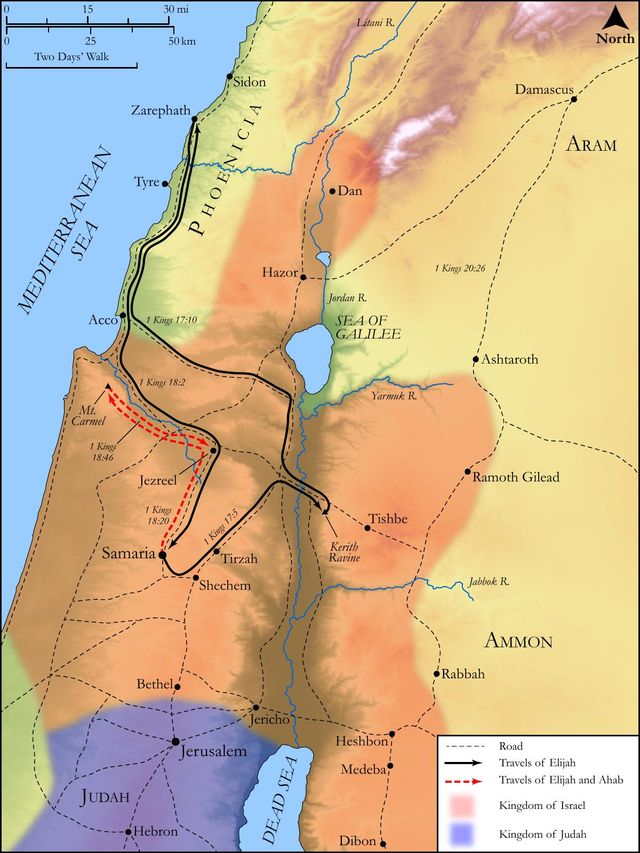
See on the biblical-era maps

Study this verse
Public-domain commentary
Matthew Henry
From his Commentary on the Whole Bible. Henry comments on passages, not single verses — this entry covers 1 Kings 18:41–46. His two-level outline is real structure in the source text, so it is rendered as structure.
Israel being thus far reformed that they had acknowledged the Lord to be God, and had consented to the execution of Baal's prophets, that they might not seduce them any more, though this was far short of a thorough reformation, yet it was so far accepted that God thereupon opened the bottles of heaven, and poured out blessings upon his land, that very evening (as it should seem) on which they did this good work, which should have confirmed them in their reformation; see Hag 2:18, Hag 2:19.
I.Elijah sent Ahab to eat and drink, for joy that God had now accepted his works, and that rain was coming; see Ecc 9:7.
Ahab had continued fasting all day, either religiously, it being a day of prayer, or for want of leisure, it being a day of great expectation; but now let him eat and rink for, though others perceive no sign of it, Elijah, by faith, hears the sound of abundance of rain, Kg1 18:41. God reveals his secrets to his servants the prophets; and yet, without a revelation, we may foresee that when man's judgments run down like a river God's mercy will. Rain is the river of God, Psa 65:9.
II.He himself retired to pray (for though God had promised rain, he must ask it, Zac 10:1), and to give thanks for God's answer by fire, now hoping for an answer by water. What he said we are not told; but,
1.He withdrew to a strange place, to the top of Carmel, which was very high and very private. Hence we read of those that hide themselves in the top of Carmel, Amo 9:3. There he would be alone. Those who are called to appear and act in public for God must yet find time to be private with him and keep up their converse with him in solitude. There he set himself, as it were, upon his watch-tower, like the prophet, Hab 2:1.
2.He put himself into a strange posture. He cast himself down on his knees upon the earth, in token of humility, reverence, and importunity, and put his face between his knees (that is, bowed his head so low that it touched his knees), thus abasing himself in the sense of his own meanness now that God had thus honoured him.
III.He ordered his servant to bring him notice as soon as he discerned a cloud arising out of the sea, the Mediterranean Sea, which he had a large prospect of from the top of Carmel. The sailors at this day call it Cape Carmel. Six times his servant goes to the point of the hill and sees nothing, brings no good news to his master; yet Elijah continues praying, will not be diverted so far as to go and see with his own eyes, but still sends his servant to see if he can discover any hopeful cloud, while he keeps his mind close and intent in prayer, and abides by it, as one that has taken up his father Jacob's resolution, I will not let thee go except thou bless me. Note, Though the answer of our fervent and believing supplications may not come quickly, yet we must continue instant in prayer, and not faint nor desist; for at the end it shall speak and not lie.
IV.A little cloud at length appeared, no bigger than a man's hand, which presently overspread the heavens and watered the earth, Kg1 18:44, Kg1 18:45. Great blessings often arise from small beginnings, and showers of plenty from a cloud of a span long. Let us therefore never despise the day of small things, but hope and wait for great things from it. This was not as a morning cloud, which passes away (though Israel's goodness was so), but one that produced a plentiful rain (Psa 68:9), and an earnest of more.
V.Elijah hereupon hastened Ahab home, and attended him himself.
Ahab rode in his chariot, at ease and in state, Kg1 18:45. Elijah ran on foot before him. If Ahab had paid the respect to Elijah that he deserved he would have taken him into his chariot, as the eunuch did Philip, that he might honour him before the elders of Israel, and confer with him further about the reformation of the kingdom. But his corruptions got the better of his convictions, and he was glad to get clear of him, as Felix of Paul, when he dismissed him, and adjourned his conference with him to a more convenient season. But, since Ahab invites him not to ride with him, he will run before him (Kg1 18:46) as one of his footmen, that he may not seem to be lifted up with the great honour God had put upon him or to abate in his civil respect to his prince, though he reproved him faithfully. God's ministers should make it appear that, how great soever they look when they deliver God's message, yet they are far from affecting worldly grandeur: let them leave that to the kings of the earth.
Continue studying 1 Kings 18:43 across the web’s major study libraries — every link below opens this exact verse, chapter, or book on the destination site.
Read & Compare
 BibleGatewayThis verse in more than 200 translations and 70 languages.
 Bible.comThe YouVersion reader — hundreds of translations, reading plans, and highlights.
 ESV.orgCrossway's official English Standard Version reader.
 NET BibleThe NET translation with 60,000+ translators' notes on every rendering decision.
 STEP BibleTyndale House's free study tool — original text, vocabulary, and scholarly resources.
 BibliaLogos Bible Software's free web reader.
 USCCBThe New American Bible (Revised Edition) with the U.S. bishops' study notes.
Commentaries
 BibleHub CommentariesDozens of classic commentaries on this verse, gathered on one page.
 StudyLightMore than 100 commentary sets — the largest collection on the web.
 BibleRefPlain-English commentary on what this verse means, verse by verse.
 Enduring WordDavid Guzik's free commentary on this chapter, widely used by Bible teachers.
 Bible Study ToolsVerse commentary alongside Greek and Hebrew study aids.
Original Language & Research
- BibleHub InterlinearThe verse word by word — original language, transliteration, and English.
- BibleHub LexiconEvery word's original-language definition and Strong's entry.
 Blue Letter BibleDeep-study tools — Strong's numbers, concordance, and word studies.
 SefariaThe Hebrew text with Rashi and centuries of Jewish commentary.
Sermons, Hymns & Audio


TrulyRandomVerse is not affiliated with these sites and doesn’t control their content. They’re linked because they’re genuinely useful.
Summary
1 Kings 18:43 captures a pivotal moment of unwavering faith and divine anticipation following Elijah's triumphant victory over the prophets of Baal on Mount Carmel. After Yahweh's dramatic display of power, consuming the sacrifice with fire, Elijah, confident in God's impending promise of rain, repeatedly dispatches his servant to scan the horizon for a sign of the downpour. The servant's seven consecutive reports of "nothing" powerfully underscore Elijah's profound trust in God's precise timing and unshakeable faithfulness, setting the stage for the miraculous end of the devastating three-and-a-half-year drought.
Context
ShowHideLiterary Context
This verse is strategically positioned immediately after the climactic confrontation on Mount Carmel, where Elijah, as the sole prophet of Yahweh, decisively defeated the 450 prophets of Baal and 400 prophets of Asherah. God's dramatic consumption of the water-drenched sacrifice by fire (1 Kings 18:38) unequivocally demonstrated His supremacy over Baal, the Canaanite storm god. Following this divine vindication and the subsequent execution of the Baal prophets (1 Kings 18:40), the narrative shifts from spiritual judgment to physical restoration. Elijah's ascent to the top of Mount Carmel and his posture of intense prayer signal his confident expectation of the rain, which God had implicitly promised through the drought's duration and Elijah's prophetic word in 1 Kings 17:1. The repeated sending of the servant highlights the tension between prophetic certainty and the absence of immediate visible evidence, building suspense for the divine intervention.
Historical & Cultural Context
Israel had been enduring a severe three-and-a-half-year drought (James 5:17), a direct divine judgment for the widespread idolatry promoted by King Ahab and Queen Jezebel, particularly their fervent worship of Baal. Baal was revered throughout Canaan as the god of storms, rain, and fertility, making the prolonged drought a direct challenge to his perceived power and a profound theological statement by Yahweh. Mount Carmel, a fertile mountain range overlooking the Mediterranean Sea, was a significant cultic site, often associated with Baal worship. Elijah's actions here directly confronted the dominant cultural and religious norms of the time, asserting Yahweh's absolute sovereignty over nature, including the giving of rain, which was Baal's supposed domain. The expectation of rain from the sea was entirely natural, as Mediterranean weather patterns typically bring rain-bearing clouds from the west.
Key Themes
ShowHideThe passage powerfully illustrates several core theological and narrative themes. Firstly, Persistent Prayer and Unwavering Faith is paramount; Elijah's repeated instruction to his servant despite initial negative reports underscores a profound trust in God's promise, even when visible evidence is lacking. This resonates deeply with the New Testament teaching on perseverance in prayer (Luke 18:1). Secondly, Divine Sovereignty over Creation is clearly demonstrated. The drought was initiated by God, and only He could end it, proving His ultimate control over natural elements, in stark contrast to the impotence of Baal. This highlights Yahweh as the true source of life and provision. Thirdly, the theme of Prophetic Authority and Intercession is central, as Elijah acts as God's chosen instrument to bring both judgment and restoration. His intercession is not a plea for something unknown, but a confident expectation of a promised divine act, highlighting the power of a righteous person's prayer (James 5:16).
Exposition and Analysis
ShowHideKey Word Analysis
ShowHideThis verb (H5927) signifies ascent, not merely a casual glance. Elijah instructs his servant to "go up," implying a climb to a vantage point on Mount Carmel, perhaps to a higher peak or a specific lookout. This physical act of ascending can also symbolize a spiritual ascent, a posture of seeking God's perspective and waiting in expectant prayer, aligning with the prophet's own prayerful posture (1 Kings 18:42). It denotes a deliberate and purposeful action to gain a better view.
The command to "look" (H5027) is precise and repeated. It is not a passive waiting but an active, expectant watchfulness. The servant is not just to be present but to diligently observe the sea, the source from which rain typically comes. This active looking signifies the human responsibility to watch for God's promised intervention, even when it seems delayed. It implies an intense, focused gaze, a scanning for any sign.
This word (H3972) literally means "a speck or point," but with a negative, it signifies "nothing" or "not anything." The servant's repeated report of "nothing" emphasizes the complete absence of visible evidence for the impending rain. It underscores the tension between Elijah's prophetic certainty and the empirical reality, highlighting that God's timing often differs from human expectation and that faith is required in the absence of immediate signs.
Verse Breakdown
ShowHide"And said to his servant, Go up now, look toward the sea."
This initial command from Elijah reveals his proactive faith and specific instruction. Having just witnessed God's power in consuming the sacrifice, Elijah is now confident that the promised rain will come. He directs his servant to a specific location (towards the sea, the natural source of rain in that region) and a specific action (look), demonstrating an active and expectant posture for God's intervention. The urgency of "now" suggests an immediate expectation.
"And he went up, and looked, and said, [There is] nothing."
The servant's immediate obedience is notable, highlighting his subservience and Elijah's authority. His report of "nothing" (Hebrew: mᵉʼûwmâh) highlights the initial lack of visible evidence for Elijah's faith. This creates a tension between prophetic certainty and empirical observation, emphasizing that God's timing often differs from human expectation and that faith is required in the absence of immediate, tangible signs. The repeated negative reports underscore the trial of patience.
"And he said, Go again seven times."
This repeated command is the heart of the verse's message and the narrative's central tension. Elijah's unwavering instruction to persist, despite the initial negative reports, underscores his profound and unshakeable faith in God's word. The "seven times" signifies not only extraordinary persistence but also the complete and perfect nature of God's plan, implying that the answer will come precisely when God intends, after a full measure of waiting and obedience has been demonstrated.
Literary Devices
ShowHideThe passage employs several potent literary devices to heighten its impact. Repetition is central, with the servant's repeated ascent, looking, and reporting "nothing," culminating in Elijah's command to "Go again seven times." This iterative structure builds Anticipation and suspense, drawing the reader into the tension of the waiting period and emphasizing the extraordinary nature of Elijah's faith. The number seven itself functions as powerful Symbolism, representing completeness, perfection, divine fullness, or a cycle of completion in biblical numerology. Here, it reinforces the thoroughness of Elijah's persistence and the certainty of God's impending answer, implying that the answer would arrive in its full measure, not before the appointed time. There is also an element of Dramatic Irony, as the reader, having witnessed God's power on Mount Carmel, knows that rain is imminent, while the servant and perhaps even the people below remain unaware of the coming downpour, making Elijah's persistent faith all the more striking. The contrast between the servant's empirical "nothing" and Elijah's unwavering conviction highlights the nature of faith that trusts beyond sight.
Theological and Thematic Connections
ShowHideThis pivotal moment in Elijah's ministry serves as a profound theological statement about the nature of prayer, faith, and divine faithfulness. It teaches that true faith does not waver in the face of delayed gratification or the absence of immediate visible evidence. God's promises are sure, and His timing is perfect, even if it requires persistent, seemingly fruitless, effort on our part. Elijah's confidence was rooted not in what he saw, but in what God had declared and demonstrated, particularly through the recent fire from heaven. This narrative reinforces the concept that God is sovereign over all creation, including the weather, and that He responds to the fervent, righteous prayers of His servants. It also highlights the importance of obedience, even when the command seems repetitive or illogical from a human perspective, demonstrating that God often tests our endurance before revealing His full blessing.
Reflection and Application
ShowHideFor believers today, 1 Kings 18:43 offers a powerful blueprint for spiritual perseverance and unwavering faith in prayer. It challenges us to cultivate a faith that trusts God's promises even when our circumstances or initial observations suggest "nothing." Just as Elijah knew God would send rain, we are called to stand firm on God's revealed will and promises, continuing to pray and act in expectation, regardless of how many times we might initially report "nothing." This passage reminds us that God's timing is perfect, and our role is to remain faithful and expectant, not to dictate the timing or the visible signs. It encourages us to persist in prayer for personal breakthroughs, for the spiritual health of our communities, and for the fulfillment of God's kingdom purposes, knowing that our faithful persistence honors God and aligns us with His divine process. It teaches us that the "nothing" reports are not denials, but often invitations to deeper trust and more fervent prayer, preparing us to recognize and appreciate God's eventual, perfect answer.
Questions for Reflection
ShowHideFAQ
ShowHideWhy did Elijah send his servant seven times?
ShowHideElijah sent his servant seven times primarily to demonstrate and embody persistent faith in God's promise. The number seven, in biblical numerology, often symbolizes completeness, perfection, or divine fullness. By sending his servant seven times, Elijah was not merely being repetitive but was acting out a complete and resolute expectation of God's answer. It underscored his unwavering confidence that God would indeed send rain, as He had promised, and that the answer would come in its full measure and at God's perfect time, not before the full cycle of waiting and obedience was complete. This persistence also served to build anticipation and highlight the dramatic contrast between the initial lack of evidence and the certainty of God's intervention, making the eventual appearance of the small cloud all the more miraculous.
What is the significance of the servant reporting "nothing" initially?
ShowHideThe servant's repeated reports of "nothing" are crucial for several reasons. Firstly, they highlight the nature of faith, which often requires believing in the absence of visible evidence. Elijah's faith was not based on what he could see, but on God's revealed word and power (Hebrews 11:1). Secondly, these reports emphasize God's perfect timing. The rain did not come immediately, but only after a period of persistent waiting, teaching patience and trust in God's sovereignty over the timing of His blessings. Thirdly, the initial "nothing" makes the eventual appearance of the small cloud (1 Kings 18:44) all the more miraculous and undeniable, clearly attributing the rain to divine intervention rather than natural occurrence. It serves to test and strengthen faith, both Elijah's and that of the reader, demonstrating that God often works in ways that defy immediate human expectation.
How does this story relate to prayer today?
ShowHideThis story is profoundly relevant to prayer today, serving as a powerful encouragement for persistent and faithful intercession. It teaches believers to pray with unwavering conviction, even when circumstances seem unchanged or when answers are not immediately apparent. Just as Elijah continued to send his servant despite reports of "nothing," we are called to persevere in prayer, trusting that God hears and will answer according to His perfect will and timing. The narrative reminds us that sometimes, the answer is just one more persistent prayer away, urging us not to give up hope in the midst of challenging circumstances. It underscores the truth that effective prayer is often characterized by patient endurance and an unwavering belief in God's faithfulness, as seen in Jesus' teaching on persistence in prayer (Luke 18:1) and the promise that those who "ask, seek, and knock" will receive (Matthew 7:7).
Christ-Centered Fulfillment
ShowHideThe narrative of Elijah's persistent prayer for rain, culminating in God's dramatic response, finds profound Christ-centered fulfillment. Elijah, as a prophet and intercessor, powerfully foreshadows Christ, the ultimate Prophet and Intercessor. Just as Elijah stood on Mount Carmel, mediating between God and His people, calling for divine intervention to restore the land, so Jesus stands as the supreme mediator, bringing spiritual rain and blessing to a parched and sinful world. Christ's authority over creation far surpasses Elijah's; He commands the winds and waves with a mere word, as seen when He calms the storm in Mark 4:39, demonstrating His inherent divine power, not merely delegated authority. Furthermore, Elijah's persistent prayer echoes Christ's own fervent prayers, particularly in Gethsemane, where He prayed "not my will, but yours be done" (Matthew 26:39-44), demonstrating ultimate submission and persistence in the face of immense spiritual struggle. The "rain" that Christ brings is not merely physical, but the outpouring of the Holy Spirit, the living water that quenches spiritual thirst and brings new life (John 7:38). Through His death and resurrection, Christ has secured the ultimate spiritual restoration, ending the drought of sin and bringing forth an abundance of grace and truth, fulfilling all of God's promises in Himself (2 Corinthians 1:20).