


1 Kings 18:44
- וַיְהִיvay·Hiand it wasH1961Conj-w ¦ V-Qal-ConsecImperf-3msVerb Qal Consecutive Imperfect 3rd Singular Masculineוַandיְהִיit was
- בַּשְּׁבִעִיתba·she·vi·'Itat the seventh [time]H7637Prep-b ¦ Adj-fsAdjective Numerical Position Singular Feminine Absoluteבַּat theשְּׁבִעִיתseventh [time]
- וַיֹּאמֶרvai·Yo·merand he saidH559Conj-w ¦ V-Qal-ConsecImperf-3msVerb Qal Consecutive Imperfect 3rd Singular Masculineוַandיֹּאמֶרhe said
- הִנֵּהhi·nehthere!H2009PrtParticle Interjection
- עָב'ava cloudH5645N-msNoun Singular Masculine Absolute
- קְטַנָּהke·ta·NahsmallH6996Adj-fsAdjective Singular Feminine Absolute
- כְּכַףke·khaflike [the] hand ofH3709Prep-k ¦ N-fscNoun Singular Feminine Constructכְּlikeכַף[the] hand of
- אִישׁ'isha personH376N-msNoun Singular Masculine Absolute
- עֹלָה'o·Lah[is] coming upH5927V-Qal-Prtcpl-fsVerb Qal Participle Singular Feminine Absolute
- מִיָּםmi·Yamfrom [the] seaH3220Prep-m ¦ N-msNoun Singular Masculine Absoluteמִfromיָּם[the] sea
- וַיֹּאמֶרvai·Yo·merand he saidH559Conj-w ¦ V-Qal-ConsecImperf-3msVerb Qal Consecutive Imperfect 3rd Singular Masculineוַandיֹּאמֶרhe said
- עֲלֵה'a·Lehgo upH5927V-Qal-Imp-2msVerb Qal Imperative 2nd Singular Masculine
- אֱמֹר'e·MorsayH559V-Qal-Imp-2msVerb Qal Imperative 2nd Singular Masculine
- אֶל'eltoH413PrepPreposition
- אַחְאָב'ach·'AvAhabH256N-proper-mNoun Proper Masculine
- אֱסֹר'e·SorharnessH631V-Qal-Imp-2msVerb Qal Imperative 2nd Singular Masculine
- וָרֵדva·Redand go downH3381Conj-w ¦ V-Qal-Imp-2msVerb Qal Imperative 2nd Singular Masculineוָandרֵדgo down
- וְלֹאve·Lo'and notH3808Conj-w ¦ NegParticle Negativeוְandלֹאnot
- יַעַצָרְכָהya·'a·tza·re·Khahit will hold back youH6113V-Qal-Imperf-3ms ¦ 2msVerb Qal Imperfect 3rd Singular Masculineיַעַצָרְit will hold backכָהyou
- הַגָּשֶׁםha·Ga·shemthe rainH1653Art ¦ N-msNoun Singular Masculine Absoluteהַtheגָּשֶׁםrain
English is a literal word-by-word gloss of the Hebrew, not the KJV's wording. Why?
This is the original text the KJV's translators worked from — each Hebrew word with its own literal English meaning in this verse, prepared by scholars at Tyndale House, Cambridge. The KJV translates whole sentences, not word by word, so its wording differs: one Hebrew word can become several English words, and the KJV may choose “the LORD” where the gloss reads “Yahweh”. Both are faithful — they answer different questions. For the KJV's own rendering, switch to the KJV text.
Details
See on the biblical-era map
Study this verse
Public-domain commentary
Matthew Henry
From his Commentary on the Whole Bible. Henry comments on passages, not single verses — this entry covers 1 Kings 18:41–46. His two-level outline is real structure in the source text, so it is rendered as structure.
Israel being thus far reformed that they had acknowledged the Lord to be God, and had consented to the execution of Baal's prophets, that they might not seduce them any more, though this was far short of a thorough reformation, yet it was so far accepted that God thereupon opened the bottles of heaven, and poured out blessings upon his land, that very evening (as it should seem) on which they did this good work, which should have confirmed them in their reformation; see Hag 2:18, Hag 2:19.
I.Elijah sent Ahab to eat and drink, for joy that God had now accepted his works, and that rain was coming; see Ecc 9:7.
Ahab had continued fasting all day, either religiously, it being a day of prayer, or for want of leisure, it being a day of great expectation; but now let him eat and rink for, though others perceive no sign of it, Elijah, by faith, hears the sound of abundance of rain, Kg1 18:41. God reveals his secrets to his servants the prophets; and yet, without a revelation, we may foresee that when man's judgments run down like a river God's mercy will. Rain is the river of God, Psa 65:9.
II.He himself retired to pray (for though God had promised rain, he must ask it, Zac 10:1), and to give thanks for God's answer by fire, now hoping for an answer by water. What he said we are not told; but,
1.He withdrew to a strange place, to the top of Carmel, which was very high and very private. Hence we read of those that hide themselves in the top of Carmel, Amo 9:3. There he would be alone. Those who are called to appear and act in public for God must yet find time to be private with him and keep up their converse with him in solitude. There he set himself, as it were, upon his watch-tower, like the prophet, Hab 2:1.
2.He put himself into a strange posture. He cast himself down on his knees upon the earth, in token of humility, reverence, and importunity, and put his face between his knees (that is, bowed his head so low that it touched his knees), thus abasing himself in the sense of his own meanness now that God had thus honoured him.
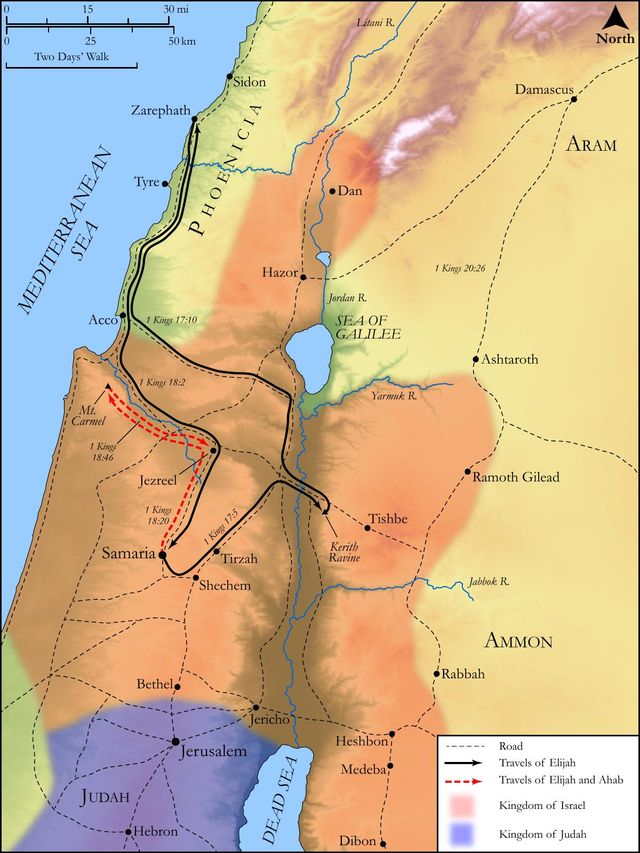
III.He ordered his servant to bring him notice as soon as he discerned a cloud arising out of the sea, the Mediterranean Sea, which he had a large prospect of from the top of Carmel. The sailors at this day call it Cape Carmel. Six times his servant goes to the point of the hill and sees nothing, brings no good news to his master; yet Elijah continues praying, will not be diverted so far as to go and see with his own eyes, but still sends his servant to see if he can discover any hopeful cloud, while he keeps his mind close and intent in prayer, and abides by it, as one that has taken up his father Jacob's resolution, I will not let thee go except thou bless me. Note, Though the answer of our fervent and believing supplications may not come quickly, yet we must continue instant in prayer, and not faint nor desist; for at the end it shall speak and not lie.
IV.A little cloud at length appeared, no bigger than a man's hand, which presently overspread the heavens and watered the earth, Kg1 18:44, Kg1 18:45. Great blessings often arise from small beginnings, and showers of plenty from a cloud of a span long. Let us therefore never despise the day of small things, but hope and wait for great things from it. This was not as a morning cloud, which passes away (though Israel's goodness was so), but one that produced a plentiful rain (Psa 68:9), and an earnest of more.
V.Elijah hereupon hastened Ahab home, and attended him himself.
Ahab rode in his chariot, at ease and in state, Kg1 18:45. Elijah ran on foot before him. If Ahab had paid the respect to Elijah that he deserved he would have taken him into his chariot, as the eunuch did Philip, that he might honour him before the elders of Israel, and confer with him further about the reformation of the kingdom. But his corruptions got the better of his convictions, and he was glad to get clear of him, as Felix of Paul, when he dismissed him, and adjourned his conference with him to a more convenient season. But, since Ahab invites him not to ride with him, he will run before him (Kg1 18:46) as one of his footmen, that he may not seem to be lifted up with the great honour God had put upon him or to abate in his civil respect to his prince, though he reproved him faithfully. God's ministers should make it appear that, how great soever they look when they deliver God's message, yet they are far from affecting worldly grandeur: let them leave that to the kings of the earth.
Historical interpretation
Two Centuries of Reception
3 surviving comments on this verse. Each one is dated, so this reads as a timeline rather than a list.
Select a marker to jump to its quote. Markers stagger vertically where authors wrote within a few decades of each other.
“Look, a little cloud no bigger than a person’s hand is rising out of the sea.” Before going up, Elijah prayed seven times. He did this, in the first place, in order to invite the people who were waiting for the rain, to meditate on the greatness of the grace that they received from their Lord; second, in order to teach them that even if their prayers were not fulfilled [immediately], they should not cease from multiplying their prayers until they were fulfilled at the time appointed by God. And at the seventh time a cloud bringing rain appeared, so that they might know that God had released [them] from the bondage of the famine into the abundance of his mercy in the fourth year, even though he had originally fixed the term to the seventh.
After this blessed Elijah presented himself to the king, “went up to Mount Carmel and put his head between his knees,” praying the Lord to send rain on the earth. “And he said to his servant, ‘Look toward the sea.’ ” When the boy reported that he saw nothing at all, he told him, “Go and look seven times.” The seventh time he returned and said, “ ‘I see a little cloud rising out of the sea like a person’s foot.’ And suddenly the heavens grew dark, and there fell a great rain.” For this reason, as we said, Elijah prefigured our Lord and Savior. Elijah prayed and offered sacrifice; Christ offered himself as a spotless sacrifice for the whole world. Elijah prayed for rain to come on the earth; Christ prayed that divine grace might come down into the hearts of humankind. When Elijah told his servant, “Go and look seven times,” he signified the sevenfold grace of the Holy Spirit that was to be given to the church. When he declared that he saw a little cloud rising out of the sea, it prefigured the body of Christ, which was to be born in the sea of this world. Therefore, lest anyone doubt, he said that the cloud had the foot of a person who said, “Who do people say the Son of man is?” After three years and six months, rain came down from heaven at the prayer of Elijah, because at the coming of our Lord and Savior the rain of the word of God happily watered the whole world during the three years and six months in which he deigned to preach. Just as at the coming of Elijah all the priests of the idols were killed and destroyed, so at the advent of the true Elijah, our Lord Jesus Christ, the wicked observances of the pagans were destroyed.
After this blessed Elijah presented himself to the king, “went up to Mount Carmel and put his head between his knees,” praying the Lord to send rain on the earth. “And he said to his servant, ‘Look toward the sea.’ ” When the boy reported that he saw nothing at all, he told him, “Go and look seven times.” The seventh time he returned and said, “ ‘I see a little cloud rising out of the sea like a person’s foot.’ And suddenly the heavens grew dark, and there fell a great rain.” For this reason, as we said, Elijah prefigured our Lord and Savior. Elijah prayed and offered sacrifice; Christ offered himself as a spotless sacrifice for the whole world. Elijah prayed for rain to come on the earth; Christ prayed that divine grace might come down into the hearts of humankind. When Elijah told his servant, “Go and look seven times,” he signified the sevenfold grace of the Holy Spirit that was to be given to the church. When he declared that he saw a little cloud rising out of the sea, it prefigured the body of Christ, which was to be born in the sea of this world. Therefore, lest anyone doubt, he said that the cloud had the foot of a person who said, “Who do people say the Son of man is?” After three years and six months, rain came down from heaven at the prayer of Elijah, because at the coming of our Lord and Savior the rain of the word of God happily watered the whole world during the three years and six months in which he deigned to preach. Just as at the coming of Elijah all the priests of the idols were killed and destroyed, so at the advent of the true Elijah, our Lord Jesus Christ, the wicked observances of the pagans were destroyed. - "Sermon 124.5"
Continue studying 1 Kings 18:44 across the web’s major study libraries — every link below opens this exact verse, chapter, or book on the destination site.
Read & Compare
 BibleGatewayThis verse in more than 200 translations and 70 languages.
 Bible.comThe YouVersion reader — hundreds of translations, reading plans, and highlights.
 ESV.orgCrossway's official English Standard Version reader.
 NET BibleThe NET translation with 60,000+ translators' notes on every rendering decision.
 STEP BibleTyndale House's free study tool — original text, vocabulary, and scholarly resources.
 BibliaLogos Bible Software's free web reader.
 USCCBThe New American Bible (Revised Edition) with the U.S. bishops' study notes.
Commentaries
 BibleHub CommentariesDozens of classic commentaries on this verse, gathered on one page.
 StudyLightMore than 100 commentary sets — the largest collection on the web.
 BibleRefPlain-English commentary on what this verse means, verse by verse.
 Enduring WordDavid Guzik's free commentary on this chapter, widely used by Bible teachers.
 Bible Study ToolsVerse commentary alongside Greek and Hebrew study aids.
Original Language & Research
- BibleHub InterlinearThe verse word by word — original language, transliteration, and English.
- BibleHub LexiconEvery word's original-language definition and Strong's entry.
 Blue Letter BibleDeep-study tools — Strong's numbers, concordance, and word studies.
 SefariaThe Hebrew text with Rashi and centuries of Jewish commentary.
Sermons, Hymns & Audio


TrulyRandomVerse is not affiliated with these sites and doesn’t control their content. They’re linked because they’re genuinely useful.
Summary
1 Kings 18:44 marks the dramatic turning point in Elijah's persistent prayer for rain, following the triumphant vindication of Yahweh over Baal on Mount Carmel. After six prior attempts yielding no sign, Elijah's servant reports the emergence of a minuscule cloud from the Mediterranean Sea, described as no larger than a man's hand. This seemingly insignificant observation is immediately recognized by Elijah as the definitive precursor to a torrential downpour, prompting his urgent instruction to King Ahab to prepare for the impending deluge, thereby signaling the divinely orchestrated end of a devastating three-and-a-half-year drought and the undeniable demonstration of God's sovereign power.
Context
ShowHideLiterary Context
This verse serves as the climactic resolution to the powerful narrative in 1 Kings 18, which vividly portrays the spiritual battle for Israel's allegiance. Immediately preceding this verse is the unparalleled confrontation on Mount Carmel where Elijah, standing alone, challenged the 450 prophets of Baal and 400 prophets of Asherah. Yahweh's dramatic response, consuming Elijah's water-drenched sacrifice with fire (1 Kings 18:38), unequivocally established His supremacy over the false gods. Following this divine demonstration, Elijah commanded the execution of Baal's prophets (1 Kings 18:40), effectively cleansing the land of their corrupting influence. With the spiritual victory secured, Elijah then turned his attention to ending the physical drought, which had been a divine judgment upon Israel for its idolatry, as declared in 1 Kings 17:1. Verses 1 Kings 18:41-43 detail Elijah's confident assurance to Ahab that rain was imminent, followed by his humble posture of prayer and his persistent instruction to his servant to watch for a sign. Verse 44 is the long-awaited answer, directly leading into the account of the torrential rain in 1 Kings 18:45.
Historical & Cultural Context
The setting for this pivotal event is Mount Carmel, a prominent ridge that offers a commanding view of the Mediterranean Sea. For ancient Israel, an agrarian society, the seasonal rains were absolutely vital for agricultural productivity and, consequently, for the very survival and prosperity of the nation. A prolonged drought, such as the three-and-a-half-year period mentioned in James 5:17, would have been catastrophic, leading to widespread famine, disease, and societal collapse. During the reign of King Ahab, the worship of Baal, the Canaanite storm and fertility god, was rampant, largely propagated by his Phoenician wife, Jezebel. Baal worship promised abundant rain and fertility, making the severe drought a direct and profound challenge to Baal's perceived power. Thus, Yahweh's intervention, bringing the rain after Baal's impotence was exposed, served as an undeniable demonstration of His absolute sovereignty over nature. The "sea" referenced is the Mediterranean, from which weather systems typically approach the land of Israel. Elijah's immediate command to Ahab to "prepare thy chariot, and get thee down" highlights the practical danger of flash floods on unpaved roads after a prolonged dry spell, making swift departure essential to avoid being stranded or swept away by the sudden deluge.
Key Themes
ShowHideThis verse powerfully encapsulates several profound theological and narrative themes. Firstly, Perseverance in Prayer is strikingly evident, as Elijah's repeated sending of his servant (seven times) underscores the critical importance of persistent intercession, even in the absence of immediate visible signs. This principle resonates deeply with teachings on prayer found elsewhere in Scripture, such as Luke 18:1. Secondly, the theme of God Working Through Small Beginnings is vividly portrayed; the "little cloud like a man's hand" serves as a powerful metaphor demonstrating that God often initiates His grandest works with humble, almost imperceptible signs, thereby challenging human expectations that demand immediate, overwhelming displays. This calls believers to cultivate a discerning faith that can perceive God's hand in the nascent stages of His activity. Thirdly, it profoundly showcases God's Faithfulness and Sovereignty over Creation. Despite Israel's pervasive idolatry and the devastating severity of the drought, God remains faithful to His covenant promises and responds to the fervent intercession of His prophet, thereby demonstrating His absolute and unchallenged control over the elements, a stark contrast to the utter impotence of Baal. Finally, the urgency embedded in Elijah's command to Ahab underscores the theme of Readiness and Timely Response to God's imminent and powerful action.
Exposition and Analysis
ShowHideKey Word Analysis
ShowHideThis ordinal number, derived from the root for "seven," carries profound biblical significance, often symbolizing completeness, perfection, or divine fullness. The appearance of the sign "at the seventh time" is not merely a chronological detail but a theological statement. It signifies that God's timing is precise and sovereign, indicating the culmination of Elijah's persistent prayer and the divinely appointed moment for God to act. It underscores the divine orchestration of events, bringing the drought to a divinely ordained and perfect end.
This term refers to an "envelope" or "density," specifically a (scud) cloud. The use of this common word for cloud, combined with its description as "little" and "like a man's hand," emphasizes the seemingly insignificant nature of the initial sign. This highlights God's characteristic method of working from humble, almost imperceptible beginnings to bring about immense and undeniable results. It challenges human reliance on grand, immediate manifestations and speaks to the nature of faith, which perceives the potential in the imperceptible.
This word denotes the hollow hand or palm, and by extension, power. In the simile "like a man's hand," it vividly conveys the minuscule size of the cloud. This specific detail is crucial as it contrasts sharply with the impending torrential rain, underscoring the theme of God's ability to bring about monumental outcomes from the smallest of origins. It also subtly alludes to human perception – the cloud is only as large as what a person can perceive, yet it holds the promise of God's vast power.
Verse Breakdown
ShowHide"And it came to pass at the seventh time, that he said,"
This opening clause marks the culmination of Elijah's unwavering persistence in prayer and his servant's diligent, repeated observation. The emphasis on "the seventh time" is not arbitrary; it signifies divine completeness and the perfect timing of God's response to Elijah's faith and intercession. It powerfully underscores the principle of tenacious prayer, where the answer arrives precisely at God's appointed and perfect moment, rewarding enduring faith.
"Behold, there ariseth a little cloud out of the sea, like a man's hand."
This is the pivotal moment of revelation and the long-awaited sign. The servant, after six previous disappointments and diligent scanning, finally sees the first, albeit tiny, indication of God's impending action. The vivid description "like a man's hand" powerfully conveys the cloud's minuscule size, highlighting its apparent insignificance from a human perspective. Yet, for Elijah, this tiny, almost imperceptible cloud is a definitive and certain sign of the impending deluge, demonstrating his profound spiritual discernment and unwavering faith in God's promise. It beautifully illustrates that God often initiates His greatest works with humble, unassuming indicators, requiring faith to perceive their true significance.
"And he said, Go up, say unto Ahab, Prepare [thy chariot], and get thee down, that the rain stop thee not."
Elijah's immediate, urgent, and authoritative command to his servant reveals his absolute certainty that the small cloud portends a massive, imminent storm. He instructs King Ahab to descend swiftly from Mount Carmel, emphasizing the practical danger of being caught by the sudden, heavy rain on the unpaved, potentially treacherous roads, which would quickly become impassable. This command underscores Elijah's prophetic authority and his practical concern for the king's safety, while simultaneously highlighting the immediacy, power, and overwhelming nature of God's impending action.
Literary Devices
ShowHideThe verse employs several potent literary devices to convey its profound message. The most prominent is Simile, vividly used in "like a man's hand," which describes the cloud's minuscule size. This simile creates a striking contrast between the seemingly insignificant sign and the immense, life-altering deluge it portends, powerfully underscoring the theme of God working from humble beginnings to achieve magnificent results. Repetition is implicitly present through the preceding verses, where the servant is sent out six times before this seventh, successful attempt. This narrative pattern emphasizes Elijah's Perseverance and amplifies the symbolic significance of the number seven, which signifies divine completion and the perfect timing of God's response. The rapid shift from the observation of a tiny cloud to Elijah's urgent command for Ahab to "get thee down, that the rain stop thee not" generates a strong sense of Urgency and Foreshadowing, building dramatic tension and highlighting the swiftness and overwhelming nature of God's impending action.
Theological and Thematic Connections
ShowHide1 Kings 18:44 stands as a powerful testament to the efficacy of persistent, faith-filled prayer and God's unwavering faithfulness to His word, even when the initial signs of His movement are almost imperceptible. It profoundly demonstrates that God is not limited by the magnitude of our problems or the seemingly smallness of His initial responses. The "little cloud" serves as a profound theological statement: God often works in ways that defy human expectation, beginning with humble, almost hidden manifestations that ultimately explode into undeniable displays of His power and glory. This narrative reinforces the truth that true faith discerns God's hand even in the smallest of signs, trusting implicitly that His promises will be fully realized. It also powerfully highlights God's absolute sovereignty over creation, directly refuting the impotent claims of Baal and unequivocally re-establishing Yahweh as the sole provider of life-sustaining rain, thereby restoring order and truth to a land steeped in idolatry.
Reflection and Application
ShowHideThe emergence of the tiny cloud in 1 Kings 18:44 offers profound and enduring encouragement for our spiritual journeys. It teaches us that authentic faith is not merely a belief in the impossible, but more critically, the spiritual discernment to perceive potential in the improbable. In our own lives, we frequently pray for monumental breakthroughs or dramatic interventions, yet God, in His sovereign wisdom, may choose to answer with "little clouds"—small, seemingly insignificant signs of His movement. These nascent indicators might manifest as a subtle shift in circumstances, a quiet but persistent prompting in our spirits, a small yet unexpected provision, or a glimmer of hope in a seemingly hopeless situation. The profound challenge presented by this verse is to cultivate the spiritual sensitivity and unwavering conviction of Elijah, enabling us to recognize these nascent signs and respond with the same urgency and decisive action. This narrative calls us to embrace persistent prayer, reminding us that even after many "no-shows" or periods of waiting, the seventh time (or the time God ordains) will bring the breakthrough. Furthermore, it urges us to be prepared for God's blessings, to act decisively when His indicators appear, ensuring we are not "stopped" or hindered by the very blessings we sought, but rather positioned to fully receive and steward them.
Questions for Reflection
ShowHideFAQ
ShowHideWhy did Elijah send his servant seven times, and what is the significance of "the seventh time"?
ShowHideElijah sent his servant seven times to look for rain, not because he lacked faith, but as a profound act of persistent prayer and watchful expectation. This repeated action demonstrated his unwavering trust in God's promise, despite the initial and prolonged absence of any visible evidence. The number "seven" in biblical numerology is highly significant, often symbolizing completeness, perfection, or divine fulfillment. Therefore, "the seventh time" signifies that the answer came at God's divinely appointed and perfect moment, marking the culmination of Elijah's intercession and the full readiness of God to act. It powerfully underscores the principle that while God always hears prayer, His timing is sovereign and often requires patient, tenacious waiting and persistent intercession from His people, as further illustrated in the parable of the persistent widow in Luke 18:7-8.
Christ-Centered Fulfillment
ShowHideThe narrative of Elijah and the rain, culminating in the "little cloud," finds profound Christ-centered fulfillment, pointing to the ultimate provision of God's grace through His Son. Just as the small cloud heralded a life-giving deluge that ended a physical drought, so too did the seemingly humble and outwardly insignificant birth of Jesus in Bethlehem (Micah 5:2) usher in the greatest outpouring of God's grace and salvation, ending humanity's spiritual barrenness caused by sin. Jesus is the ultimate "spring of water welling up to eternal life" (John 4:14) and the one who promises "rivers of living water" to flow from within believers (John 7:38), providing spiritual sustenance where there was drought. Furthermore, Elijah's persistent prayer for rain foreshadows Christ's own ceaseless intercessory ministry, where He continually prays for His people at the right hand of the Father (Romans 8:34). The urgency with which Elijah commanded Ahab to prepare for the impending rain also serves as a powerful type for the urgency of preparing for Christ's glorious return, for He will come unexpectedly, and His followers must be ready (Matthew 24:44). Ultimately, the "little cloud" of God's initial promise through Christ's first coming, often overlooked by the world, will culminate in the glorious, overwhelming manifestation of His kingdom at His second coming, when all things are made new and perfected (Revelation 21:5).