


1 Samuel 6:7
- וְעַתָּהve·'a·Tahand thereforeH6258Conj-w ¦ AdvAdverbוְandעַתָּהtherefore
- קְחוּke·ChutakeH3947V-Qal-Imp-2mpVerb Qal Imperative 2nd Plural Masculine
- וַעֲשׂוּva·'a·Suand makeH6213Conj-w ¦ V-Qal-Imp-2mpVerb Qal Imperative 2nd Plural Masculineוַandעֲשׂוּmake
- עֲגָלָה'a·ga·Laha cartH5699N-fsNoun Singular Feminine Absolute
- חֲדָשָׁהcha·da·ShahnewH2319Adj-fsAdjective Singular Feminine Absolute
- אֶחָת'e·ChatoneH259N-fsNoun Singular Feminine Absolute
- וּשְׁתֵּיu·she·Teiand twoH8147Conj-w ¦ N-fdcNoun Dual Feminine Constructוּandשְׁתֵּיtwo
- פָרוֹתfa·rOtcowsH6510N-fpNoun Plural Feminine Absolute
- עָלוֹתa·LotnursingH5763V-Qal-Prtcpl-fpVerb Qal Participle Plural Feminine Absolute
- אֲשֶׁר'a·SherwhichH834RelParticle Relative
- לֹאlo'notH3808NegParticle Negative
- עָלָה'a·Lahit has gone upH5927V-Qal-Perf-3msVerb Qal Perfect 3rd Singular Masculine
- עֲלֵיהֶם'a·lei·Hemon themH5921Prep ¦ 3mpPreposition Definiteעֲלֵיonהֶםthem
- עֹל'Ola yokeH5923N-msNoun Singular Masculine Absolute
- וַאֲסַרְתֶּםva·'a·sar·Temand you will harnessH631Conj-w ¦ V-Qal-ConsecPerf-2mpVerb Qal Consecutive Perfect 2nd Plural Masculineוַandאֲסַרְתֶּםyou will harness
- אֶת'et<obj.>H853DirObjMParticle Object Indicator
- הַפָּרוֹתha·pa·rOtthe cowsH6510Art ¦ N-fpNoun Plural Feminine Absoluteהַtheפָּרוֹתcows
- בָּעֲגָלָהba·'a·ga·Lahon the cartH5699Prep-b ¦ N-fsNoun Singular Feminine Absoluteבָּon theעֲגָלָהcart
- וַהֲשֵׁיבֹתֶםva·ha·shei·vo·Temand you will take backH7725Conj-w ¦ V-Hiphil-ConsecPerf-2mpVerb Hiphil Consecutive Perfect 2nd Plural Masculineוַandהֲשֵׁיבֹתֶםyou will take back
- בְּנֵיהֶםbe·nei·Hemtheir young onesH1121N-mpc ¦ 3mpNoun Plural Masculine Constructבְּנֵיyoung onesהֶםtheir
- מֵאַחֲרֵיהֶםme·'a·cha·rei·Hemfrom after themH310Prep-m ¦ Adj-mpc ¦ 3mpAdjective Numerical Plural Masculine Constructמֵfromאַחֲרֵיafterהֶםthem
- הַבָּיְתָהha·Ba·ye·tahthe house towardsH1004Art ¦ N-ms ¦ SfxNoun Singular Masculine Absoluteהַtheבָּיְתָhouseהtowards
English is a literal word-by-word gloss of the Hebrew, not the KJV's wording. Why?
This is the original text the KJV's translators worked from — each Hebrew word with its own literal English meaning in this verse, prepared by scholars at Tyndale House, Cambridge. The KJV translates whole sentences, not word by word, so its wording differs: one Hebrew word can become several English words, and the KJV may choose “the LORD” where the gloss reads “Yahweh”. Both are faithful — they answer different questions. For the KJV's own rendering, switch to the KJV text.
Details
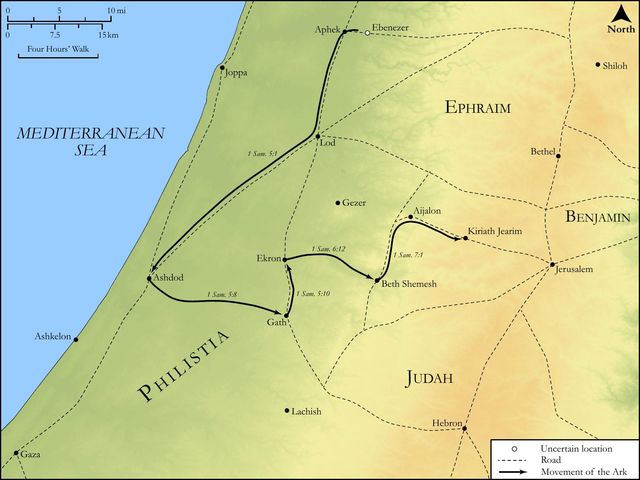
See on the biblical-era map
Study this verse
Public-domain commentary
Matthew Henry
From his Commentary on the Whole Bible. Henry comments on passages, not single verses — this entry covers 1 Samuel 6:1–9. His two-level outline is real structure in the source text, so it is rendered as structure.
The first words of the chapter tell us how long the captivity of the ark continued - it was in the country of the Philistines seven months. In the field of the Philistines (so it is in the original), from which some gather that, having tried it in all their cities, and found it a plague to the inhabitants of each, at length they sent it into the open fields, upon which mice sprang up out of the ground in great multitudes, and destroyed the corn which was now nearly ripe and marred the land. With that judgment they were plagued (Sa1 6:5), and yet it is not mentioned in the foregoing chapter; so God let them know that wherever they carried the ark, so long as they carried it captive, they should find it a curse to them. Cursed shalt thou be in the city, and cursed in the field, Deu 28:16. But, most take it to signify, as we render it, The country of the Philistines. Now, 1. Seven months Israel was punished with the absence of the ark, that special token of God's presence. How bare did the tabernacle look without it! How was the holy city now a desolation, and the holy land a wilderness! A melancholy time no doubt it was to the good people among them, particularly to Samuel; but they had this to comfort themselves with, as we have in the like distress when we are deprived of the comfort of public ordinances, that, wherever the ark is, the Lord is in his holy temple, the Lord's throne is in heaven, and by faith and prayer we may have access with boldness to him there. We may have God nigh unto us when the ark is at a distance. 2. Seven months the Philistines were punished with the presence of the ark; so long it was a plague to them, because they would not send it home sooner. Note, Sinners lengthen out their own miseries by obstinately refusing to part with their sins. Egypt's plagues would have been fewer than ten if Pharaoh's heart had not been hardened not to let the people go. But at length it is determined that the ark must be sent back; there is no remedy, they are undone if they detain it.
I.The priests and the diviners are consulted about it, Sa1 6:2.
They were supposed to be best acquainted both with the rules of wisdom and with the rites of worship and atonement. And the Israelites being their neighbours, and famed above all people for the institutions of their religion, they had no doubt the curiosity to acquaint themselves with their laws and usages; and therefore it was proper to ask them, What shall we do to the ark of Jehovah? All nations have had a regard to their priests, as the men whose lips keep knowledge. Had the Philistines diviners? We have divines, of whom we should enquire wherewith we shall come before the Lord and bow ourselves before the most high God.
II.They give their advice very fully, and seem to be very unanimous in it.
It was a wonder they did not, as friends to their country, give it, ex officio - officially, before they were asked.
1.They urge it upon them that it was absolutely necessary to send the ark back, from the example of Pharaoh and the Egyptians, Sa1 6:6. Some, it may be, were loth to yield, and were willing to try it out with the ark awhile longer, and to them they apply themselves: Wherefore do you harden your hearts, as the Egyptians and Pharaoh did? It seems they were well acquainted with the Mosaic history, and could cite precedents out of it. This good use we should make of the remaining records of God's judgments upon obstinate sinners, we should by them be warned not to harden our hearts as they did. It is much cheaper to learn by other people's experience than by our own. The Egyptians were forced at last to let Israel go; therefore let the Philistines yield in time to let the ark go.
2.They advise that, when they sent it back, they should send a trespass-offering with it, Sa1 6:3. Whatever the gods of other nations were, they knew the God of Israel was a jealous God, and how strict he was in his demands of sin-offerings and trespass-offerings from his own people; and therefore, since they found how highly he resented the affront of holding his ark captive, those with whom he had such a quarrel must in any wise return him a trespass-offering, and they could not expect to be healed upon any other terms. Injured justice demands satisfaction. So far natural light instructed men. But when they began to contrive what that satisfaction should be, they became wretchedly vain in their imaginations. But those who by wilful sin have imprisoned the truth in unrighteousness, as the Philistines did the ark (Rom 1:18), may conclude that there is no making their peace with him whom they have thus injured but by a sin-offering; and we know but one that can take away sin.
3.They direct that this trespass-offering should be an acknowledgement of the punishment of their iniquity, by which they might take shame to themselves as conquered and yielding, and guilty before God, and might give glory to the God of Israel as their mighty conqueror and most just avenger, Sa1 6:5. They must make images of the emerods, that is, of the swellings and sores with which they had been afflicted, so making the reproach of that shameful disease perpetual by their own act and deed (Psa 78:66), also images of the mice that had marred the land, owning thereby the almighty power of the God of Israel, who could chastise and humble them, even in the day of their triumph, by such small and despicable animals. These images must be made of gold, the most precious metal, to intimate that they would gladly purchase their peace with the God of Israel at any rate, and would not think it bought too dearly with gold, with much fine gold. The golden emerods must be, in number, five, according to the number of the lords, who, it is likely, were all afflicted with them, and were content thus to own it; it was advised that the golden mice should be five too, but, because the whole country was infested with them, it should seem, upon second thoughts, they sent more of them, according to the number both of the fenced cities and of the country villages, Sa1 6:18. Their priests reminded them that one plague was on them all; they could not blame one another, for they were all guilty, which they were plainly told by being all plagued. Their proposal to offer a trespass-offering for their offence was conformable enough to divine revelation at that time; but to send such things as these for trespass-offerings was very foreign, and showed them grossly ignorant of the methods of reconciliation appointed by the law of Moses; for there it appears all along that it is blood, and not gold, that makes atonement for the soul.
4.They encourage them to hope that hereby they would take an effectual course to get rid of the plague: You shall be healed, Sa1 6:3. For, it seems, the disease obstinately resisted all the methods of cure their physicians had prescribed. "Let them therefore send back the ark, and then," say they, "It shall be known to you why his hand is not removed from you, that is, by this it will appear whether it is for your detaining the ark that you are thus plagued; for, if it be, upon your delivering it up the plague will cease." God has sometimes put his people upon making such a trial, whether their reformation would not be their relief. Prove me now herewith, saith the Lord of hosts, Mal 3:10; Hag 2:18, Hag 2:19. Yet they speak doubtfully (Sa1 6:5): Peradventure he will lighten his hand from off you; as if now they began to think that the judgment might come from God's hand, and yet not be removed immediately upon the restitution of the ark; however that was the likeliest way to obtain mercy. Take away the cause and the effect will cease.
5.Yet they put them in a way to make a further trial whether it was the hand of the God of Israel that had smitten them with these plagues or no. They must, in honour of the ark, put it on a new cart or carriage, to be drawn by two milch-cows, that had calves daily sucking them (Sa1 6:7), unused to draw, and inclined to home, both for the sake of the crib where they were fed and of the calves they nourished, and, besides, altogether unacquainted with the road that led towards the land of Israel. They must have no one to lead or drive them, but must take their own way, which, in all reason, one might expect, would be home again; and yet, unless the God of Israel, after all the other miracles he has wrought, will work one more, and by an invisible power lead these cows, contrary to their natural instinct and inclination, to the land of Israel, and particularly to Beth-shemesh, they will retract their former opinion, and will believe it was not the hand of God that smote them, but it was a chance that happened to them, Sa1 6:8, Sa1 6:9. Thus did God suffer himself to be tempted and prescribed to, after he had been otherwise affronted, by these uncircumcised Philistines. Would they have been content that the honour of Dagon, their god, should be put upon such an issue as this? See how willing bad men are to shift off their convictions of the hand of God upon them, and to believe, when they are in trouble, that it is a chance that happens to them; and, if so, the rod has no voice which they are concerned to hear or heed.
Historical interpretation
Historical reception
1 surviving comment on this verse from the historical church.
Now, therefore, seize and make a new cart, etc. Now, they say, hasten, and either in your hearts or in the hearts of your brethren, putting off the old man with his deeds, put on the new one, which is created according to God in righteousness and holiness and truth (Ephes. IV); and this in the unity of Catholic peace, in which it is so beneficial to salvation to perform whatever good one can, and as noble teachers in the twin, that is, the love of God and neighbor, free from the yoke of sin, rejoicing in the offspring of spiritual faithful children, whether for the burden of preaching the faith or bearing the necessity of the brethren, submit. But hold back any little ones and infants still in Christ within the small scope of your counsel until they grow into a perfect man.
Continue studying 1 Samuel 6:7 across the web’s major study libraries — every link below opens this exact verse, chapter, or book on the destination site.
Read & Compare
 BibleGatewayThis verse in more than 200 translations and 70 languages.
 Bible.comThe YouVersion reader — hundreds of translations, reading plans, and highlights.
 ESV.orgCrossway's official English Standard Version reader.
 NET BibleThe NET translation with 60,000+ translators' notes on every rendering decision.
 STEP BibleTyndale House's free study tool — original text, vocabulary, and scholarly resources.
 BibliaLogos Bible Software's free web reader.
 USCCBThe New American Bible (Revised Edition) with the U.S. bishops' study notes.
Commentaries
 BibleHub CommentariesDozens of classic commentaries on this verse, gathered on one page.
 StudyLightMore than 100 commentary sets — the largest collection on the web.
 BibleRefPlain-English commentary on what this verse means, verse by verse.
 Enduring WordDavid Guzik's free commentary on this chapter, widely used by Bible teachers.
 Bible Study ToolsVerse commentary alongside Greek and Hebrew study aids.
Original Language & Research
- BibleHub InterlinearThe verse word by word — original language, transliteration, and English.
- BibleHub LexiconEvery word's original-language definition and Strong's entry.
 Blue Letter BibleDeep-study tools — Strong's numbers, concordance, and word studies.
 SefariaThe Hebrew text with Rashi and centuries of Jewish commentary.
Sermons, Hymns & Audio


TrulyRandomVerse is not affiliated with these sites and doesn’t control their content. They’re linked because they’re genuinely useful.
Summary
1 Samuel 6:7 records the Philistine priests' and diviners' specific, counter-intuitive instructions for returning the Ark of the Covenant to Israel. Following a period of devastating plagues and divine judgment that afflicted their cities, the Philistine lords sought to appease the God of Israel. Their prescribed method involved constructing a new cart, harnessing two nursing cows that had never been yoked, and critically, separating these cows from their calves. This seemingly irrational and unnatural procedure was designed to eliminate any possible natural explanation for the Ark's return, thereby providing undeniable proof of the Lord's direct, supernatural intervention and His supreme power over all creation and human affairs.
Context
ShowHideLiterary Context
This verse is strategically placed within the narrative of the Ark of the Covenant's tumultuous journey, immediately following its capture by the Philistines in 1 Samuel 4. The preceding chapters, 1 Samuel 5 and the opening verses of 1 Samuel 6, meticulously detail the severe divine judgments—including tumors and a plague of mice—that afflicted the Philistine cities of Ashdod, Gath, and Ekron as long as the Ark remained in their possession. The Philistine leaders, recognizing the supernatural origin of their suffering, consulted their pagan priests and diviners to ascertain the proper means of appeasing the God of Israel and removing the source of their distress. Verse 7 outlines the precise, ritualistic, and highly symbolic instructions for the Ark's return, serving as a divinely orchestrated "test" to confirm that their affliction was indeed from the Lord and not a mere coincidence. The subsequent verses then describe the meticulous execution of this plan and the miraculous, instinct-defying journey of the cows, culminating in the Ark's arrival at Beth-shemesh, which unequivocally validates the Philistines' (and implicitly, Israel's) understanding of God's irresistible power.
Historical & Cultural Context
The Philistines were a powerful, non-Semitic maritime people who had settled on the southwestern coast of Canaan, forming a confederation of five major city-states (the Pentapolis). Their culture was deeply polytheistic, characterized by the worship of various deities, including Dagon, whose idol famously toppled and shattered before the Ark in 1 Samuel 5:3-5. In the ancient Near Eastern worldview, it was common to believe that foreign gods possessed power within their own territories, and if a foreign deity caused distress, it was crucial to identify and appease them through appropriate cultic actions. The Philistine consultation of their priests and diviners, as seen in 1 Samuel 6:2, was a standard practice when facing national calamities, seeking divine insight and prescribing ritualistic responses. The specific instructions for the Ark's return—a new cart, unyoked cows, and the separation from their calves—were meticulously designed to create a scenario that defied all natural explanation. This elaborate "divine test" was intended to provide irrefutable evidence of a supernatural force at work, a method of discerning divine will that, while common in ancient cultures, here uniquely served to magnify the God of Israel.
Key Themes
ShowHideThis verse profoundly contributes to several overarching theological and narrative themes within 1 Samuel and the broader biblical metanarrative. Firstly, it powerfully underscores the Divine Sovereignty and Irresistible Power of God. Even a pagan nation, through their own superstitious and pragmatic consultation, is compelled to acknowledge and react to the Lord's overwhelming might, which transcends their own deities, natural laws, and human understanding. Secondly, the precise instructions highlight the Holiness and Peril of God's Presence, as embodied by the Ark of the Covenant. The requirements for a "new cart" and "unyoked" animals emphasize the Ark's sacredness, demanding a consecrated and undefiled means of transport, distinct from ordinary use. This implicitly warns against treating God's holy presence lightly. Thirdly, the Philistines' "test" serves as a dramatic demonstration of God's willingness to Vindicate His Name and Reveal His Power even to His enemies. Their attempt to discern the source of their suffering inadvertently becomes a public, undeniable display of the Lord's unique identity and omnipotence, as vividly seen in the miraculous journey described in 1 Samuel 6:12. Finally, this passage subtly introduces the theme of Supernatural Guidance and Obedience, as the cows, against their strongest natural instincts, are compelled to obey a divine directive, foreshadowing the greater call to obedience and sacrifice for God's redemptive purposes.
Exposition and Analysis
ShowHideKey Word Analysis
ShowHideThe Hebrew word H2319, châdâsh (חָדָשׁ), translated as "new," denotes something unused, fresh, or recently made. In the context of sacred objects or rituals, "new" often carries the connotation of ritual purity and consecration, meaning it has not been defiled by common or profane use. The instruction to make a "new cart" was not merely for structural integrity but signified a special, set-apart vehicle appropriate for carrying the holy Ark of the Covenant, underscoring its unique, sacred status and the reverence, albeit superstitious, afforded to it by the Philistines.
The phrase "milch kine" refers to "nursing cows" or "cows that are suckling." H6510, pârâh (פָּרָה), is the feminine noun for "heifer" or "cow." H5763, ʻûwl (עוּל), is a primitive root meaning "to suckle" or "give milk," here used as a participle describing the cows. This detail is crucial to the Philistines' test, as a mother cow's strongest natural instinct is to remain with or return to her calves for nursing. For these cows to willingly leave their young and proceed directly to Israel would be a profound act against nature, thus serving as undeniable proof of divine intervention.
The phrase "on which there hath come no yoke" signifies that these cows were untrained, unbroken, and had never been used for labor. H5923, ʻôl (עֹל), means "a yoke" (as imposed on the neck), literally or figuratively. H5927, ʻâlâh (עָלָה), is a primitive root meaning "to ascend" or "come upon." The combination indicates that no yoke had "come upon" them. This detail further eliminates any natural explanation for their disciplined and direct movement. Untrained animals are typically unruly and unpredictable. Their ability to pull a cart in a straight line, without human guidance or prior training, would unequivocally point to a supernatural force directing their path, making their journey a clear demonstration of God's power over creation.
Verse Breakdown
ShowHide"Now therefore make a new cart,"
This initial command from the Philistine priests and diviners reflects an attempt to show appropriate reverence and ritual purity for the Ark of the Covenant. A "new" cart, never having been used for common, profane purposes, was considered ritually clean and therefore suitable for transporting such a holy object. This aligns with ancient Near Eastern customs where sacred items required consecrated means of transport, emphasizing the Ark's unique status even in the eyes of its pagan captors.
"and take two milch kine, on which there hath come no yoke,"
This instruction specifies the exact type of animals to be used for pulling the cart. "Milch kine" (nursing cows) possess a powerful maternal instinct to remain with or return to their dependent calves. The phrase "on which there hath come no yoke" means these cows were untrained, unbroken, and unaccustomed to labor. Their selection was deliberate: their disciplined, direct movement, contrary to both natural maternal instinct and untrained animal behavior, would serve as the central proof of divine intervention.
"and tie the kine to the cart,"
This is the practical directive for harnessing the chosen animals to the vehicle. The Philistines were to physically attach these untrained, instinct-driven animals to the cart carrying the Ark. This action sets the stage for the extraordinary demonstration of God's power, as it creates the scenario where the cows' subsequent behavior would either confirm or deny the divine origin of their suffering.
"and bring their calves home from them:"
This final, crucial instruction is the most profound element of the test, designed to challenge the strongest natural instinct. By separating the nursing cows from their calves, the Philistines created a scenario where the cows' overwhelming natural inclination would be to immediately return to their young for nursing and protection. If, despite this powerful maternal drive, the cows proceeded directly towards Israel without deviation, it would be irrefutable proof that a supernatural force—the God of Israel—was directing them, thereby validating the divine origin of the plagues.
Literary Devices
ShowHideThe passage in 1 Samuel 6:7, particularly when viewed within its broader narrative, masterfully employs several powerful Literary Devices. Irony is strikingly evident, as the pagan Philistines, through their desperate and pragmatic test, inadvertently become instruments for the glorification and vindication of the God of Israel. Their attempt to "scientifically" verify the source of their plagues leads to an undeniable, miraculous display of divine power, validating the very God they sought to understand or appease. Symbolism is also profoundly at play: the "new cart" and "unyoked kine" symbolize the unique holiness of the Ark and, by extension, the extraordinary, unconstrained nature of God's power, which operates entirely outside of human control or natural order. The entire scenario functions as a Divine Test, meticulously designed by the Philistine priests and diviners, yet ultimately orchestrated and fulfilled by God to demonstrate His absolute sovereignty. Furthermore, the precise and unusual instructions in this verse serve as powerful Foreshadowing, building anticipation for the miraculous journey of the cows described in subsequent verses and setting the stage for an undeniable display of God's supernatural guidance and authority.
Theological and Thematic Connections
ShowHideThis verse, and the subsequent narrative, profoundly illustrates the absolute sovereignty of God, demonstrating His power over both creation and human/pagan intentions. The Philistines, despite their polytheistic worldview and their attempts to control or understand divine power through their own means, are forced to confront the undeniable reality of a God who is not confined to human understanding, natural laws, or the limitations of other deities. Their elaborate test, meticulously designed to remove all natural explanations, ultimately serves only to magnify the Lord's unique power and holiness. This event underscores that God's will prevails, even through the actions of those who do not know Him, and He can use the most unlikely means—even untrained, instinct-driven animals—to accomplish His purposes and vindicate His name. It reveals that the God of Israel is not merely one god among many, but the supreme, living God who actively intervenes in human history and holds ultimate authority over all things.
Reflection and Application
ShowHideThe Philistines' desperate attempt to understand and appease the God of Israel, culminating in the precise instructions of 1 Samuel 6:7, offers profound lessons for believers today concerning faith and divine sovereignty. It serves as a powerful reminder that God's purposes are often accomplished through means that defy human logic, conventional wisdom, or even natural explanation. Just as the untrained, nursing cows acted against their strongest instincts, God can direct circumstances, influence people, and even orchestrate nature in ways we cannot predict or fully comprehend, all to fulfill His divine plan and reveal His glory. This passage challenges us to cultivate a robust faith that trusts God's sovereignty even when His methods seem unconventional, counter-intuitive, or outright impossible from a human perspective. It encourages us to look beyond immediate circumstances and recognize the invisible hand of God at work, affirming that His will ultimately prevails, regardless of human intentions, obstacles, or our limited understanding. For us, it should foster a deeper trust in God's ability to work powerfully in our lives and in the world, even when the path forward seems unnatural or beyond our grasp.
Questions for Reflection
ShowHideFAQ
ShowHideWhy did the Philistines specify a "new cart" and "unyoked" cows?
ShowHideThe Philistines, advised by their pagan priests and diviners, specified a "new cart" because it was unused and therefore considered ritually clean and appropriate for transporting a sacred object like the Ark of the Covenant. The "unyoked" cows were chosen because they had never been trained to pull a cart or perform labor. This was a crucial element of their test: if untrained, wild animals could pull the cart directly to Israel without human guidance, it would be undeniable proof that a supernatural force—the God of Israel—was directing them, rather than mere chance, human manipulation, or learned behavior. This eliminated any natural explanation for the Ark's return.
Why was it significant that they chose "milch kine" (nursing cows) and separated them from their calves?
ShowHideThis detail was arguably the most critical and profound element of the Philistines' divine test. "Milch kine" refers to cows that are currently nursing their young. A mother cow's strongest natural instinct is to remain with or return to her calves to feed and protect them. By separating the cows from their calves and sending them in the opposite direction (towards Israel), the Philistines created a scenario where the cows' natural inclination would be overwhelmingly to return to their offspring. If, against this powerful maternal instinct, the cows proceeded directly towards Israel, it would be irrefutable proof of a divine, supernatural intervention, confirming that the severe plagues were indeed from the God of Israel.
What was the Philistines' motivation for this elaborate test?
ShowHideThe Philistines' motivation for this elaborate test was primarily pragmatic and driven by self-preservation. After suffering severe and escalating plagues—including tumors and a devastating plague of mice—in every city where the Ark resided (1 Samuel 5:6-12), they concluded that their suffering was directly linked to the Ark and its God. They desperately wanted to end the affliction and ensure the Ark was returned properly to appease the powerful God of Israel. Their elaborate test was designed to provide empirical, undeniable evidence that their suffering was not coincidental but a direct act of the Lord, thereby justifying their actions to their own people and gods, and ensuring they had taken the correct steps for appeasement and relief.
Christ-Centered Fulfillment
ShowHideThe seemingly strange and counter-intuitive instructions in 1 Samuel 6:7, leading to a miraculous journey against natural instinct, powerfully foreshadow the ultimate Christ-centered fulfillment. The Ark of the Covenant, representing God's holy presence among His people, finds its ultimate and perfect embodiment in Jesus Christ, who is God incarnate, the very presence of God "tabernacling" among us (John 1:14). Just as the Ark's journey defied natural laws and human expectations, Christ's entire mission and journey to the cross were utterly supernatural, a divine plan unfolding beyond human comprehension or natural inclination. The unyoked, unblemished cows, compelled by an unseen divine force to carry the Ark, can be seen as a faint echo of Christ, the perfect and unblemished Lamb of God, who takes away the sin of the world!, who willingly submitted Himself to His Father's will, even to the point of death on a cross (Philippians 2:8), defying the natural human instinct for self-preservation. His journey to Calvary was not by human design or natural compulsion, but by divine purpose, demonstrating God's sovereign power over sin, death, and even the natural order. Through Christ, God's holiness is fully revealed, and His presence is made accessible, not through a physical Ark, but through the indwelling Spirit for all who believe, as Christ in us is the hope of glory.