


1 Samuel 6:2
- וַיִּקְרְאוּvai·yik·re·'Uand they summonedH7121Conj-w ¦ V-Qal-ConsecImperf-3mpVerb Qal Consecutive Imperfect 3rd Plural Masculineוַandיִּקְרְאוּthey summoned
- פְלִשְׁתִּיםfe·lish·Tim[the] PhilistinesH6430N-mpNoun Gentilic Plural Masculine Absolute
- לַכֹּהֲנִיםla·ko·ha·Nim<to> the priestsH3548Prep-l ¦ N-mpNoun Plural Masculine Absoluteלַ<to> theכֹּהֲנִיםpriests
- וְלַקֹּסְמִיםve·la·ko·se·Mimand <to> the divinersH7080Conj-w ¦ Prep-l ¦ V-Qal-Prtcpl-mpVerb Qal Participle Plural Masculine Absoluteוְandלַ<to> theקֹּסְמִיםdiviners
- לֵאמֹרle·Mor<to> sayingH559Prep-l ¦ V-Qal-InfVerb Qal Infinitive Constructלֵ<to>אמֹרsaying
- מַהmahwhat?H4100InterrogPronoun Interrogative
- נַּעֲשֶׂהna·'a·Sehwill we doH6213V-Qal-Imperf-1cpVerb Qal Imperfect 1st Plural common gender
- לַאֲרוֹןla·'a·Ronto [the] ark ofH727Prep-l ¦ N-mscNoun Singular Masculine Constructלַtoאֲרוֹן[the] ark of
- יְהוָהYah·wehYahwehH3068N-properNoun Proper Title
- הוֹדִעֻנוּho·di·'U·numake known to usH3045V-Hiphil-Imp-2mp ¦ 1cpVerb Hiphil Imperative 2nd Plural Masculineהוֹדִעֻmake known toנוּus
- בַּמֶּהba·Meh<in> how?H4100Prep-b ¦ InterrogPronoun Interrogativeבַּ<in>מֶּהhow?
- נְשַׁלְּחֶנּוּne·shal·le·Che·nuwill we send itH7971V-Piel-Imperf-1cp ¦ 3msVerb Piel Imperfect 1st Plural common genderנְשַׁלְּחֶwill we sendנּוּit
- לִמְקוֹמוֹlim·ko·Moto its own placeH4725Prep-l ¦ N-msc ¦ 3msNoun Singular Masculine Constructלִtoמְקוֹמown placeוֹits
English is a literal word-by-word gloss of the Hebrew, not the KJV's wording. Why?
This is the original text the KJV's translators worked from — each Hebrew word with its own literal English meaning in this verse, prepared by scholars at Tyndale House, Cambridge. The KJV translates whole sentences, not word by word, so its wording differs: one Hebrew word can become several English words, and the KJV may choose “the LORD” where the gloss reads “Yahweh”. Both are faithful — they answer different questions. For the KJV's own rendering, switch to the KJV text.
Details
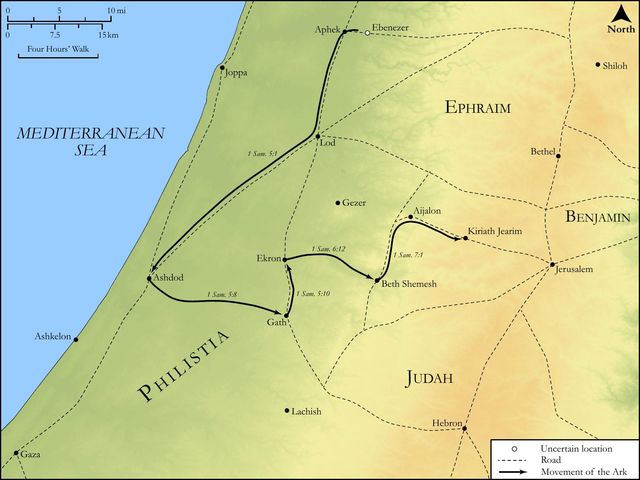
See on the biblical-era map
Study this verse
Public-domain commentary
Matthew Henry
From his Commentary on the Whole Bible. Henry comments on passages, not single verses — this entry covers 1 Samuel 6:1–9. His two-level outline is real structure in the source text, so it is rendered as structure.
The first words of the chapter tell us how long the captivity of the ark continued - it was in the country of the Philistines seven months. In the field of the Philistines (so it is in the original), from which some gather that, having tried it in all their cities, and found it a plague to the inhabitants of each, at length they sent it into the open fields, upon which mice sprang up out of the ground in great multitudes, and destroyed the corn which was now nearly ripe and marred the land. With that judgment they were plagued (Sa1 6:5), and yet it is not mentioned in the foregoing chapter; so God let them know that wherever they carried the ark, so long as they carried it captive, they should find it a curse to them. Cursed shalt thou be in the city, and cursed in the field, Deu 28:16. But, most take it to signify, as we render it, The country of the Philistines. Now, 1. Seven months Israel was punished with the absence of the ark, that special token of God's presence. How bare did the tabernacle look without it! How was the holy city now a desolation, and the holy land a wilderness! A melancholy time no doubt it was to the good people among them, particularly to Samuel; but they had this to comfort themselves with, as we have in the like distress when we are deprived of the comfort of public ordinances, that, wherever the ark is, the Lord is in his holy temple, the Lord's throne is in heaven, and by faith and prayer we may have access with boldness to him there. We may have God nigh unto us when the ark is at a distance. 2. Seven months the Philistines were punished with the presence of the ark; so long it was a plague to them, because they would not send it home sooner. Note, Sinners lengthen out their own miseries by obstinately refusing to part with their sins. Egypt's plagues would have been fewer than ten if Pharaoh's heart had not been hardened not to let the people go. But at length it is determined that the ark must be sent back; there is no remedy, they are undone if they detain it.
I.The priests and the diviners are consulted about it, Sa1 6:2.
They were supposed to be best acquainted both with the rules of wisdom and with the rites of worship and atonement. And the Israelites being their neighbours, and famed above all people for the institutions of their religion, they had no doubt the curiosity to acquaint themselves with their laws and usages; and therefore it was proper to ask them, What shall we do to the ark of Jehovah? All nations have had a regard to their priests, as the men whose lips keep knowledge. Had the Philistines diviners? We have divines, of whom we should enquire wherewith we shall come before the Lord and bow ourselves before the most high God.
II.They give their advice very fully, and seem to be very unanimous in it.
It was a wonder they did not, as friends to their country, give it, ex officio - officially, before they were asked.
1.They urge it upon them that it was absolutely necessary to send the ark back, from the example of Pharaoh and the Egyptians, Sa1 6:6. Some, it may be, were loth to yield, and were willing to try it out with the ark awhile longer, and to them they apply themselves: Wherefore do you harden your hearts, as the Egyptians and Pharaoh did? It seems they were well acquainted with the Mosaic history, and could cite precedents out of it. This good use we should make of the remaining records of God's judgments upon obstinate sinners, we should by them be warned not to harden our hearts as they did. It is much cheaper to learn by other people's experience than by our own. The Egyptians were forced at last to let Israel go; therefore let the Philistines yield in time to let the ark go.
2.They advise that, when they sent it back, they should send a trespass-offering with it, Sa1 6:3. Whatever the gods of other nations were, they knew the God of Israel was a jealous God, and how strict he was in his demands of sin-offerings and trespass-offerings from his own people; and therefore, since they found how highly he resented the affront of holding his ark captive, those with whom he had such a quarrel must in any wise return him a trespass-offering, and they could not expect to be healed upon any other terms. Injured justice demands satisfaction. So far natural light instructed men. But when they began to contrive what that satisfaction should be, they became wretchedly vain in their imaginations. But those who by wilful sin have imprisoned the truth in unrighteousness, as the Philistines did the ark (Rom 1:18), may conclude that there is no making their peace with him whom they have thus injured but by a sin-offering; and we know but one that can take away sin.
3.They direct that this trespass-offering should be an acknowledgement of the punishment of their iniquity, by which they might take shame to themselves as conquered and yielding, and guilty before God, and might give glory to the God of Israel as their mighty conqueror and most just avenger, Sa1 6:5. They must make images of the emerods, that is, of the swellings and sores with which they had been afflicted, so making the reproach of that shameful disease perpetual by their own act and deed (Psa 78:66), also images of the mice that had marred the land, owning thereby the almighty power of the God of Israel, who could chastise and humble them, even in the day of their triumph, by such small and despicable animals. These images must be made of gold, the most precious metal, to intimate that they would gladly purchase their peace with the God of Israel at any rate, and would not think it bought too dearly with gold, with much fine gold. The golden emerods must be, in number, five, according to the number of the lords, who, it is likely, were all afflicted with them, and were content thus to own it; it was advised that the golden mice should be five too, but, because the whole country was infested with them, it should seem, upon second thoughts, they sent more of them, according to the number both of the fenced cities and of the country villages, Sa1 6:18. Their priests reminded them that one plague was on them all; they could not blame one another, for they were all guilty, which they were plainly told by being all plagued. Their proposal to offer a trespass-offering for their offence was conformable enough to divine revelation at that time; but to send such things as these for trespass-offerings was very foreign, and showed them grossly ignorant of the methods of reconciliation appointed by the law of Moses; for there it appears all along that it is blood, and not gold, that makes atonement for the soul.
4.They encourage them to hope that hereby they would take an effectual course to get rid of the plague: You shall be healed, Sa1 6:3. For, it seems, the disease obstinately resisted all the methods of cure their physicians had prescribed. "Let them therefore send back the ark, and then," say they, "It shall be known to you why his hand is not removed from you, that is, by this it will appear whether it is for your detaining the ark that you are thus plagued; for, if it be, upon your delivering it up the plague will cease." God has sometimes put his people upon making such a trial, whether their reformation would not be their relief. Prove me now herewith, saith the Lord of hosts, Mal 3:10; Hag 2:18, Hag 2:19. Yet they speak doubtfully (Sa1 6:5): Peradventure he will lighten his hand from off you; as if now they began to think that the judgment might come from God's hand, and yet not be removed immediately upon the restitution of the ark; however that was the likeliest way to obtain mercy. Take away the cause and the effect will cease.
5.Yet they put them in a way to make a further trial whether it was the hand of the God of Israel that had smitten them with these plagues or no. They must, in honour of the ark, put it on a new cart or carriage, to be drawn by two milch-cows, that had calves daily sucking them (Sa1 6:7), unused to draw, and inclined to home, both for the sake of the crib where they were fed and of the calves they nourished, and, besides, altogether unacquainted with the road that led towards the land of Israel. They must have no one to lead or drive them, but must take their own way, which, in all reason, one might expect, would be home again; and yet, unless the God of Israel, after all the other miracles he has wrought, will work one more, and by an invisible power lead these cows, contrary to their natural instinct and inclination, to the land of Israel, and particularly to Beth-shemesh, they will retract their former opinion, and will believe it was not the hand of God that smote them, but it was a chance that happened to them, Sa1 6:8, Sa1 6:9. Thus did God suffer himself to be tempted and prescribed to, after he had been otherwise affronted, by these uncircumcised Philistines. Would they have been content that the honour of Dagon, their god, should be put upon such an issue as this? See how willing bad men are to shift off their convictions of the hand of God upon them, and to believe, when they are in trouble, that it is a chance that happens to them; and, if so, the rod has no voice which they are concerned to hear or heed.
Continue studying 1 Samuel 6:2 across the web’s major study libraries — every link below opens this exact verse, chapter, or book on the destination site.
Read & Compare
 BibleGatewayThis verse in more than 200 translations and 70 languages.
 Bible.comThe YouVersion reader — hundreds of translations, reading plans, and highlights.
 ESV.orgCrossway's official English Standard Version reader.
 NET BibleThe NET translation with 60,000+ translators' notes on every rendering decision.
 STEP BibleTyndale House's free study tool — original text, vocabulary, and scholarly resources.
 BibliaLogos Bible Software's free web reader.
 USCCBThe New American Bible (Revised Edition) with the U.S. bishops' study notes.
Commentaries
 BibleHub CommentariesDozens of classic commentaries on this verse, gathered on one page.
 StudyLightMore than 100 commentary sets — the largest collection on the web.
 BibleRefPlain-English commentary on what this verse means, verse by verse.
 Enduring WordDavid Guzik's free commentary on this chapter, widely used by Bible teachers.
 Bible Study ToolsVerse commentary alongside Greek and Hebrew study aids.
Original Language & Research
- BibleHub InterlinearThe verse word by word — original language, transliteration, and English.
- BibleHub LexiconEvery word's original-language definition and Strong's entry.
 Blue Letter BibleDeep-study tools — Strong's numbers, concordance, and word studies.
 SefariaThe Hebrew text with Rashi and centuries of Jewish commentary.
Sermons, Hymns & Audio


TrulyRandomVerse is not affiliated with these sites and doesn’t control their content. They’re linked because they’re genuinely useful.
Summary
After enduring seven months of divine judgment manifested through devastating plagues and the humiliation of their god Dagon, the Philistines, overwhelmed by the presence of the Ark of the LORD, desperately sought counsel from their highest religious authorities. This verse captures their urgent consultation with their pagan priests and diviners, as they collectively grappled with the severe consequences of possessing the sacred Ark and sought guidance on the proper means by which to return it to its rightful place, acknowledging a supernatural power beyond their comprehension and control.
Context
ShowHideLiterary Context
This verse serves as a pivotal turning point following the dramatic narrative of the Ark's capture and its subsequent destructive journey through Philistia, detailed extensively in 1 Samuel 4-5. The Israelites had suffered a crushing defeat at Ebenezer, leading to the capture of the Ark of the Covenant, a tangible symbol of God's presence among His people. However, the Ark's presence brought not triumph but divine judgment upon its captors. In Ashdod, the idol Dagon repeatedly fell prostrate and was utterly broken before the Ark (1 Samuel 5:1-5). Subsequently, severe plagues, specifically tumors (emerods), afflicted the people of Ashdod, Gath, and Ekron, accompanied by widespread panic and death (1 Samuel 5:6-12). The Philistine lords, facing escalating suffering and recognizing the "hand of God" upon them, had reached a point of utter desperation. 1 Samuel 6:2 marks their formal attempt to understand and mitigate this divine wrath, setting the stage for the Ark's return journey and the subsequent testing of its divine origin.
Historical & Cultural Context
The Philistines were a formidable "Sea People" who had settled on the southwestern coast of Canaan, distinct in their origin from the Semitic peoples of the region. They were known for their advanced iron technology, military prowess, and polytheistic religion, worshipping a pantheon that included gods like Dagon (a grain/fish deity), Baal, and Ashtoreth. In their worldview, deities were often associated with specific territories or peoples, and a god's power was demonstrated through military victories, fertility, or control over natural phenomena. When the Ark of the LORD, representing the God of Israel, began to exert overwhelming power over their land, their idol, and their bodies, it fundamentally challenged their understanding of divine authority and cosmic order. Consulting "priests" (religious functionaries serving their gods) and "diviners" (practitioners of various forms of divination, seeking omens or supernatural guidance) was their customary method for discerning the will of their gods or explaining inexplicable events. This practice was strictly forbidden in Israelite law, as seen in Deuteronomy 18:9-12, highlighting the stark contrast between Philistine paganism and Israelite monotheism. Their desperate consultation reveals their pagan framework for understanding a supernatural crisis, even as the true God of Israel was compelling their actions.
Key Themes
ShowHideThis verse powerfully underscores several key themes central to the book of 1 Samuel and the broader biblical narrative. Firstly, it highlights the Divine Sovereignty and Irresistible Power of Yahweh. Even when His Ark is captured and His people are defeated, God demonstrates His absolute control over all nations and their false gods. The Philistines, a powerful military force, are rendered helpless by His unseen hand, forced to acknowledge His supremacy. This echoes the plagues in Egypt where Pharaoh was forced to let Israel go (Exodus 7-12). Secondly, it illustrates the Futility of Idolatry and Pagan Wisdom. The Philistines' reliance on their own religious systems and human wisdom proves utterly inadequate in the face of the true God. Their gods cannot protect them, and their diviners cannot truly understand or appease Yahweh, forcing them to seek practical means to remove His holy presence. This theme resonates with passages like Psalm 115:3-8). Lastly, the narrative emphasizes the Holiness of God and the Consequences of Disrespecting His Sacred Presence. The Ark, representing God's dwelling place among His people, is not a mere war trophy. Its presence among the unholy Philistines brings judgment, serving as a stark warning about the dangers of treating God's sacred things lightly or bringing His glory into defiled spaces, a theme tragically echoed in Israel's own later struggles with the Ark's handling (2 Samuel 6:6-7).
Exposition and Analysis
ShowHideKey Word Analysis
ShowHideIn the Philistine context, these were the religious functionaries responsible for the rituals, sacrifices, and maintenance of their pagan temples and idols (like Dagon). They served as intermediaries between the people and their gods, tasked with discerning divine will and offering propitiation. The Philistines' calling for them indicates their initial approach to a divine problem through their established religious framework, seeking their gods' favor or understanding their displeasure, even though the crisis was clearly from Yahweh.
These were practitioners of divination, a broad category of occult practices aimed at discovering hidden knowledge or foretelling the future through various means such as omens, lots, necromancy, or interpreting natural phenomena. This practice was strictly forbidden in Israelite law (Deuteronomy 18:10-12). The Philistines' consultation of diviners reveals their pagan worldview, where supernatural crises were addressed by attempting to manipulate or discern the will of various deities through magical or occult methods, rather than through repentance and obedience to the one true God.
This verb, meaning "to know" or "to ascertain by seeing," is used here in the sense of "to make known" or "to inform." The Philistines are demanding clear, actionable knowledge from their religious experts: "tell us wherewith we shall send it to his place." This highlights their desperation for a concrete solution, not just an explanation. They want to know how to end their suffering, indicating their recognition that the problem is beyond their normal understanding and requires specialized, even supernatural, insight.
Verse Breakdown
ShowHide"And the Philistines called for the priests and the diviners,"
This opening clause highlights the Philistines' desperate and collective action. After enduring seven months of relentless plagues and witnessing the humiliation of their god Dagon, they turned to their highest religious and spiritual authorities. This indicates their recognition that the problem was supernatural in origin and required supernatural guidance, albeit through their own pagan channels. It underscores their profound distress and their inability to resolve the crisis through military or medical means, signaling a shift from defiance to a desperate search for a solution.
"saying, What shall we do to the ark of the LORD?"
This direct question reveals their central dilemma. They understood that the Ark was the source of their affliction, and they identified it as belonging to "the LORD" (Yahweh), indicating a grudging acknowledgment of its divine power, even if they didn't fully comprehend the God of Israel. Their question is not about how to defeat this God, but how to manage His powerful, destructive presence and alleviate their suffering. It signifies a shift from attempting to control the Ark as a war trophy to a desperate search for a means to be rid of it.
"tell us wherewith we shall send it to his place."
This final plea articulates their ultimate goal: to rid themselves of the Ark and the plagues it brought. They are no longer interested in keeping it as a trophy; they simply want it gone. The phrase "to his place" implies an understanding that the Ark belongs to the God of Israel and should be returned to His territory, demonstrating a forced recognition of Yahweh's claim over His sacred object and His people. It sets the stage for the Philistine's proposed method of returning the Ark, which will be detailed in the subsequent verses, revealing their attempt to appease or test the God of Israel according to their own pagan understanding.
Literary Devices
ShowHideThe verse employs several potent literary devices that amplify its theological impact. Irony is profoundly present, as the Philistines, who initially captured the Ark as a symbol of Israel's defeat and their own triumph, are now forced to consult their own pagan authorities on how to return it. This action implicitly, yet powerfully, acknowledges the superior power of the God of Israel over their own deities and military might. This creates a stark Contrast between the Philistines' initial triumphalism and their current state of abject desperation and fear. The very act of consultation highlights the Futility of human wisdom and pagan practices when confronted with divine power; their priests and diviners, despite their claims to supernatural insight, are utterly bewildered and can only offer practical advice born of fear and observation. The narrative also employs Foreshadowing, as the Philistines' forced inquiry into the proper handling of the Ark implicitly sets the stage for the later, equally disastrous mishandling of the Ark by the Israelites themselves (e.g., Uzzah's death in 2 Samuel 6:6-7), underscoring the universal demand for holiness in God's presence.
Theological and Thematic Connections
ShowHide1 Samuel 6:2 stands as a powerful testament to the active, sovereign presence of God, even among His enemies. It demonstrates that God needs no human army to defend His honor or vindicate His name; His holiness alone is sufficient to bring judgment upon those who desecrate His presence or defy His authority. The Philistines' consultation with their pagan priests and diviners highlights the universal human tendency to seek spiritual answers in times of crisis, yet it simultaneously underscores the impotence of false gods and human-devised religious systems when confronted with the living God. This forced acknowledgment of Yahweh's power by a pagan nation serves as a divine object lesson, revealing that God's glory cannot be contained or manipulated by human hands, nor can His holiness be trifled with without severe consequence. It emphasizes that true wisdom and deliverance come only from the one true God, not from human ingenuity or pagan rituals.
Reflection and Application
ShowHideThis verse offers profound lessons for contemporary believers, reminding us that God's power and holiness are not confined by human expectations or limitations. He is capable of vindicating His name and demonstrating His supremacy even in the most unexpected circumstances, such as when His people are defeated and His sacred symbols are captured. The Philistines' desperate consultation with their pagan authorities serves as a potent illustration of the futility of seeking answers or security in anything other than the true God. In our own lives, when faced with challenges or uncertainties, we are often tempted to turn to human wisdom, popular ideologies, or even superstitious practices rather than seeking God's counsel through His Word and prayer. This passage calls us to a radical trust in God's sovereignty and a deep respect for His holiness. It challenges us to examine where we truly seek our answers and security, urging us to recognize that true peace and deliverance come only from acknowledging God's authority and aligning our lives with His will, rather than attempting to manipulate or appease Him through our own devices. It compels us to cultivate a profound reverence for God, understanding that His presence is both glorious and consuming, demanding our humble submission and worship.
Questions for Reflection
ShowHideFAQ
ShowHideWhy did the Philistines consult their own priests and diviners about the Ark of the LORD?
ShowHideThe Philistines consulted their own religious authorities because they were facing a crisis of supernatural origin that their military and medical means could not resolve. As a polytheistic society, their natural inclination when confronted with a powerful, destructive force (which they recognized as coming from "the LORD") was to seek guidance from their established religious leaders—their priests, who served their gods, and their diviners, who specialized in interpreting divine will or omens. This was their cultural framework for understanding and responding to perceived divine displeasure. They did not know the God of Israel, nor did they have access to His prophets or His Law. Therefore, they turned to the only spiritual resources available to them, hoping their own deities or divination practices could provide insight into appeasing or managing the God of Israel, who was clearly demonstrating His power over their land and their gods, as seen in 1 Samuel 5:1-5.
What does this verse reveal about the Philistines' understanding of the God of Israel?
ShowHideThis verse reveals a grudging, fear-driven acknowledgment of the God of Israel's power, rather than a true understanding or reverence. While they identify the Ark as belonging to "the LORD" (Yahweh), they do not worship Him or seek to understand His covenant. Instead, their question, "What shall we do to the ark of the LORD? tell us wherewith we shall send it to his place," indicates that they perceive Him as a powerful, territorial deity whose presence is dangerous and needs to be removed. They recognize His ability to bring judgment (plagues, tumors, death, the humiliation of Dagon in 1 Samuel 5:6-12), but they still operate within their pagan worldview, attempting to manage or appease this foreign deity through their own religious rituals and divinations. They understand His power but not His character, His holiness, or His redemptive purpose.
Christ-Centered Fulfillment
ShowHideThe desperate plea of the Philistines in 1 Samuel 6:2, seeking to rid themselves of the Ark's destructive presence, profoundly foreshadows the ultimate solution to humanity's far greater problem of sin and God's holy wrath. The Ark, a tangible symbol of God's holy presence, brought judgment and death to those who treated it irreverently or without proper atonement. Humanity, in its fallen state, is inherently unholy and incapable of standing in God's presence without being consumed by His righteous judgment, as dramatically illustrated by the Philistine plagues. However, in Christ, the ultimate "Ark" of God's presence, we find not judgment but reconciliation. Jesus, as Immanuel, "God with us", perfectly embodies God's holiness and presence, yet He came not to bring destruction but salvation. He is the Lamb of God who takes away the sin of the world, bearing the full weight of divine judgment on the cross, thereby removing the curse that sin brought upon humanity (Galatians 3:13). Unlike the Philistines who sought to send God's presence away to escape judgment, the New Covenant invites us to draw near to God through Christ's atoning sacrifice, granting us access to His holy presence without fear of condemnation (Hebrews 10:19-22). Thus, what the Ark represented as a terrifying, untouchable holiness, Christ fulfills as an approachable, redemptive holiness, making peace between God and humanity and providing the way for us to truly "know" Him (John 17:3).