


Micah 6:9
Bible text: King James Version (1769 Blayney text) · Public domain
Bible text: Berean Standard Bible · Public domain
Bible text: American Standard Version (1901) · Public domain
Bible text: World English Bible, Messianic edition · Public domain
Bible text: Geneva Bible (1599) · Public domain
Bible text: Young's Literal Translation · Public domain
- קוֹלKol[the] voice ofH6963N-mscNoun Singular Masculine Construct
- יְהוָהYah·wehYahwehH3068N-properNoun Proper Title
- לָעִירla·'Irto the cityH5892Prep-l ¦ N-fsNoun Singular Feminine Absoluteלָto theעִירcity
- יִקְרָאyik·Ra'it calls outH7121V-Qal-Imperf-3msVerb Qal Imperfect 3rd Singular Masculine
- וְתוּשִׁיָּהve·tu·shi·Yahand successH8454Conj-w ¦ N-fsNoun Singular Feminine Absoluteוְandתוּשִׁיָּהsuccess
- יִרְאֶהyir·'Ehit will seeH7200V-Qal-Imperf-3msVerb Qal Imperfect 3rd Singular Masculine
- שְׁמֶךָshe·Me·khayour nameH8034N-msc ¦ 2msNoun Singular Masculine Constructשְׁמֶnameךָyour
- שִׁמְעוּshim·'UhearH8085V-Qal-Imp-2mpVerb Qal Imperative 2nd Plural Masculine
- מַטֶּהma·TehO tribeH4294N-msNoun Singular Masculine Absolute
- וּמִיu·Miand whoeverH4310Conj-w ¦ InterrogPronoun Interrogativeוּandמִיwhoever
- יְעָדָהּye·'a·Dahhe appointed itH3259V-Qal-Perf-3ms ¦ 3fsVerb Qal Perfect 3rd Singular Masculineיְעָדָhe appointedהּit
English is a literal word-by-word gloss of the Hebrew, not the KJV's wording. Why?
This is the original text the KJV's translators worked from — each Hebrew word with its own literal English meaning in this verse, prepared by scholars at Tyndale House, Cambridge. The KJV translates whole sentences, not word by word, so its wording differs: one Hebrew word can become several English words, and the KJV may choose “the LORD” where the gloss reads “Yahweh”. Both are faithful — they answer different questions. For the KJV's own rendering, switch to the KJV text.
Details
See on the biblical-era map
Study this verse
Public-domain commentary
Matthew Henry
From his Commentary on the Whole Bible. Henry comments on passages, not single verses — this entry covers Micah 6:9–16. His three-level outline is real structure in the source text, so it is rendered as structure.
God, having shown them how necessary it was that they should do justly, here shows them how plain it was that they had done unjustly; and since they submitted not to his controversy, nor went the right way to have it taken up, here he proceeds in it. Observe,
I.How the action is entered against them, Mic 6:9.
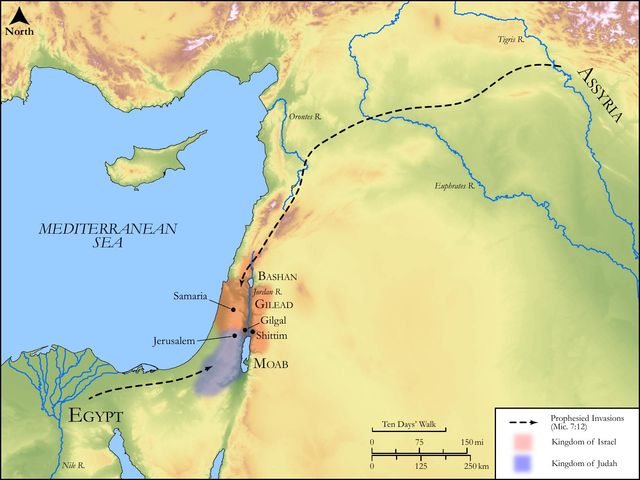
God speaks to the city, to Jerusalem, to Samaria. His voice cries to it by his servants the prophets who were to cry aloud and not spare. Note, The voice of the prophets is the Lord's voice, and that cries to the city, cries to the country. Doth not wisdom cry? Pro 8:1. When the sin of a city cries to God his voice cries against the city; and, when the judgments of God are coming upon a city, his voice first cries unto it. He warns before he wounds, because he is not willing that any should perish. Now observe,
1.How the voice of God is discerned by some: The man of wisdom will see thy name. When the voice of God cries to us we may by it see his name, may discern and perceive that by which he makes himself known. Yet many see it not, are not aware of it, because they do not regard it. God speaks once, yea, twice, and they perceive it not (Job 33:14); but those that are men of wisdom will see it, and perceive it, and make a good use of it. Note, It is a point of true wisdom to discover the name of God in the voice of God, and to learn what he is from what he says. Wisdom shall see thy name, for the knowledge of the holy is understanding.
2.What this voice of God says to all: "Hear you the rod, and who hath appointed it. Hear the rod when it is coming; hear it at a distance, before you see it and feel it; and be awakened to go forth to meet the Lord in the way of his judgments. Hear the rod when it has come, and is actually upon you, and you are sensible of the smart of it; hear what it says to you, what convictions, what counsels, what cautions, it speaks to you." Note, Every rod has a voice, and it is the voice of God that is to be heard in the rod of God, and it is well for those that understand the language of it, which if we would do we must have an eye to him that appointed it. Note, Every rod is appointed, of what kind it shall be, where it shall light, and how long it shall lie. God in every affliction performs the thing that is appointed for us (Job 23:14), and to him therefore we must have an eye, to him we must have an ear; we must hear what he says to us by the affliction. Hear it, and know it for thy good, Job 5:27. The work of ministers is to explain the providences of God and to quicken and direct men to learn the lessons that are taught by them.
II.What is the ground of the action, and what are the things that are laid to their charge.
1.They are charged with injustice, a sin against the second table. Are there yet to be found among them the marks and means of fraudulent dealing? What! after all the methods that God has taken to teach them to do justly, will they yet deal unjustly? It seems, they will, Mic 6:10. And shall I count them pure? Mic 6:11. No; this is a sin which will by no means consist with a profession of purity. Those that are dishonest in their dealings have not the spots of God's children, and shall never be reckoned pure, whatever shows of devotion they may make. Be not deceived, God is not mocked. When a man is suspected of theft, or fraud, the justice of peace will send a warrant to search his house. God here does, as it were, search the houses of those citizens, and there he finds,
(1.)Treasures of wickedness, abundance of wealth, but it is ill-got, and not likely to prosper; for treasures of wickedness profit nothing.
(2.)A scant measure, by which they sold to the poor, and so exacted upon them and cheated them.
(3.)They had wicked balances and a bag of false weights, by which, under a pretence of weighing what they sold, and giving the buyer what was right, they did him the greatest wrong, Mic 6:11.
(4.)Those that had wealth and power in their hands abused it to oppression and extortion; The rich men thereof are full of violence; for those that have much would have more, and are in a capacity of making it more by the power which their abundance of wealth gives them. They are full of violence, that is, they have their houses full of that which is got by violence.
(5.)Those that had not the advantage of doing wrong by their wealth yet found means of defrauding those they dealt with: The inhabitants thereof have spoken lies; if they are not able to use force and violence, they use fraud and deceit; the inhabitants have spoken lies, and their tongue is deceitful in their mouth; they do not stick at a deliberate lie, to make a good bargain. Some understand it of their speaking falsely concerning God, saying, The Lord seeth not; he hath forsaken the earth, Eze 8:12.
2.They are charged with idolatry (Mic 6:6): The statutes of Omri are kept, and all the work of the house of Ahab. Both these kings were wicked, and did evil in the sight of the Lord; but the wickedness which they established by a law, concerning which they made statutes, and which was the peculiar work of that house, was idolatry. Omri walked in the way of Jeroboam, and in his sin of provoking God to anger with their vanities, Kg1 16:26, Kg1 16:31. Ahab introduced the worship of Baal. These reigns were some ages before the time when this prophet lived, and yet the wickedness which they established by their laws and examples remained to this day; those statutes were still kept, and that work was still done; and the princes and people still walked in their counsels, took the same measures, and governed themselves and the people by the same politics. Observe,
(1.)The same wickedness continued from one generation to another. Sin is a root of bitterness, soon planted, but not so soon plucked up again. The iniquity of former ages is often transmitted to, and entailed upon, the succeeding ones. Those that make corrupt laws, and bring in corrupt usages, are doing that which perhaps may prove the ruin of the child unborn.
(2.)It was not the less evil in itself, provoking to God, and dangerous to the sinners, for its having been established and confirmed by the laws of princes, the examples of great men, and a long prescription. Though the worship of idols is enacted by the statutes of Omri, recommended by the practice of the house of Ahab, and pleads that it has been the usage of many generations, yet it is still displeasing to God and destructive to Israel; for no laws nor customs are of force against the divine command.
III.What is the judgment given upon this.
Being found guilty of these crimes, the sentence is that that which God had given them warning of (Mic 6:9) shall be brought upon them (Mic 6:13): Therefore also will I make thee sick, in smiting thee. As they had smitten the poor with the rod of their oppressions, so would God in like manner smite them, so as to make them sick, sick of the gains they had unjustly gotten, so that though they had swallowed down riches they should vomit them up again, Job 20:15. Their doom is,
1.That what they have they shall not have any comfortable enjoyment of; it shall do them no good. They grasped at more than enough, but, when they have it, it shall not be enough to make them easy and happy. What is got by fraud and oppression cannot be kept or enjoyed with any satisfaction.
(1.)Their food shall not nourish them: Thou shalt eat, but not be satisfied, either because the food shall not digest, for want of God's blessing going along with it, or because the appetite shall by disease be made insatiable and still craving, the just punishment of those that were greedy of gain and enlarged their desires as hell. Men may be surfeited with the good things of this world and yet not satisfied, Ecc 5:10; Isa 55:2.
(2.)Their country shall not harbour and protect them: "Thy casting down shall be in the midst of thee, that is, thou shalt be broken and ruined by the intestine troubles, mischiefs at home enough to cast thee down, though thou shouldst not be invaded by a foreign force." God can cast a nation down by that which is in the midst of them, can consume them by a fire in their own bowels.
(3.)They shall not be able to preserve what they have from a foreign force, nor to recover what they have lost: "Thou shalt take hold of what is about to be taken from thee, but thou shalt not hold it fast, shalt catch at it, but shalt not deliver it, shalt not retrieve it." It is meant of their wives and children, that were very dear to them, which they took hold of, as resolved not to part with them, but there is no remedy, they must go into captivity. Note, What we hold closest we commonly lose soonest, and that proves least safe which is most dear.
(4.)What they save for a time shall be reserved for a future and sorer stroke: That which thou deliverest out of the hand of one enemy will I give up to the sword of another enemy; for God has many arrows in his quiver; if one miss the sinner, the next shall not.
(5.)What they have laboured for they shall not enjoy (Mic 6:15): "Thou shalt sow, but thou shalt not reap; it shall be blasted and withered, and there shall be nothing to reap, or an enemy shall come and reap it for himself, or thou shalt be carried into captivity, and leave it to be reaped by thou knowest not whom. Thou shalt tread the olives, but thou shalt not anoint thyself with oil, having no heart to make use of ornaments and refreshments when all is going to ruin. Thou shalt tread out the sweet wine, but shalt not drink wine, for many things may fall between the cup and the lip." Note, It is very grievous to be disappointed of our expectations, and not to have the pleasure of that which we have taken pains for; and this will be the just punishment of those that frustrate God's expectations from them, and answer not the cost he has been at upon them. See this threatened in the law, Lev 26:16; Deu 28:30, Deu 28:38, etc.; and compare Isa 62:8, Isa 62:9.
2.That all they have shall at length be taken from them (Mic 6:13): Thou shalt be made desolate because of thy sins; and Mic 6:16, a desolation and a hissing. Sin makes a nation desolate; and when a people that have been famous and flourishing are made desolate it is the astonishment of some and the triumph of others; some lament it, and others hiss at it. Thus you shall bear the reproach of my people. Their being the people of God, in name and profession while they kept close to their duty and kept themselves in his love, was an honour to them, and all their neighbours thought it so; but now that they have corrupted and ruined themselves, now that their sins and God's judgments have made their land desolate, their having been once the people of God does but turn so much the more to their reproach; their enemies will say, These are the people of the Lord, Eze 36:20. Note, If professors of religion ruin themselves, their ruin will be the most reproachful of any; and they in a special manner will rise at the last day to everlasting shame and contempt.
Continue studying Micah 6:9 across the web’s major study libraries — every link below opens this exact verse, chapter, or book on the destination site.
Read & Compare
 BibleGatewayThis verse in more than 200 translations and 70 languages.
 Bible.comThe YouVersion reader — hundreds of translations, reading plans, and highlights.
 ESV.orgCrossway's official English Standard Version reader.
 NET BibleThe NET translation with 60,000+ translators' notes on every rendering decision.
 STEP BibleTyndale House's free study tool — original text, vocabulary, and scholarly resources.
 BibliaLogos Bible Software's free web reader.
 USCCBThe New American Bible (Revised Edition) with the U.S. bishops' study notes.
Commentaries
 BibleHub CommentariesDozens of classic commentaries on this verse, gathered on one page.
 StudyLightMore than 100 commentary sets — the largest collection on the web.
 BibleRefPlain-English commentary on what this verse means, verse by verse.
 Enduring WordDavid Guzik's free commentary on this chapter, widely used by Bible teachers.
 Bible Study ToolsVerse commentary alongside Greek and Hebrew study aids.
Original Language & Research
- BibleHub InterlinearThe verse word by word — original language, transliteration, and English.
- BibleHub LexiconEvery word's original-language definition and Strong's entry.
 Blue Letter BibleDeep-study tools — Strong's numbers, concordance, and word studies.
 SefariaThe Hebrew text with Rashi and centuries of Jewish commentary.
Sermons, Hymns & Audio


TrulyRandomVerse is not affiliated with these sites and doesn’t control their content. They’re linked because they’re genuinely useful.
Summary
Micah 6:9 delivers a profound and urgent divine proclamation, emphasizing the LORD's active communication to His people, the necessity of spiritual discernment, and the sovereign purpose behind His disciplinary actions. It serves as a solemn call to attention, urging the inhabitants of the city to recognize God's hand and ultimate authority in all circumstances, particularly in times of hardship, and to respond with humble understanding and obedience.
Context
ShowHideLiterary Context
Micah 6:9 is situated within a powerful section of the book (Micah 6:1-8) that presents a "divine lawsuit" or covenant lawsuit (Hebrew: rîḇ). In this legal drama, God calls upon the mountains and hills as witnesses as He brings charges against His unfaithful people, Israel and Judah. Following the profound summary of what the LORD truly requires of humanity in Micah 6:8, which emphasizes justice, mercy, and humility, verse 9 acts as a direct, authoritative pronouncement from the divine Judge. It transitions from the general indictment and the call to righteous living to a specific, urgent warning about impending judgment and the proper response to it, highlighting God's direct involvement in their national affairs.
Historical & Cultural Context
The prophet Micah ministered during the reigns of Jotham, Ahaz, and Hezekiah in Judah (late 8th century BCE), a period marked by significant oppression, widespread idolatry, and moral decay in both the northern kingdom of Israel and the southern kingdom of Judah. The rich oppressed the poor, judges were corrupt, and religious leaders often led the people astray. Externally, both kingdoms faced the looming threat of the Assyrian Empire, which had already conquered Israel and was pressing against Judah. The "city" likely refers to Jerusalem, the capital of Judah, but could also broadly represent the urban centers where much of the unrighteousness was concentrated. The "rod" metaphor would have been readily understood by an ancient audience as an instrument of discipline, authority, or punishment, often wielded by a shepherd, a parent, or a ruler, and in this context, by God Himself, often through an invading nation like Assyria.
Key Themes
ShowHideThis verse contributes significantly to several major themes found throughout Micah and the broader prophetic literature. It underscores the theme of Divine Sovereignty and Justice, revealing God's active governance over human affairs and His righteous response to sin. The phrase "The LORD'S voice crieth unto the city" highlights Divine Communication and Warning, demonstrating God's persistent efforts to call His people to repentance before judgment is fully executed. The emphasis on "the man of wisdom shall see thy name" introduces the theme of True Wisdom and Spiritual Discernment, contrasting superficial knowledge with a profound understanding of God's character and purposes, especially in difficult times. Finally, "hear ye the rod, and who hath appointed it" powerfully conveys the theme of Divine Discipline and Restoration, portraying God's chastisement not as random misfortune but as a purposeful, loving act designed to bring His people back to Himself, a concept echoed in Proverbs 3:11-12.
Exposition and Analysis
ShowHideKey Word Analysis
ShowHideFrom an unused root meaning "to call aloud," this word denotes a powerful, authoritative sound or proclamation. In Micah 6:9, it signifies God's direct, public, and urgent address to the city, not a whisper but a commanding cry that demands attention and implies the critical nature of the message.
This term refers to "sound wisdom," "effective wisdom," or "ability." It implies practical, discerning understanding that leads to effective action. Here, it is not mere intellectual knowledge but a spiritual insight that enables one to perceive God's character, authority, and purpose ("thy name") behind the events unfolding, especially those that involve divine discipline.
Derived from a root meaning "to extend," this word can refer to a branch, a staff, or a rod. Biblically, it often symbolizes authority, support, or, as in this context, an instrument of chastisement or punishment. It represents the means by which God exercises His discipline, whether through natural calamities, foreign invaders, or other forms of affliction.
Verse Breakdown
ShowHide"The LORD'S voice crieth unto the city,"
This opening clause establishes the divine origin and urgent nature of the message. The "voice" (qôwl) of the LORD is not a quiet whisper but a loud, public cry (qârâʼ), indicating the critical importance of what is being declared. The "city" (ʻîyr) likely refers to Jerusalem, the capital of Judah, representing the people and their leadership who are the recipients of God's indictment and warning. This phrase emphasizes God's active engagement and direct communication with His people.
"and [the man of] wisdom shall see thy name:"
This segment highlights the proper response to God's cry. The phrase "the man of wisdom" (literally, "and sound wisdom") implies that true spiritual understanding (tûwshîyâh) is required to discern God's presence and purpose. To "see thy name" (shêm) means to recognize God's character, authority, and covenant faithfulness as the underlying reality behind all events, including the impending judgment. It's about perceiving God's active hand and righteous nature in the unfolding circumstances.
"hear ye the rod, and who hath appointed it."
This is a direct command urging the people to pay attention to the instrument of divine discipline ("the rod," maṭṭeh) and, more importantly, to discern its ultimate source. The "rod" symbolizes God's corrective judgment or affliction. The crucial question, "who hath appointed it" (yâʻad), emphasizes God's absolute sovereignty over all trials and difficulties. It calls the people to look beyond the immediate cause of their suffering and recognize that God Himself has purposefully ordained it for their correction and ultimate good.
Literary Devices
ShowHideMicah 6:9 masterfully employs several literary devices to convey its urgent message. Personification is evident in "The LORD'S voice crieth unto the city," attributing the human action of "crying" to God's voice, thereby emphasizing the intensity and directness of His communication. The "rod" serves as a powerful metaphor for divine discipline, correction, or judgment. It is not a literal rod but represents the afflictions or instruments (like invading armies) God uses to chastise His people. The phrase "who hath appointed it" functions as a rhetorical question, not seeking an answer from the audience, but rather compelling them to acknowledge the obvious truth: God Himself is the sovereign orchestrator of their circumstances, including their trials. This question forces introspection and a recognition of divine authority.
Theological and Thematic Connections
ShowHideMicah 6:9 powerfully articulates the biblical truth that God is actively involved in the lives of His people, not as a distant observer, but as a righteous Judge and a loving Father who disciplines those He loves. The "rod" of judgment is not arbitrary but purposeful, designed to bring about repentance and restoration. True wisdom, therefore, lies in discerning God's hand in all circumstances, recognizing His "name"—His character, authority, and covenant faithfulness—even amidst hardship. This understanding transforms suffering from a meaningless ordeal into an opportunity for spiritual growth and a deeper relationship with the sovereign God. The call to "hear the rod" is an invitation to humility and a renewed commitment to obedience, acknowledging that God's discipline is ultimately for our good.
Reflection and Application
ShowHideMicah 6:9 offers a timeless and profound challenge for believers today. It calls us to cultivate a posture of spiritual attentiveness, recognizing that God is continually speaking, not always in a literal voice, but often through the circumstances of our lives. When we face difficulties, trials, or even periods of intense suffering—the "rod" of God—our primary response should not be despair or resentment, but rather a humble inquiry into God's purpose. Instead of asking "Why me?" or "Why is this happening?", this verse prompts us to ask, "What is God trying to teach me through this?" and "How is God's 'name' (His character, power, and faithfulness) being revealed in this situation?" Understanding that God sovereignly "appoints" our trials provides immense comfort and direction, assuring us that even in the darkest valleys, we are under the loving, purposeful hand of our Heavenly Father. This perspective transforms our suffering into a crucible for spiritual refinement, drawing us closer to Him and aligning our hearts with His will.
Questions for Reflection
ShowHideFAQ
ShowHideWhat does "the rod" symbolize in Micah 6:9?
ShowHideIn Micah 6:9, "the rod" (Hebrew: maṭṭeh) is a powerful symbol for divine discipline, correction, or judgment. It represents the means by which God chastises His people for their unfaithfulness and disobedience. This "rod" is not random misfortune but a purposeful instrument in God's sovereign hand, designed to lead to repentance, refinement, and ultimately, restoration. Throughout the Old Testament, the rod can symbolize a shepherd's staff for guidance, a king's scepter for authority, or an instrument of punishment, often referring to an invading nation (like Assyria in Isaiah 10:5) that God uses as His tool of judgment.
How does "wisdom" relate to "seeing thy name" in this verse?
ShowHideThe "wisdom" (Hebrew: tûwshîyâh) mentioned in Micah 6:9 refers to sound, effective, and discerning understanding. It's not merely intellectual knowledge but a spiritual insight that allows one to perceive God's character, authority, and presence ("thy name") behind all events, especially those that bring hardship or discipline. To "see thy name" means to recognize God's active hand, His righteous nature, and His covenant faithfulness as the ultimate source and purpose of the circumstances. Therefore, true wisdom enables a person to look beyond the immediate pain or difficulty of the "rod" and discern the sovereign, purposeful work of God, leading to a reverent understanding and a humble response, much like the fear of the LORD being the beginning of wisdom as stated in Proverbs 9:10.
Christ-Centered Fulfillment
ShowHideMicah 6:9 finds its ultimate fulfillment and deepest meaning in Jesus Christ. The "LORD'S voice crieth unto the city" foreshadows the very incarnation of God's voice in Jesus, the Word made flesh, who came to proclaim the kingdom of God and call humanity to repentance. He is the ultimate revelation of God's "name," embodying His character, authority, and redemptive purpose. The "man of wisdom" who truly "sees God's name" is one who recognizes Jesus as the wisdom of God personified, in whom "are hidden all the treasures of wisdom and knowledge" (Colossians 2:3). Furthermore, the "rod" of divine discipline, which points to God's judgment on sin, is fully borne by Christ on the cross. He became the object of God's righteous wrath, taking upon Himself the chastisement due to humanity (Isaiah 53:5). Through His atoning sacrifice, the "rod" that would have fallen upon us was "appointed" to Him, allowing those who believe to escape condemnation and instead receive God's loving discipline as children, leading to holiness (Hebrews 12:10-11). Thus, in Christ, we not only understand "who hath appointed" the rod, but we also find grace to endure it and the ultimate deliverance from its eternal consequences.