


Micah 6:8
- הִגִּידhi·Gidhe has toldH5046V-Hiphil-Perf-3msVerb Hiphil Perfect 3rd Singular Masculine
- לְךָle·Khato youPrep-l ¦ 2msSuffix Personal 2nd Singular Masculineלְtoךָyou
- אָדָם'a·DamO humankindH120N-msNoun Singular Masculine Absolute
- מַהmahwhat?H4100InterrogPronoun Interrogative
- טּוֹבTov[is] goodH2896Adj-msAdjective Singular Masculine Absolute
- וּמָהu·mahand what?H4100Conj-w ¦ InterrogPronoun Interrogativeוּandמָהwhat?
- יְהוָהYah·weh[is] YahwehH3068N-properNoun Proper Title
- דּוֹרֵשׁdo·ReshrequiringH1875V-Qal-Prtcpl-msVerb Qal Participle Singular Masculine Absolute
- מִמְּךָmi·me·Khafrom youH4480Prep ¦ 2msPrepositionמִמְּfromךָyou
- כִּיkithatH3588PrtParticle Conditional
- אִם'imexceptH518PrtParticle Conditional
- עֲשׂוֹתa·Sotto doH6213V-Qal-InfVerb Qal Infinitive Construct
- מִשְׁפָּטmish·PatjusticeH4941N-msNoun Singular Masculine Absolute
- וְאַהֲבַתve·'A·ha·vatand to loveH157Conj-w ¦ V-Qal-InfVerb Qal Infinitive Constructוְandאַהֲבַתto love
- חֶסֶדChe·sedcovenant loyaltyH2617N-msNoun Singular Masculine Absolute
- וְהַצְנֵעַve·hatz·Ne·a'and to be modestH6800Conj-w ¦ V-Hiphil-InfAbsVerb Hiphil Infinitive Absoluteוְandהַצְנֵעַto be modest
- לֶכֶתLe·khetto walkH1980V-Qal-InfVerb Qal Infinitive Construct
- עִם'imwithH5973PrepPreposition
- אֱלֹהֶיךָ'e·lo·Hei·khayour GodH430N-mpc ¦ 2msNoun Plural Masculine ConstructאֱלֹהֶיGodךָyour
English is a literal word-by-word gloss of the Hebrew, not the KJV's wording. Why?
This is the original text the KJV's translators worked from — each Hebrew word with its own literal English meaning in this verse, prepared by scholars at Tyndale House, Cambridge. The KJV translates whole sentences, not word by word, so its wording differs: one Hebrew word can become several English words, and the KJV may choose “the LORD” where the gloss reads “Yahweh”. Both are faithful — they answer different questions. For the KJV's own rendering, switch to the KJV text.
Details
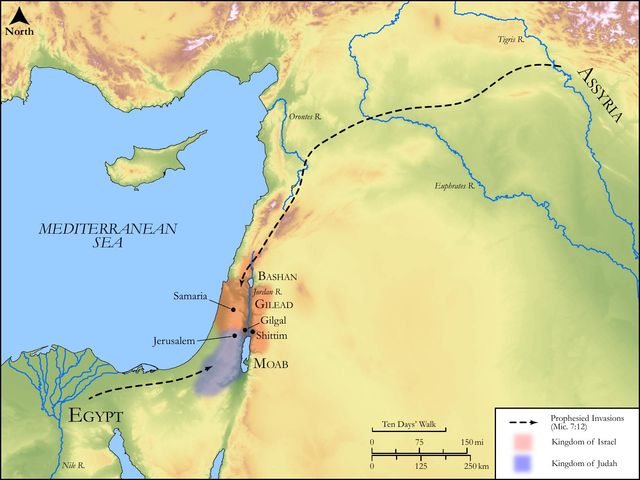
See on the biblical-era map
Study this verse
Public-domain commentary
Matthew Henry
From his Commentary on the Whole Bible. Henry comments on passages, not single verses — this entry covers Micah 6:6–8. His three-level outline is real structure in the source text, so it is rendered as structure.
Here is the proposal for accommodation between God and Israel, the parties that were at variance in the beginning of the chapter. Upon the trial, judgment is given against Israel; they are convicted of injustice and ingratitude towards God, the crimes with which they stood charged. Their guilt is too plain to be denied, too great to be excused, and therefore,
I.They express their desires to be at peace with God upon any terms (Mic 6:6, Mic 6:7):
Wherewith shall I come before the Lord? Being made sensible of the justice of God's controversy with them, and dreading the consequences of it, they were inquisitive what they might do to be reconciled to God and to make him their friend. They apply to a proper person, with this enquiry, to the prophet, the Lord's messenger, by whose ministry they had been convinced. Who so fit to show them their way as he that had made them sensible of their having missed it? And it is observable that each one speaks for himself: Wherewith shall I come? Knowing every one the plague of his own heart, they ask, not, What shall this man do? But, What shall I do? Note, Deep convictions of guilt and wrath will put men upon careful enquiries after peace and pardon, and then, and not till then, there begins to be some hope of them. They enquire wherewith they may come before the Lord, and bow themselves before the high God. They believe there is a God, that he is Jehovah, and that he is the high God, the Most High. Those whose consciences are convinced learn to speak very honourably of God, whom before they spoke slightly of. Now,
1.We know we must come before God; he is the God with whom we have to do; we must come as subjects, to pay our homage to him, as beggars, to ask alms from him, nay, we must come before him, as criminals, to receive our doom from him, must come before him as our Judge.
2.When we come before him we must bow before him; it is our duty to be very humble and reverent in our approaches to him; and, when we come before him, there is no remedy but we must submit; it is to no purpose to contend with him.
3.When we come and bow before him it is our great concern to find favour with him, and to be accepted of him; their enquiry is, What will the Lord be pleased with? Note, All that rightly understand their own interest cannot but be solicitous what they must do to please God, to avoid his displeasure and to obtain his good-will.
4.In order to God's being pleased with us, our care must be that the sin by which we have displeased him may be taken away, and an atonement made for it. The enquiry here is, What shall I give for my transgression, for the sin of my soul? Note, The transgression we are guilty of is the sin of our soul, for the soul acts it (without the soul's act it is not sin) and the soul suffers by it; it is the disorder, disease, and defilement of the soul, and threatens to be the death of it: What shall I give for my transgressions? What will be accepted as a satisfaction to his justice, a reparation of his honour? And what will avail to shelter me from his wrath?
5.We must therefore ask, Wherewith may we come before him? We must not appear before the Lord empty. What shall we bring with us? In what manner must we come? In whose name must we come? We have not that in ourselves which will recommend us to him, but must have it from another. What righteousness then shall we appear before him in?
II.They make proposals, such as they are, in order to it.
Their enquiry was very good and right, and what we are all concerned to make, but their proposals betray their ignorance, though they show their zeal; let us examine them: -
1.They bid high. They offer,
(1.)That which is very rich and costly - thousands of rams. God required one ram for a sin-offering; they proffer flocks of them, their whole stock, will be content to make themselves beggars, so that they may but be at peace with God. They will bring the best they have, the rams, and the most of them, till it comes to thousands.
(2.)That which is very dear to them, and which they would be most loth to part with. They could be content to part with their first-born for their transgressions, if that would be accepted as an atonement, and the fruit of their body for the sin of their soul. To those that had become vain in their imaginations this seemed a probable expedient of making satisfaction for sin, because our children are pieces of ourselves; and therefore the heathen sacrificed their children, to appease their offended deities. Note, Those that are thoroughly convinced of sin, of the malignity of it, and of their misery and danger by reason of it, would give all the world, if they had it, for peace and pardon.
2.Yet they do not bid right. It is true some of these things were instituted by the ceremonial law, as the bringing of burnt-offerings to God's altar, and calves of a year old, rams for sin-offerings, and oil for the meat-offerings; but these alone would not recommend them to God. God had often declared that to obey is better than sacrifice, and to hearken than the fat of rams, that sacrifice and offering he would not; the legal sacrifices had their virtue and value from the institution, and the reference they had to Christ the great propitiation; but otherwise, of themselves, it was impossible that the blood of bulls and goats should take away sin. And as to the other things here mentioned,
(1.)Some of them are impracticable things, as rivers of oil, which nature has not provided to feed men's luxury, but rivers of water to supply men's necessity. All the proposals of peace but those that are according to the gospel are absurd. One stream of the blood of Christ is worth ten thousand rivers of oil.
(2.)Some of them are wicked things, as to give our first-born and the fruit of our body to death, which would but add to the transgression and the sin of the soul. He that hates robbery for burnt-offerings much more hates murder, such murder. What right have we to our first born and the fruit of our body? Do they not belong to God? Are they not his already, and born to him? Are they not sinners by nature, and their lives forfeited upon their own account? How then can they be a ransom for ours?
(3.)They are all external things, parts of that bodily exercise which profiteth little, and which could not make the comers thereunto perfect.
(4.)They are all insignificant, and insufficient to attain the end proposed; they could not answer the demands of divine justice, nor satisfy the wrong done to God in his honour by sin, nor would they serve in lieu of the sanctification of the heart and the reformation of the life. Men will part with any thing rather than their sins, but they part with nothing to God's acceptance unless they part with them.
III.God tells them plainly what he demands, and insists upon, from those that would be accepted of him, Mic 6:8.
Let their money perish with them that think the pardon of sin and the favour of God may be so purchased; no, God has shown thee, O man! what is good. Here we are told,
1.That God has made a discovery of his mind and will to us, for the rectifying of our mistakes and the direction of our practice.
(1.)It is God himself that has shown us what we must do. We need not trouble ourselves to make proposals, the terms are already settled and laid down. He whom we have offended, and to whom we are accountable, has told us upon what conditions he will be reconciled to us.
(2.)It is to man that he has shown it, not only to thee, O Israel! but to thee, O man! Gentiles as well as Jews - to men, who are rational creatures, and capable of receiving the discovery, and not to brutes, - to men, for whom a remedy is provided, not to devils, whose case is desperate. What is spoken to all men every where in general, must by faith be applied to ourselves in particular, as if it were spoken to thee, O man! by name, and to no other.
(3.)It is a discovery of that which is good, and which the Lord requires of us. He has shown us our end, which we should aim at, in showing us what is good, wherein our true happiness does consist; he has shown us our way in which we must walk towards that end in showing us what he requires of us. There is something which God requires we should do for him and devote to him; and it is good. It is good in itself; there is an innate goodness in moral duties, antecedent to the command; they are not, as ceremonial observances, good because they are commanded, but commanded because they are good, consonant to the eternal rule and reason of good and evil, which are unalterable. It has likewise a direct tendency to our good; our conformity to it is not only the condition of our future happiness, but is a great expedient of our present happiness; in keeping God's commandments there is great reward, as well as after keeping them.
(4.)It is shown us. God has not only made it known, but made it plain; he has discovered it to us with such convincing evidence as amounts to a demonstration. Lo this, we have searched it, so it is.
2.What that discovery is. The good which God requires of us is not the paying of a price for the pardon of sin and acceptance with God, but doing the duty which is the condition of our interest in the pardon purchased.
(1.)We must do justly, must render to all their due, according as our relation and obligation to them are; we must do wrong to none, but do right to all, in their bodies, goods, and good name.
(2.)We must love mercy; we must delight in it, as our God does, must be glad of an opportunity to do good, and do it cheerfully. Justice is put before mercy, for we must not give that in alms which is wrongfully got, or with which our debts should be paid. God hates robbery for a burnt-offering.
(3.)We must walk humbly with our God. This includes all the duties of the first table, as the two former include all the duties of the second table. We must take the Lord for our God in covenant, must attend on him and adhere to him as ours, and must make it our constant care and business to please him. Enoch's walking with God is interpreted (Heb 11:5) his pleasing God. We must, in the whole course of our conversation, conform ourselves to the will of God, keep up our communion with God, and study to approve ourselves to him in our integrity; and this we must do humbly (submitting our understandings to the truths of God and our will to his precepts and providences); we must humble ourselves to walk with God (so the margin reads it); every thought within us must be brought down, to be brought into obedience to God, if we would walk comfortably with him. This is that which God requires, and without which the most costly services are vain oblations; this is more than all burnt-offerings and sacrifices.
Historical interpretation
Five Centuries of Reception
8 surviving comments on this verse. Each one is dated, so this reads as a timeline rather than a list.
Select a marker to jump to its quote. Markers stagger vertically where authors wrote within a few decades of each other.
“But God,”[adulterers and fornicators say,] “is good and most kind.” He is “merciful, compassionate and rich in mercy,” which “he prefers to every sacrifice.” “He desires not so much the death as the repentance of the sinner.” He is “the Savior of all people, and especially of the faithful.” Therefore the children of God must also be “merciful” and “peacemakers,” “forgiving each other as Christ also forgave us,” “not judging, lest we be judged.” For to “his master a man stands or falls; who are you to judge the servant of another?” “Forgive, and you will be forgiven.” Yet many such things as these are only said, not done, merely bandied about, unmanning rather than strengthening discipline, flattering God and pandering to themselves.
“You have been told, O man, what is good. And what does the Lord require of you, but to do justice, to love mercy and to be prepared to walk with your Lord?” Accordingly, the gospel says to you, “Arise, let us go from here,” while the law says to you, “You shall walk after the Lord your God.” You have learned the method of your flight from here—why do you delay?
(Verse 8) I will show you, O man, what is good, and what the Lord requires of you: to do justice, and to love mercy, and to walk humbly with your God. LXX: It has been told to you, O man, what is good, or what the Lord requires of you: only to do justice, and to love mercy, and to be prepared to walk with your God. For you hesitate, O people of Israel, indeed the entire human race (for I am not speaking specifically to the Jewish people, but generally to all mankind, my message reaches everyone), how you can appease God for your sins if you do not have victims with which your wickedness can be atoned: I will answer you, what God seeks, indeed I have shown it already in the Law. For it is written in Deuteronomy: And now, Israel, what does the Lord your God require of you, but to fear the Lord your God, to walk in all his ways, and to love him, and to serve the Lord your God with all your heart and with all your soul, and to keep the commandments of the Lord your God and his statutes, which I command you today for your good? (Deut. X, 12) The Lord asks of us, seeking our necessary salvation, demands to receive what is profitable for the giver, so that we may exercise judgment, that is, do nothing without reason and counsel, and consider before our mind judges what it should do, and afterward complete it in action; so that we may love mercy, and not be merciful as if compelled or by necessity, for God loves a cheerful giver (II Cor. IX). And let us not say, go today, and return tomorrow, and I will give to you. And when we shall have done judgment, and loved mercy, what reward shall we receive? We shall walk with the Lord our God, as Enoch walked with God according to the faith of the Hebrew volumes (Genesis 5; Ecclesiasticus 44), and pleased him, and was not found, because God had translated him. For you have said, in what shall I obtain the Lord, or in what shall I apprehend him? I promise you more, do judgment, and love mercy, and you shall walk with your God. Certainly, to walk with God is not a reward, but a commandment. Just as we are commanded to do justice and love mercy, so we are instructed to be prepared to walk with our Lord God; we should not sleep at any hour, we should not be secure at any time, but always expect the coming of the father of the household, and fear the day of judgment, and in the night of this world say: I sleep, but my heart is awake (Song of Solomon 5:2). Theodotius expressed more significantly the phrase 'Verbum Esne' (which the Septuagint translated as 'ready to go and we have said, anxious to walk') as 'καὶ ἀσφαλίζου τοῦ πορεύεσθαι μετὰ Ἐλωαίχ', that is, 'and be careful to walk diligently with your God'. Or, as the fifth edition translated, 'καὶ φροντίζειν', meaning to act diligently and have this care, to walk with your God. For whoever says they believe in Christ should walk as He walked (1 John 2:6). And the Apostle Paul said: 'Be imitators of me, as I am of Christ.' (I Cor. 11)
The voice of the Lord cries out to the city, and salvation will be to those who fear your name. The Septuagint version says: The voice of the Lord will cry out to the city, and those who fear his name will be saved. In the Hebrew, this is the beginning of another chapter, but in the Septuagint, it is the end of the previous chapter. It means: God asks nothing else of you, O man, but that you do justice, love mercy, and be ready to walk with your God. For the voice of the Lord is heard in his city, the Church, and in the holy Scriptures, it resounds every day, that not only those who love mercy, but also those who are lowly and still fear the name of the Lord, may be saved by his teaching and mercy. But if the beginning of the following chapter is, let us recount according to the story, what is said about the metropolis of the ten tribes, which, as Michaeas prophesied, was captured, and let us say: The Lord rebukes Samaria, and he threatens the blows that are to come, so that the people of Judah, either out of fear of the name of the Lord, or out of fear of suffering other punishments, may themselves, being seized by fear, obtain salvation. For when a city is plagued by pestilence, not only the wise, but even the foolish become more prudent. And this itself applies to sinners in general and to the righteous, so that the suffering of others becomes an example to the rest. Indeed, the Lord also interprets this in the Gospel concerning those on whom the tower in Siloam fell (Luke 13): that they were not the only sinners among the people, but rather that their punishment would provoke the others to repentance.
Forget about burnt offerings, countless sacrifices and oblations of firstborn, he is saying. If you are concerned to appease the divinity, practice what God ordered you in the beginning through Moses. What in fact is that? To deliver fair judgment and decision in all cases where you have to choose better from worse, to continue giving evidence of all possible love and fellow-feeling to your neighbor, and be ready to put into practice what is pleasing to God in every way. He means, in short, “You will love God with all your heart, all your mind and all your soul, and you will love your neighbor as yourself,” as was said of old through Moses. Do this, he is saying, as something preferable to sacrifices in God’s eyes.
You ask what you should offer: offer yourself. For what else does the Lord seek of you but you? Because of all earthly creatures he has made nothing better than you, he seeks yourself from yourself, because you have lost yourself.
A brother asked a hermit, ‘Tell me something good that I may do it and live by it.’ The hermit said, ‘God alone knows what is good. But I have heard that one of the hermits asked the great Nesteros, who was a friend of Antony, ‘What good work shall I do?’ and he replied, ‘Surely all works please God equally? Scripture says, Abraham was hospitable and God was with him; Elijah loved quiet and God was with him; David was humble and God was with him.’ So whatever you find you are drawn to in following God’s will, do it and let your heart be at peace.’
A hermit was asked by a brother, ‘How do I find God? With fasts, or labour, or vigils, or works of mercy?’ He replied, ‘You will find Him in all those, and also in discretion. I tell you many have been very stern with their bodies, but have gained nothing by it because they did it without discretion. Even if our mouths stink from fasting, and we have learnt all the Scriptures, and memorized the whole Psalter, we may still lack what God wants, humility and love.’
Here is a priest who serves at every hour with great fear while walking humbly with the Lord his God in accordance with the word of the prophet. Meanwhile another priest is hardly capable of having that much fear even when he is about to die and enter into the last judgment before his Lord. But the full expression of the priesthood is comprised of the combination of the teaching of truth with good works. This is in accord with blessed Luke’s comment that in writing his Gospel he had composed a treatise concerning all the things that Jesus began both to do and to teach.
Continue studying Micah 6:8 across the web’s major study libraries — every link below opens this exact verse, chapter, or book on the destination site.
Read & Compare
 BibleGatewayThis verse in more than 200 translations and 70 languages.
 Bible.comThe YouVersion reader — hundreds of translations, reading plans, and highlights.
 ESV.orgCrossway's official English Standard Version reader.
 NET BibleThe NET translation with 60,000+ translators' notes on every rendering decision.
 STEP BibleTyndale House's free study tool — original text, vocabulary, and scholarly resources.
 BibliaLogos Bible Software's free web reader.
 USCCBThe New American Bible (Revised Edition) with the U.S. bishops' study notes.
Commentaries
 BibleHub CommentariesDozens of classic commentaries on this verse, gathered on one page.
 StudyLightMore than 100 commentary sets — the largest collection on the web.
 BibleRefPlain-English commentary on what this verse means, verse by verse.
 Enduring WordDavid Guzik's free commentary on this chapter, widely used by Bible teachers.
 Bible Study ToolsVerse commentary alongside Greek and Hebrew study aids.
Original Language & Research
- BibleHub InterlinearThe verse word by word — original language, transliteration, and English.
- BibleHub LexiconEvery word's original-language definition and Strong's entry.
 Blue Letter BibleDeep-study tools — Strong's numbers, concordance, and word studies.
 SefariaThe Hebrew text with Rashi and centuries of Jewish commentary.
Sermons, Hymns & Audio


TrulyRandomVerse is not affiliated with these sites and doesn’t control their content. They’re linked because they’re genuinely useful.
Summary
Micah 6:8 stands as a profound and concise summary of God's core requirements for humanity, cutting through ritualistic religion to the essence of true faith and ethical living. It declares that God has already revealed what is truly "good," and what He fundamentally seeks is not elaborate sacrifices but a life characterized by active justice, compassionate mercy, and a humble, continuous walk with Him. This verse serves as a timeless prophetic call for internal transformation expressed through external action and a reverent relationship with the Divine.
Context
ShowHideLiterary Context
Micah 6:8 is the climactic answer to a dramatic divine lawsuit (Hebrew: rib) that begins in Micah 6:1. God calls the mountains and hills to witness His case against Israel, reminding them of His faithful acts, such as delivering them from Egypt and guiding them through the wilderness (Micah 6:3-5). In response, the people, perhaps feigning ignorance or attempting to appease God through external means, ask what costly sacrifices they should bring—ranging from burnt offerings to thousands of rams, or even the horrific suggestion of sacrificing their firstborn (Micah 6:6-7). Micah 6:8 directly refutes this transactional understanding of faith, providing God's definitive and simple answer that transcends ritualism and points to the heart of His covenantal demands. It is the theological high point of the book's first major section, summarizing the ethical demands of God's covenant.
Historical & Cultural Context
Micah, an 8th-century BC prophet, ministered during a tumultuous period in Judah and Israel, encompassing the reigns of Jotham, Ahaz, and Hezekiah in Judah. This era was marked by significant injustice, economic oppression of the poor by the wealthy elite, widespread idolatry, and corrupt leadership (both political and religious). While people engaged in religious rituals and sacrifices, their daily lives often contradicted the very essence of God's law. The northern kingdom of Israel was on the verge of Assyrian conquest (which occurred in 722 BC), and Judah faced similar threats. In this environment, the people sought to appease God through external acts, mirroring the common practices of surrounding pagan religions where costly sacrifices were believed to placate deities. Micah's message, therefore, was a radical counter-cultural declaration, emphasizing that God desired transformed hearts and righteous living over mere religious performance.
Key Themes
ShowHideMicah 6:8 encapsulates several overarching themes found throughout the book of Micah and the broader prophetic tradition. Firstly, it highlights the theme of Divine Revelation and Expectation, asserting that God's will is not obscure but has been clearly "shewed" to humanity. This resonates with the covenantal expectations laid out in Deuteronomy 10:12-13. Secondly, it underscores the Critique of Empty Ritualism, a recurring prophetic theme where external religious observances without internal righteousness are condemned. The prophets consistently prioritized justice and mercy over mere sacrifices, as seen in Hosea 6:6 and Isaiah 1:11-17. Thirdly, the verse articulates the Tripartite Pillars of Righteous Living: justice, mercy, and humility. These three virtues form the bedrock of ethical conduct and a proper relationship with God, reflecting the very character of God Himself. Finally, it emphasizes Covenantal Relationship, portraying faith not as a series of transactions but as an ongoing "walk" with God, implying intimacy, dependence, and obedience.
Exposition and Analysis
ShowHideKey Word Analysis
ShowHideThis word, from H1875, means "to seek or ask," "to inquire," or "to search." In this context, it signifies God's earnest seeking or demanding of something from His people. It's not a casual request but a profound expectation rooted in His nature and their covenant relationship, implying a diligent search for what is truly pleasing to Him.
This term is broad, encompassing "good" in the widest sense—beautiful, excellent, pleasant, beneficial, and morally right. When God shows "what is good," it refers to the inherently right and beneficial way of living that aligns with His character and brings flourishing, not merely a subjective preference but an objective moral standard.
This powerful term refers to "judgment," "justice," "ordinance," or "right." It denotes acting in accordance with what is right, fair, and equitable, upholding the law, and ensuring fairness, especially for the vulnerable. It's about rectifying wrongs and establishing social order based on divine standards.
This is a foundational Old Testament concept, often translated as "steadfast love," "lovingkindness," or "covenant loyalty." It signifies a loyal, committed, and compassionate love that goes beyond mere obligation, reflecting God's own faithful love towards His people. To "love mercy" means to actively embrace and cherish this quality as an intrinsic part of one's character.
This root means "to humiliate" or "to be lowly." In the Hithpael stem (as used here), it conveys the idea of acting discreetly, modestly, or humbly. It implies a disposition of dependence, submission, and reverence before God, acknowledging one's finite place and God's infinite greatness and sovereignty, contrasting with pride or self-sufficiency.
Verse Breakdown
ShowHide"He hath shewed thee, O man, what [is] good;"
This opening clause asserts divine revelation. God has not hidden His will; He has clearly demonstrated to humanity ("O man," referring to mankind, H120, ʼâdâm') what is inherently and morally "good" (H2896, ṭôwb'). This implies that ignorance is not an excuse; the path to righteousness has been made plain.
"and what doth the LORD require of thee, but"
This rhetorical question, posed by the prophet on behalf of God, directly addresses the people's earlier query about what sacrifices they should bring. The "but" signals that the answer will be a stark contrast to their expectations of elaborate rituals, emphasizing that God's requirement (H1875, dârash') is something far more fundamental and internal.
"to do justly,"
This is the first of the three core requirements. It calls for active engagement in "justice" (H4941, mishpâṭ'). This is not merely abstaining from injustice but proactively seeking fairness, equity, and righteousness in all dealings, especially concerning the vulnerable and oppressed in society. It demands ethical conduct that reflects God's own righteous character.
"and to love mercy,"
The second requirement emphasizes the internal disposition. It's not just about performing acts of kindness, but cultivating a deep affection for and commitment to "mercy" (H2617, chêçêd'), which encompasses steadfast love, compassion, and covenant loyalty. This implies a heart that delights in extending grace and compassion to others.
"and to walk humbly with thy God?"
The third and final requirement speaks to the relational aspect. "To walk" (H3212, yâlak') implies a continuous lifestyle, a journey of life lived in communion. "Humbly" (H6800, tsânaʻ') signifies a disposition of dependence, reverence, and submission before "thy God" (H430, ʼĕlôhîym'). This encapsulates a life lived in conscious awareness of God's sovereignty, acknowledging one's own limitations, and seeking His guidance in all things.
Literary Devices
ShowHideMicah 6:8 is rich in Rhetorical Question and Parallelism. The phrase "and what doth the LORD require of thee, but..." functions as a powerful rhetorical question, designed not to elicit an answer from the audience, but to emphasize the obvious and profound nature of God's true demands, contrasting them sharply with the people's misguided focus on ritual. The three subsequent clauses—"to do justly," "to love mercy," and "to walk humbly with thy God"—demonstrate clear Tricolon and Syntactic Parallelism, presenting a concise, memorable, and balanced list of God's core requirements. This structure makes the verse highly impactful and easy to recall, underscoring the interconnectedness of ethical action, compassionate disposition, and humble relationship with God. The use of Metaphor is also present in "walk humbly with thy God," where "walk" symbolizes a continuous manner of life or a journey, implying an ongoing, intimate relationship rather than a static state.
Theological and Thematic Connections
ShowHideMicah 6:8 stands as a theological cornerstone, distilling the essence of prophetic teaching regarding true religion. It profoundly reorients understanding from external performance to internal transformation, emphasizing that God's primary desire is not for elaborate sacrifices or rituals, but for a people whose lives embody His own character of justice, mercy, and humility. This verse underscores the holistic nature of biblical faith, where right relationship with God (walking humbly) is inextricably linked to right relationship with others (doing justly and loving mercy). It reveals a God who values ethical conduct and compassionate character over mere religious observance, a truth echoed throughout the Old Testament and fully realized in the New. This prophetic word serves as a timeless reminder that genuine piety is demonstrated not by what we offer to God, but by how we live for God in the world.
Reflection and Application
ShowHideMicah 6:8 remains profoundly relevant for believers today, challenging us to examine the authenticity of our faith beyond outward expressions. In a world often preoccupied with external achievements, appearances, and even religious performances, this verse calls us back to the heart of what God truly desires: a life lived in integrity, compassion, and humble dependence. It compels us to move beyond superficial religiosity, urging us to embody God's character in our daily interactions and relationships. To "do justly" means actively seeking fairness and righteousness in all spheres—personal, professional, and societal—advocating for the lowly and upholding truth. To "love mercy" requires cultivating a deep, heartfelt compassion that extends kindness, forgiveness, and steadfast love to others, especially those in need, mirroring God's own hesed. And to "walk humbly with thy God" means maintaining a continuous, reverent relationship with our Creator, acknowledging His sovereignty, submitting to His will, and recognizing that all good comes from Him, fostering a spirit of dependence rather than self-sufficiency. This verse is a powerful call to holistic discipleship, where our actions, attitudes, and relationship with God are seamlessly integrated into a life that truly honors Him.
Questions for Reflection
ShowHideFAQ
ShowHideWhat is the "good" that God has shown to humanity in Micah 6:8?
ShowHideThe "good" (Hebrew: ṭôwb) that God has shown is not a hidden mystery or a complex theological system, but the clear, inherent moral standard and way of life that aligns with His character and brings true flourishing. It refers to the righteous and beneficial path for humanity, which the rest of the verse then elaborates upon: doing justly, loving mercy, and walking humbly with God. This "good" has been revealed through His law, His prophets, and His ongoing interaction with humanity, making His expectations clear and accessible. It contrasts sharply with the people's misconception that "good" might involve elaborate or costly sacrifices, as suggested in Micah 6:6-7.
Does Micah 6:8 imply that sacrifices and religious rituals are unimportant to God?
ShowHideMicah 6:8 does not negate the importance of sacrifices or rituals entirely, especially those commanded by God in the Old Covenant. Rather, it prioritizes the internal disposition and ethical conduct over mere external observance. The prophets consistently taught that rituals without a righteous heart and just actions are an abomination to God. For example, Isaiah 1:11-17 and Amos 5:21-24 show God's disdain for religious acts performed by those who simultaneously practice injustice and oppression. Micah 6:8 is a powerful corrective, asserting that true worship involves a transformed life characterized by justice, mercy, and humility, which are far more pleasing to God than any external offering.
Christ-Centered Fulfillment
ShowHideMicah 6:8 finds its ultimate and most profound fulfillment in the person and work of Jesus Christ. He perfectly embodied the three core requirements: He did justly in every aspect of His life, upholding God's righteousness and challenging injustice, even as He faced an unjust trial and crucifixion (Isaiah 53:9). He loved mercy with a boundless compassion, extending grace to sinners, healing the sick, and teaching parables like the Good Samaritan that redefined mercy and neighborly love (Luke 10:30-37). Indeed, Jesus explicitly stated that God desires mercy, not sacrifice (Matthew 9:13). Most significantly, Jesus walked humbly with His God in perfect obedience and submission to the Father's will, even to the point of death on a cross (Philippians 2:5-8). His entire life was a seamless demonstration of humble dependence on the Father, culminating in His ultimate act of self-giving love. Through His atoning sacrifice, Christ not only fulfilled these requirements on our behalf but also empowers believers, through the indwelling Holy Spirit, to live out the very justice, mercy, and humility that Micah proclaimed, transforming hearts to genuinely reflect God's character and walk in newness of life (Romans 8:3-4).